


WHAT IS
WEARABLE
TECHNOLOGY?
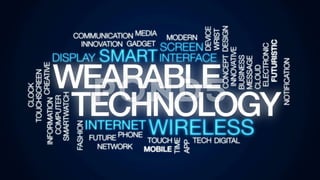
• Wearable technology is a
category of electronic devices
that can be worn as
accessories, embedded in
clothing, implanted in the
user's body, or even tattooed
on the skin.
• The devices are hands-free
gadgets with practical uses,
powered by microprocessors
and enhanced with the ability
to send and receive data via
the internet.
SO, WHERE DID YOU SEE THE
FIRST WEARABLES EVER?
In the 1987 movie, Mr. India
showed a gold watch worn on
the wrist, which when
activated, made the wearer
invisible to the naked eye
2 years later, in 1989 back to the
future Part 2 captured the public’s
attention when the future family of
Marty McFly uses “Connected
Goggles” to watch TV and make
video phone calls
& then… there is Giordi La Forge’s
VISOR from Star Trek: The next
generation, a device that helped him
to see, even though he was blind
& BEFORE THAT….
Stan Lee
Creator of
Avengers
Gardner Fox
creator of Justice
League
AGE OF WEARABLES
Healthcare & Medical
CGM – Continuous Glucose
Monitoring
ECG Monitoring
Pulse Oximetry
BP monitors
Wearable Patches
Fitness and wellness
Sports & Heart rate
monitors
Pedometers, Activity
Monitors
Smart sports glasses
Smart clothing
Sleep monitors
Infotainment
Smart Watches
Augmented Reality
Headsets
Smart Glasses
Wearable Imaging Devices
Industrial & Military
Augmented Reality
headsets
Smart Clothing
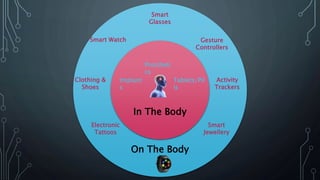
In The Body
Implant
s
Prostheti
cs
Tablets/Pil
ls
On The Body
Electronic
Tattoos
Clothing &
Shoes
Smart Watch
Smart
Glasses
Gesture
Controllers
Activity
Trackers
Smart
Jewellery
GLUCOSE
MONITORS
• Continuous glucose monitors (CGMs)
are becoming increasingly popular
with diabetic patients, who can wear
the devices day and night to keep an
eye on their glucose levels
• Real-time glucose levels help
patients make more informed
choices about the types of food,
physical activities and medication
they require throughout the day.
HERE’S SOME OF THE WEIRDEST
WEARABLE TECH FROM CES
(CONSUMER ELECTRONIC SHOW)
2019.
MONIT SMART
DIAPER
• Monit claims the device can tell
the difference between pee and
poo, and hopes the device can
reduce the instances of urinary
tract infections and diaper rash.
• The device has been for sale in
Korea and Japan since the end of
2018, and Monit is hoping to
launch a partnership with
Huggies in the U.S. in 2019.
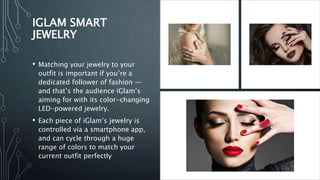
IGLAM SMART
JEWELRY
• Matching your jewelry to your
outfit is important if you’re a
dedicated follower of fashion —
and that’s the audience iGlam’s
aiming for with its color-changing
LED-powered jewelry.
• Each piece of iGlam’s jewelry is
controlled via a smartphone app,
and can cycle through a huge
range of colors to match your
current outfit perfectly
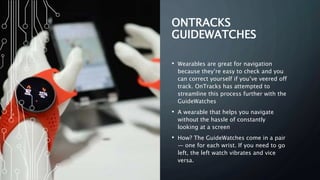
ONTRACKS
GUIDEWATCHES
• Wearables are great for navigation
because they’re easy to check and you
can correct yourself if you’ve veered off
track. OnTracks has attempted to
streamline this process further with the
GuideWatches
• A wearable that helps you navigate
without the hassle of constantly
looking at a screen
• How? The GuideWatches come in a pair
— one for each wrist. If you need to go
left, the left watch vibrates and vice
versa.
DFREE TOILET TIMING PREDICTIVE DEVICE
• The Dfree is a device that uses
ultrasound to monitor and detect the
movement of the bladder,
communicating to an attached smart
device that it’s time to go to the
toilet.
• While that may seem initially odd,
this device is a lifeline for sufferers of
incontinence, and a huge aid for their
caregivers, reducing the stress
caused by such issues, and
increasing the ability of sufferers to
live independently.
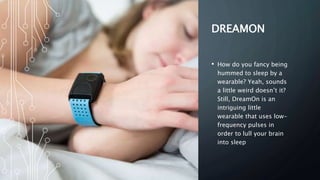
DREAMON
• How do you fancy being
hummed to sleep by a
wearable? Yeah, sounds
a little weird doesn’t it?
Still, DreamOn is an
intriguing little
wearable that uses low-
frequency pulses in
order to lull your brain
into sleep
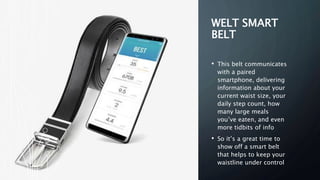
WELT SMART
BELT
• This belt communicates
with a paired
smartphone, delivering
information about your
current waist size, your
daily step count, how
many large meals
you’ve eaten, and even
more tidbits of info
• So it’s a great time to
show off a smart belt
that helps to keep your
waistline under control
While futurism is an imperfect
science, it’s human nature to
guess at what’s just around the
corner.
From existing outside our bodies
to residing inside us. The future
of wearable technology lies in
implantable wearables.
WHAT FUTURE
HOLDS…
LET’S TAKE A LOOK AT SOME
OUTLANDISH CONCEPTS THAT MAY
BECOME A POSSIBILITY
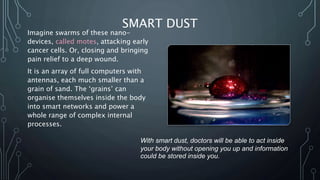
SMART DUST
Imagine swarms of these nano-
devices, called motes, attacking early
cancer cells. Or, closing and bringing
pain relief to a deep wound.
It is an array of full computers with
antennas, each much smaller than a
grain of sand. The ‘grains’ can
organise themselves inside the body
into smart networks and power a
whole range of complex internal
processes.
With smart dust, doctors will be able to act inside
your body without opening you up and information
could be stored inside you.
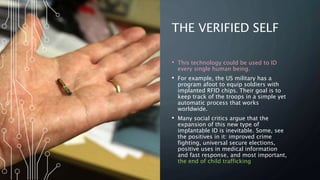
THE VERIFIED SELF
• This technology could be used to ID
every single human being.
• For example, the US military has a
program afoot to equip soldiers with
implanted RFID chips. Their goal is to
keep track of the troops in a simple yet
automatic process that works
worldwide.
• Many social critics argue that the
expansion of this new type of
implantable ID is inevitable. Some, see
the positives in it: improved crime
fighting, universal secure elections,
positive uses in medical information
and fast response, and most important,
the end of child trafficking
3D PRINTED
SMART
ORGANS
• We can already make the
skin for patients with burns
or skin ulcers, and others
like corneas and liver are in
trials.
• The idea behind tissue
engineering is that you take
a piece of plastic 3d printed
to the desired form. Add
human cells to it, put some
special media into the mix
and voila! You have just
become a god. You now
have the ability to make
skin, bones, tissues or any
organ in the human body.
CYBER PILLS
CONNECTED TO
YOUR DOCTOR
• A British research team is developing cyber-
pills with microprocessors in them that can
text doctors directly from inside your body.
• Implantables won’t just communicate with
your smartphone but “chat up” with your
doctor as well. In a project named Proteus,
after the microscopic body-navigating vessel
in the film Fantastic Voyage, a team of
British researchers is developing a cyber-pill
with a microprocessor inside that can text
the doctors right from inside your body.
• The pills can share (literally) inside info to
help doctors know if you are taking your
medication properly and if it is having the
desired effect.
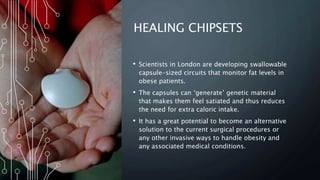
HEALING CHIPSETS
• Scientists in London are developing swallowable
capsule-sized circuits that monitor fat levels in
obese patients.
• The capsules can ‘generate’ genetic material
that makes them feel satiated and thus reduces
the need for extra caloric intake.
• It has a great potential to become an alternative
solution to the current surgical procedures or
any other invasive ways to handle obesity and
any associated medical conditions.
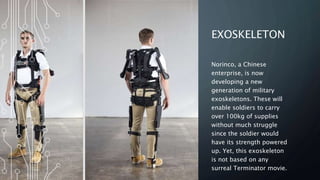
EXOSKELETON
Norinco, a Chinese
enterprise, is now
developing a new
generation of military
exoskeletons. These will
enable soldiers to carry
over 100kg of supplies
without much struggle
since the soldier would
have its strength powered
up. Yet, this exoskeleton
is not based on any
surreal Terminator movie.
THE NEXT GENERATION OF APPLE WATCHES
WILL REPORTEDLY FEATURE GLUCOSE
MONITORING FOR PEOPLE WITH DIABETES.
MC10 HAS CREATED WEARABLE PATCHES
FOR ECG RECORDING AND CARDIAC
MONITORING.
MC10 HAS ALSO COLLABORATED WITH
L’OREAL TO DESIGN THE FIRST-EVER SKIN
SENSOR THAT DETECTS UVA AND UVB
EXPOSURE.
WEARABLES AS
NECESSITIES
AN EFFECTIVE
WAY TO ACHIEVE
HEALTHCARE
INTEROPERABILITY
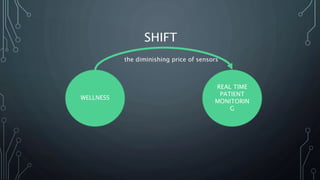
WELLNESS
REAL TIME
PATIENT
MONITORIN
G
SHIFT
the diminishing price of sensors
IN THE
HEALTHCARE
FIELD, WEARABLE
TECHNOLOGY IS
BEING USED TO
MANUFACTURE
ACTIVITY
TRACKING
DEVICES,
PACEMAKERS, AND
HEARING AIDS
IN THE NEAR
FUTURE, WE
SHOULD SEE
ADVANCEMENTS
WHICH
COMPLETELY
ELIMINATE THE
NEED FOR BULKY
FILES FOR EACH
PATIENT.
ALL THE
IMPORTANT
INFORMATION
WOULD BE MADE
AVAILABLE ON THE
WEARABLE
APPLICATION
WEARABLES FOR THE DISABLED
• As per the country’s latest statistics, an estimated 2.1 percent
of the Indian population has a disability; a humbling figure of
over 26 million people.
• A person can face disability — intellectually and physically — at
any point in their life from medical complications or life-
altering events.
GLOBAL DISABILITY MARKET IS BIGGER
THAN YOU THINK
40 – 45 Mn people are
blind
135M have low Vision 360 M Disabling
Hearing Loss
• DOT
How about a Braille watch? This watch doesn’t just tell time. It allows the visually impaired user to read
emails, text, and fully engage with their smartphone. The device connects to any smartphone via
Bluetooth, and then translates the text into Braille.
• THE BRADLEY BY EONE
The Bradley is a watch that allows the wearer to tell the time using touch. Two ball bearings replace
traditional watch hands, with one ball indicating hours and the other indicating minutes.
• THE FINGER READER
This device uses a small camera to scan text and give real-time audio feedback. It allows the visually
impaired person to read from traditional books or an electronic device by pointing a finger at the text,
one line at a time.
• ORCAM
Israeli company, Orcam, developed smart glasses that recognise faces, text, products, money, and lots
more. These glasses use an AI that tells the wearer what they are looking at.
• SMART SHOES
Indian company, Ducere Technologies, created Lechal – smart shoes that could replace the white cane.
Their aim is to provide intuitive navigation using vibratory feedback to guide the wearer to wherever
they need to go.
• RADAR SYSTEMS
• THE SOUND SHIRT
Just as the name suggests, The Sound Shirt allows deaf people to feel the music. A
computer system picks up sound from the speakers around them. Connected to this
system, the shirt is filled with little motors that vibrate as the music plays.
• VIBEAT
he Vibeat range of devices allow people who are deaf or hard-of-hearing to enjoy music
through vibration. Designed by Liron Gino, a graduate of Bezalel Academy of Arts and
Design, the Vibeat collection is a fashionable set that includes a bracelet, neck piece, and
pin.
• COCHLEAR IMPLANT
A cochlear implant is an electronic medical device that replaces the function of the damaged
inner ear. Unlike hearing aids, which make sounds louder, cochlear implants bypass the
damaged hair cells of the inner ear (cochlea) to provide sound signals to the brain.
• UNI
UNI is the wearable, two-way communication device for the deaf. It works by detecting hand
and finger gestures with specialized camera technology that has the ability to convert sign
language into words. This whole process can be accomplished in a short amount of time to
help people communicate with deaf individuals.
LIFTWARE
• One of the most frustrating things for people with limited hand/arm
mobility or tremors is being unable to do simple tasks with that limb.
• Being able to use a knife and fork is a key ability for retaining one’s
dignity and confidence. Tremors and other issues often make it
impossible to do safely.
• Liftware offers assistive devices that work like regular cutlery, albeit
with advanced sensor and motor based technology that keeps the
utensil steady at all times.
WHAT MIGHT HINDER WEARABLE APP
DEVELOPMENT FROM BURGEONING
Wearables, even though they have seen tremendous improvements, are encumbered by several factors.
Data security,
short battery lifespan, and
user-personalization
the emergence of new users will further complicate the issue.
CONCLUSION
• Even though we might not currently
have the sophisticated gadgets Tony
Stark has in his home, neither do we
have Batman’s assorted collection of
fancy toys yet.
• We are definitely enjoying wearable
app development products hitherto
unimagined.
• The future promises to be exciting
and fulfilling at the same time and
the hard work of any wearable app
development company will not go
unnoticed.
TAKEAWAY
SINCE THE LAST LAP OF THE PRESENTATION
FOCUSSED ON PEOPLE WITH DISABILITY, I WOULD
LIKE TO USE THIS OPPORTUNITY TO MAKE LIFE
BETTER FOR THEM IN THE MALL.
SINCE WE ARE A PEOPLE MANAGEMENT
ORGANIZATION WE NEED TO BE ABLE TO MANAGE
PEOPLE FROM DIFFERENT CULTURES, & ABILITIES
SOME
IDEAS WE
CAN
IMPLY AT
THE
SHOPPING
CENTRES
1. Employment opportunity to the handicapped
2. Well trained staff
3. Design – (Universal Design)
4. Using Hearing Loop for those using hearing
aids (Slide 42)
5. Navigation - Use Braille directions, tactile
guidance and easy-to-read pictographs to
help the visually impaired
6. Wheelchair on call
7. Disabled-friendly washrooms
8. Specially allotted parking space
9. Braille Menu’s should be made available
10.Braille Buttons in the lifts
11.Larger changing room for the disabled
WHY USE A HEARING LOOP?
Cuts out unwanted
background noise
No need to use a
receiver/headset
Sound goes directly
into the hearing aid
Can be used by anyone
with a compatible
hearing aid
It is inconspicuous Cost effective
Any number of users
can use the system
Wearable tech

Wearable tech

  • 2.
    WHAT IS WEARABLE TECHNOLOGY? • Wearabletechnology is a category of electronic devices that can be worn as accessories, embedded in clothing, implanted in the user's body, or even tattooed on the skin. • The devices are hands-free gadgets with practical uses, powered by microprocessors and enhanced with the ability to send and receive data via the internet.
  • 3.
    SO, WHERE DIDYOU SEE THE FIRST WEARABLES EVER?
  • 4.
    In the 1987movie, Mr. India showed a gold watch worn on the wrist, which when activated, made the wearer invisible to the naked eye 2 years later, in 1989 back to the future Part 2 captured the public’s attention when the future family of Marty McFly uses “Connected Goggles” to watch TV and make video phone calls & then… there is Giordi La Forge’s VISOR from Star Trek: The next generation, a device that helped him to see, even though he was blind
  • 5.
  • 7.
    Stan Lee Creator of Avengers GardnerFox creator of Justice League
  • 8.
    AGE OF WEARABLES Healthcare& Medical CGM – Continuous Glucose Monitoring ECG Monitoring Pulse Oximetry BP monitors Wearable Patches Fitness and wellness Sports & Heart rate monitors Pedometers, Activity Monitors Smart sports glasses Smart clothing Sleep monitors Infotainment Smart Watches Augmented Reality Headsets Smart Glasses Wearable Imaging Devices Industrial & Military Augmented Reality headsets Smart Clothing
  • 9.
    In The Body Implant s Prostheti cs Tablets/Pil ls OnThe Body Electronic Tattoos Clothing & Shoes Smart Watch Smart Glasses Gesture Controllers Activity Trackers Smart Jewellery
  • 11.
    GLUCOSE MONITORS • Continuous glucosemonitors (CGMs) are becoming increasingly popular with diabetic patients, who can wear the devices day and night to keep an eye on their glucose levels • Real-time glucose levels help patients make more informed choices about the types of food, physical activities and medication they require throughout the day.
  • 12.
    HERE’S SOME OFTHE WEIRDEST WEARABLE TECH FROM CES (CONSUMER ELECTRONIC SHOW) 2019.
  • 13.
    MONIT SMART DIAPER • Monitclaims the device can tell the difference between pee and poo, and hopes the device can reduce the instances of urinary tract infections and diaper rash. • The device has been for sale in Korea and Japan since the end of 2018, and Monit is hoping to launch a partnership with Huggies in the U.S. in 2019.
  • 14.
    IGLAM SMART JEWELRY • Matchingyour jewelry to your outfit is important if you’re a dedicated follower of fashion — and that’s the audience iGlam’s aiming for with its color-changing LED-powered jewelry. • Each piece of iGlam’s jewelry is controlled via a smartphone app, and can cycle through a huge range of colors to match your current outfit perfectly
  • 15.
    ONTRACKS GUIDEWATCHES • Wearables aregreat for navigation because they’re easy to check and you can correct yourself if you’ve veered off track. OnTracks has attempted to streamline this process further with the GuideWatches • A wearable that helps you navigate without the hassle of constantly looking at a screen • How? The GuideWatches come in a pair — one for each wrist. If you need to go left, the left watch vibrates and vice versa.
  • 16.
    DFREE TOILET TIMINGPREDICTIVE DEVICE • The Dfree is a device that uses ultrasound to monitor and detect the movement of the bladder, communicating to an attached smart device that it’s time to go to the toilet. • While that may seem initially odd, this device is a lifeline for sufferers of incontinence, and a huge aid for their caregivers, reducing the stress caused by such issues, and increasing the ability of sufferers to live independently.
  • 17.
    DREAMON • How doyou fancy being hummed to sleep by a wearable? Yeah, sounds a little weird doesn’t it? Still, DreamOn is an intriguing little wearable that uses low- frequency pulses in order to lull your brain into sleep
  • 18.
    WELT SMART BELT • Thisbelt communicates with a paired smartphone, delivering information about your current waist size, your daily step count, how many large meals you’ve eaten, and even more tidbits of info • So it’s a great time to show off a smart belt that helps to keep your waistline under control
  • 20.
    While futurism isan imperfect science, it’s human nature to guess at what’s just around the corner. From existing outside our bodies to residing inside us. The future of wearable technology lies in implantable wearables.
  • 21.
    WHAT FUTURE HOLDS… LET’S TAKEA LOOK AT SOME OUTLANDISH CONCEPTS THAT MAY BECOME A POSSIBILITY
  • 22.
    SMART DUST Imagine swarmsof these nano- devices, called motes, attacking early cancer cells. Or, closing and bringing pain relief to a deep wound. It is an array of full computers with antennas, each much smaller than a grain of sand. The ‘grains’ can organise themselves inside the body into smart networks and power a whole range of complex internal processes. With smart dust, doctors will be able to act inside your body without opening you up and information could be stored inside you.
  • 23.
    THE VERIFIED SELF •This technology could be used to ID every single human being. • For example, the US military has a program afoot to equip soldiers with implanted RFID chips. Their goal is to keep track of the troops in a simple yet automatic process that works worldwide. • Many social critics argue that the expansion of this new type of implantable ID is inevitable. Some, see the positives in it: improved crime fighting, universal secure elections, positive uses in medical information and fast response, and most important, the end of child trafficking
  • 24.
    3D PRINTED SMART ORGANS • Wecan already make the skin for patients with burns or skin ulcers, and others like corneas and liver are in trials. • The idea behind tissue engineering is that you take a piece of plastic 3d printed to the desired form. Add human cells to it, put some special media into the mix and voila! You have just become a god. You now have the ability to make skin, bones, tissues or any organ in the human body.
  • 25.
    CYBER PILLS CONNECTED TO YOURDOCTOR • A British research team is developing cyber- pills with microprocessors in them that can text doctors directly from inside your body. • Implantables won’t just communicate with your smartphone but “chat up” with your doctor as well. In a project named Proteus, after the microscopic body-navigating vessel in the film Fantastic Voyage, a team of British researchers is developing a cyber-pill with a microprocessor inside that can text the doctors right from inside your body. • The pills can share (literally) inside info to help doctors know if you are taking your medication properly and if it is having the desired effect.
  • 26.
    HEALING CHIPSETS • Scientistsin London are developing swallowable capsule-sized circuits that monitor fat levels in obese patients. • The capsules can ‘generate’ genetic material that makes them feel satiated and thus reduces the need for extra caloric intake. • It has a great potential to become an alternative solution to the current surgical procedures or any other invasive ways to handle obesity and any associated medical conditions.
  • 27.
    EXOSKELETON Norinco, a Chinese enterprise,is now developing a new generation of military exoskeletons. These will enable soldiers to carry over 100kg of supplies without much struggle since the soldier would have its strength powered up. Yet, this exoskeleton is not based on any surreal Terminator movie.
  • 28.
    THE NEXT GENERATIONOF APPLE WATCHES WILL REPORTEDLY FEATURE GLUCOSE MONITORING FOR PEOPLE WITH DIABETES. MC10 HAS CREATED WEARABLE PATCHES FOR ECG RECORDING AND CARDIAC MONITORING. MC10 HAS ALSO COLLABORATED WITH L’OREAL TO DESIGN THE FIRST-EVER SKIN SENSOR THAT DETECTS UVA AND UVB EXPOSURE.
  • 29.
    WEARABLES AS NECESSITIES AN EFFECTIVE WAYTO ACHIEVE HEALTHCARE INTEROPERABILITY
  • 30.
  • 31.
    IN THE HEALTHCARE FIELD, WEARABLE TECHNOLOGYIS BEING USED TO MANUFACTURE ACTIVITY TRACKING DEVICES, PACEMAKERS, AND HEARING AIDS IN THE NEAR FUTURE, WE SHOULD SEE ADVANCEMENTS WHICH COMPLETELY ELIMINATE THE NEED FOR BULKY FILES FOR EACH PATIENT. ALL THE IMPORTANT INFORMATION WOULD BE MADE AVAILABLE ON THE WEARABLE APPLICATION
  • 32.
    WEARABLES FOR THEDISABLED • As per the country’s latest statistics, an estimated 2.1 percent of the Indian population has a disability; a humbling figure of over 26 million people. • A person can face disability — intellectually and physically — at any point in their life from medical complications or life- altering events.
  • 33.
    GLOBAL DISABILITY MARKETIS BIGGER THAN YOU THINK 40 – 45 Mn people are blind 135M have low Vision 360 M Disabling Hearing Loss
  • 34.
    • DOT How abouta Braille watch? This watch doesn’t just tell time. It allows the visually impaired user to read emails, text, and fully engage with their smartphone. The device connects to any smartphone via Bluetooth, and then translates the text into Braille. • THE BRADLEY BY EONE The Bradley is a watch that allows the wearer to tell the time using touch. Two ball bearings replace traditional watch hands, with one ball indicating hours and the other indicating minutes. • THE FINGER READER This device uses a small camera to scan text and give real-time audio feedback. It allows the visually impaired person to read from traditional books or an electronic device by pointing a finger at the text, one line at a time. • ORCAM Israeli company, Orcam, developed smart glasses that recognise faces, text, products, money, and lots more. These glasses use an AI that tells the wearer what they are looking at. • SMART SHOES Indian company, Ducere Technologies, created Lechal – smart shoes that could replace the white cane. Their aim is to provide intuitive navigation using vibratory feedback to guide the wearer to wherever they need to go. • RADAR SYSTEMS
  • 35.
    • THE SOUNDSHIRT Just as the name suggests, The Sound Shirt allows deaf people to feel the music. A computer system picks up sound from the speakers around them. Connected to this system, the shirt is filled with little motors that vibrate as the music plays. • VIBEAT he Vibeat range of devices allow people who are deaf or hard-of-hearing to enjoy music through vibration. Designed by Liron Gino, a graduate of Bezalel Academy of Arts and Design, the Vibeat collection is a fashionable set that includes a bracelet, neck piece, and pin. • COCHLEAR IMPLANT A cochlear implant is an electronic medical device that replaces the function of the damaged inner ear. Unlike hearing aids, which make sounds louder, cochlear implants bypass the damaged hair cells of the inner ear (cochlea) to provide sound signals to the brain. • UNI UNI is the wearable, two-way communication device for the deaf. It works by detecting hand and finger gestures with specialized camera technology that has the ability to convert sign language into words. This whole process can be accomplished in a short amount of time to help people communicate with deaf individuals.
  • 36.
    LIFTWARE • One ofthe most frustrating things for people with limited hand/arm mobility or tremors is being unable to do simple tasks with that limb. • Being able to use a knife and fork is a key ability for retaining one’s dignity and confidence. Tremors and other issues often make it impossible to do safely. • Liftware offers assistive devices that work like regular cutlery, albeit with advanced sensor and motor based technology that keeps the utensil steady at all times.
  • 38.
    WHAT MIGHT HINDERWEARABLE APP DEVELOPMENT FROM BURGEONING Wearables, even though they have seen tremendous improvements, are encumbered by several factors. Data security, short battery lifespan, and user-personalization the emergence of new users will further complicate the issue.
  • 39.
    CONCLUSION • Even thoughwe might not currently have the sophisticated gadgets Tony Stark has in his home, neither do we have Batman’s assorted collection of fancy toys yet. • We are definitely enjoying wearable app development products hitherto unimagined. • The future promises to be exciting and fulfilling at the same time and the hard work of any wearable app development company will not go unnoticed.
  • 40.
  • 41.
    SINCE THE LASTLAP OF THE PRESENTATION FOCUSSED ON PEOPLE WITH DISABILITY, I WOULD LIKE TO USE THIS OPPORTUNITY TO MAKE LIFE BETTER FOR THEM IN THE MALL. SINCE WE ARE A PEOPLE MANAGEMENT ORGANIZATION WE NEED TO BE ABLE TO MANAGE PEOPLE FROM DIFFERENT CULTURES, & ABILITIES
  • 42.
    SOME IDEAS WE CAN IMPLY AT THE SHOPPING CENTRES 1.Employment opportunity to the handicapped 2. Well trained staff 3. Design – (Universal Design) 4. Using Hearing Loop for those using hearing aids (Slide 42) 5. Navigation - Use Braille directions, tactile guidance and easy-to-read pictographs to help the visually impaired 6. Wheelchair on call 7. Disabled-friendly washrooms 8. Specially allotted parking space 9. Braille Menu’s should be made available 10.Braille Buttons in the lifts 11.Larger changing room for the disabled
  • 43.
    WHY USE AHEARING LOOP? Cuts out unwanted background noise No need to use a receiver/headset Sound goes directly into the hearing aid Can be used by anyone with a compatible hearing aid It is inconspicuous Cost effective Any number of users can use the system