Understanding Ionization
The Process
Ionizationinvolves adding or removing
electrons from a molecule, creating a
charged species called an ion.
Why It Matters
Ionization allows molecules to be
manipulated and analyzed in a mass
spectrometer, providing information about
their mass and structure.
3.
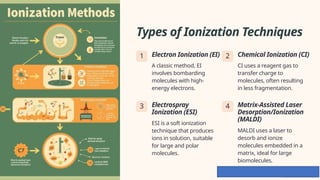
Types of IonizationTechniques
1 Electron Ionization (EI)
A classic method, EI
involves bombarding
molecules with high-
energy electrons.
2 Chemical Ionization (CI)
CI uses a reagent gas to
transfer charge to
molecules, often resulting
in less fragmentation.
3 Electrospray
Ionization (ESI)
ESI is a soft ionization
technique that produces
ions in solution, suitable
for large and polar
molecules.
4 Matrix-Assisted Laser
Desorption/Ionization
(MALDI)
MALDI uses a laser to
desorb and ionize
molecules embedded in a
matrix, ideal for large
biomolecules.
4.
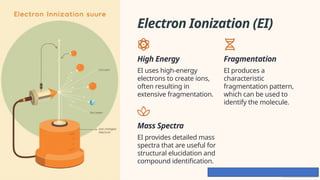
Electron Ionization (EI)
HighEnergy
EI uses high-energy
electrons to create ions,
often resulting in
extensive fragmentation.
Fragmentation
EI produces a
characteristic
fragmentation pattern,
which can be used to
identify the molecule.
Mass Spectra
EI provides detailed mass
spectra that are useful for
structural elucidation and
compound identification.
5.
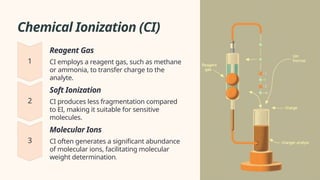
Chemical Ionization (CI)
ReagentGas
CI employs a reagent gas, such as methane
or ammonia, to transfer charge to the
analyte.
Soft Ionization
CI produces less fragmentation compared
to EI, making it suitable for sensitive
molecules.
Molecular Ions
CI often generates a significant abundance
of molecular ions, facilitating molecular
weight determination.
6.
Electrospray Ionization (ESI)
1
Solution-Based
ESIionizes molecules directly from solution, avoiding the need for a gas phase.
2
Soft Ionization
ESI is a gentle technique that minimizes fragmentation, making it ideal for large
biomolecules.
3
Multiple Charges
ESI can produce multiply charged ions, extending the mass range of the
analysis.
4
High Sensitivity
ESI is highly sensitive, allowing the analysis of trace amounts of
analytes.
7.
Matrix-Assisted Laser Desorption/Ionization
(MALDI)
1
LaserDesorption
MALDI uses a laser to desorb and ionize molecules embedded in a matrix, a solid support.
2
Matrix Absorption
The matrix absorbs the laser energy, transferring it to the analyte, leading to
ionization.
3
Biomolecules
MALDI is well-suited for analyzing large biomolecules, such
as proteins and peptides.
8.
Applications and Considerations
1
AnalyticalChemistry
Analyzing complex mixtures, identifying
unknown compounds, and quantifying
analytes.
2
Biochemistry
Studying proteins, peptides, and other
biomolecules, revealing their structure and
function.
3
Environmental Science
Monitoring pollutants, analyzing
environmental samples, and understanding
environmental processes.
4
Pharmaceuticals
Developing new drugs, controlling drug quality,
and analyzing drug metabolism.



![Symbolism_in_Jane_Eyre[1].pptx Symbolism](https://cdn.slidesharecdn.com/ss_thumbnails/symbolisminjaneeyre1-251011164440-654c5d70-thumbnail.jpg?width=640&height=640&fit=bounds)


![ONFH[AVN HIP] -TRIPLE REGIME -A NOVAL SURGICAL CONCEPT .pptx](https://cdn.slidesharecdn.com/ss_thumbnails/onfhavnhip2026koaconcalicutdrgokuldevdrmashraf-260210064517-213ec005-thumbnail.jpg?width=640&height=640&fit=bounds)

![CTEV [ clubfoot] DR ARUN LAL ,DR MOHAMED ASHRAF travancore medical college k...](https://cdn.slidesharecdn.com/ss_thumbnails/ctevclubfootdrarunlaldrmohamedashraftravancoremedicalcollegekollamkeralaindia-260208063247-18fc466c-thumbnail.jpg?width=640&height=640&fit=bounds)


