ELECTROPHORESIS


   Sudheer kumar kamarapu
     Assistant professor
Sri Shivani college of Pharmacy


 1                          sudheerkumar kamarapu
CONTENTS

   Introduction
   Principle And Theory
   Factors
   Classification
   Capillary electrophoresis
   Zone Electrophoresis


2                          sudheerkumar kamarapu
INTRODUCTION


   The word electrophoresis is derived from a Greek word, which
    means borne by electricity.
   It is a separation technique in which the components are
    separated due to their varying behaviour under the influence
    of applied electric field.
   It is defined as the migration of charged molecules under the
    influence of external electric field.
   The major requirement of the component to be subjected to
    electrophoresis is that the component should be charged.


3                             sudheerkumar kamarapu
INTRODUCTION (cont..,)
       It is mostly used for the separation of complex biological
        substances such as:
         Proteins
         Polysaccharides
         Nucleic acids
         Peptides
         Aminoacids
         Oligosaccharides
         Nucleosides
         Organic acids
         Small anions and cations in body fluids


    4                                sudheerkumar kamarapu
Cont...

        Separation Scientists work in many different
        disciplines, some of these include:

       Analytical Chemistry
       Biochemistry
       Biotechnology
       Forensic Science
       Food Science
       Clinical Science
       Neuro-Science
       Medical Research and Production
       Pharmaceutical Science
       Other Disciplines
5                      sudheerkumar kamarapu
PRINCIPLE

   This technique is mainly used for separation of complex
    mixtures of biological substances which possess ionisable
    functional groups.
   Therefore they can be made to exist as electrically charged
    species, either as cation/anion.
   Molecules with similar charges will have different m/e ratio.
   This forms basis for differential migration when these ions in
    solution are subjected to an electric field.


6                              sudheerkumar kamarapu
PRINCIPLE (cont..,)
 Therefore electrophoresis can be applied to any mixture in which the
  components carry a charge & have differential mobilities in an electrical
  field.
 The migration in an electrophoretic system depends on properties of
  particle as well as instrumental system
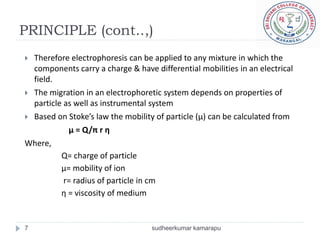
 Based on Stoke’s law the mobility of particle (µ) can be calculated from
            µ = Q/π r η
Where,
          Q= charge of particle
          µ= mobility of ion
           r= radius of particle in cm
          η = viscosity of medium


7                                  sudheerkumar kamarapu
TECHNIQUES OF ELECTROPHORESIS


 It can be carried out by using either:
1. Low voltage
2. High voltage
Low voltage electrophoresis:
•   It consists of two compartments to hold the buffer &
    electrodes & a suitable carrier for support medium, such
    that its ends are in contact with buffer compartments


8                            sudheerkumar kamarapu
9   sudheerkumar kamarapu
TECHNIQUES OF ELECTROPHORESIS
(cont..,)


•    The design of carrier depends on the medium
•    The medium doesn’t dip into electrode compartments, but
     into separate compartments connected by wicks with anode
     & cathode cells
•    The apparatus is enclosed to avoid evaporation
•    LVE can be used in principle to separate any ionic substances
•    Its main application is examination of biological and clinical
     specimens for aminoacids and proteins


10                              sudheerkumar kamarapu
TECHNIQUES OF ELECTROPHORESIS
(cont..,)


High voltage electrophoresis:
• The construction of apparatus is similar to that of LVE except
  that it contains additional cooling system.
• It was found that much reduced analysis time could be
  achieved by using high voltage gradient


11                            sudheerkumar kamarapu
CLASSIFICATION


A.        Capillary electrophoresis
B.        Zone electrophoresis
     1.     Paper electrophoresis
     2.    Cellulose acetate electrophoresis
     3.    Thin layer electrophoresis
     4.    Gel electrophoresis


12                             sudheerkumar kamarapu
Capillary
Electrophoresis
                              13
      sudheerkumar kamarapu
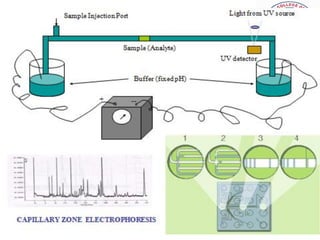
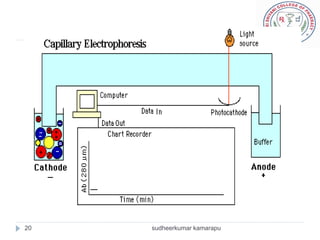
   In practical terms, a positive (anode) and negative (cathode)
     electrode are placed in a solution containing ions.
    Then, when a voltage is applied across the electrodes, solute
     ions of different charge, i.e., anions (negative) and cations
     (positive), will move through the solution towards the
     electrode of opposite charge.
     Capillary electrophoresis, then, is the technique of
     performing electrophoresis in buffer-filled, narrow-bore
      capillaries, normally from 25 to 100 pm in internal diameter
     (ID).


14                             sudheerkumar kamarapu
    Definition: The differential movement for migration of
     ions by attraction or repulsion in an electric field.
        Separation of components of a mixture using an electric field
    v=Eq/f
        v = velocity of molecule
        E = electric field
        q = net charge of molecule
        f = friction coefficient


    15                                sudheerkumar kamarapu
Capillary Electrophoresis – The Basics
     Of Instrumentation
    Electrophoresis in a buffer filled, narrow-bore
     capillaries
    Each capillary is about 25-100 μm in internal
     diameter
    When a voltage is applied to the solution, the
     molecules move through the solution towards the
     electrode of opposite charge
    Depending on the charge, the molecules move
     through at different speeds
        Separation is achieved


    16                            sudheerkumar kamarapu
Basics                                cont.

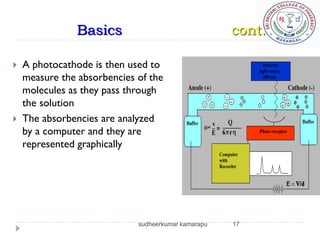
   A photocathode is then used to
    measure the absorbencies of the
    molecules as they pass through
    the solution
   The absorbencies are analyzed
    by a computer and they are
    represented graphically


                             sudheerkumar kamarapu   17
Equipment

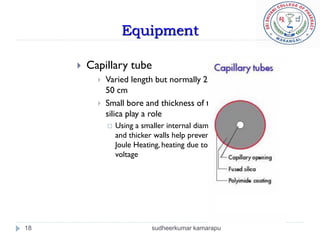
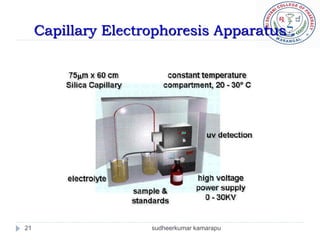
        Capillary tube
              Varied length but normally 25-
               50 cm
              Small bore and thickness of the
               silica play a role
                  Using a smaller internal diameter
                   and thicker walls help prevent
                   Joule Heating, heating due to
                   voltage


18                            sudheerkumar kamarapu
Equipment                         Cont….

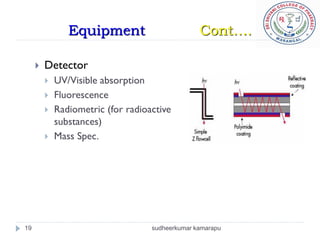
        Detector
            UV/Visible absorption
            Fluorescence
            Radiometric (for radioactive
             substances)
            Mass Spec.


19                                  sudheerkumar kamarapu
20   sudheerkumar kamarapu
Capillary Electrophoresis Apparatus


21                   sudheerkumar kamarapu
The Electropherogram
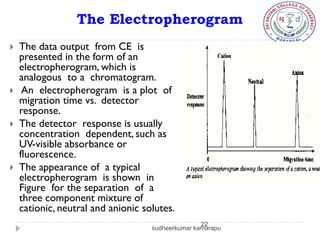
   The data output from CE is
    presented in the form of an
    electropherogram, which is
    analogous to a chromatogram.
    An electropherogram is a plot of
    migration time vs. detector
    response.
   The detector response is usually
    concentration dependent, such as
    UV-visible absorbance or
    fluorescence.
   The appearance of a typical
    electropherogram is shown in
    Figure for the separation of a
    three component mixture of
    cationic, neutral and anionic solutes.
                                                   22
                                    sudheerkumar kamarapu
ZONE
Electrophoresis
                              23
      sudheerkumar kamarapu
ZONE ELECTROPHORESIS

  It involves migration of charged particles, which are supported on
   relatively inert and homogeneous solid or gel framework.
 In this method the separated components are distributed into
   discrete zones on stabilizing media.
 The zones are heterogeneous and physically separated from one
   another.
 It is classified based on supporting material used.
They are:
1. Paper electrophoresis
2. Cellulose acetate electrophoresis
3. Thin layer electrophoresis
4. Gel electrophoresis

24                              sudheerkumar kamarapu
Principle :
                   Basically a supporting media is saturated with
     buffer solution and a small amount of sample solution is
     applied as narrow band.
           On application of potential difference between the ends
     of strip, each component migrates at a rate determined by its
     electrophoretic mobility.


25                              sudheerkumar kamarapu
ADVANTAGES AND DISADVANTAGES

    Useful in biochemical investigation.
    Very small quantity of samples can be analysed.
    Useful to study both simple and complex mixtures equally.
    Equipment cost is low and maintenance is easy.
    Unsuitable for accurate mobility and isoelectric point
     determination.
    Complications such as capillary flow, electro osmosis,
     adsorption and molecular sieving are introduced.


26                             sudheerkumar kamarapu
GENERAL METHOD OF OPERATION
    Saturation of medium: the supporting medium other than gel
     must be saturated with a buffer so that it can conduct current.
    Sample application: sample is applied as spot or streak.
    Electrophoretic separation: the power is switched on at
     required voltage.
    After completion of separation the power is switched off
     before supporting media is removed.
    Removal of supporting medium: paper, cellulose acetate strips
     and thin layer plate are removed and air dried or in oven. The
     gels are removed by forcing water from hypodermic syringe.


    27                           sudheerkumar kamarapu
INSTRUMENTATION

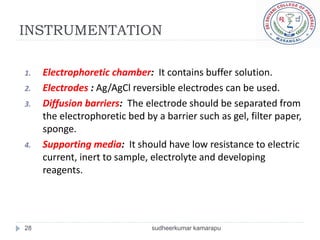
1.   Electrophoretic chamber: It contains buffer solution.
2.   Electrodes : Ag/AgCl reversible electrodes can be used.
3.   Diffusion barriers: The electrode should be separated from
     the electrophoretic bed by a barrier such as gel, filter paper,
     sponge.
4.   Supporting media: It should have low resistance to electric
     current, inert to sample, electrolyte and developing
     reagents.


28                             sudheerkumar kamarapu
PAPER ELECTROPHORESIS

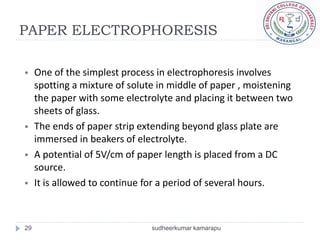
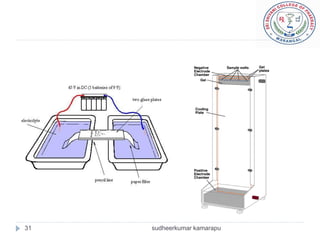
    One of the simplest process in electrophoresis involves
     spotting a mixture of solute in middle of paper , moistening
     the paper with some electrolyte and placing it between two
     sheets of glass.
    The ends of paper strip extending beyond glass plate are
     immersed in beakers of electrolyte.
    A potential of 5V/cm of paper length is placed from a DC
     source.
    It is allowed to continue for a period of several hours.


29                              sudheerkumar kamarapu
ADVANTAGES AND DISADVANTAGES


    It is economical and also easy to use.
    Some compounds such as proteins can not be adequately
     resolved.
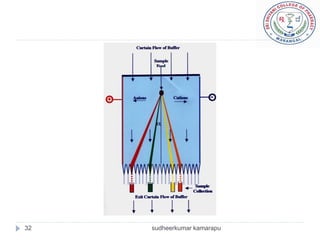
    There are three types of paper electrophoresis:
1.     Horizontal
2.     Vertical and
3.     Continuous


30                           sudheerkumar kamarapu
31   sudheerkumar kamarapu
32   sudheerkumar kamarapu
CELLULOSE ACETATE
ELECTROPHORESIS

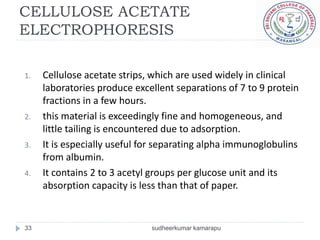
1.   Cellulose acetate strips, which are used widely in clinical
     laboratories produce excellent separations of 7 to 9 protein
     fractions in a few hours.
2.   this material is exceedingly fine and homogeneous, and
     little tailing is encountered due to adsorption.
3.   It is especially useful for separating alpha immunoglobulins
     from albumin.
4.   It contains 2 to 3 acetyl groups per glucose unit and its
     absorption capacity is less than that of paper.


33                            sudheerkumar kamarapu
GEL ELECTROPHORESIS
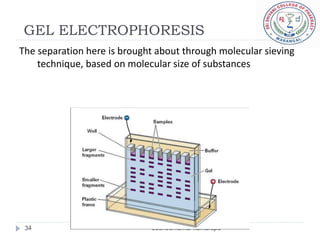
The separation here is brought about through molecular sieving
    technique, based on molecular size of substances


 34                          sudheerkumar kamarapu
THIN LAYER ELECTROPHORESIS

1.   Electrophoretic studies can be also carried out on thin
     layers of silica, keisulghur,alumina.
2.   The studies with these materials offer advantages of
     speed and resolution when compared with paper.
3.   They have greatest application in combined
     electrophoretic-chromatography studies in two-
     dimensional study of proteins and nucleic acid
     hydrolysates.


35                          sudheerkumar kamarapu
sudheerkumar kamarapu


THANK
 YOU


                                36

Electro phoresis sud mpharm pdf

  • 1.
    ELECTROPHORESIS Sudheer kumar kamarapu Assistant professor Sri Shivani college of Pharmacy 1 sudheerkumar kamarapu
  • 2.
    CONTENTS  Introduction  Principle And Theory  Factors  Classification  Capillary electrophoresis  Zone Electrophoresis 2 sudheerkumar kamarapu
  • 3.
    INTRODUCTION  The word electrophoresis is derived from a Greek word, which means borne by electricity.  It is a separation technique in which the components are separated due to their varying behaviour under the influence of applied electric field.  It is defined as the migration of charged molecules under the influence of external electric field.  The major requirement of the component to be subjected to electrophoresis is that the component should be charged. 3 sudheerkumar kamarapu
  • 4.
    INTRODUCTION (cont..,)  It is mostly used for the separation of complex biological substances such as:  Proteins  Polysaccharides  Nucleic acids  Peptides  Aminoacids  Oligosaccharides  Nucleosides  Organic acids  Small anions and cations in body fluids 4 sudheerkumar kamarapu
  • 5.
    Cont... Separation Scientists work in many different disciplines, some of these include:  Analytical Chemistry  Biochemistry  Biotechnology  Forensic Science  Food Science  Clinical Science  Neuro-Science  Medical Research and Production  Pharmaceutical Science  Other Disciplines 5 sudheerkumar kamarapu
  • 6.
    PRINCIPLE  This technique is mainly used for separation of complex mixtures of biological substances which possess ionisable functional groups.  Therefore they can be made to exist as electrically charged species, either as cation/anion.  Molecules with similar charges will have different m/e ratio.  This forms basis for differential migration when these ions in solution are subjected to an electric field. 6 sudheerkumar kamarapu
  • 7.
    PRINCIPLE (cont..,)  Thereforeelectrophoresis can be applied to any mixture in which the components carry a charge & have differential mobilities in an electrical field.  The migration in an electrophoretic system depends on properties of particle as well as instrumental system  Based on Stoke’s law the mobility of particle (µ) can be calculated from µ = Q/π r η Where, Q= charge of particle µ= mobility of ion r= radius of particle in cm η = viscosity of medium 7 sudheerkumar kamarapu
  • 8.
    TECHNIQUES OF ELECTROPHORESIS It can be carried out by using either: 1. Low voltage 2. High voltage Low voltage electrophoresis: • It consists of two compartments to hold the buffer & electrodes & a suitable carrier for support medium, such that its ends are in contact with buffer compartments 8 sudheerkumar kamarapu
  • 9.
    9 sudheerkumar kamarapu
  • 10.
    TECHNIQUES OF ELECTROPHORESIS (cont..,) • The design of carrier depends on the medium • The medium doesn’t dip into electrode compartments, but into separate compartments connected by wicks with anode & cathode cells • The apparatus is enclosed to avoid evaporation • LVE can be used in principle to separate any ionic substances • Its main application is examination of biological and clinical specimens for aminoacids and proteins 10 sudheerkumar kamarapu
  • 11.
    TECHNIQUES OF ELECTROPHORESIS (cont..,) Highvoltage electrophoresis: • The construction of apparatus is similar to that of LVE except that it contains additional cooling system. • It was found that much reduced analysis time could be achieved by using high voltage gradient 11 sudheerkumar kamarapu
  • 12.
    CLASSIFICATION A. Capillary electrophoresis B. Zone electrophoresis 1. Paper electrophoresis 2. Cellulose acetate electrophoresis 3. Thin layer electrophoresis 4. Gel electrophoresis 12 sudheerkumar kamarapu
  • 13.
    Capillary Electrophoresis 13 sudheerkumar kamarapu
  • 14.
    In practical terms, a positive (anode) and negative (cathode) electrode are placed in a solution containing ions.  Then, when a voltage is applied across the electrodes, solute ions of different charge, i.e., anions (negative) and cations (positive), will move through the solution towards the electrode of opposite charge.  Capillary electrophoresis, then, is the technique of performing electrophoresis in buffer-filled, narrow-bore capillaries, normally from 25 to 100 pm in internal diameter (ID). 14 sudheerkumar kamarapu
  • 15.
    Definition: The differential movement for migration of ions by attraction or repulsion in an electric field.  Separation of components of a mixture using an electric field  v=Eq/f  v = velocity of molecule  E = electric field  q = net charge of molecule  f = friction coefficient 15 sudheerkumar kamarapu
  • 16.
    Capillary Electrophoresis –The Basics Of Instrumentation  Electrophoresis in a buffer filled, narrow-bore capillaries  Each capillary is about 25-100 μm in internal diameter  When a voltage is applied to the solution, the molecules move through the solution towards the electrode of opposite charge  Depending on the charge, the molecules move through at different speeds  Separation is achieved 16 sudheerkumar kamarapu
  • 17.
    Basics cont.  A photocathode is then used to measure the absorbencies of the molecules as they pass through the solution  The absorbencies are analyzed by a computer and they are represented graphically sudheerkumar kamarapu 17
  • 18.
    Equipment  Capillary tube  Varied length but normally 25- 50 cm  Small bore and thickness of the silica play a role  Using a smaller internal diameter and thicker walls help prevent Joule Heating, heating due to voltage 18 sudheerkumar kamarapu
  • 19.
    Equipment Cont….  Detector  UV/Visible absorption  Fluorescence  Radiometric (for radioactive substances)  Mass Spec. 19 sudheerkumar kamarapu
  • 20.
    20 sudheerkumar kamarapu
  • 21.
  • 22.
    The Electropherogram  The data output from CE is presented in the form of an electropherogram, which is analogous to a chromatogram.  An electropherogram is a plot of migration time vs. detector response.  The detector response is usually concentration dependent, such as UV-visible absorbance or fluorescence.  The appearance of a typical electropherogram is shown in Figure for the separation of a three component mixture of cationic, neutral and anionic solutes. 22 sudheerkumar kamarapu
  • 23.
    ZONE Electrophoresis 23 sudheerkumar kamarapu
  • 24.
    ZONE ELECTROPHORESIS  It involves migration of charged particles, which are supported on relatively inert and homogeneous solid or gel framework.  In this method the separated components are distributed into discrete zones on stabilizing media.  The zones are heterogeneous and physically separated from one another.  It is classified based on supporting material used. They are: 1. Paper electrophoresis 2. Cellulose acetate electrophoresis 3. Thin layer electrophoresis 4. Gel electrophoresis 24 sudheerkumar kamarapu
  • 25.
    Principle : Basically a supporting media is saturated with buffer solution and a small amount of sample solution is applied as narrow band. On application of potential difference between the ends of strip, each component migrates at a rate determined by its electrophoretic mobility. 25 sudheerkumar kamarapu
  • 26.
    ADVANTAGES AND DISADVANTAGES  Useful in biochemical investigation.  Very small quantity of samples can be analysed.  Useful to study both simple and complex mixtures equally.  Equipment cost is low and maintenance is easy.  Unsuitable for accurate mobility and isoelectric point determination.  Complications such as capillary flow, electro osmosis, adsorption and molecular sieving are introduced. 26 sudheerkumar kamarapu
  • 27.
    GENERAL METHOD OFOPERATION  Saturation of medium: the supporting medium other than gel must be saturated with a buffer so that it can conduct current.  Sample application: sample is applied as spot or streak.  Electrophoretic separation: the power is switched on at required voltage.  After completion of separation the power is switched off before supporting media is removed.  Removal of supporting medium: paper, cellulose acetate strips and thin layer plate are removed and air dried or in oven. The gels are removed by forcing water from hypodermic syringe. 27 sudheerkumar kamarapu
  • 28.
    INSTRUMENTATION 1. Electrophoretic chamber: It contains buffer solution. 2. Electrodes : Ag/AgCl reversible electrodes can be used. 3. Diffusion barriers: The electrode should be separated from the electrophoretic bed by a barrier such as gel, filter paper, sponge. 4. Supporting media: It should have low resistance to electric current, inert to sample, electrolyte and developing reagents. 28 sudheerkumar kamarapu
  • 29.
    PAPER ELECTROPHORESIS  One of the simplest process in electrophoresis involves spotting a mixture of solute in middle of paper , moistening the paper with some electrolyte and placing it between two sheets of glass.  The ends of paper strip extending beyond glass plate are immersed in beakers of electrolyte.  A potential of 5V/cm of paper length is placed from a DC source.  It is allowed to continue for a period of several hours. 29 sudheerkumar kamarapu
  • 30.
    ADVANTAGES AND DISADVANTAGES  It is economical and also easy to use.  Some compounds such as proteins can not be adequately resolved.  There are three types of paper electrophoresis: 1. Horizontal 2. Vertical and 3. Continuous 30 sudheerkumar kamarapu
  • 31.
    31 sudheerkumar kamarapu
  • 32.
    32 sudheerkumar kamarapu
  • 33.
    CELLULOSE ACETATE ELECTROPHORESIS 1. Cellulose acetate strips, which are used widely in clinical laboratories produce excellent separations of 7 to 9 protein fractions in a few hours. 2. this material is exceedingly fine and homogeneous, and little tailing is encountered due to adsorption. 3. It is especially useful for separating alpha immunoglobulins from albumin. 4. It contains 2 to 3 acetyl groups per glucose unit and its absorption capacity is less than that of paper. 33 sudheerkumar kamarapu
  • 34.
    GEL ELECTROPHORESIS The separationhere is brought about through molecular sieving technique, based on molecular size of substances 34 sudheerkumar kamarapu
  • 35.
    THIN LAYER ELECTROPHORESIS 1. Electrophoretic studies can be also carried out on thin layers of silica, keisulghur,alumina. 2. The studies with these materials offer advantages of speed and resolution when compared with paper. 3. They have greatest application in combined electrophoretic-chromatography studies in two- dimensional study of proteins and nucleic acid hydrolysates. 35 sudheerkumar kamarapu
  • 36.