EXPERT SYSTEMS AND SOLUTIONS
     Email: expertsyssol@gmail.com
        expertsyssol@yahoo.com
          Cell: 9952749533
     www.researchprojects.info
    PAIYANOOR, OMR, CHENNAI
 Call For Research Projects          Final
 year students of B.E in EEE, ECE,
    EI, M.E (Power Systems), M.E
  (Applied Electronics), M.E (Power
              Electronics)
  Ph.D Electrical and Electronics.
Students can assemble their hardware in our
 Research labs. Experts will be guiding the
                 projects.
Control of Induction Motor


       Under the Guidance
               of
      Prof.Pramod Agarwal
    Dr.Sumit Ghatak Choudhri
INTRODUCTION TO VECTOR
Nikola Tesla in 1880 introduced the concept of
PolyPhase Induction Machine, from which the
world has witnessed continued growth in the use
of Induction Machine
Three phase induction motors has been mainly
preferred for is simplicity, robustness and
maintenance free operation
But for variable speed drive normally D.C drives
are preferred . The main problem with D.C
drives is the time to time maintenance of the
commutators, brushes and brush holders
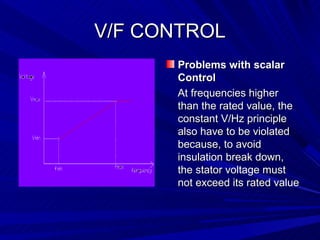
Problems with scalar Control
At frequencies higher than the rated value,
the constant V/Hz principle also have to
be violated because, to avoid insulation
break down, the stator voltage must not
exceed its rated value
WHAT IS VECTOR CONTROL
Vector control mode is defined as a control
technique in which two equivalent control signals
are produced to control Flux and Torque in
decoupled Manner.
both the magnetic field and the torque
developed in the motor can be controlled
independently;
Optimal conditions for torque productions,
resulting in the maximum torque per unit
ampere, occur in the motor both in the steady
state conditions and transient conditions of an
operation.
Direct and Indirect
Direct Method          Indirect Method
 hall effect            no direct
transducers are used   measurement is done
to obtain rotor flux   but a larger
                       computation is used
Typical hardware layout of FOC
            system
V/F CONTROL
      Problems with scalar
      Control
      At frequencies higher
      than the rated value, the
      constant V/Hz principle
      also have to be violated
      because, to avoid
      insulation break down,
      the stator voltage must
      not exceed its rated value
SPACE PHASOR
Clarke Transformation
PARK TRANSFORMATION
PHASOR DIAGRAM OF VECTOR
        CONTROL
Flux Orientation Methods
 Rotor flux orientation
It gives a natural decoupling control
Stator flux orientation
It gives a coupling effect which needs to be
compensated by a decoupling compensation
current
 Air gap flux orientation
It gives a coupling effect which needs to be
compensated by a decoupling compensation
current
PWM MERITS AND DEMERITS
MERTS
 Relatively simple and robust Power circuit
 Low Manufacturing Cost
 Simple Voltage and Current Control techinques
Demerits
 Most PWM inverters operate at low and medium
 switching frequency levels; a reason for this is that
 such converters need to switch rapidly to minimize
 loss. Any attempt to increase switching frequencies
 will also follow in an increase of switching loss and an
 increase in the generation of electromagnetic
 interference.
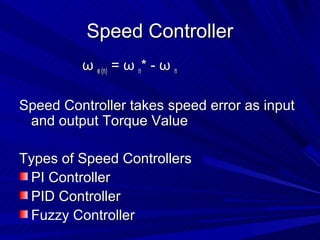
Speed Controller
         ω e (n) = ω n* - ω n

Speed Controller takes speed error as input
 and output Torque Value

Types of Speed Controllers
 PI Controller
 PID Controller
 Fuzzy Controller
PI controller
                                        K P and K i are
                                       proportional and integral
                                       gain parameters of the
                                       PI speed controller


T (n) = T (n-1) * + KP [ω re (n) - ω re(n-1) ] + K i ω re (n)
PID Controller


T (n) = T (n-1) * +KP [ω re(n) - ω re(n-1) ] + K i ω re(n) +
           K d [ω re (n) - 2 ω re(n-1) + ω re(n-2) ]
Fuzzy Logic Controller
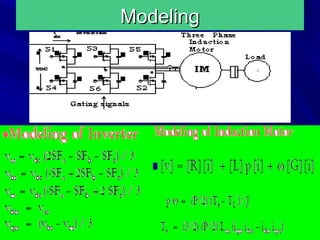
Modelling
Modeling
The Concept of Space Vector
BLOCK DIAGRAM OF INDUCTION
          MOTOR
SPEED SENSORLESS DRIVE
Reduction of Hardware
Increased Mechanical robustness
Higher reliability
Unaffected machine Inertia
INDUCTION MOTOR
DOL STARTER MODEL IN
       MATLAB
SIMULATED STARTING
          RESPONSE OF A 1HP MACHINE
                                                    Stator Voltage
Van,Vbn,Vcn


                 500

                   0

                 -500
                    0.5   0.55   0.6   0.65   0.7       0.75         0.8        0.85   0.9   0.95   1
                                                 Stator Currents
                  20
      Ia Ib Ic


                   0

                  -20
                    0.5   0.55   0.6   0.65   0.7       0.75         0.8        0.85   0.9   0.95   1
                                                       Speed
                 4000
Wm


                 2000

                   0
                   0.5    0.55   0.6   0.65   0.7       0.75         0.8        0.85   0.9   0.95   1
                                                       Torque
                  20
      TL TE


                   0

                  -20
                    0.5   0.55   0.6   0.65   0.7        0.75        0.8        0.85   0.9   0.95   1

                                                                           Time --->
REVERSAL and RE-REVERSAL
                                                     S ta tor V olta ge
                  500
V an,V bn,V cn


                     0

                  -500
                         1   1.2   1.4   1.6   1.8          2        2.2              2.4    2.6   2.8   3
                                                  S ta tor Curre nts
                   20
      Ia Ib Ic


                     0
                   -20
                         1   1.2   1.4   1.6   1.8           2            2.2         2.4    2.6   2.8   3
                                                         S pe e d
                 5000
                     0
Wm


                 -5000
                         1   1.2   1.4   1.6   1.8          2             2.2         2.4    2.6   2.8   3
                                                         Torque
                   50
      TL TE


                     0
                   -50
                         1   1.2   1.4   1.6   1.8           2            2.2         2.4    2.6   2.8   3
                                                                                Tim e --->
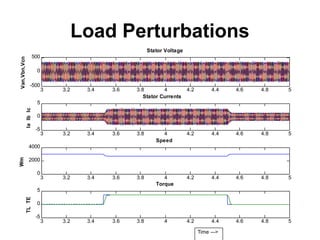
Load Perturbations
                                                            Stator Voltage
                         500
Van,Vbn,Vcn


                          0

                   -500
                               3   3.2    3.4   3.6   3.8        4           4.2         4.4   4.6   4.8   5
                                                         Stator Currents
                          5
              Ia Ib Ic


                          0

                          -5
                               3   3.2    3.4   3.6   3.8        4           4.2         4.4   4.6   4.8   5
                                                               Speed
                  4000
Wm


                  2000

                          0
                               3   3.2    3.4   3.6   3.8         4          4.2         4.4   4.6   4.8   5
                                                               Torque
                          5
              TL TE


                          0

                          -5
                               3   3.2    3.4   3.6   3.8         4          4.2         4.4   4.6   4.8   5

                                                                                   Time --->
LITERATURE SURVEY
F. Blaschke, ”The principle of field orientation as applied to the new TRANSVEKTOR closed-loop control for
rotating field machines,” Siemens Review, pp. 217-220, 1972.
                                    Review,
G.Diana, R.G. Harley, “ An aid for teaching field oriented control applied to Induction Machines,” IEEE Trans.
on Power Systems, Vol. 4, no.3, pp.1258-1262, Aug 1989
            Systems,
James A. Norris, “ Vector Control of A.C Motors,” in Proc. 1993 IEEE Textile, Fibre and Film Industry
Technical Conf., pp. 3/1 – 3/8.
            Conf.,
W.Leonard, “ Field Oriented for Controlling AC Machine-Principle and Applications,” in Proc. 1988 Power
Electronics and variable Speed Drives Conf., pp.277-282
                                          Conf.,
B.K.Bose, Power Electronics and A.C Drives, New Jersey, Prentice-Hall, 1986
                                          Drives,
P.C Krause, Analysis of Electrical machinery, New York; McGraw-Hill 1986.
                                    machinery,
J. Murphy and E Turnbull, Power Electronic control of A.C Motors. Oxford,U.K., Pergamon Press, 1988.
                            Power
S.Yamamura, AC Motor for High Performance Applications, Analysis and Control, New York, Marcel dekker,
                                                                              Control,
1986
R.Krishnan, Electric Motor Drives Modeling Analysis and Control , Pearson Education, New Delhi, India, 2003
J.W.Finch, “ Scalar and vector : a simplified treatment of induction motors performance,” in Proc. 1998 IEE
vector control colloquium, pp2/1- 2/4.
                colloquium,
C.C Lee, “ Fuzzy logic on Control System Part-I,” IEEE Trans. on Systems, Manual Cybernetics, vol.20, no.2,
                                                                                        Cybernetics,
pp.404-418, Mar/Apr 1990
C.C Lee, “ Fuzzy logic on Control System Part-II,” IEEE Trans. on Systems, Manual Cybernetics, vol.20, no.2,
                                                                                         Cybernetics,
pp.404-418, Mar/Apr 1990
 Hellendoom H. and C. Thomas, “Defuzzifications in Fuzzy controllers”, Intelligence and Fuzzy Systems, Vol.
1, 28-30 1996. pp. 109-123, 1993.
 B.N.Singh, “Investigations on vector Controlled Induction Motor Drive,” Ph.D dissertation, Dept. of Electrical
Eng., Indian Institute of Technology, Delhi. India. 1995.
 S.Ghatak Choudhuri, “Analysis and Development of vector Control of Induction Motor Drive,” Ph.D
dissertation, Dept. of Electrical Eng., Indian Institute of Technology, Delhi. India. 2004.

Electricmotors6

  • 1.
    EXPERT SYSTEMS ANDSOLUTIONS Email: expertsyssol@gmail.com expertsyssol@yahoo.com Cell: 9952749533 www.researchprojects.info PAIYANOOR, OMR, CHENNAI Call For Research Projects Final year students of B.E in EEE, ECE, EI, M.E (Power Systems), M.E (Applied Electronics), M.E (Power Electronics) Ph.D Electrical and Electronics. Students can assemble their hardware in our Research labs. Experts will be guiding the projects.
  • 2.
    Control of InductionMotor Under the Guidance of Prof.Pramod Agarwal Dr.Sumit Ghatak Choudhri
  • 3.
    INTRODUCTION TO VECTOR NikolaTesla in 1880 introduced the concept of PolyPhase Induction Machine, from which the world has witnessed continued growth in the use of Induction Machine Three phase induction motors has been mainly preferred for is simplicity, robustness and maintenance free operation But for variable speed drive normally D.C drives are preferred . The main problem with D.C drives is the time to time maintenance of the commutators, brushes and brush holders
  • 5.
    Problems with scalarControl At frequencies higher than the rated value, the constant V/Hz principle also have to be violated because, to avoid insulation break down, the stator voltage must not exceed its rated value
  • 6.
    WHAT IS VECTORCONTROL Vector control mode is defined as a control technique in which two equivalent control signals are produced to control Flux and Torque in decoupled Manner. both the magnetic field and the torque developed in the motor can be controlled independently; Optimal conditions for torque productions, resulting in the maximum torque per unit ampere, occur in the motor both in the steady state conditions and transient conditions of an operation.
  • 8.
    Direct and Indirect DirectMethod Indirect Method hall effect no direct transducers are used measurement is done to obtain rotor flux but a larger computation is used
  • 9.
  • 10.
    V/F CONTROL Problems with scalar Control At frequencies higher than the rated value, the constant V/Hz principle also have to be violated because, to avoid insulation break down, the stator voltage must not exceed its rated value
  • 11.
  • 12.
  • 13.
  • 14.
    PHASOR DIAGRAM OFVECTOR CONTROL
  • 15.
    Flux Orientation Methods Rotor flux orientation It gives a natural decoupling control Stator flux orientation It gives a coupling effect which needs to be compensated by a decoupling compensation current Air gap flux orientation It gives a coupling effect which needs to be compensated by a decoupling compensation current
  • 18.
    PWM MERITS ANDDEMERITS MERTS Relatively simple and robust Power circuit Low Manufacturing Cost Simple Voltage and Current Control techinques Demerits Most PWM inverters operate at low and medium switching frequency levels; a reason for this is that such converters need to switch rapidly to minimize loss. Any attempt to increase switching frequencies will also follow in an increase of switching loss and an increase in the generation of electromagnetic interference.
  • 19.
    Speed Controller ω e (n) = ω n* - ω n Speed Controller takes speed error as input and output Torque Value Types of Speed Controllers PI Controller PID Controller Fuzzy Controller
  • 20.
    PI controller K P and K i are proportional and integral gain parameters of the PI speed controller T (n) = T (n-1) * + KP [ω re (n) - ω re(n-1) ] + K i ω re (n)
  • 21.
    PID Controller T (n)= T (n-1) * +KP [ω re(n) - ω re(n-1) ] + K i ω re(n) + K d [ω re (n) - 2 ω re(n-1) + ω re(n-2) ]
  • 22.
  • 23.
  • 24.
  • 25.
    The Concept ofSpace Vector
  • 26.
    BLOCK DIAGRAM OFINDUCTION MOTOR
  • 29.
    SPEED SENSORLESS DRIVE Reductionof Hardware Increased Mechanical robustness Higher reliability Unaffected machine Inertia
  • 30.
  • 31.
  • 32.
    SIMULATED STARTING RESPONSE OF A 1HP MACHINE Stator Voltage Van,Vbn,Vcn 500 0 -500 0.5 0.55 0.6 0.65 0.7 0.75 0.8 0.85 0.9 0.95 1 Stator Currents 20 Ia Ib Ic 0 -20 0.5 0.55 0.6 0.65 0.7 0.75 0.8 0.85 0.9 0.95 1 Speed 4000 Wm 2000 0 0.5 0.55 0.6 0.65 0.7 0.75 0.8 0.85 0.9 0.95 1 Torque 20 TL TE 0 -20 0.5 0.55 0.6 0.65 0.7 0.75 0.8 0.85 0.9 0.95 1 Time --->
  • 33.
    REVERSAL and RE-REVERSAL S ta tor V olta ge 500 V an,V bn,V cn 0 -500 1 1.2 1.4 1.6 1.8 2 2.2 2.4 2.6 2.8 3 S ta tor Curre nts 20 Ia Ib Ic 0 -20 1 1.2 1.4 1.6 1.8 2 2.2 2.4 2.6 2.8 3 S pe e d 5000 0 Wm -5000 1 1.2 1.4 1.6 1.8 2 2.2 2.4 2.6 2.8 3 Torque 50 TL TE 0 -50 1 1.2 1.4 1.6 1.8 2 2.2 2.4 2.6 2.8 3 Tim e --->
  • 34.
    Load Perturbations Stator Voltage 500 Van,Vbn,Vcn 0 -500 3 3.2 3.4 3.6 3.8 4 4.2 4.4 4.6 4.8 5 Stator Currents 5 Ia Ib Ic 0 -5 3 3.2 3.4 3.6 3.8 4 4.2 4.4 4.6 4.8 5 Speed 4000 Wm 2000 0 3 3.2 3.4 3.6 3.8 4 4.2 4.4 4.6 4.8 5 Torque 5 TL TE 0 -5 3 3.2 3.4 3.6 3.8 4 4.2 4.4 4.6 4.8 5 Time --->
  • 40.
    LITERATURE SURVEY F. Blaschke,”The principle of field orientation as applied to the new TRANSVEKTOR closed-loop control for rotating field machines,” Siemens Review, pp. 217-220, 1972. Review, G.Diana, R.G. Harley, “ An aid for teaching field oriented control applied to Induction Machines,” IEEE Trans. on Power Systems, Vol. 4, no.3, pp.1258-1262, Aug 1989 Systems, James A. Norris, “ Vector Control of A.C Motors,” in Proc. 1993 IEEE Textile, Fibre and Film Industry Technical Conf., pp. 3/1 – 3/8. Conf., W.Leonard, “ Field Oriented for Controlling AC Machine-Principle and Applications,” in Proc. 1988 Power Electronics and variable Speed Drives Conf., pp.277-282 Conf., B.K.Bose, Power Electronics and A.C Drives, New Jersey, Prentice-Hall, 1986 Drives, P.C Krause, Analysis of Electrical machinery, New York; McGraw-Hill 1986. machinery, J. Murphy and E Turnbull, Power Electronic control of A.C Motors. Oxford,U.K., Pergamon Press, 1988. Power S.Yamamura, AC Motor for High Performance Applications, Analysis and Control, New York, Marcel dekker, Control, 1986 R.Krishnan, Electric Motor Drives Modeling Analysis and Control , Pearson Education, New Delhi, India, 2003 J.W.Finch, “ Scalar and vector : a simplified treatment of induction motors performance,” in Proc. 1998 IEE vector control colloquium, pp2/1- 2/4. colloquium, C.C Lee, “ Fuzzy logic on Control System Part-I,” IEEE Trans. on Systems, Manual Cybernetics, vol.20, no.2, Cybernetics, pp.404-418, Mar/Apr 1990 C.C Lee, “ Fuzzy logic on Control System Part-II,” IEEE Trans. on Systems, Manual Cybernetics, vol.20, no.2, Cybernetics, pp.404-418, Mar/Apr 1990 Hellendoom H. and C. Thomas, “Defuzzifications in Fuzzy controllers”, Intelligence and Fuzzy Systems, Vol. 1, 28-30 1996. pp. 109-123, 1993. B.N.Singh, “Investigations on vector Controlled Induction Motor Drive,” Ph.D dissertation, Dept. of Electrical Eng., Indian Institute of Technology, Delhi. India. 1995. S.Ghatak Choudhuri, “Analysis and Development of vector Control of Induction Motor Drive,” Ph.D dissertation, Dept. of Electrical Eng., Indian Institute of Technology, Delhi. India. 2004.