EXPERT SYSTEMS AND SOLUTIONS
                     Email: expertsyssol@gmail.com
                        expertsyssol@yahoo.com
                          Cell: 9952749533
                     www.researchprojects.info
                    PAIYANOOR, OMR, CHENNAI
                 Call For Research Projects          Final
                 year students of B.E in EEE, ECE,
                    EI, M.E (Power Systems), M.E
                  (Applied Electronics), M.E (Power
                              Electronics)
                  Ph.D Electrical and Electronics.
                Students can assemble their hardware in our
                 Research labs. Experts will be guiding the
                                 projects.


Prof. Dr. -Ing. Ralph M. Kennel   Wuppertal University
                                                         Page 1
Tutorial 2

Sensorless Motor Drives

       Ralph M. Kennel


    Elektrical Machines and Drives
         Wuppertal University


                                     Page 2
Reasons for Industrial Applications
                  of Drives with Encoderless Control:

                    • Cost

                    • Reliability

                    • Robustness


           Prof. Dr. -Ing. Ralph M. Kennel   Wuppertal University
                                                                    Page 3
Industrial Drives with Sensorless Control
since several years / decades sensorless control is investigated
                                    and published on conferences and magazines
- acceptance in industry, however, is rather low
                                        Why ?
new ideas and concepts are interesting for industry,
                         only if they do not result in higher cost or higher effort!!!

                        What does that mean
            for industrial drives with sensorless control ?
 no additional or more powerful processors / controllers
 no additional hardware or additional sensors (e. g. voltage sensors)
 no increased installation effort with respect to parameter adjustments


                   Prof. Dr. -Ing. Ralph M. Kennel   Wuppertal University
                                                                                Page 4
Sensorless (Encoderless) Motor Drives


introduction
•    fundamental model methods
•    high frequency injection methods

sensorless control of electrical machines
•   machine response on high frequency injection voltages
•   tracking of magnetic saliencies / anisotropies

practical results
•   experiences with industrial drives

conclusions


       Prof. Dr. -Ing. Ralph M. Kennel   Wuppertal University
                                                                Page 5
Categories of Machine Models for „Sensorless“ Control


           Prof. Dr. -Ing. Ralph M. Kennel   Wuppertal University
                                                                    Page 6
fundamental model                               high frequency injection

• simple realisation
• does not work at frequency 0
• parameter dependencies


            current injection                                  voltage injection

• measuring voltage is high enough
• additional voltage sensors


                       Basic Principles current response
      transient current response       stationary
• no additional hardware          • standard microcontroller sufficient
               of Encoderless• very small measuring current
• very short measuring time         Control

                  Prof. Dr. -Ing. Ralph M. Kennel   Wuppertal University
                                                                                     Page 7
Fundamental Model of an Induction Machine
                 stator                         rotor


when knowing voltage uS                                          mechanics

   as well as current iS
it should be possible
      calculate speed ω


                  Prof. Dr. -Ing. Ralph M. Kennel       Wuppertal University
                                                                               Page 8
Calculation of Speed by Fundamental Model
      is not Practicable for Very Low Speeds
... because
• the voltage signal becomes very small
• errors between real voltage and values used for calculation
               cannot be avoided and become more significant
• DC components of these errors
                 let the integrators for flux calculation drift away
          the calculated speed gets more and more incorrect
   is an encoder/resolver the only feasable solution ??


               Prof. Dr. -Ing. Ralph M. Kennel   Wuppertal University
                                                                        Page 9
Signal Injection Method
           according to J. Holtz, H.Pan, etc.
• this is basically a current injection method
                           voltage sensors are necessary !!!
• it is possible to use current derivatives
                   instead of motor voltages
   measuring current derivatives, however,
        by standard current transducers is not really possible
• but, industrial current transducers
                  have a current derivative available internally
       can this be made available for customers ???

             Prof. Dr. -Ing. Ralph M. Kennel   Wuppertal University
                                                                      Page
INFORM method
                 according to M. Schroedl
                (Technical University of Vienna, Austria)

• this is basically a transient voltage injection method
            currents have to be sensed at specific times !!!
• when using standard current transducers
                  these cannot be synchronized with PWM

   the hardware of a standard industrial drive
                                        has to be changed

nevertheless this method comes close to industrial needs !


             Prof. Dr. -Ing. Ralph M. Kennel   Wuppertal University
                                                                      Page
Stationary Signal Injection Methods
     according to R. Lorenz, S.-K. Sul, R. Kennel, etc.
• the basic idea is
          to use the electrical machine itself as a resolver !!!
• a resolver is nothing else but an electrical machine
           can we operate the motor itself like a resolver ?

• if the machine itself is a resolver (encoder)
                 is that really an „encoderless“ control ???

              good idea – but does it work ???
                                                                      

             Prof. Dr. -Ing. Ralph M. Kennel   Wuppertal University
                                                                      Page
Resolver
     injection of a     sensing of a two-dimensional
stationary (sinusoidal)    stationary (sinusoidal)
high frequency signal         signal response
                                   Tamagawa


                                        S2
                                             u1(γ)                    π         2π
 R1                                                  0
                                                                                     γ
  Stator    Rotor
                               Stator
  ue         uR
                               u2

  R2                                    S4

                                             u2(γ)
                     Stator                                           π         2π
                                                     0
                     u1                                                              γ
                S1            S3


                     Prof. Dr. -Ing. Ralph M. Kennel     Wuppertal University
                                                                                Page
Stationary Signal Injection Methods
     according to R. Lorenz, S.-K. Sul, R. Kennel, etc.
• the basic idea is
          to use the electrical machine itself as a resolver !!!
• a resolver is nothing else but an electrical machine
           can we operate the motor itself like a resolver ?

• if the machine itself is a resolver (encoder)
                 is that really an „encoderless“ control ???

    now we do the same with an electrical AC machine
                                                                      

             Prof. Dr. -Ing. Ralph M. Kennel   Wuppertal University
                                                                      Page
Fundamental Frequency Excitation
                (in α-β coordinates)


 Prof. Dr. -Ing. Ralph M. Kennel   Wuppertal University
                                                          Page
High Frequency Excitation
               (in α-β coordinates)


Prof. Dr. -Ing. Ralph M. Kennel   Wuppertal University
                                                         Page
Machine Model for High Frequency Signals


                             d ic(F)                                      (F)    lsσ d     0 
uc(F) = rs ic(F) + lsσ (F)           + jωa lsσ (F) ic(F)            lsσ         =
                               dt                                                 0      lsσ q 
                                                                                                


                  Prof. Dr. -Ing. Ralph M. Kennel          Wuppertal University
                                                                                                    Page
High Frequency Behaviour of the Machine Model

       Prof. Dr. -Ing. Ralph M. Kennel   Wuppertal University
                                                                Page
injection of high frequency voltages

                                     fundamental voltage phasor/vector

                                     fundamental current phasor/vector

                                     injected high frequency
                                                       voltage phasor/vector
                                     high frequency
                                           current phasor/vector (response)


   Prof. Dr. -Ing. Ralph M. Kennel   Wuppertal University
                                                                      Page
injection of high frequency voltages

                                     fundamental voltage phasor/vector

                                     fundamental current phasor/vector

                                     injected high frequency
                                                       voltage phasor/vector
                                     high frequency
                                           current phasor/vector (response)


   Prof. Dr. -Ing. Ralph M. Kennel   Wuppertal University
                                                                      Page
injection of high frequency voltages

                                     fundamental voltage phasor/vector

                                     fundamental current phasor/vector

                                     injected high frequency
                                                       voltage phasor/vector
                                     high frequency
                                           current phasor/vector (response)


   Prof. Dr. -Ing. Ralph M. Kennel   Wuppertal University
                                                                      Page
injection of high frequency voltages

                                     fundamental voltage phasor/vector

                                     fundamental current phasor/vector

                                     injected high frequency
                                                       voltage phasor/vector
                                     high frequency
                                           current phasor/vector (response)


   Prof. Dr. -Ing. Ralph M. Kennel   Wuppertal University
                                                                      Page
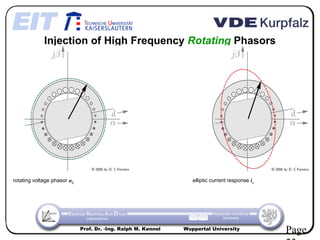
Injection of High Frequency Rotating Phasors


rotating voltage phasor uc                                        elliptic current response ic


                             Prof. Dr. -Ing. Ralph M. Kennel   Wuppertal University
                                                                                                 Page
Position Information of Salient Rotors
in High Frequency Rotating Phasors

• machine responds
  on a rotating voltage phasor
  with an elliptic current response
• ellipse is correlated
  with the geometric anisotropy
                          of the rotor
• rotor position information
  is included                                       elliptic current response ic (rotating)
       in the high frequency current


              Prof. Dr. -Ing. Ralph M. Kennel   Wuppertal University
                                                                                        Page
Saturation Anisotropy
of a Permanent Magnet Synchronous Machine


                                        rotor flux saturation of a
                                        permanent magnet synchronous machine


      Prof. Dr. -Ing. Ralph M. Kennel      Wuppertal University
                                                                       Page
Position Information of non-salient rotors
in High Frequency Rotating Phasors


• machine responds
  on a rotating voltage phasor
  with an elliptic current response
• ellipse is correlated
  with the saturation anisotropy
• rotor position information
  is included
        in the high frequency current               elliptic current response ic (rotating)


              Prof. Dr. -Ing. Ralph M. Kennel   Wuppertal University
                                                                                        Page
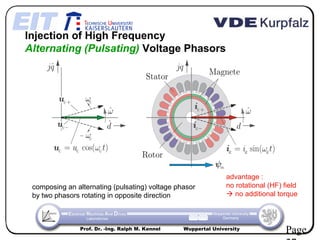
Injection of High Frequency
Alternating (Pulsating) Voltage Phasors


                                                                 advantage :
 composing an alternating (pulsating) voltage phasor             no rotational (HF) field
 by two phasors rotating in opposite direction                    no additional torque


                Prof. Dr. -Ing. Ralph M. Kennel   Wuppertal University
                                                                                     Page
High Frequency Current Response
    of a Synchronous Machine


  Prof. Dr. -Ing. Ralph M. Kennel   Wuppertal University
                                                           Page
Current Response
     of a Misoriented System


      voltage and current
   show different orientation !!


Prof. Dr. -Ing. Ralph M. Kennel   Wuppertal University
                                                         Page
Current Response
under a Misorientation of 90°


Prof. Dr. -Ing. Ralph M. Kennel   Wuppertal University
                                                         Page
Tracking Scheme for Magnetic Anisotropies


     ˆ
icd (F) = K ⋅ sin ( ω c t ) lcq
     ˆ
                             (         )
icq (F) = − K ⋅ sin ( ω c t ) lcq − lcd ∆ δˆa


                         Prof. Dr. -Ing. Ralph M. Kennel   Wuppertal University
                                                                                  Page
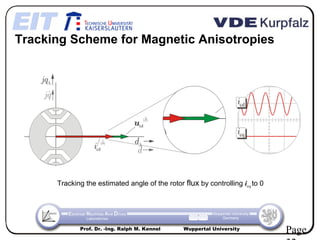
Tracking Scheme for Magnetic Anisotropies


      Tracking the estimated angle of the rotor flux by controlling icq to 0


             Prof. Dr. -Ing. Ralph M. Kennel    Wuppertal University
                                                                               Page
tracking control of injection voltage

                                    fundamental voltage phasor/vector

                                    fundamental current phasor/vector

                                    injected high frequency
                                                voltage phasor/vector
                                    high frequency
                                           current phasor/vector (response)


  Prof. Dr. -Ing. Ralph M. Kennel    Wuppertal University
                                                                     Page
tracking control of injection voltage

                                    fundamental voltage phasor/vector

                                    fundamental current phasor/vector

                                    injected high frequency
                                                 voltage phasor/vector
                                    high frequency
                                          current phasor/vector (response)


  Prof. Dr. -Ing. Ralph M. Kennel   Wuppertal University
                                                                    Page
tracking control of injection voltage

                                    fundamental voltage phasor/vector

                                    fundamental current phasor/vector

                                    injected high frequency
                                                  voltage phasor/vector
                                    high frequency
                                          current phasor/vector (response)


  Prof. Dr. -Ing. Ralph M. Kennel   Wuppertal University
                                                                    Page
tracking control of injection voltage

                                    fundamental voltage phasor/vector

                                    fundamental current phasor/vector

                                    injected high frequency
                                                      voltage phasor/vector
                                    high frequency
                                          current phasor/vector (response)


  Prof. Dr. -Ing. Ralph M. Kennel   Wuppertal University
                                                                     Page
)      e
                                ns
tracking control of injection voltage   r(
                                          res
                                             po
                                                                        to
                                                                   /v ec
                                                               s or
                                                                   fundamental voltage phasor/vector
                                                                               ph
                                                                                 a
                                                                             t       n
                                                                                 rre       y
                                                                   fundamental current phasor/vector
                                                                              cu
                                                                                      e nc
                                                                                   qu
                                                                             h fre
                                                                                               hig


                                     injecte
                                 d hi gh
                                         freque
                                          voltag

                                                nc y
                                                e pha
                                                      sor/ve
                                                            ctor


  Prof. Dr. -Ing. Ralph M. Kennel                                  Wuppertal University
                                                                                                     Page
tracking control of injection voltage

                                    fundamental voltage phasor/vector

                                    fundamental current phasor/vector

                                    injected high frequency
                                                      voltage phasor/vector
                                    high frequency
                                          current phasor/vector (response)


  Prof. Dr. -Ing. Ralph M. Kennel   Wuppertal University
                                                                     Page
Encoderless Control Structure


  step response of the PLL;
  PLL is locked after ca. 10 -15 ms


                    Prof. Dr. -Ing. Ralph M. Kennel   Wuppertal University
                                                                             Page
tracking control of injection voltage

                                    fundamental voltage phasor/vector

                                    fundamental current phasor/vector

                                    injected high frequency
                                                      voltage phasor/vector
                                    high frequency
                                          current phasor/vector (response)


  Prof. Dr. -Ing. Ralph M. Kennel   Wuppertal University
                                                                     Page
tracking control of injection voltage

                                    fundamental voltage phasor/vector

                                    fundamental current phasor/vector

                                    injected high frequency
                                                  voltage phasor/vector
                                    high frequency
                                          current phasor/vector (response)


  Prof. Dr. -Ing. Ralph M. Kennel   Wuppertal University
                                                                    Page
tracking control of injection voltage

                                    fundamental voltage phasor/vector

                                                              cy
                                    fundamental currentnphasor/vector
                                                     freque                ctor
                                           e d hi gh            pha sor/ve
                                     inject            v oltage


                                    high frequency
                                           current phasor/vector (response)


  Prof. Dr. -Ing. Ralph M. Kennel    Wuppertal University
                                                                           Page
control structure
      of an encoderless control
   with alternating high frequency
            signal injection


the estimated angle can be used
for field orientation as well as for
speed or position control
of synchronous machines


                     Prof. Dr. -Ing. Ralph M. Kennel   Wuppertal University
                                                                              Page
north and south pole
                                                             can be distinguished


a) theoretisch                   b) experimentell


trajectory of stator admittance
(SMPMSM, carrier frequency fc = 0.5 kHz)

            Stator Admittance in Complex Plane

                 Prof. Dr. -Ing. Ralph M. Kennel    Wuppertal University
                                                                                    Page
Prof. Dr. -Ing. Ralph M. Kennel   Wuppertal University
                                                         Page
Prof. Dr. -Ing. Ralph M. Kennel   Wuppertal University
                                                         Page
Prof. Dr. -Ing. Ralph M. Kennel   Wuppertal University
                                                         Page
Prof. Dr. -Ing. Ralph M. Kennel   Wuppertal University
                                                         Page
Prof. Dr. -Ing. Ralph M. Kennel   Wuppertal University
                                                         Page
Tracking Control


tracking of estimated rotor flux angle by adjusting/controlling icq to zero


                Prof. Dr. -Ing. Ralph M. Kennel   Wuppertal University
                                                                         Page
north and south pole
                                                             can be distinguished


a) theoretisch                   b) experimentell


trajectory of stator admittance
(SMPMSM, carrier frequency fc = 0.5 kHz)

            Stator Admittance in Complex Plane

                 Prof. Dr. -Ing. Ralph M. Kennel    Wuppertal University
                                                                                    Page
the concept of encoderless control as presented here
                  works similar to radio broadcasting :

the information of rotor position
              is modulated by a high frequency signal

the information is demodulated / extracted
                                  from motor currents


             Prof. Dr. -Ing. Ralph M. Kennel   Wuppertal University
                                                                      Page
Modulation of Carrier Signals by Electrcial Machines
• Synchronous Machines


                                                                    works fine !!
• Induction Machines


                                               further research to be done !!

             Prof. Dr. -Ing. Ralph M. Kennel      Wuppertal University
                                                                               Page
Combination of
           Field Oriented Control
         and Encoderless Detection
              of Rotor Position

•   the estimated angle can be used
    for field orientation as well as
    for speed and/or position control
    of synchronous machines

•   high frequency test signals are superposed to
    the fundamental stator voltage(s)

•   drive control structure remains as before

•   no additional sensors required

•   the scheme is parameter independant


                     Prof. Dr. -Ing. Ralph M. Kennel   Wuppertal University
                                                                              Page
Sprungantwort der Drehzahlregelung


      Drive with Speed Control

Prof. Dr. -Ing. Ralph M. Kennel        Wuppertal University
                                                              Page
Sprungantwort der Lageregelung


Step Response of Encoderless Position Control

       Prof. Dr. -Ing. Ralph M. Kennel        Wuppertal University
                                                                     Page
Results
• the tracking control scheme presented here
  synchronizes on the saturation anisotropy
  of a synchronous machine.

• the tracking control scheme
  is not depending on any machine parameter.

• the size of additional software for the tracking control
  is comparable to the software of a rotor model
  for the field oriented control of an induction machine.

• the high frequency current signal can be measured
  together with the fundamental current
  by the standard current transducers
  of a standard drive inverter.


         Prof. Dr. -Ing. Ralph M. Kennel   Wuppertal University
                                                                  Page
Practical Experience with an Industrial Servo Drive

Implementation of a sensorless control
into a servo drive of

• training of a development engineer
       2 x 1 week in our laboratory
• programming of additional software
        in manufacturer‘s factory
• delivery of prototype
               after ca. 3 months

• presentation on Hanover Fair
                  in April 2006


                Prof. Dr. -Ing. Ralph M. Kennel   Wuppertal University
                                                                         Page
Conclusion
•   The proposed estimation method is simple
                       and therefore suitable for usual microcontrollers
     no additional or more powerful processors / controllers

•   The sensorless control scheme presented here
           does not need additional voltage measurement devices
                       - neither on the machine/motor side nor on the line side
     no additional hardware or additional sensors (e. g. voltage sensors)
•   The phase tracking method
                         is very robust to variations of the system parameters
     no increased installation effort with respect to parameter adjustments


                Prof. Dr. -Ing. Ralph M. Kennel   Wuppertal University
                                                                           Page

Electricmotors5

  • 1.
    EXPERT SYSTEMS ANDSOLUTIONS Email: expertsyssol@gmail.com expertsyssol@yahoo.com Cell: 9952749533 www.researchprojects.info PAIYANOOR, OMR, CHENNAI Call For Research Projects Final year students of B.E in EEE, ECE, EI, M.E (Power Systems), M.E (Applied Electronics), M.E (Power Electronics) Ph.D Electrical and Electronics. Students can assemble their hardware in our Research labs. Experts will be guiding the projects. Prof. Dr. -Ing. Ralph M. Kennel Wuppertal University Page 1
  • 2.
    Tutorial 2 Sensorless MotorDrives Ralph M. Kennel Elektrical Machines and Drives Wuppertal University Page 2
  • 3.
    Reasons for IndustrialApplications of Drives with Encoderless Control: • Cost • Reliability • Robustness Prof. Dr. -Ing. Ralph M. Kennel Wuppertal University Page 3
  • 4.
    Industrial Drives withSensorless Control since several years / decades sensorless control is investigated and published on conferences and magazines - acceptance in industry, however, is rather low Why ? new ideas and concepts are interesting for industry, only if they do not result in higher cost or higher effort!!! What does that mean for industrial drives with sensorless control ?  no additional or more powerful processors / controllers  no additional hardware or additional sensors (e. g. voltage sensors)  no increased installation effort with respect to parameter adjustments Prof. Dr. -Ing. Ralph M. Kennel Wuppertal University Page 4
  • 5.
    Sensorless (Encoderless) MotorDrives introduction • fundamental model methods • high frequency injection methods sensorless control of electrical machines • machine response on high frequency injection voltages • tracking of magnetic saliencies / anisotropies practical results • experiences with industrial drives conclusions Prof. Dr. -Ing. Ralph M. Kennel Wuppertal University Page 5
  • 6.
    Categories of MachineModels for „Sensorless“ Control Prof. Dr. -Ing. Ralph M. Kennel Wuppertal University Page 6
  • 7.
    fundamental model high frequency injection • simple realisation • does not work at frequency 0 • parameter dependencies current injection voltage injection • measuring voltage is high enough • additional voltage sensors Basic Principles current response transient current response stationary • no additional hardware • standard microcontroller sufficient of Encoderless• very small measuring current • very short measuring time Control Prof. Dr. -Ing. Ralph M. Kennel Wuppertal University Page 7
  • 8.
    Fundamental Model ofan Induction Machine stator rotor when knowing voltage uS mechanics as well as current iS it should be possible calculate speed ω Prof. Dr. -Ing. Ralph M. Kennel Wuppertal University Page 8
  • 9.
    Calculation of Speedby Fundamental Model is not Practicable for Very Low Speeds ... because • the voltage signal becomes very small • errors between real voltage and values used for calculation cannot be avoided and become more significant • DC components of these errors let the integrators for flux calculation drift away  the calculated speed gets more and more incorrect is an encoder/resolver the only feasable solution ?? Prof. Dr. -Ing. Ralph M. Kennel Wuppertal University Page 9
  • 10.
    Signal Injection Method according to J. Holtz, H.Pan, etc. • this is basically a current injection method  voltage sensors are necessary !!! • it is possible to use current derivatives instead of motor voltages  measuring current derivatives, however, by standard current transducers is not really possible • but, industrial current transducers have a current derivative available internally can this be made available for customers ??? Prof. Dr. -Ing. Ralph M. Kennel Wuppertal University Page
  • 11.
    INFORM method according to M. Schroedl (Technical University of Vienna, Austria) • this is basically a transient voltage injection method  currents have to be sensed at specific times !!! • when using standard current transducers  these cannot be synchronized with PWM  the hardware of a standard industrial drive has to be changed nevertheless this method comes close to industrial needs ! Prof. Dr. -Ing. Ralph M. Kennel Wuppertal University Page
  • 12.
    Stationary Signal InjectionMethods according to R. Lorenz, S.-K. Sul, R. Kennel, etc. • the basic idea is to use the electrical machine itself as a resolver !!! • a resolver is nothing else but an electrical machine  can we operate the motor itself like a resolver ? • if the machine itself is a resolver (encoder)  is that really an „encoderless“ control ??? good idea – but does it work ???  Prof. Dr. -Ing. Ralph M. Kennel Wuppertal University Page
  • 13.
    Resolver injection of a sensing of a two-dimensional stationary (sinusoidal) stationary (sinusoidal) high frequency signal signal response Tamagawa S2 u1(γ) π 2π R1 0 γ Stator Rotor Stator ue uR u2 R2 S4 u2(γ) Stator π 2π 0 u1 γ S1 S3 Prof. Dr. -Ing. Ralph M. Kennel Wuppertal University Page
  • 14.
    Stationary Signal InjectionMethods according to R. Lorenz, S.-K. Sul, R. Kennel, etc. • the basic idea is to use the electrical machine itself as a resolver !!! • a resolver is nothing else but an electrical machine  can we operate the motor itself like a resolver ? • if the machine itself is a resolver (encoder)  is that really an „encoderless“ control ??? now we do the same with an electrical AC machine  Prof. Dr. -Ing. Ralph M. Kennel Wuppertal University Page
  • 15.
    Fundamental Frequency Excitation (in α-β coordinates) Prof. Dr. -Ing. Ralph M. Kennel Wuppertal University Page
  • 16.
    High Frequency Excitation (in α-β coordinates) Prof. Dr. -Ing. Ralph M. Kennel Wuppertal University Page
  • 17.
    Machine Model forHigh Frequency Signals d ic(F) (F) lsσ d 0  uc(F) = rs ic(F) + lsσ (F) + jωa lsσ (F) ic(F) lsσ = dt  0 lsσ q   Prof. Dr. -Ing. Ralph M. Kennel Wuppertal University Page
  • 18.
    High Frequency Behaviourof the Machine Model Prof. Dr. -Ing. Ralph M. Kennel Wuppertal University Page
  • 19.
    injection of highfrequency voltages fundamental voltage phasor/vector fundamental current phasor/vector injected high frequency voltage phasor/vector high frequency current phasor/vector (response) Prof. Dr. -Ing. Ralph M. Kennel Wuppertal University Page
  • 20.
    injection of highfrequency voltages fundamental voltage phasor/vector fundamental current phasor/vector injected high frequency voltage phasor/vector high frequency current phasor/vector (response) Prof. Dr. -Ing. Ralph M. Kennel Wuppertal University Page
  • 21.
    injection of highfrequency voltages fundamental voltage phasor/vector fundamental current phasor/vector injected high frequency voltage phasor/vector high frequency current phasor/vector (response) Prof. Dr. -Ing. Ralph M. Kennel Wuppertal University Page
  • 22.
    injection of highfrequency voltages fundamental voltage phasor/vector fundamental current phasor/vector injected high frequency voltage phasor/vector high frequency current phasor/vector (response) Prof. Dr. -Ing. Ralph M. Kennel Wuppertal University Page
  • 23.
    Injection of HighFrequency Rotating Phasors rotating voltage phasor uc elliptic current response ic Prof. Dr. -Ing. Ralph M. Kennel Wuppertal University Page
  • 24.
    Position Information ofSalient Rotors in High Frequency Rotating Phasors • machine responds on a rotating voltage phasor with an elliptic current response • ellipse is correlated with the geometric anisotropy of the rotor • rotor position information is included elliptic current response ic (rotating) in the high frequency current Prof. Dr. -Ing. Ralph M. Kennel Wuppertal University Page
  • 25.
    Saturation Anisotropy of aPermanent Magnet Synchronous Machine rotor flux saturation of a permanent magnet synchronous machine Prof. Dr. -Ing. Ralph M. Kennel Wuppertal University Page
  • 26.
    Position Information ofnon-salient rotors in High Frequency Rotating Phasors • machine responds on a rotating voltage phasor with an elliptic current response • ellipse is correlated with the saturation anisotropy • rotor position information is included in the high frequency current elliptic current response ic (rotating) Prof. Dr. -Ing. Ralph M. Kennel Wuppertal University Page
  • 27.
    Injection of HighFrequency Alternating (Pulsating) Voltage Phasors advantage : composing an alternating (pulsating) voltage phasor no rotational (HF) field by two phasors rotating in opposite direction  no additional torque Prof. Dr. -Ing. Ralph M. Kennel Wuppertal University Page
  • 28.
    High Frequency CurrentResponse of a Synchronous Machine Prof. Dr. -Ing. Ralph M. Kennel Wuppertal University Page
  • 29.
    Current Response of a Misoriented System voltage and current show different orientation !! Prof. Dr. -Ing. Ralph M. Kennel Wuppertal University Page
  • 30.
    Current Response under aMisorientation of 90° Prof. Dr. -Ing. Ralph M. Kennel Wuppertal University Page
  • 31.
    Tracking Scheme forMagnetic Anisotropies ˆ icd (F) = K ⋅ sin ( ω c t ) lcq ˆ ( ) icq (F) = − K ⋅ sin ( ω c t ) lcq − lcd ∆ δˆa Prof. Dr. -Ing. Ralph M. Kennel Wuppertal University Page
  • 32.
    Tracking Scheme forMagnetic Anisotropies Tracking the estimated angle of the rotor flux by controlling icq to 0 Prof. Dr. -Ing. Ralph M. Kennel Wuppertal University Page
  • 33.
    tracking control ofinjection voltage fundamental voltage phasor/vector fundamental current phasor/vector injected high frequency voltage phasor/vector high frequency current phasor/vector (response) Prof. Dr. -Ing. Ralph M. Kennel Wuppertal University Page
  • 34.
    tracking control ofinjection voltage fundamental voltage phasor/vector fundamental current phasor/vector injected high frequency voltage phasor/vector high frequency current phasor/vector (response) Prof. Dr. -Ing. Ralph M. Kennel Wuppertal University Page
  • 35.
    tracking control ofinjection voltage fundamental voltage phasor/vector fundamental current phasor/vector injected high frequency voltage phasor/vector high frequency current phasor/vector (response) Prof. Dr. -Ing. Ralph M. Kennel Wuppertal University Page
  • 36.
    tracking control ofinjection voltage fundamental voltage phasor/vector fundamental current phasor/vector injected high frequency voltage phasor/vector high frequency current phasor/vector (response) Prof. Dr. -Ing. Ralph M. Kennel Wuppertal University Page
  • 37.
    ) e ns tracking control of injection voltage r( res po to /v ec s or fundamental voltage phasor/vector ph a t n rre y fundamental current phasor/vector cu e nc qu h fre hig injecte d hi gh freque voltag nc y e pha sor/ve ctor Prof. Dr. -Ing. Ralph M. Kennel Wuppertal University Page
  • 38.
    tracking control ofinjection voltage fundamental voltage phasor/vector fundamental current phasor/vector injected high frequency voltage phasor/vector high frequency current phasor/vector (response) Prof. Dr. -Ing. Ralph M. Kennel Wuppertal University Page
  • 39.
    Encoderless Control Structure step response of the PLL; PLL is locked after ca. 10 -15 ms Prof. Dr. -Ing. Ralph M. Kennel Wuppertal University Page
  • 40.
    tracking control ofinjection voltage fundamental voltage phasor/vector fundamental current phasor/vector injected high frequency voltage phasor/vector high frequency current phasor/vector (response) Prof. Dr. -Ing. Ralph M. Kennel Wuppertal University Page
  • 41.
    tracking control ofinjection voltage fundamental voltage phasor/vector fundamental current phasor/vector injected high frequency voltage phasor/vector high frequency current phasor/vector (response) Prof. Dr. -Ing. Ralph M. Kennel Wuppertal University Page
  • 42.
    tracking control ofinjection voltage fundamental voltage phasor/vector cy fundamental currentnphasor/vector freque ctor e d hi gh pha sor/ve inject v oltage high frequency current phasor/vector (response) Prof. Dr. -Ing. Ralph M. Kennel Wuppertal University Page
  • 43.
    control structure of an encoderless control with alternating high frequency signal injection the estimated angle can be used for field orientation as well as for speed or position control of synchronous machines Prof. Dr. -Ing. Ralph M. Kennel Wuppertal University Page
  • 44.
    north and southpole can be distinguished a) theoretisch b) experimentell trajectory of stator admittance (SMPMSM, carrier frequency fc = 0.5 kHz) Stator Admittance in Complex Plane Prof. Dr. -Ing. Ralph M. Kennel Wuppertal University Page
  • 45.
    Prof. Dr. -Ing.Ralph M. Kennel Wuppertal University Page
  • 46.
    Prof. Dr. -Ing.Ralph M. Kennel Wuppertal University Page
  • 47.
    Prof. Dr. -Ing.Ralph M. Kennel Wuppertal University Page
  • 48.
    Prof. Dr. -Ing.Ralph M. Kennel Wuppertal University Page
  • 49.
    Prof. Dr. -Ing.Ralph M. Kennel Wuppertal University Page
  • 50.
    Tracking Control tracking ofestimated rotor flux angle by adjusting/controlling icq to zero Prof. Dr. -Ing. Ralph M. Kennel Wuppertal University Page
  • 51.
    north and southpole can be distinguished a) theoretisch b) experimentell trajectory of stator admittance (SMPMSM, carrier frequency fc = 0.5 kHz) Stator Admittance in Complex Plane Prof. Dr. -Ing. Ralph M. Kennel Wuppertal University Page
  • 52.
    the concept ofencoderless control as presented here works similar to radio broadcasting : the information of rotor position is modulated by a high frequency signal the information is demodulated / extracted from motor currents Prof. Dr. -Ing. Ralph M. Kennel Wuppertal University Page
  • 53.
    Modulation of CarrierSignals by Electrcial Machines • Synchronous Machines works fine !! • Induction Machines further research to be done !! Prof. Dr. -Ing. Ralph M. Kennel Wuppertal University Page
  • 54.
    Combination of Field Oriented Control and Encoderless Detection of Rotor Position • the estimated angle can be used for field orientation as well as for speed and/or position control of synchronous machines • high frequency test signals are superposed to the fundamental stator voltage(s) • drive control structure remains as before • no additional sensors required • the scheme is parameter independant Prof. Dr. -Ing. Ralph M. Kennel Wuppertal University Page
  • 55.
    Sprungantwort der Drehzahlregelung Drive with Speed Control Prof. Dr. -Ing. Ralph M. Kennel Wuppertal University Page
  • 56.
    Sprungantwort der Lageregelung StepResponse of Encoderless Position Control Prof. Dr. -Ing. Ralph M. Kennel Wuppertal University Page
  • 57.
    Results • the trackingcontrol scheme presented here synchronizes on the saturation anisotropy of a synchronous machine. • the tracking control scheme is not depending on any machine parameter. • the size of additional software for the tracking control is comparable to the software of a rotor model for the field oriented control of an induction machine. • the high frequency current signal can be measured together with the fundamental current by the standard current transducers of a standard drive inverter. Prof. Dr. -Ing. Ralph M. Kennel Wuppertal University Page
  • 58.
    Practical Experience withan Industrial Servo Drive Implementation of a sensorless control into a servo drive of • training of a development engineer 2 x 1 week in our laboratory • programming of additional software in manufacturer‘s factory • delivery of prototype after ca. 3 months • presentation on Hanover Fair in April 2006 Prof. Dr. -Ing. Ralph M. Kennel Wuppertal University Page
  • 59.
    Conclusion • The proposed estimation method is simple and therefore suitable for usual microcontrollers  no additional or more powerful processors / controllers • The sensorless control scheme presented here does not need additional voltage measurement devices - neither on the machine/motor side nor on the line side  no additional hardware or additional sensors (e. g. voltage sensors) • The phase tracking method is very robust to variations of the system parameters  no increased installation effort with respect to parameter adjustments Prof. Dr. -Ing. Ralph M. Kennel Wuppertal University Page