CHAPTER 6
Electricity
and
Magnetism
6.1 Generation of Electrical Energy
Various Energy Sources to generate
Electrical Energy
Source of energy can be divided into two
groups which are renewable energy and
non-renewable energy
Energy Sources
Renewable energy source
Energy source that can be
replaced and cannot be
depleted
Examples:
Wind energy
Biomass energy
Geothermal energy
Hydro energy
Wave energy
Tidal energy
Solar energy
Non-renewable source
Energy source that cannot
be replaced and can be
depleted
Examples:
Coal
Nuclear energy
Natural gas
Petroleum such as
diesel
What is electricity and
magnetism?
 Electricity is the phenomena
associated with the presence and
motion of electric charge.
Magnetism is a force that can
attract or repel objects that have
a magnetic material like iron.
Electrical Energy Generators
The renewable energy like wind
and non-renewable energy like coal
can be used to generate electricity.
There are various types of
electricity generator, such as
thermal generator, hydroelectric
generator, biomass generator,
nuclear generator and solar energy
generator.
Generally, all these electrical
energy generators use the same
principle of generation.
Turbine is rotated
The turbine turns the dynamo that is
connected to it. The dynamo has a wire
coil placed in between a magnet
The wire coil cuts across the
magnetic lines of force and
electric current is produced
A hydroelectric generator is only
suitable for use in areas that
receive rain throughout the year.
Nuclear generators are usually
found in countries that lack
natural fuels such as Japan.
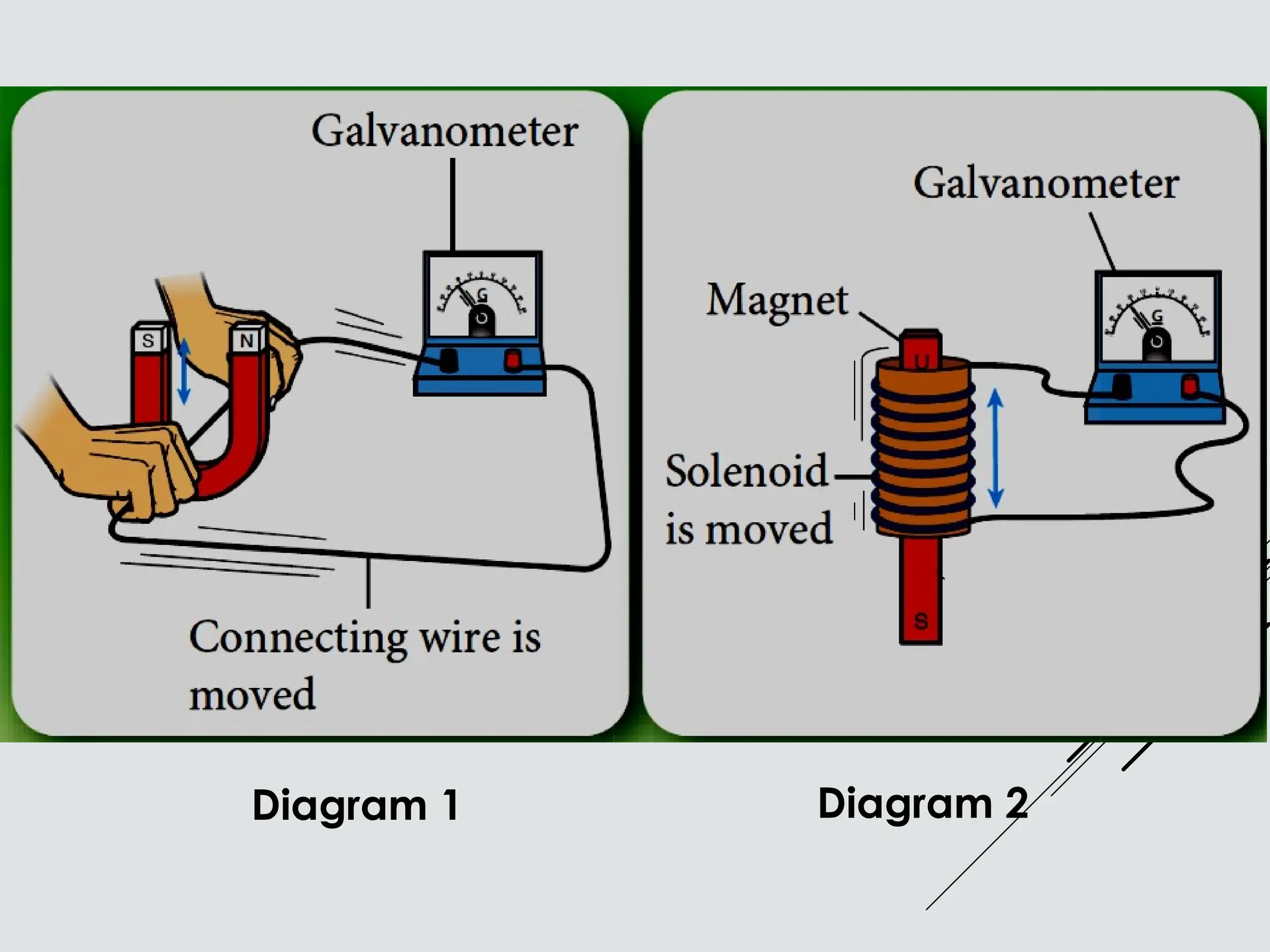
• Movement of the wire which causes the
magnetic field lines to be cut.
A connecting wire or solenoid is moved
rapidly through the space between the
magnetic poles as shown in Diagram 1 and
2. An induced current is produced in the
connecting wire or solenoid, and it flows
through the galvanometer. The pointer in
the galvanometer deflects.
Process Of Generating Electricity
Diagram 1 Diagram 2
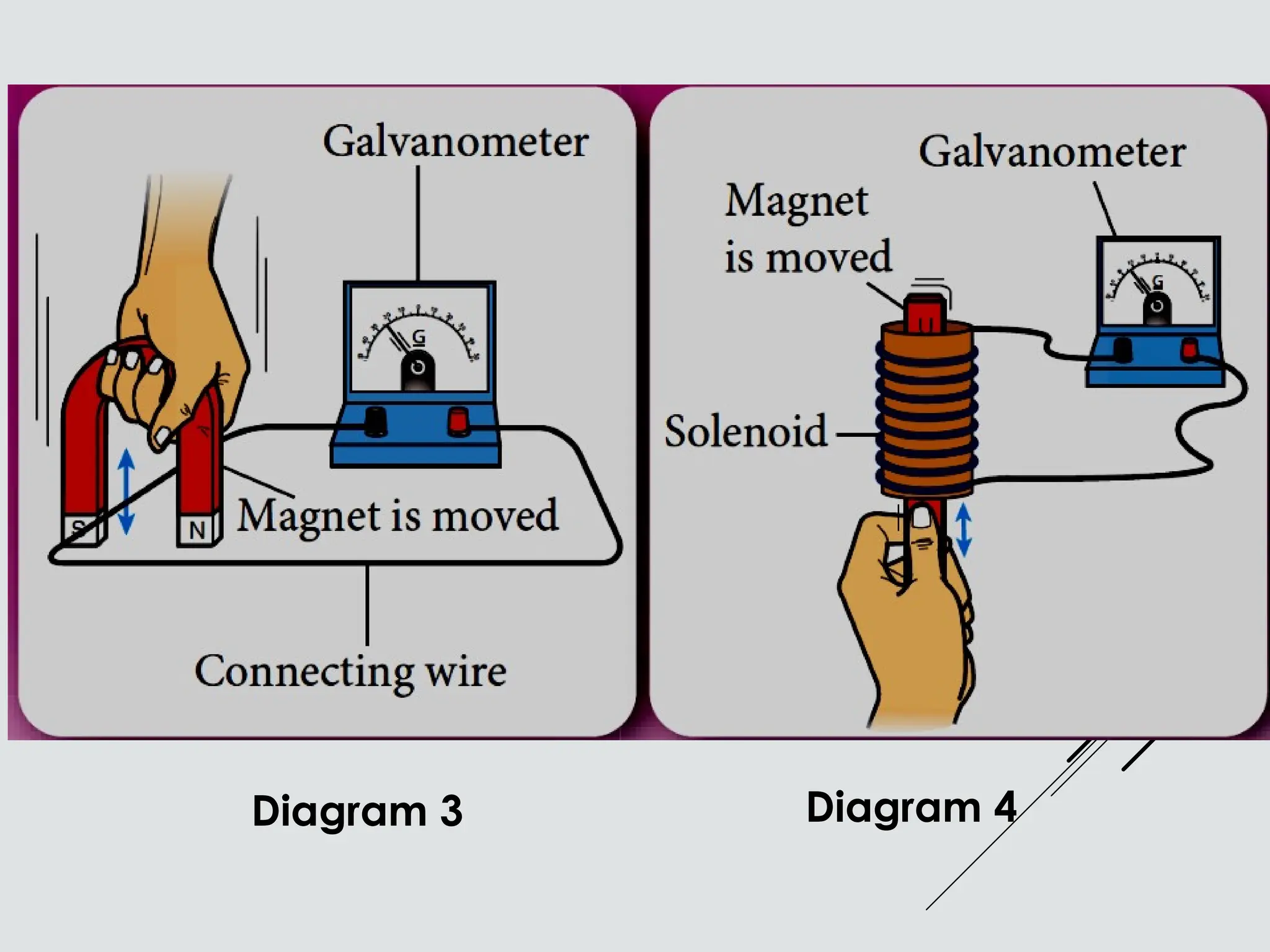
Movement of the magnet which causes the
magnetic field lines to be cut.
A magnet is moved as shown in Diagram 3
and 4 so that the magnetic field lines are
cut by the connecting wire or solenoid. An
induced current is produced in the
connecting wire or solenoid, and it flows
through the galvanometer. The pointer in
the galvanometer deflects.
Diagram 3 Diagram 4
Petroleum or natural gas is burnt to boil water in
a furnace to produce steam
Steam used to
turns a turbine
Dynamo
connected o
turbine
Thermal Generator
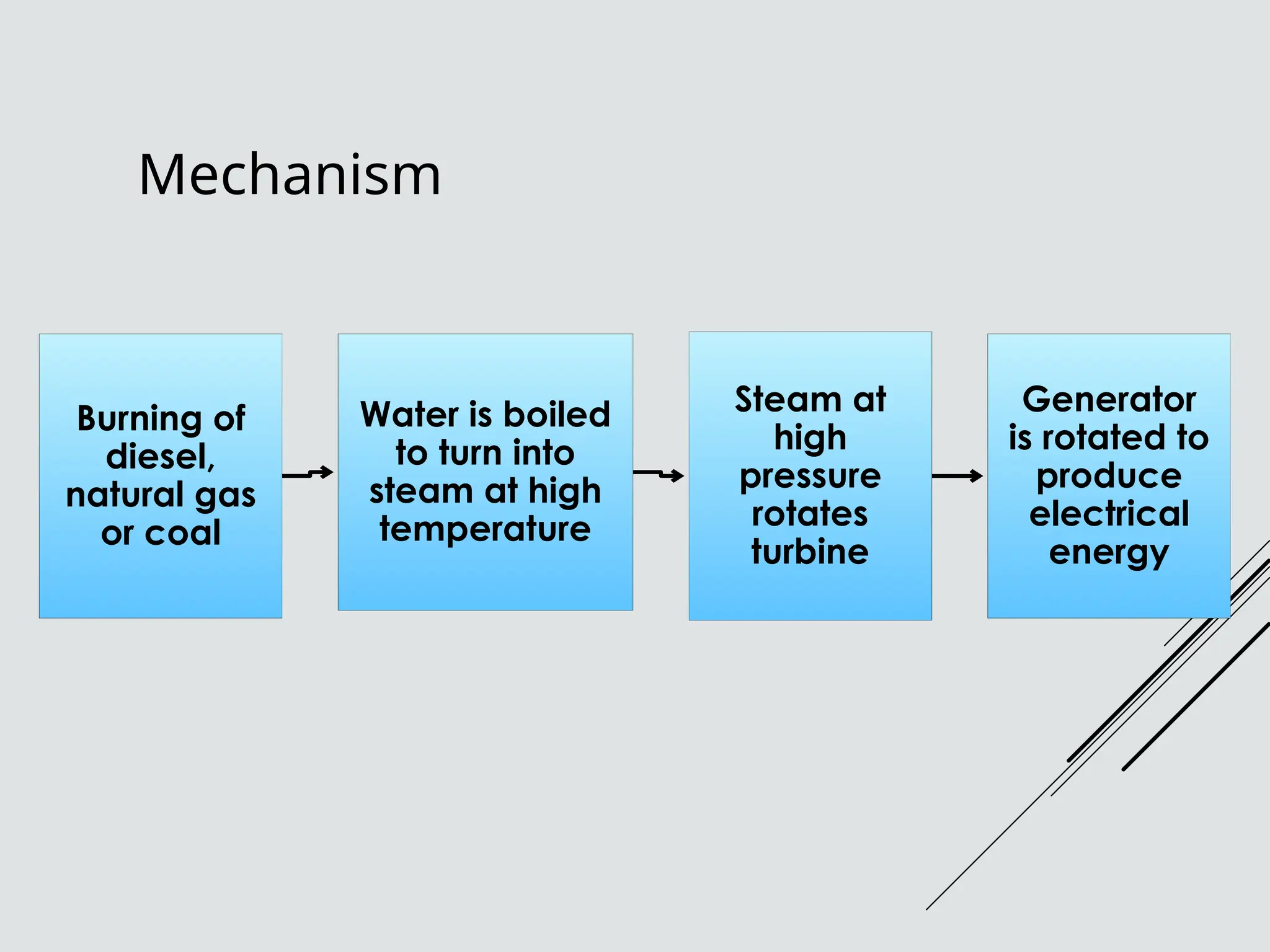
Mechanism
Burning of
diesel,
natural gas
or coal
Water is boiled
to turn into
steam at high
temperature
Steam at
high
pressure
rotates
turbine
Generator
is rotated to
produce
electrical
energy
From
petroleum or
natural gas
Steam consist
of heat energy
Kinetic energy
turns turbine
Electric energy
produced by
dynamo
Energy Change
Chemical
energy
Heat
energy
Kinetic
energy
Electric
energy
Solar Generator
Mechanism
Light from the
Sun’s rays are
absorbed by
solar cells in
solar panels
Solar cells
convert light
into electrical
energy
Energy Change
Light
energy
Electric
energy
From Sun
Hydroelectric Generator
Water from
reservoir
Energy from
the waterfall
turns the
turbine
Turbine turns
the generator
and produced
electric energy
Mechanism
Water
stored in
high
reservoir
flows out
Water flows
from high
level to low
level
Swift flow of
water
rotates
turbine
Generator is
rotated to
produce
electrical
energy
Water reserve in the
dam consist of this
energy
Kinetic energy
from the waterfall
turns the turbine
Electric energy
produced by
dynamo
Energy Change
Potential energy Kinetic energy Electric energy
Wind Turbine
Blade
Generator
Tower
Mechanism
Moving air
or wind
Wind rotates
blade
Blade
rotates
turbine
Generator is
rotated to
produce
electrical
energy
Moving wind
Energy Change
Kinetic energy
Electric
energy
Electric energy
produced by
dynamo
Nuclear Generator
Nuclear energy
produced in
nuclear reactor by
nuclear fision
Heat energy
released to boil
the water to
produced steam
High
pressure
steam turns
the turbine
Generator is
rotated to
produce electric
energy
Mechanism
Nuclear
reaction in
nuclear
reactor
Water is
boiled to turn
into steam at
high pressure
Steam at
high
pressure
rotates
turbine
Generator is
rotated to
produce
electrical
energy
Fision of
radioactive in
nuclear reactor
Released from
nuclear energy
Kinetic energy
turns turbine
Electric energy
produced by
dynamo
Energy Change
Nuclear
energy
Heat
energy
Kinetic
energy
Electric
energy
Biomass
Mechanism
Combustion
of methane
produced by
biomass
Water is
boiled to
turn into
steam at
high
pressure
Steam at
high
pressure
rotates
turbine
Generator
is rotated to
produce
electrical
energy
Wave Power Station
Mechanism
Air pushed out of
the chamber when
the water level in
the chamber rises
Swift flow of air
rotates turbine
Generator is
rotated to
produce
electrical
energy
Energy Change
Kinetic
energy
Electric
energy
Potential
energy
Direct Current And Alternating Current
Electric current is divided into two types,
direct current (d.c.) and alternating
current (a.c.).
Direct Current (D.C.)
Direct current is an electric current that flows
in one direction only. Examples of devices
that use direct current are:
Torchlight
Toy car
Calculator
Examples of generators or sources of
electricity that produce direct current are:
Solar cell
Accumulator
Batteries
Alternating Current (a.c.)
Alternating current is an electric current that flows in
constantly reversing directions. Examples of devices
that use alternating current:
Bread toaster
Air conditioner
Hair dryer
Cathode Ray Oscilloscope (C.R.O.)
Cathode Ray Oscilloscope (C.R.O.) is an electronic
device that is used to show the differences in the
shape of graph, direction of current and voltage
change for direct current and alternating current.
Solving Problems Related to Electrical
Energy Supply in Life
a) By using biogas sources to generate
electricity
 Biogas is a gas that is highly flammable
and is produced when organic matter
such as cow dung decays
 In a biogas generator, cow dung is
collected and is placed into a biogas
fermentation tank.
 The biogas obtained is used to run a
generator in a combustion engine to
produce electricity
b) By building a hydroelectric generator in
a river
 Power stations that use river water to
generate power depend on the
rapidity of the water flowing through
the river.
 Therefore, watermills are built across a
rapidly flowing river.
 The water will turn the turbine which in
turn spins the dynamo. Electricity is
generated.
6.2 Transformers
1. A transformer is a device that changes
the voltage of an alternating current.
2. It is made up of a soft iron core with a coil
of insulated wire on both sides of the core.
3. When alternating current is flowing
through the primary coil, a changing
magnetic field is created continuously.
4. This changing magnetic field induces an
alternating voltage in the secondary coil.
5. Primary coil – receives input voltage,
Secondary coil – produces output voltage.
6. The voltage produced (output voltage)can
either increases or decreases, depends on:
i. The input voltage
ii. The number of turns of the primary and
secondary coil.
7. In a transformer, the voltage is larger on the
side with more turns (wire coil).
8. Types of transformers:
(i) Step -up transformer
(ii) Step- down transformer
9. Differences between step-up and step-
down transformer
Step-up transformer Step-down transformer
Input voltage,Vp 
output voltage, Vs
Input voltage,Vp 
output voltage, Vs
Number of turns in the
primary coil is less than
that
in the secondary coil
Np  Ns
Number of turns in
primary coils is
more than that in the
secondary coil.
Np  Ns
Np
Np
Ns Ns
Solution formula:
𝑉 𝑝
𝑉 𝑠
+
𝑁 𝑝
𝑁 𝑠
Where;
Vp = input voltage of primary coil or primary
voltage
Vs = output voltage of secondary coil or
secondary voltage
Np = number of turns of primary coil
Ns = number of turns of secondary coil
Diagram below shows a 12V bulb connected
to a 240V power source that through a
transformer. What should be the number of
turns in the secondary coil, Ns, for the 12V bulb
to light up with normal brightness?
Solution:
The 12V bulb will light up with normal brightness if it
supplied with voltage of 12V.
- Input voltage, Vp = 240V
- Output voltage, Vs = 12V
- Number of turns in primary coil, Np = 120
According to the formula,
 Ns = 120 X = 6
Number of turns of secondary coil, Ns = 6
𝑁 𝑝
𝑁 𝑠
=
𝑉 𝑝
𝑉 𝑠
120
𝑁 𝑠
=
240
12
12
240
6.3 Transmission and Distribution of
Electricity
1. The components involved in the
electrical power transmission and
distribution system are
a. Power station
b. Step-up transformer station
c. National Grid Network
d. Step-down transformer
e. Substation
2. The generators at a power station
produce alternating current with a
voltage of 11kV or 25kV.
3. This current enters a transformer station.
Here, the voltage is raised to 132kV or
275kV using a step-up transformer.
4. The alternating current then flows through
a network of transmission cables called
the National Grid Network.
5. Then it enters into a regional control and
switching zone. Here, the electrical
power is controlled before it is sent where
and when it is needed. It is also allowing
some stations and lines to be shut down
without cutting off power supply.
6. From this zone, the alternating current
flows through a series of step-down
transformers and switching zones at the
main substation and its branches before
distributing to consumers.
Diagram below shows the electrical energy
transmission and distribution system
The Advantage of the National Grid
Network
The National Grid Network is a network of
cables connecting all the power stations in
the country.
The cables are made up of copper or
aluminium.
Electrical energy from the power stations
can be sent out to any area requiring
without interruption.
The main advantages of the network are:
a) any area requiring additional electric
energy can be supplied by an additional
power.
b) The function of a power station which is
interrupted for maintenance can be
taken over by another power station in
the network.
c) Very large power stations are not
necessary. An area requiring a large
quantity of electrical energy can be
supply by two or more power station in the
network.
Electricity Supply And Wiring System In
Homes
1. Alternating current with a voltage of 240 V is
supplied
to our homes by the live wire.
2. Current is returned to the substation by the
neutral wire.
3. Types of electrical wiring system:
a. Single- phase wiring
b. Three- phase wiring
Single-phase Wiring
This type of wiring is only
suitable and stable enough for
electrical energy usage not
exceeding 10kW or 50A.
Example: the residential areas in
the country side.
Three-phase Wiring
For electrical energy usage
exceeding 10kW or 50A, three-
phase wiring that is more stable
and more reliable is often used.
Example: the commercial and
industrial areas
Supply of Electrical Energy and Home Electrical
Wiring System
5. The Components In The Electrical Wiring System At
Home And Their Functions Are Shown In The Following.
PART FUNCTION
Fuse box Protects a house circuit from damage
caused by a large current or
overloading.
Main switch Controls the amount of current which
flows through the circuit into
the house.
Circuit
breaker
Breaks the circuit by springing out or
tripping its switch when the
current flowing through it exceeds its
rating.
PART FUNCTION
Live wire Carries current at a voltage of 240V from the
local substation to
home.
Neutral wire Returns the current from homes to
substations.
Earth wire Connects an appliance directly to earth as a
safety measure.
Electric
meter
Records the amount of electrical energy that
has been used.
3-pin Plugs
Electrical appliances such as electric irons,
kettles and fans are connected to the power
supply of the house through 3-pin plug.
A 3-pin plug has three-pin. Each pin is
connected to the following wire:
- Live wire (L) which is brown
- Neutral wire (N) which is blue
- Earth wire (E) which has stripes of green &
yellow
3-pin Plug
2-pin Plugs
Electric appliances such as radio,
hair dryer and electric clock are
connected to the home power
supply by 2-pin plug.
Live wire and neutral wire are
connected to the 2-pin plug
The colour code
- The wiring colour code is important to
ensure safety in the application of
electrical appliances
Type of wire International colour
code
Live Brown
Neutral Blue
Earth Yellow with green
stripes
Safety Component in
Home Wiring Systems
Lightning Conductor
Lightning conductor is a safety
component attached to the highest
peak of a building and is connected
directly to earth using thick iron rods
When there is heavy rains with
lightning, the lightning will strike the
lightning conductor on a building and
electric current will flow through the
iron rod that is connected to earth.
Flow the current occurs without any
damage to the building
Functions Of Fuse And Earth Wire
1. Types of fuse:
(a) Cartridge fuse
(b) Replaceable fuse
2. The rating of a fuse is the value of the
maximum current that is allowed to flow
through the fuse without causing its fuse
wire to melt.
3. Some common ratings of fuses are 1A,
2A, 3A, 5A,10A and 13A.
4. A fuse functions as a safety device to
protect the wiring and appliance against
excessive current flow.
5. The fuse has a slightly higher rating than
the magnitude of current which flows in the
appliances.
6. When excessive current flows in a circuit,
the fuse will melt and break the circuit.
7. The earth wire connects the metal part of
electrical appliances to the earth. It
carries the leaked current from the
appliance to earth.
Wire fuse Cartridge fuse
Replaceable
wire fuse
Solid cartridge
fuse Large cartridge
fuse
Glass cartridge
fuse
The Importance Of Safety Precautions In
The Use Of Electrical Energy
Safety Precautions in the Use of Electrical
Energy
1. Do not overloaded electrical sockets
2. Replace old wires with worn out
insulations with new wires
3. Do not touch electrical appliances or
switches with wet hand
4. Do not poke anything into an electric
socket
5. In case of an electrical fire
• switch off the main switch
• use a powder fire extinguisher to put
out the fire
• call the fire brigade
6. In case of a person getting an electric
shock,
• switch off the main switch
• use an insulator such as wood, rubber or
plastic to separate the person from the
source of electric shock
• never touch the person with your bare
hands
• give first aid to the victim
• send the victim to the hospital.
Cost Of Using Electrical Energy
1. Power is the rate of using energy.
2. The S.I. unit for power is watt (W) or joules
per second.
3. Electrical appliances are normally marked
with the power and voltage rating.
4. The unit commonly used for electrical
energy is the kilowatt-hour [kWh].
Cost of electrical energy used = electrical energy used in units X cost per unit
Cost Of Using Electrical Energy
Power =electric energy(J)
Time used (s)
Unit: Watt (W)
1 kilowatt = 1000 W
Cost Of Using Electrical Energy
Electric
appliance
Voltan (V) Power (W)
Stand fan 240 75
Refrigerator 240 103
Washing
machine
240 400
Juice maker 240 300
Electric kettle 220-240 2000-2400
Rice cooker 240 650
Relationship Between Power, Voltage And Current
Current(A) = Power (W)
Voltage (V)
Example:
An electric appliance is 150 W and the
voltage is 250 V. Calculate the electric
current of the electric appliance.
Current(A) = Power (W)
Voltage (V)
Current= 150
250
= 0.6 A
Relationship Between Electric Energy, Power
And Time
Electric energy(kWh) = Power (kW) x Time (h)
Example:
An electric appliance have a power of 1 kW (1000W)
that be used 5 hours. Calculate the electric energy
used.
Electric energy(kWh) = Power (kW) x Time (h)
= 1 x 5
= 5 kWh
The amount of electrical energy used by
electrical appliances depends on:
 Power of the electric appliance
 Duration the electric appliance is being
used
Cost Of Using Electrical Energy
1 kWh = 1 unit energy
Electric energy used (unit) Price rate (RM)
For the first 200 units 0.128
For the next 200 units 0.258
For subsequent additional units 0.278
Example:
The cost of energy usage is as follow:
Calculate the energy cost if 474 units were used.
Electrical energy usage (unit) Unit cost (RM)
For the first 200 units 0.218
For the next 100 units 0.334
For the next 300 units 0.516
200 X 0.218 = RM43.60
100 X 0.334 = RM33.40
174 X 0.516 = RM89.78
Energy cost = RM166.78
Conserving Electrical Energy
• Steps to conserve electrical energy
(a) Turn off the lights that are not in use
(b) Use fluorescent lamps which are more
efficient in lightning
(c) Iron all your clothes at one time
(d) Keep the refrigerator away from heating
appliances such as ovens and do not
open refrigerator door often.
(e) use energy-efficient electric appliances in
homes and offices

science form 3 chapter 6 CHAPTER 6_F3.pptx

  • 1.
  • 2.
    6.1 Generation ofElectrical Energy Various Energy Sources to generate Electrical Energy Source of energy can be divided into two groups which are renewable energy and non-renewable energy
  • 3.
    Energy Sources Renewable energysource Energy source that can be replaced and cannot be depleted Examples: Wind energy Biomass energy Geothermal energy Hydro energy Wave energy Tidal energy Solar energy Non-renewable source Energy source that cannot be replaced and can be depleted Examples: Coal Nuclear energy Natural gas Petroleum such as diesel
  • 4.
    What is electricityand magnetism?  Electricity is the phenomena associated with the presence and motion of electric charge. Magnetism is a force that can attract or repel objects that have a magnetic material like iron.
  • 5.
    Electrical Energy Generators Therenewable energy like wind and non-renewable energy like coal can be used to generate electricity. There are various types of electricity generator, such as thermal generator, hydroelectric generator, biomass generator, nuclear generator and solar energy generator.
  • 6.
    Generally, all theseelectrical energy generators use the same principle of generation. Turbine is rotated The turbine turns the dynamo that is connected to it. The dynamo has a wire coil placed in between a magnet The wire coil cuts across the magnetic lines of force and electric current is produced
  • 7.
    A hydroelectric generatoris only suitable for use in areas that receive rain throughout the year. Nuclear generators are usually found in countries that lack natural fuels such as Japan.
  • 8.
    • Movement ofthe wire which causes the magnetic field lines to be cut. A connecting wire or solenoid is moved rapidly through the space between the magnetic poles as shown in Diagram 1 and 2. An induced current is produced in the connecting wire or solenoid, and it flows through the galvanometer. The pointer in the galvanometer deflects. Process Of Generating Electricity
  • 9.
  • 10.
    Movement of themagnet which causes the magnetic field lines to be cut. A magnet is moved as shown in Diagram 3 and 4 so that the magnetic field lines are cut by the connecting wire or solenoid. An induced current is produced in the connecting wire or solenoid, and it flows through the galvanometer. The pointer in the galvanometer deflects.
  • 11.
  • 12.
    Petroleum or naturalgas is burnt to boil water in a furnace to produce steam Steam used to turns a turbine Dynamo connected o turbine Thermal Generator
  • 13.
    Mechanism Burning of diesel, natural gas orcoal Water is boiled to turn into steam at high temperature Steam at high pressure rotates turbine Generator is rotated to produce electrical energy
  • 14.
    From petroleum or natural gas Steamconsist of heat energy Kinetic energy turns turbine Electric energy produced by dynamo Energy Change Chemical energy Heat energy Kinetic energy Electric energy
  • 15.
  • 16.
    Mechanism Light from the Sun’srays are absorbed by solar cells in solar panels Solar cells convert light into electrical energy
  • 17.
  • 18.
    Hydroelectric Generator Water from reservoir Energyfrom the waterfall turns the turbine Turbine turns the generator and produced electric energy
  • 19.
    Mechanism Water stored in high reservoir flows out Waterflows from high level to low level Swift flow of water rotates turbine Generator is rotated to produce electrical energy
  • 20.
    Water reserve inthe dam consist of this energy Kinetic energy from the waterfall turns the turbine Electric energy produced by dynamo Energy Change Potential energy Kinetic energy Electric energy
  • 21.
  • 22.
    Mechanism Moving air or wind Windrotates blade Blade rotates turbine Generator is rotated to produce electrical energy
  • 23.
    Moving wind Energy Change Kineticenergy Electric energy Electric energy produced by dynamo
  • 24.
    Nuclear Generator Nuclear energy producedin nuclear reactor by nuclear fision Heat energy released to boil the water to produced steam High pressure steam turns the turbine Generator is rotated to produce electric energy
  • 25.
    Mechanism Nuclear reaction in nuclear reactor Water is boiledto turn into steam at high pressure Steam at high pressure rotates turbine Generator is rotated to produce electrical energy
  • 26.
    Fision of radioactive in nuclearreactor Released from nuclear energy Kinetic energy turns turbine Electric energy produced by dynamo Energy Change Nuclear energy Heat energy Kinetic energy Electric energy
  • 27.
  • 28.
    Mechanism Combustion of methane produced by biomass Wateris boiled to turn into steam at high pressure Steam at high pressure rotates turbine Generator is rotated to produce electrical energy
  • 29.
  • 30.
    Mechanism Air pushed outof the chamber when the water level in the chamber rises Swift flow of air rotates turbine Generator is rotated to produce electrical energy
  • 31.
  • 32.
    Direct Current AndAlternating Current Electric current is divided into two types, direct current (d.c.) and alternating current (a.c.).
  • 33.
    Direct Current (D.C.) Directcurrent is an electric current that flows in one direction only. Examples of devices that use direct current are: Torchlight Toy car Calculator
  • 34.
    Examples of generatorsor sources of electricity that produce direct current are: Solar cell Accumulator Batteries
  • 35.
    Alternating Current (a.c.) Alternatingcurrent is an electric current that flows in constantly reversing directions. Examples of devices that use alternating current: Bread toaster Air conditioner Hair dryer
  • 36.
    Cathode Ray Oscilloscope(C.R.O.) Cathode Ray Oscilloscope (C.R.O.) is an electronic device that is used to show the differences in the shape of graph, direction of current and voltage change for direct current and alternating current.
  • 39.
    Solving Problems Relatedto Electrical Energy Supply in Life a) By using biogas sources to generate electricity  Biogas is a gas that is highly flammable and is produced when organic matter such as cow dung decays  In a biogas generator, cow dung is collected and is placed into a biogas fermentation tank.  The biogas obtained is used to run a generator in a combustion engine to produce electricity
  • 40.
    b) By buildinga hydroelectric generator in a river  Power stations that use river water to generate power depend on the rapidity of the water flowing through the river.  Therefore, watermills are built across a rapidly flowing river.  The water will turn the turbine which in turn spins the dynamo. Electricity is generated.
  • 41.
    6.2 Transformers 1. Atransformer is a device that changes the voltage of an alternating current. 2. It is made up of a soft iron core with a coil of insulated wire on both sides of the core. 3. When alternating current is flowing through the primary coil, a changing magnetic field is created continuously. 4. This changing magnetic field induces an alternating voltage in the secondary coil.
  • 42.
    5. Primary coil– receives input voltage, Secondary coil – produces output voltage. 6. The voltage produced (output voltage)can either increases or decreases, depends on: i. The input voltage ii. The number of turns of the primary and secondary coil. 7. In a transformer, the voltage is larger on the side with more turns (wire coil).
  • 43.
    8. Types oftransformers: (i) Step -up transformer (ii) Step- down transformer 9. Differences between step-up and step- down transformer
  • 44.
    Step-up transformer Step-downtransformer Input voltage,Vp  output voltage, Vs Input voltage,Vp  output voltage, Vs Number of turns in the primary coil is less than that in the secondary coil Np  Ns Number of turns in primary coils is more than that in the secondary coil. Np  Ns Np Np Ns Ns
  • 46.
    Solution formula: 𝑉 𝑝 𝑉𝑠 + 𝑁 𝑝 𝑁 𝑠 Where; Vp = input voltage of primary coil or primary voltage Vs = output voltage of secondary coil or secondary voltage Np = number of turns of primary coil Ns = number of turns of secondary coil
  • 47.
    Diagram below showsa 12V bulb connected to a 240V power source that through a transformer. What should be the number of turns in the secondary coil, Ns, for the 12V bulb to light up with normal brightness?
  • 48.
    Solution: The 12V bulbwill light up with normal brightness if it supplied with voltage of 12V. - Input voltage, Vp = 240V - Output voltage, Vs = 12V - Number of turns in primary coil, Np = 120 According to the formula,  Ns = 120 X = 6 Number of turns of secondary coil, Ns = 6 𝑁 𝑝 𝑁 𝑠 = 𝑉 𝑝 𝑉 𝑠 120 𝑁 𝑠 = 240 12 12 240
  • 49.
    6.3 Transmission andDistribution of Electricity 1. The components involved in the electrical power transmission and distribution system are a. Power station b. Step-up transformer station c. National Grid Network d. Step-down transformer e. Substation
  • 50.
    2. The generatorsat a power station produce alternating current with a voltage of 11kV or 25kV. 3. This current enters a transformer station. Here, the voltage is raised to 132kV or 275kV using a step-up transformer. 4. The alternating current then flows through a network of transmission cables called the National Grid Network.
  • 51.
    5. Then itenters into a regional control and switching zone. Here, the electrical power is controlled before it is sent where and when it is needed. It is also allowing some stations and lines to be shut down without cutting off power supply. 6. From this zone, the alternating current flows through a series of step-down transformers and switching zones at the main substation and its branches before distributing to consumers.
  • 52.
    Diagram below showsthe electrical energy transmission and distribution system
  • 53.
    The Advantage ofthe National Grid Network The National Grid Network is a network of cables connecting all the power stations in the country. The cables are made up of copper or aluminium. Electrical energy from the power stations can be sent out to any area requiring without interruption.
  • 54.
    The main advantagesof the network are: a) any area requiring additional electric energy can be supplied by an additional power. b) The function of a power station which is interrupted for maintenance can be taken over by another power station in the network. c) Very large power stations are not necessary. An area requiring a large quantity of electrical energy can be supply by two or more power station in the network.
  • 56.
    Electricity Supply AndWiring System In Homes 1. Alternating current with a voltage of 240 V is supplied to our homes by the live wire. 2. Current is returned to the substation by the neutral wire. 3. Types of electrical wiring system: a. Single- phase wiring b. Three- phase wiring
  • 57.
    Single-phase Wiring This typeof wiring is only suitable and stable enough for electrical energy usage not exceeding 10kW or 50A. Example: the residential areas in the country side.
  • 58.
    Three-phase Wiring For electricalenergy usage exceeding 10kW or 50A, three- phase wiring that is more stable and more reliable is often used. Example: the commercial and industrial areas
  • 59.
    Supply of ElectricalEnergy and Home Electrical Wiring System
  • 60.
    5. The ComponentsIn The Electrical Wiring System At Home And Their Functions Are Shown In The Following. PART FUNCTION Fuse box Protects a house circuit from damage caused by a large current or overloading. Main switch Controls the amount of current which flows through the circuit into the house. Circuit breaker Breaks the circuit by springing out or tripping its switch when the current flowing through it exceeds its rating.
  • 61.
    PART FUNCTION Live wireCarries current at a voltage of 240V from the local substation to home. Neutral wire Returns the current from homes to substations. Earth wire Connects an appliance directly to earth as a safety measure. Electric meter Records the amount of electrical energy that has been used.
  • 62.
    3-pin Plugs Electrical appliancessuch as electric irons, kettles and fans are connected to the power supply of the house through 3-pin plug. A 3-pin plug has three-pin. Each pin is connected to the following wire: - Live wire (L) which is brown - Neutral wire (N) which is blue - Earth wire (E) which has stripes of green & yellow
  • 63.
  • 64.
    2-pin Plugs Electric appliancessuch as radio, hair dryer and electric clock are connected to the home power supply by 2-pin plug. Live wire and neutral wire are connected to the 2-pin plug
  • 65.
    The colour code -The wiring colour code is important to ensure safety in the application of electrical appliances Type of wire International colour code Live Brown Neutral Blue Earth Yellow with green stripes
  • 66.
  • 67.
    Lightning Conductor Lightning conductoris a safety component attached to the highest peak of a building and is connected directly to earth using thick iron rods When there is heavy rains with lightning, the lightning will strike the lightning conductor on a building and electric current will flow through the iron rod that is connected to earth. Flow the current occurs without any damage to the building
  • 70.
    Functions Of FuseAnd Earth Wire 1. Types of fuse: (a) Cartridge fuse (b) Replaceable fuse 2. The rating of a fuse is the value of the maximum current that is allowed to flow through the fuse without causing its fuse wire to melt. 3. Some common ratings of fuses are 1A, 2A, 3A, 5A,10A and 13A.
  • 71.
    4. A fusefunctions as a safety device to protect the wiring and appliance against excessive current flow. 5. The fuse has a slightly higher rating than the magnitude of current which flows in the appliances.
  • 72.
    6. When excessivecurrent flows in a circuit, the fuse will melt and break the circuit. 7. The earth wire connects the metal part of electrical appliances to the earth. It carries the leaked current from the appliance to earth.
  • 73.
    Wire fuse Cartridgefuse Replaceable wire fuse Solid cartridge fuse Large cartridge fuse Glass cartridge fuse
  • 74.
    The Importance OfSafety Precautions In The Use Of Electrical Energy Safety Precautions in the Use of Electrical Energy 1. Do not overloaded electrical sockets 2. Replace old wires with worn out insulations with new wires 3. Do not touch electrical appliances or switches with wet hand 4. Do not poke anything into an electric socket
  • 75.
    5. In caseof an electrical fire • switch off the main switch • use a powder fire extinguisher to put out the fire • call the fire brigade
  • 76.
    6. In caseof a person getting an electric shock, • switch off the main switch • use an insulator such as wood, rubber or plastic to separate the person from the source of electric shock • never touch the person with your bare hands • give first aid to the victim • send the victim to the hospital.
  • 77.
    Cost Of UsingElectrical Energy 1. Power is the rate of using energy. 2. The S.I. unit for power is watt (W) or joules per second. 3. Electrical appliances are normally marked with the power and voltage rating.
  • 78.
    4. The unitcommonly used for electrical energy is the kilowatt-hour [kWh]. Cost of electrical energy used = electrical energy used in units X cost per unit
  • 79.
    Cost Of UsingElectrical Energy Power =electric energy(J) Time used (s) Unit: Watt (W) 1 kilowatt = 1000 W
  • 80.
    Cost Of UsingElectrical Energy Electric appliance Voltan (V) Power (W) Stand fan 240 75 Refrigerator 240 103 Washing machine 240 400 Juice maker 240 300 Electric kettle 220-240 2000-2400 Rice cooker 240 650
  • 81.
    Relationship Between Power,Voltage And Current Current(A) = Power (W) Voltage (V) Example: An electric appliance is 150 W and the voltage is 250 V. Calculate the electric current of the electric appliance. Current(A) = Power (W) Voltage (V) Current= 150 250 = 0.6 A
  • 82.
    Relationship Between ElectricEnergy, Power And Time Electric energy(kWh) = Power (kW) x Time (h) Example: An electric appliance have a power of 1 kW (1000W) that be used 5 hours. Calculate the electric energy used. Electric energy(kWh) = Power (kW) x Time (h) = 1 x 5 = 5 kWh
  • 83.
    The amount ofelectrical energy used by electrical appliances depends on:  Power of the electric appliance  Duration the electric appliance is being used Cost Of Using Electrical Energy 1 kWh = 1 unit energy Electric energy used (unit) Price rate (RM) For the first 200 units 0.128 For the next 200 units 0.258 For subsequent additional units 0.278
  • 85.
    Example: The cost ofenergy usage is as follow: Calculate the energy cost if 474 units were used. Electrical energy usage (unit) Unit cost (RM) For the first 200 units 0.218 For the next 100 units 0.334 For the next 300 units 0.516 200 X 0.218 = RM43.60 100 X 0.334 = RM33.40 174 X 0.516 = RM89.78 Energy cost = RM166.78
  • 86.
    Conserving Electrical Energy •Steps to conserve electrical energy (a) Turn off the lights that are not in use (b) Use fluorescent lamps which are more efficient in lightning (c) Iron all your clothes at one time (d) Keep the refrigerator away from heating appliances such as ovens and do not open refrigerator door often. (e) use energy-efficient electric appliances in homes and offices