ELECTRICITY REVISION
Basic elements in an electric circuit:
  Components that produce electric current (e.c.)
  Components that conduct an e.c.
  Components that transform an e.c.
  Components that control the flow of e.c.
Basic electric magnitudes:
  Voltage
  Intensity
  Resistance
Ohm's Law
                                  Dpto. Tecnoloxía, IES de Pastoriza, Arteixo
ELECTRICITY REVISION
Components that produce e.c.:
  Batteries and generators
Components that conduct an e.c.:
  Wires of conductor materials.
Components that transform an e.c.:
  Electric motor, light bulb, electric fire, resistors
Components that control the flow of e.c.:
  Switches, circuit switches, push button N.O. and
  N.C.

                                      Dpto. Tecnoloxía, IES de Pastoriza, Arteixo
ELECTRICITY REVISION
Basic magnitudes :
 MAGNITUDE         DEFINITION                    UNITS

             Opposition that materials OHMS (Ω)
RESISTANCE   offer to electric current KΩ = 1000 Ω = 10 3 Ω
             flow.                     MΩ = 1000000Ω = 106 Ω

             Number of charges that
                                       AMPS (A)
INTENSITY    go through the section of
                                       mA = 0,001A = 10-3A
             a conductor per unit of
                                       μA= 0,000001A = 10-6A
             time.
                                       VOLTS (V)
             Energy         difference
                                       KV = 1000V = 103 V
VOLTAGE      between both of the
                                       MV= 1000000V
             extremes of a conductor.


                                              Dpto. Tecnoloxía, IES de Pastoriza, Arteixo
ELECTRICITY REVISION
         RESISTORS
There are 2 types:

    fixed resistors:

    variable resistors:

        fixed resistor    Potentiometers


                            Dpto. Tecnoloxía, IES de Pastoriza, Arteixo
ELECTRICITY REVISION
         RESISTORS
Fixed resistors:

  These resistors have a fixed value represented by a
  colour code that we can observe over their surface.

  The most common are those of coal, they are small
  cylinders of graphite recovered with a film of paint
  and they have two terminals to connect them.


                                  Dpto. Tecnoloxía, IES de Pastoriza, Arteixo
VARIABLE RESISTORS
       POTENTIOMETERS
Its value can be changed with a cursor or turning an
axle.
The resistance varies from 0 ohms to a maximum
value indicated at potentiometer
Applications
  Thermostat of a heating
  Volume control of a radio


                                   Dpto. Tecnoloxía, IES de Pastoriza, Arteixo
ELECTRICITY REVISION
             Ohm's law

Ohm's law relates the intensity that flows through a
conductor whith its resistance and the applied voltage.

                         V
                      I= ―
                         R


                                      Dpto. Tecnoloxía, IES de Pastoriza, Arteixo
SERIES CIRCUITS
They are circuits where components are connected
one behind the other.

There is a different tension in each component, but
through all circulates the same intensity.

Resolution:

R e = R1 + R2 + R3 + … = ΣR


                               Dpto. Tecnoloxía, IES de Pastoriza, Arteixo
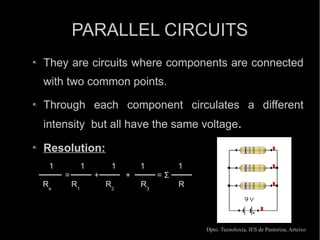
PARALLEL CIRCUITS
They are circuits where components are connected
with two common points.

Through each component circulates a different
intensity but all have the same voltage.

Resolution:
 1            1        1       1         1
     =            +        +        =Σ
Re       R1           R2       R3        R


                                             Dpto. Tecnoloxía, IES de Pastoriza, Arteixo
MIXED CIRCUITS
They are circuits that have components connected
either in series or in parallel.


Resolution:

There is not an only way to solve these circuits.
We have to calculate equivalent resistances by
sections.
                                   Dpto. Tecnoloxía, IES de Pastoriza, Arteixo
POWER AND ENERGY
Power is the electric magnitude that measures the
consumed energy per unit of time.

We represent it by P and it is measured in watts
(W).

If in a component circulates an intensity I and it is
fed with a voltage V, then, the power that consumes
it is calculated like:

                         P=V·I
                                 Dpto. Tecnoloxía, IES de Pastoriza, Arteixo
POWER AND ENERGY
Power is a characteristic of all electrical devices.
All electrical appliances present the relation of their
electrical characteristics. We refer to that like
nameplate.


                                                    Frecuency
Voltage


                                                       Power
                                      Dpto. Tecnoloxía, IES de Pastoriza, Arteixo
POWER AND ENERGY
Energy consumed by an electrical device is
determined by its power and the time in which it is
running:
                        E= P·t
Consumed electrical energy it is measured in W·s or in
KW·h
If an electrical appliance is has a voltage of 230 V and
consumes 640 W, then we can calculate its resistance
like: R=V2/P
Then R = 2302/640 = 82,65 Ω

                                    Dpto. Tecnoloxía, IES de Pastoriza, Arteixo
POWER AND ENERGY
The consume in the electric bill is measured in
kWh (power in kW and time in hours)
If we multiply by the price of a kWh, we obtain
the cost of use of that electrical appliance.
Example: The cost of use of a hairdryer of 2200
W running during 30 minutes is
P = 2200 W = 2,2 kW
t = 30 min = 0,5 h
E = P.t = 2,2 . 0,5 = 1,1 kWh (consumed energy)
If the price of a kWh is 0.12 €, then the cost is: 1,1 x 0,12 = 0,13 €

                                                    Dpto. Tecnoloxía, IES de Pastoriza, Arteixo

Electricity

  • 1.
    ELECTRICITY REVISION Basic elementsin an electric circuit: Components that produce electric current (e.c.) Components that conduct an e.c. Components that transform an e.c. Components that control the flow of e.c. Basic electric magnitudes: Voltage Intensity Resistance Ohm's Law Dpto. Tecnoloxía, IES de Pastoriza, Arteixo
  • 2.
    ELECTRICITY REVISION Components thatproduce e.c.: Batteries and generators Components that conduct an e.c.: Wires of conductor materials. Components that transform an e.c.: Electric motor, light bulb, electric fire, resistors Components that control the flow of e.c.: Switches, circuit switches, push button N.O. and N.C. Dpto. Tecnoloxía, IES de Pastoriza, Arteixo
  • 3.
    ELECTRICITY REVISION Basic magnitudes: MAGNITUDE DEFINITION UNITS Opposition that materials OHMS (Ω) RESISTANCE offer to electric current KΩ = 1000 Ω = 10 3 Ω flow. MΩ = 1000000Ω = 106 Ω Number of charges that AMPS (A) INTENSITY go through the section of mA = 0,001A = 10-3A a conductor per unit of μA= 0,000001A = 10-6A time. VOLTS (V) Energy difference KV = 1000V = 103 V VOLTAGE between both of the MV= 1000000V extremes of a conductor. Dpto. Tecnoloxía, IES de Pastoriza, Arteixo
  • 4.
    ELECTRICITY REVISION RESISTORS There are 2 types: fixed resistors: variable resistors: fixed resistor Potentiometers Dpto. Tecnoloxía, IES de Pastoriza, Arteixo
  • 5.
    ELECTRICITY REVISION RESISTORS Fixed resistors: These resistors have a fixed value represented by a colour code that we can observe over their surface. The most common are those of coal, they are small cylinders of graphite recovered with a film of paint and they have two terminals to connect them. Dpto. Tecnoloxía, IES de Pastoriza, Arteixo
  • 6.
    VARIABLE RESISTORS POTENTIOMETERS Its value can be changed with a cursor or turning an axle. The resistance varies from 0 ohms to a maximum value indicated at potentiometer Applications Thermostat of a heating Volume control of a radio Dpto. Tecnoloxía, IES de Pastoriza, Arteixo
  • 7.
    ELECTRICITY REVISION Ohm's law Ohm's law relates the intensity that flows through a conductor whith its resistance and the applied voltage. V I= ― R Dpto. Tecnoloxía, IES de Pastoriza, Arteixo
  • 8.
    SERIES CIRCUITS They arecircuits where components are connected one behind the other. There is a different tension in each component, but through all circulates the same intensity. Resolution: R e = R1 + R2 + R3 + … = ΣR Dpto. Tecnoloxía, IES de Pastoriza, Arteixo
  • 9.
    PARALLEL CIRCUITS They arecircuits where components are connected with two common points. Through each component circulates a different intensity but all have the same voltage. Resolution: 1 1 1 1 1 = + + =Σ Re R1 R2 R3 R Dpto. Tecnoloxía, IES de Pastoriza, Arteixo
  • 10.
    MIXED CIRCUITS They arecircuits that have components connected either in series or in parallel. Resolution: There is not an only way to solve these circuits. We have to calculate equivalent resistances by sections. Dpto. Tecnoloxía, IES de Pastoriza, Arteixo
  • 11.
    POWER AND ENERGY Poweris the electric magnitude that measures the consumed energy per unit of time. We represent it by P and it is measured in watts (W). If in a component circulates an intensity I and it is fed with a voltage V, then, the power that consumes it is calculated like: P=V·I Dpto. Tecnoloxía, IES de Pastoriza, Arteixo
  • 12.
    POWER AND ENERGY Poweris a characteristic of all electrical devices. All electrical appliances present the relation of their electrical characteristics. We refer to that like nameplate. Frecuency Voltage Power Dpto. Tecnoloxía, IES de Pastoriza, Arteixo
  • 13.
    POWER AND ENERGY Energyconsumed by an electrical device is determined by its power and the time in which it is running: E= P·t Consumed electrical energy it is measured in W·s or in KW·h If an electrical appliance is has a voltage of 230 V and consumes 640 W, then we can calculate its resistance like: R=V2/P Then R = 2302/640 = 82,65 Ω Dpto. Tecnoloxía, IES de Pastoriza, Arteixo
  • 14.
    POWER AND ENERGY Theconsume in the electric bill is measured in kWh (power in kW and time in hours) If we multiply by the price of a kWh, we obtain the cost of use of that electrical appliance. Example: The cost of use of a hairdryer of 2200 W running during 30 minutes is P = 2200 W = 2,2 kW t = 30 min = 0,5 h E = P.t = 2,2 . 0,5 = 1,1 kWh (consumed energy) If the price of a kWh is 0.12 €, then the cost is: 1,1 x 0,12 = 0,13 € Dpto. Tecnoloxía, IES de Pastoriza, Arteixo