TRANSFORMERS
FUNDAMENTALS
NYU EE 3824 ENERGY
CONVERSION SYSTEMS
INSTRUCTOR Prof. Z. Jan Bochynski
1/12/2023 Prof. Z. Jan Bochynski 1
Transformers in a Power Grid
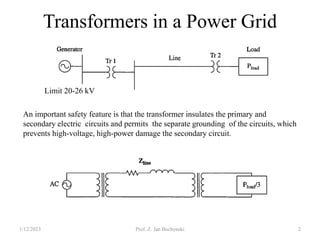
An important safety feature is that the transformer insulates the primary and
secondary electric circuits and permits the separate grounding of the circuits, which
prevents high-voltage, high-power damage the secondary circuit.
Limit 20-26 kV
1/12/2023 Prof. Z. Jan Bochynski 2
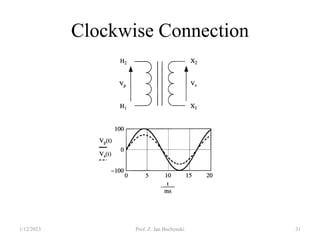
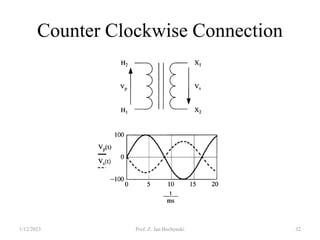
Transformers Polarity
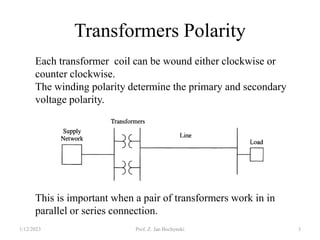
Each transformer coil can be wound either clockwise or
counter clockwise.
The winding polarity determine the primary and secondary
voltage polarity.
This is important when a pair of transformers work in in
parallel or series connection.
1/12/2023 Prof. Z. Jan Bochynski 3
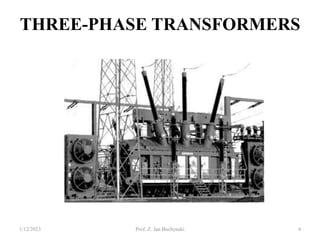
THREE-PHASE TRANSFORMERS
1/12/2023 Prof. Z. Jan Bochynski 4
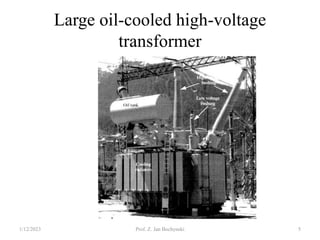
Large oil-cooled high-voltage
transformer
1/12/2023 Prof. Z. Jan Bochynski 5
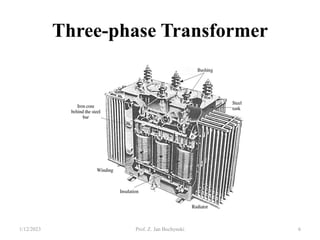
Three-phase Transformer
1/12/2023 Prof. Z. Jan Bochynski 6
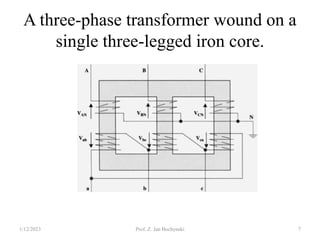
A three-phase transformer wound on a
single three-legged iron core.
1/12/2023 Prof. Z. Jan Bochynski 7
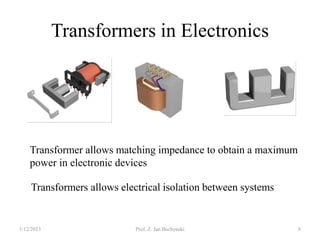
Transformers in Electronics
1/12/2023 Prof. Z. Jan Bochynski 8
Transformer allows matching impedance to obtain a maximum
power in electronic devices
Transformers allows electrical isolation between systems
TRANSFORMER PROPERTIES
1/12/2023 Prof. Z. Jan Bochynski 9
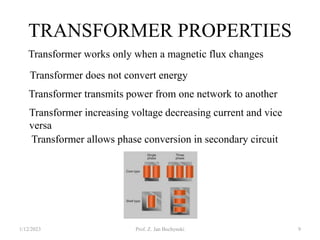
Transformer works only when a magnetic flux changes
Transformer does not convert energy
Transformer transmits power from one network to another
Transformer increasing voltage decreasing current and vice
versa
Transformer allows phase conversion in secondary circuit
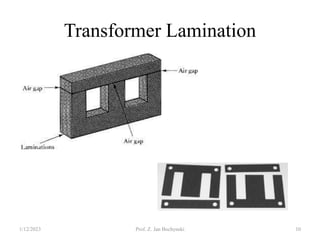
Transformer Lamination
1/12/2023 Prof. Z. Jan Bochynski 10
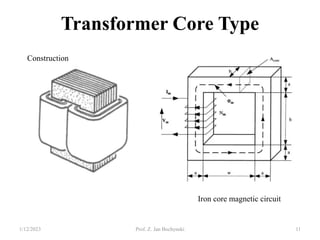
Transformer Core Type
Construction
Iron core magnetic circuit
1/12/2023 Prof. Z. Jan Bochynski 11
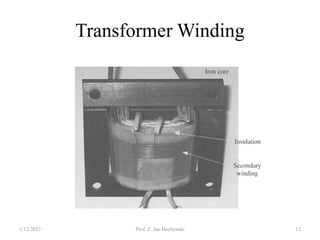
Transformer Winding
1/12/2023 Prof. Z. Jan Bochynski 12
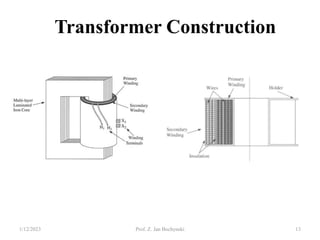
Transformer Construction
1/12/2023 Prof. Z. Jan Bochynski 13
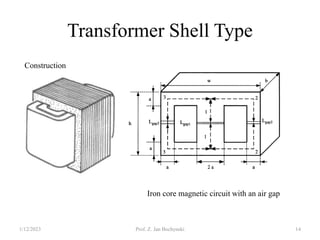
Transformer Shell Type
Construction
Iron core magnetic circuit with an air gap
1/12/2023 Prof. Z. Jan Bochynski 14
H1
H2
X1
X2
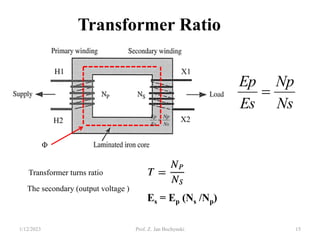
Transformer Ratio
Transformer turns ratio
Ns
Np
Es
Ep

Ns
Np
Es
Ep

1/12/2023 Prof. Z. Jan Bochynski 15
Φ
Es = Ep (Ns /Np)
The secondary (output voltage )
Power, Currents, Voltage, Flux
1/12/2023 Prof. Z. Jan Bochynski 16
]
[
44
.
4
4
11
.
1 V
N
f
N
f
E m
m
rms 







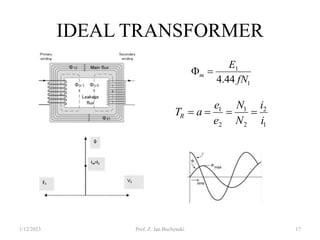
IDEAL TRANSFORMER
1/12/2023 Prof. Z. Jan Bochynski 17

m 
E1
4.44 fN1

TR  a 
e1
e2

N1
N2

i2
i1
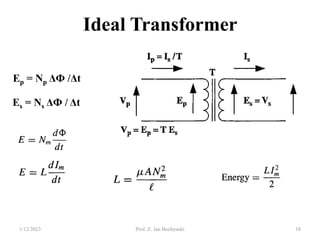
Ideal Transformer
Es = Ns ΔФ / Δt
Ep = Np ΔФ /Δt
1/12/2023 Prof. Z. Jan Bochynski 18
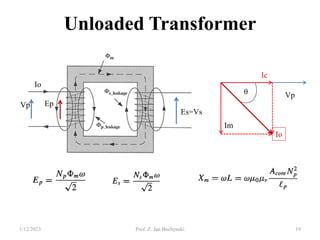
Unloaded Transformer
Vp
Ic
Im
Io
θ
Io
Vp Ep
Es=Vs
1/12/2023 Prof. Z. Jan Bochynski 19
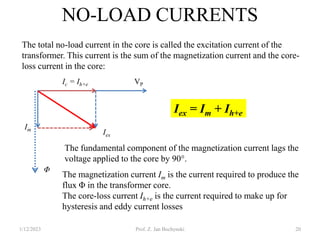
NO-LOAD CURRENTS
1/12/2023 Prof. Z. Jan Bochynski 20
Iex
Ic = Ih+e VP
Im
Φ
The magnetization current Im is the current required to produce the
flux Φ in the transformer core.
The core-loss current Ih+e is the current required to make up for
hysteresis and eddy current losses
The fundamental component of the magnetization current lags the
voltage applied to the core by 90°.
The total no-load current in the core is called the excitation current of the
transformer. This current is the sum of the magnetization current and the core-
loss current in the core:
Iex = Im + Ih+e
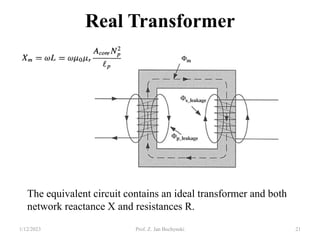
Real Transformer
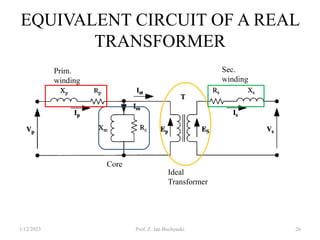
The equivalent circuit contains an ideal transformer and both
network reactance X and resistances R.
1/12/2023 Prof. Z. Jan Bochynski 21
PARTS OF REAL TRANSFORMER
1/12/2023 Prof. Z. Jan Bochynski 22
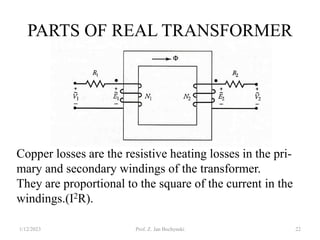
Copper losses are the resistive heating losses in the pri-
mary and secondary windings of the transformer.
They are proportional to the square of the current in the
windings.(I2R).
REAL TRANSFORMER
1/12/2023 Prof. Z. Jan Bochynski 23
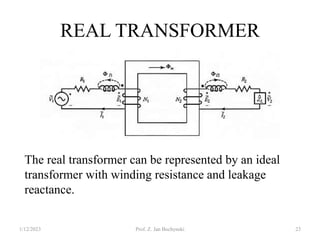
The real transformer can be represented by an ideal
transformer with winding resistance and leakage
reactance.
Loaded Transformer
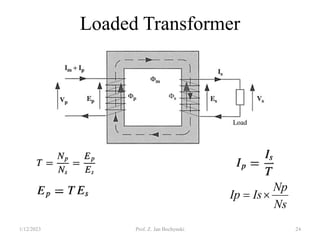
Ns
Np
Is
Ip 

1/12/2023 Prof. Z. Jan Bochynski 24
LEAKAGE FLUXES
1/12/2023 Prof. Z. Jan Bochynski 25
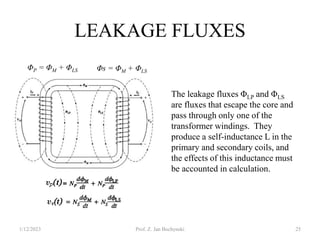
The leakage fluxes ΦLP and ΦLS
are fluxes that escape the core and
pass through only one of the
transformer windings. They
produce a self-inductance L in the
primary and secondary coils, and
the effects of this inductance must
be accounted in calculation.
Φs = ΦM + ΦLS
ΦP = ΦM + ΦLS
EQUIVALENT CIRCUIT OF A REAL
TRANSFORMER
1/12/2023 Prof. Z. Jan Bochynski 26
Ideal
Transformer
Sec.
winding
Prim.
winding
Core
Real Transformer Equivalent Circuit
Ep =4.44 Фm f Np [V]
Es = 4.44 Фm f Ns [V]
Ф (Wb), f (Hz)
Ep = Vp + ΔVp = Vp + (IoRp + Io Xp )
Vp = Ep - ΔVp = Ep + (IoRp + Io Xp )
1/12/2023 Prof. Z. Jan Bochynski 27
TRANSFORMER MODEL REFERRED
TO ITS PRIMARY VOLTAGE LEVEL
1/12/2023 Prof. Z. Jan Bochynski 28
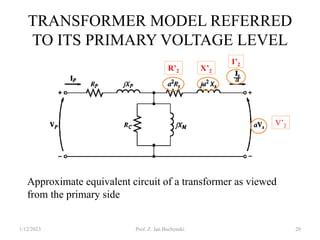
Approximate equivalent circuit of a transformer as viewed
from the primary side
R’2 X’2
I’2
V’2
TRANSFORMER MODEL REFLECTED
TO ITS SECONDARY VOLTAGE LEVEL
1/12/2023 Prof. Z. Jan Bochynski 29
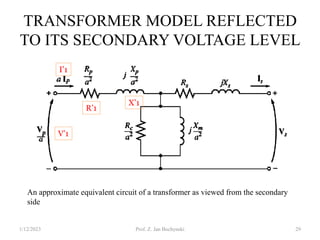
An approximate equivalent circuit of a transformer as viewed from the secondary
side
R’1
X’1
I’1
V’1
APPROXIMATE EQUIVALENT
TRANSFORMER CIRCUIT
1/12/2023 Prof. Z. Jan Bochynski 30
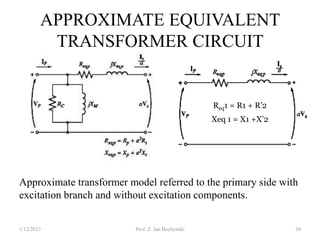
Approximate transformer model referred to the primary side with
excitation branch and without excitation components.
Req1 = R1 + R’2
Xeq 1 = X1 +X’2
Clockwise Connection
1/12/2023 Prof. Z. Jan Bochynski 31
Counter Clockwise Connection
1/12/2023 Prof. Z. Jan Bochynski 32
Transformer with Center -Tapped
Secondary Windings
1/12/2023 Prof. Z. Jan Bochynski 33
Two Secondary Windings Transformer
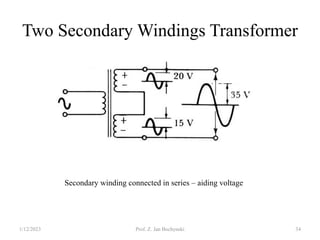
Secondary winding connected in series – aiding voltage
1/12/2023 Prof. Z. Jan Bochynski 34
Two Secondary Winding Transformer
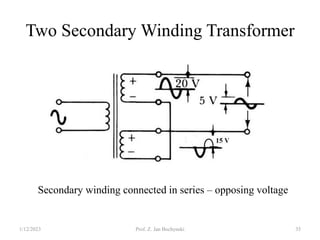
Secondary winding connected in series – opposing voltage
1/12/2023 Prof. Z. Jan Bochynski 35
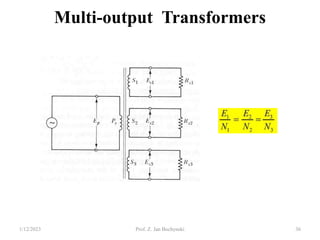
Multi-output Transformers
1/12/2023 Prof. Z. Jan Bochynski 36
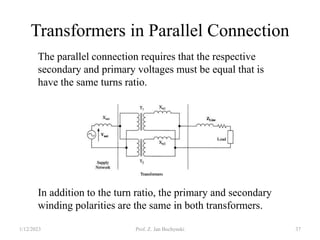
Transformers in Parallel Connection
In addition to the turn ratio, the primary and secondary
winding polarities are the same in both transformers.
The parallel connection requires that the respective
secondary and primary voltages must be equal that is
have the same turns ratio.
1/12/2023 Prof. Z. Jan Bochynski 37
CONDITIONS FOR
TRANSFORMERS IN PARALLEL
1/12/2023 Prof. Z. Jan Bochynski 38
The condition for connecting two transformers in parallel:
1. Two transformers must the same turns ratios
2. The nominal voltage and current ratings must be the same
3. The equivalent resistance, reactance, and impedance must be
the same
4. The polarities must be the same
5. Two transformers must have the same construction of core or
shell type.
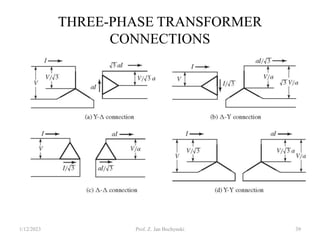
THREE-PHASE TRANSFORMER
CONNECTIONS
1/12/2023 Prof. Z. Jan Bochynski 39
TRANSFORMERS CONNECTIONS
1/12/2023 Prof. Z. Jan Bochynski 40
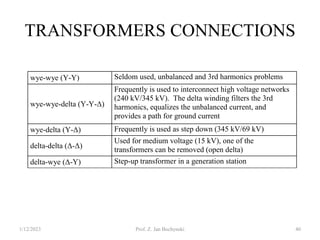
wye-wye (Y-Y) Seldom used, unbalanced and 3rd harmonics problems
wye-wye-delta (Y-Y-Δ)
Frequently is used to interconnect high voltage networks
(240 kV/345 kV). The delta winding filters the 3rd
harmonics, equalizes the unbalanced current, and
provides a path for ground current
wye-delta (Y-Δ) Frequently is used as step down (345 kV/69 kV)
delta-delta (Δ-Δ)
Used for medium voltage (15 kV), one of the
transformers can be removed (open delta)
delta-wye (Δ-Y) Step-up transformer in a generation station
RATIO FOR Y-Y CONNECTION
1/12/2023 Prof. Z. Jan Bochynski 41
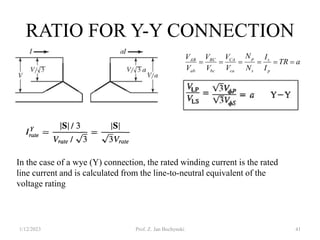
In the case of a wye (Y) connection, the rated winding current is the rated
line current and is calculated from the line-to-neutral equivalent of the
voltage rating
a
TR
I
I
N
N
V
V
V
V
V
V
p
s
s
p
ca
CA
bc
BC
ab
AB






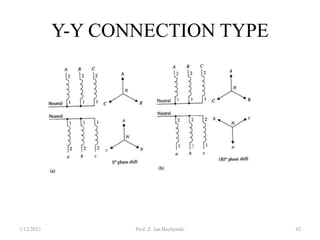
Y-Y CONNECTION TYPE
1/12/2023 Prof. Z. Jan Bochynski 42
RATIO FOR Y-Δ CONNECTION
1/12/2023 Prof. Z. Jan Bochynski 43
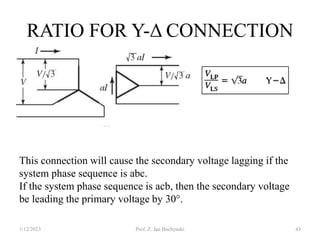
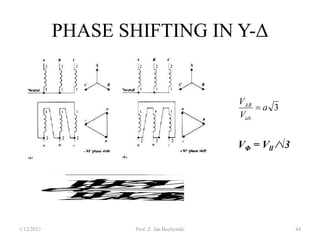
This connection will cause the secondary voltage lagging if the
system phase sequence is abc.
If the system phase sequence is acb, then the secondary voltage
be leading the primary voltage by 30°.
PHASE SHIFTING IN Y-Δ
1/12/2023 Prof. Z. Jan Bochynski 44
l
l
l
l
l
l
l
l
V
V
V
V
V
/
V
V
V
V
V
a
2
2
2
1
2
1
3
3
3









VΦ = Vll /√3
3
a
V
V
ab
AB

RATIO FOR Δ-Y CONNECTION
1/12/2023 Prof. Z. Jan Bochynski 45
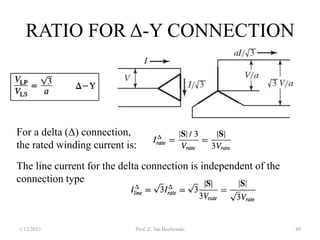
For a delta (Δ) connection,
the rated winding current is:
The line current for the delta connection is independent of the
connection type
RATIO FOR Δ-Δ CONNECTION
1/12/2023 Prof. Z. Jan Bochynski 46
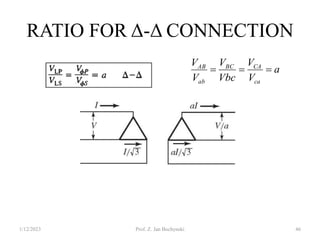
a
V
V
Vbc
V
V
V
ca
CA
BC
ab
AB



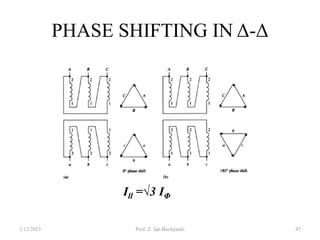
PHASE SHIFTING IN Δ-Δ
1/12/2023 Prof. Z. Jan Bochynski 47
Ill =√3 IΦ
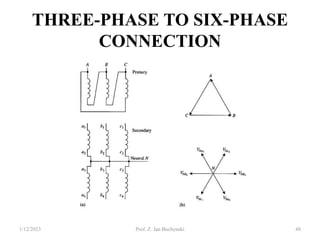
THREE-PHASE TO SIX-PHASE
CONNECTION
1/12/2023 Prof. Z. Jan Bochynski 48
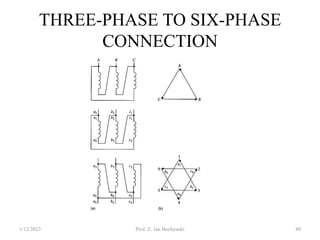
THREE-PHASE TO SIX-PHASE
CONNECTION
1/12/2023 Prof. Z. Jan Bochynski 49
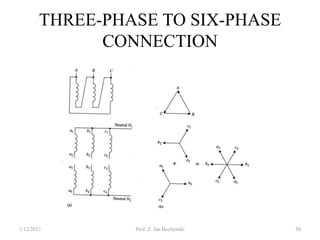
THREE-PHASE TO SIX-PHASE
CONNECTION
1/12/2023 Prof. Z. Jan Bochynski 50
Examples
1/12/2023 Prof. Z. Jan Bochynski 51
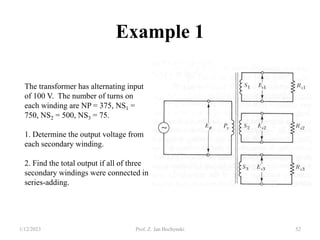
Example 1
The transformer has alternating input
of 100 V. The number of turns on
each winding are NP = 375, NS1 =
750, NS2 = 500, NS3 = 75.
1. Determine the output voltage from
each secondary winding.
2. Find the total output if all of three
secondary windings were connected in
series-adding.
1/12/2023 Prof. Z. Jan Bochynski 52
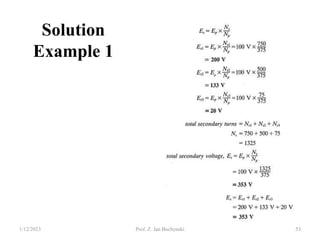
Solution
Example 1
1/12/2023 Prof. Z. Jan Bochynski 53
EXAMPLE 2
The three secondary in Problem 1 have following loads
attached: RS1 =1 kΩ, RS2 = 500 Ω, and RS3 = 100 Ω.
Assuming that the transformer is 100 % efficient find
the total primary current Ip.
1/12/2023 Prof. Z. Jan Bochynski 54
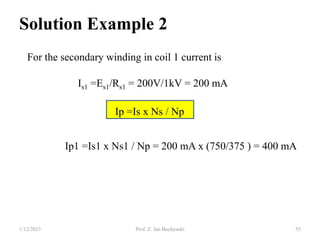
Solution Example 2
For the secondary winding in coil 1 current is
Is1 =Es1/Rs1 = 200V/1kV = 200 mA
Ip =Is x Ns / Np
Ip1 =Is1 x Ns1 / Np = 200 mA x (750/375 ) = 400 mA
1/12/2023 Prof. Z. Jan Bochynski 55
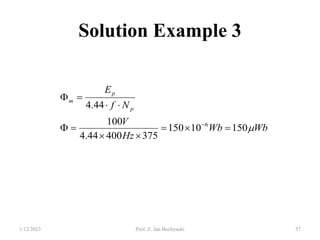
Example 3
The transformer input max voltage is 100 V, frequency 400 Hz
and the primary winding has 375 turns.
Determine the pick value of the flux Φ.
1/12/2023 Prof. Z. Jan Bochynski 56
Solution Example 3
Wb
Wb
Hz
V
N
f
E
p
p
m

150
10
150
375
400
44
.
4
100
44
.
4
6












1/12/2023 Prof. Z. Jan Bochynski 57
Example 4
1/12/2023 Prof. Z. Jan Bochynski 58
A transformer with two secondary windings has these turns
data: N1 = 4000, N2 = 1000, N3 = 500. The primary rms
voltage is 120 V. The secondary voltage is V2 = 30<00 and
V3 = 15<00. The secondary windings loads are: Z2 = 3 +j 4;
and Z3 = 5 +j 0.
Compute the followings:
1. Current in all three windings
2. Active power in the primary circuit
3. Apparent power in the primary winding
4. Reactive power in the primary winding
5. Power factor of the system
1/12/2023 Prof. Z. Jan Bochynski 59
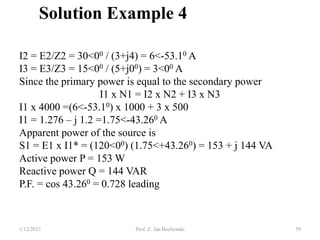
Solution Example 4
I2 = E2/Z2 = 30<00 / (3+j4) = 6<-53.10 A
I3 = E3/Z3 = 15<00 / (5+j00) = 3<00 A
Since the primary power is equal to the secondary power
I1 x N1 = I2 x N2 + I3 x N3
I1 x 4000 =(6<-53.10) x 1000 + 3 x 500
I1 = 1.276 – j 1.2 =1.75<-43.260 A
Apparent power of the source is
S1 = E1 x I1* = (120<00) (1.75<+43.260) = 153 + j 144 VA
Active power P = 153 W
Reactive power Q = 144 VAR
P.F. = cos 43.260 = 0.728 leading

TRANSFORMERS FOR EE-UY-2613.pptx

  • 1.
    TRANSFORMERS FUNDAMENTALS NYU EE 3824ENERGY CONVERSION SYSTEMS INSTRUCTOR Prof. Z. Jan Bochynski 1/12/2023 Prof. Z. Jan Bochynski 1
  • 2.
    Transformers in aPower Grid An important safety feature is that the transformer insulates the primary and secondary electric circuits and permits the separate grounding of the circuits, which prevents high-voltage, high-power damage the secondary circuit. Limit 20-26 kV 1/12/2023 Prof. Z. Jan Bochynski 2
  • 3.
    Transformers Polarity Each transformercoil can be wound either clockwise or counter clockwise. The winding polarity determine the primary and secondary voltage polarity. This is important when a pair of transformers work in in parallel or series connection. 1/12/2023 Prof. Z. Jan Bochynski 3
  • 4.
  • 5.
  • 6.
  • 7.
    A three-phase transformerwound on a single three-legged iron core. 1/12/2023 Prof. Z. Jan Bochynski 7
  • 8.
    Transformers in Electronics 1/12/2023Prof. Z. Jan Bochynski 8 Transformer allows matching impedance to obtain a maximum power in electronic devices Transformers allows electrical isolation between systems
  • 9.
    TRANSFORMER PROPERTIES 1/12/2023 Prof.Z. Jan Bochynski 9 Transformer works only when a magnetic flux changes Transformer does not convert energy Transformer transmits power from one network to another Transformer increasing voltage decreasing current and vice versa Transformer allows phase conversion in secondary circuit
  • 10.
  • 11.
    Transformer Core Type Construction Ironcore magnetic circuit 1/12/2023 Prof. Z. Jan Bochynski 11
  • 12.
  • 13.
  • 14.
    Transformer Shell Type Construction Ironcore magnetic circuit with an air gap 1/12/2023 Prof. Z. Jan Bochynski 14
  • 15.
    H1 H2 X1 X2 Transformer Ratio Transformer turnsratio Ns Np Es Ep  Ns Np Es Ep  1/12/2023 Prof. Z. Jan Bochynski 15 Φ Es = Ep (Ns /Np) The secondary (output voltage )
  • 16.
    Power, Currents, Voltage,Flux 1/12/2023 Prof. Z. Jan Bochynski 16 ] [ 44 . 4 4 11 . 1 V N f N f E m m rms        
  • 17.
    IDEAL TRANSFORMER 1/12/2023 Prof.Z. Jan Bochynski 17  m  E1 4.44 fN1  TR  a  e1 e2  N1 N2  i2 i1
  • 18.
    Ideal Transformer Es =Ns ΔФ / Δt Ep = Np ΔФ /Δt 1/12/2023 Prof. Z. Jan Bochynski 18
  • 19.
  • 20.
    NO-LOAD CURRENTS 1/12/2023 Prof.Z. Jan Bochynski 20 Iex Ic = Ih+e VP Im Φ The magnetization current Im is the current required to produce the flux Φ in the transformer core. The core-loss current Ih+e is the current required to make up for hysteresis and eddy current losses The fundamental component of the magnetization current lags the voltage applied to the core by 90°. The total no-load current in the core is called the excitation current of the transformer. This current is the sum of the magnetization current and the core- loss current in the core: Iex = Im + Ih+e
  • 21.
    Real Transformer The equivalentcircuit contains an ideal transformer and both network reactance X and resistances R. 1/12/2023 Prof. Z. Jan Bochynski 21
  • 22.
    PARTS OF REALTRANSFORMER 1/12/2023 Prof. Z. Jan Bochynski 22 Copper losses are the resistive heating losses in the pri- mary and secondary windings of the transformer. They are proportional to the square of the current in the windings.(I2R).
  • 23.
    REAL TRANSFORMER 1/12/2023 Prof.Z. Jan Bochynski 23 The real transformer can be represented by an ideal transformer with winding resistance and leakage reactance.
  • 24.
  • 25.
    LEAKAGE FLUXES 1/12/2023 Prof.Z. Jan Bochynski 25 The leakage fluxes ΦLP and ΦLS are fluxes that escape the core and pass through only one of the transformer windings. They produce a self-inductance L in the primary and secondary coils, and the effects of this inductance must be accounted in calculation. Φs = ΦM + ΦLS ΦP = ΦM + ΦLS
  • 26.
    EQUIVALENT CIRCUIT OFA REAL TRANSFORMER 1/12/2023 Prof. Z. Jan Bochynski 26 Ideal Transformer Sec. winding Prim. winding Core
  • 27.
    Real Transformer EquivalentCircuit Ep =4.44 Фm f Np [V] Es = 4.44 Фm f Ns [V] Ф (Wb), f (Hz) Ep = Vp + ΔVp = Vp + (IoRp + Io Xp ) Vp = Ep - ΔVp = Ep + (IoRp + Io Xp ) 1/12/2023 Prof. Z. Jan Bochynski 27
  • 28.
    TRANSFORMER MODEL REFERRED TOITS PRIMARY VOLTAGE LEVEL 1/12/2023 Prof. Z. Jan Bochynski 28 Approximate equivalent circuit of a transformer as viewed from the primary side R’2 X’2 I’2 V’2
  • 29.
    TRANSFORMER MODEL REFLECTED TOITS SECONDARY VOLTAGE LEVEL 1/12/2023 Prof. Z. Jan Bochynski 29 An approximate equivalent circuit of a transformer as viewed from the secondary side R’1 X’1 I’1 V’1
  • 30.
    APPROXIMATE EQUIVALENT TRANSFORMER CIRCUIT 1/12/2023Prof. Z. Jan Bochynski 30 Approximate transformer model referred to the primary side with excitation branch and without excitation components. Req1 = R1 + R’2 Xeq 1 = X1 +X’2
  • 31.
  • 32.
    Counter Clockwise Connection 1/12/2023Prof. Z. Jan Bochynski 32
  • 33.
    Transformer with Center-Tapped Secondary Windings 1/12/2023 Prof. Z. Jan Bochynski 33
  • 34.
    Two Secondary WindingsTransformer Secondary winding connected in series – aiding voltage 1/12/2023 Prof. Z. Jan Bochynski 34
  • 35.
    Two Secondary WindingTransformer Secondary winding connected in series – opposing voltage 1/12/2023 Prof. Z. Jan Bochynski 35
  • 36.
  • 37.
    Transformers in ParallelConnection In addition to the turn ratio, the primary and secondary winding polarities are the same in both transformers. The parallel connection requires that the respective secondary and primary voltages must be equal that is have the same turns ratio. 1/12/2023 Prof. Z. Jan Bochynski 37
  • 38.
    CONDITIONS FOR TRANSFORMERS INPARALLEL 1/12/2023 Prof. Z. Jan Bochynski 38 The condition for connecting two transformers in parallel: 1. Two transformers must the same turns ratios 2. The nominal voltage and current ratings must be the same 3. The equivalent resistance, reactance, and impedance must be the same 4. The polarities must be the same 5. Two transformers must have the same construction of core or shell type.
  • 39.
  • 40.
    TRANSFORMERS CONNECTIONS 1/12/2023 Prof.Z. Jan Bochynski 40 wye-wye (Y-Y) Seldom used, unbalanced and 3rd harmonics problems wye-wye-delta (Y-Y-Δ) Frequently is used to interconnect high voltage networks (240 kV/345 kV). The delta winding filters the 3rd harmonics, equalizes the unbalanced current, and provides a path for ground current wye-delta (Y-Δ) Frequently is used as step down (345 kV/69 kV) delta-delta (Δ-Δ) Used for medium voltage (15 kV), one of the transformers can be removed (open delta) delta-wye (Δ-Y) Step-up transformer in a generation station
  • 41.
    RATIO FOR Y-YCONNECTION 1/12/2023 Prof. Z. Jan Bochynski 41 In the case of a wye (Y) connection, the rated winding current is the rated line current and is calculated from the line-to-neutral equivalent of the voltage rating a TR I I N N V V V V V V p s s p ca CA bc BC ab AB      
  • 42.
    Y-Y CONNECTION TYPE 1/12/2023Prof. Z. Jan Bochynski 42
  • 43.
    RATIO FOR Y-ΔCONNECTION 1/12/2023 Prof. Z. Jan Bochynski 43 This connection will cause the secondary voltage lagging if the system phase sequence is abc. If the system phase sequence is acb, then the secondary voltage be leading the primary voltage by 30°.
  • 44.
    PHASE SHIFTING INY-Δ 1/12/2023 Prof. Z. Jan Bochynski 44 l l l l l l l l V V V V V / V V V V V a 2 2 2 1 2 1 3 3 3          VΦ = Vll /√3 3 a V V ab AB 
  • 45.
    RATIO FOR Δ-YCONNECTION 1/12/2023 Prof. Z. Jan Bochynski 45 For a delta (Δ) connection, the rated winding current is: The line current for the delta connection is independent of the connection type
  • 46.
    RATIO FOR Δ-ΔCONNECTION 1/12/2023 Prof. Z. Jan Bochynski 46 a V V Vbc V V V ca CA BC ab AB   
  • 47.
    PHASE SHIFTING INΔ-Δ 1/12/2023 Prof. Z. Jan Bochynski 47 Ill =√3 IΦ
  • 48.
  • 49.
  • 50.
  • 51.
  • 52.
    Example 1 The transformerhas alternating input of 100 V. The number of turns on each winding are NP = 375, NS1 = 750, NS2 = 500, NS3 = 75. 1. Determine the output voltage from each secondary winding. 2. Find the total output if all of three secondary windings were connected in series-adding. 1/12/2023 Prof. Z. Jan Bochynski 52
  • 53.
  • 54.
    EXAMPLE 2 The threesecondary in Problem 1 have following loads attached: RS1 =1 kΩ, RS2 = 500 Ω, and RS3 = 100 Ω. Assuming that the transformer is 100 % efficient find the total primary current Ip. 1/12/2023 Prof. Z. Jan Bochynski 54
  • 55.
    Solution Example 2 Forthe secondary winding in coil 1 current is Is1 =Es1/Rs1 = 200V/1kV = 200 mA Ip =Is x Ns / Np Ip1 =Is1 x Ns1 / Np = 200 mA x (750/375 ) = 400 mA 1/12/2023 Prof. Z. Jan Bochynski 55
  • 56.
    Example 3 The transformerinput max voltage is 100 V, frequency 400 Hz and the primary winding has 375 turns. Determine the pick value of the flux Φ. 1/12/2023 Prof. Z. Jan Bochynski 56
  • 57.
  • 58.
    Example 4 1/12/2023 Prof.Z. Jan Bochynski 58 A transformer with two secondary windings has these turns data: N1 = 4000, N2 = 1000, N3 = 500. The primary rms voltage is 120 V. The secondary voltage is V2 = 30<00 and V3 = 15<00. The secondary windings loads are: Z2 = 3 +j 4; and Z3 = 5 +j 0. Compute the followings: 1. Current in all three windings 2. Active power in the primary circuit 3. Apparent power in the primary winding 4. Reactive power in the primary winding 5. Power factor of the system
  • 59.
    1/12/2023 Prof. Z.Jan Bochynski 59 Solution Example 4 I2 = E2/Z2 = 30<00 / (3+j4) = 6<-53.10 A I3 = E3/Z3 = 15<00 / (5+j00) = 3<00 A Since the primary power is equal to the secondary power I1 x N1 = I2 x N2 + I3 x N3 I1 x 4000 =(6<-53.10) x 1000 + 3 x 500 I1 = 1.276 – j 1.2 =1.75<-43.260 A Apparent power of the source is S1 = E1 x I1* = (120<00) (1.75<+43.260) = 153 + j 144 VA Active power P = 153 W Reactive power Q = 144 VAR P.F. = cos 43.260 = 0.728 leading

Editor's Notes

  • #3 The generator voltage is limited to 20-26 kV. This voltage is suitable to transport 5-10 MW of power for a distance of 5-10 miles (8-16 km). The development of the transformer permitted the increase of the transmission voltage to a few hundred kV while simultaneously reducing the current, consequently allowing the transport of large amounts of energy over a few hundred miles. An important safety feature is that the transformer insulates the primary and secondary electric circuits and permits the separate grounding of the circuits, which prevents high-voltage-caused accidents.
  • #16 The transformer is an application of mutual inductance. An alternating voltage applied to a primary winding generates an alternating magnetic flux, which links with a secondary winding and induces an alternating emf in the secondary. Transformer primary terminals are marked H1 , H2, the secondary terminals are denoted as X1 , X2.
  • #20 The total primary no-load current Io is composed of the magnetizing current Im and the current Ic that represents the core losses.
  • #21  1. The magnetization current in the transformer is not sinusoidal. The higher­ frequency components in the magnetization current are due to magnetic sat­uration in the transformer core. 2. Once the peak flux reaches the saturation point in the core, a small increase in peak flux requires a very large increase in the peak magnetization current. 3. The fundamental component of the magnetization current lags the voltage ap­plied to the core by 90°. 4. The higher-frequency components in the magnetization current can be quite large compared to the fundamental component. In general the further a transformer core is driven into saturation, the larger the harmonic components will become.
  • #22 The primary and secondary windings of a real transformer have resistance R and leakage reactance X, and the magnetizing current Im and the current Ic losses in the iron core and all have to be included.
  • #23 The other component of the no-load current in the transformer is the current required to supply power to make up the hysteresis and eddy current losses in the core. This is the core-loss current. Assume that the flux in the core is sinusoidal. The eddy currents in the core are proportional to dΦ/dt. The core-loss current is greatest as the flux passes through zero.
  • #24 The leakage flux associated with either winding is responsible for the voltage drop across it. We represent the voltage drop due to the leakage flux by a leakage reactance X l and X 2 tha are respectively the leakage reactances for the primary and secondary windings. The real transformer can be represented in terms of an idealized transformer with winding resistances and leakage reactances as shown below.
  • #25 When the transformer has a load at the secondary, the induced secondary voltage drives a current through the load. The secondary current generates a flux Φs, which opposes the main flux Φp, as shown. The main flux cannot be reduced because the primary induced voltage Ep is equal with the constant supply voltage Vp. To maintain the main flux Φp constant, a primary current Ip starts to flow. This current generates a primary flux Φp, which compensates for the secondary current generated flux Φs. The described phenomenon is demonstrated basic transformer operation.
  • #26 Leakage Fluxes Part of the windings flux does not go through the magnetic core but complete its path through the air. Each winding in a transformer creates its own leakage flux. The leakage flux does not reach the other winding. The main flux circulates in the core and links both windings.
  • #28 Like the ideal transformer, the unloaded real transformer is supplied by a primary voltage that drives a magnetizing current through the primary winding. The magnetizing current generates the main flux that induces voltage in both the primary and secondary windings. Excitation for the main flux can be represented by a current through an equivalent magnetizing reactance Xm, which is connected in parallel at the primary side of an ideal transformer. The magnetizing inductance can be calculated by Equation shown using the iron core dimensions and the number of turns in the primary.
  • #31  The excitation branch has a very small current compared to the load current of the transformers. This current is so small that under normal circumstances it causes a completely negligible voltage drop on Rp and Xp. Because of this, we can simplify equivalent circuit that works almost as well as the full model. Thus, the excitation branch can be moved to the front of the transformer, and the primary and secondary impedances stays in series with each other.
  • #37 In the transformers with multiple secondary windings each of the secondary (output) voltage depends on the primary voltage and the ratio of primary to secondary turns.
  • #42 The Y-Y connection has two very serious problems: 1. If loads on the transformer circuit are unbalanced then the voltages on the phases of the transformer can become severely unbalanced. 2. Third-harmonic voltages can be large.
  • #46 This connection has the same advantages and the same phase shift as the Y- Δ transformer. The connection makes the secondary voltage lagging the primary voltage by 30°.
  • #47 The delta-delta connection is best suited for large low- to medium-voltage transformer banks of single-phase transformers, no problems with unbalanced loads or harmonics, but is rarely met in a three-phase transformer. This transformer has no phase shift associated with it.
  • #48 A disadvantage of the delta-delta connection is the absence of a neutral point, what in unbalanced load no path for unbalanced currents is provided and dual-voltage outputs cannot be acquired.
  • #49 Three-to-six-phase conversion using diametrical connection
  • #50 Three-to-six-phase conversion using double-delta connection