BANYU URIP PROJECT
EPC1 - Production Processing Facilities
Contract No. C-3207067
Module 3 – Electrical Safety
CONSTRUCTION SAFETY
TRAINING
Objectives
The objectives of the Electrical Safety Procedures (ESP) are the following:
• to provide directives for the application of safety electrical work rules,
• to eliminate personnel injuries, reduction of damage to equipment/property and
to prevent reoccurrence,
• to establish responsibility and accountability,
• to assure the safety of the company's employees and contractors who work on
electrical equipment,
• to ensure the continuity of the electrical supply in the best safe conditions.
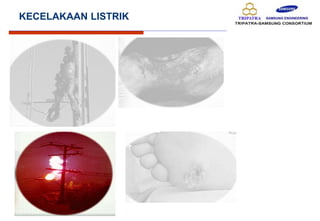
KECELAKAAN LISTRIK
ELECTRICAL SAFETY
Portable Electrical Apparatus
• In order to minimize the effects of electrical shock, All portable electrical tools and lamps shall be:
• Safety Extra Low Voltage (SELV) Class, or
• double insulation class II with the double square identification sign, or
• supplied by a feeder equipped with a residual differential 30 mA device including ground
conductor,
• In the very conductive area or enclosure, only SELV Class tools and lamps shall be used.
• An LV/ SELV isolation transformer located out of the area or outside the enclosure shall supply the
AC voltage equipment.
– Inspection & Testing
• All electrical portable power operated apparatus shall be subjected to regular inspection and tested
by certified company.
SAFETY BASICS
Generalities Electricity
Electricity help in many ways to improve daily life for all of us, at home and work.
However, electricity is dangerous and causes many accidents which kill around 200 people every year in
France only.
Most of these accidents are due to carelessness. Ignorance or negligence.
While qualified electricians would seem to be the ones most exposed to these dangers, many serious
accidents involve non electricians personnel such as: painters, cleaners, welders etc.
WE CAN NEVER TAKE ANYTHING FOR GRANTED AS REGARDS OF SAFETY.
EVERYONE MUST WORK TO ENSURE THAT THE NUMBER OF ACCIDENTS CONTINUE TO
DECREASE.
ELECTRICAL HAZARDS
Electricity Involves The Following Risks:
• The passage of current through the human body
• The projection of matter in fusion as a result of short circuit
• Various risks such as machines starting up unexpectedly.
The passage of current through the Human body
Electrification
is an electric shock that does not kill, whereas electrocution is fatal.
Electrical current passing through the human body causes contractions and internal or superficial
burns which increase with the voltage.
Shock
• Over 30,000 non fatal electrical shock accidents occur each year
• Over 600 people die from electrocution each year
• Electrocution remains the fourth (4th) highest cause of industrial fatalities
• Most injuries and deaths could be avoided.
ELECTRICAL HAZARDS
PORTABLE ELECTRICAL EQUIPMENT
General Observations:
Portable electrical equipment is connected to the mains by flexible cables and plugs, which
because they are easily damaged are a potentially dangerous source of electric shocks. Hand-
held, portable equipment are the most dangerous because tetanization can prevent the user from
releasing the equipment if there is an insulation fault. Users should always check their equipment
before use. They should also be inspected periodically by designated maintenance personnel.
Protection against risks of direct contact
To avoid risks of direct contact a few simple rules must be followed;
• Make sure the tool and its power cable are in good working condition.
• Do not carry out any ‘do-it-yourself’ repairs.
• Do not use an extension that has two pins at each end.
• Use industrial cables against risk of walking on in passageways.
• Use standard plugs and sockets that are in good state.
PORTABLE ELECTRICAL EQUIPMENT
The principal causes of electric shock from portable electric tools are:
1. FAULTY, DAMAGED OR MISUSED PLUGS, SOCKETS AND TERMINALS.
 Faulty or damaged flexible cables or extension leads.
 Insulation failure.
 Damage to the tool or transformer.
 Misuse of equipment.
2. PLUGS, SOCKETS AND TERMINALS ,
 An earth wire may be pulled out, due to a faulty cord grip, and touch the live terminal, making the
metalwork on the apparatus live.
 The use of wrong connectors when wiring up a plug or terminal can make the apparatus live.
 Missing or damaged covers can expose live terminals or conductors.
3. FLEXIBLE CABLES AND EXTENSION LEADS
 Damage can be caused by dragging the cable over sharp objects or exposure to hot surfaces,
chemicals, solvents and moving parts of machinery.
 The earth conductor may be severed, so that the metalwork or frame becomes live.
 Wear, in flexible cables, is usually concentrated at points where cable enters the appliance and
plug - continuous flexing is a common cause of damage.
PORTABLE ELECTRICAL EQUIPMENT
The principal causes of electric shock from portable electric tools are:
4. INSULATION FAILURE
• Failure or damage to insulation may cause leakage currents and short circuits, which may result in
metalwork being made live.
5. APPLIANCE OR TRANSFORMER DAMAGE
• If there are loose wires, or damaged casings, switches or connectors, the equipment should not be
used, but returned for servicing.
• Sudden cutting out of equipment, changes in speed, and burning smells are typical indications of
damage.
6. MISUSE OF EQUIPMENT
• Typical examples include:
• Servicing or repairing equipment without isolating it from the power supply.
• Use of wrong or unserviceable connectors or plugs.
• Using equipment which is unsuitable for the service required.
FIRST AID
What to do? First aid for victims of electric shocks
• Follow the instructions for giving first aid to electrical accident victims.
The rule is P.A.I.
• Protect; free the victim, taking care not to become a second victim yourself,
• Assist: Give first aid while waiting for the Emergency Services,
• Inform: Or get someone else to inform the emergency services.
Resuscitation Measures
• Switch off the current, if possible, but do not waste time looking for the switch,
• Separate the casualty from the live apparatus, using something dry which will not conduct
electricity, or CATU kit material if available,
• Do not touch the casualty while he is still in contact with the live apparatus,
• Send for medical assistance, do not delay resuscitation by summoning assistance
yourself,
• Check if casualty is breathing commence mouth to mouth resuscitation, continue until
normal breathing return.
• If pallid, pupils dilated, heart may have stopped, (If Certified FIRST AIDER) start external
hearth massage immediately combined with artificial respiration. Continue resuscitation,
cardiac massage until medical assistance arrives. .
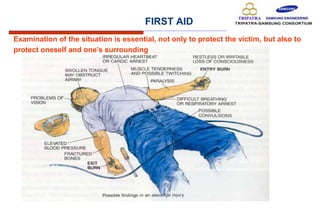
FIRST AID
Examination of the situation is essential, not only to protect the victim, but also to
protect oneself and one’s surrounding
ELECTRICAL REMINDER
Grinder mounted on steel table with wiring
running under the spark area resulted in short
circuit when the cable burned through. The
other people working on the table received
electrical shocks as well as the person
operating the grinder
Extension power cords must be protected and
clamped properly to avoid exposure to the
elements. In this case the use of improper
equipment resulted in injury to workers
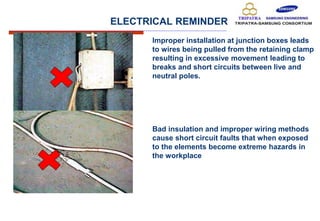
ELECTRICAL REMINDER
Improper installation at junction boxes leads
to wires being pulled from the retaining clamp
resulting in excessive movement leading to
breaks and short circuits between live and
neutral poles.
Bad insulation and improper wiring methods
cause short circuit faults that when exposed
to the elements become extreme hazards in
the workplace
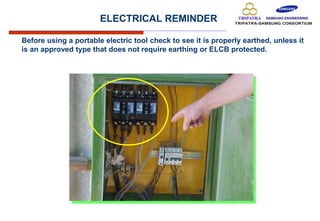
Before using a portable electric tool check to see it is properly earthed, unless it
is an approved type that does not require earthing or ELCB protected.
ELECTRICAL REMINDER
Make sure that all cables, plugs or connectors are sound and properly wired
up.
ELECTRICAL REMINDER
Use tools only on the correct power supply as instructed on the marker’s
label.
ELECTRICAL REMINDER
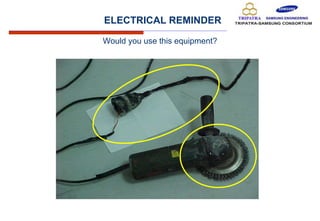
Would you use this equipment?
ELECTRICAL REMINDER
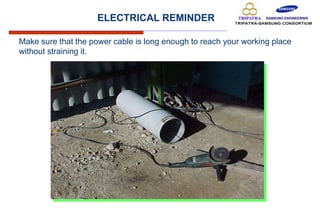
Make sure that the power cable is long enough to reach your working place
without straining it.
ELECTRICAL REMINDER
Never stand on a damp or wet surface
when using electrical equipment and keep
equipment clean and dry.
ELECTRICAL REMINDER
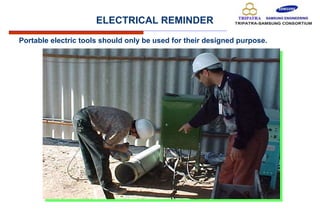
Portable electric tools should only be used for their designed purpose.
ELECTRICAL REMINDER
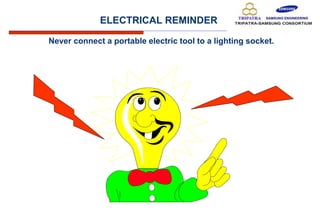
Never connect a portable electric tool to a lighting socket.
ELECTRICAL REMINDER
Never carry or lower a power tool by its cable.
One cable . . . . One tool!
ELECTRICAL REMINDER
Electric power tools should be regularly inspected and maintained by a
competent electrician.
ELECTRICAL REMINDER
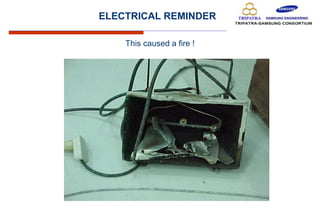
This caused a fire !
ELECTRICAL REMINDER
Always check the working voltage of the tool and the voltage of the supply. They
must be the same!
ELECTRICAL REMINDER
02/11/04
ELECTRICAL SAFETY
THANK YOU
“FOLLOW THE SAFETY RULE
AND BE SAFE”
“NOBODY GETS HURT”

ELECTRICAL SAFETY Training module pembelajaran

  • 1.
    BANYU URIP PROJECT EPC1- Production Processing Facilities Contract No. C-3207067 Module 3 – Electrical Safety CONSTRUCTION SAFETY TRAINING
  • 2.
    Objectives The objectives ofthe Electrical Safety Procedures (ESP) are the following: • to provide directives for the application of safety electrical work rules, • to eliminate personnel injuries, reduction of damage to equipment/property and to prevent reoccurrence, • to establish responsibility and accountability, • to assure the safety of the company's employees and contractors who work on electrical equipment, • to ensure the continuity of the electrical supply in the best safe conditions.
  • 3.
  • 4.
    ELECTRICAL SAFETY Portable ElectricalApparatus • In order to minimize the effects of electrical shock, All portable electrical tools and lamps shall be: • Safety Extra Low Voltage (SELV) Class, or • double insulation class II with the double square identification sign, or • supplied by a feeder equipped with a residual differential 30 mA device including ground conductor, • In the very conductive area or enclosure, only SELV Class tools and lamps shall be used. • An LV/ SELV isolation transformer located out of the area or outside the enclosure shall supply the AC voltage equipment. – Inspection & Testing • All electrical portable power operated apparatus shall be subjected to regular inspection and tested by certified company.
  • 5.
    SAFETY BASICS Generalities Electricity Electricityhelp in many ways to improve daily life for all of us, at home and work. However, electricity is dangerous and causes many accidents which kill around 200 people every year in France only. Most of these accidents are due to carelessness. Ignorance or negligence. While qualified electricians would seem to be the ones most exposed to these dangers, many serious accidents involve non electricians personnel such as: painters, cleaners, welders etc. WE CAN NEVER TAKE ANYTHING FOR GRANTED AS REGARDS OF SAFETY. EVERYONE MUST WORK TO ENSURE THAT THE NUMBER OF ACCIDENTS CONTINUE TO DECREASE.
  • 6.
    ELECTRICAL HAZARDS Electricity InvolvesThe Following Risks: • The passage of current through the human body • The projection of matter in fusion as a result of short circuit • Various risks such as machines starting up unexpectedly. The passage of current through the Human body Electrification is an electric shock that does not kill, whereas electrocution is fatal. Electrical current passing through the human body causes contractions and internal or superficial burns which increase with the voltage. Shock • Over 30,000 non fatal electrical shock accidents occur each year • Over 600 people die from electrocution each year • Electrocution remains the fourth (4th) highest cause of industrial fatalities • Most injuries and deaths could be avoided.
  • 7.
  • 8.
    PORTABLE ELECTRICAL EQUIPMENT GeneralObservations: Portable electrical equipment is connected to the mains by flexible cables and plugs, which because they are easily damaged are a potentially dangerous source of electric shocks. Hand- held, portable equipment are the most dangerous because tetanization can prevent the user from releasing the equipment if there is an insulation fault. Users should always check their equipment before use. They should also be inspected periodically by designated maintenance personnel. Protection against risks of direct contact To avoid risks of direct contact a few simple rules must be followed; • Make sure the tool and its power cable are in good working condition. • Do not carry out any ‘do-it-yourself’ repairs. • Do not use an extension that has two pins at each end. • Use industrial cables against risk of walking on in passageways. • Use standard plugs and sockets that are in good state.
  • 9.
    PORTABLE ELECTRICAL EQUIPMENT Theprincipal causes of electric shock from portable electric tools are: 1. FAULTY, DAMAGED OR MISUSED PLUGS, SOCKETS AND TERMINALS.  Faulty or damaged flexible cables or extension leads.  Insulation failure.  Damage to the tool or transformer.  Misuse of equipment. 2. PLUGS, SOCKETS AND TERMINALS ,  An earth wire may be pulled out, due to a faulty cord grip, and touch the live terminal, making the metalwork on the apparatus live.  The use of wrong connectors when wiring up a plug or terminal can make the apparatus live.  Missing or damaged covers can expose live terminals or conductors. 3. FLEXIBLE CABLES AND EXTENSION LEADS  Damage can be caused by dragging the cable over sharp objects or exposure to hot surfaces, chemicals, solvents and moving parts of machinery.  The earth conductor may be severed, so that the metalwork or frame becomes live.  Wear, in flexible cables, is usually concentrated at points where cable enters the appliance and plug - continuous flexing is a common cause of damage.
  • 10.
    PORTABLE ELECTRICAL EQUIPMENT Theprincipal causes of electric shock from portable electric tools are: 4. INSULATION FAILURE • Failure or damage to insulation may cause leakage currents and short circuits, which may result in metalwork being made live. 5. APPLIANCE OR TRANSFORMER DAMAGE • If there are loose wires, or damaged casings, switches or connectors, the equipment should not be used, but returned for servicing. • Sudden cutting out of equipment, changes in speed, and burning smells are typical indications of damage. 6. MISUSE OF EQUIPMENT • Typical examples include: • Servicing or repairing equipment without isolating it from the power supply. • Use of wrong or unserviceable connectors or plugs. • Using equipment which is unsuitable for the service required.
  • 11.
    FIRST AID What todo? First aid for victims of electric shocks • Follow the instructions for giving first aid to electrical accident victims. The rule is P.A.I. • Protect; free the victim, taking care not to become a second victim yourself, • Assist: Give first aid while waiting for the Emergency Services, • Inform: Or get someone else to inform the emergency services. Resuscitation Measures • Switch off the current, if possible, but do not waste time looking for the switch, • Separate the casualty from the live apparatus, using something dry which will not conduct electricity, or CATU kit material if available, • Do not touch the casualty while he is still in contact with the live apparatus, • Send for medical assistance, do not delay resuscitation by summoning assistance yourself, • Check if casualty is breathing commence mouth to mouth resuscitation, continue until normal breathing return. • If pallid, pupils dilated, heart may have stopped, (If Certified FIRST AIDER) start external hearth massage immediately combined with artificial respiration. Continue resuscitation, cardiac massage until medical assistance arrives. .
  • 12.
    FIRST AID Examination ofthe situation is essential, not only to protect the victim, but also to protect oneself and one’s surrounding
  • 13.
    ELECTRICAL REMINDER Grinder mountedon steel table with wiring running under the spark area resulted in short circuit when the cable burned through. The other people working on the table received electrical shocks as well as the person operating the grinder Extension power cords must be protected and clamped properly to avoid exposure to the elements. In this case the use of improper equipment resulted in injury to workers
  • 14.
    ELECTRICAL REMINDER Improper installationat junction boxes leads to wires being pulled from the retaining clamp resulting in excessive movement leading to breaks and short circuits between live and neutral poles. Bad insulation and improper wiring methods cause short circuit faults that when exposed to the elements become extreme hazards in the workplace
  • 15.
    Before using aportable electric tool check to see it is properly earthed, unless it is an approved type that does not require earthing or ELCB protected. ELECTRICAL REMINDER
  • 16.
    Make sure thatall cables, plugs or connectors are sound and properly wired up. ELECTRICAL REMINDER
  • 17.
    Use tools onlyon the correct power supply as instructed on the marker’s label. ELECTRICAL REMINDER
  • 18.
    Would you usethis equipment? ELECTRICAL REMINDER
  • 19.
    Make sure thatthe power cable is long enough to reach your working place without straining it. ELECTRICAL REMINDER
  • 20.
    Never stand ona damp or wet surface when using electrical equipment and keep equipment clean and dry. ELECTRICAL REMINDER
  • 21.
    Portable electric toolsshould only be used for their designed purpose. ELECTRICAL REMINDER
  • 22.
    Never connect aportable electric tool to a lighting socket. ELECTRICAL REMINDER
  • 23.
    Never carry orlower a power tool by its cable. One cable . . . . One tool! ELECTRICAL REMINDER
  • 24.
    Electric power toolsshould be regularly inspected and maintained by a competent electrician. ELECTRICAL REMINDER
  • 25.
    This caused afire ! ELECTRICAL REMINDER
  • 26.
    Always check theworking voltage of the tool and the voltage of the supply. They must be the same! ELECTRICAL REMINDER
  • 27.
    02/11/04 ELECTRICAL SAFETY THANK YOU “FOLLOWTHE SAFETY RULE AND BE SAFE” “NOBODY GETS HURT”