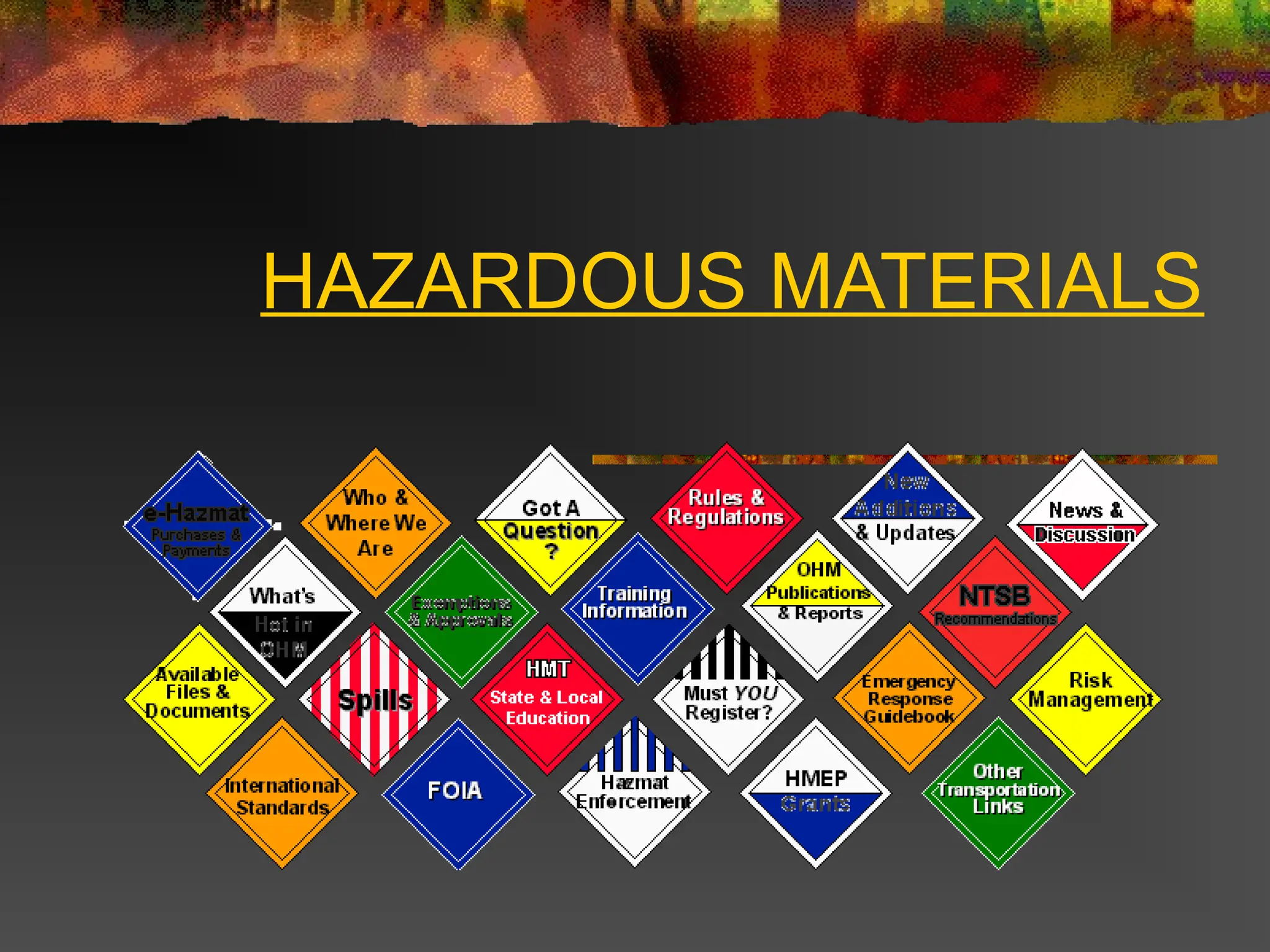
HAZARDOUS MATERIALS
Hazardous materials can be silent killers.
Almost every household and workplace has
varying amounts of chemicals that, if spilled or
combined, will cause great harm and even
death. It is important that you have a basic
knowledge of how to recognize these
chemicals, where they may be found, and
what to do, or not do, about hazardous
material spills.
Ways that hazardous materials can enter
the body:
 Inhalation; through breathing, most rapid way
 Absorption;through skin or eyes
 Ingestion; swallowing
 Injection; penetrating skin
The key to dealing with hazardous material spills is to
remember S.I.N. (Safety, Isolation, Notification).
Safety:
 Always assume that spilled chemicals are
extremely toxic
 Do not approach; stay at a safe distance
 Mixtures of chemicals can be very
dangerous
- bleach mixed with ammonia creates poisonous
gas(es)
Isolation:
 Close off room and/or
building
 Mark outside of building
Notification:
 Notify Incident Commander
local emergency personal
Hazardous Materials are an
ever-present danger:
 In the home or workplace
 On roadways
 In industrial or commercial
areas
IN THE HOME OR WORKPLACE
INVENTORY:
 Make a list of hazardous materials
 Read the labels on all products you purchase
 Segregate and store or dispose of properly
 Know what steps to take if chemicals are
spilled
 Secure and segregate all containers at work
TYPICAL PLACES HAZARDOUS MATERIALS ARE
FOUND IN THE HOME:
Kitchen
 oven cleaners, drain cleaners, ammonia,
bleach
Laundry
 bleach, spot removers, cleaners
Garage
 gasoline, solvents, pesticides, paints, paint
removers, thinners
ASBESTOS:
Asbestos is one of the potential hazards that you
may encounter in a damaged building. Asbestos
is a human carcinogen, which can be found in a
number of different building materials throughout
city and campus buildings. The hazard
presented by asbestos varies considerably
based upon the nature of the materials and the
likelihood of causing an airborne release of
asbestos fibers.
If left un-disturbed, a release is unlikely.
ON ROADWAYS
Hazardous materials transported on roadways must carry a
Department of Transportation (DOT) warning label on the package.
Vehicles transporting quantities of hazardous materials must have
DOT placards affixed to all sides of the vehicle. Bulk shipments,
such as in gasoline tanker trucks, will have a four digit numeric
code instead of the hazard class in the center of the placard. This
number can be referenced in the DOTs "Emergency Response
Guide Book" to determine the identity and the emergency handling
for the chemical involved.
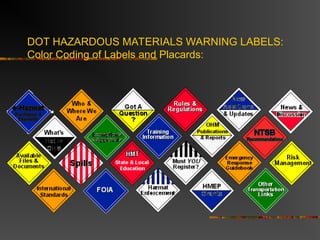
DOT HAZARDOUS MATERIALS WARNING LABELS:
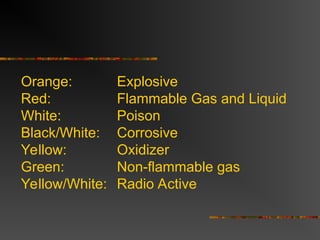
Color Coding of Labels and Placards:
Orange: Explosive
Red: Flammable Gas and Liquid
White: Poison
Black/White: Corrosive
Yellow: Oxidizer
Green: Non-flammable gas
Yellow/White: Radio Active
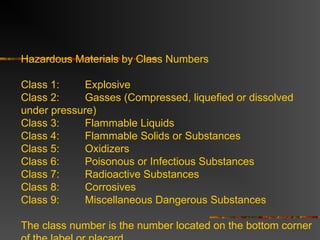
Hazardous Materials by Class Numbers
Class 1: Explosive
Class 2: Gasses (Compressed, liquefied or dissolved
under pressure)
Class 3: Flammable Liquids
Class 4: Flammable Solids or Substances
Class 5: Oxidizers
Class 6: Poisonous or Infectious Substances
Class 7: Radioactive Substances
Class 8: Corrosives
Class 9: Miscellaneous Dangerous Substances
The class number is the number located on the bottom corner
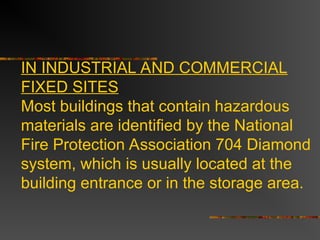
IN INDUSTRIAL AND COMMERCIAL
FIXED SITES
Most buildings that contain hazardous
materials are identified by the National
Fire Protection Association 704 Diamond
system, which is usually located at the
building entrance or in the storage area.
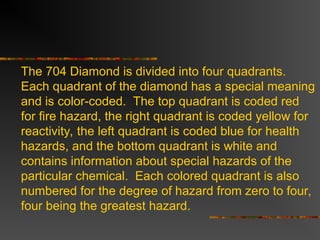
The 704 Diamond is divided into four quadrants.
Each quadrant of the diamond has a special meaning
and is color-coded. The top quadrant is coded red
for fire hazard, the right quadrant is coded yellow for
reactivity, the left quadrant is coded blue for health
hazards, and the bottom quadrant is white and
contains information about special hazards of the
particular chemical. Each colored quadrant is also
numbered for the degree of hazard from zero to four,
four being the greatest hazard.
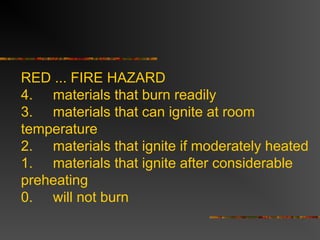
RED ... FIRE HAZARD
4. materials that burn readily
3. materials that can ignite at room
temperature
2. materials that ignite if moderately heated
1. materials that ignite after considerable
preheating
0. will not burn
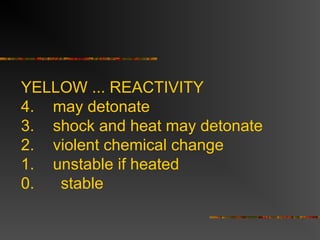
YELLOW ... REACTIVITY
4. may detonate
3. shock and heat may detonate
2. violent chemical change
1. unstable if heated
0. stable
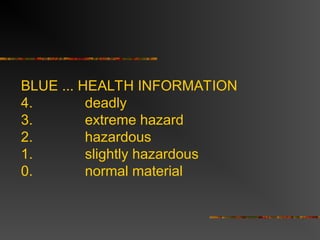
BLUE ... HEALTH INFORMATION
4. deadly
3. extreme hazard
2. hazardous
1. slightly hazardous
0. normal material
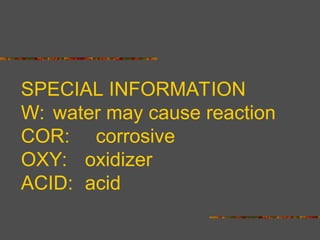
SPECIAL INFORMATION
W: water may cause reaction
COR: corrosive
OXY: oxidizer
ACID: acid
COMMON HAZARDOUS MATERIAL
LOCATIONS:
Industrial or manufacturing plants
 Shopping centers, supermarkets
 Dry cleaners
 Hardware stores
 Auto repair shops
SIGNS OF HAZARDOUS MATERIAL SPILLS:
 Overturned containers with DOT label especially
on roadways
 Pungent or noxious odor you should never
intentionally get close enough to smell it
 Bubbling liquid
 Vapor anything that is letting off a vapor is
having a reaction and should be avoided
If you see one or more of these signs of a hazardous
materials spill on roadway or at a fixed facility, take
the following actions:
 Get uphill, and upwind, and a safe distance
away from the spill
 Evacuate the surrounding areas if possible, but
do not put your self in danger of exposure to
the spill
 Notify authorities as quickly as possible

"Hazardous Materials" is a very comprehensive
subject. The important concept to understand is
recognition. DOT placards are placed on vehicles,
DOT labels are placed on packages, and the 704
Diamonds are placed on buildings or storage areas
containing hazardous materials. Being able to
recognize warning signs and being able to recognize
that there is a hazardous condition present may save
your life and the lives of others.
Remember, "Hazardous Materials" in the
home and workplace should be segregated
and stored in well-marked, unbreakable
containers. They should also be stored in a
low cabinet with an earthquake-proof latch.
Dispose of any hazardous materials that are
no longer needed.
Questions???

Hazardous_Materials.ppt enviromrnt to kk

  • 1.
  • 2.
    Hazardous materials canbe silent killers. Almost every household and workplace has varying amounts of chemicals that, if spilled or combined, will cause great harm and even death. It is important that you have a basic knowledge of how to recognize these chemicals, where they may be found, and what to do, or not do, about hazardous material spills.
  • 3.
    Ways that hazardousmaterials can enter the body:  Inhalation; through breathing, most rapid way  Absorption;through skin or eyes  Ingestion; swallowing  Injection; penetrating skin
  • 4.
    The key todealing with hazardous material spills is to remember S.I.N. (Safety, Isolation, Notification). Safety:  Always assume that spilled chemicals are extremely toxic  Do not approach; stay at a safe distance  Mixtures of chemicals can be very dangerous - bleach mixed with ammonia creates poisonous gas(es)
  • 5.
    Isolation:  Close offroom and/or building  Mark outside of building
  • 6.
    Notification:  Notify IncidentCommander local emergency personal
  • 7.
    Hazardous Materials arean ever-present danger:  In the home or workplace  On roadways  In industrial or commercial areas
  • 8.
    IN THE HOMEOR WORKPLACE
  • 9.
    INVENTORY:  Make alist of hazardous materials  Read the labels on all products you purchase  Segregate and store or dispose of properly  Know what steps to take if chemicals are spilled  Secure and segregate all containers at work
  • 10.
    TYPICAL PLACES HAZARDOUSMATERIALS ARE FOUND IN THE HOME: Kitchen  oven cleaners, drain cleaners, ammonia, bleach Laundry  bleach, spot removers, cleaners Garage  gasoline, solvents, pesticides, paints, paint removers, thinners
  • 11.
    ASBESTOS: Asbestos is oneof the potential hazards that you may encounter in a damaged building. Asbestos is a human carcinogen, which can be found in a number of different building materials throughout city and campus buildings. The hazard presented by asbestos varies considerably based upon the nature of the materials and the likelihood of causing an airborne release of asbestos fibers. If left un-disturbed, a release is unlikely.
  • 12.
    ON ROADWAYS Hazardous materialstransported on roadways must carry a Department of Transportation (DOT) warning label on the package. Vehicles transporting quantities of hazardous materials must have DOT placards affixed to all sides of the vehicle. Bulk shipments, such as in gasoline tanker trucks, will have a four digit numeric code instead of the hazard class in the center of the placard. This number can be referenced in the DOTs "Emergency Response Guide Book" to determine the identity and the emergency handling for the chemical involved.
  • 13.
    DOT HAZARDOUS MATERIALSWARNING LABELS: Color Coding of Labels and Placards:
  • 14.
    Orange: Explosive Red: FlammableGas and Liquid White: Poison Black/White: Corrosive Yellow: Oxidizer Green: Non-flammable gas Yellow/White: Radio Active
  • 15.
    Hazardous Materials byClass Numbers Class 1: Explosive Class 2: Gasses (Compressed, liquefied or dissolved under pressure) Class 3: Flammable Liquids Class 4: Flammable Solids or Substances Class 5: Oxidizers Class 6: Poisonous or Infectious Substances Class 7: Radioactive Substances Class 8: Corrosives Class 9: Miscellaneous Dangerous Substances The class number is the number located on the bottom corner
  • 16.
    IN INDUSTRIAL ANDCOMMERCIAL FIXED SITES Most buildings that contain hazardous materials are identified by the National Fire Protection Association 704 Diamond system, which is usually located at the building entrance or in the storage area.
  • 17.
    The 704 Diamondis divided into four quadrants. Each quadrant of the diamond has a special meaning and is color-coded. The top quadrant is coded red for fire hazard, the right quadrant is coded yellow for reactivity, the left quadrant is coded blue for health hazards, and the bottom quadrant is white and contains information about special hazards of the particular chemical. Each colored quadrant is also numbered for the degree of hazard from zero to four, four being the greatest hazard.
  • 18.
    RED ... FIREHAZARD 4. materials that burn readily 3. materials that can ignite at room temperature 2. materials that ignite if moderately heated 1. materials that ignite after considerable preheating 0. will not burn
  • 19.
    YELLOW ... REACTIVITY 4.may detonate 3. shock and heat may detonate 2. violent chemical change 1. unstable if heated 0. stable
  • 20.
    BLUE ... HEALTHINFORMATION 4. deadly 3. extreme hazard 2. hazardous 1. slightly hazardous 0. normal material
  • 21.
    SPECIAL INFORMATION W: watermay cause reaction COR: corrosive OXY: oxidizer ACID: acid
  • 22.
    COMMON HAZARDOUS MATERIAL LOCATIONS: Industrialor manufacturing plants  Shopping centers, supermarkets  Dry cleaners  Hardware stores  Auto repair shops
  • 23.
    SIGNS OF HAZARDOUSMATERIAL SPILLS:  Overturned containers with DOT label especially on roadways  Pungent or noxious odor you should never intentionally get close enough to smell it  Bubbling liquid  Vapor anything that is letting off a vapor is having a reaction and should be avoided
  • 24.
    If you seeone or more of these signs of a hazardous materials spill on roadway or at a fixed facility, take the following actions:  Get uphill, and upwind, and a safe distance away from the spill  Evacuate the surrounding areas if possible, but do not put your self in danger of exposure to the spill  Notify authorities as quickly as possible 
  • 25.
    "Hazardous Materials" isa very comprehensive subject. The important concept to understand is recognition. DOT placards are placed on vehicles, DOT labels are placed on packages, and the 704 Diamonds are placed on buildings or storage areas containing hazardous materials. Being able to recognize warning signs and being able to recognize that there is a hazardous condition present may save your life and the lives of others.
  • 26.
    Remember, "Hazardous Materials"in the home and workplace should be segregated and stored in well-marked, unbreakable containers. They should also be stored in a low cabinet with an earthquake-proof latch. Dispose of any hazardous materials that are no longer needed.
  • 27.