Electrical Safety
Electrical Safety
for Construction
for Construction
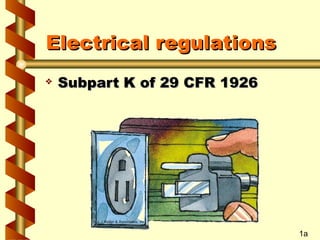
Electrical regulations
 Subpart K of 29 CFR 1926
Subpart K of 29 CFR 1926
1a
Electrical regulations
 Part I - Safety requirements for
Part I - Safety requirements for
installing/using equipment
• approval of electrical components
approval of electrical components
• examination, installation, use of
examination, installation, use of
electrical equipment
• guarding of electrical equipment
guarding of electrical equipment
• overcurrent protection
overcurrent protection
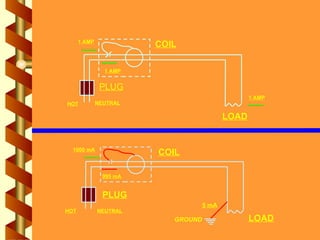
• grounding of equipment
grounding of equipment
1b
Electrical regulations
 Part II - Safety-related work
Part II - Safety-related work
practices
practices
• protection of employees
protection of employees
• passageways and open spaces
passageways and open spaces
• lockout/tagging of circuits
lockout/tagging of circuits
1c
Electrical regulations
 Part III - Safety-related
Part III - Safety-related
maintenance and environmental
considerations
considerations
• protection of wiring components
protection of wiring components
• environmental deterioration of
environmental deterioration of
equipment
equipment
1d
Electrical regulations
 Part IV - Safety requirements for
Part IV - Safety requirements for
special equipment
special equipment
• batteries and battery charging
batteries and battery charging
• PPE
PPE
• emergency eyewash stations
emergency eyewash stations
1e
How electricity works
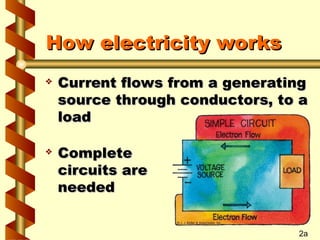
 Current flows from a generating
Current flows from a generating
source through conductors, to a
load
load
 Complete
Complete
circuits are
circuits are
needed
needed
2a
How electricity works
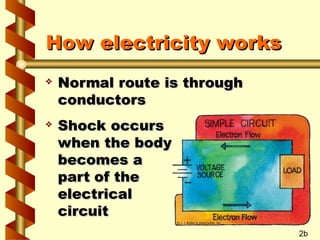
 Normal route is through
Normal route is through
conductors
conductors
 Shock occurs
Shock occurs
when the body
when the body
becomes a
becomes a
part of the
part of the
electrical
electrical
circuit
circuit
2b
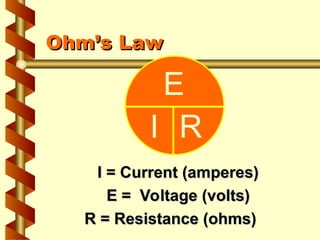
I = Current (amperes)
E = Voltage (volts)
E = Voltage (volts)
R = Resistance (ohms)
E
I R
Ohm’s Law
Ohm’s Law
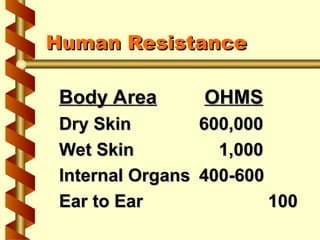
Body Area
Body Area OHMS
OHMS
Dry Skin
Dry Skin 600,000
600,000
Wet Skin
Wet Skin 1,000
1,000
Internal Organs
Internal Organs 400-600
400-600
Ear to Ear
Ear to Ear 100
100
Human Resistance
Human Resistance
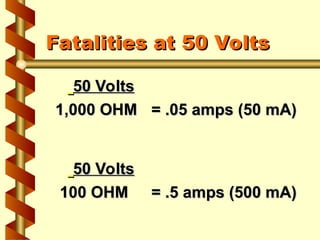
50 Volts
50 Volts
1,000 OHM
1,000 OHM = .05 amps (50 mA)
= .05 amps (50 mA)
50 Volts
50 Volts
100 OHM
100 OHM = .5 amps (500 mA)
= .5 amps (500 mA)
Fatalities at 50 Volts
Electric shock
Electric shock
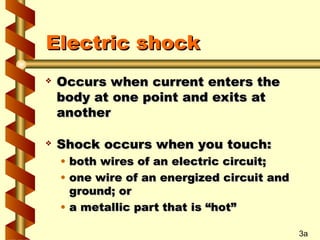
 Occurs when current enters the
Occurs when current enters the
body at one point and exits at
another
another
 Shock occurs when you touch:
Shock occurs when you touch:
• both wires of an electric circuit;
both wires of an electric circuit;
• one wire of an energized circuit and
one wire of an energized circuit and
ground; or
ground; or
• a metallic part that is “hot”
a metallic part that is “hot”
3a
Electric shock
Electric shock
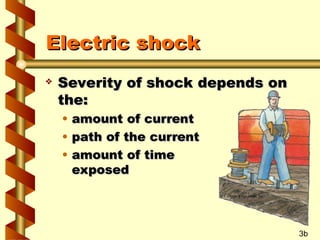
 Severity of shock depends on
Severity of shock depends on
the:
the:
• amount of current
amount of current
• path of the current
path of the current
• amount of time
amount of time
exposed
exposed
3b
Electric shock
Electric shock
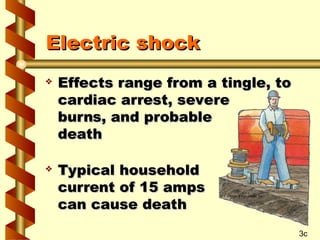
 Effects range from a tingle, to
Effects range from a tingle, to
cardiac arrest, severe
burns, and probable
burns, and probable
death
death
 Typical household
Typical household
current of 15 amps
current of 15 amps
can cause death
can cause death
3c
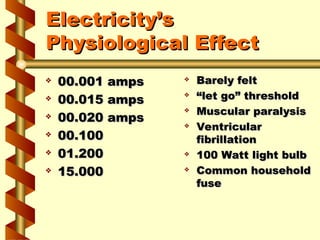
Electricity’s
Electricity’s
Physiological Effect
 00.001 amps
00.001 amps
 00.015 amps
00.015 amps
 00.020 amps
00.020 amps
 00.100
00.100
 01.200
01.200
 15.000
15.000
 Barely felt
Barely felt
 “
“let go” threshold
let go” threshold
 Muscular paralysis
Muscular paralysis
 Ventricular
Ventricular
fibrillation
fibrillation
 100 Watt light bulb
100 Watt light bulb
 Common household
Common household
fuse
fuse
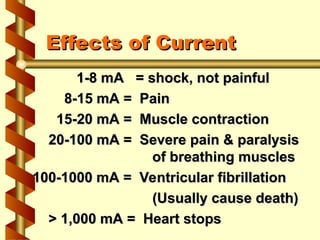
1-8 mA = shock, not painful
8-15 mA = Pain
8-15 mA = Pain
15-20 mA = Muscle contraction
20-100 mA = Severe pain & paralysis
of breathing muscles
100-1000 mA = Ventricular fibrillation
(Usually cause death)
> 1,000 mA = Heart stops
Effects of Current
Effects of Current
Grounding
Grounding
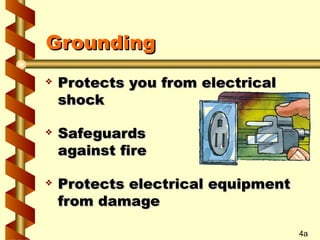
 Protects you from electrical
Protects you from electrical
shock
shock
 Safeguards
Safeguards
against fire
against fire
 Protects electrical equipment
Protects electrical equipment
from damage
from damage
4a
Grounding
Grounding
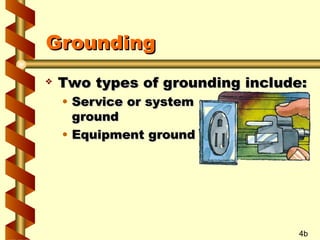
 Two types of grounding include:
Two types of grounding include:
• Service or system
Service or system
ground
ground
• Equipment ground
Equipment ground
4b
Circuit protective
Circuit protective
devices
devices
 At construction sites, the most
At construction sites, the most
common electrical hazard is the
ground fault electrical shock
 OSHA requires either:
OSHA requires either:
• Ground fault circuit interrupters
Ground fault circuit interrupters
(GFCIs); or
(GFCIs); or
• Assured Grounding Conductor
Assured Grounding Conductor
Program
Program
5a
Circuit protective
Circuit protective
devices
devices
 Circuit protective devices
Circuit protective devices
include:
include:
• fuses and circuit breakers -
fuses and circuit breakers -
protect conductors and equipment
• GFCIs - limit or shut off current
GFCIs - limit or shut off current
flow
flow
5b
Ground fault circuit
interrupters
interrupters
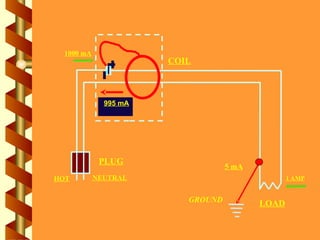
 A fast-acting circuit breaker
A fast-acting circuit breaker
that senses small imbalances in
the circuit caused by current
leakage to ground
leakage to ground
6a
PLUG
COIL
LOAD
HOT NEUTRAL
1 AMP
1 AMP
1 AMP
PLUG
COIL
LOAD
HOT NEUTRAL
1000 mA
995 mA
5 mA
GROUND
1000 mA
PLUG
COIL
LOAD
HOT NEUTRAL
1000 mA
1 AMP
5 mA
GROUND
995 mA
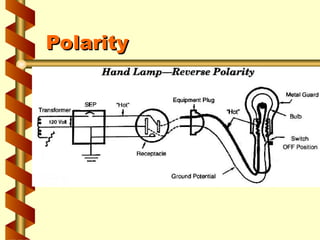
Polarity
Polarity
Assured Equipment
Assured Equipment
Grounding Conductor
Grounding Conductor
program
program
 If GFCIs are not used,
If GFCIs are not used,
employers must have a
scheduled and recorded
Assured Equipment Grounding
Conductor program
Conductor program
7a
 The AEGC program is an
The AEGC program is an
inspection program covering:
• all cord sets
all cord sets
• receptacles that are not part of a
receptacles that are not part of a
permanent wiring structure
• equipment connected by cord and
equipment connected by cord and
plug
plug
7b
Assured Equipment
Assured Equipment
Grounding Conductor
Grounding Conductor
program
program
 Equipment must be visually
Equipment must be visually
inspected for damage/defects
before each day’s use
7c
Assured Equipment
Assured Equipment
Grounding Conductor
Grounding Conductor
program
program
 Tests must be performed:
Tests must be performed:
• before the first use of new
before the first use of new
equipment
equipment
• after suspected damage to
after suspected damage to
equipment
equipment
• at three month intervals
at three month intervals
– continuity test
continuity test
– grounding conductor test
grounding conductor test
7d
Assured Equipment
Assured Equipment
Grounding Conductor
Grounding Conductor
program
program
Lockout/Tagout
Lockout/Tagout
 Electrical equipment deactivated
Electrical equipment deactivated
for repair must be locked out and
tagged at the point where it can be
energized
energized
 Protects maintenance workers
Protects maintenance workers
 Warns others that work is being
Warns others that work is being
performed
performed
8a
Lockout/Tagout
Lockout/Tagout
 Only the person who
Only the person who
locked/tagged the equipment
can turn it back on
can turn it back on
 Before equipment is energized,
Before equipment is energized,
a qualified person must conduct
tests and visual inspections
8b
Lockout/Tagout
Lockout/Tagout
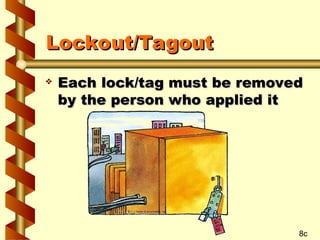
 Each lock/tag must be removed
Each lock/tag must be removed
by the person who applied it
8c
Lockout/Tagout
Lockout/Tagout
 If the employee is absent, the
If the employee is absent, the
lock/tag can be removed by a
qualified person if:
• the employee who applied the lock
the employee who applied the lock
has left the premises
• it is visually determined that all
it is visually determined that all
employees are clear of the
circuits/equipment
circuits/equipment
8d
Guarding requirements
 Any live parts of electrical
Any live parts of electrical
equipment operating at 50 volts
or more must be guarded to
avoid accidental contact
9a
Guarding requirements
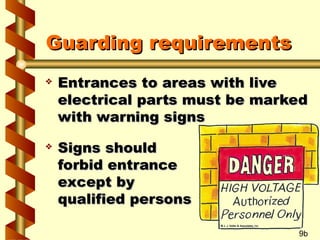
 Entrances to areas with live
Entrances to areas with live
electrical parts must be marked
with warning signs
with warning signs
 Signs should
Signs should
forbid entrance
forbid entrance
except by
except by
qualified persons
qualified persons
9b
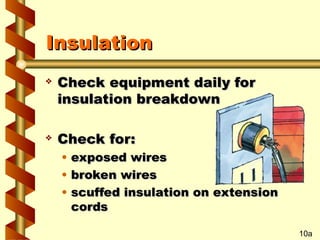
Insulation
Insulation
 Check equipment daily for
Check equipment daily for
insulation breakdown
 Check for:
Check for:
• exposed wires
exposed wires
• broken wires
broken wires
• scuffed insulation on extension
scuffed insulation on extension
cords
cords
10a
Insulation
Insulation
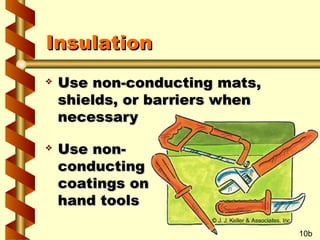
 Use non-conducting mats,
Use non-conducting mats,
shields, or barriers when
necessary
necessary
 Use non-
Use non-
conducting
conducting
coatings on
coatings on
hand tools
hand tools
10b
Personal protective
Personal protective
equipment
equipment
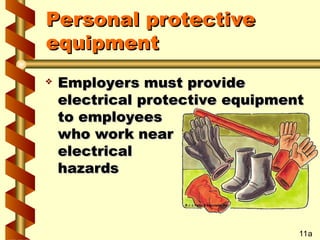
 Employers must provide
Employers must provide
electrical protective equipment
to employees
to employees
who work near
who work near
electrical
electrical
hazards
hazards
11a
Personal protective
Personal protective
equipment
equipment
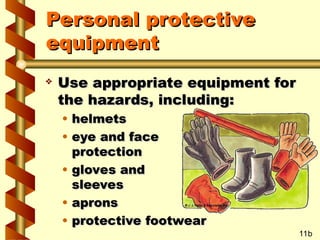
 Use appropriate equipment for
Use appropriate equipment for
the hazards, including:
• helmets
helmets
• eye and face
eye and face
protection
protection
• gloves and
gloves and
sleeves
sleeves
• aprons
aprons
• protective footwear
protective footwear
11b

Electrical_Safety,_Construction_revised.ppt

  • 1.
    Electrical Safety Electrical Safety forConstruction for Construction
  • 2.
    Electrical regulations Electrical regulations Subpart K of 29 CFR 1926 Subpart K of 29 CFR 1926 1a
  • 3.
    Electrical regulations Electrical regulations Part I - Safety requirements for Part I - Safety requirements for installing/using equipment installing/using equipment • approval of electrical components approval of electrical components • examination, installation, use of examination, installation, use of electrical equipment electrical equipment • guarding of electrical equipment guarding of electrical equipment • overcurrent protection overcurrent protection • grounding of equipment grounding of equipment 1b
  • 4.
    Electrical regulations Electrical regulations Part II - Safety-related work Part II - Safety-related work practices practices • protection of employees protection of employees • passageways and open spaces passageways and open spaces • lockout/tagging of circuits lockout/tagging of circuits 1c
  • 5.
    Electrical regulations Electrical regulations Part III - Safety-related Part III - Safety-related maintenance and environmental maintenance and environmental considerations considerations • protection of wiring components protection of wiring components • environmental deterioration of environmental deterioration of equipment equipment 1d
  • 6.
    Electrical regulations Electrical regulations Part IV - Safety requirements for Part IV - Safety requirements for special equipment special equipment • batteries and battery charging batteries and battery charging • PPE PPE • emergency eyewash stations emergency eyewash stations 1e
  • 7.
    How electricity works Howelectricity works  Current flows from a generating Current flows from a generating source through conductors, to a source through conductors, to a load load  Complete Complete circuits are circuits are needed needed 2a
  • 8.
    How electricity works Howelectricity works  Normal route is through Normal route is through conductors conductors  Shock occurs Shock occurs when the body when the body becomes a becomes a part of the part of the electrical electrical circuit circuit 2b
  • 9.
    I = Current(amperes) I = Current (amperes) E = Voltage (volts) E = Voltage (volts) R = Resistance (ohms) R = Resistance (ohms) E I R Ohm’s Law Ohm’s Law
  • 10.
    Body Area Body AreaOHMS OHMS Dry Skin Dry Skin 600,000 600,000 Wet Skin Wet Skin 1,000 1,000 Internal Organs Internal Organs 400-600 400-600 Ear to Ear Ear to Ear 100 100 Human Resistance Human Resistance
  • 11.
    50 Volts 50 Volts 1,000OHM 1,000 OHM = .05 amps (50 mA) = .05 amps (50 mA) 50 Volts 50 Volts 100 OHM 100 OHM = .5 amps (500 mA) = .5 amps (500 mA) Fatalities at 50 Volts Fatalities at 50 Volts
  • 12.
    Electric shock Electric shock Occurs when current enters the Occurs when current enters the body at one point and exits at body at one point and exits at another another  Shock occurs when you touch: Shock occurs when you touch: • both wires of an electric circuit; both wires of an electric circuit; • one wire of an energized circuit and one wire of an energized circuit and ground; or ground; or • a metallic part that is “hot” a metallic part that is “hot” 3a
  • 13.
    Electric shock Electric shock Severity of shock depends on Severity of shock depends on the: the: • amount of current amount of current • path of the current path of the current • amount of time amount of time exposed exposed 3b
  • 14.
    Electric shock Electric shock Effects range from a tingle, to Effects range from a tingle, to cardiac arrest, severe cardiac arrest, severe burns, and probable burns, and probable death death  Typical household Typical household current of 15 amps current of 15 amps can cause death can cause death 3c
  • 15.
    Electricity’s Electricity’s Physiological Effect Physiological Effect 00.001 amps 00.001 amps  00.015 amps 00.015 amps  00.020 amps 00.020 amps  00.100 00.100  01.200 01.200  15.000 15.000  Barely felt Barely felt  “ “let go” threshold let go” threshold  Muscular paralysis Muscular paralysis  Ventricular Ventricular fibrillation fibrillation  100 Watt light bulb 100 Watt light bulb  Common household Common household fuse fuse
  • 16.
    1-8 mA =shock, not painful 1-8 mA = shock, not painful 8-15 mA = Pain 8-15 mA = Pain 15-20 mA = Muscle contraction 15-20 mA = Muscle contraction 20-100 mA = Severe pain & paralysis 20-100 mA = Severe pain & paralysis of breathing muscles of breathing muscles 100-1000 mA = Ventricular fibrillation 100-1000 mA = Ventricular fibrillation (Usually cause death) (Usually cause death) > 1,000 mA = Heart stops > 1,000 mA = Heart stops Effects of Current Effects of Current
  • 17.
    Grounding Grounding  Protects youfrom electrical Protects you from electrical shock shock  Safeguards Safeguards against fire against fire  Protects electrical equipment Protects electrical equipment from damage from damage 4a
  • 18.
    Grounding Grounding  Two typesof grounding include: Two types of grounding include: • Service or system Service or system ground ground • Equipment ground Equipment ground 4b
  • 19.
    Circuit protective Circuit protective devices devices At construction sites, the most At construction sites, the most common electrical hazard is the common electrical hazard is the ground fault electrical shock ground fault electrical shock  OSHA requires either: OSHA requires either: • Ground fault circuit interrupters Ground fault circuit interrupters (GFCIs); or (GFCIs); or • Assured Grounding Conductor Assured Grounding Conductor Program Program 5a
  • 20.
    Circuit protective Circuit protective devices devices Circuit protective devices Circuit protective devices include: include: • fuses and circuit breakers - fuses and circuit breakers - protect conductors and equipment protect conductors and equipment • GFCIs - limit or shut off current GFCIs - limit or shut off current flow flow 5b
  • 21.
    Ground fault circuit Groundfault circuit interrupters interrupters  A fast-acting circuit breaker A fast-acting circuit breaker that senses small imbalances in that senses small imbalances in the circuit caused by current the circuit caused by current leakage to ground leakage to ground 6a
  • 22.
    PLUG COIL LOAD HOT NEUTRAL 1 AMP 1AMP 1 AMP PLUG COIL LOAD HOT NEUTRAL 1000 mA 995 mA 5 mA GROUND
  • 23.
    1000 mA PLUG COIL LOAD HOT NEUTRAL 1000mA 1 AMP 5 mA GROUND 995 mA
  • 24.
  • 25.
    Assured Equipment Assured Equipment GroundingConductor Grounding Conductor program program  If GFCIs are not used, If GFCIs are not used, employers must have a employers must have a scheduled and recorded scheduled and recorded Assured Equipment Grounding Assured Equipment Grounding Conductor program Conductor program 7a
  • 26.
     The AEGCprogram is an The AEGC program is an inspection program covering: inspection program covering: • all cord sets all cord sets • receptacles that are not part of a receptacles that are not part of a permanent wiring structure permanent wiring structure • equipment connected by cord and equipment connected by cord and plug plug 7b Assured Equipment Assured Equipment Grounding Conductor Grounding Conductor program program
  • 27.
     Equipment mustbe visually Equipment must be visually inspected for damage/defects inspected for damage/defects before each day’s use before each day’s use 7c Assured Equipment Assured Equipment Grounding Conductor Grounding Conductor program program
  • 28.
     Tests mustbe performed: Tests must be performed: • before the first use of new before the first use of new equipment equipment • after suspected damage to after suspected damage to equipment equipment • at three month intervals at three month intervals – continuity test continuity test – grounding conductor test grounding conductor test 7d Assured Equipment Assured Equipment Grounding Conductor Grounding Conductor program program
  • 29.
    Lockout/Tagout Lockout/Tagout  Electrical equipmentdeactivated Electrical equipment deactivated for repair must be locked out and for repair must be locked out and tagged at the point where it can be tagged at the point where it can be energized energized  Protects maintenance workers Protects maintenance workers  Warns others that work is being Warns others that work is being performed performed 8a
  • 30.
    Lockout/Tagout Lockout/Tagout  Only theperson who Only the person who locked/tagged the equipment locked/tagged the equipment can turn it back on can turn it back on  Before equipment is energized, Before equipment is energized, a qualified person must conduct a qualified person must conduct tests and visual inspections tests and visual inspections 8b
  • 31.
    Lockout/Tagout Lockout/Tagout  Each lock/tagmust be removed Each lock/tag must be removed by the person who applied it by the person who applied it 8c
  • 32.
    Lockout/Tagout Lockout/Tagout  If theemployee is absent, the If the employee is absent, the lock/tag can be removed by a lock/tag can be removed by a qualified person if: qualified person if: • the employee who applied the lock the employee who applied the lock has left the premises has left the premises • it is visually determined that all it is visually determined that all employees are clear of the employees are clear of the circuits/equipment circuits/equipment 8d
  • 33.
    Guarding requirements Guarding requirements Any live parts of electrical Any live parts of electrical equipment operating at 50 volts equipment operating at 50 volts or more must be guarded to or more must be guarded to avoid accidental contact avoid accidental contact 9a
  • 34.
    Guarding requirements Guarding requirements Entrances to areas with live Entrances to areas with live electrical parts must be marked electrical parts must be marked with warning signs with warning signs  Signs should Signs should forbid entrance forbid entrance except by except by qualified persons qualified persons 9b
  • 35.
    Insulation Insulation  Check equipmentdaily for Check equipment daily for insulation breakdown insulation breakdown  Check for: Check for: • exposed wires exposed wires • broken wires broken wires • scuffed insulation on extension scuffed insulation on extension cords cords 10a
  • 36.
    Insulation Insulation  Use non-conductingmats, Use non-conducting mats, shields, or barriers when shields, or barriers when necessary necessary  Use non- Use non- conducting conducting coatings on coatings on hand tools hand tools 10b
  • 37.
    Personal protective Personal protective equipment equipment Employers must provide Employers must provide electrical protective equipment electrical protective equipment to employees to employees who work near who work near electrical electrical hazards hazards 11a
  • 38.
    Personal protective Personal protective equipment equipment Use appropriate equipment for Use appropriate equipment for the hazards, including: the hazards, including: • helmets helmets • eye and face eye and face protection protection • gloves and gloves and sleeves sleeves • aprons aprons • protective footwear protective footwear 11b