Electrical Safety
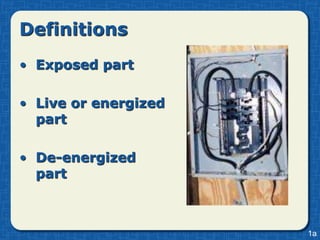
Definitions
• Exposed part

• Live or energized
  part

• De-energized
  part


                      1a
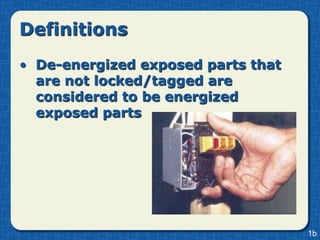
Definitions
• De-energized exposed parts that
  are not locked/tagged are
  considered to be energized
  exposed parts


                                    1b
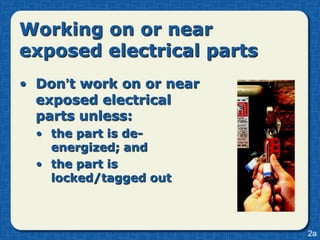
Working on or near
exposed electrical parts
• Don’t work on or near
  exposed electrical
  parts unless:
  • the part is de-
    energized; and
  • the part is
    locked/tagged out


                           2a
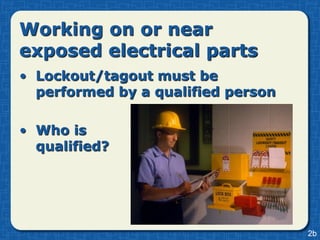
Working on or near
exposed electrical parts
• Lockout/tagout must be
  performed by a qualified person

• Who is
  qualified?


                                    2b
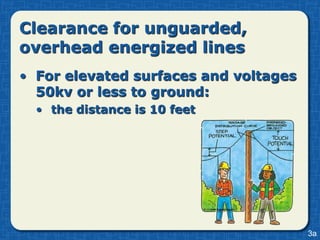
Clearance for unguarded,
overhead energized lines
• For elevated surfaces and voltages
  50kv or less to ground:
  • the distance is 10 feet


                                       3a
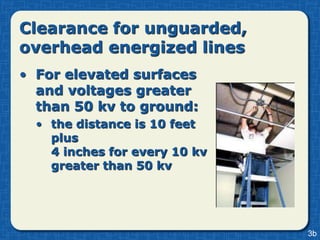
Clearance for unguarded,
overhead energized lines
• For elevated surfaces
  and voltages greater
  than 50 kv to ground:
  • the distance is 10 feet
    plus
    4 inches for every 10 kv
    greater than 50 kv


                               3b
Clearance for unguarded,
overhead energized lines
• When working on the ground in
  the vicinity of unguarded,
  energized overhead lines 50 kv or
  less to ground:
  • keep conductive objects at least 10
    feet away


                                          3c
Clearance for unguarded,
overhead energized lines
• When working on the
  ground in the vicinity of
  unguarded, energized
  overhead lines greater than
  50 kv to ground:
  • keep conductive objects at
    least 10 feet away, plus 4
    inches for every 10 kv over 50
    kv

                                     3d
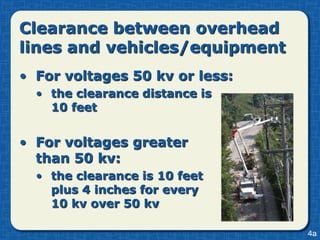
Clearance between overhead
lines and vehicles/equipment
• For voltages 50 kv or less:
  • the clearance distance is
    10 feet


• For voltages greater
  than 50 kv:
  • the clearance is 10 feet
    plus 4 inches for every
    10 kv over 50 kv

                                4a
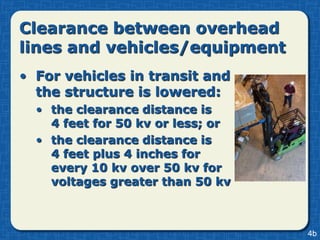
Clearance between overhead
lines and vehicles/equipment
• For vehicles in transit and
  the structure is lowered:
  • the clearance distance is
    4 feet for 50 kv or less; or
  • the clearance distance is
    4 feet plus 4 inches for
    every 10 kv over 50 kv for
    voltages greater than 50 kv


                                   4b
Clearance between overhead
lines and vehicles/equipment
• When insulating barriers
  designed for line voltage are
  installed, and not
  attached to, or
  part of, the vehicle
  or mechanical
  equipment:
  • the clearance is the
    designed working
    dimensions of the barrier
                                  4c
Clearance between overhead
lines and vehicles/equipment
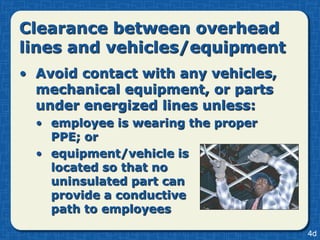
• Avoid contact with any vehicles,
  mechanical equipment, or parts
  under energized lines unless:
  • employee is wearing the proper
    PPE; or
  • equipment/vehicle is
    located so that no
    uninsulated part can
    provide a conductive
    path to employees

                                     4d
Clearance between overhead
lines and vehicles/equipment
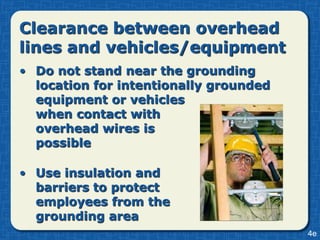
• Do not stand near the grounding
  location for intentionally grounded
  equipment or vehicles
  when contact with
  overhead wires is
  possible

• Use insulation and
  barriers to protect
  employees from the
  grounding area
                                        4e
Use of nonconductive
ladders
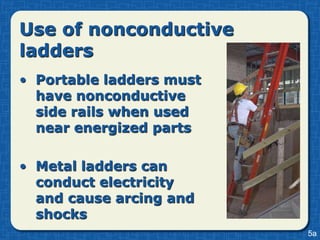
• Portable ladders must
  have nonconductive
  side rails when used
  near energized parts

• Metal ladders can
  conduct electricity
  and cause arcing and
  shocks
                          5a
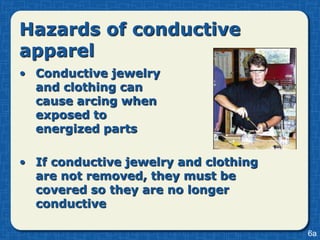
Hazards of conductive
apparel
• Conductive jewelry
  and clothing can
  cause arcing when
  exposed to
  energized parts

• If conductive jewelry and clothing
  are not removed, they must be
  covered so they are no longer
  conductive

                                       6a
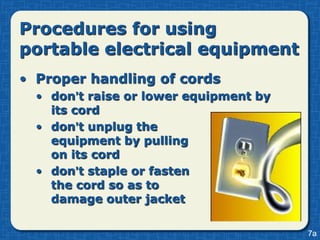
Procedures for using
portable electrical equipment
• Proper handling of cords
  • don’t raise or lower equipment by
    its cord
  • don’t unplug the
    equipment by pulling
    on its cord
  • don’t staple or fasten
    the cord so as to
    damage outer jacket

                                        7a
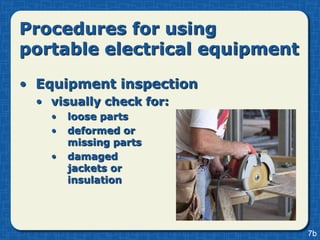
Procedures for using
portable electrical equipment
• Equipment inspection
  • visually check for:
    •   loose parts
    •   deformed or
        missing parts
    •   damaged
        jackets or
        insulation


                                7b
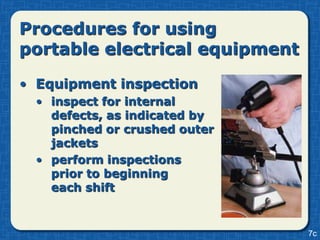
Procedures for using
portable electrical equipment
• Equipment inspection
  • inspect for internal
    defects, as indicated by
    pinched or crushed outer
    jackets
  • perform inspections
    prior to beginning
    each shift


                                7c
Procedures for using
portable electrical equipment
• Equipment inspection
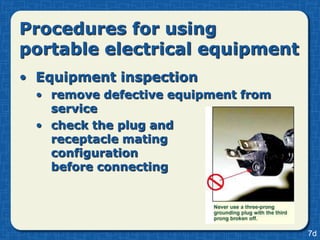
  • remove defective equipment from
    service
  • check the plug and
    receptacle mating
    configuration
    before connecting


                                      7d
Procedures for using
portable electrical equipment
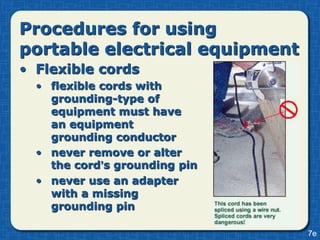
• Flexible cords
  • flexible cords with
    grounding-type of
    equipment must have
    an equipment
    grounding conductor
  • never remove or alter
    the cord’s grounding pin
  • never use an adapter
    with a missing
    grounding pin

                                7e
Procedures for using
portable electrical equipment
• Electrical equipment and cords to
  be used near water must be
  approved for this use


                                      7f
Procedures for using
portable electrical equipment
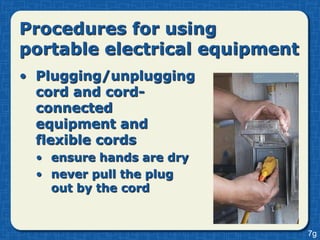
• Plugging/unplugging
  cord and cord-
  connected
  equipment and
  flexible cords
 • ensure hands are dry
 • never pull the plug
   out by the cord


                                7g
Procedures for using
portable electrical equipment
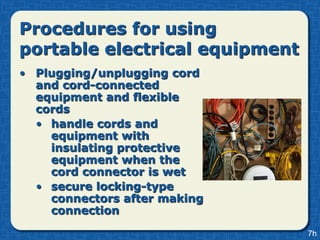
• Plugging/unplugging cord
  and cord-connected
  equipment and flexible
  cords
  • handle cords and
    equipment with
    insulating protective
    equipment when the
    cord connector is wet
  • secure locking-type
    connectors after making
    connection
                                7h
Procedures for using
portable electrical equipment
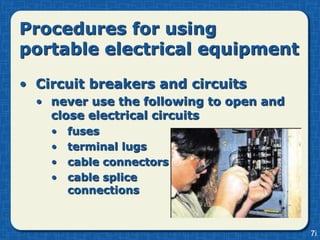
• Circuit breakers and circuits
  • never use the following to open and
    close electrical circuits
    •   fuses
    •   terminal lugs
    •   cable connectors
    •   cable splice
        connections


                                          7i
Procedures for using
portable electrical equipment
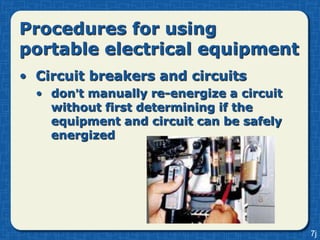
• Circuit breakers and circuits
  • don’t manually re-energize a circuit
    without first determining if the
    equipment and circuit can be safely
    energized


                                           7j
Procedures for using
portable electrical equipment
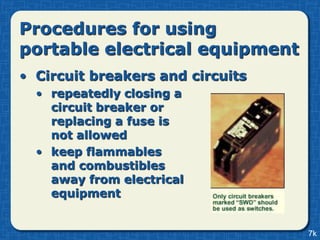
• Circuit breakers and circuits
  • repeatedly closing a
    circuit breaker or
    replacing a fuse is
    not allowed
  • keep flammables
    and combustibles
    away from electrical
    equipment


                                  7k
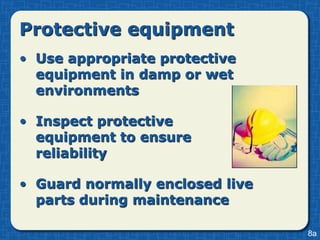
Protective equipment
• Use appropriate protective
  equipment in damp or wet
  environments

• Inspect protective
  equipment to ensure
  reliability

• Guard normally enclosed live
  parts during maintenance

                                 8a
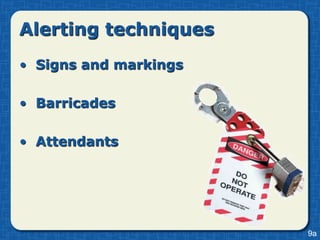
Alerting techniques
• Signs and markings

• Barricades

• Attendants


                       9a
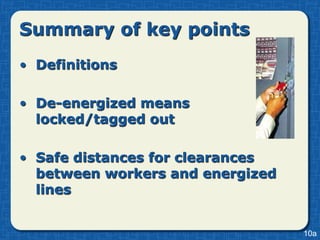
Summary of key points
• Definitions

• De-energized means
  locked/tagged out

• Safe distances for clearances
  between workers and energized
  lines


                                  10a
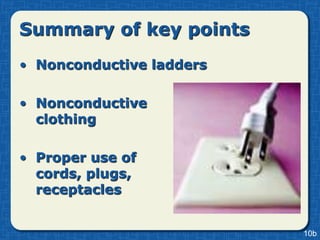
Summary of key points
• Nonconductive ladders

• Nonconductive
  clothing

• Proper use of
  cords, plugs,
  receptacles


                          10b
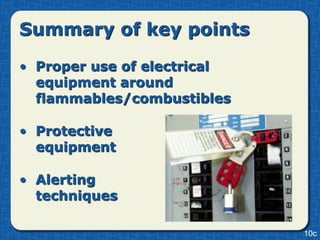
Summary of key points

• Proper use of electrical
  equipment around
  flammables/combustibles

• Protective
  equipment

• Alerting
  techniques

                             10c

Electrical power point training from pete

  • 1.
  • 2.
    Definitions • Exposed part •Live or energized part • De-energized part 1a
  • 3.
    Definitions • De-energized exposedparts that are not locked/tagged are considered to be energized exposed parts 1b
  • 4.
    Working on ornear exposed electrical parts • Don’t work on or near exposed electrical parts unless: • the part is de- energized; and • the part is locked/tagged out 2a
  • 5.
    Working on ornear exposed electrical parts • Lockout/tagout must be performed by a qualified person • Who is qualified? 2b
  • 6.
    Clearance for unguarded, overheadenergized lines • For elevated surfaces and voltages 50kv or less to ground: • the distance is 10 feet 3a
  • 7.
    Clearance for unguarded, overheadenergized lines • For elevated surfaces and voltages greater than 50 kv to ground: • the distance is 10 feet plus 4 inches for every 10 kv greater than 50 kv 3b
  • 8.
    Clearance for unguarded, overheadenergized lines • When working on the ground in the vicinity of unguarded, energized overhead lines 50 kv or less to ground: • keep conductive objects at least 10 feet away 3c
  • 9.
    Clearance for unguarded, overheadenergized lines • When working on the ground in the vicinity of unguarded, energized overhead lines greater than 50 kv to ground: • keep conductive objects at least 10 feet away, plus 4 inches for every 10 kv over 50 kv 3d
  • 10.
    Clearance between overhead linesand vehicles/equipment • For voltages 50 kv or less: • the clearance distance is 10 feet • For voltages greater than 50 kv: • the clearance is 10 feet plus 4 inches for every 10 kv over 50 kv 4a
  • 11.
    Clearance between overhead linesand vehicles/equipment • For vehicles in transit and the structure is lowered: • the clearance distance is 4 feet for 50 kv or less; or • the clearance distance is 4 feet plus 4 inches for every 10 kv over 50 kv for voltages greater than 50 kv 4b
  • 12.
    Clearance between overhead linesand vehicles/equipment • When insulating barriers designed for line voltage are installed, and not attached to, or part of, the vehicle or mechanical equipment: • the clearance is the designed working dimensions of the barrier 4c
  • 13.
    Clearance between overhead linesand vehicles/equipment • Avoid contact with any vehicles, mechanical equipment, or parts under energized lines unless: • employee is wearing the proper PPE; or • equipment/vehicle is located so that no uninsulated part can provide a conductive path to employees 4d
  • 14.
    Clearance between overhead linesand vehicles/equipment • Do not stand near the grounding location for intentionally grounded equipment or vehicles when contact with overhead wires is possible • Use insulation and barriers to protect employees from the grounding area 4e
  • 15.
    Use of nonconductive ladders •Portable ladders must have nonconductive side rails when used near energized parts • Metal ladders can conduct electricity and cause arcing and shocks 5a
  • 16.
    Hazards of conductive apparel •Conductive jewelry and clothing can cause arcing when exposed to energized parts • If conductive jewelry and clothing are not removed, they must be covered so they are no longer conductive 6a
  • 17.
    Procedures for using portableelectrical equipment • Proper handling of cords • don’t raise or lower equipment by its cord • don’t unplug the equipment by pulling on its cord • don’t staple or fasten the cord so as to damage outer jacket 7a
  • 18.
    Procedures for using portableelectrical equipment • Equipment inspection • visually check for: • loose parts • deformed or missing parts • damaged jackets or insulation 7b
  • 19.
    Procedures for using portableelectrical equipment • Equipment inspection • inspect for internal defects, as indicated by pinched or crushed outer jackets • perform inspections prior to beginning each shift 7c
  • 20.
    Procedures for using portableelectrical equipment • Equipment inspection • remove defective equipment from service • check the plug and receptacle mating configuration before connecting 7d
  • 21.
    Procedures for using portableelectrical equipment • Flexible cords • flexible cords with grounding-type of equipment must have an equipment grounding conductor • never remove or alter the cord’s grounding pin • never use an adapter with a missing grounding pin 7e
  • 22.
    Procedures for using portableelectrical equipment • Electrical equipment and cords to be used near water must be approved for this use 7f
  • 23.
    Procedures for using portableelectrical equipment • Plugging/unplugging cord and cord- connected equipment and flexible cords • ensure hands are dry • never pull the plug out by the cord 7g
  • 24.
    Procedures for using portableelectrical equipment • Plugging/unplugging cord and cord-connected equipment and flexible cords • handle cords and equipment with insulating protective equipment when the cord connector is wet • secure locking-type connectors after making connection 7h
  • 25.
    Procedures for using portableelectrical equipment • Circuit breakers and circuits • never use the following to open and close electrical circuits • fuses • terminal lugs • cable connectors • cable splice connections 7i
  • 26.
    Procedures for using portableelectrical equipment • Circuit breakers and circuits • don’t manually re-energize a circuit without first determining if the equipment and circuit can be safely energized 7j
  • 27.
    Procedures for using portableelectrical equipment • Circuit breakers and circuits • repeatedly closing a circuit breaker or replacing a fuse is not allowed • keep flammables and combustibles away from electrical equipment 7k
  • 28.
    Protective equipment • Useappropriate protective equipment in damp or wet environments • Inspect protective equipment to ensure reliability • Guard normally enclosed live parts during maintenance 8a
  • 29.
    Alerting techniques • Signsand markings • Barricades • Attendants 9a
  • 30.
    Summary of keypoints • Definitions • De-energized means locked/tagged out • Safe distances for clearances between workers and energized lines 10a
  • 31.
    Summary of keypoints • Nonconductive ladders • Nonconductive clothing • Proper use of cords, plugs, receptacles 10b
  • 32.
    Summary of keypoints • Proper use of electrical equipment around flammables/combustibles • Protective equipment • Alerting techniques 10c