
DC CIRCUIT
TOPIC:
PRESENTED BY,
G.DHARANI
G.ANUPRIYA
ELECTRICAL CIRCUIT
The Path taken by the electric current under the
resistor.
A simple circuit consists of Supply, Battery, Switch,
Resistance or capacitance.
Types of electric circuit
 Simple or closed circuit
 Open circuit
 Short circuit
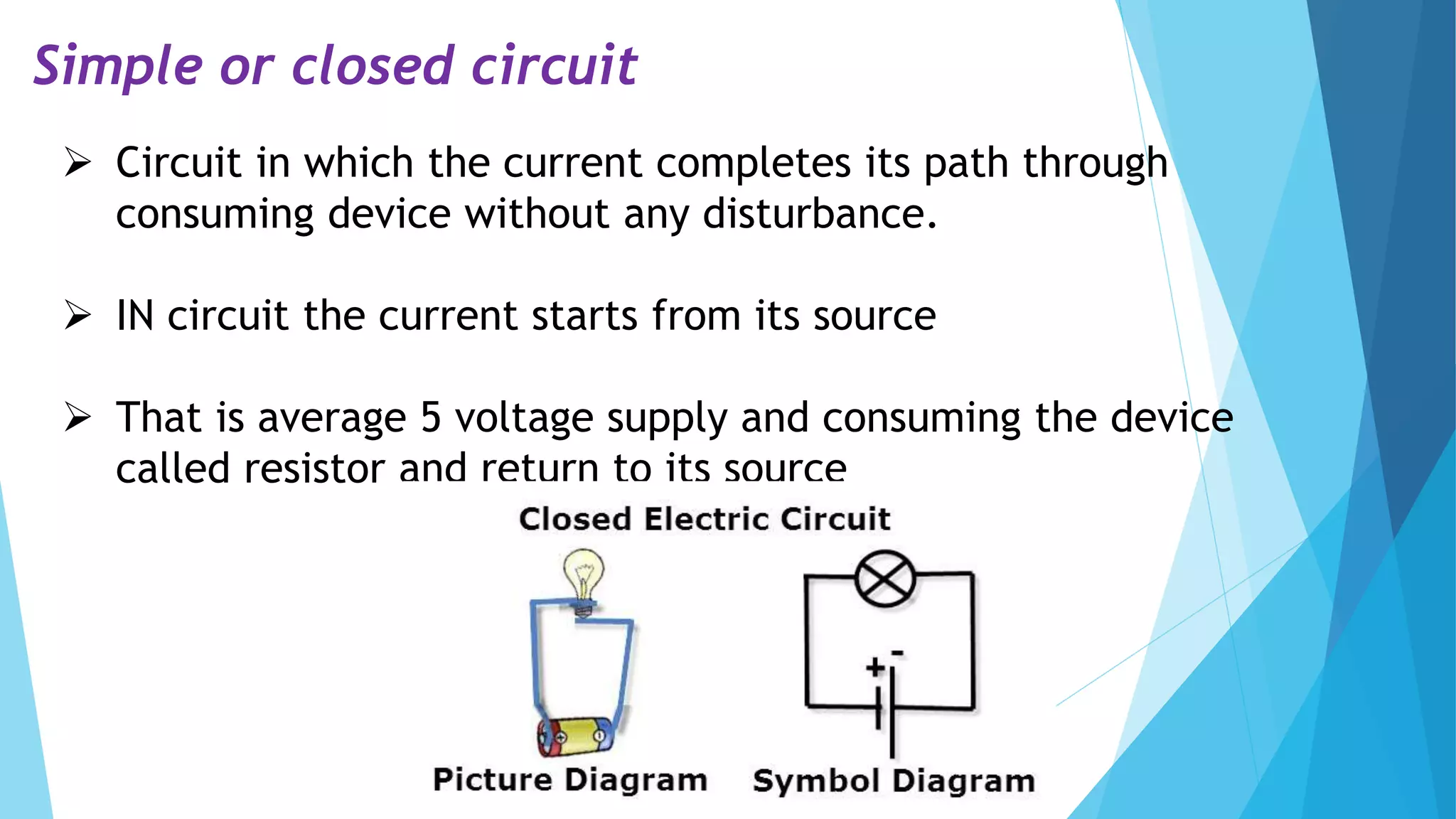
Simple or closed circuit
 Circuit in which the current completes its path through
consuming device without any disturbance.
 IN circuit the current starts from its source
 That is average 5 voltage supply and consuming the device
called resistor and return to its source
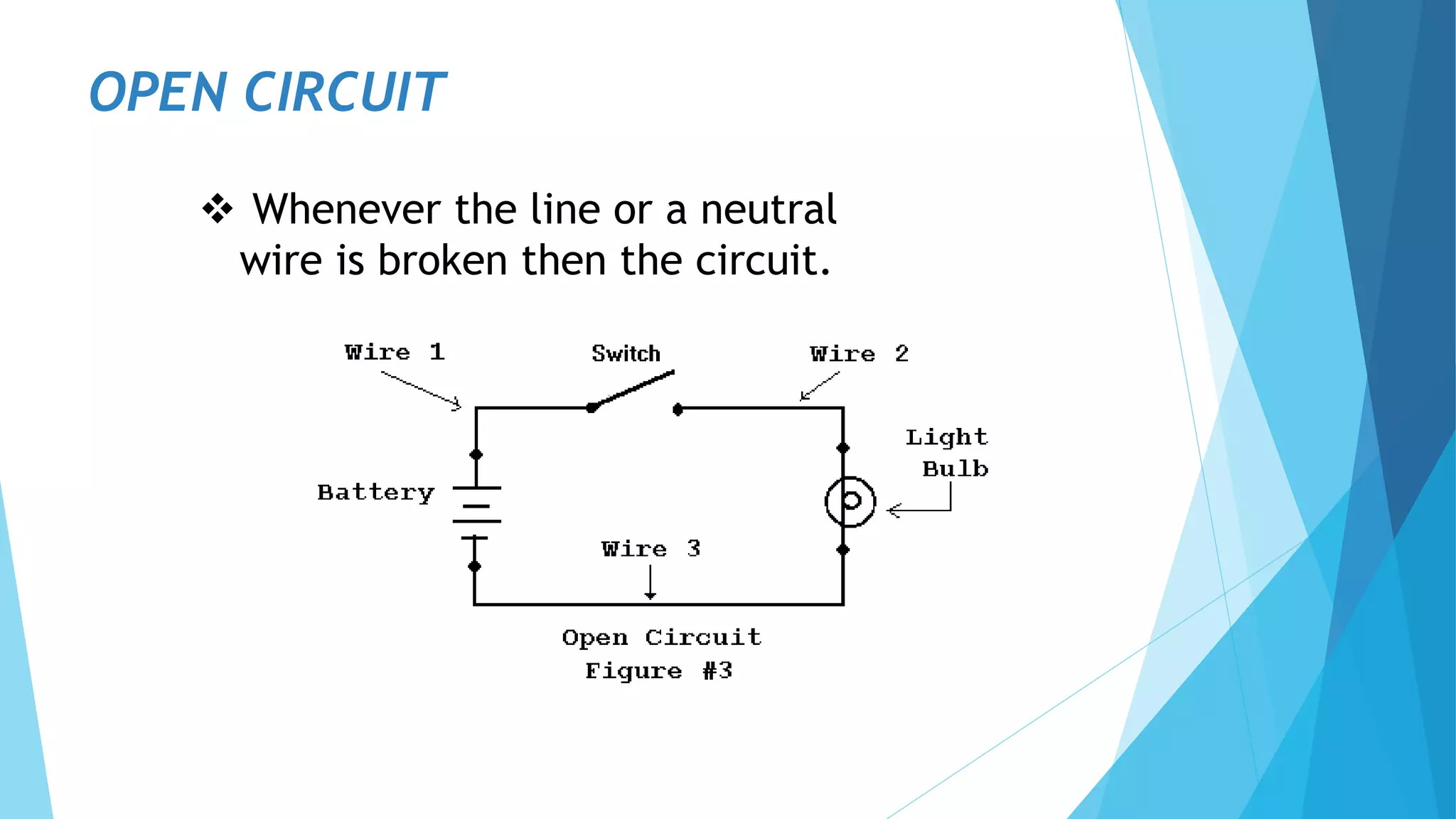
OPEN CIRCUIT
 Whenever the line or a neutral
wire is broken then the circuit.
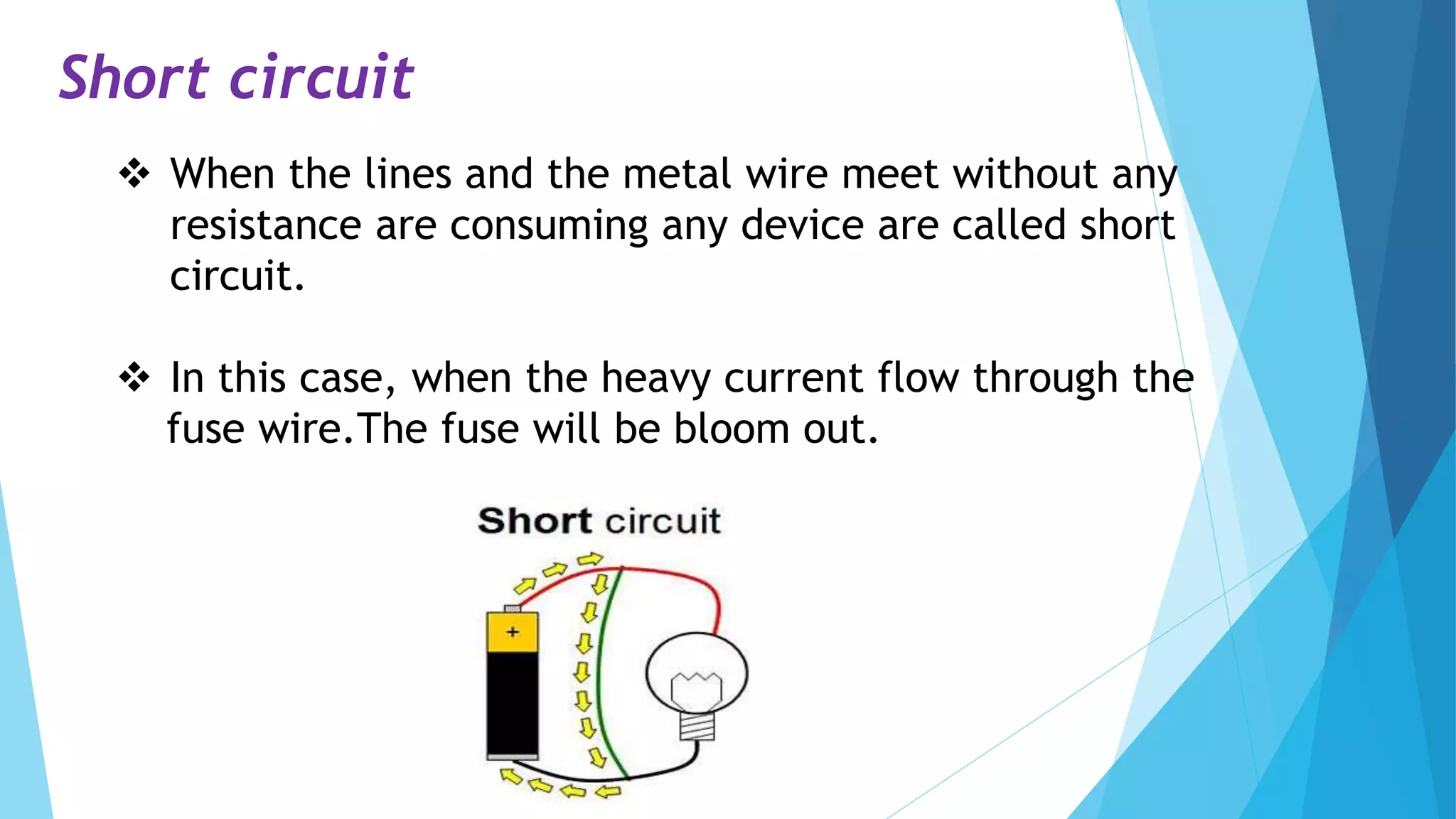
Short circuit
 When the lines and the metal wire meet without any
resistance are consuming any device are called short
circuit.
 In this case, when the heavy current flow through the
fuse wire.The fuse will be bloom out.
Potential difference
Difference in the potential of two charged
bodies is called potential difference.
Unit: volt(u)
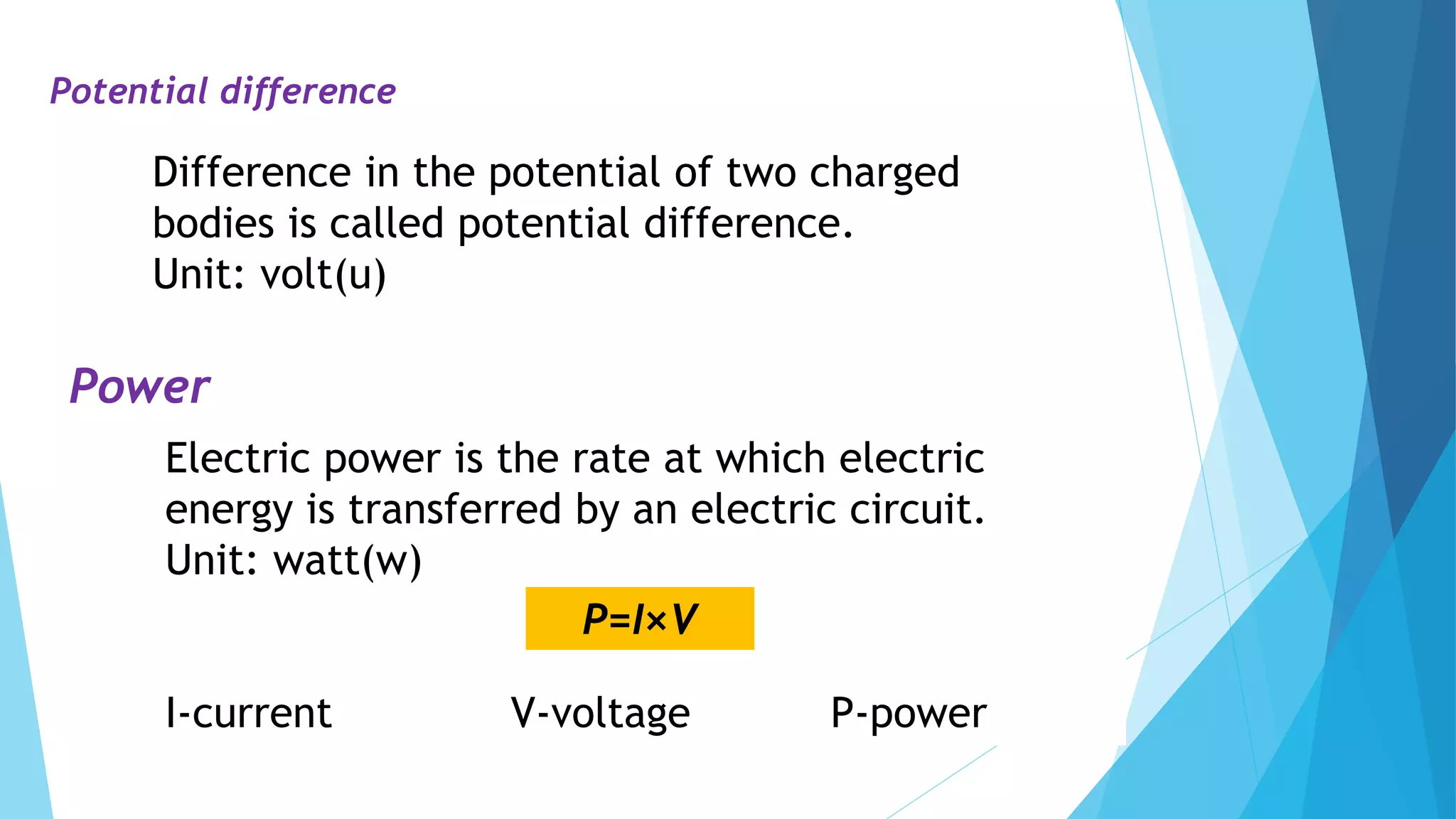
Power
Electric power is the rate at which electric
energy is transferred by an electric circuit.
Unit: watt(w)
I-current V-voltage P-power
P=I×V
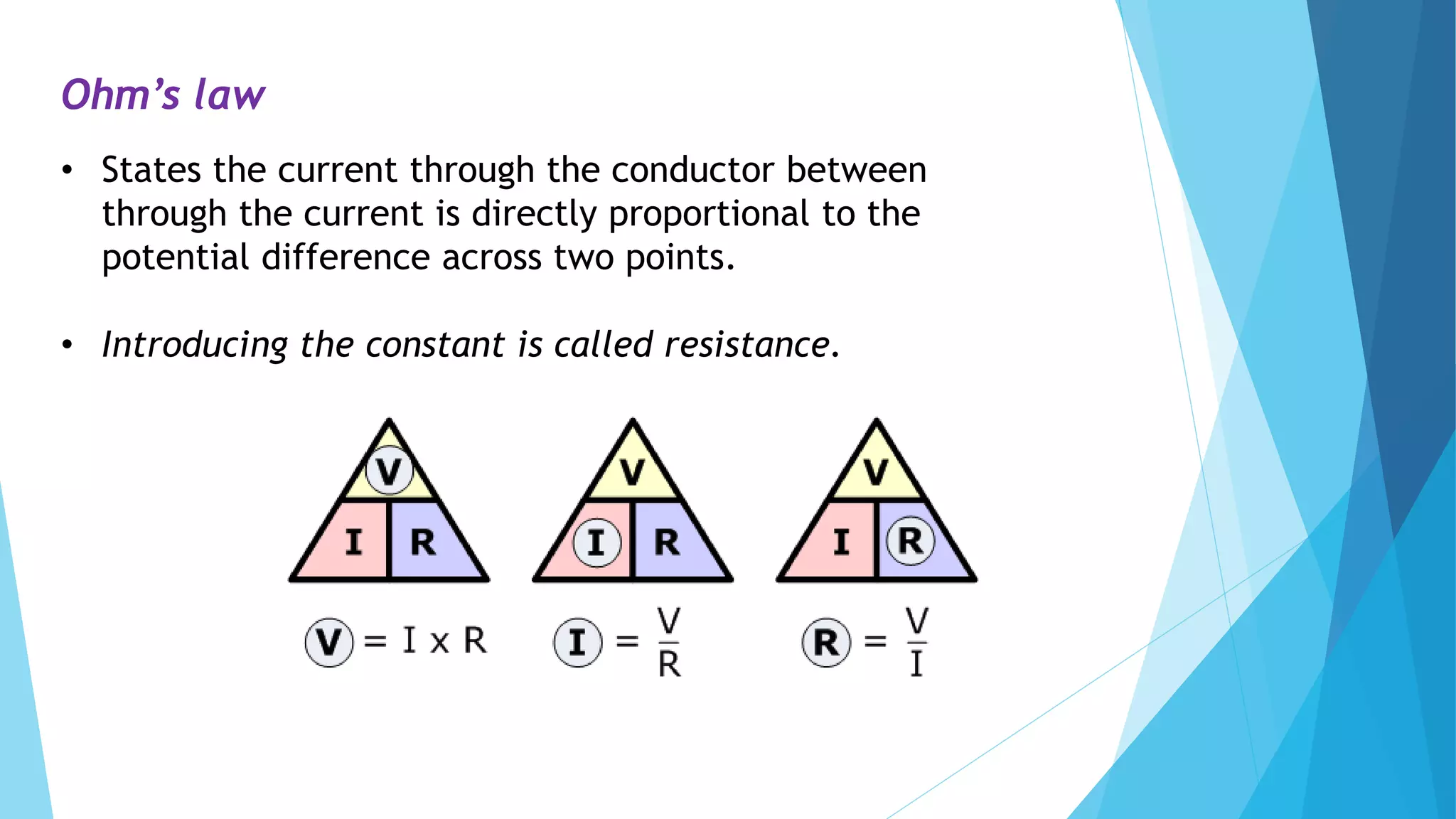
Ohm’s law
• States the current through the conductor between
through the current is directly proportional to the
potential difference across two points.
• Introducing the constant is called resistance.
Kirchoff’s law:
Two types of Kirchoff’s law are
 Kirchoff’s current law
 Kirchoff’s voltage law
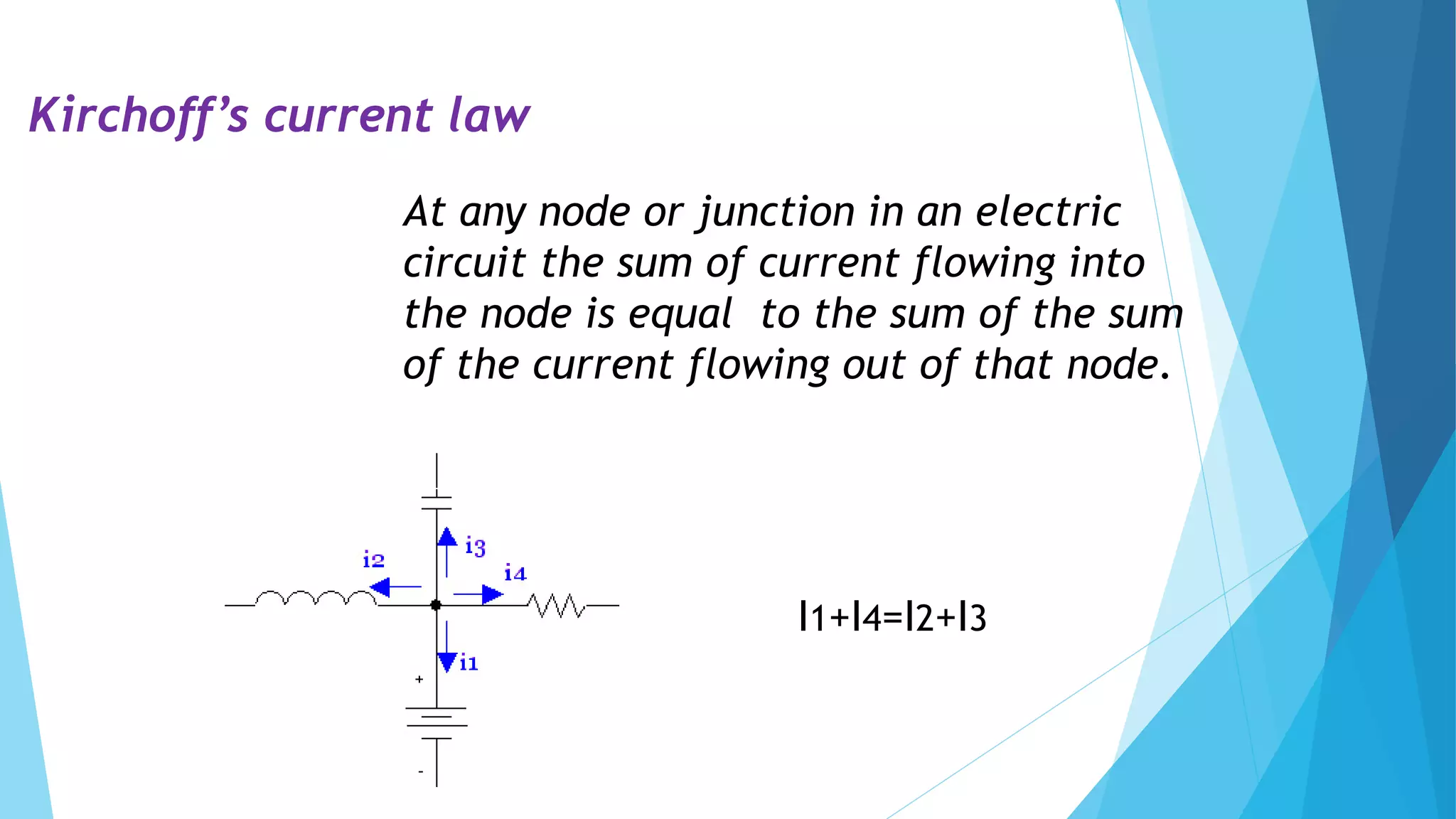
Kirchoff’s current law
At any node or junction in an electric
circuit the sum of current flowing into
the node is equal to the sum of the sum
of the current flowing out of that node.
I1+I4=I2+I3
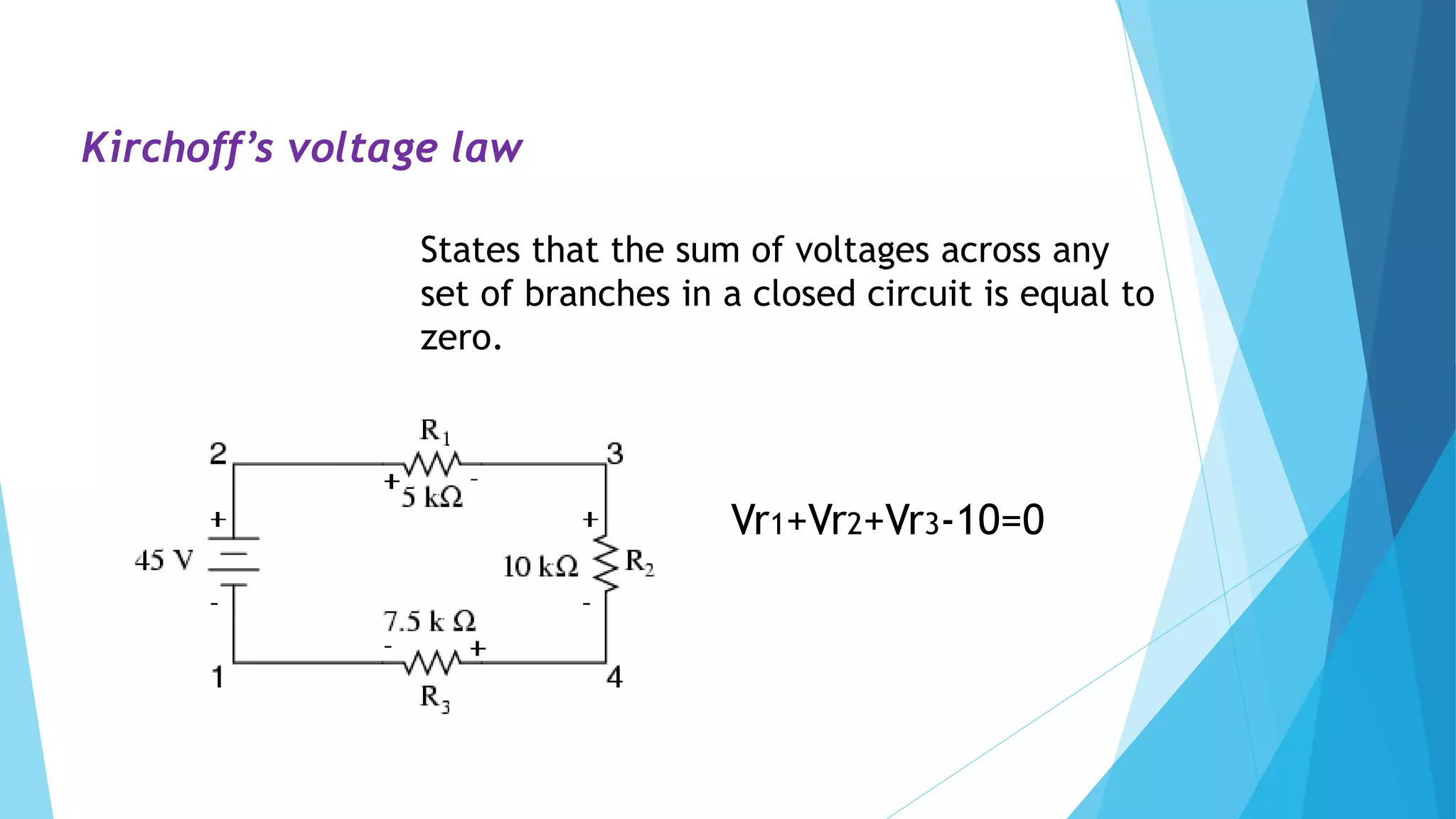
Kirchoff’s voltage law
States that the sum of voltages across any
set of branches in a closed circuit is equal to
zero.
Vr1+Vr2+Vr3-10=0
Types of circuit
• Series circuit
• Parallel circuit
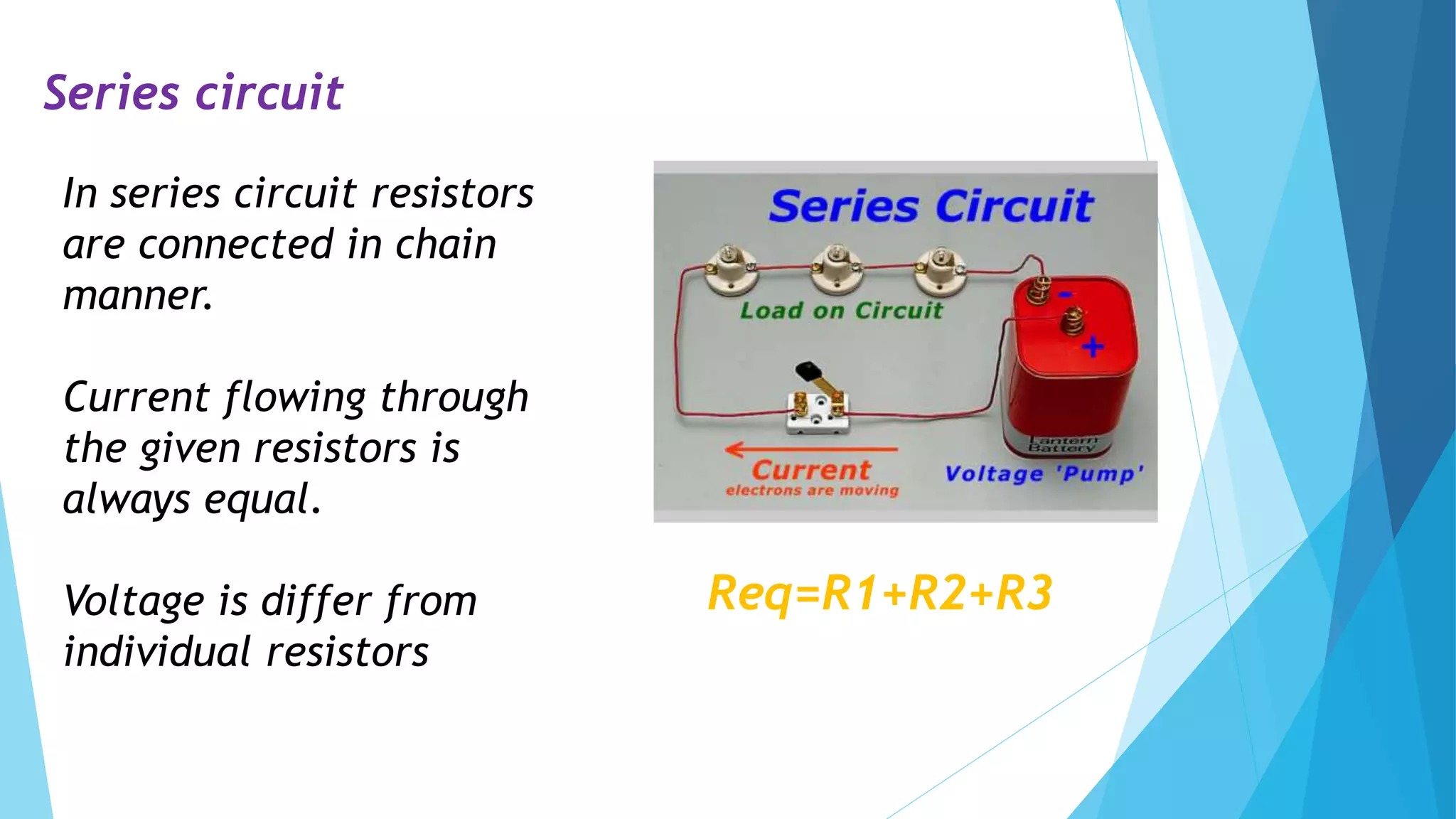
Series circuit
In series circuit resistors
are connected in chain
manner.
Current flowing through
the given resistors is
always equal.
Voltage is differ from
individual resistors
Req=R1+R2+R3
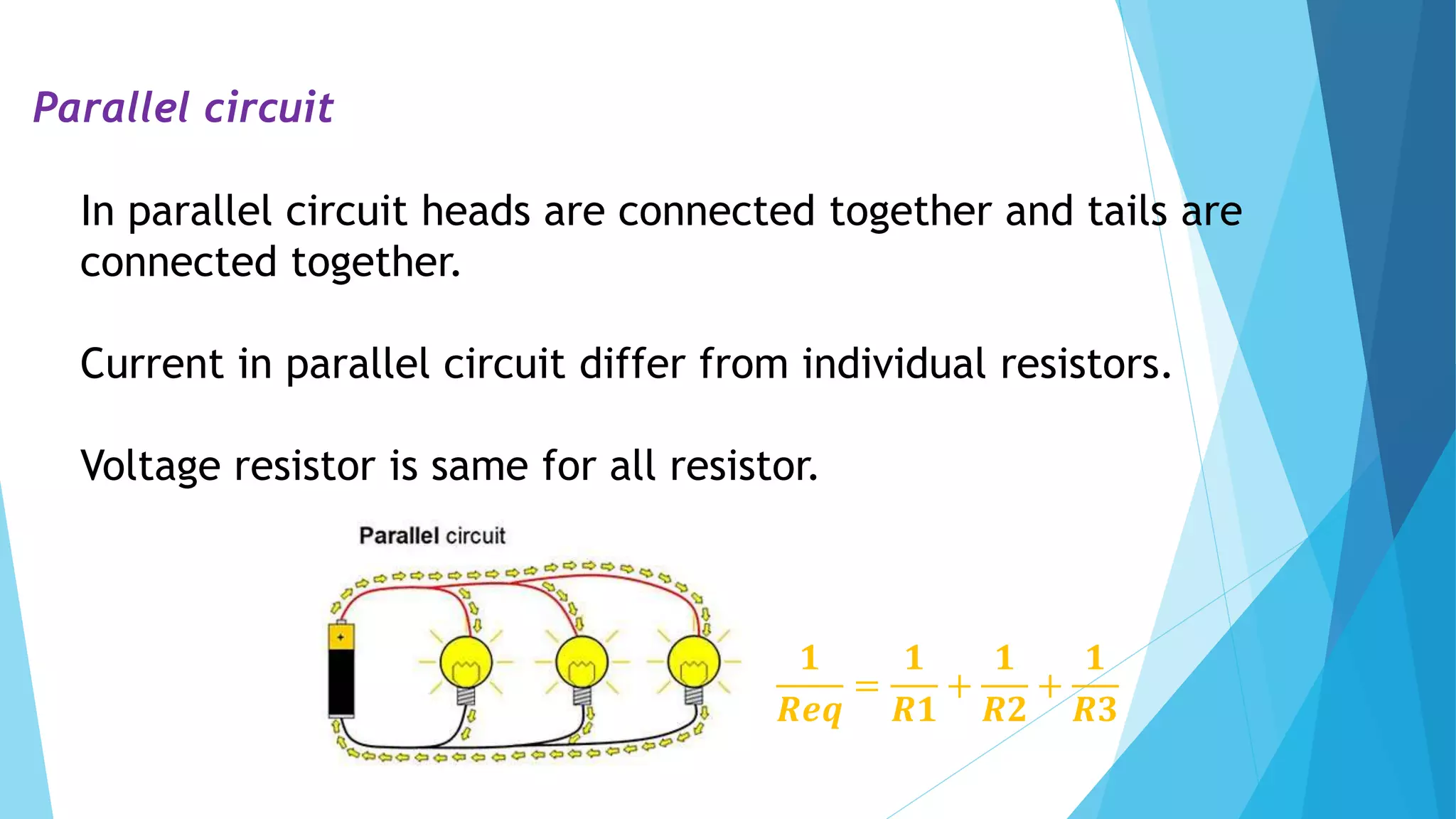
Parallel circuit
In parallel circuit heads are connected together and tails are
connected together.
Current in parallel circuit differ from individual resistors.
Voltage resistor is same for all resistor.
𝟏
𝑹𝒆𝒒
=
𝟏
𝑹𝟏
+
𝟏
𝑹𝟐
+
𝟏
𝑹𝟑
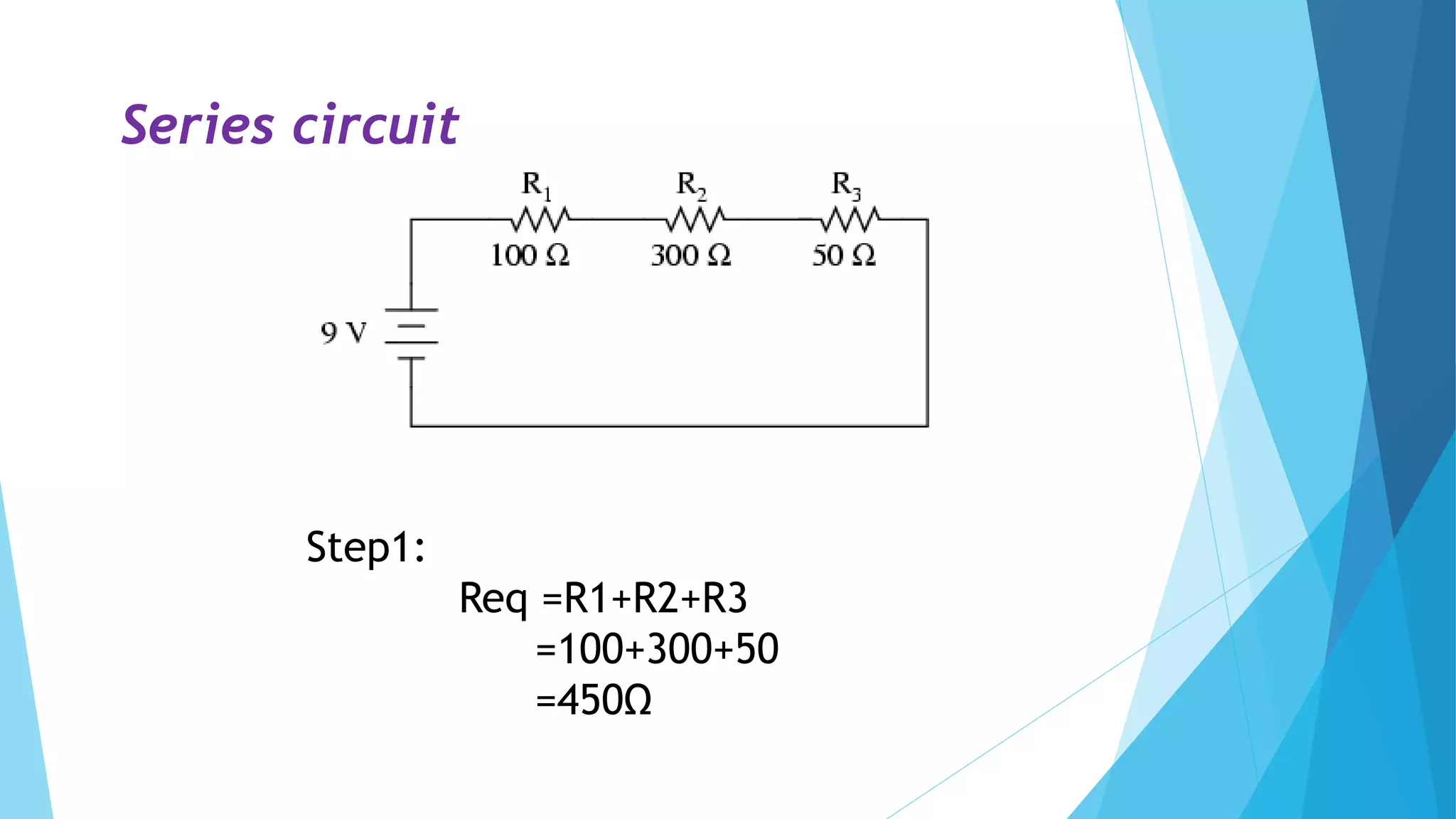
Step1:
Req =R1+R2+R3
=100+300+50
=450Ω
Series circuit
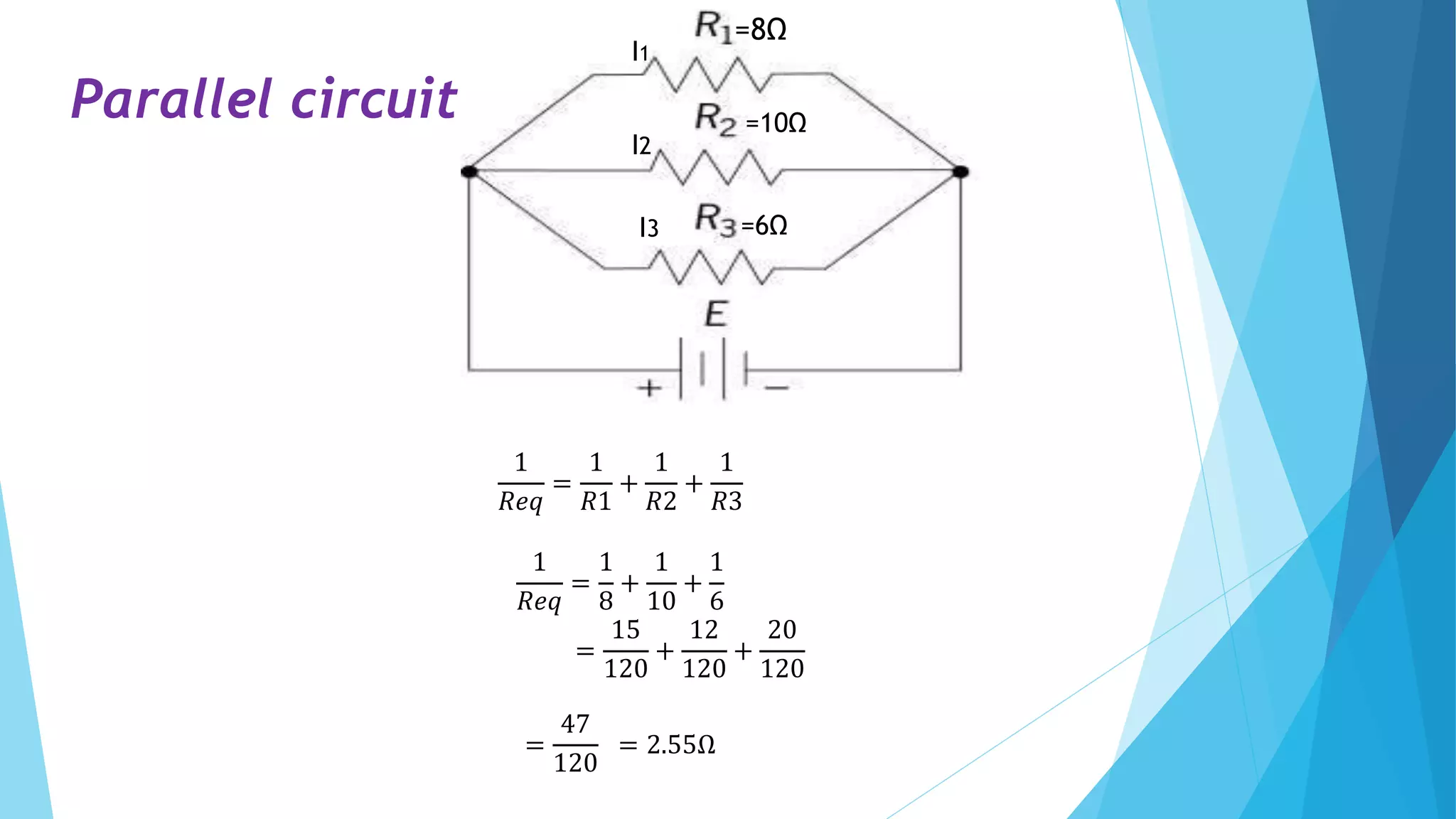
=8Ω
=10Ω
=6Ω
I1
I2
I3
1
𝑅𝑒𝑞
=
1
𝑅1
+
1
𝑅2
+
1
𝑅3
1
𝑅𝑒𝑞
=
1
8
+
1
10
+
1
6
=
15
120
+
12
120
+
20
120
=
47
120
= 2.55Ω
Parallel circuit
Electrical quantities

Electrical quantities