
The Roosevelt Corollary (1904)Merely an expansion of the Monroe Doctrine (1823)? 			or A completely new principle of Foreign Relations?
Why does it matter and what are the implications?You be the judge!
Let’s start with some terminology…Doctrine:a principle of law established through past decisions; a statement of fundamental government policy especially in international relations Corollary: an immediate consequence or easily drawn conclusion; a natural consequence or result.
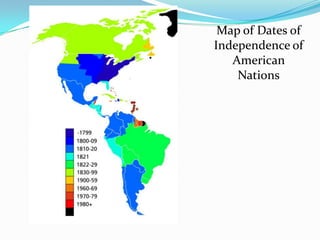
Review: Leading up to the Monroe Doctrine…  Latin AmericaNapoleon Bonaparte’s intervention in Spain triggered the start of numerous independence movements in Spain’s American coloniesAs these colonies began to achieve independence, European re-colonization was seen as a threat to national security and other U.S. interests in the AmericasU.S. wanted to maintain political and physical separation from Europe
Map of Dates of Independence of American Nations
The Monroe Doctrine (1823)Contained in President James Monroe’s annual message to CongressSought to solidify split between the U.S. and imperial European powersDesigned to prevent further European intervention in the Western hemisphere: “European Containment”Sent a strong message to European powers :Separate “spheres  of influence” for the U.S. and EuropeNon-colonization Non-Intervention
Domestic Life: The Gilded Age1865 through the 1890sTerm coined by Mark Twain to reflect a time that seemed shiny on the outside yet corrupt on the insideShift from agrarian to industrial societyFormation of first U.S. labor organizations
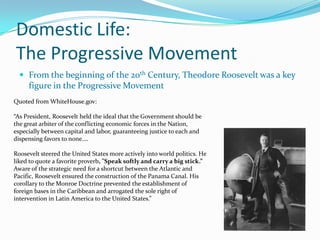
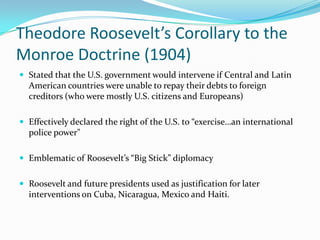
Domestic Life: The Progressive MovementFrom the beginning of the 20th Century, Theodore Roosevelt was a key figure in the Progressive MovementQuoted from WhiteHouse.gov:“As President, Roosevelt held the ideal that the Government should be the great arbiter of the conflicting economic forces in the Nation, especially between capital and labor, guaranteeing justice to each and dispensing favors to none….Roosevelt steered the United States more actively into world politics. He liked to quote a favorite proverb, "Speak softly and carry a big stick.” Aware of the strategic need for a shortcut between the Atlantic and Pacific, Roosevelt ensured the construction of the Panama Canal. His corollary to the Monroe Doctrine prevented the establishment of foreign bases in the Caribbean and arrogated the sole right of intervention in Latin America to the United States.”
Leading up toRoosevelt’s Corollary…1895: In response to an ongoing boundary dispute over the border of British Guiana and Venezuela (Great Britain/Germany and Venezuela)Venezuela asks the U.S. to arbitrate Secretary of State Richard Olney invokes a broader interpretation of the Monroe Doctrine declaring U.S. supremacy in the hemisphere.“Today the United Stats is practically sovereign on this continent, and its fiat is law upon the subjects to which it confines its interposition.” (Olney, 1895)
1898: Spanish-American War“The Spanish-American War and the subsequent occupation of Cuba can be traced to the rapid growth of the American public’s interest in economic, territorial, and cultural expansion during the 1890s. This interest was due in part to domestic economic distress. The Depression and the dominance of monopolies such as Standard Oil and Carnegie Steel forced struggling farmers and aspiring entrepreneurs to look abroad for better economic opportunities.” (Source: http://www.hsl.virginia.edu/historical/medical_history/yellow_fever/politics.cfm)1901: The Platt AmendmentAn amendment drafted by U.S. politicians was reluctantly added to the Cuban constitutionThis amendment gave the U.S. right to intervene in Cuban affairs for “the preservation of Cuban independence, the maintenance of a government adequate for the protection of life, property, and individual liberty, and for discharging the obligations with respect to Cuba imposed by the Treaty of Paris on the United States, now to be assumed and undertaken by the Government of Cuba.”
1902/03: Venezuela Crisis
Since its independence in 1811, Venezuela had endured multiple civil wars
Yet, from 1870-1898, a period of stability had encouraged foreign investment in the nation’s infrastructure which were financed in large part by government bonds
When the government refused or was unable to honor these bonds, European Powers (Great Britain, Germany, Italy) created a blockade on Venezuelan ports, seeking 30% of custom revenues
The U.S. did not want European powers, (especially Germany) involved in the Caribbean
Eventually, the dispute was arbitrated but served as a strict warning to Roosevelt…

Rcpp

  • 1.
    The Roosevelt Corollary(1904)Merely an expansion of the Monroe Doctrine (1823)? or A completely new principle of Foreign Relations?
  • 2.
    Why does itmatter and what are the implications?You be the judge!
  • 3.
    Let’s start withsome terminology…Doctrine:a principle of law established through past decisions; a statement of fundamental government policy especially in international relations Corollary: an immediate consequence or easily drawn conclusion; a natural consequence or result.
  • 4.
    Review: Leading upto the Monroe Doctrine… Latin AmericaNapoleon Bonaparte’s intervention in Spain triggered the start of numerous independence movements in Spain’s American coloniesAs these colonies began to achieve independence, European re-colonization was seen as a threat to national security and other U.S. interests in the AmericasU.S. wanted to maintain political and physical separation from Europe
  • 5.
    Map of Datesof Independence of American Nations
  • 6.
    The Monroe Doctrine(1823)Contained in President James Monroe’s annual message to CongressSought to solidify split between the U.S. and imperial European powersDesigned to prevent further European intervention in the Western hemisphere: “European Containment”Sent a strong message to European powers :Separate “spheres of influence” for the U.S. and EuropeNon-colonization Non-Intervention
  • 7.
    Domestic Life: TheGilded Age1865 through the 1890sTerm coined by Mark Twain to reflect a time that seemed shiny on the outside yet corrupt on the insideShift from agrarian to industrial societyFormation of first U.S. labor organizations
  • 8.
    Domestic Life: TheProgressive MovementFrom the beginning of the 20th Century, Theodore Roosevelt was a key figure in the Progressive MovementQuoted from WhiteHouse.gov:“As President, Roosevelt held the ideal that the Government should be the great arbiter of the conflicting economic forces in the Nation, especially between capital and labor, guaranteeing justice to each and dispensing favors to none….Roosevelt steered the United States more actively into world politics. He liked to quote a favorite proverb, "Speak softly and carry a big stick.” Aware of the strategic need for a shortcut between the Atlantic and Pacific, Roosevelt ensured the construction of the Panama Canal. His corollary to the Monroe Doctrine prevented the establishment of foreign bases in the Caribbean and arrogated the sole right of intervention in Latin America to the United States.”
  • 9.
    Leading up toRoosevelt’sCorollary…1895: In response to an ongoing boundary dispute over the border of British Guiana and Venezuela (Great Britain/Germany and Venezuela)Venezuela asks the U.S. to arbitrate Secretary of State Richard Olney invokes a broader interpretation of the Monroe Doctrine declaring U.S. supremacy in the hemisphere.“Today the United Stats is practically sovereign on this continent, and its fiat is law upon the subjects to which it confines its interposition.” (Olney, 1895)
  • 10.
    1898: Spanish-American War“TheSpanish-American War and the subsequent occupation of Cuba can be traced to the rapid growth of the American public’s interest in economic, territorial, and cultural expansion during the 1890s. This interest was due in part to domestic economic distress. The Depression and the dominance of monopolies such as Standard Oil and Carnegie Steel forced struggling farmers and aspiring entrepreneurs to look abroad for better economic opportunities.” (Source: http://www.hsl.virginia.edu/historical/medical_history/yellow_fever/politics.cfm)1901: The Platt AmendmentAn amendment drafted by U.S. politicians was reluctantly added to the Cuban constitutionThis amendment gave the U.S. right to intervene in Cuban affairs for “the preservation of Cuban independence, the maintenance of a government adequate for the protection of life, property, and individual liberty, and for discharging the obligations with respect to Cuba imposed by the Treaty of Paris on the United States, now to be assumed and undertaken by the Government of Cuba.”
  • 11.
  • 12.
    Since its independencein 1811, Venezuela had endured multiple civil wars
  • 13.
    Yet, from 1870-1898,a period of stability had encouraged foreign investment in the nation’s infrastructure which were financed in large part by government bonds
  • 14.
    When the governmentrefused or was unable to honor these bonds, European Powers (Great Britain, Germany, Italy) created a blockade on Venezuelan ports, seeking 30% of custom revenues
  • 15.
    The U.S. didnot want European powers, (especially Germany) involved in the Caribbean
  • 16.
    Eventually, the disputewas arbitrated but served as a strict warning to Roosevelt…