Fracture Dislocations
of the Elbow
OCNA 2016, 1
Jennings et. al.
•The elbow is a highly congruent
trochoginglymoid joint with a significant amount
of stability conferred from its bony structures.
•Functional range of motion at the elbow is
classically described as 50 degrees of pronation
and supination with a 100degree arc of flexion,
ranging from 30 to 130 degrees
•In general, complex dislocations are described as
anterior or posterior based on the translation of the
ulna with respect to the distal humerus.
•Posterior dislocations are typically the result of an
axial load applied through a supinated elbow with
valgus stress.
•Conversely, anterior dislocations occur in the setting
of a posterior force applied to the elbow in a flexed
position or hyperextension trauma.
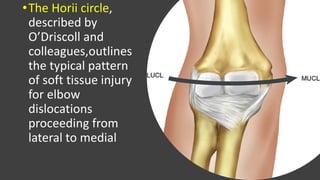
•The Horii circle,
described by
O’Driscoll and
colleagues,outlines
the typical pattern
of soft tissue injury
for elbow
dislocations
proceeding from
lateral to medial
Ring and Jupiter noted 4 common patterns of
injury:
1. Posterior dislocation of the elbow with fracture of the radial head
2. Posterior dislocation with fracture of both the radial head and
coronoid, described by Hotchkiss as the “terrible triad”
3. Anterior transolecranon fracture dislocation
4. Proximal Monteggia posterior fracture dislocations
•Elbow dislocations with associated
periarticular fractures (ie, complex
dislocations); frequently necessitate surgical
intervention, and the indications are
predicated on the specific fracture pattern.
•For this reason, CT scan is often helpful in
preoperative planning
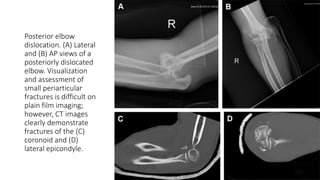
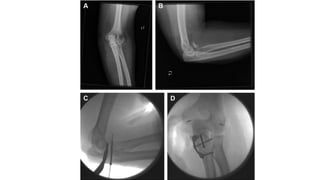
Posterior elbow
dislocation. (A) Lateral
and (B) AP views of a
posteriorly dislocated
elbow. Visualization
and assessment of
small periarticular
fractures is difficult on
plain film imaging;
however, CT images
clearly demonstrate
fractures of the (C)
coronoid and (D)
lateral epicondyle.
1. Radial Head Fractures
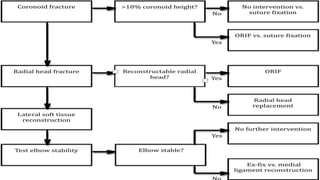
•Always conserve the radial head as far as
possible in the setting of acute elbow dislocation
•Nonoperative treatment is reserved only for
cases where concentric reduction is achieved,
there are no blocks to motion, and fracture
fragments are small and nondisplaced
2. Coronoid fractures
Surgical fixation is indicated for elbow dislocations
with fractures greater than 10% of coronoid
height as well as the well-known terrible triad
injury of simultaneous elbow dislocation with
coronoid and radial head fractures
3.Olecranon fracture
The ulnar articular surface must be anatomically
restored and any associated injuries to the
coronoid, distal humerus, or radial head
addressed at the time of fixation
4. Soft Tissue Injury
• O’Driscoll and colleagues described the disruption of soft tissue
structures from lateral to medial in elbow dislocations originating at
the lateral ulnar collateral ligament (LUCL) and, in cases of high
energy trauma, progressing to disruption of the medial ulnar
collateral ligament (MUCL).
• After bony anatomy is restored, attention should be turned to the
soft tissue structures for reconstruction. The annular ligament and
LUCL should be repaired, because rotatory instability ensues with any
deficit in the lateral collateral ligament (LCL) complex
4. Soft Tissue Injury ……contd
• The medial collateral ligament (MCL), however, needs only to be
restored if the elbow remains unstable after all other fractures and
soft tissue structures have been addressed.
• An alternative option is to place a hinged external fixator in this
situation
Decision-making
algorithm
Positioning
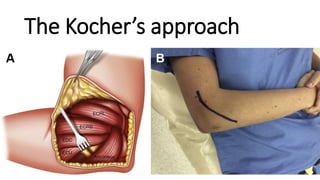
The Kocher’s approach
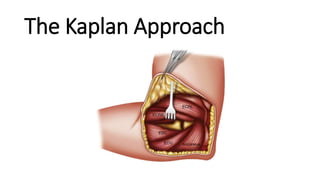
The Kaplan Approach
Regardless of the interval chosen,
dissection should be carried out with
the elbow in pronation to reduce risk
of injury to the posterior
interosseous nerve (PIN)
•Medially, an anteromedial interval between the
pronator teres and brachialis may be used to
access the anterior capsule.
•The posteromedial (flexor carpi ulnaris [FCU]-
splitting) exposure necessitates anterior ulnar
nerve transposition and the FCU is divided
between the 2 heads of the muscle
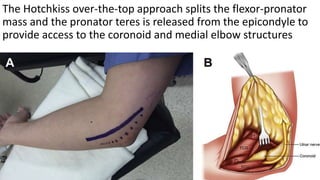
The Hotchkiss over-the-top approach splits the flexor-pronator
mass and the pronator teres is released from the epicondyle to
provide access to the coronoid and medial elbow structures
Surgical Procedures
For Coronoid
• Type I requires only suture fixation
• Suture fixation may also be used for type 2 fractures if adequate
screw fixation is not possible due to fracture size or bone quality or to
augment internal fixation
•The coronoid can frequently be approached through the
lateral approach, because the radial-sided structures are
commonly already interrupted.
•If suture fixation is chosen 2 drill holes are created along
the subcutaneous border of the ulna to serve as tunnels
for the suture, directed toward either side of the
coronoid footprint
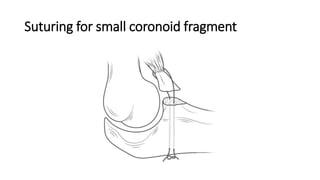
•Typically the coronoid fragment is too small to
accommodate drill holes and, therefore, is most
commonly captured by passing a number-1 braided
suture through its anterior capsular attachment
Suturing for small coronoid fragment
•Types 2 and 3 fractures often require a medialsided
approach because they are commonly fixed with formal
open reduction and internal fixation.
•Smaller fractures can be fixed with a headless screw that
can be augmented with the addition of suture fixation.
•In this case, the fragment must be large enough to
accommodate the screw and the bone must be of
adequate quality.
•The screw should be placed in the posterior to anterior
direction to achieve greater fixation strength and to
reduce the risk of injury to anterior neurovascular
structure
•For larger fragments, anteromedial buttress
plating can be used with or without combined
headless compression screws.
•Occasionally, a surgeon is faced with multiple
coronoid fragments that may necessitate
separate medial and dorsal plates, which again
may be augmented with suture or screw
fixation.
For radial head
• If a few large fragments exist and bone is healthy enough to achieve
secure fixation, headless compression screws may be used.
• The radial ead articular surface is anatomically restored and
maintained with pointed reduction forceps.
• Kirschner wires are placed and cannulated headless compression
screws are implanted over their respective pins.
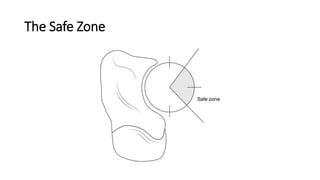
• If standard screws are used, it is important to place these implants in
the nonarticulating safe zone of the radius to avoid any symptoms
with pronation or supination
The Safe Zone
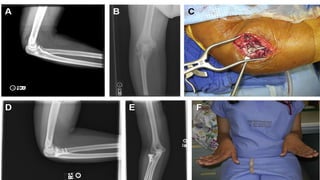
•Fracture extension into the neck is treated
with a buttress plate, again placed in the
safe zone of the proximal radius to avoid
impingement
•It is important to restore anatomic
alignment and length to avoid future
instability
•If the radial head is extensively comminuted or
osteopenic, internal fixation may not be ideal.
•In this situation, radial head replacement is
advisable and has demonstrated good results
•The most important aspects of replacement are
appropriate sizing and positioning of the
prosthesis.
•Importantly, the radial head must not be
overstuffed, which inevitably leads to increased
radiocapitellar contact pressures, elbow pain,
loss of range of motion, and component failure
For soft tissue injury
• Due to the critical role of the LCL as the primary lateral elbow
stabilizer, soft tissue repair is mandatory at the time of surgery
because failure to address this injury is a significant cause for
recurrent instability.
• Most commonly, the LCL and posterolateral capsule are avulsed as a
sleeve from the lateral condyle, leaving a characteristic bare spot
• Surgical repair with suture anchors or bone tunnels placed at the
origin of the LCL at the bare area on the epicondyle with the elbow in
supination
Complications
Heterotopic Ossification
• Indomethacin prophylaxis
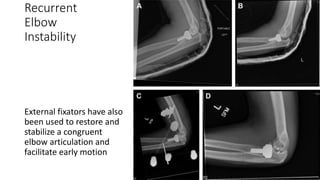
Recurrent
Elbow
Instability
External fixators have also
been used to restore and
stabilize a congruent
elbow articulation and
facilitate early motion
Ulnar Neuropathy
• Seldom requires anterior transpositioning
Arthrofibrosis
• Usually anatomic in nature
Post traumatic Arthrosis
• Difficult to tackle

200324 Complex elbow dislocations

  • 1.
    Fracture Dislocations of theElbow OCNA 2016, 1 Jennings et. al.
  • 2.
    •The elbow isa highly congruent trochoginglymoid joint with a significant amount of stability conferred from its bony structures. •Functional range of motion at the elbow is classically described as 50 degrees of pronation and supination with a 100degree arc of flexion, ranging from 30 to 130 degrees
  • 3.
    •In general, complexdislocations are described as anterior or posterior based on the translation of the ulna with respect to the distal humerus. •Posterior dislocations are typically the result of an axial load applied through a supinated elbow with valgus stress. •Conversely, anterior dislocations occur in the setting of a posterior force applied to the elbow in a flexed position or hyperextension trauma.
  • 4.
    •The Horii circle, describedby O’Driscoll and colleagues,outlines the typical pattern of soft tissue injury for elbow dislocations proceeding from lateral to medial
  • 5.
    Ring and Jupiternoted 4 common patterns of injury: 1. Posterior dislocation of the elbow with fracture of the radial head 2. Posterior dislocation with fracture of both the radial head and coronoid, described by Hotchkiss as the “terrible triad” 3. Anterior transolecranon fracture dislocation 4. Proximal Monteggia posterior fracture dislocations
  • 6.
    •Elbow dislocations withassociated periarticular fractures (ie, complex dislocations); frequently necessitate surgical intervention, and the indications are predicated on the specific fracture pattern. •For this reason, CT scan is often helpful in preoperative planning
  • 7.
    Posterior elbow dislocation. (A)Lateral and (B) AP views of a posteriorly dislocated elbow. Visualization and assessment of small periarticular fractures is difficult on plain film imaging; however, CT images clearly demonstrate fractures of the (C) coronoid and (D) lateral epicondyle.
  • 8.
    1. Radial HeadFractures •Always conserve the radial head as far as possible in the setting of acute elbow dislocation •Nonoperative treatment is reserved only for cases where concentric reduction is achieved, there are no blocks to motion, and fracture fragments are small and nondisplaced
  • 9.
    2. Coronoid fractures Surgicalfixation is indicated for elbow dislocations with fractures greater than 10% of coronoid height as well as the well-known terrible triad injury of simultaneous elbow dislocation with coronoid and radial head fractures
  • 10.
    3.Olecranon fracture The ulnararticular surface must be anatomically restored and any associated injuries to the coronoid, distal humerus, or radial head addressed at the time of fixation
  • 11.
    4. Soft TissueInjury • O’Driscoll and colleagues described the disruption of soft tissue structures from lateral to medial in elbow dislocations originating at the lateral ulnar collateral ligament (LUCL) and, in cases of high energy trauma, progressing to disruption of the medial ulnar collateral ligament (MUCL). • After bony anatomy is restored, attention should be turned to the soft tissue structures for reconstruction. The annular ligament and LUCL should be repaired, because rotatory instability ensues with any deficit in the lateral collateral ligament (LCL) complex
  • 12.
    4. Soft TissueInjury ……contd • The medial collateral ligament (MCL), however, needs only to be restored if the elbow remains unstable after all other fractures and soft tissue structures have been addressed. • An alternative option is to place a hinged external fixator in this situation
  • 13.
  • 15.
  • 16.
  • 17.
  • 18.
    Regardless of theinterval chosen, dissection should be carried out with the elbow in pronation to reduce risk of injury to the posterior interosseous nerve (PIN)
  • 19.
    •Medially, an anteromedialinterval between the pronator teres and brachialis may be used to access the anterior capsule. •The posteromedial (flexor carpi ulnaris [FCU]- splitting) exposure necessitates anterior ulnar nerve transposition and the FCU is divided between the 2 heads of the muscle
  • 20.
    The Hotchkiss over-the-topapproach splits the flexor-pronator mass and the pronator teres is released from the epicondyle to provide access to the coronoid and medial elbow structures
  • 21.
  • 22.
    For Coronoid • TypeI requires only suture fixation • Suture fixation may also be used for type 2 fractures if adequate screw fixation is not possible due to fracture size or bone quality or to augment internal fixation
  • 23.
    •The coronoid canfrequently be approached through the lateral approach, because the radial-sided structures are commonly already interrupted. •If suture fixation is chosen 2 drill holes are created along the subcutaneous border of the ulna to serve as tunnels for the suture, directed toward either side of the coronoid footprint •Typically the coronoid fragment is too small to accommodate drill holes and, therefore, is most commonly captured by passing a number-1 braided suture through its anterior capsular attachment
  • 24.
    Suturing for smallcoronoid fragment
  • 25.
    •Types 2 and3 fractures often require a medialsided approach because they are commonly fixed with formal open reduction and internal fixation. •Smaller fractures can be fixed with a headless screw that can be augmented with the addition of suture fixation. •In this case, the fragment must be large enough to accommodate the screw and the bone must be of adequate quality. •The screw should be placed in the posterior to anterior direction to achieve greater fixation strength and to reduce the risk of injury to anterior neurovascular structure
  • 26.
    •For larger fragments,anteromedial buttress plating can be used with or without combined headless compression screws. •Occasionally, a surgeon is faced with multiple coronoid fragments that may necessitate separate medial and dorsal plates, which again may be augmented with suture or screw fixation.
  • 28.
    For radial head •If a few large fragments exist and bone is healthy enough to achieve secure fixation, headless compression screws may be used. • The radial ead articular surface is anatomically restored and maintained with pointed reduction forceps. • Kirschner wires are placed and cannulated headless compression screws are implanted over their respective pins. • If standard screws are used, it is important to place these implants in the nonarticulating safe zone of the radius to avoid any symptoms with pronation or supination
  • 29.
  • 30.
    •Fracture extension intothe neck is treated with a buttress plate, again placed in the safe zone of the proximal radius to avoid impingement •It is important to restore anatomic alignment and length to avoid future instability
  • 32.
    •If the radialhead is extensively comminuted or osteopenic, internal fixation may not be ideal. •In this situation, radial head replacement is advisable and has demonstrated good results •The most important aspects of replacement are appropriate sizing and positioning of the prosthesis. •Importantly, the radial head must not be overstuffed, which inevitably leads to increased radiocapitellar contact pressures, elbow pain, loss of range of motion, and component failure
  • 33.
    For soft tissueinjury • Due to the critical role of the LCL as the primary lateral elbow stabilizer, soft tissue repair is mandatory at the time of surgery because failure to address this injury is a significant cause for recurrent instability. • Most commonly, the LCL and posterolateral capsule are avulsed as a sleeve from the lateral condyle, leaving a characteristic bare spot • Surgical repair with suture anchors or bone tunnels placed at the origin of the LCL at the bare area on the epicondyle with the elbow in supination
  • 34.
  • 35.
  • 36.
    Recurrent Elbow Instability External fixators havealso been used to restore and stabilize a congruent elbow articulation and facilitate early motion
  • 37.
    Ulnar Neuropathy • Seldomrequires anterior transpositioning
  • 38.
  • 39.
    Post traumatic Arthrosis •Difficult to tackle