Solar magnetic field as seen from a balloon Santiago Vargas Domínguez UCL DEPARTMENT OF SPACE AND CLIMATE PHYSICS MULLARD SPACE SCIENCE LABORATORY Fluex Emergence Workshop @ MSSL  March 2010 A sneak peek at data from Sunrise
Ballon-borne  1 -m solar telescope + What is Sunrise ? Electronics  box Secondary mirror Instrumentation Gondola Damping system Solar panels Swedish Solar Telescope (SST) Observatory  Roque de Los Muchachos  (La Palma)  @  2400 m Diffraction limited:  ~ 0.1”  CWS: Correlator and Wavefront Sensor SUFI: Sunrise Filter Imager   (high-res images visible & UV) IMaX: Imaging Magnetoraph eXperiment  (2D maps of complete magnetic field vector, LOS velocity, white-light images Aim at: High-resolution Spectro-polarimetric observations of  the solar atmosphere .  Study magnetoconvection at fine scales
What is Sunrise ? SST  FOV 16”x16” 0.034 “/pix 11 8 images  Cadence:  1 0 s Sunrise combines strengths of SST  (aperture) and  Hinode  (spectro-polarimetry  with stable image quality ). Images in UV down to 0.05” Gband  (  430.5 nm) 1 000 km
Launched on 08/06/2009  from ESRANGE base  Kiruna ( Sweden) Launching & flight 6 days Altitude: 40 km v ~ 50 km/h 1 40 m
Back on Earth Somerset  island A week  after .....
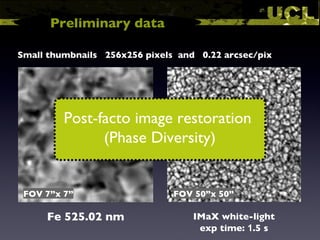
Fe 525.02 nm FOV 7”x 7” Small thumbnails  256x256 pixels  and  0.22 arcsec/pix FOV 50”x 50” IMaX white-light Preliminary data exp time:  1 .5 s Post-facto image restoration  (Phase Diversity)
Preliminary data Summer Schedule July  1 st  week :  Sunrise back home -   Lindau (Germany) 2 nd  week :  Sunrise data meeting -  Lindau (Germany) 3 rd  week :  IMaX data reduction meeting -  somewhere (Spain) August September Data reduction (first steps)  Spanish Solar Physics Meeting  ( IMaX first results ? ) Data available for  scientific community  in early 20 1 0
Science with Sunrise Filter positions 388 nm (CN) 397 nm (CaH) 300 nm 313 nm (OH) 214 nm Pointing Measure 3D-distribution of B vector, v, T   Polarization sensitive spectroscopy in  photospheric/chromospheric line(s)   Coordinated Observations Hinode, SOHO, TRACE SST, DOT,  VTT, DST
Science with Sunrise Formation/destruction of intense magnetic elements Quiet Sun  Convective collapse  (Parker 1978).  Convincing observation of the formation of intense flux tubes  (~ KG) Photospheric footpoints of chromospheric and TR loops Dynamics of solar vortex flows  (Bonet et al 2008)   Coupling to the TR Photospheric structure  @  spatial resolution  ~35 km  (2 1 4 nm) Magnetic landscape and coupling of the Polar Regions
Science with Sunrise Solar active regions  Magnetoconvection  at small scales Are umbral dots, light bridges and penumbral filaments intrusions of field-free plasma from beneath the sunspot  ? Internal structure and evolution of individual penumbral filaments (< dark cores,  Scharmer et al 2002 ) Those are still open questions generating an ongoing debate 1 000 km 1 000 km
Science with Sunrise Solar active regions  Kaysukawa et al, 2007 Photospheric/Chromospheric drivers of penumbral microjets
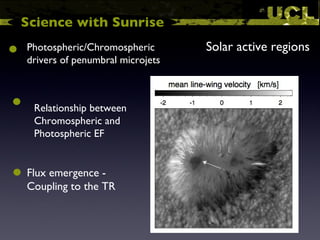
Science with Sunrise Solar active regions  Relationship between Chromospheric and Photospheric EF Photospheric/Chromospheric drivers of penumbral microjets Flux emergence - Coupling to the TR
Future plans 2 nd  Sunrise flight planned for 20 11 The penguin in the logo will make sense then From McMurdo base Antarctica  (9 - 12 days)
Thank you

Eis meeting talk

  • 1.
  • 2.
    Solar magnetic fieldas seen from a balloon Santiago Vargas Domínguez UCL DEPARTMENT OF SPACE AND CLIMATE PHYSICS MULLARD SPACE SCIENCE LABORATORY Fluex Emergence Workshop @ MSSL March 2010 A sneak peek at data from Sunrise
  • 3.
    Ballon-borne 1-m solar telescope + What is Sunrise ? Electronics box Secondary mirror Instrumentation Gondola Damping system Solar panels Swedish Solar Telescope (SST) Observatory Roque de Los Muchachos (La Palma) @ 2400 m Diffraction limited: ~ 0.1” CWS: Correlator and Wavefront Sensor SUFI: Sunrise Filter Imager (high-res images visible & UV) IMaX: Imaging Magnetoraph eXperiment (2D maps of complete magnetic field vector, LOS velocity, white-light images Aim at: High-resolution Spectro-polarimetric observations of the solar atmosphere . Study magnetoconvection at fine scales
  • 4.
    What is Sunrise? SST FOV 16”x16” 0.034 “/pix 11 8 images Cadence: 1 0 s Sunrise combines strengths of SST (aperture) and Hinode (spectro-polarimetry with stable image quality ). Images in UV down to 0.05” Gband (  430.5 nm) 1 000 km
  • 5.
    Launched on 08/06/2009 from ESRANGE base Kiruna ( Sweden) Launching & flight 6 days Altitude: 40 km v ~ 50 km/h 1 40 m
  • 6.
    Back on EarthSomerset island A week after .....
  • 7.
    Fe 525.02 nmFOV 7”x 7” Small thumbnails 256x256 pixels and 0.22 arcsec/pix FOV 50”x 50” IMaX white-light Preliminary data exp time: 1 .5 s Post-facto image restoration (Phase Diversity)
  • 8.
    Preliminary data SummerSchedule July 1 st week : Sunrise back home - Lindau (Germany) 2 nd week : Sunrise data meeting - Lindau (Germany) 3 rd week : IMaX data reduction meeting - somewhere (Spain) August September Data reduction (first steps) Spanish Solar Physics Meeting ( IMaX first results ? ) Data available for scientific community in early 20 1 0
  • 9.
    Science with SunriseFilter positions 388 nm (CN) 397 nm (CaH) 300 nm 313 nm (OH) 214 nm Pointing Measure 3D-distribution of B vector, v, T Polarization sensitive spectroscopy in photospheric/chromospheric line(s) Coordinated Observations Hinode, SOHO, TRACE SST, DOT, VTT, DST
  • 10.
    Science with SunriseFormation/destruction of intense magnetic elements Quiet Sun Convective collapse (Parker 1978). Convincing observation of the formation of intense flux tubes (~ KG) Photospheric footpoints of chromospheric and TR loops Dynamics of solar vortex flows (Bonet et al 2008) Coupling to the TR Photospheric structure @ spatial resolution ~35 km (2 1 4 nm) Magnetic landscape and coupling of the Polar Regions
  • 11.
    Science with SunriseSolar active regions Magnetoconvection at small scales Are umbral dots, light bridges and penumbral filaments intrusions of field-free plasma from beneath the sunspot ? Internal structure and evolution of individual penumbral filaments (< dark cores, Scharmer et al 2002 ) Those are still open questions generating an ongoing debate 1 000 km 1 000 km
  • 12.
    Science with SunriseSolar active regions Kaysukawa et al, 2007 Photospheric/Chromospheric drivers of penumbral microjets
  • 13.
    Science with SunriseSolar active regions Relationship between Chromospheric and Photospheric EF Photospheric/Chromospheric drivers of penumbral microjets Flux emergence - Coupling to the TR
  • 14.
    Future plans 2nd Sunrise flight planned for 20 11 The penguin in the logo will make sense then From McMurdo base Antarctica (9 - 12 days)
  • 15.