1
Understanding Microbiological
Sampling and Testing
Office of Public Health Science
Microbiology Division
FSIS 2010 Advanced EIAO
Methodology Course
Today’s Presentation
• Objective- Cover aspects of
microbiological sampling and testing that
should be considered for food safety
programs.
– Sample collection- methods and plans
– Laboratory testing- test portions and methods
2
Why Do We Test For Bacteria In Foods?
• Foodborne pathogens
– Why? – Pathogens cause illness!
– Challenges for pathogen detection:
• Heterogeneous distribution in a lot or even a
sample.
• Pathogen cells on products are often at low levels
and stressed.
• Indicator bacteria
– Why? - Easier to detect and quantify for process
control purposes
3
Sampling
4
5
Sampling
• All sampling plans have significant limitations.
– Therefore, we evaluate relative rigor of the program.
• Best sampling plans provide the opportunity but no
guarantee of detection.
– i.e., scattered contamination is difficult to detect.
• Frequent sampling and sampling multiple sites/time points
provides a better opportunity for detection.
– Examples:
• Multiple samples per day vs. once per month
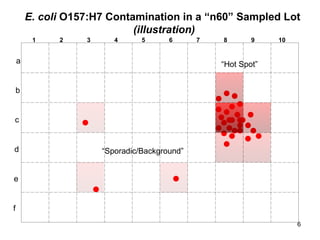
• One “grab” sample per lot vs. “n60” per lot
• Does the type of sampling meet the intended need?
– Destructive vs. non-destructive sampling
6
E. coli O157:H7 Contamination in a “n60” Sampled Lot
(illustration)
f
e
d
c
b
a
1 2 3 4 5 6 7 8 9 10
“Hot Spot”
“Sporadic/Background”
7
0
100
%
contaminated
samples
Time of production, hrs
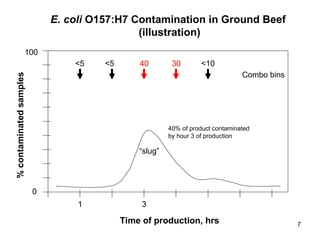
E. coli O157:H7 Contamination in Ground Beef
(illustration)
40% of product contaminated
by hour 3 of production
Combo bins
<5 <5 40 30 <10
“slug”
1 3
8
What is “n60”?
• “n60” = number of samples (n) = 60
– Multiple representative samples provides best option
for detecting scattered contamination.
– Provides 95% confidence that no more than 5% of
food pieces the size of each “n” in the entire lot are
contaminated.
• Keys to success
– Must ensure that sampling is as representative as
possible across the lot
– Large composite “n60” samples typical need a larger
test portion.
Common Sampling Problems
• Small sample or sampling method may not be ideal for
detection.
– Examples- small swab device, small carcass or
environmental area sampled
• Sanitizer or excessive intervention might interfere with the
test.
– Insufficient drip time prior to carcass rinse procedure.
• Temperature abuse for the sample prior to testing
– Holding under refrigeration for long periods allows
competing bacteria to grow.
– Freezing can kill some pathogens (e.g., Campylobacter)
9
Testing
10
Laboratory Testing
• Two areas of focus
– The test portion taken from the sample
– The method used to test that portion
• Screening methods
• Confirmatory methods
• Establishments should ensure their lab is aware of FSIS
guidance, Directives, and Notices related to testing
issues
11
12
Establishment Responsibilities For
Laboratory Testing
• The establishment is ultimately responsible for the
testing they request from private laboratories
• Has the establishment properly conveyed testing needs?
– e.g., test portion equivalent to FSIS as opposed to the
default 25-g in protocols.
• Is the laboratory aware of FSIS expectations?
– Directives, Notices and guidance (some are pending)
• Establishment should document detailed methodology
and validation information for FSIS review.
13
The “Test Portion”
• Laboratory sample preparation => “test portion”
– a.k.a., “analytical unit”
– Definition- the part of the “sample” that is actually
tested by the laboratory.
• Test portion determines the theoretical (i.e., best
possible) sensitivity of the test
– i.e., 1 cell/test portion
– 25-gram- detecting 0.04 cells/gram is possible
– 325-gram- detecting 0.003 cells/gram is possible
14
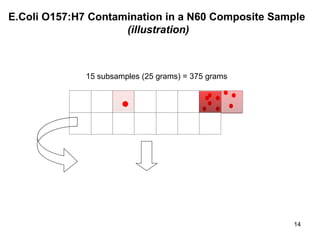
E.Coli O157:H7 Contamination in a N60 Composite Sample
(illustration)
15 subsamples (25 grams) = 375 grams
Special Considerations for Larger E. coli
O157:H7 Test Portions?
• Larger test portions (325-375 grams) are most important
for “n60” and other composite samples containing many
samples.
• Less important for ground beef final product testing
when:
– Trim and components have already been tested using
robust sampling and 325-375-gram test portions, and
– multiple samples are collected throughout the
production day.
• Methods must be adapted, optimized and validated for
effective use with 325-375 gram test portions.
15
16
Pathogen Detection Methods
• Complete multi-step method below can
take at least one week:
– Sample preparation
– 1-2 stage culture broth enrichment
– Screening test
– Selective plating and purification
– Confirmation using multiple tests
17
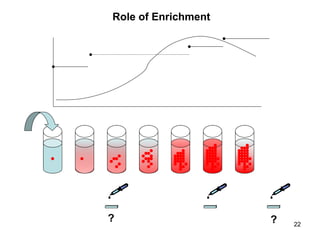
Enrichment
• Test portion is incubated 8-48 hours in a culture broth
– Why?
• Contamination levels are too low for detection
without enrichment
• Must grow to high levels so very small volumes
have enough for later detection steps.
– Different pathogens require a different broths
– One vs two-stage enrichment
• resuscitation vs selective growth
18
Considerations for proper enrichment
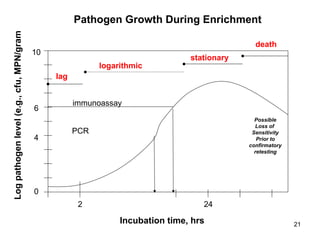
• Resuscitation (lag phase) can require 2-3 hours
before log-phase growth begins.
– Some samples support slower growth
• Has enrichment broth been tempered to warm
temperature prior to incubation?
– Particularly critical for large test portions or
shorter incubation periods.
19
Screening Tests
• Usually commercial testing products
• Most validated screening tests are:
– Immunoassays (ELISA, ELFA,
immunochromatographic devices, etc.)
– Polymerase Chain Reaction (PCR) assays
• Must be validated for performance with a
specific broth and incubation period.
20
Incubation period
• PCR screens may require less growth than
immunoassays.
• Shorter incubation periods (<15 hours) may warrant
additional scrutiny of laboratory compliance to the
validated protocol.
• Has enrichment/screening combination been validated
for a larger test portion?
– Particular concern for large test portions incubated for
shorter periods.
– e.g., 375-gram test portion incubated for 8 hours
• Proposed incubations < 8 hours may warrant OPHS
review.
21
0
10
Log
pathogen
level
(e.g.,
cfu,
MPN/gram
Incubation time, hrs
Pathogen Growth During Enrichment
2 24
lag
logarithmic
stationary
death
4
6
PCR
immunoassay
Possible
Loss of
Sensitivity
Prior to
confirmatory
retesting
22
Role of Enrichment
? ?
Considerations for Testing Methods
• Is the method fit for the intended purpose
of the analysis?
• Has the method been optimized and
experimentally validated for sensitive
detection of pathogens?
• Is the laboratory complying to the
validated method protocol?
23
24
Fitness For Purpose
• Is the method intended for detecting the
lowest possible levels of potentially injured
pathogen cells in meat/poultry products
like the corresponding FSIS method?
• Was this demonstrated by the validation
study?
25
Value of Validation
• Determines performance characteristics of the
method in comparison to a gold standard
method (i.e., usually FSIS or FDA method).
• Independent evaluation provides credibility
• Rigor varies
• Still must consider fitness for purpose and how
the method is applied.
– e.g., some AOAC-validated methods are not
consistent with FSIS goals or Compliance
Guidelines.
26
Method Validation
• Recognized independent method validation organizations:
– Government- FSIS and FDA
– AOAC International (U.S.A.)
• AOAC Official Method (OM) validations
• AOAC-RI “Performance Tested Method” validations
– AFNOR (France)- e.g., bioMerieux-Vitek tests
– Others (ISO, NMKL, etc.)
• However, past validations conducted by these
organizations may not be relevant to larger test portions or
other testing scenarios.
27
Testing Method Specifications
• Common specifications determined through experimental validation
studies:
– How well does the method work for low levels of contamination?
• e.g., sensitivity, false negative rate, limit of detection (LOD)
– How specific is the test for the target pathogen?
• e.g., inclusivity, exclusivity
– How reliable is the method in different hands?
• e.g., repeatability, reproducibility
• However, these experiments can produce variable results according
to experimental design, product, strains, and other factors.
– Past sensitivity and LOD measurements cited for FSIS MLG
methods are not intended as a standard for other methods.
28
Sensitivity
• Does the method detect low levels of pathogens?
• False negative rate = critical issue
– Does the method miss positive samples compared to
“gold standard” method?
• Limit of detection (LOD)
– Expressed as CFU/gram or CFU/test portion
– Rough estimate of performance
• Variable based on numerous factors (e.g., product,
competing flora, pathogen injury, etc.)
• Note significant differences (i.e., Do not over-
interpret)
29
Specificity
• Bacteria can mutate and evolve into forms that
defy the traditional rules.
– As a result, much diversity within a pathogen species
• False negative potential-
– Does the test miss some subgroup of the target
pathogen?
• False positive potential-
– Is an unconfirmed result a potential problem?
– Depends on context (industry vs. FSIS testing)
30
Method Application
• Can the method accommodate the
necessary test portion?
• Does the lab specifically comply to the
validated method instructions, or have
they altered the method in some way?
• AOAC/AFNOR validations typically apply
only to commercial screening methods
without regard to any necessary follow-up
tests.
Confirmatory Testing
• Non-culture confirmation (e.g.,PCR)
• Culture confirmation (e.g., FSIS confirmation)
– Plating the enrichment on selective and differential agar
media
• Immunomagnetic separation (IMS) necessary prior to
plating for E. coli O157:H7
– Suspect colonies = “presumptive positive”
– Purification and confirmatory identification tests
including:
• Biochemical (e.g., identifies “E. coli”)
• Serological (e.g., identifies “O157” and “H7”)
• Genetic (e.g., identifies “stx” = Shiga toxin genes)
31
32
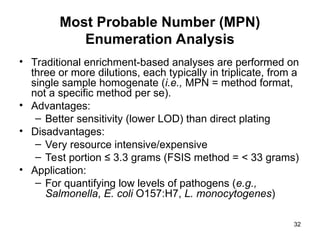
Most Probable Number (MPN)
Enumeration Analysis
• Traditional enrichment-based analyses are performed on
three or more dilutions, each typically in triplicate, from a
single sample homogenate (i.e., MPN = method format,
not a specific method per se).
• Advantages:
– Better sensitivity (lower LOD) than direct plating
• Disadvantages:
– Very resource intensive/expensive
– Test portion ≤ 3.3 grams (FSIS method = < 33 grams)
• Application:
– For quantifying low levels of pathogens (e.g.,
Salmonella, E. coli O157:H7, L. monocytogenes)
33
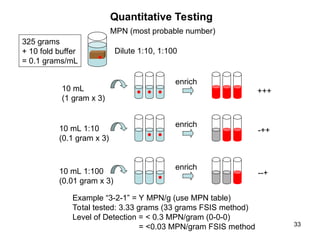
Quantitative Testing
MPN (most probable number)
Dilute 1:10, 1:100
enrich
10 mL
(1 gram x 3)
enrich
10 mL 1:10
(0.1 gram x 3)
enrich
10 mL 1:100
(0.01 gram x 3)
+++
-++
--+
Example “3-2-1” = Y MPN/g (use MPN table)
Total tested: 3.33 grams (33 grams FSIS method)
Level of Detection = < 0.3 MPN/gram (0-0-0)
= <0.03 MPN/gram FSIS method
325 grams
+ 10 fold buffer
= 0.1 grams/mL
34
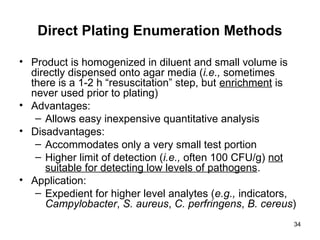
Direct Plating Enumeration Methods
• Product is homogenized in diluent and small volume is
directly dispensed onto agar media (i.e., sometimes
there is a 1-2 h “resuscitation” step, but enrichment is
never used prior to plating)
• Advantages:
– Allows easy inexpensive quantitative analysis
• Disadvantages:
– Accommodates only a very small test portion
– Higher limit of detection (i.e., often 100 CFU/g) not
suitable for detecting low levels of pathogens.
• Application:
– Expedient for higher level analytes (e.g., indicators,
Campylobacter, S. aureus, C. perfringens, B. cereus)
35
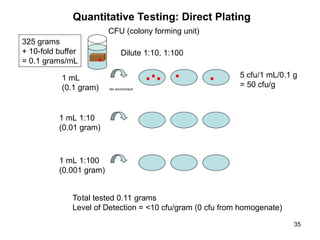
Quantitative Testing: Direct Plating
CFU (colony forming unit)
1 mL
(0.1 gram)
1 mL 1:10
(0.01 gram)
1 mL 1:100
(0.001 gram)
Total tested 0.11 grams
Level of Detection = <10 cfu/gram (0 cfu from homogenate)
325 grams
+ 10-fold buffer
= 0.1 grams/mL
5 cfu/1 mL/0.1 g
= 50 cfu/g
No enrichment
Dilute 1:10, 1:100
36
Expectations For Listeria Environmental
Testing Equivalence
• Compliance Guidelines, May 2006, pp. 42-44
• For optimal sensitivity of detection, method for food
contact surface testing must:
– validated by a recognized body (e.g., AOAC, AFNOR)
– be enrichment-based
– enrich the entire sponge/swab sample
• i.e., aliquot from sponge/swab does not provide
opportunity to detect bacteria trapped in the
sponge.
37
Analytes for Industry Food Contact
or Environmental Surface Testing
• Production establishment laboratories test for one of the following:
– Listeria monocytogenes- Use internationally recognized
enrichment-based method that biochemically confirms culture as
L. monocytogenes.
– Listeria spp.- Use internationally recognized enrichment-based
method that uses ELISA, PCR or other screening technology to
provide more rapid but less specific Listeria spp. result.
– “Listeria-like” indicator bacteria- Use the first part of an
internationally recognized enrichment-based method to find
suspect Listeria colonies (e.g., darkened colonies on MOX using
the FSIS method).
38
Issues for Industry Labs
• On-site vs. off-site labs- jurisdiction issues
• Overarching concerns for on-site labs
– Is testing effective?
– Is testing safe in that facility?
• Evaluate the following:
– Are personnel qualified?
– Does the lab have proper equipment and materials for
testing and disposal of contaminated media?
– Do they follow the validated testing protocol?
39
ISO 17025 Laboratory Accreditation
• ISO 17025 = protocol for establishing and
documenting a microbiology laboratory quality
program (i.e., “HACCP” for labs)
• Accrediting bodies = A2LA and others
• Accreditation implies robust quality program but
does not necessarily indicate methods meet
FSIS expectations.
40
Questions?

EIAO_Micro_Sampling_Testing DavidManyielAgok.ppt

  • 1.
    1 Understanding Microbiological Sampling andTesting Office of Public Health Science Microbiology Division FSIS 2010 Advanced EIAO Methodology Course
  • 2.
    Today’s Presentation • Objective-Cover aspects of microbiological sampling and testing that should be considered for food safety programs. – Sample collection- methods and plans – Laboratory testing- test portions and methods 2
  • 3.
    Why Do WeTest For Bacteria In Foods? • Foodborne pathogens – Why? – Pathogens cause illness! – Challenges for pathogen detection: • Heterogeneous distribution in a lot or even a sample. • Pathogen cells on products are often at low levels and stressed. • Indicator bacteria – Why? - Easier to detect and quantify for process control purposes 3
  • 4.
  • 5.
    5 Sampling • All samplingplans have significant limitations. – Therefore, we evaluate relative rigor of the program. • Best sampling plans provide the opportunity but no guarantee of detection. – i.e., scattered contamination is difficult to detect. • Frequent sampling and sampling multiple sites/time points provides a better opportunity for detection. – Examples: • Multiple samples per day vs. once per month • One “grab” sample per lot vs. “n60” per lot • Does the type of sampling meet the intended need? – Destructive vs. non-destructive sampling
  • 6.
    6 E. coli O157:H7Contamination in a “n60” Sampled Lot (illustration) f e d c b a 1 2 3 4 5 6 7 8 9 10 “Hot Spot” “Sporadic/Background”
  • 7.
    7 0 100 % contaminated samples Time of production,hrs E. coli O157:H7 Contamination in Ground Beef (illustration) 40% of product contaminated by hour 3 of production Combo bins <5 <5 40 30 <10 “slug” 1 3
  • 8.
    8 What is “n60”? •“n60” = number of samples (n) = 60 – Multiple representative samples provides best option for detecting scattered contamination. – Provides 95% confidence that no more than 5% of food pieces the size of each “n” in the entire lot are contaminated. • Keys to success – Must ensure that sampling is as representative as possible across the lot – Large composite “n60” samples typical need a larger test portion.
  • 9.
    Common Sampling Problems •Small sample or sampling method may not be ideal for detection. – Examples- small swab device, small carcass or environmental area sampled • Sanitizer or excessive intervention might interfere with the test. – Insufficient drip time prior to carcass rinse procedure. • Temperature abuse for the sample prior to testing – Holding under refrigeration for long periods allows competing bacteria to grow. – Freezing can kill some pathogens (e.g., Campylobacter) 9
  • 10.
  • 11.
    Laboratory Testing • Twoareas of focus – The test portion taken from the sample – The method used to test that portion • Screening methods • Confirmatory methods • Establishments should ensure their lab is aware of FSIS guidance, Directives, and Notices related to testing issues 11
  • 12.
    12 Establishment Responsibilities For LaboratoryTesting • The establishment is ultimately responsible for the testing they request from private laboratories • Has the establishment properly conveyed testing needs? – e.g., test portion equivalent to FSIS as opposed to the default 25-g in protocols. • Is the laboratory aware of FSIS expectations? – Directives, Notices and guidance (some are pending) • Establishment should document detailed methodology and validation information for FSIS review.
  • 13.
    13 The “Test Portion” •Laboratory sample preparation => “test portion” – a.k.a., “analytical unit” – Definition- the part of the “sample” that is actually tested by the laboratory. • Test portion determines the theoretical (i.e., best possible) sensitivity of the test – i.e., 1 cell/test portion – 25-gram- detecting 0.04 cells/gram is possible – 325-gram- detecting 0.003 cells/gram is possible
  • 14.
    14 E.Coli O157:H7 Contaminationin a N60 Composite Sample (illustration) 15 subsamples (25 grams) = 375 grams
  • 15.
    Special Considerations forLarger E. coli O157:H7 Test Portions? • Larger test portions (325-375 grams) are most important for “n60” and other composite samples containing many samples. • Less important for ground beef final product testing when: – Trim and components have already been tested using robust sampling and 325-375-gram test portions, and – multiple samples are collected throughout the production day. • Methods must be adapted, optimized and validated for effective use with 325-375 gram test portions. 15
  • 16.
    16 Pathogen Detection Methods •Complete multi-step method below can take at least one week: – Sample preparation – 1-2 stage culture broth enrichment – Screening test – Selective plating and purification – Confirmation using multiple tests
  • 17.
    17 Enrichment • Test portionis incubated 8-48 hours in a culture broth – Why? • Contamination levels are too low for detection without enrichment • Must grow to high levels so very small volumes have enough for later detection steps. – Different pathogens require a different broths – One vs two-stage enrichment • resuscitation vs selective growth
  • 18.
    18 Considerations for properenrichment • Resuscitation (lag phase) can require 2-3 hours before log-phase growth begins. – Some samples support slower growth • Has enrichment broth been tempered to warm temperature prior to incubation? – Particularly critical for large test portions or shorter incubation periods.
  • 19.
    19 Screening Tests • Usuallycommercial testing products • Most validated screening tests are: – Immunoassays (ELISA, ELFA, immunochromatographic devices, etc.) – Polymerase Chain Reaction (PCR) assays • Must be validated for performance with a specific broth and incubation period.
  • 20.
    20 Incubation period • PCRscreens may require less growth than immunoassays. • Shorter incubation periods (<15 hours) may warrant additional scrutiny of laboratory compliance to the validated protocol. • Has enrichment/screening combination been validated for a larger test portion? – Particular concern for large test portions incubated for shorter periods. – e.g., 375-gram test portion incubated for 8 hours • Proposed incubations < 8 hours may warrant OPHS review.
  • 21.
    21 0 10 Log pathogen level (e.g., cfu, MPN/gram Incubation time, hrs PathogenGrowth During Enrichment 2 24 lag logarithmic stationary death 4 6 PCR immunoassay Possible Loss of Sensitivity Prior to confirmatory retesting
  • 22.
  • 23.
    Considerations for TestingMethods • Is the method fit for the intended purpose of the analysis? • Has the method been optimized and experimentally validated for sensitive detection of pathogens? • Is the laboratory complying to the validated method protocol? 23
  • 24.
    24 Fitness For Purpose •Is the method intended for detecting the lowest possible levels of potentially injured pathogen cells in meat/poultry products like the corresponding FSIS method? • Was this demonstrated by the validation study?
  • 25.
    25 Value of Validation •Determines performance characteristics of the method in comparison to a gold standard method (i.e., usually FSIS or FDA method). • Independent evaluation provides credibility • Rigor varies • Still must consider fitness for purpose and how the method is applied. – e.g., some AOAC-validated methods are not consistent with FSIS goals or Compliance Guidelines.
  • 26.
    26 Method Validation • Recognizedindependent method validation organizations: – Government- FSIS and FDA – AOAC International (U.S.A.) • AOAC Official Method (OM) validations • AOAC-RI “Performance Tested Method” validations – AFNOR (France)- e.g., bioMerieux-Vitek tests – Others (ISO, NMKL, etc.) • However, past validations conducted by these organizations may not be relevant to larger test portions or other testing scenarios.
  • 27.
    27 Testing Method Specifications •Common specifications determined through experimental validation studies: – How well does the method work for low levels of contamination? • e.g., sensitivity, false negative rate, limit of detection (LOD) – How specific is the test for the target pathogen? • e.g., inclusivity, exclusivity – How reliable is the method in different hands? • e.g., repeatability, reproducibility • However, these experiments can produce variable results according to experimental design, product, strains, and other factors. – Past sensitivity and LOD measurements cited for FSIS MLG methods are not intended as a standard for other methods.
  • 28.
    28 Sensitivity • Does themethod detect low levels of pathogens? • False negative rate = critical issue – Does the method miss positive samples compared to “gold standard” method? • Limit of detection (LOD) – Expressed as CFU/gram or CFU/test portion – Rough estimate of performance • Variable based on numerous factors (e.g., product, competing flora, pathogen injury, etc.) • Note significant differences (i.e., Do not over- interpret)
  • 29.
    29 Specificity • Bacteria canmutate and evolve into forms that defy the traditional rules. – As a result, much diversity within a pathogen species • False negative potential- – Does the test miss some subgroup of the target pathogen? • False positive potential- – Is an unconfirmed result a potential problem? – Depends on context (industry vs. FSIS testing)
  • 30.
    30 Method Application • Canthe method accommodate the necessary test portion? • Does the lab specifically comply to the validated method instructions, or have they altered the method in some way? • AOAC/AFNOR validations typically apply only to commercial screening methods without regard to any necessary follow-up tests.
  • 31.
    Confirmatory Testing • Non-cultureconfirmation (e.g.,PCR) • Culture confirmation (e.g., FSIS confirmation) – Plating the enrichment on selective and differential agar media • Immunomagnetic separation (IMS) necessary prior to plating for E. coli O157:H7 – Suspect colonies = “presumptive positive” – Purification and confirmatory identification tests including: • Biochemical (e.g., identifies “E. coli”) • Serological (e.g., identifies “O157” and “H7”) • Genetic (e.g., identifies “stx” = Shiga toxin genes) 31
  • 32.
    32 Most Probable Number(MPN) Enumeration Analysis • Traditional enrichment-based analyses are performed on three or more dilutions, each typically in triplicate, from a single sample homogenate (i.e., MPN = method format, not a specific method per se). • Advantages: – Better sensitivity (lower LOD) than direct plating • Disadvantages: – Very resource intensive/expensive – Test portion ≤ 3.3 grams (FSIS method = < 33 grams) • Application: – For quantifying low levels of pathogens (e.g., Salmonella, E. coli O157:H7, L. monocytogenes)
  • 33.
    33 Quantitative Testing MPN (mostprobable number) Dilute 1:10, 1:100 enrich 10 mL (1 gram x 3) enrich 10 mL 1:10 (0.1 gram x 3) enrich 10 mL 1:100 (0.01 gram x 3) +++ -++ --+ Example “3-2-1” = Y MPN/g (use MPN table) Total tested: 3.33 grams (33 grams FSIS method) Level of Detection = < 0.3 MPN/gram (0-0-0) = <0.03 MPN/gram FSIS method 325 grams + 10 fold buffer = 0.1 grams/mL
  • 34.
    34 Direct Plating EnumerationMethods • Product is homogenized in diluent and small volume is directly dispensed onto agar media (i.e., sometimes there is a 1-2 h “resuscitation” step, but enrichment is never used prior to plating) • Advantages: – Allows easy inexpensive quantitative analysis • Disadvantages: – Accommodates only a very small test portion – Higher limit of detection (i.e., often 100 CFU/g) not suitable for detecting low levels of pathogens. • Application: – Expedient for higher level analytes (e.g., indicators, Campylobacter, S. aureus, C. perfringens, B. cereus)
  • 35.
    35 Quantitative Testing: DirectPlating CFU (colony forming unit) 1 mL (0.1 gram) 1 mL 1:10 (0.01 gram) 1 mL 1:100 (0.001 gram) Total tested 0.11 grams Level of Detection = <10 cfu/gram (0 cfu from homogenate) 325 grams + 10-fold buffer = 0.1 grams/mL 5 cfu/1 mL/0.1 g = 50 cfu/g No enrichment Dilute 1:10, 1:100
  • 36.
    36 Expectations For ListeriaEnvironmental Testing Equivalence • Compliance Guidelines, May 2006, pp. 42-44 • For optimal sensitivity of detection, method for food contact surface testing must: – validated by a recognized body (e.g., AOAC, AFNOR) – be enrichment-based – enrich the entire sponge/swab sample • i.e., aliquot from sponge/swab does not provide opportunity to detect bacteria trapped in the sponge.
  • 37.
    37 Analytes for IndustryFood Contact or Environmental Surface Testing • Production establishment laboratories test for one of the following: – Listeria monocytogenes- Use internationally recognized enrichment-based method that biochemically confirms culture as L. monocytogenes. – Listeria spp.- Use internationally recognized enrichment-based method that uses ELISA, PCR or other screening technology to provide more rapid but less specific Listeria spp. result. – “Listeria-like” indicator bacteria- Use the first part of an internationally recognized enrichment-based method to find suspect Listeria colonies (e.g., darkened colonies on MOX using the FSIS method).
  • 38.
    38 Issues for IndustryLabs • On-site vs. off-site labs- jurisdiction issues • Overarching concerns for on-site labs – Is testing effective? – Is testing safe in that facility? • Evaluate the following: – Are personnel qualified? – Does the lab have proper equipment and materials for testing and disposal of contaminated media? – Do they follow the validated testing protocol?
  • 39.
    39 ISO 17025 LaboratoryAccreditation • ISO 17025 = protocol for establishing and documenting a microbiology laboratory quality program (i.e., “HACCP” for labs) • Accrediting bodies = A2LA and others • Accreditation implies robust quality program but does not necessarily indicate methods meet FSIS expectations.
  • 40.