Egyptian Civilizations
TAYLOR WILEY & CASSIDY ARNOLD
Civilization of
the Nile
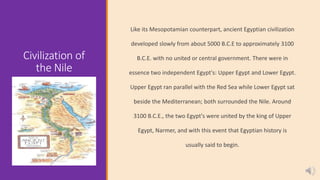
Like its Mesopotamian counterpart, ancient Egyptian civilization
developed slowly from about 5000 B.C.E to approximately 3100
B.C.E. with no united or central government. There were in
essence two independent Egypt's: Upper Egypt and Lower Egypt.
Upper Egypt ran parallel with the Red Sea while Lower Egypt sat
beside the Mediterranean; both surrounded the Nile. Around
3100 B.C.E., the two Egypt's were united by the king of Upper
Egypt, Narmer, and with this event that Egyptian history is
usually said to begin.
Egyptian history is traditionally divided into about thirty dynasties. We know very little of the
first two dynasties, but beginning with the third, the Egyptian dynasties are grouped into several
major periods distinguished by their stability and achievement: the Old Kingdom, the Middle
Kingdom, and the New Kingdom.
Old Kingdom
The old kingdom was a time of political and social stability in Egypt.
Architecture
The ancient Egyptian architecture extant today was made of stone.
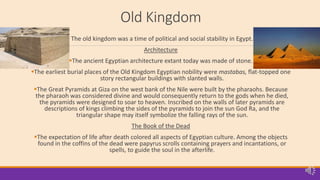
The earliest burial places of the Old Kingdom Egyptian nobility were mastabas, flat-topped one
story rectangular buildings with slanted walls.
The Great Pyramids at Giza on the west bank of the Nile were built by the pharaohs. Because
the pharaoh was considered divine and would consequently return to the gods when he died,
the pyramids were designed to soar to heaven. Inscribed on the walls of later pyramids are
descriptions of kings climbing the sides of the pyramids to join the sun God Ra, and the
triangular shape may itself symbolize the falling rays of the sun.
The Book of the Dead
The expectation of life after death colored all aspects of Egyptian culture. Among the objects
found in the coffins of the dead were papyrus scrolls containing prayers and incantations, or
spells, to guide the soul in the afterlife.
Old Kingdom
cont.
Sculpture
Most extant Egyptian sculpture is religious or political in
purpose, and either reflects the characteristic of Egyptian
desire for immortality and belief in an afterlife or
demonstrates the pharaoh’s power and divinity.
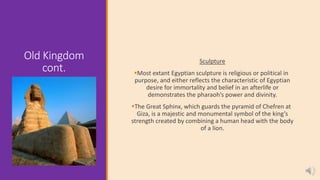
The Great Sphinx, which guards the pyramid of Chefren at
Giza, is a majestic and monumental symbol of the king’s
strength created by combining a human head with the body
of a lion.
Middle Kingdom
After the collapse of the Old Kingdom, a period of political and social turmoil ensued-the first of
the so-called intermediate periods of Egyptian history. The subsequent government was far less
centralized than that of the Old Kingdom, with only affairs of national import being left to the
king, while much more authority was given to regional governors. Under these new conditions,
the country prospered as never before. Large-scale waterworks were undertaken to irrigate
higher ground in the Nile basin, and farming yields, which were already higher than anywhere
else in the world, increased dramatically.
Architecture
Few monuments of the Middle Kingdom can be seen today, for they were replaced by grander
structures during the New Kingdom or were built of mud brick and , consequently, have largely
disappeared.
New Kingdom
After the Middle Kingdom collapsed and a second
intermediate period had begun, an eastern Mediterranean
tribe called the Hyksos invaded northern Egypt in 1674 B.C.E
bringing with them bronze weapons and horse drawn
chariots. For over two-hundred years Egypt was again divided.
The New Kingdom or Empire that resulted was most brilliant
period in Egyptian history. The great empire only fell into
decline after about 1200 B.C.E when it came under the
successive influence of Assyria and Libya, and finally lost its
independence to Persia in about 525 B.C.E.
Architecture
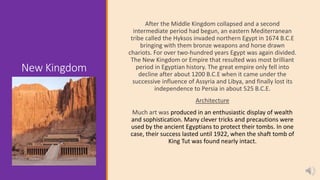
Much art was produced in an enthusiastic display of wealth
and sophistication. Many clever tricks and precautions were
used by the ancient Egyptians to protect their tombs. In one
case, their success lasted until 1922, when the shaft tomb of
King Tut was found nearly intact.
New Kingdom cont.
SCULPTURE RELIEF SCULPTURE AND PAINTING
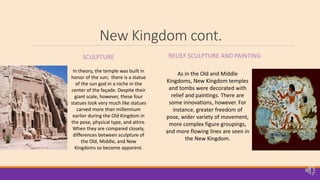
In theory, the temple was built in
honor of the sun; there is a statue
of the sun god in a niche in the
center of the façade. Despite their
giant scale, however, these four
statues look very much like statues
carved more than millennium
earlier during the Old Kingdom in
the pose, physical type, and attire.
When they are compared closely,
differences between sculpture of
the Old, Middle, and New
Kingdoms so become apparent.
As in the Old and Middle
Kingdoms, New Kingdom temples
and tombs were decorated with
relief and paintings. There are
some innovations, however. For
instance, greater freedom of
pose, wider variety of movement,
more complex figure groupings,
and more flowing lines are seen in
the New Kingdom.
Akhenaten and Tutankhamen
Akhenaten
Although royalty, Akhenaten and his family are not idealized, perfect physical types. Royalty is now
depicted in domestic situations, causally, intimately. Rather than stressing dignity, the art of him and his
wife with three daughters is playful and informal.
King Tut
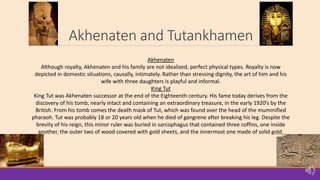
King Tut was Akhenaten successor at the end of the Eighteenth century. His fame today derives from the
discovery of his tomb, nearly intact and containing an extraordinary treasure, in the early 1920’s by the
British. From his tomb comes the death mask of Tut, which was found over the head of the mummified
pharaoh. Tut was probably 18 or 20 years old when he died of gangrene after breaking his leg. Despite the
brevity of his reign, this minor ruler was buried in sarcophagus that contained three coffins, one inside
another, the outer two of wood covered with gold sheets, and the innermost one made of solid gold.
Egyptian Music
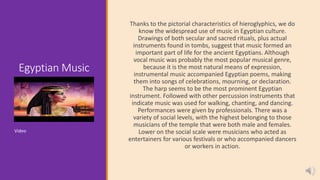
Thanks to the pictorial characteristics of hieroglyphics, we do
know the widespread use of music in Egyptian culture.
Drawings of both secular and sacred rituals, plus actual
instruments found in tombs, suggest that music formed an
important part of life for the ancient Egyptians. Although
vocal music was probably the most popular musical genre,
because it is the most natural means of expression,
instrumental music accompanied Egyptian poems, making
them into songs of celebrations, mourning, or declaration.
The harp seems to be the most prominent Egyptian
instrument. Followed with other percussion instruments that
indicate music was used for walking, chanting, and dancing.
Performances were given by professionals. There was a
variety of social levels, with the highest belonging to those
musicians of the temple that were both male and females.
Lower on the social scale were musicians who acted as
entertainers for various festivals or who accompanied dancers
or workers in action.
Video
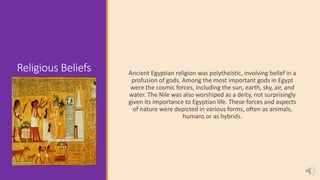
Religious Beliefs Ancient Egyptian religion was polytheistic, involving belief in a
profusion of gods. Among the most important gods in Egypt
were the cosmic forces, including the sun, earth, sky, air, and
water. The Nile was also worshiped as a deity, not surprisingly
given its importance to Egyptian life. These forces and aspects
of nature were depicted in various forms, often as animals,
humans or as hybrids.
Work Cited
Benton, Janetta and Robert DiYanni. Arts And Culture: An Introduction to Humanities. 4th ed.
2012. Pearson Education Inc, Prentice Hall.

Egyptian civilizations

  • 1.
  • 2.
    Civilization of the Nile Likeits Mesopotamian counterpart, ancient Egyptian civilization developed slowly from about 5000 B.C.E to approximately 3100 B.C.E. with no united or central government. There were in essence two independent Egypt's: Upper Egypt and Lower Egypt. Upper Egypt ran parallel with the Red Sea while Lower Egypt sat beside the Mediterranean; both surrounded the Nile. Around 3100 B.C.E., the two Egypt's were united by the king of Upper Egypt, Narmer, and with this event that Egyptian history is usually said to begin.
  • 3.
    Egyptian history istraditionally divided into about thirty dynasties. We know very little of the first two dynasties, but beginning with the third, the Egyptian dynasties are grouped into several major periods distinguished by their stability and achievement: the Old Kingdom, the Middle Kingdom, and the New Kingdom.
  • 4.
    Old Kingdom The oldkingdom was a time of political and social stability in Egypt. Architecture The ancient Egyptian architecture extant today was made of stone. The earliest burial places of the Old Kingdom Egyptian nobility were mastabas, flat-topped one story rectangular buildings with slanted walls. The Great Pyramids at Giza on the west bank of the Nile were built by the pharaohs. Because the pharaoh was considered divine and would consequently return to the gods when he died, the pyramids were designed to soar to heaven. Inscribed on the walls of later pyramids are descriptions of kings climbing the sides of the pyramids to join the sun God Ra, and the triangular shape may itself symbolize the falling rays of the sun. The Book of the Dead The expectation of life after death colored all aspects of Egyptian culture. Among the objects found in the coffins of the dead were papyrus scrolls containing prayers and incantations, or spells, to guide the soul in the afterlife.
  • 5.
    Old Kingdom cont. Sculpture Most extantEgyptian sculpture is religious or political in purpose, and either reflects the characteristic of Egyptian desire for immortality and belief in an afterlife or demonstrates the pharaoh’s power and divinity. The Great Sphinx, which guards the pyramid of Chefren at Giza, is a majestic and monumental symbol of the king’s strength created by combining a human head with the body of a lion.
  • 6.
    Middle Kingdom After thecollapse of the Old Kingdom, a period of political and social turmoil ensued-the first of the so-called intermediate periods of Egyptian history. The subsequent government was far less centralized than that of the Old Kingdom, with only affairs of national import being left to the king, while much more authority was given to regional governors. Under these new conditions, the country prospered as never before. Large-scale waterworks were undertaken to irrigate higher ground in the Nile basin, and farming yields, which were already higher than anywhere else in the world, increased dramatically. Architecture Few monuments of the Middle Kingdom can be seen today, for they were replaced by grander structures during the New Kingdom or were built of mud brick and , consequently, have largely disappeared.
  • 7.
    New Kingdom After theMiddle Kingdom collapsed and a second intermediate period had begun, an eastern Mediterranean tribe called the Hyksos invaded northern Egypt in 1674 B.C.E bringing with them bronze weapons and horse drawn chariots. For over two-hundred years Egypt was again divided. The New Kingdom or Empire that resulted was most brilliant period in Egyptian history. The great empire only fell into decline after about 1200 B.C.E when it came under the successive influence of Assyria and Libya, and finally lost its independence to Persia in about 525 B.C.E. Architecture Much art was produced in an enthusiastic display of wealth and sophistication. Many clever tricks and precautions were used by the ancient Egyptians to protect their tombs. In one case, their success lasted until 1922, when the shaft tomb of King Tut was found nearly intact.
  • 8.
    New Kingdom cont. SCULPTURERELIEF SCULPTURE AND PAINTING In theory, the temple was built in honor of the sun; there is a statue of the sun god in a niche in the center of the façade. Despite their giant scale, however, these four statues look very much like statues carved more than millennium earlier during the Old Kingdom in the pose, physical type, and attire. When they are compared closely, differences between sculpture of the Old, Middle, and New Kingdoms so become apparent. As in the Old and Middle Kingdoms, New Kingdom temples and tombs were decorated with relief and paintings. There are some innovations, however. For instance, greater freedom of pose, wider variety of movement, more complex figure groupings, and more flowing lines are seen in the New Kingdom.
  • 9.
    Akhenaten and Tutankhamen Akhenaten Althoughroyalty, Akhenaten and his family are not idealized, perfect physical types. Royalty is now depicted in domestic situations, causally, intimately. Rather than stressing dignity, the art of him and his wife with three daughters is playful and informal. King Tut King Tut was Akhenaten successor at the end of the Eighteenth century. His fame today derives from the discovery of his tomb, nearly intact and containing an extraordinary treasure, in the early 1920’s by the British. From his tomb comes the death mask of Tut, which was found over the head of the mummified pharaoh. Tut was probably 18 or 20 years old when he died of gangrene after breaking his leg. Despite the brevity of his reign, this minor ruler was buried in sarcophagus that contained three coffins, one inside another, the outer two of wood covered with gold sheets, and the innermost one made of solid gold.
  • 10.
    Egyptian Music Thanks tothe pictorial characteristics of hieroglyphics, we do know the widespread use of music in Egyptian culture. Drawings of both secular and sacred rituals, plus actual instruments found in tombs, suggest that music formed an important part of life for the ancient Egyptians. Although vocal music was probably the most popular musical genre, because it is the most natural means of expression, instrumental music accompanied Egyptian poems, making them into songs of celebrations, mourning, or declaration. The harp seems to be the most prominent Egyptian instrument. Followed with other percussion instruments that indicate music was used for walking, chanting, and dancing. Performances were given by professionals. There was a variety of social levels, with the highest belonging to those musicians of the temple that were both male and females. Lower on the social scale were musicians who acted as entertainers for various festivals or who accompanied dancers or workers in action. Video
  • 11.
    Religious Beliefs AncientEgyptian religion was polytheistic, involving belief in a profusion of gods. Among the most important gods in Egypt were the cosmic forces, including the sun, earth, sky, air, and water. The Nile was also worshiped as a deity, not surprisingly given its importance to Egyptian life. These forces and aspects of nature were depicted in various forms, often as animals, humans or as hybrids.
  • 12.
    Work Cited Benton, Janettaand Robert DiYanni. Arts And Culture: An Introduction to Humanities. 4th ed. 2012. Pearson Education Inc, Prentice Hall.