Virology
Laboratory Guide Line in
Embryo inoculation
Technique
Contents
1. Sampling
2. virus isolation in embryonated eggs
2.1. Material
2.2. Inoculation site
2.3. Candling
2.4. Harvesting virus
2.5. Result
Sample Processing
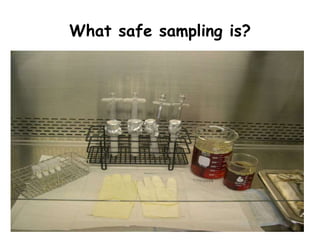
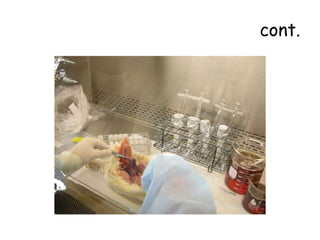
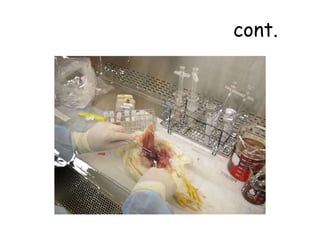
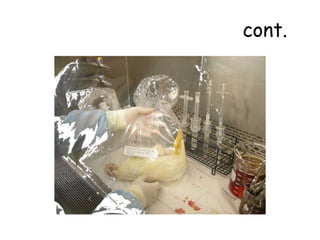
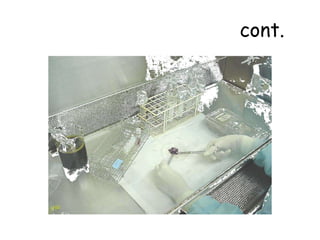
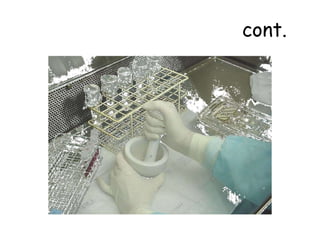
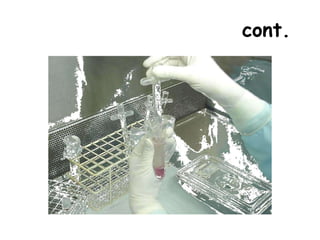
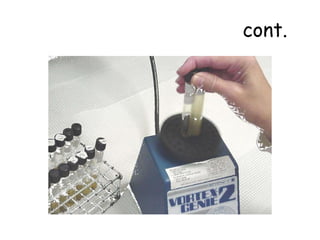
What safe sampling is?
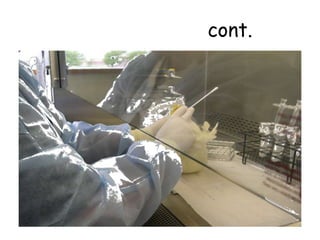
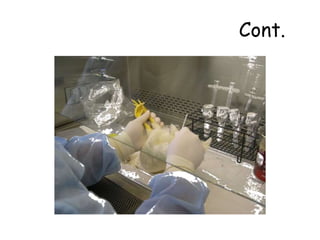
cont.
Cont.
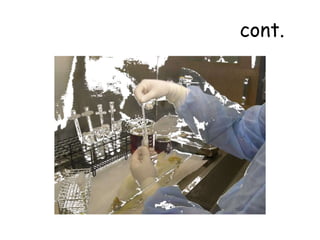
cont.
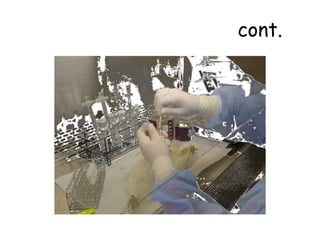
cont.
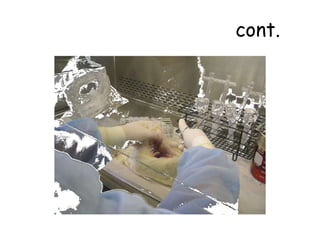
cont.
cont.
cont.
cont.
Processing Tissues for Isolation of
AIV and APMV
• Diluents Prepare 10% suspension in
antibiotic
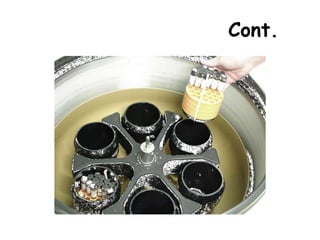
• Centrifuge at 1,500 x g – 20 minutes
• and place in sterile vial Remove
supernatant with pipette
• Temperature Incubate 1 hour at room
cont.
cont.
cont.
cont.
Cont.
VIRUS CULTIVATION SYSTEMS
1. BIOLOGICAL SYSTEM
2. EMBRYONATED EGGS
3. TISSUE CULTURE SYSTEM
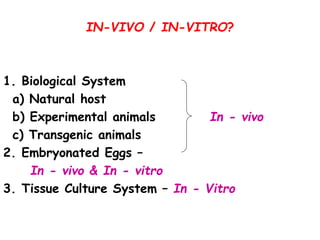
IN-VIVO / IN-VITRO?
1. Biological System
a) Natural host
b) Experimental animals In - vivo
c) Transgenic animals
2. Embryonated Eggs –
In - vivo & In - vitro
3. Tissue Culture System – In - Vitro
ANIMAL INOCULATION-
DISADVANTAGES
• Cost
• Maintenance
• Interference of immune system
• Individual variations
• Difficulty in choosing of animals
for particular virus
EMBRYONATED EGGS
ADVANTAGES
• Isolation and cultivation of many avian
and few mammalian viruses
• Ideal receptacle for virus to grow
• Sterile & wide range of tissues and
fluids
• Cost- much less
• Maintenance-easier
• Less labour
• Readily available
• Free from bacteria and many
latent viruses.
• Free from specific and non
specific factors of defense.
• Sensitive to viruses which do not
produce infection in adult birds.
virus isolation in embryonated
eggs
Why Egg?
The avian embryo, especially the chicken embryo, is a valuable and
widely used medium for the initial isolation and subsequent
passage of many viruses for stock cultures and the production of
vaccines. Chicken embryos are used almost exclusively because of
their.
(1) Availability
(2) Economy
(3) Convenient size
(4) Relative freedom from latent infection and extraneous
Contamination, and
(5) Lack of production of antibodies against the viral inoculums.
Eggs only from healthy, disease-free flocks should be used. It is
desirable to have one source of supply for reasons of uniformity
of production and management of the breeder flock.
Material
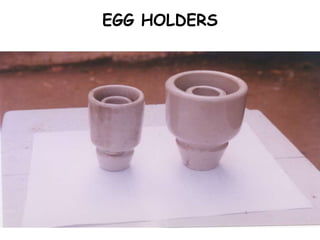
EGG HOLDERS
Paraffin wax/Elmer’s Glue
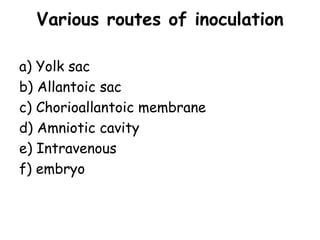
Various routes of inoculation
a) Yolk sac
b) Allantoic sac
c) Chorioallantoic membrane
d) Amniotic cavity
e) Intravenous
f) embryo
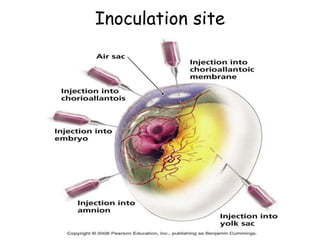
Inoculation site
Allantoic Cavity
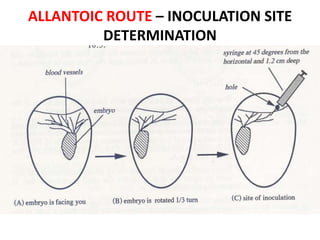
1. Candle the egg and select an area of the chorioallantoic
membrane distant from the embryo and amnionic cavity
and free of large blood vessels about 3 mm below the
base of the air cell. In this area make a pencil mark at
the point of inoculation.
2. Make a similar mark at the upper extremity of the shell
over the air cell.
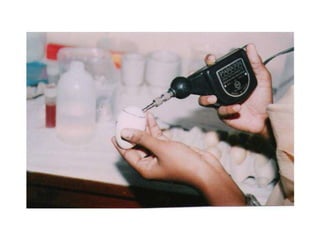
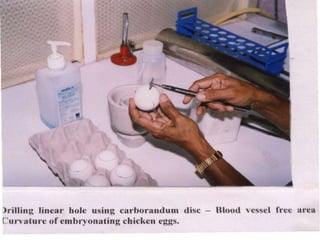
3. Drill a small hole through the shell at each mark but do not
pierce the shell membrane.
4. Apply tincture of metaphen or another suitable
disinfectant to the holes and allow to dry
34
Cont.
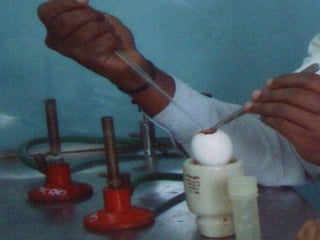
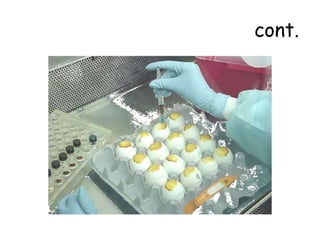
• After all the eggs have been nicked, they
are inoculated with virus using a tuberculin
syringe – a 1 ml syringe fitted with a 1/2
inch, 27 gauge needle.
• The needle passes through the hole in the
shell, through the chorioallantoic
membrane. The hole in the shell is sealed
with melted paraffin, and the eggs are
placed at 37 °C for 48 hours
ALLANTOIC ROUTE – INOCULATION SITE
DETERMINATION
ALLANTOIC ROUTE
• Most popular
• Most of avian viruses
• High titered virus
• Simple technique
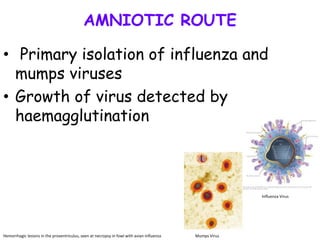
AMNIOTIC ROUTE
• Primary isolation of influenza and
mumps viruses
• Growth of virus detected by
haemagglutination
Hemorrhagic lesions in the proventriculus, seen at necropsy in fowl with avian influenza
Influenza Virus
Mumps Virus
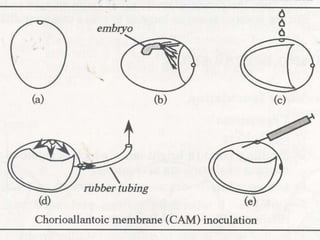
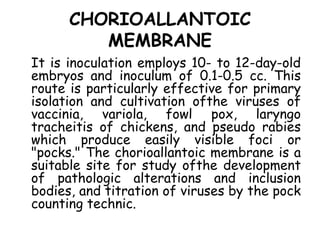
CHORIOALLANTOIC
MEMBRANE
It is inoculation employs 10- to 12-day-old
embryos and inoculum of 0.1-0.5 cc. This
route is particularly effective for primary
isolation and cultivation ofthe viruses of
vaccinia, variola, fowl pox, laryngo
tracheitis of chickens, and pseudo rabies
which produce easily visible foci or
"pocks." The chorioallantoic membrane is a
suitable site for study ofthe development
of pathologic alterations and inclusion
bodies, and titration of viruses by the pock
counting technic.
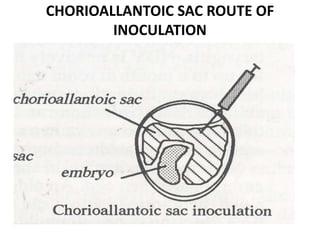
CHORIOALLANTOIC SAC ROUTE OF
INOCULATION
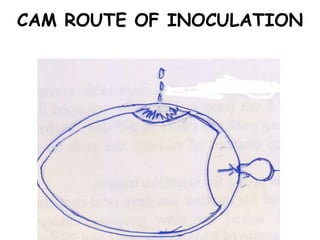
CAM ROUTE OF INOCULATION
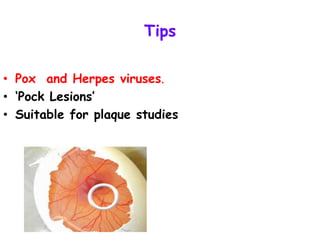
Tips
• Pox and Herpes viruses.
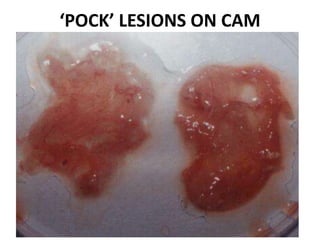
• ‘Pock Lesions’
• Suitable for plaque studies
YOLK SAC inoculation
YOLK SAC inoculation is performed
with 5- to 8-day-old embryos and
inoculum of 0.2-1.0 cc. This route may
be used for initial isolation of mumps
virus
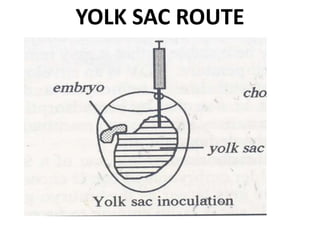
YOLK SAC ROUTE
YOLK SAC ROUTE
Advantages
•Simplest method
•Mostly mammalian viruses
•Immune interference for most of avian
viruses
Disadvantages
•Not suited for avian viruses
Intracerebral inoculation
Intracerebral inoculation can be performed with
8- to 14-day-old embryos and inoculum of 0.01-
0.02 cc. This route may be employed in studies of
pathologic alterations of the brain following
infection. The viruses of herpes simplex and
rabies may be cultivated by this route.
Embryos are incubated after inoculation for a
period appropriate for the virus employed
andthey are examined at least once daily. Death
of the embryo within the first 24 hours after
inoculation is generally considered to be due to
nonspecific causes such as trauma. Some viruses.
Cont.
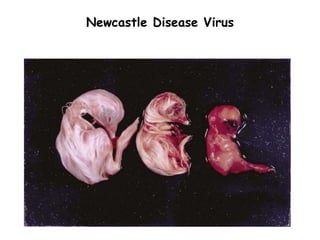
kill all embryos and mortality is the criterion of
infection. Newcastle disease virus is an example in which
embryos are killed in two to four days depending upon
the strain of the virus. With some viruses such as
influenza virus the mortality rate varies on initial
passage but may increase with subsequent passage.
The criterion of infection with herpes and pox viruses is
the formation of pock lesions on the chorioallantoic
membrane. Other gross pathologic manifestations of
infection of the embryo may be curling and dwarfing of
the embryo, fibrosis of the amnionic membrane, edema
of the chorioallantoic membrane, and urates in the
kidney and mesonephros such as produced by avian
coronaviruses on initial and low passage in the embryo.
Cont.
Various types of cytologic changes,
including inclusion bodies with certain
viruses, may be detected by microscopy.
The embryo should be examined soon after
death so that postmortem changes do not
obscure any specific pathologic alterations.
Chilling of the embryos for several hours
or for overnight before collection of
extraembryonic fluids is recommended to
reduce hemorrhage into the fluids.
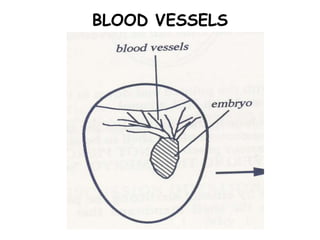
Intravenous inoculation
Intravenous inoculation does not have wide
practical application for study of
experimental infections of the avian
embryo.The procedure is generally
employed for hematologic studies. Embryos
of 10- to 15-days incubation are most
suitable for this route. The amount
ofinoculum may vary from 0.02 to 0.05 cc.
BLOOD VESSELS
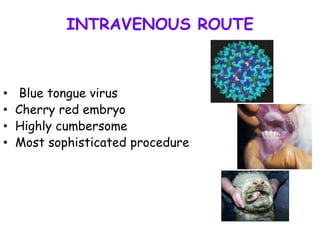
INTRAVENOUS ROUTE
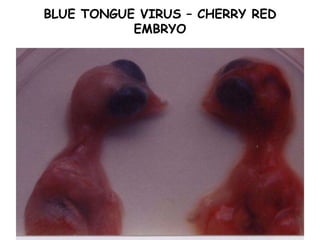
• Blue tongue virus
• Cherry red embryo
• Highly cumbersome
• Most sophisticated procedure
Student Task
1. Why we select egg for cultivation of viral inoculums?
2. How can we detect the viability of embryo while candling?
3. What is the relationship b/n embryo inoculation site and
viral inoculums?
4.The best selective site for pox viral inoculum is m/m how it
could be?
5. White egg is selective for embryo inoculation technique
than other colored egg, why this is so?
Student Task
Q) What is your base on site selection ?
Q) What is the effect of maternal immunity on
injected inoculums?
Q) What types of viral samples selectively
inoculated in yolk sac?
Q) If u encountered death of embryo within
24hr after inoculation of fertile egg ,it is
indicative of ____?
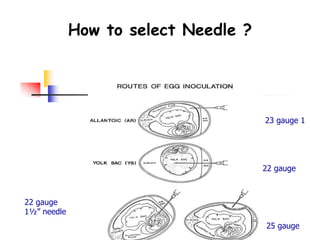
How to select Needle ?
25 23 gauge 1
2222 gauge
25 gauge
22 gauge
1½” needle
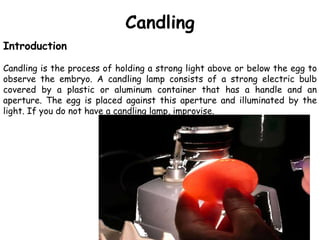
Candling
Introduction
Candling is the process of holding a strong light above or below the egg to
observe the embryo. A candling lamp consists of a strong electric bulb
covered by a plastic or aluminum container that has a handle and an
aperture. The egg is placed against this aperture and illuminated by the
light. If you do not have a candling lamp, improvise.
Equipment Needed for Egg
Candling and Inoculation
• 4 eggs/student
• Egg flat
• Drill
• 70% Ethanol spray bottle
• Marker
• Glue
• 23 guage 1” needle
• Egg labels
• Sharps container
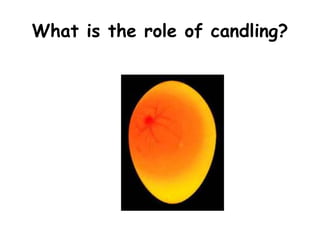
What is the role of candling?
CANDLING BOX
Cont.
Storage and cleaning of eggs
• Do not buy dirty eggs.
• Eggs that are stained can be disinfected by washing in a
warm (37°C) solution of 0.1 percent Chloramin B (benzine
sulfonamide sodium salt) or wiped with a 70 percent
alcohol solution.
• Fertile eggs that have not been incubated can be
purchased. They can then be placed in an incubator when
they are delivered. Alternatively, they can be stored for
several days in cool conditions (16°C to 18°C) prior to
incubation. This may reduce the number of viable embryos,
as some embryos may not develop after storage.
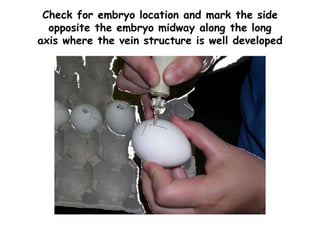
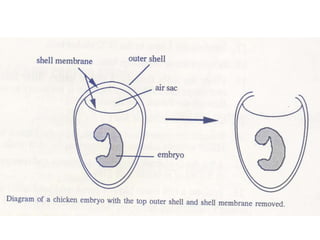
Check for embryo location and mark the side
opposite the embryo midway along the long
axis where the vein structure is well developed
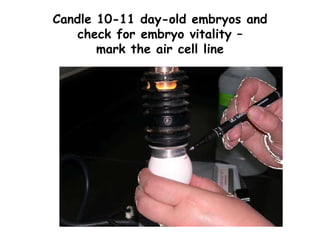
Candle 10-11 day-old embryos and
check for embryo vitality –
mark the air cell line
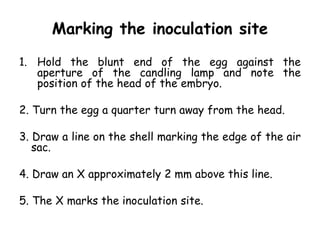
Marking the inoculation site
1. Hold the blunt end of the egg against the
aperture of the candling lamp and note the
position of the head of the embryo.
2. Turn the egg a quarter turn away from the head.
3. Draw a line on the shell marking the edge of the air
sac.
4. Draw an X approximately 2 mm above this line.
5. The X marks the inoculation site.
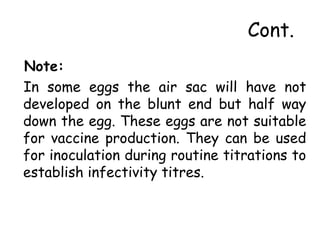
Cont.
Note:
In some eggs the air sac will have not
developed on the blunt end but half way
down the egg. These eggs are not suitable
for vaccine production. They can be used
for inoculation during routine titrations to
establish infectivity titres.
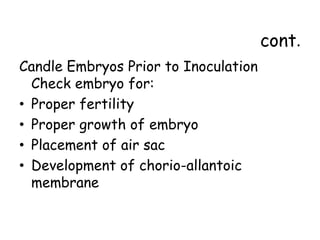
cont.
Candle Embryos Prior to Inoculation
Check embryo for:
• Proper fertility
• Proper growth of embryo
• Placement of air sac
• Development of chorio-allantoic
membrane
cont.
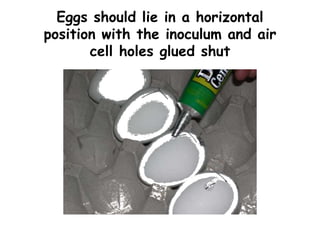
Eggs should lie in a horizontal
position with the inoculum and air
cell holes glued shut
Cleaning and decontamination of
incubators
Keep surfaces clean by wiping out with a
wet cloth and disinfecting with 70
percent alcohol solution or a non-
corrosive disinfectant.
Incubation of eggs after
inoculation
Inoculated eggs contain virus and should
be placed in a different incubator. Eggs
inoculated with virulent strains of
Newcastle disease virus should not be
incubated in the same incubator as used
for eggs inoculated with the avirulent I-2
strain of Newcastle disease virus.
Inoculated eggs are incubated under the
same conditions as uninoculated eggs but
do NOT turn the eggs.
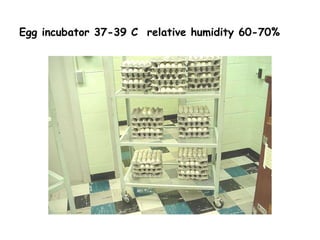
Egg incubator 37-39 C relative humidity 60-70%
Tips
Humidity should be maintained at 60 to 65
percent. A tray filled with water and
placed in the bottom of the incubator is
usually sufficient to maintain this level of
humidity.
Place the eggs in the incubator with the air
sac on top.
Eggs should be turned three times a day.
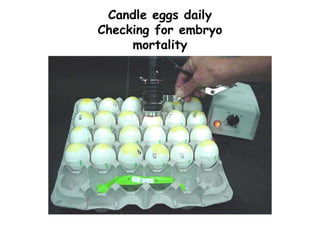
Candle eggs daily
Checking for embryo
mortality
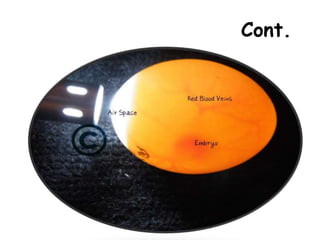
Determining the viability of the
embryo
Under the candling lamp, the embryo appears as a dark
shadow with the head as a dark spot. Healthy embryos will
respond to the light by moving Sometimes the movement is
very sluggish and it can take 30 to 40 seconds for the
embryo to move when held under the candling lamp. This
indicates the embryo is not healthy and the egg should be
discarded.
Look carefully at the blood vessels. They are well defined
in a healthy embryo. After an embryo has died, the blood
vessels start to break down. They then appear as streaks
under the shell when viewed under the candling lamp.
Candling will also reveal cracks in the eggshells. Eggs with
cracked shells should be discarded.
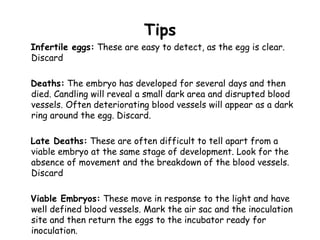
Tips
Infertile eggs: These are easy to detect, as the egg is clear.
Discard
Deaths: The embryo has developed for several days and then
died. Candling will reveal a small dark area and disrupted blood
vessels. Often deteriorating blood vessels will appear as a dark
ring around the egg. Discard.
Late Deaths: These are often difficult to tell apart from a
viable embryo at the same stage of development. Look for the
absence of movement and the breakdown of the blood vessels.
Discard
Viable Embryos: These move in response to the light and have
well defined blood vessels. Mark the air sac and the inoculation
site and then return the eggs to the incubator ready for
inoculation.
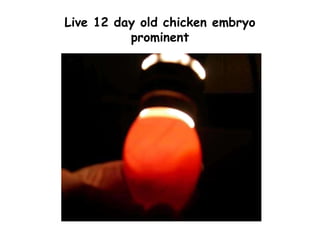
Live 12 day old chicken embryo
prominent
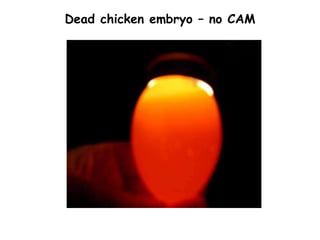
Dead chicken embryo – no CAM
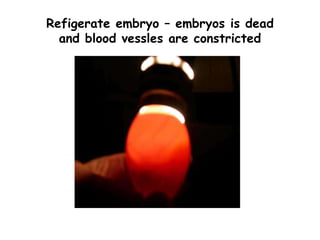
Refigerate embryo – embryos is dead
and blood vessles are constricted
Harvesting
Equipment Needed for
Harvesting
AAF from Dead Eggs
2 embryos/student
2 Forceps
Iodine box for forceps
5 ml pipettes and
pipette aid
Gloves
Blood Agar plate
Plastic loops
Cont.
• Snap cap tube with
• labels
• Ethanol spray bottle
• Iodine bucket for
• pipettes
• Discard bucket with
• bags for embryos
• Plastic bags to discard
• flats
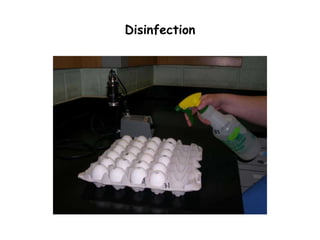
Disinfection
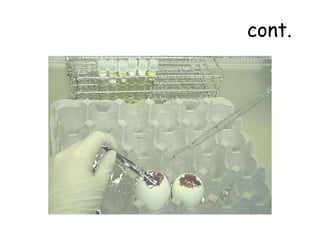
cont.
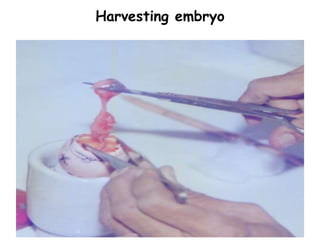
Harvesting embryo
Harvesting AAF from Dead
Embryos
1. Disinfect egg shell surface one time in the
BSC
2. 2. Only open eggs from a single specimen at
3. Open egg from air cell end with forceps
4. Break allantoic sac with sterile forceps
pipette tip with forceps
5. Hold membranes and embryo away from
6. Harvest AAF
7. Streak BA plate
8. Centrifuge 1,500 x g for 15 min.
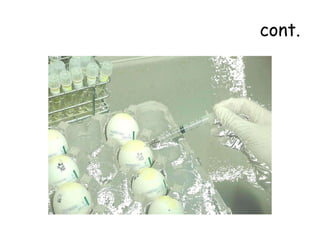
Harvesting AAF for Live Embryos
constrict chorioallantoic vessels
1. Refrigerate embryo to kill embryo and
2. Disinfect shell
3. Drill small hole above air cell line
4. Aspirate AAF with 3cc 22 gauge 1½” syringe
will bind with virus
5. Discard AAF with red blood cells – RBC
cont.
Harvesting and storage of allantoic fluid
Introduction
Allantoic fluid from inoculated eggs will be harvested for three
reasons.
1. To prepare I-2 Newcastle disease working seed or vaccine.
2. To use as antigen in the haemagglutination inhibition test.
3. To be tested for the presence or absence of Newcastle disease
virus by the haemagglutination test. These results are then used
to calculate the infectivity titre of a suspension of virus.
Note
Maternal antibody is confined to the yolk sac until about 14
days of incubation and then enters the embryo. Virus
harvested in allantoic fluid at 14 days will not have been
exposed to antibody.
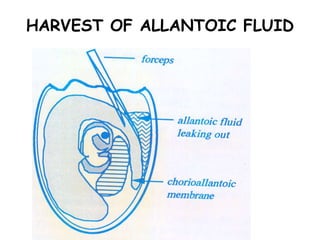
HARVEST OF ALLANTOIC FLUID
92
Cont.
• During the incubation period, the virus replicates in
the cells that make up the chorioallantoic membrane.
As new virus particles are produced by budding, they
are released into the allantoic fluid. To harvest the
virus, the top of the egg shell – the part covering the
air sac – is removed.
• The shell membrane and chorioallantoic membrane are
pierced with a pipette which is then used to remove
the allantoic fluid – about 10 ml per egg.
Harvesting allantoic fluid to prepare
working seed, vaccine or antigen
Materials
Forceps or a small pair of scissors
Absolute alcohol for flaming forceps
Cotton wool
70 percent alcohol solution in water
Discard tray
50 mL micropipette and tips or a wire loop
Sterile Pasteur pipettes with short blunt ends
96 well microwell plate
10 percent washed red blood cells
Sterile containers for receiving the harvested
allantoic fluid.
Method
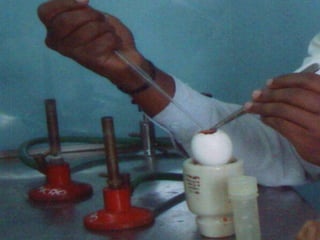
1. Chill eggs at 4°C for at least two hours to kill the embryo and to reduce the
contamination of the allantoic fluid with blood during harvesting.
2. Remove stationery tape (if used to seal the eggs) and swab each egg with cotton
wool soaked with 70 percent alcohol to disinfect and remove condensation from
the shells.
3. Dip the forceps or scissors in disinfectant OR if using a Bunsen burner, dip the
forceps or scissors in absolute alcohol and flame to sterilize. Remove the
eggshell above the air space.
4. Discard embryos that are visibly contaminated.
5. Remove a sample of allantoic fluid from each egg. Use a micropipette and sterile
tip, sterile glass pipette or a flamed loop. Test each sample for the presence of
Newcastle disease virus by the haemagglutination (HA) test.
6. Discard embryos that do not test HA positive for Newcastle disease virus.
7. Use sterile glass Pasteur pipettes to harvest the allantoic fluid from the eggs.
The pipettes can be either hand held or used unplugged and connected to a
vacuum pump. Collect the fluid into sterile containers.
Preliminary Quality Control
This step involves the inoculation of a general purpose broth
culture.
1. Test each container for bacterial contamination by
inoculating tryptic soy broth with test samples and
incubation at 37°C overnight.
2. Centrifuge the samples of allantoic fluid or stand
overnight at 4°C to allow particles including red blood cells
to settle. The allantoic fluid should appear clear after
centrifugation or standing overnight.
3. After 24 hours, read the results of the tests for bacterial
contamination.
4. Use aseptic technique to transfer the clear allantoic fluid
supernatant from containers that showed no bacterial
growth into a sterile container for storage. This step pools
the fluid and ensures homogeneity.
Storage of allantoic fluid
The optimum temperature for storage of allantoic fluid
containing live Newcastle disease virus is -70°C. Storage
at -20°C is not as effective and the infectivity titre will
slowly decrease. The action of the freezing and thawing
also decreases the infectivity titre of the virus. Allantoic
fluid containing Newcastle disease virus has been stored
for up to 6 weeks at 4°C without significant loss of titre.
Allantoic fluid will be stored for two purposes.
1. Antigen for use in the haemagglutination inhibition test.
Prepare 1 mL aliquots of undiluted allantoic fluid in vials.
2. Preparation of vaccine.
Storage of allantoic fluid at 4°C for use as a
wet vaccine
Diluents containing a stabilizing agent are used in the
preparation of wet Newcastle disease vaccine. Suitable
stabilizing agents are gelatin and skim milk powder.
Diluents containing 2 percent gelatin solution or 8 percent
skim milk powder in phosphate buffered saline are
sterilized prior to use and mixed one part diluent with one
part allantoic fluid.
A further dilution step in two parts of PSG antibiotic
solution will reduce the risk of growth of contaminating
bacteria during storage. Trials at John Francis Virology
Laboratory have shown that 1 percent gelatin is a superior
storage agent to 4 percent skim milk.
Control allantoic fluid samples
• Negative and positive control samples are tested in both
the rapid and micro haemagglutination tests to ensure the
validity of the test.
• Negative control allantoic fluid is harvested from 14-day
old embryonated eggs that have not been inoculated with
Newcastle disease virus. It should always test negative for
the presence of haemagglutinins. There should not be any
sign of haemagglutination.
• Positive control allantoic fluid is known to contain a high
infectivity titre of Newcastle disease virus. It should
always test positive for the presence of haemagglutinins.
Haemagglutination should be visible.
100
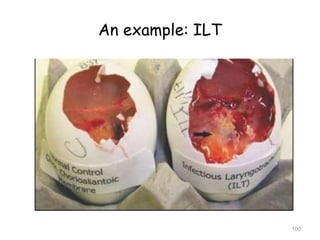
An example: ILT
Result
Interpretation
Newcastle Disease Virus
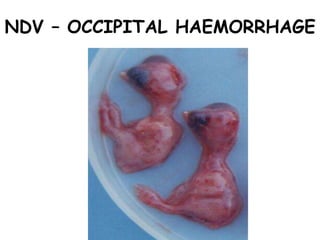
NDV – OCCIPITAL HAEMORRHAGE
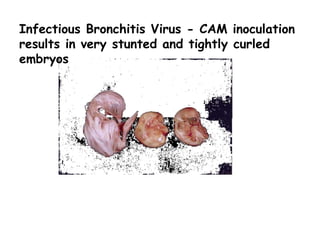
Infectious Bronchitis Virus - CAM inoculation
results in very stunted and tightly curled
embryos
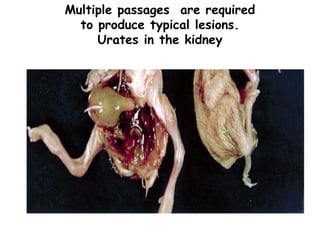
Multiple passages are required
to produce typical lesions.
Urates in the kidney
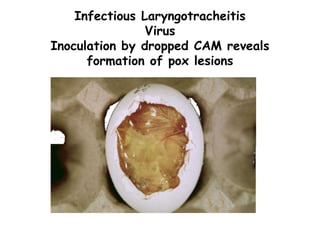
Infectious Laryngotracheitis
Virus
Inoculation by dropped CAM reveals
formation of pox lesions
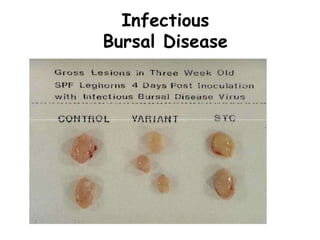
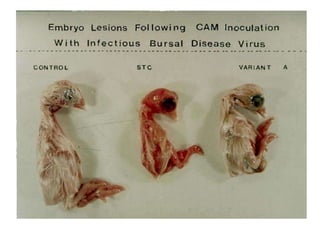
Infectious
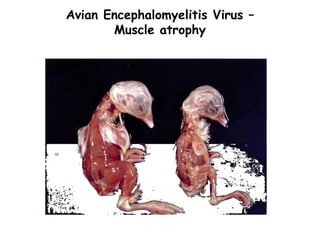
Bursal Disease
Avian Encephalomyelitis Virus –
Muscle atrophy
BLUE TONGUE VIRUS – CHERRY RED
EMBRYO
‘POCK’ LESIONS ON CAM

Egg inoculation new1

  • 1.
    Virology Laboratory Guide Linein Embryo inoculation Technique
  • 2.
    Contents 1. Sampling 2. virusisolation in embryonated eggs 2.1. Material 2.2. Inoculation site 2.3. Candling 2.4. Harvesting virus 2.5. Result
  • 3.
  • 4.
  • 5.
  • 6.
  • 7.
  • 8.
  • 9.
  • 10.
  • 11.
  • 12.
  • 13.
    Processing Tissues forIsolation of AIV and APMV • Diluents Prepare 10% suspension in antibiotic • Centrifuge at 1,500 x g – 20 minutes • and place in sterile vial Remove supernatant with pipette • Temperature Incubate 1 hour at room
  • 14.
  • 15.
  • 16.
  • 17.
  • 18.
  • 19.
    VIRUS CULTIVATION SYSTEMS 1.BIOLOGICAL SYSTEM 2. EMBRYONATED EGGS 3. TISSUE CULTURE SYSTEM
  • 20.
    IN-VIVO / IN-VITRO? 1.Biological System a) Natural host b) Experimental animals In - vivo c) Transgenic animals 2. Embryonated Eggs – In - vivo & In - vitro 3. Tissue Culture System – In - Vitro
  • 21.
    ANIMAL INOCULATION- DISADVANTAGES • Cost •Maintenance • Interference of immune system • Individual variations • Difficulty in choosing of animals for particular virus
  • 22.
    EMBRYONATED EGGS ADVANTAGES • Isolationand cultivation of many avian and few mammalian viruses • Ideal receptacle for virus to grow • Sterile & wide range of tissues and fluids
  • 23.
    • Cost- muchless • Maintenance-easier • Less labour • Readily available
  • 24.
    • Free frombacteria and many latent viruses. • Free from specific and non specific factors of defense. • Sensitive to viruses which do not produce infection in adult birds.
  • 25.
    virus isolation inembryonated eggs
  • 26.
    Why Egg? The avianembryo, especially the chicken embryo, is a valuable and widely used medium for the initial isolation and subsequent passage of many viruses for stock cultures and the production of vaccines. Chicken embryos are used almost exclusively because of their. (1) Availability (2) Economy (3) Convenient size (4) Relative freedom from latent infection and extraneous Contamination, and (5) Lack of production of antibodies against the viral inoculums. Eggs only from healthy, disease-free flocks should be used. It is desirable to have one source of supply for reasons of uniformity of production and management of the breeder flock.
  • 27.
  • 28.
  • 30.
  • 31.
    Various routes ofinoculation a) Yolk sac b) Allantoic sac c) Chorioallantoic membrane d) Amniotic cavity e) Intravenous f) embryo
  • 32.
  • 33.
    Allantoic Cavity 1. Candlethe egg and select an area of the chorioallantoic membrane distant from the embryo and amnionic cavity and free of large blood vessels about 3 mm below the base of the air cell. In this area make a pencil mark at the point of inoculation. 2. Make a similar mark at the upper extremity of the shell over the air cell. 3. Drill a small hole through the shell at each mark but do not pierce the shell membrane. 4. Apply tincture of metaphen or another suitable disinfectant to the holes and allow to dry
  • 34.
    34 Cont. • After allthe eggs have been nicked, they are inoculated with virus using a tuberculin syringe – a 1 ml syringe fitted with a 1/2 inch, 27 gauge needle. • The needle passes through the hole in the shell, through the chorioallantoic membrane. The hole in the shell is sealed with melted paraffin, and the eggs are placed at 37 °C for 48 hours
  • 35.
    ALLANTOIC ROUTE –INOCULATION SITE DETERMINATION
  • 36.
    ALLANTOIC ROUTE • Mostpopular • Most of avian viruses • High titered virus • Simple technique
  • 37.
    AMNIOTIC ROUTE • Primaryisolation of influenza and mumps viruses • Growth of virus detected by haemagglutination Hemorrhagic lesions in the proventriculus, seen at necropsy in fowl with avian influenza Influenza Virus Mumps Virus
  • 38.
    CHORIOALLANTOIC MEMBRANE It is inoculationemploys 10- to 12-day-old embryos and inoculum of 0.1-0.5 cc. This route is particularly effective for primary isolation and cultivation ofthe viruses of vaccinia, variola, fowl pox, laryngo tracheitis of chickens, and pseudo rabies which produce easily visible foci or "pocks." The chorioallantoic membrane is a suitable site for study ofthe development of pathologic alterations and inclusion bodies, and titration of viruses by the pock counting technic.
  • 39.
  • 41.
    CAM ROUTE OFINOCULATION
  • 42.
    Tips • Pox andHerpes viruses. • ‘Pock Lesions’ • Suitable for plaque studies
  • 43.
    YOLK SAC inoculation YOLKSAC inoculation is performed with 5- to 8-day-old embryos and inoculum of 0.2-1.0 cc. This route may be used for initial isolation of mumps virus
  • 44.
  • 45.
    YOLK SAC ROUTE Advantages •Simplestmethod •Mostly mammalian viruses •Immune interference for most of avian viruses Disadvantages •Not suited for avian viruses
  • 46.
    Intracerebral inoculation Intracerebral inoculationcan be performed with 8- to 14-day-old embryos and inoculum of 0.01- 0.02 cc. This route may be employed in studies of pathologic alterations of the brain following infection. The viruses of herpes simplex and rabies may be cultivated by this route. Embryos are incubated after inoculation for a period appropriate for the virus employed andthey are examined at least once daily. Death of the embryo within the first 24 hours after inoculation is generally considered to be due to nonspecific causes such as trauma. Some viruses.
  • 47.
    Cont. kill all embryosand mortality is the criterion of infection. Newcastle disease virus is an example in which embryos are killed in two to four days depending upon the strain of the virus. With some viruses such as influenza virus the mortality rate varies on initial passage but may increase with subsequent passage. The criterion of infection with herpes and pox viruses is the formation of pock lesions on the chorioallantoic membrane. Other gross pathologic manifestations of infection of the embryo may be curling and dwarfing of the embryo, fibrosis of the amnionic membrane, edema of the chorioallantoic membrane, and urates in the kidney and mesonephros such as produced by avian coronaviruses on initial and low passage in the embryo.
  • 48.
    Cont. Various types ofcytologic changes, including inclusion bodies with certain viruses, may be detected by microscopy. The embryo should be examined soon after death so that postmortem changes do not obscure any specific pathologic alterations. Chilling of the embryos for several hours or for overnight before collection of extraembryonic fluids is recommended to reduce hemorrhage into the fluids.
  • 49.
    Intravenous inoculation Intravenous inoculationdoes not have wide practical application for study of experimental infections of the avian embryo.The procedure is generally employed for hematologic studies. Embryos of 10- to 15-days incubation are most suitable for this route. The amount ofinoculum may vary from 0.02 to 0.05 cc.
  • 50.
  • 51.
    INTRAVENOUS ROUTE • Bluetongue virus • Cherry red embryo • Highly cumbersome • Most sophisticated procedure
  • 52.
    Student Task 1. Whywe select egg for cultivation of viral inoculums? 2. How can we detect the viability of embryo while candling? 3. What is the relationship b/n embryo inoculation site and viral inoculums? 4.The best selective site for pox viral inoculum is m/m how it could be? 5. White egg is selective for embryo inoculation technique than other colored egg, why this is so?
  • 53.
    Student Task Q) Whatis your base on site selection ? Q) What is the effect of maternal immunity on injected inoculums? Q) What types of viral samples selectively inoculated in yolk sac? Q) If u encountered death of embryo within 24hr after inoculation of fertile egg ,it is indicative of ____?
  • 54.
    How to selectNeedle ? 25 23 gauge 1 2222 gauge 25 gauge 22 gauge 1½” needle
  • 55.
    Candling Introduction Candling is theprocess of holding a strong light above or below the egg to observe the embryo. A candling lamp consists of a strong electric bulb covered by a plastic or aluminum container that has a handle and an aperture. The egg is placed against this aperture and illuminated by the light. If you do not have a candling lamp, improvise.
  • 56.
    Equipment Needed forEgg Candling and Inoculation • 4 eggs/student • Egg flat • Drill • 70% Ethanol spray bottle • Marker • Glue • 23 guage 1” needle • Egg labels • Sharps container
  • 57.
    What is therole of candling?
  • 58.
  • 59.
  • 60.
    Storage and cleaningof eggs • Do not buy dirty eggs. • Eggs that are stained can be disinfected by washing in a warm (37°C) solution of 0.1 percent Chloramin B (benzine sulfonamide sodium salt) or wiped with a 70 percent alcohol solution. • Fertile eggs that have not been incubated can be purchased. They can then be placed in an incubator when they are delivered. Alternatively, they can be stored for several days in cool conditions (16°C to 18°C) prior to incubation. This may reduce the number of viable embryos, as some embryos may not develop after storage.
  • 61.
    Check for embryolocation and mark the side opposite the embryo midway along the long axis where the vein structure is well developed
  • 63.
    Candle 10-11 day-oldembryos and check for embryo vitality – mark the air cell line
  • 64.
    Marking the inoculationsite 1. Hold the blunt end of the egg against the aperture of the candling lamp and note the position of the head of the embryo. 2. Turn the egg a quarter turn away from the head. 3. Draw a line on the shell marking the edge of the air sac. 4. Draw an X approximately 2 mm above this line. 5. The X marks the inoculation site.
  • 65.
    Cont. Note: In some eggsthe air sac will have not developed on the blunt end but half way down the egg. These eggs are not suitable for vaccine production. They can be used for inoculation during routine titrations to establish infectivity titres.
  • 66.
    cont. Candle Embryos Priorto Inoculation Check embryo for: • Proper fertility • Proper growth of embryo • Placement of air sac • Development of chorio-allantoic membrane
  • 68.
  • 69.
    Eggs should liein a horizontal position with the inoculum and air cell holes glued shut
  • 70.
    Cleaning and decontaminationof incubators Keep surfaces clean by wiping out with a wet cloth and disinfecting with 70 percent alcohol solution or a non- corrosive disinfectant.
  • 71.
    Incubation of eggsafter inoculation Inoculated eggs contain virus and should be placed in a different incubator. Eggs inoculated with virulent strains of Newcastle disease virus should not be incubated in the same incubator as used for eggs inoculated with the avirulent I-2 strain of Newcastle disease virus. Inoculated eggs are incubated under the same conditions as uninoculated eggs but do NOT turn the eggs.
  • 72.
    Egg incubator 37-39C relative humidity 60-70%
  • 73.
    Tips Humidity should bemaintained at 60 to 65 percent. A tray filled with water and placed in the bottom of the incubator is usually sufficient to maintain this level of humidity. Place the eggs in the incubator with the air sac on top. Eggs should be turned three times a day.
  • 74.
    Candle eggs daily Checkingfor embryo mortality
  • 75.
    Determining the viabilityof the embryo Under the candling lamp, the embryo appears as a dark shadow with the head as a dark spot. Healthy embryos will respond to the light by moving Sometimes the movement is very sluggish and it can take 30 to 40 seconds for the embryo to move when held under the candling lamp. This indicates the embryo is not healthy and the egg should be discarded. Look carefully at the blood vessels. They are well defined in a healthy embryo. After an embryo has died, the blood vessels start to break down. They then appear as streaks under the shell when viewed under the candling lamp. Candling will also reveal cracks in the eggshells. Eggs with cracked shells should be discarded.
  • 76.
    Tips Infertile eggs: Theseare easy to detect, as the egg is clear. Discard Deaths: The embryo has developed for several days and then died. Candling will reveal a small dark area and disrupted blood vessels. Often deteriorating blood vessels will appear as a dark ring around the egg. Discard. Late Deaths: These are often difficult to tell apart from a viable embryo at the same stage of development. Look for the absence of movement and the breakdown of the blood vessels. Discard Viable Embryos: These move in response to the light and have well defined blood vessels. Mark the air sac and the inoculation site and then return the eggs to the incubator ready for inoculation.
  • 77.
    Live 12 dayold chicken embryo prominent
  • 78.
  • 79.
    Refigerate embryo –embryos is dead and blood vessles are constricted
  • 80.
  • 81.
    Equipment Needed for Harvesting AAFfrom Dead Eggs 2 embryos/student 2 Forceps Iodine box for forceps 5 ml pipettes and pipette aid Gloves Blood Agar plate Plastic loops
  • 82.
    Cont. • Snap captube with • labels • Ethanol spray bottle • Iodine bucket for • pipettes • Discard bucket with • bags for embryos • Plastic bags to discard • flats
  • 83.
  • 84.
  • 85.
  • 86.
    Harvesting AAF fromDead Embryos 1. Disinfect egg shell surface one time in the BSC 2. 2. Only open eggs from a single specimen at 3. Open egg from air cell end with forceps 4. Break allantoic sac with sterile forceps pipette tip with forceps 5. Hold membranes and embryo away from 6. Harvest AAF 7. Streak BA plate 8. Centrifuge 1,500 x g for 15 min.
  • 87.
    Harvesting AAF forLive Embryos constrict chorioallantoic vessels 1. Refrigerate embryo to kill embryo and 2. Disinfect shell 3. Drill small hole above air cell line 4. Aspirate AAF with 3cc 22 gauge 1½” syringe will bind with virus 5. Discard AAF with red blood cells – RBC
  • 88.
  • 90.
    Harvesting and storageof allantoic fluid Introduction Allantoic fluid from inoculated eggs will be harvested for three reasons. 1. To prepare I-2 Newcastle disease working seed or vaccine. 2. To use as antigen in the haemagglutination inhibition test. 3. To be tested for the presence or absence of Newcastle disease virus by the haemagglutination test. These results are then used to calculate the infectivity titre of a suspension of virus. Note Maternal antibody is confined to the yolk sac until about 14 days of incubation and then enters the embryo. Virus harvested in allantoic fluid at 14 days will not have been exposed to antibody.
  • 91.
  • 92.
    92 Cont. • During theincubation period, the virus replicates in the cells that make up the chorioallantoic membrane. As new virus particles are produced by budding, they are released into the allantoic fluid. To harvest the virus, the top of the egg shell – the part covering the air sac – is removed. • The shell membrane and chorioallantoic membrane are pierced with a pipette which is then used to remove the allantoic fluid – about 10 ml per egg.
  • 93.
    Harvesting allantoic fluidto prepare working seed, vaccine or antigen Materials Forceps or a small pair of scissors Absolute alcohol for flaming forceps Cotton wool 70 percent alcohol solution in water Discard tray 50 mL micropipette and tips or a wire loop Sterile Pasteur pipettes with short blunt ends 96 well microwell plate 10 percent washed red blood cells Sterile containers for receiving the harvested allantoic fluid.
  • 94.
    Method 1. Chill eggsat 4°C for at least two hours to kill the embryo and to reduce the contamination of the allantoic fluid with blood during harvesting. 2. Remove stationery tape (if used to seal the eggs) and swab each egg with cotton wool soaked with 70 percent alcohol to disinfect and remove condensation from the shells. 3. Dip the forceps or scissors in disinfectant OR if using a Bunsen burner, dip the forceps or scissors in absolute alcohol and flame to sterilize. Remove the eggshell above the air space. 4. Discard embryos that are visibly contaminated. 5. Remove a sample of allantoic fluid from each egg. Use a micropipette and sterile tip, sterile glass pipette or a flamed loop. Test each sample for the presence of Newcastle disease virus by the haemagglutination (HA) test. 6. Discard embryos that do not test HA positive for Newcastle disease virus. 7. Use sterile glass Pasteur pipettes to harvest the allantoic fluid from the eggs. The pipettes can be either hand held or used unplugged and connected to a vacuum pump. Collect the fluid into sterile containers.
  • 95.
    Preliminary Quality Control Thisstep involves the inoculation of a general purpose broth culture. 1. Test each container for bacterial contamination by inoculating tryptic soy broth with test samples and incubation at 37°C overnight. 2. Centrifuge the samples of allantoic fluid or stand overnight at 4°C to allow particles including red blood cells to settle. The allantoic fluid should appear clear after centrifugation or standing overnight. 3. After 24 hours, read the results of the tests for bacterial contamination. 4. Use aseptic technique to transfer the clear allantoic fluid supernatant from containers that showed no bacterial growth into a sterile container for storage. This step pools the fluid and ensures homogeneity.
  • 96.
    Storage of allantoicfluid The optimum temperature for storage of allantoic fluid containing live Newcastle disease virus is -70°C. Storage at -20°C is not as effective and the infectivity titre will slowly decrease. The action of the freezing and thawing also decreases the infectivity titre of the virus. Allantoic fluid containing Newcastle disease virus has been stored for up to 6 weeks at 4°C without significant loss of titre. Allantoic fluid will be stored for two purposes. 1. Antigen for use in the haemagglutination inhibition test. Prepare 1 mL aliquots of undiluted allantoic fluid in vials. 2. Preparation of vaccine.
  • 97.
    Storage of allantoicfluid at 4°C for use as a wet vaccine Diluents containing a stabilizing agent are used in the preparation of wet Newcastle disease vaccine. Suitable stabilizing agents are gelatin and skim milk powder. Diluents containing 2 percent gelatin solution or 8 percent skim milk powder in phosphate buffered saline are sterilized prior to use and mixed one part diluent with one part allantoic fluid. A further dilution step in two parts of PSG antibiotic solution will reduce the risk of growth of contaminating bacteria during storage. Trials at John Francis Virology Laboratory have shown that 1 percent gelatin is a superior storage agent to 4 percent skim milk.
  • 98.
    Control allantoic fluidsamples • Negative and positive control samples are tested in both the rapid and micro haemagglutination tests to ensure the validity of the test. • Negative control allantoic fluid is harvested from 14-day old embryonated eggs that have not been inoculated with Newcastle disease virus. It should always test negative for the presence of haemagglutinins. There should not be any sign of haemagglutination. • Positive control allantoic fluid is known to contain a high infectivity titre of Newcastle disease virus. It should always test positive for the presence of haemagglutinins. Haemagglutination should be visible.
  • 100.
  • 101.
  • 102.
  • 103.
    NDV – OCCIPITALHAEMORRHAGE
  • 104.
    Infectious Bronchitis Virus- CAM inoculation results in very stunted and tightly curled embryos
  • 105.
    Multiple passages arerequired to produce typical lesions. Urates in the kidney
  • 106.
    Infectious Laryngotracheitis Virus Inoculation bydropped CAM reveals formation of pox lesions
  • 107.
  • 109.
  • 110.
    BLUE TONGUE VIRUS– CHERRY RED EMBRYO
  • 111.