
Effective Supervisory Skill Seta A. Wicaksana
Seta A. Wicaksana
0811 19 53 43
wicaksana@humanikaconsulting.com
• Business Psychologist
• Pendiri dan Direktur Humanika Consulting dan hipotest.com
• Dosen Tetap dan Peneliti di Fakultas Psikologi Universitas Pancasila
• Pembina Yayasan Humanika Edukasi Indonesia
• Penulis Buku: Sobat Way (2016), Industri dan Organisasi: Pendekatan Integratif dalam
menghadapi Perubahan (2020), Human Faktor Engineering: Integratif Desain Manusia
dan Lingkungan Kerja (2021), Psikologi Industri dan Organisasi (2021), Psikologi Umum
(2021), Manajemen Pengembangan Talenta (2021), PIODiagnostik: Pengukuran Psikologi
di Lingkungan Kerja (2021), Transformasi Digital: Perspektif Organisasi, Talenta dan
Budaya Organisasi (2021), Psikologi Pelayanan (2021) dan Psikologi Konsumen (2021).
• Dosen Tidak Tetap di: Program Pasca Sarjana Ekonomi di Univ. Pancasila, STP TRISAKTI,
Fakultas Psikologi Universitas Mercu Buana, STIKOM IMA
• Certified of Assessor Talent Management
• Certified of Human Resources Management (Reward Management)
• Certified of Human Resources as a Business Partner
• Certified of Risk Professional
• Certified of HR Audit
• Ilmu Ekonomi dan Manajemen (MSDM) S3 Universitas Pancasila
• Fakultas Psikologi S1 dan S2 Universitas Indonesia
• Sekolah ikatan dinas Akademi Sandi Negara
INTRODUCTION
In management, supervision means
supervising the work of
subordinates and seeing that they
work according to the orders and
directions issued to them. The
person who performs the work of
supervision is called a supervisor. A
supervisor is also known as a
foreman, superintendent, overseer,
etc.
What does the
company expect
from supervisors?
• Stay aware of the big picture
• Create a productive environment
for your employees
• Make decisions on your own
• Implement new programs and
methods
• Inform your people about company
policies and procedures
• Teach effectively
What do employees
want from their jobs?
1. Appreciation
2. Recognition
3. Involvement with the company
4. Comfortable work environment
5. Money
6. Security and stability
7. Social needs
8. Independence
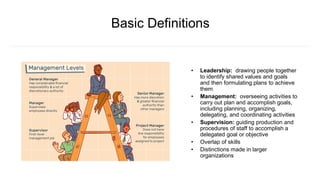
Basic Definitions
• Leadership: drawing people together
to identify shared values and goals
and then formulating plans to achieve
them
• Management: overseeing activities to
carry out plan and accomplish goals,
including planning, organizing,
delegating, and coordinating activities
• Supervision: guiding production and
procedures of staff to accomplish a
delegated goal or objective
• Overlap of skills
• Distinctions made in larger
organizations
DEFINITON OF SUPERVISION
• A few definitions by some of the prominent writers
on the subject are given below:
• (1) “Supervision refers to the direct and
immediate guidance and control of
subordinates in the performance of their task”.
- Viteles
• (2) “Supervisors are those having authority to
exercise independent judgment in discharging,
discipline, recording and taking other actions of
a similar nature with respect to the employees”.
- Tajt Hartely Act.
• Thus, it is clear that the supervision is a process
through which a person directs, guides, and controls
the performance of subordinates.
WHO IS A SUPERVISOR
• A supervisor is a person who is primarily in charge of
a section and its employees. He is responsible for
both the quantity and quality of production, for the
efficient performance of the equipment, and for the
employees in his charge and efficiency, training, and
morale.
• A supervisor derives authority from the department
head for getting work done from the workers by using
the resources of the enterprise. He issues orders and
instructions to the workers, directs their activities,
and reports to the departmental head on the
performance of his section.
• Supervision consists primarily of instructing, guiding,
and inspiring human beings towards better
performance which in a sense amounts to effective
directing.
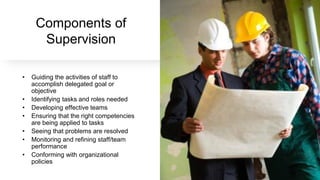
Components of
Supervision
• Guiding the activities of staff to
accomplish delegated goal or
objective
• Identifying tasks and roles needed
• Developing effective teams
• Ensuring that the right competencies
are being applied to tasks
• Seeing that problems are resolved
• Monitoring and refining staff/team
performance
• Conforming with organizational
policies
Core Skills of
Supervision
• Translating delegated goals into action,
including:
• Conducting feasibility studies to refine work
plan and to identify required resources and
skills
• Mobilizing the right mix of people and skills to
accomplish components of delegated goals
• Team building
• Ensuring understanding of work objectives
and tasks
• Facilitating meetings, sustaining progress
• Monitoring progress toward goals and
objectives
• Trouble-shooting, resolving problems &
conflicts
STATUS OF SUPERVISOR
• The lower-level management (supervisory
management) establishes a link between
management and workers.
• The level of management is known as supervisor,
superintendent, foremen, overseer, head clerk etc.
• This is the last important level of management.
• The status of a supervisor can be explained as
follows:
• 1- As a keyman of the Organization
• 2- As a Linkman
• 3- As a Human Relations Specialist
• 4- As a Marginal Man
• 5- As an Employee
The status of a supervisor
• As a keyman of the Organization - He
communicates the policies, plans, programs,
strategies rules, etc., decided by management to
the workers and the opinions, feelings,
suggestions, and grievances of the workers to the
management. Thus, a supervisor is the keyman of
the organization.
• As a Linkman - A supervisor is a linkman between
management and workers. He communicates the
message of top management to the workers and
the message of workers to the management. Thus,
he works as a linkman between the two sides.
The status of a
supervisor
• As a Human Relations Specialist – the Supervisor lives
in direct touch with workers. He is responsible for
developing good relations in the enterprise.
• As a Marginal Man - A Supervisor is a marginal man in
an organization because he is not included in any
group. The workers do not recognize him as one of
them. They feel that the supervisor is a man of
management and thus they ignore him. On the other
hand, the management does not consider a supervisor
one of them. They feel that he is a man of workers.
Thus, a supervisor is a marginal man in an organization.
• As an Employee - All the important decisions of the
enterprise are taken by top management. He is not
empowered to take such decisions. Thus, a supervisor
works in an enterprise as an employee.
Effective Supervisor
• For effective directing, a supervisor
has to rely on:
• Leadership Skill
• Management Skill
• Risk Management
• Communication
• Social – Emotional Quotient
• Motivation
• Technical Competence
• Rules and Regulation
Effective Supervisor:
Leadership Skill
• A supervisor should be a leader in the true
sense of the term. As a leader, he will be able
to guide the subordinates and promote
harmonious relations among them.
• Envisioning situations that are in line with
values, vision for the future
• Engaging others in shaping the vision
• Deciding together on our shared goals
• Identifying ways to attain them
– Inspiration rather than authority
– Motivated by vision and purpose
– Problems resolved by referring back to
shared vision
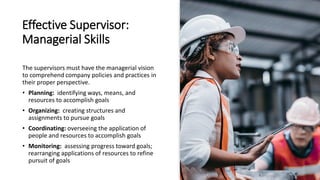
Effective Supervisor:
Managerial Skills
The supervisors must have the managerial vision
to comprehend company policies and practices in
their proper perspective.
• Planning: identifying ways, means, and
resources to accomplish goals
• Organizing: creating structures and
assignments to pursue goals
• Coordinating: overseeing the application of
people and resources to accomplish goals
• Monitoring: assessing progress toward goals;
rearranging applications of resources to refine
pursuit of goals
Effective
Supervisor: Core
Skills of
Management
• Planning, goal setting
• Problem-solving and decision-making
• Delegating
• Motivating
• Sustaining communications
• Facilitating meetings
• Ensuring accomplishment of goals
– Monitoring staff performance
– Removing barriers to
performance
• Managing oneself, improving
interpersonal skills
Effective Supervisor:
Communication
• Instruction Skill
• Giving feedback
• Active listening
• Handling conflict
• Negotiating agreement
Effective Supervisor:
Risk Management
• Definition: Steps to ensure that critical assets and resources
are protected from loss or damage
• People
– Screen applicants, clear job descriptions, fair reviews,
adequate compensation, prevention of discrimination
and harassment
– Responsiveness to problems, complaints, grievances
– Policies on conflicts of interest, whistle-blowing
– Policies on giving public information
• Property and resources
– Careful accounting and regular audits
– Monitor and ensure workplace safety
– Insurance (liability, D&O, property)
– Policies on document retention, access, and destruction
Effective Supervisor: Emotional Intelligence
• Identifying emotions: the ability to
perceive and recognize emotions in
oneself and others
• Using emotions: the ability to
generate and feel emotions in
communication
• Understanding emotions: the ability
to understand emotional information,
how they arise and combine
• Managing emotions: the ability to
regulate expressions of emotions in
oneself and others so as to promote
interpersonal understanding and
growth.
Effective Supervisor: Personal Emotional
Competencies
• Self-awareness of one’s own inner states
• Recognition of how one’s emotions influence
attitudes and communications
• Self-confidence in one’s own worth and
capabilities
• Self-management and control of one’s own
feelings, impulses, resources
• Trustworthiness in maintaining personal
honesty and integrity
• Conscientiousness, taking responsibility for
personal performance
• Adaptability, flexibility in handling change
• Initiative, readiness to act on opportunities
• Achievement-orientation, internal readiness
to improve or meet higher standards of
excellence
Effective Supervisor:
Social-emotional
competencies
• Social awareness of others’ feelings, needs,
concerns
• Body language: reading voice, movement,
gestures, eye contact, volume, posture, silence,
timing
• Empathy: sensing others’ feelings, perspectives,
taking an active interest in their concerns
• Organizational awareness: reading a group’s
emotional currents and power relationships
• Service orientation: anticipating, recognizing, and
acting on consumers’ needs and interests
• Social skills in inducing desirable responses in
others
• Developing others: sensing others’ developmental
needs and bolstering their competencies and
Performance
Effective Supervisor:
More social-emotional
competencies
• Leadership: inspiring and guiding others,
using effective tactics for persuasion
• Communication: listening actively and
openly and sending convincing messages
• Change catalyst: initiating and managing
change in relationships
• Conflict management: negotiating and
resolving disagreements
• Teamwork and collaboration: working well
with others toward shared goals; creating
group synergy in pursuing collective goals;
show appreciation to others for
accomplishments.
Effective Supervisor:
Staff Motivation
• Motivating others starts with motivating yourself.
Enthusiasm is contagious. What energizes you?
• Find out what motivates other individuals (ask, listen,
observe, recognize differences)
• Note the important distinction between satisfiers and
hygiene factors
• Link assignments and rewards with individual
motivations, and keep fresh on this as work and
people change over time
• Align tasks with the mission and goals of
organizations, and help others stay clear of those
links. “Here’s why you and your skills are so essential
for our success.”
• While positive relationships are important, make sure
policies, assignments, and procedures are clear and
fair to everyone
• Recognize and celebrate successes in variety of
ways
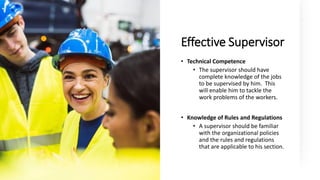
Effective Supervisor
• Technical Competence
• The supervisor should have
complete knowledge of the jobs
to be supervised by him. This
will enable him to tackle the
work problems of the workers.
• Knowledge of Rules and Regulations
• A supervisor should be familiar
with the organizational policies
and the rules and regulations
that are applicable to his section.
Learning and Giving for Better Indonesia www.humanikaconsulting.com

Effective Supervisory Skill

  • 1.
    Effective Supervisory SkillSeta A. Wicaksana
  • 2.
    Seta A. Wicaksana 081119 53 43 wicaksana@humanikaconsulting.com • Business Psychologist • Pendiri dan Direktur Humanika Consulting dan hipotest.com • Dosen Tetap dan Peneliti di Fakultas Psikologi Universitas Pancasila • Pembina Yayasan Humanika Edukasi Indonesia • Penulis Buku: Sobat Way (2016), Industri dan Organisasi: Pendekatan Integratif dalam menghadapi Perubahan (2020), Human Faktor Engineering: Integratif Desain Manusia dan Lingkungan Kerja (2021), Psikologi Industri dan Organisasi (2021), Psikologi Umum (2021), Manajemen Pengembangan Talenta (2021), PIODiagnostik: Pengukuran Psikologi di Lingkungan Kerja (2021), Transformasi Digital: Perspektif Organisasi, Talenta dan Budaya Organisasi (2021), Psikologi Pelayanan (2021) dan Psikologi Konsumen (2021). • Dosen Tidak Tetap di: Program Pasca Sarjana Ekonomi di Univ. Pancasila, STP TRISAKTI, Fakultas Psikologi Universitas Mercu Buana, STIKOM IMA • Certified of Assessor Talent Management • Certified of Human Resources Management (Reward Management) • Certified of Human Resources as a Business Partner • Certified of Risk Professional • Certified of HR Audit • Ilmu Ekonomi dan Manajemen (MSDM) S3 Universitas Pancasila • Fakultas Psikologi S1 dan S2 Universitas Indonesia • Sekolah ikatan dinas Akademi Sandi Negara
  • 3.
    INTRODUCTION In management, supervisionmeans supervising the work of subordinates and seeing that they work according to the orders and directions issued to them. The person who performs the work of supervision is called a supervisor. A supervisor is also known as a foreman, superintendent, overseer, etc.
  • 4.
    What does the companyexpect from supervisors? • Stay aware of the big picture • Create a productive environment for your employees • Make decisions on your own • Implement new programs and methods • Inform your people about company policies and procedures • Teach effectively
  • 5.
    What do employees wantfrom their jobs? 1. Appreciation 2. Recognition 3. Involvement with the company 4. Comfortable work environment 5. Money 6. Security and stability 7. Social needs 8. Independence
  • 6.
    Basic Definitions • Leadership:drawing people together to identify shared values and goals and then formulating plans to achieve them • Management: overseeing activities to carry out plan and accomplish goals, including planning, organizing, delegating, and coordinating activities • Supervision: guiding production and procedures of staff to accomplish a delegated goal or objective • Overlap of skills • Distinctions made in larger organizations
  • 7.
    DEFINITON OF SUPERVISION •A few definitions by some of the prominent writers on the subject are given below: • (1) “Supervision refers to the direct and immediate guidance and control of subordinates in the performance of their task”. - Viteles • (2) “Supervisors are those having authority to exercise independent judgment in discharging, discipline, recording and taking other actions of a similar nature with respect to the employees”. - Tajt Hartely Act. • Thus, it is clear that the supervision is a process through which a person directs, guides, and controls the performance of subordinates.
  • 8.
    WHO IS ASUPERVISOR • A supervisor is a person who is primarily in charge of a section and its employees. He is responsible for both the quantity and quality of production, for the efficient performance of the equipment, and for the employees in his charge and efficiency, training, and morale. • A supervisor derives authority from the department head for getting work done from the workers by using the resources of the enterprise. He issues orders and instructions to the workers, directs their activities, and reports to the departmental head on the performance of his section. • Supervision consists primarily of instructing, guiding, and inspiring human beings towards better performance which in a sense amounts to effective directing.
  • 9.
    Components of Supervision • Guidingthe activities of staff to accomplish delegated goal or objective • Identifying tasks and roles needed • Developing effective teams • Ensuring that the right competencies are being applied to tasks • Seeing that problems are resolved • Monitoring and refining staff/team performance • Conforming with organizational policies
  • 10.
    Core Skills of Supervision •Translating delegated goals into action, including: • Conducting feasibility studies to refine work plan and to identify required resources and skills • Mobilizing the right mix of people and skills to accomplish components of delegated goals • Team building • Ensuring understanding of work objectives and tasks • Facilitating meetings, sustaining progress • Monitoring progress toward goals and objectives • Trouble-shooting, resolving problems & conflicts
  • 11.
    STATUS OF SUPERVISOR •The lower-level management (supervisory management) establishes a link between management and workers. • The level of management is known as supervisor, superintendent, foremen, overseer, head clerk etc. • This is the last important level of management. • The status of a supervisor can be explained as follows: • 1- As a keyman of the Organization • 2- As a Linkman • 3- As a Human Relations Specialist • 4- As a Marginal Man • 5- As an Employee
  • 12.
    The status ofa supervisor • As a keyman of the Organization - He communicates the policies, plans, programs, strategies rules, etc., decided by management to the workers and the opinions, feelings, suggestions, and grievances of the workers to the management. Thus, a supervisor is the keyman of the organization. • As a Linkman - A supervisor is a linkman between management and workers. He communicates the message of top management to the workers and the message of workers to the management. Thus, he works as a linkman between the two sides.
  • 13.
    The status ofa supervisor • As a Human Relations Specialist – the Supervisor lives in direct touch with workers. He is responsible for developing good relations in the enterprise. • As a Marginal Man - A Supervisor is a marginal man in an organization because he is not included in any group. The workers do not recognize him as one of them. They feel that the supervisor is a man of management and thus they ignore him. On the other hand, the management does not consider a supervisor one of them. They feel that he is a man of workers. Thus, a supervisor is a marginal man in an organization. • As an Employee - All the important decisions of the enterprise are taken by top management. He is not empowered to take such decisions. Thus, a supervisor works in an enterprise as an employee.
  • 14.
    Effective Supervisor • Foreffective directing, a supervisor has to rely on: • Leadership Skill • Management Skill • Risk Management • Communication • Social – Emotional Quotient • Motivation • Technical Competence • Rules and Regulation
  • 15.
    Effective Supervisor: Leadership Skill •A supervisor should be a leader in the true sense of the term. As a leader, he will be able to guide the subordinates and promote harmonious relations among them. • Envisioning situations that are in line with values, vision for the future • Engaging others in shaping the vision • Deciding together on our shared goals • Identifying ways to attain them – Inspiration rather than authority – Motivated by vision and purpose – Problems resolved by referring back to shared vision
  • 16.
    Effective Supervisor: Managerial Skills Thesupervisors must have the managerial vision to comprehend company policies and practices in their proper perspective. • Planning: identifying ways, means, and resources to accomplish goals • Organizing: creating structures and assignments to pursue goals • Coordinating: overseeing the application of people and resources to accomplish goals • Monitoring: assessing progress toward goals; rearranging applications of resources to refine pursuit of goals
  • 17.
    Effective Supervisor: Core Skills of Management •Planning, goal setting • Problem-solving and decision-making • Delegating • Motivating • Sustaining communications • Facilitating meetings • Ensuring accomplishment of goals – Monitoring staff performance – Removing barriers to performance • Managing oneself, improving interpersonal skills
  • 18.
    Effective Supervisor: Communication • InstructionSkill • Giving feedback • Active listening • Handling conflict • Negotiating agreement
  • 19.
    Effective Supervisor: Risk Management •Definition: Steps to ensure that critical assets and resources are protected from loss or damage • People – Screen applicants, clear job descriptions, fair reviews, adequate compensation, prevention of discrimination and harassment – Responsiveness to problems, complaints, grievances – Policies on conflicts of interest, whistle-blowing – Policies on giving public information • Property and resources – Careful accounting and regular audits – Monitor and ensure workplace safety – Insurance (liability, D&O, property) – Policies on document retention, access, and destruction
  • 20.
    Effective Supervisor: EmotionalIntelligence • Identifying emotions: the ability to perceive and recognize emotions in oneself and others • Using emotions: the ability to generate and feel emotions in communication • Understanding emotions: the ability to understand emotional information, how they arise and combine • Managing emotions: the ability to regulate expressions of emotions in oneself and others so as to promote interpersonal understanding and growth.
  • 21.
    Effective Supervisor: PersonalEmotional Competencies • Self-awareness of one’s own inner states • Recognition of how one’s emotions influence attitudes and communications • Self-confidence in one’s own worth and capabilities • Self-management and control of one’s own feelings, impulses, resources • Trustworthiness in maintaining personal honesty and integrity • Conscientiousness, taking responsibility for personal performance • Adaptability, flexibility in handling change • Initiative, readiness to act on opportunities • Achievement-orientation, internal readiness to improve or meet higher standards of excellence
  • 22.
    Effective Supervisor: Social-emotional competencies • Socialawareness of others’ feelings, needs, concerns • Body language: reading voice, movement, gestures, eye contact, volume, posture, silence, timing • Empathy: sensing others’ feelings, perspectives, taking an active interest in their concerns • Organizational awareness: reading a group’s emotional currents and power relationships • Service orientation: anticipating, recognizing, and acting on consumers’ needs and interests • Social skills in inducing desirable responses in others • Developing others: sensing others’ developmental needs and bolstering their competencies and Performance
  • 23.
    Effective Supervisor: More social-emotional competencies •Leadership: inspiring and guiding others, using effective tactics for persuasion • Communication: listening actively and openly and sending convincing messages • Change catalyst: initiating and managing change in relationships • Conflict management: negotiating and resolving disagreements • Teamwork and collaboration: working well with others toward shared goals; creating group synergy in pursuing collective goals; show appreciation to others for accomplishments.
  • 24.
    Effective Supervisor: Staff Motivation •Motivating others starts with motivating yourself. Enthusiasm is contagious. What energizes you? • Find out what motivates other individuals (ask, listen, observe, recognize differences) • Note the important distinction between satisfiers and hygiene factors • Link assignments and rewards with individual motivations, and keep fresh on this as work and people change over time • Align tasks with the mission and goals of organizations, and help others stay clear of those links. “Here’s why you and your skills are so essential for our success.” • While positive relationships are important, make sure policies, assignments, and procedures are clear and fair to everyone • Recognize and celebrate successes in variety of ways
  • 25.
    Effective Supervisor • TechnicalCompetence • The supervisor should have complete knowledge of the jobs to be supervised by him. This will enable him to tackle the work problems of the workers. • Knowledge of Rules and Regulations • A supervisor should be familiar with the organizational policies and the rules and regulations that are applicable to his section.
  • 26.
    Learning and Givingfor Better Indonesia www.humanikaconsulting.com