Investigation Report Writing


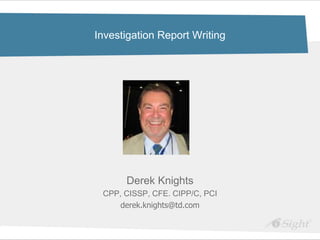
      Derek Knights
 CPP, CISSP, CFE. CIPP/C, PCI
    derek.knights@td.com
Click to edit Master title style
Introduction

•   Click to edit Master text styles
     - fdsfds


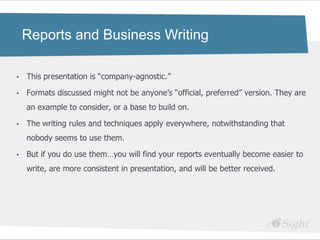
                   Derek Knights, CFE, CIPP/C, PCI, CISSP

                   As a Senior Manager in TD Bank's Global Security & Investigations group,
                   Knights's responsibilities include best practices and governance as well
                   as delivering training in business and report writing. Knights has also
                   held investigation positions at Sun Life Financial and Ontario
                   Hydro/Ontario Power Generation. With an educational background in law
                   enforcement, policing, and security, Knights has also taught courses at
                   the Centennial College School of Business, focusing on financial
                   crimes/fraud investigation.
Reports and Business Writing

•   This presentation is ―company-agnostic.‖

•   Formats discussed might not be anyone‘s ―official, preferred‖ version. They are
    an example to consider, or a base to build on.

•   The writing rules and techniques apply everywhere, notwithstanding that
    nobody seems to use them.

•   But if you do use them…you will find your reports eventually become easier to
    write, are more consistent in presentation, and will be better received.
Effective Reports

•   Everything today is about ―Brand.‖ From an individual perspective, too. In the business
    world what was once called reputation is now called brand.

•   Your reports to your superiors or to your customers are, nowadays, an ambassador to
    your ―Brand.‖
•   There are emails, digital copies, mass storage, disparate audiences…

•   More than ever your reports and other business documents must be professional and
    useful. These two factors flow from ―style‖ and ―substance‖—or how your report looks,
    and what it contains.

•   And style and substance are inextricably conjoined.
―When something can be read without effort, great effort has
    gone into its writing.‖ - Enrique Jardiel Poncela


•   Writing properly is difficult. It requires concentration and deliberation.

•   If you find it easy you‘re probably doing something wrong!

•   Writing often has more in common with construction than…well…writing.

•   Computers make it easy to move paragraphs, count words, check spelling and
    grammar—but we have misplaced paragraphs, overlong sentences, misspelled words,
    and bad grammar. Why? It makes no cents. (See…spellcheck doesn‘t know everything.)

•   The computer gives you tools…but just as with other tools, they don‘t do the work…they
    help you to do it!

•   And there is always room for improvement.
Basics

Look at the challenges writers face:

   •   The audiences and what information each needs
   •   The purpose: what does the writer want to happen
   •   The ―level‖ of writing (and readability)—clarity
   •   Using proper grammar
   •   The right length and structure
   •   The appropriate ―tone‖
   •   The best point-of-view
   •   What level of detail
   •   What should be attachments
   •   Useful photos/graphics
   •   …writer‘s block…where to start.
Types of Reports

•    Investigation                •   Today we are discussing Narrative Reports

•    Statistical                  •   Your ―investigation report‖ might be a 4-

•    Proposals                        inch binder of multiple tabs or the electronic

•    Updates and Briefing Notes       equivalent, or a lengthy series of forms and
                                      checklists…there are many different types.
•    Intelligence
                                  •   But one thing 99.9% have in common is a
•    Incident
                                      part that ―tells the story.‖
•    Staffing
                                  •   That‘s what we‘ll talk about here.
•    Administration
A Report’s Purpose

•   A report permits informed decision-making by a competent authority. The client or manager
    might need the report to buttress an employee termination, an insurance claim, litigation, or
    criminal charges.

•   An investigative report needs to be informative—it ―reports‖ back something that happened,
    the steps taken to reveal the circumstances, and describes actions taken.

•   It might also need to be persuasive—it might describe necessary remediation, or the need
    for further investigation; maybe preventative measures to prevent a recurrence.
A Report’s Purpose (continued)

•   In any case, the report does not serve its purpose and is not useful if,

     •   the reader can‘t understand it;

     •   the reader stops half-way (or doesn‘t even start!) because reading it seems like too
         much of a chore; or

     •   the report doesn‘t say what the author meant.

•   If any of these happens, your report—your ―Brand‖—has lost credibility.
Audience

•   Senior Management        •   Informing

•   Line Management          •   Persuading

•   Police

•   Lawyers

•   Peers

•   All the same people in
    the future…
Gain Your Audience’s Confidence

•   A report no-one has confidence in is not useful. The report‘s presentation and its
    structure is as important as its content. After all, the reader sees the report before
    reading it.

                              We all judge books by their covers.
•   A late report doesn‘t evoke confidence. A late report might be useless. Time is often of
    the essence.

•   The narrative needs to tell the story understandably and easily. So how does a writer tell
    a 25-page tale in 4-page document? A wise use of layout and structure coupled with
    word-processing tools is a big help.

•   Here Style blends into its partner, Substance…
Components

Investigation reports normally contain:
    • Background – why the investigation was conducted
    • Executive Summary – summarizes actions and results
    • Scope – a statement of objective
    • Approach – the method and participants
    • Findings – results of the investigation
    • Summary – wrap-up of the investigation
    • Impact – the effect on the victim
    • Recommendations – if necessary
    • Appendices – those documents that will be evidence (in some form)
        down the line; spreadsheets, copies of letters, invoices, etc.
                               - adapted from the ACFE Report Writing Manual
A Reader-Friendly Format

•   Those are all things a good report needs to touch on…but no law says they have to
    be in this order or even in those discrete sections.

•   In today‘s business environment, communications and transactions are rapid.

•   The competition for an executive‘s attention is tough.

•   A literal interpretation of these sections and their sequence might be counter-
    productive.

•   What you might find more effective in today‘s business world is a blend of the
    points above.

•   Find what you like best to write and what your primary audience likes best to read,
    balance it, and then standardize it as your investigative report format.
Style and Substance

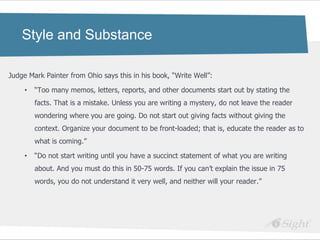
Judge Mark Painter from Ohio says this in his book, ―Write Well‖:

     •   ―Too many memos, letters, reports, and other documents start out by stating the
         facts. That is a mistake. Unless you are writing a mystery, do not leave the reader
         wondering where you are going. Do not start out giving facts without giving the
         context. Organize your document to be front-loaded; that is, educate the reader as to
         what is coming.‖

     •   ―Do not start writing until you have a succinct statement of what you are writing
         about. And you must do this in 50-75 words. If you can‘t explain the issue in 75
         words, you do not understand it very well, and neither will your reader.‖
Style and Substance (continued)

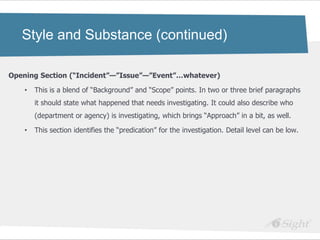
Opening Section (―Incident‖—‖Issue‖—‖Event‖…whatever)

    •   This is a blend of ―Background‖ and ―Scope‖ points. In two or three brief paragraphs
        it should state what happened that needs investigating. It could also describe who
        (department or agency) is investigating, which brings ―Approach‖ in a bit, as well.

    •   This section identifies the ―predication‖ for the investigation. Detail level can be low.
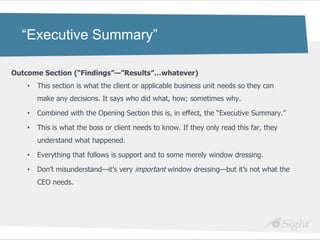
“Executive Summary”

Outcome Section (―Findings‖—‖Results‖…whatever)
    •   This section is what the client or applicable business unit needs so they can
        make any decisions. It says who did what, how; sometimes why.

    •   Combined with the Opening Section this is, in effect, the ―Executive Summary.‖

    •   This is what the boss or client needs to know. If they only read this far, they
        understand what happened.

    •   Everything that follows is support and to some merely window dressing.

    •   Don‘t misunderstand—it‘s very important window dressing—but it‘s not what the
        CEO needs.
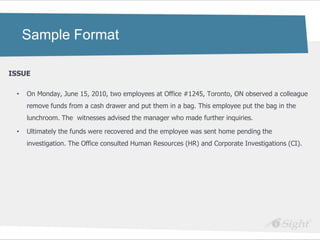
Sample Format

ISSUE

 •   On Monday, June 15, 2010, two employees at Office #1245, Toronto, ON observed a colleague
     remove funds from a cash drawer and put them in a bag. This employee put the bag in the
     lunchroom. The witnesses advised the manager who made further inquiries.

 •   Ultimately the funds were recovered and the employee was sent home pending the
     investigation. The Office consulted Human Resources (HR) and Corporate Investigations (CI).
Sample Format (continued)

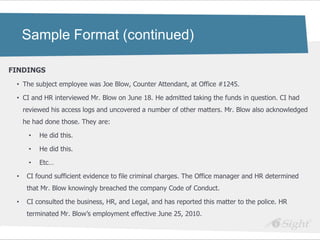
FINDINGS
 • The subject employee was Joe Blow, Counter Attendant, at Office #1245.

 • CI and HR interviewed Mr. Blow on June 18. He admitted taking the funds in question. CI had
     reviewed his access logs and uncovered a number of other matters. Mr. Blow also acknowledged
     he had done those. They are:

      •   He did this.

      •   He did this.

      •   Etc…

 •    CI found sufficient evidence to file criminal charges. The Office manager and HR determined
      that Mr. Blow knowingly breached the company Code of Conduct.

 •    CI consulted the business, HR, and Legal, and has reported this matter to the police. HR
      terminated Mr. Blow‘s employment effective June 25, 2010.
Sample Format (continued)

INVESTIGATION
   •   This is the meat and potatoes of the report. In here is comment on all five W‘s, synopses of
       interviews, descriptions and assessments of evidence, etc. This section builds on the two
       previous points, and, from the earlier list: Approach, Findings, Summary, and Impact.

   •   Opinions rarely have a place in an investigative report unless they are comments in an
       expert‘s report (which will be in an appendix). But remember that a careful analysis of facts
       and pointing out a logical conclusion is not (necessarily) an opinion. The author of an
       investigative report—e.g. a CFE—should be a professional and his or her analysis of facts is
       important.

   •   While this section might not be the focus of the CEO or the client, it is the part the lawyers
       and law enforcement will pay attention to.
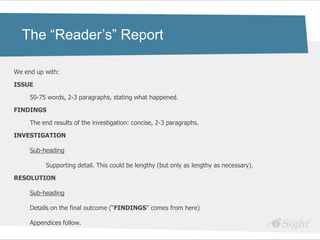
The “Reader’s” Report

We end up with:

ISSUE

     50-75 words, 2-3 paragraphs, stating what happened.

FINDINGS

     The end results of the investigation: concise, 2-3 paragraphs.

INVESTIGATION

     Sub-heading

          Supporting detail. This could be lengthy (but only as lengthy as necessary).

RESOLUTION

     Sub-heading

     Details on the final outcome (―FINDINGS‖ comes from here)

     Appendices follow.
Form and Format

•   Consistency is important. Form sometimes trumps function in the reader‘s eyes.

•   Make it look good. Imagine how you‘d feel seeing the keynote speaker stumbling onto
    the stage, late, in disheveled, mismatched clothes. Before you heard a word, what
    credibility would you ascribe?

•   If your organization has a style guide, follow it.

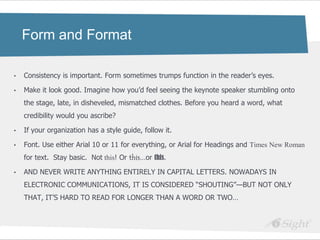
•   Font. Use either Arial 10 or 11 for everything, or Arial for Headings and Times New Roman
    for text. Stay basic. Not this! Or this…or this.

•   AND NEVER WRITE ANYTHING ENTIRELY IN CAPITAL LETTERS. NOWADAYS IN
    ELECTRONIC COMMUNICATIONS, IT IS CONSIDERED ―SHOUTING‖—BUT NOT ONLY
    THAT, IT‘S HARD TO READ FOR LONGER THAN A WORD OR TWO…
Form and Format (continued)

•   Margins should be 1‖/2.5cm minimum—aim for 1.5‖/3.25cm. Align left.

•   In MS Word, set Paragraph to 12pt/3pt, for pretty much everything except bulleted or
    numbered lists. Make them 6pt/3pt or 6pt/6pt. Maybe titles at 18pt/3pt—up to you. But be
    consistent.

•   Do not use bold for emphasis. Use italics.

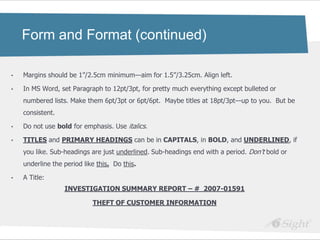
•   TITLES and PRIMARY HEADINGS can be in CAPITALS, in BOLD, and UNDERLINED, if
    you like. Sub-headings are just underlined. Sub-headings end with a period. Don‘t bold or
    underline the period like this. Do this.

•   A Title:
                  INVESTIGATION SUMMARY REPORT – # 2007-01591

                            THEFT OF CUSTOMER INFORMATION
Reports Must…Communicate!

•   Communication: a process in which information is exchanged between parties using a common
    system of symbols, signs, and behaviour.

•   Our ―common system?‖ English, spelling, grammar.

•   The Five P‘s

     •   Plain Language

     •   Passive Voice

     •   Punctuation

     •   Pretentiousness (big words!)

     •   Paragraphs
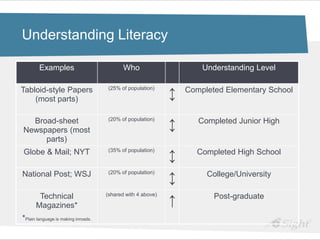
Understanding Literacy

        Examples                            Who                      Understanding Level


                                                             ↕
Tabloid-style Papers                  (25% of population)        Completed Elementary School
    (most parts)


                                                             ↕
  Broad-sheet                         (20% of population)           Completed Junior High
Newspapers (most
     parts)

                                                             ↕
Globe & Mail; NYT                     (35% of population)           Completed High School


                                                             ↕
National Post; WSJ                    (20% of population)             College/University


                                                             ↑
       Technical                     (shared with 4 above)              Post-graduate
      Magazines*
*Plain language is making inroads.
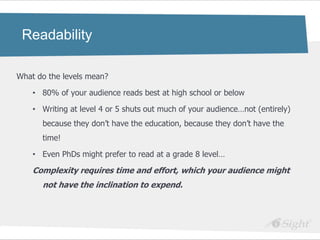
Readability

What do the levels mean?

    • 80% of your audience reads best at high school or below

    • Writing at level 4 or 5 shuts out much of your audience…not (entirely)
      because they don‘t have the education, because they don‘t have the
      time!

    • Even PhDs might prefer to read at a grade 8 level…

    Complexity requires time and effort, which your audience might
      not have the inclination to expend.
Consider This…

Science News

   ... from universities, journals, and other research organizations
   The Secret of Impressive Writing? Keep It Plain and Simple

   - Science Daily (Nov. 1, 2005) — Writers who use long words needlessly and choose
   complicated font styles are seen as less intelligent than those who stick with basic
   vocabulary and plain text, according to new research from the Princeton University in
   New Jersey, to be published in the next edition of Applied Cognitive Psychology.

   - This implies that efforts to impress readers by using florid font styles and searching
   through a thesaurus may have the opposite effect.
Consider This…(continued)

- In a series of five experiments, [the study] found that people tended to rate the
intelligence of authors who wrote essays in simpler language, using an easy-to-read font,
as higher than those who authored more complex works. (Emphasis added)

- "It's important to point out that this research is not about problems with using long
words but about using long words needlessly," said study author Daniel Oppenheimer.

- "Anything that makes a text hard to read and understand, such as unnecessarily long
words or complicated fonts, will lower readers' evaluations of the text and its author."

http://www.sciencedaily.com/releases/2005/10/051031075447.htm
Readability

Our reports should aim for a level in the middle–aiming at the ―average reader‘s‖ abilities.

     •   This translates to

           •   Short sentences of 15-20 words / Paragraphs of 3-4 sentences;

           •   Simple words and phrases (plain language) e.g., say ―the guard on patrol walked
               around the building,‖ not ―the guard on patrol circumnavigated the building‖ or
               ―…perambulated the edifice.‖ Don‘t say ―we utilized the following nomenclature,‖ say
               ―we used the following terms.‖

           •   The report is not the time to show off your vocabulary. Use fancy words only when
               the specific reason for their existence arises. (And use them correctly!)

           •   Active voice vs. passive voice

           •   Punctuation
Writing Tips


Audience

     •   Does your audience already have a good familiarity on the subject matter? Or do you
         have to explain all the facts, and maybe the terms, from scratch? What if your
         audience is a mixture of both? How do you inform one part without boring the other?

Point-of-View

     •   First person (―I did this.‖)

     •   Second person (―You did that.‖)

     •   Third person (―She did it.‖)
―I didn’t have the time to write a short
letter, so I wrote a long one instead.‖-
 Mark Twain (or Blaise Pascal, just in
               case…).
Words

•   There‘s a saying: ―Say it, forget it; write it, regret it.‖

•   We use certain colloquialisms in speech we shouldn‘t when we write. Some things we
    shouldn‘t say, either.

•   For example: ―irregardless‖ is not a real word. A lot of people say it, sometimes tongue-
    in-cheek. But using it in a written report diminishes you. It would be like using ―ain‘t.‖

•   ―Incidence‖ means ―rate‖ or ―frequency.‖ There is no such word as ―incidences.‖ ―The
    incidence of B & Es is up‖; that‘s a good sentence. Not ―there were more incidences of B
    & Es.‖ An ―incident‖ is an event—more than one is ―incidents.‖
Words (continued)

•   Use words you know. Use them correctly.

•   Same goes for other terms, e.g., ―e.g.‖ and ―i.e.‖ In latin, e.g. is exempli gratia—
    ―example given‖ or ―for example‖; i.e. is id est—―that is.‖ E.g. will be followed by one or
    more examples; i.e. by one thing.

     •   ―Joe looked for items that stood out, e.g., incorrect totals, erasures, stale dates.
         But what he really needed was the thing that would bring it all together, i.e., the
         missing disc.‖

•   You can find, in many places—books, internet—lists of commonly misused words. Some
    follow here:
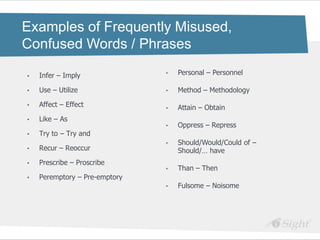
Examples of Frequently Misused,
Confused Words / Phrases

•   Infer – Imply              •   Personal – Personnel

•   Use – Utilize              •   Method – Methodology

•   Affect – Effect            •   Attain – Obtain
•   Like – As
                               •   Oppress – Repress
•   Try to – Try and
                               •   Should/Would/Could of –
•   Recur – Reoccur                Should/… have
•   Prescribe – Proscribe
                               •   Than – Then
•   Peremptory – Pre-emptory
                               •   Fulsome – Noisome
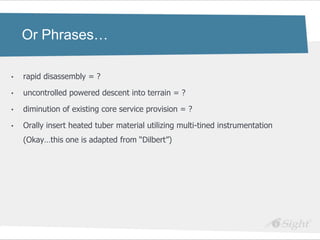
Or Phrases…

•   rapid disassembly = ?

•   uncontrolled powered descent into terrain = ?

•   diminution of existing core service provision = ?

•   Orally insert heated tuber material utilizing multi-tined instrumentation
    (Okay…this one is adapted from ―Dilbert‖)
Or Sentences…

•   ―The Governing Body are [sic] agreeing to this budget as the financial mechanism to support the
    education priorities of the school as identified in the School Development Plan and will adhere to
    the best value principles in spending its school funding allocation.‖

      •   It means, ―We approve the budget and spending rules.‖

•   ―Our mission is to improve the lives and outcomes of heart failure patients by connecting patients'
    objective findings and subjective symptoms to caring health professionals who use evidence-
    based programs to educate patients about their illness and treatment thereby empowering them
    to lead healthier and more satisfying lives.‖

      •   How about, ―We develop programs to help cardiac patients lead healthy and satisfying lives.
•    ―A designer knows he has achieved perfection not when there is nothing left to
    add, but when there is nothing left to take away.‖
                                                                       - Antoine de Saint-Exupery.
DYA


•   Define Your Acronyms. Always.


•   There can be more than one meaning to sets of initials.


•   The underlying terms can change…
Statement Analysis – Find the “Red Flag”


1.   I got up and had my shower and then I drove to work.

2.   My boss told me which truck was mine today.

3.   Bill Jones was working with me.

4.   We drove to the customer‘s address.

5.   The truck was parked and the delivery was made.

6.   Bill and I drove straight back to the depot.
“Don’t write so you can be understood,
write so you cannot be misunderstood.” Epictetus

•   We use the passive when we are interested in the object or when we do not know (or
    care) who caused the action

     •   ―Cheques are distributed on Thursdays.‖ ―The snow was plowed before the bus
         arrived.‖

•   We misuse passive voice more often. Sometimes unintentionally but sometimes to
    purposely obscure information. We use passive voice and never identify the doer of the
    action. It sounds vague and abstract.

     •   ―The parking lot was checked.‖ By who? For what?

     •   ―The bag was left on the counter.‖ By who? Why?

     •   ―Approval was received for the project.‖ By who? From who? Which project?
Passive-to-Active Voice


•   Officer Smith checked the parking lot.‖ (―…for weapons.‖; if you want.)

•   ―Bill Jones put the bag on the counter for the courier.‖

•   ―Mary Brown approved the photocopier project.‖

•   Active voice makes documents stronger by showing responsibility or giving credit for an
    action. When we avoid showing responsibility, we often don't give enough information to
    clearly explain the situation.

•   Active voice should appear 80-90% of the time. Passive voice should be for specific
    reasons only.
Stuffy, Officious, Pretentious

•   People somehow believe Passive Voice is more ―Formal.‖ It‘s not. (Those same people
    think contractions don‘t belong in ―Formal‖ writing. They‘re wrong about that, too.)

•   Passive voice is cumbersome, indirect, vague, misleading, and as we determined a
    minute ago, is a ―Red Flag‖ in a statement.

•   So why do we write our reports that way so much?


           If you only take away from this session a goal to reduce passive voice

                         and increase active voice in your reports…

          your writing will increase in readability and clarity…and professionalism.
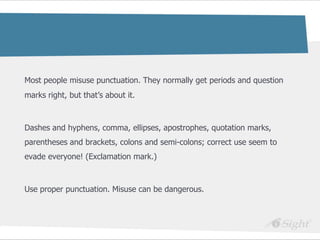
Most people misuse punctuation. They normally get periods and question
marks right, but that‘s about it.


Dashes and hyphens, comma, ellipses, apostrophes, quotation marks,
parentheses and brackets, colons and semi-colons; correct use seem to
evade everyone! (Exclamation mark.)


Use proper punctuation. Misuse can be dangerous.
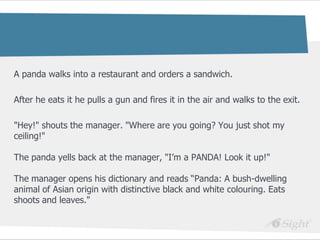
A panda walks into a restaurant and orders a sandwich.

After he eats it he pulls a gun and fires it in the air and walks to the exit.

"Hey!" shouts the manager. "Where are you going? You just shot my
ceiling!"

The panda yells back at the manager, "I‘m a PANDA! Look it up!"

The manager opens his dictionary and reads ―Panda: A bush-dwelling
animal of Asian origin with distinctive black and white colouring. Eats
shoots and leaves."
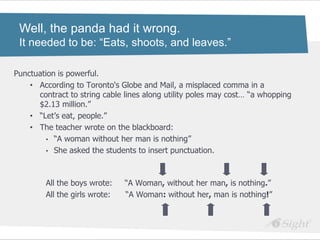
Well, the panda had it wrong.
 It needed to be: “Eats, shoots, and leaves.”

Punctuation is powerful.
    • According to Toronto's Globe and Mail, a misplaced comma in a
      contract to string cable lines along utility poles may cost… ―a whopping
      $2.13 million.‖
    • ―Let‘s eat, people.‖
    • The teacher wrote on the blackboard:
         • ―A woman without her man is nothing‖
         • She asked the students to insert punctuation.


        All the boys wrote:    ―A Woman, without her man, is nothing.‖
        All the girls wrote:   ―A Woman: without her, man is nothing!‖
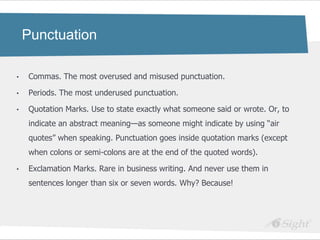
Punctuation

•   Commas. The most overused and misused punctuation.

•   Periods. The most underused punctuation.

•   Quotation Marks. Use to state exactly what someone said or wrote. Or, to
    indicate an abstract meaning—as someone might indicate by using ―air
    quotes‖ when speaking. Punctuation goes inside quotation marks (except
    when colons or semi-colons are at the end of the quoted words).

•   Exclamation Marks. Rare in business writing. And never use them in
    sentences longer than six or seven words. Why? Because!
Punctuation

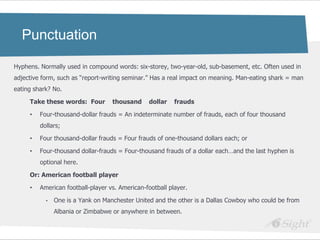
Hyphens. Normally used in compound words: six-storey, two-year-old, sub-basement, etc. Often used in
adjective form, such as ―report-writing seminar.‖ Has a real impact on meaning. Man-eating shark = man
eating shark? No.

     Take these words: Four        thousand     dollar    frauds

     •   Four-thousand-dollar frauds = An indeterminate number of frauds, each of four thousand
         dollars;

     •   Four thousand-dollar frauds = Four frauds of one-thousand dollars each; or

     •   Four-thousand dollar-frauds = Four-thousand frauds of a dollar each…and the last hyphen is
         optional here.

     Or: American football player

     •   American football-player vs. American-football player.

           •   One is a Yank on Manchester United and the other is a Dallas Cowboy who could be from
               Albania or Zimbabwe or anywhere in between.
Punctuation

En-dash. Construction, or ―joins between,‖ e.g., There are 6-8 eggs left. The meeting is
1:00-2:00pm. There are many Toronto - Montreal flights, which we agree 5-4 are better
with Porter.

Em-dash. Similar to parentheses—which also break up sentences for related
information—the em-dash is a stronger break (though parentheses are still useful). It‘s
longer than an en-dash.

[Brackets], including (Parentheses). Parentheses (see above). Brackets add clarification:
―Did he do it?‖ Did he [start the fire]? Or like this. [Emphasis added.] And punctuation
goes outside the brackets (when part of another sentence). (But inside when it‘s on its
own.)
Punctuation


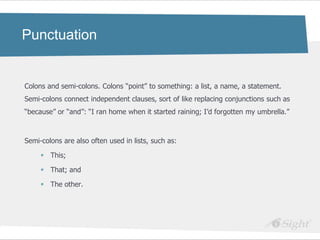
Colons and semi-colons. Colons ―point‖ to something: a list, a name, a statement.
Semi-colons connect independent clauses, sort of like replacing conjunctions such as
―because‖ or ―and‖: ―I ran home when it started raining; I‘d forgotten my umbrella.‖


Semi-colons are also often used in lists, such as:

      This;

      That; and

      The other.
Punctuation


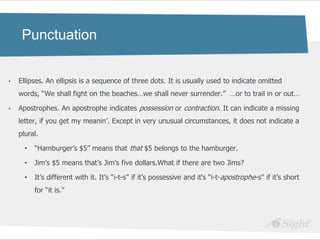
•   Ellipses. An ellipsis is a sequence of three dots. It is usually used to indicate omitted
    words, ―We shall fight on the beaches…we shall never surrender.‖ …or to trail in or out…

•   Apostrophes. An apostrophe indicates possession or contraction. It can indicate a missing
    letter, if you get my meanin‘. Except in very unusual circumstances, it does not indicate a
    plural.

      •   ―Hamburger‘s $5‖ means that that $5 belongs to the hamburger.

      •   Jim‘s $5 means that‘s Jim‘s five dollars.What if there are two Jims?

      •   It‘s different with it. It‘s ―i-t-s‖ if it‘s possessive and it‗s ―i-t-apostrophe-s‖ if it‘s short
          for ―it is.‖
Punctuation


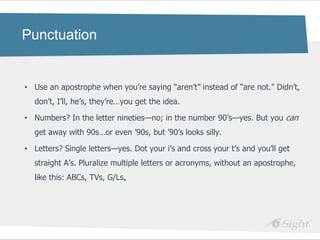
• Use an apostrophe when you‘re saying ―aren‘t‖ instead of ―are not.‖ Didn‘t,
  don‘t, I‘ll, he‘s, they‘re…you get the idea.

• Numbers? In the letter nineties—no; in the number 90‘s—yes. But you can
  get away with 90s…or even ‘90s, but ‘90‘s looks silly.

• Letters? Single letters—yes. Dot your i‘s and cross your t‘s and you‘ll get
  straight A‘s. Pluralize multiple letters or acronyms, without an apostrophe,
  like this: ABCs, TVs, G/Ls.
Every investigative office should have one
     or more of these books:

•   The Plain English Approach to Business Writing, by Edward P. Bailey, Jr., Oxford University Press

•   Plain English at Work, by Edward P. Bailey, Jr., Oxford University Press

•   The Elements of Style (any recent edition), by William Strunk Jr. and E. B. White, Penguin Books

•   Eats, Shoots, and Leaves, by Lynne Truss, Gotham Books

•   The Little English Handbook for Canadians, 2nd Edition, by James B. Bell and Edward P. J. Corbett, Wiley

•   Garner‘s Modern American Usage, Bryan a. Garner, Oxford University Press

•   Woe is I - The Grammarphobe‘s Guide to Better English in Plain English, by Patricia T. O‘Conner

•   On Writing Well, by William Zinsser, Harper Collins

•   Write Well, by Judge Mark Painter, Cincinnati Book Publishing

•   Report Writing Manual, ACFE
Writing…and Reading

•   Do you read? (Not ―can you read‖…―do you read?‖)

•   Reading helps your writing.

•   Non-fiction informs or persuades—it might use words to evoke feelings or ideas, in a
    particular manner, and with a particular intent.

•   Fiction writing is different from non-fiction writing…or business writing. Fiction uses
    words in a different way; to arouse feelings, to paint a picture and encourage
    imagination, to thrill or sadden….

•   But even reading fiction will help your writing, your spelling, and your use of words.

•   So. Read.
Questions or Comments?

Derek Knights, CFE, CPP, CISSP, CIPP/C, PCI
Senior Manager, Strategic Initiatives
Global Security & Investigations
TD Bank
derek.knights@td.com


Joe Gerard
Vice-President, Marketing and Sales
i-Sight Software
j.gerard@i-sight.com

Effective Investigation Reports - Derek Knights - i-Sight

  • 1.
    Investigation Report Writing Derek Knights CPP, CISSP, CFE. CIPP/C, PCI derek.knights@td.com
  • 2.
    Click to editMaster title style Introduction • Click to edit Master text styles - fdsfds Derek Knights, CFE, CIPP/C, PCI, CISSP As a Senior Manager in TD Bank's Global Security & Investigations group, Knights's responsibilities include best practices and governance as well as delivering training in business and report writing. Knights has also held investigation positions at Sun Life Financial and Ontario Hydro/Ontario Power Generation. With an educational background in law enforcement, policing, and security, Knights has also taught courses at the Centennial College School of Business, focusing on financial crimes/fraud investigation.
  • 3.
    Reports and BusinessWriting • This presentation is ―company-agnostic.‖ • Formats discussed might not be anyone‘s ―official, preferred‖ version. They are an example to consider, or a base to build on. • The writing rules and techniques apply everywhere, notwithstanding that nobody seems to use them. • But if you do use them…you will find your reports eventually become easier to write, are more consistent in presentation, and will be better received.
  • 4.
    Effective Reports • Everything today is about ―Brand.‖ From an individual perspective, too. In the business world what was once called reputation is now called brand. • Your reports to your superiors or to your customers are, nowadays, an ambassador to your ―Brand.‖ • There are emails, digital copies, mass storage, disparate audiences… • More than ever your reports and other business documents must be professional and useful. These two factors flow from ―style‖ and ―substance‖—or how your report looks, and what it contains. • And style and substance are inextricably conjoined.
  • 5.
    ―When something canbe read without effort, great effort has gone into its writing.‖ - Enrique Jardiel Poncela • Writing properly is difficult. It requires concentration and deliberation. • If you find it easy you‘re probably doing something wrong! • Writing often has more in common with construction than…well…writing. • Computers make it easy to move paragraphs, count words, check spelling and grammar—but we have misplaced paragraphs, overlong sentences, misspelled words, and bad grammar. Why? It makes no cents. (See…spellcheck doesn‘t know everything.) • The computer gives you tools…but just as with other tools, they don‘t do the work…they help you to do it! • And there is always room for improvement.
  • 6.
    Basics Look at thechallenges writers face: • The audiences and what information each needs • The purpose: what does the writer want to happen • The ―level‖ of writing (and readability)—clarity • Using proper grammar • The right length and structure • The appropriate ―tone‖ • The best point-of-view • What level of detail • What should be attachments • Useful photos/graphics • …writer‘s block…where to start.
  • 7.
    Types of Reports • Investigation • Today we are discussing Narrative Reports • Statistical • Your ―investigation report‖ might be a 4- • Proposals inch binder of multiple tabs or the electronic • Updates and Briefing Notes equivalent, or a lengthy series of forms and checklists…there are many different types. • Intelligence • But one thing 99.9% have in common is a • Incident part that ―tells the story.‖ • Staffing • That‘s what we‘ll talk about here. • Administration
  • 8.
    A Report’s Purpose • A report permits informed decision-making by a competent authority. The client or manager might need the report to buttress an employee termination, an insurance claim, litigation, or criminal charges. • An investigative report needs to be informative—it ―reports‖ back something that happened, the steps taken to reveal the circumstances, and describes actions taken. • It might also need to be persuasive—it might describe necessary remediation, or the need for further investigation; maybe preventative measures to prevent a recurrence.
  • 9.
    A Report’s Purpose(continued) • In any case, the report does not serve its purpose and is not useful if, • the reader can‘t understand it; • the reader stops half-way (or doesn‘t even start!) because reading it seems like too much of a chore; or • the report doesn‘t say what the author meant. • If any of these happens, your report—your ―Brand‖—has lost credibility.
  • 10.
    Audience • Senior Management • Informing • Line Management • Persuading • Police • Lawyers • Peers • All the same people in the future…
  • 11.
    Gain Your Audience’sConfidence • A report no-one has confidence in is not useful. The report‘s presentation and its structure is as important as its content. After all, the reader sees the report before reading it. We all judge books by their covers. • A late report doesn‘t evoke confidence. A late report might be useless. Time is often of the essence. • The narrative needs to tell the story understandably and easily. So how does a writer tell a 25-page tale in 4-page document? A wise use of layout and structure coupled with word-processing tools is a big help. • Here Style blends into its partner, Substance…
  • 12.
    Components Investigation reports normallycontain: • Background – why the investigation was conducted • Executive Summary – summarizes actions and results • Scope – a statement of objective • Approach – the method and participants • Findings – results of the investigation • Summary – wrap-up of the investigation • Impact – the effect on the victim • Recommendations – if necessary • Appendices – those documents that will be evidence (in some form) down the line; spreadsheets, copies of letters, invoices, etc. - adapted from the ACFE Report Writing Manual
  • 13.
    A Reader-Friendly Format • Those are all things a good report needs to touch on…but no law says they have to be in this order or even in those discrete sections. • In today‘s business environment, communications and transactions are rapid. • The competition for an executive‘s attention is tough. • A literal interpretation of these sections and their sequence might be counter- productive. • What you might find more effective in today‘s business world is a blend of the points above. • Find what you like best to write and what your primary audience likes best to read, balance it, and then standardize it as your investigative report format.
  • 14.
    Style and Substance JudgeMark Painter from Ohio says this in his book, ―Write Well‖: • ―Too many memos, letters, reports, and other documents start out by stating the facts. That is a mistake. Unless you are writing a mystery, do not leave the reader wondering where you are going. Do not start out giving facts without giving the context. Organize your document to be front-loaded; that is, educate the reader as to what is coming.‖ • ―Do not start writing until you have a succinct statement of what you are writing about. And you must do this in 50-75 words. If you can‘t explain the issue in 75 words, you do not understand it very well, and neither will your reader.‖
  • 15.
    Style and Substance(continued) Opening Section (―Incident‖—‖Issue‖—‖Event‖…whatever) • This is a blend of ―Background‖ and ―Scope‖ points. In two or three brief paragraphs it should state what happened that needs investigating. It could also describe who (department or agency) is investigating, which brings ―Approach‖ in a bit, as well. • This section identifies the ―predication‖ for the investigation. Detail level can be low.
  • 16.
    “Executive Summary” Outcome Section(―Findings‖—‖Results‖…whatever) • This section is what the client or applicable business unit needs so they can make any decisions. It says who did what, how; sometimes why. • Combined with the Opening Section this is, in effect, the ―Executive Summary.‖ • This is what the boss or client needs to know. If they only read this far, they understand what happened. • Everything that follows is support and to some merely window dressing. • Don‘t misunderstand—it‘s very important window dressing—but it‘s not what the CEO needs.
  • 17.
    Sample Format ISSUE • On Monday, June 15, 2010, two employees at Office #1245, Toronto, ON observed a colleague remove funds from a cash drawer and put them in a bag. This employee put the bag in the lunchroom. The witnesses advised the manager who made further inquiries. • Ultimately the funds were recovered and the employee was sent home pending the investigation. The Office consulted Human Resources (HR) and Corporate Investigations (CI).
  • 18.
    Sample Format (continued) FINDINGS • The subject employee was Joe Blow, Counter Attendant, at Office #1245. • CI and HR interviewed Mr. Blow on June 18. He admitted taking the funds in question. CI had reviewed his access logs and uncovered a number of other matters. Mr. Blow also acknowledged he had done those. They are: • He did this. • He did this. • Etc… • CI found sufficient evidence to file criminal charges. The Office manager and HR determined that Mr. Blow knowingly breached the company Code of Conduct. • CI consulted the business, HR, and Legal, and has reported this matter to the police. HR terminated Mr. Blow‘s employment effective June 25, 2010.
  • 19.
    Sample Format (continued) INVESTIGATION • This is the meat and potatoes of the report. In here is comment on all five W‘s, synopses of interviews, descriptions and assessments of evidence, etc. This section builds on the two previous points, and, from the earlier list: Approach, Findings, Summary, and Impact. • Opinions rarely have a place in an investigative report unless they are comments in an expert‘s report (which will be in an appendix). But remember that a careful analysis of facts and pointing out a logical conclusion is not (necessarily) an opinion. The author of an investigative report—e.g. a CFE—should be a professional and his or her analysis of facts is important. • While this section might not be the focus of the CEO or the client, it is the part the lawyers and law enforcement will pay attention to.
  • 20.
    The “Reader’s” Report Weend up with: ISSUE 50-75 words, 2-3 paragraphs, stating what happened. FINDINGS The end results of the investigation: concise, 2-3 paragraphs. INVESTIGATION Sub-heading Supporting detail. This could be lengthy (but only as lengthy as necessary). RESOLUTION Sub-heading Details on the final outcome (―FINDINGS‖ comes from here) Appendices follow.
  • 21.
    Form and Format • Consistency is important. Form sometimes trumps function in the reader‘s eyes. • Make it look good. Imagine how you‘d feel seeing the keynote speaker stumbling onto the stage, late, in disheveled, mismatched clothes. Before you heard a word, what credibility would you ascribe? • If your organization has a style guide, follow it. • Font. Use either Arial 10 or 11 for everything, or Arial for Headings and Times New Roman for text. Stay basic. Not this! Or this…or this. • AND NEVER WRITE ANYTHING ENTIRELY IN CAPITAL LETTERS. NOWADAYS IN ELECTRONIC COMMUNICATIONS, IT IS CONSIDERED ―SHOUTING‖—BUT NOT ONLY THAT, IT‘S HARD TO READ FOR LONGER THAN A WORD OR TWO…
  • 22.
    Form and Format(continued) • Margins should be 1‖/2.5cm minimum—aim for 1.5‖/3.25cm. Align left. • In MS Word, set Paragraph to 12pt/3pt, for pretty much everything except bulleted or numbered lists. Make them 6pt/3pt or 6pt/6pt. Maybe titles at 18pt/3pt—up to you. But be consistent. • Do not use bold for emphasis. Use italics. • TITLES and PRIMARY HEADINGS can be in CAPITALS, in BOLD, and UNDERLINED, if you like. Sub-headings are just underlined. Sub-headings end with a period. Don‘t bold or underline the period like this. Do this. • A Title: INVESTIGATION SUMMARY REPORT – # 2007-01591 THEFT OF CUSTOMER INFORMATION
  • 23.
    Reports Must…Communicate! • Communication: a process in which information is exchanged between parties using a common system of symbols, signs, and behaviour. • Our ―common system?‖ English, spelling, grammar. • The Five P‘s • Plain Language • Passive Voice • Punctuation • Pretentiousness (big words!) • Paragraphs
  • 24.
    Understanding Literacy Examples Who Understanding Level ↕ Tabloid-style Papers (25% of population) Completed Elementary School (most parts) ↕ Broad-sheet (20% of population) Completed Junior High Newspapers (most parts) ↕ Globe & Mail; NYT (35% of population) Completed High School ↕ National Post; WSJ (20% of population) College/University ↑ Technical (shared with 4 above) Post-graduate Magazines* *Plain language is making inroads.
  • 25.
    Readability What do thelevels mean? • 80% of your audience reads best at high school or below • Writing at level 4 or 5 shuts out much of your audience…not (entirely) because they don‘t have the education, because they don‘t have the time! • Even PhDs might prefer to read at a grade 8 level… Complexity requires time and effort, which your audience might not have the inclination to expend.
  • 26.
    Consider This… Science News ... from universities, journals, and other research organizations The Secret of Impressive Writing? Keep It Plain and Simple - Science Daily (Nov. 1, 2005) — Writers who use long words needlessly and choose complicated font styles are seen as less intelligent than those who stick with basic vocabulary and plain text, according to new research from the Princeton University in New Jersey, to be published in the next edition of Applied Cognitive Psychology. - This implies that efforts to impress readers by using florid font styles and searching through a thesaurus may have the opposite effect.
  • 27.
    Consider This…(continued) - Ina series of five experiments, [the study] found that people tended to rate the intelligence of authors who wrote essays in simpler language, using an easy-to-read font, as higher than those who authored more complex works. (Emphasis added) - "It's important to point out that this research is not about problems with using long words but about using long words needlessly," said study author Daniel Oppenheimer. - "Anything that makes a text hard to read and understand, such as unnecessarily long words or complicated fonts, will lower readers' evaluations of the text and its author." http://www.sciencedaily.com/releases/2005/10/051031075447.htm
  • 28.
    Readability Our reports shouldaim for a level in the middle–aiming at the ―average reader‘s‖ abilities. • This translates to • Short sentences of 15-20 words / Paragraphs of 3-4 sentences; • Simple words and phrases (plain language) e.g., say ―the guard on patrol walked around the building,‖ not ―the guard on patrol circumnavigated the building‖ or ―…perambulated the edifice.‖ Don‘t say ―we utilized the following nomenclature,‖ say ―we used the following terms.‖ • The report is not the time to show off your vocabulary. Use fancy words only when the specific reason for their existence arises. (And use them correctly!) • Active voice vs. passive voice • Punctuation
  • 29.
    Writing Tips Audience • Does your audience already have a good familiarity on the subject matter? Or do you have to explain all the facts, and maybe the terms, from scratch? What if your audience is a mixture of both? How do you inform one part without boring the other? Point-of-View • First person (―I did this.‖) • Second person (―You did that.‖) • Third person (―She did it.‖)
  • 30.
    ―I didn’t havethe time to write a short letter, so I wrote a long one instead.‖- Mark Twain (or Blaise Pascal, just in case…).
  • 31.
    Words • There‘s a saying: ―Say it, forget it; write it, regret it.‖ • We use certain colloquialisms in speech we shouldn‘t when we write. Some things we shouldn‘t say, either. • For example: ―irregardless‖ is not a real word. A lot of people say it, sometimes tongue- in-cheek. But using it in a written report diminishes you. It would be like using ―ain‘t.‖ • ―Incidence‖ means ―rate‖ or ―frequency.‖ There is no such word as ―incidences.‖ ―The incidence of B & Es is up‖; that‘s a good sentence. Not ―there were more incidences of B & Es.‖ An ―incident‖ is an event—more than one is ―incidents.‖
  • 32.
    Words (continued) • Use words you know. Use them correctly. • Same goes for other terms, e.g., ―e.g.‖ and ―i.e.‖ In latin, e.g. is exempli gratia— ―example given‖ or ―for example‖; i.e. is id est—―that is.‖ E.g. will be followed by one or more examples; i.e. by one thing. • ―Joe looked for items that stood out, e.g., incorrect totals, erasures, stale dates. But what he really needed was the thing that would bring it all together, i.e., the missing disc.‖ • You can find, in many places—books, internet—lists of commonly misused words. Some follow here:
  • 33.
    Examples of FrequentlyMisused, Confused Words / Phrases • Infer – Imply • Personal – Personnel • Use – Utilize • Method – Methodology • Affect – Effect • Attain – Obtain • Like – As • Oppress – Repress • Try to – Try and • Should/Would/Could of – • Recur – Reoccur Should/… have • Prescribe – Proscribe • Than – Then • Peremptory – Pre-emptory • Fulsome – Noisome
  • 34.
    Or Phrases… • rapid disassembly = ? • uncontrolled powered descent into terrain = ? • diminution of existing core service provision = ? • Orally insert heated tuber material utilizing multi-tined instrumentation (Okay…this one is adapted from ―Dilbert‖)
  • 35.
    Or Sentences… • ―The Governing Body are [sic] agreeing to this budget as the financial mechanism to support the education priorities of the school as identified in the School Development Plan and will adhere to the best value principles in spending its school funding allocation.‖ • It means, ―We approve the budget and spending rules.‖ • ―Our mission is to improve the lives and outcomes of heart failure patients by connecting patients' objective findings and subjective symptoms to caring health professionals who use evidence- based programs to educate patients about their illness and treatment thereby empowering them to lead healthier and more satisfying lives.‖ • How about, ―We develop programs to help cardiac patients lead healthy and satisfying lives. • ―A designer knows he has achieved perfection not when there is nothing left to add, but when there is nothing left to take away.‖ - Antoine de Saint-Exupery.
  • 36.
    DYA • Define Your Acronyms. Always. • There can be more than one meaning to sets of initials. • The underlying terms can change…
  • 37.
    Statement Analysis –Find the “Red Flag” 1. I got up and had my shower and then I drove to work. 2. My boss told me which truck was mine today. 3. Bill Jones was working with me. 4. We drove to the customer‘s address. 5. The truck was parked and the delivery was made. 6. Bill and I drove straight back to the depot.
  • 38.
    “Don’t write soyou can be understood, write so you cannot be misunderstood.” Epictetus • We use the passive when we are interested in the object or when we do not know (or care) who caused the action • ―Cheques are distributed on Thursdays.‖ ―The snow was plowed before the bus arrived.‖ • We misuse passive voice more often. Sometimes unintentionally but sometimes to purposely obscure information. We use passive voice and never identify the doer of the action. It sounds vague and abstract. • ―The parking lot was checked.‖ By who? For what? • ―The bag was left on the counter.‖ By who? Why? • ―Approval was received for the project.‖ By who? From who? Which project?
  • 39.
    Passive-to-Active Voice • Officer Smith checked the parking lot.‖ (―…for weapons.‖; if you want.) • ―Bill Jones put the bag on the counter for the courier.‖ • ―Mary Brown approved the photocopier project.‖ • Active voice makes documents stronger by showing responsibility or giving credit for an action. When we avoid showing responsibility, we often don't give enough information to clearly explain the situation. • Active voice should appear 80-90% of the time. Passive voice should be for specific reasons only.
  • 40.
    Stuffy, Officious, Pretentious • People somehow believe Passive Voice is more ―Formal.‖ It‘s not. (Those same people think contractions don‘t belong in ―Formal‖ writing. They‘re wrong about that, too.) • Passive voice is cumbersome, indirect, vague, misleading, and as we determined a minute ago, is a ―Red Flag‖ in a statement. • So why do we write our reports that way so much? If you only take away from this session a goal to reduce passive voice and increase active voice in your reports… your writing will increase in readability and clarity…and professionalism.
  • 41.
    Most people misusepunctuation. They normally get periods and question marks right, but that‘s about it. Dashes and hyphens, comma, ellipses, apostrophes, quotation marks, parentheses and brackets, colons and semi-colons; correct use seem to evade everyone! (Exclamation mark.) Use proper punctuation. Misuse can be dangerous.
  • 42.
    A panda walksinto a restaurant and orders a sandwich. After he eats it he pulls a gun and fires it in the air and walks to the exit. "Hey!" shouts the manager. "Where are you going? You just shot my ceiling!" The panda yells back at the manager, "I‘m a PANDA! Look it up!" The manager opens his dictionary and reads ―Panda: A bush-dwelling animal of Asian origin with distinctive black and white colouring. Eats shoots and leaves."
  • 43.
    Well, the pandahad it wrong. It needed to be: “Eats, shoots, and leaves.” Punctuation is powerful. • According to Toronto's Globe and Mail, a misplaced comma in a contract to string cable lines along utility poles may cost… ―a whopping $2.13 million.‖ • ―Let‘s eat, people.‖ • The teacher wrote on the blackboard: • ―A woman without her man is nothing‖ • She asked the students to insert punctuation. All the boys wrote: ―A Woman, without her man, is nothing.‖ All the girls wrote: ―A Woman: without her, man is nothing!‖
  • 44.
    Punctuation • Commas. The most overused and misused punctuation. • Periods. The most underused punctuation. • Quotation Marks. Use to state exactly what someone said or wrote. Or, to indicate an abstract meaning—as someone might indicate by using ―air quotes‖ when speaking. Punctuation goes inside quotation marks (except when colons or semi-colons are at the end of the quoted words). • Exclamation Marks. Rare in business writing. And never use them in sentences longer than six or seven words. Why? Because!
  • 45.
    Punctuation Hyphens. Normally usedin compound words: six-storey, two-year-old, sub-basement, etc. Often used in adjective form, such as ―report-writing seminar.‖ Has a real impact on meaning. Man-eating shark = man eating shark? No. Take these words: Four thousand dollar frauds • Four-thousand-dollar frauds = An indeterminate number of frauds, each of four thousand dollars; • Four thousand-dollar frauds = Four frauds of one-thousand dollars each; or • Four-thousand dollar-frauds = Four-thousand frauds of a dollar each…and the last hyphen is optional here. Or: American football player • American football-player vs. American-football player. • One is a Yank on Manchester United and the other is a Dallas Cowboy who could be from Albania or Zimbabwe or anywhere in between.
  • 46.
    Punctuation En-dash. Construction, or―joins between,‖ e.g., There are 6-8 eggs left. The meeting is 1:00-2:00pm. There are many Toronto - Montreal flights, which we agree 5-4 are better with Porter. Em-dash. Similar to parentheses—which also break up sentences for related information—the em-dash is a stronger break (though parentheses are still useful). It‘s longer than an en-dash. [Brackets], including (Parentheses). Parentheses (see above). Brackets add clarification: ―Did he do it?‖ Did he [start the fire]? Or like this. [Emphasis added.] And punctuation goes outside the brackets (when part of another sentence). (But inside when it‘s on its own.)
  • 47.
    Punctuation Colons and semi-colons.Colons ―point‖ to something: a list, a name, a statement. Semi-colons connect independent clauses, sort of like replacing conjunctions such as ―because‖ or ―and‖: ―I ran home when it started raining; I‘d forgotten my umbrella.‖ Semi-colons are also often used in lists, such as:  This;  That; and  The other.
  • 48.
    Punctuation • Ellipses. An ellipsis is a sequence of three dots. It is usually used to indicate omitted words, ―We shall fight on the beaches…we shall never surrender.‖ …or to trail in or out… • Apostrophes. An apostrophe indicates possession or contraction. It can indicate a missing letter, if you get my meanin‘. Except in very unusual circumstances, it does not indicate a plural. • ―Hamburger‘s $5‖ means that that $5 belongs to the hamburger. • Jim‘s $5 means that‘s Jim‘s five dollars.What if there are two Jims? • It‘s different with it. It‘s ―i-t-s‖ if it‘s possessive and it‗s ―i-t-apostrophe-s‖ if it‘s short for ―it is.‖
  • 49.
    Punctuation • Use anapostrophe when you‘re saying ―aren‘t‖ instead of ―are not.‖ Didn‘t, don‘t, I‘ll, he‘s, they‘re…you get the idea. • Numbers? In the letter nineties—no; in the number 90‘s—yes. But you can get away with 90s…or even ‘90s, but ‘90‘s looks silly. • Letters? Single letters—yes. Dot your i‘s and cross your t‘s and you‘ll get straight A‘s. Pluralize multiple letters or acronyms, without an apostrophe, like this: ABCs, TVs, G/Ls.
  • 50.
    Every investigative officeshould have one or more of these books: • The Plain English Approach to Business Writing, by Edward P. Bailey, Jr., Oxford University Press • Plain English at Work, by Edward P. Bailey, Jr., Oxford University Press • The Elements of Style (any recent edition), by William Strunk Jr. and E. B. White, Penguin Books • Eats, Shoots, and Leaves, by Lynne Truss, Gotham Books • The Little English Handbook for Canadians, 2nd Edition, by James B. Bell and Edward P. J. Corbett, Wiley • Garner‘s Modern American Usage, Bryan a. Garner, Oxford University Press • Woe is I - The Grammarphobe‘s Guide to Better English in Plain English, by Patricia T. O‘Conner • On Writing Well, by William Zinsser, Harper Collins • Write Well, by Judge Mark Painter, Cincinnati Book Publishing • Report Writing Manual, ACFE
  • 51.
    Writing…and Reading • Do you read? (Not ―can you read‖…―do you read?‖) • Reading helps your writing. • Non-fiction informs or persuades—it might use words to evoke feelings or ideas, in a particular manner, and with a particular intent. • Fiction writing is different from non-fiction writing…or business writing. Fiction uses words in a different way; to arouse feelings, to paint a picture and encourage imagination, to thrill or sadden…. • But even reading fiction will help your writing, your spelling, and your use of words. • So. Read.
  • 52.
    Questions or Comments? DerekKnights, CFE, CPP, CISSP, CIPP/C, PCI Senior Manager, Strategic Initiatives Global Security & Investigations TD Bank derek.knights@td.com Joe Gerard Vice-President, Marketing and Sales i-Sight Software j.gerard@i-sight.com