EFFECTIVE COMMUNICATION
Designed by: Franck Ngahane
Why effective communication?
QUESTION!
How do you define “effective communication”?
Effective Communication
Communication is a two-way process between a
sender of information and a receiver of information
Communication is composed of different methods:
words, voice, tone and non-verbal
Why effective communication?
QUESTION!
“Why do you think it is important for a team to
communicate effectively?”
Effective Communication in a team
Communicating effectively helps group
members build trust and respect, develop
learning and accomplish goals
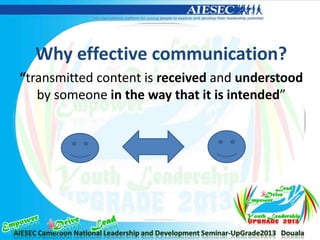
Why effective communication?
“transmitted content is received and understood
by someone in the way that it is intended”
How to communicate effectively?
Step 1: Know clearly WHAT you want to
communicate
Step 2: Know WHO to communicate with in
particular situation
Step 3: Prepare carefully
Step 4: Use communication method effectively
Let’s make an example!
Face-to-face(meeting)
Emailing
Teleconference (Skype)
ETC….
How many communication methods
we use ?
Face-to-face (meeting)
Preparation
 Assign meeting objectives and agenda
 Write down/prepare any materials that you
might need to provide to the listener
Face-to-face (meeting)
During
 Listen actively! (listening is not only for
getting information but also to defining the
things that the speaker might not understand)
 Take-note and SUM UP in bullet points.
EMAILING
It is more complicated that you
thought!!!
EMAILING – Common mistakes
 “no subject”/irrelevant subject emails or
multiple emails of same content & subjects
 Too wordy
 Use upper case or lower case only, no
punctuation sign
 Neglect the layout (excess or lack of them)
 Use inappropriate language (too formal or too
casual, language of command)
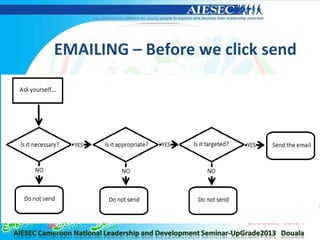
EMAILING – Before we click send
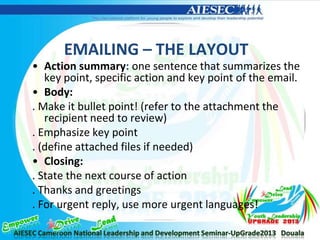
EMAILING – THE LAYOUT
• Action summary: one sentence that summarizes the
key point, specific action and key point of the email.
• Body:
. Make it bullet point! (refer to the attachment the
recipient need to review)
. Emphasize key point
. (define attached files if needed)
• Closing:
. State the next course of action
. Thanks and greetings
. For urgent reply, use more urgent languages!
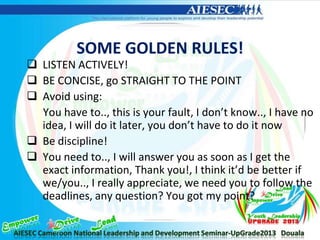
SOME GOLDEN RULES!
 LISTEN ACTIVELY!
 BE CONCISE, go STRAIGHT TO THE POINT
 Avoid using:
You have to.., this is your fault, I don’t know.., I have no
idea, I will do it later, you don’t have to do it now
 Be discipline!
 You need to.., I will answer you as soon as I get the
exact information, Thank you!, I think it’d be better if
we/you.., I really appreciate, we need you to follow the
deadlines, any question? You got my point?
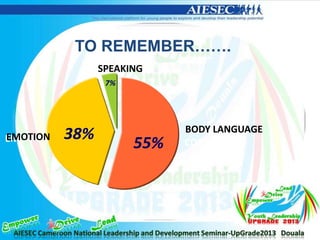
TO REMEMBER…….
PALABRA
7%
EMOCIÓN 38% LENGUAJE
CORPORAL55%EMOTION
SPEAKING
BODY LANGUAGE
THANK YOU

Effective communication up

  • 1.
  • 2.
    Why effective communication? QUESTION! Howdo you define “effective communication”?
  • 3.
    Effective Communication Communication isa two-way process between a sender of information and a receiver of information Communication is composed of different methods: words, voice, tone and non-verbal
  • 4.
    Why effective communication? QUESTION! “Whydo you think it is important for a team to communicate effectively?”
  • 5.
    Effective Communication ina team Communicating effectively helps group members build trust and respect, develop learning and accomplish goals
  • 6.
    Why effective communication? “transmittedcontent is received and understood by someone in the way that it is intended”
  • 7.
    How to communicateeffectively? Step 1: Know clearly WHAT you want to communicate Step 2: Know WHO to communicate with in particular situation Step 3: Prepare carefully Step 4: Use communication method effectively
  • 8.
  • 9.
  • 10.
    Face-to-face (meeting) Preparation  Assignmeeting objectives and agenda  Write down/prepare any materials that you might need to provide to the listener
  • 11.
    Face-to-face (meeting) During  Listenactively! (listening is not only for getting information but also to defining the things that the speaker might not understand)  Take-note and SUM UP in bullet points.
  • 12.
    EMAILING It is morecomplicated that you thought!!!
  • 13.
    EMAILING – Commonmistakes  “no subject”/irrelevant subject emails or multiple emails of same content & subjects  Too wordy  Use upper case or lower case only, no punctuation sign  Neglect the layout (excess or lack of them)  Use inappropriate language (too formal or too casual, language of command)
  • 14.
    EMAILING – Beforewe click send
  • 15.
    EMAILING – THELAYOUT • Action summary: one sentence that summarizes the key point, specific action and key point of the email. • Body: . Make it bullet point! (refer to the attachment the recipient need to review) . Emphasize key point . (define attached files if needed) • Closing: . State the next course of action . Thanks and greetings . For urgent reply, use more urgent languages!
  • 16.
    SOME GOLDEN RULES! LISTEN ACTIVELY!  BE CONCISE, go STRAIGHT TO THE POINT  Avoid using: You have to.., this is your fault, I don’t know.., I have no idea, I will do it later, you don’t have to do it now  Be discipline!  You need to.., I will answer you as soon as I get the exact information, Thank you!, I think it’d be better if we/you.., I really appreciate, we need you to follow the deadlines, any question? You got my point?
  • 17.
    TO REMEMBER……. PALABRA 7% EMOCIÓN 38%LENGUAJE CORPORAL55%EMOTION SPEAKING BODY LANGUAGE
  • 18.