Effective Communication
Involves three components……..
• Verbal Messages
• Para-verbal Messages
• Non-Verbal Messages
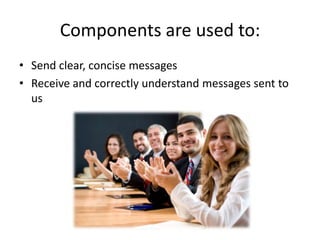
Components are used to:
• Send clear, concise messages
• Receive and correctly understand messages sent to
  us
Sending Messages
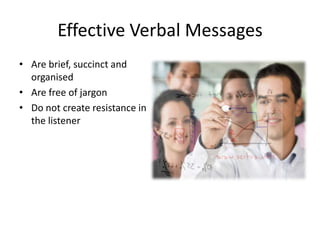
Effective Verbal Messages
• Are brief, succinct and
  organised
• Are free of jargon
• Do not create resistance in
  the listener
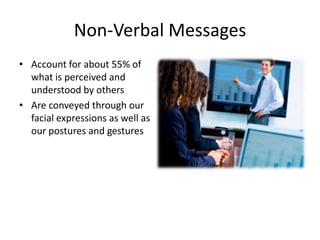
Non-Verbal Messages
• Account for about 55% of
  what is perceived and
  understood by others
• Are conveyed through our
  facial expressions as well as
  our postures and gestures
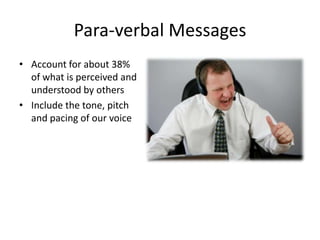
Para-verbal Messages
• Account for about 38%
  of what is perceived and
  understood by others
• Include the tone, pitch
  and pacing of our voice
Receiving Messages
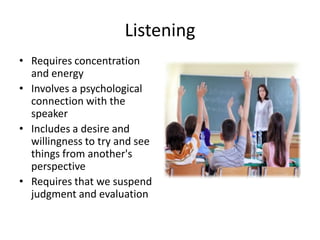
Listening
• Requires concentration
  and energy
• Involves a psychological
  connection with the
  speaker
• Includes a desire and
  willingness to try and see
  things from another's
  perspective
• Requires that we suspend
  judgment and evaluation
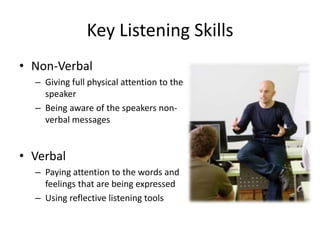
Key Listening Skills
• Non-Verbal
  – Giving full physical attention to the
    speaker
  – Being aware of the speakers non-
    verbal messages


• Verbal
  – Paying attention to the words and
    feelings that are being expressed
  – Using reflective listening tools
Verbal Communication Tools
•   Paraphrasing
•   Reflecting Feeling
•   Summarizing
•   Questioning
Barriers to Effective
 Communication
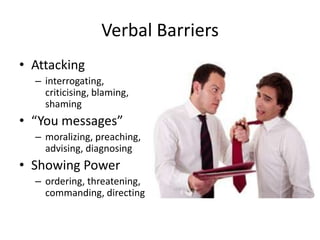
Verbal Barriers
• Attacking
  – interrogating,
    criticising, blaming,
    shaming
• “You messages”
  – moralizing, preaching,
    advising, diagnosing
• Showing Power
  – ordering, threatening,
    commanding, directing
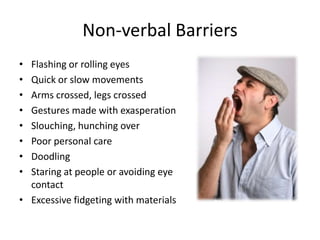
Non-verbal Barriers
• Flashing or rolling eyes
• Quick or slow movements
• Arms crossed, legs crossed
• Gestures made with exasperation
• Slouching, hunching over
• Poor personal care
• Doodling
• Staring at people or avoiding eye
  contact
• Excessive fidgeting with materials
Effective Communication………
•   It is two way
•   It involves active listening
•   It reflects the accountability of speaker and listener
•   It ustilises feedback
•   It is free of stress
•   It is clear
Kind words can be
short and easy to
 speak, but their
 echoes are truly
     endless.
For more questions feel free to contact
  vravindra@ventechsolutions.com


           Thank you!

Effective communication 24nov2011

  • 1.
  • 2.
    Involves three components…….. •Verbal Messages • Para-verbal Messages • Non-Verbal Messages
  • 3.
    Components are usedto: • Send clear, concise messages • Receive and correctly understand messages sent to us
  • 4.
  • 5.
    Effective Verbal Messages •Are brief, succinct and organised • Are free of jargon • Do not create resistance in the listener
  • 6.
    Non-Verbal Messages • Accountfor about 55% of what is perceived and understood by others • Are conveyed through our facial expressions as well as our postures and gestures
  • 7.
    Para-verbal Messages • Accountfor about 38% of what is perceived and understood by others • Include the tone, pitch and pacing of our voice
  • 8.
  • 9.
    Listening • Requires concentration and energy • Involves a psychological connection with the speaker • Includes a desire and willingness to try and see things from another's perspective • Requires that we suspend judgment and evaluation
  • 10.
    Key Listening Skills •Non-Verbal – Giving full physical attention to the speaker – Being aware of the speakers non- verbal messages • Verbal – Paying attention to the words and feelings that are being expressed – Using reflective listening tools
  • 11.
    Verbal Communication Tools • Paraphrasing • Reflecting Feeling • Summarizing • Questioning
  • 12.
  • 13.
    Verbal Barriers • Attacking – interrogating, criticising, blaming, shaming • “You messages” – moralizing, preaching, advising, diagnosing • Showing Power – ordering, threatening, commanding, directing
  • 14.
    Non-verbal Barriers • Flashingor rolling eyes • Quick or slow movements • Arms crossed, legs crossed • Gestures made with exasperation • Slouching, hunching over • Poor personal care • Doodling • Staring at people or avoiding eye contact • Excessive fidgeting with materials
  • 15.
    Effective Communication……… • It is two way • It involves active listening • It reflects the accountability of speaker and listener • It ustilises feedback • It is free of stress • It is clear
  • 16.
    Kind words canbe short and easy to speak, but their echoes are truly endless.
  • 17.
    For more questionsfeel free to contact vravindra@ventechsolutions.com Thank you!