Are You REALLY
Listening?
Of all the component skills of
communication (speaking, writing,
reading, listening), for most people,
LISTENING is the hardest skill to learn.
Andyet…. By:-
Manoj Singh
Professor – Technical English (AKTU)
MCSGOC
• Sometimes we may hear what
someone is saying without really
listening.
• In youropinion, what’s the difference
between hearing and listening?
• Successful communication requires
ACTIVE LISTENING.
• What’sthe difference between
passive listening and active
listening?
How to be an ACTIVE
Listener:
• 1. Be attentive. FOCUS on the speaker.
• 2. Use nonverbal actions to show you are
listening.
– relaxed posture
– head-nodding
– facial expression
– relaxed body expression
– eye contact
• 3. Listen with an accepting attitude.
• 4.Ask some questions to demonstrate that
you are sincerely interested.
• 5. Use reflections and restatements
frequently to try to communicate to the
person what you think they are saying and
test for understanding.
• 6. Practice “mirroring.”
• 7. Use encouraging words to show
you are listening and to invite speaker
to continue.
– "I see."
– "Right."
– "Uh, huh.”
– "Tell me more."
– "Sounds like you have some ideas on
this."
– "I'm interested in what you have to say."
– "Let's talk about it."
THINGS TO AVOID
While Being an Active
Listener
1. DO NOT INTERRUPT!!!
2. Do not interrogate. Limit the number of
questions you ask so that you are not
"drilling" them.
3. Do not try to think of your response in
your own head while you are listening.
4. Do not change the subject.
5. Do not be judgmental. Avoid
phrases like:
– "Are you sure?"
– "You shouldn't feel that way."
– "It’s not thatbad."
– You're making something out ofnothing.”
– "That's adumb question.”
• According to Sean Covey, author of The7
Habits of Highly Effective Teens,there are
five different poor listening styles.
1. Spacing out
2. Pretend listening
3. Selective listening
4. Word listening
5. Self-centered listening
• Judging
• advising
• probing
• 1. Spacing out occurs when we are so
tuned out to what someone is saying it’s like
we’re in another world.
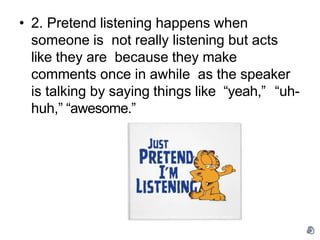
• 2. Pretend listening happens when
someone is not really listening but acts
like they are because they make
comments once in awhile as the speaker
is talking by saying things like “yeah,” “uh-
huh,” “awesome.”
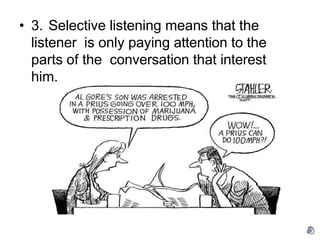
• 3. Selective listening means that the
listener is only paying attention to the
parts of the conversation that interest
him.
• 4. Word listening means that you pay
attention only to the words that
someone is saying, and not to their
body language.
• 5. Self-centered listening happens when we
hear everything from our own point of view,
not the point of view of the speaker.
• There are three types of self-centered
listening:
• judging – sometimes we make
judgments about the speaker instead
of listening
• advising – sometimes we give advice
instead of just listening
• probing – this happens when we question
and try to dig up emotions before the
speaker is ready to share them
• Do your parents ever do this to
you? 
Listening skills active passive

Listening skills active passive

  • 1.
    Are You REALLY Listening? Ofall the component skills of communication (speaking, writing, reading, listening), for most people, LISTENING is the hardest skill to learn. Andyet…. By:- Manoj Singh Professor – Technical English (AKTU) MCSGOC
  • 2.
    • Sometimes wemay hear what someone is saying without really listening. • In youropinion, what’s the difference between hearing and listening?
  • 3.
    • Successful communicationrequires ACTIVE LISTENING. • What’sthe difference between passive listening and active listening?
  • 4.
    How to bean ACTIVE Listener: • 1. Be attentive. FOCUS on the speaker. • 2. Use nonverbal actions to show you are listening. – relaxed posture – head-nodding – facial expression – relaxed body expression – eye contact • 3. Listen with an accepting attitude.
  • 5.
    • 4.Ask somequestions to demonstrate that you are sincerely interested. • 5. Use reflections and restatements frequently to try to communicate to the person what you think they are saying and test for understanding. • 6. Practice “mirroring.”
  • 6.
    • 7. Useencouraging words to show you are listening and to invite speaker to continue. – "I see." – "Right." – "Uh, huh.” – "Tell me more." – "Sounds like you have some ideas on this." – "I'm interested in what you have to say." – "Let's talk about it."
  • 7.
    THINGS TO AVOID WhileBeing an Active Listener 1. DO NOT INTERRUPT!!! 2. Do not interrogate. Limit the number of questions you ask so that you are not "drilling" them.
  • 8.
    3. Do nottry to think of your response in your own head while you are listening. 4. Do not change the subject.
  • 9.
    5. Do notbe judgmental. Avoid phrases like: – "Are you sure?" – "You shouldn't feel that way." – "It’s not thatbad." – You're making something out ofnothing.” – "That's adumb question.”
  • 10.
    • According toSean Covey, author of The7 Habits of Highly Effective Teens,there are five different poor listening styles. 1. Spacing out 2. Pretend listening 3. Selective listening 4. Word listening 5. Self-centered listening • Judging • advising • probing
  • 11.
    • 1. Spacingout occurs when we are so tuned out to what someone is saying it’s like we’re in another world.
  • 12.
    • 2. Pretendlistening happens when someone is not really listening but acts like they are because they make comments once in awhile as the speaker is talking by saying things like “yeah,” “uh- huh,” “awesome.”
  • 13.
    • 3. Selectivelistening means that the listener is only paying attention to the parts of the conversation that interest him.
  • 14.
    • 4. Wordlistening means that you pay attention only to the words that someone is saying, and not to their body language.
  • 15.
    • 5. Self-centeredlistening happens when we hear everything from our own point of view, not the point of view of the speaker. • There are three types of self-centered listening:
  • 16.
    • judging –sometimes we make judgments about the speaker instead of listening
  • 17.
    • advising –sometimes we give advice instead of just listening
  • 18.
    • probing –this happens when we question and try to dig up emotions before the speaker is ready to share them • Do your parents ever do this to you? 