Effective Board Meetings Paul Hanscom, CAE  Kathie Pugaczewski, CAE
Exercises:   1. List the top three issues facing your members  2. Board Self-evaluation
Ewald Consulting Association management and government relations firm: 25+ years Variety of client associations include: psychologists, economic developers, property managers, cardiologists, researchers, publishers, child care, trainers, fleet leasing dealers, well drillers…
Common Attributes of  Effective Boards Buy-in to mission of organization Come to meeting prepared - read Understand role of staff and board Respect each other and keep each other accountable Stay strategic and out of the day-to-day Focus on relevant issues
“ People only change when confronted with strong leadership, crisis, or both.  Therefore, unless you are willing to be at the whim of crises, strong leadership is the only reliable change force you have.”    – Thomas Gibson
Realities of the Business Environment Time – People are busy/multiple priorities Attention economy – rapid growth of information causes scarcity of attention Technology – BlackBerries, blogs, MySpace, Facebook, instant messaging, LinkedIn…What’s next?
Given these realities, association leaders need to…   Focus on relevant issues Plan effectively and efficiently Make the most of in-person meetings Connect between meetings Be accountable – don’t over commit Develop future leaders – mentorship
Generational Realities: Developing Future Leaders We need to engage Gen X and Y differently Mentoring Gen Y – participation episodic Invite Gen X and Gen Y on board even if they haven’t “paid their dues” Young Professional Groups Shorter and focused meetings…
Why Do We Meet?   Make decisions Share information Plan work Learn from one another Create buy-in Solve problems From Basic Facilitation Skills, American Society for Quality, Association for Quality and Participation, International Association of Facilitators, May 2002 Americans participate in an average of 25 million meetings every day.* * Doyle & Straus Study as featured by Sauer, Patrick J.  Escape from Meeting Hell.  Inc. Magazine. May 2004.
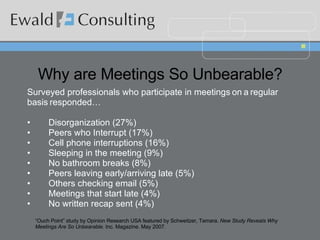
Why are Meetings So Unbearable?   Surveyed professionals who participate in meetings   on   a   regular basis   responded… Disorganization (27%) Peers who Interrupt (17%) Cell phone interruptions (16%) Sleeping in the meeting (9%) No bathroom breaks (8%) Peers leaving early/arriving late (5%) Others checking email (5%) Meetings that start late (4%) No written recap sent (4%) “ Ouch Point” study by Opinion Research USA featured by Schweitzer, Tamara.  New Study Reveals Why Meetings Are So Unbearable.  Inc. Magazine. May 2007.
“ 7 Sins of a Deadly Meeting”   Arriving late and leaving early Meetings that are too long Getting off-topic Poor follow-through Diluted opinion sharing Insufficient preparation Stagnant/stale content Matson, Eric.  The Seven Sins of Deadly Meetings.  Fast Company. Issue 2. April 1996. Pg 122.
The Effect of Unproductive Meetings Surveyed professionals who frequently participate in meetings admit to...   Daydreaming (91%) Missing meetings (96%) parts of meetings (95%) Bringing other work along (73%) Sleeping (39%) Network MCI Conferencing White Paper.  Meetings in America: A study of trends, costs and attitudes toward business travel, teleconferencing, and their impact on productivity  (Greenwich, CT: INFOCOMM, 1998), 3. on  www.effectivemeetings.com
How to Ensure a Successful Meeting   Good reason to meet Firm start and finish times  Clear expectations of participants  Timed agenda with stimulating discussion items  Skilled facilitation  Walters, Jamie.  Meetings 101: Was That a Good Meeting, or a Bad  One? Inc. Magazine. January 2003.
Attributes of an Effective Facilitator Openness Honesty & fairness Consistency in actions Focus Active listening Accessibility  Flexibility Assertiveness Enthusiasm From  Basic Facilitation Skills, American Society for Quality, Association for Quality and Participation, International Association of Facilitators, May 2002 “ A facilitator focuses on effective processes (meeting dynamics) allowing the participants to focus on the content or the substance of their work together.”
7 Common Ground Rules Attend all meetings and be on time ACTIVELY listen to and show respect for the opinions of others Follow the agenda – stay on track The only stupid question is the one that isn’t asked Ensure that credit is given to those to whom it is due No disruptive side conversations Cell phones, BlackBerries, and pagers off From  Basic Facilitation Skills, American Society for Quality, Association for Quality and Participation, International Association of Facilitators, May 2002
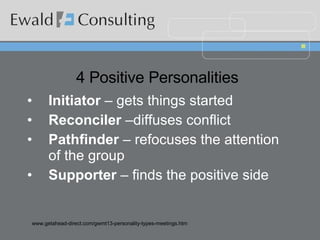
4 Positive Personalities   Initiator  – gets things started Reconciler  –diffuses conflict Pathfinder  – refocuses the attention of the group Supporter  – finds the positive side  www.getahead-direct.com/gwmt13-personality-types-meetings.htm
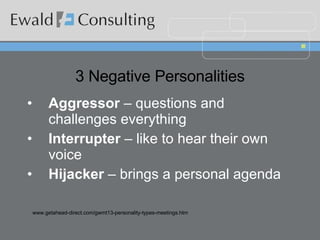
3 Negative Personalities Aggressor  – questions and challenges everything Interrupter  – like to hear their own voice Hijacker  – brings a personal agenda www.getahead-direct.com/gwmt13-personality-types-meetings.htm
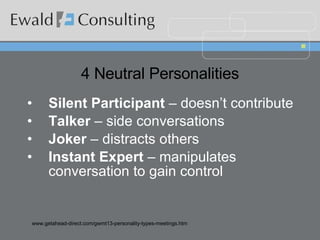
4 Neutral Personalities Silent Participant  – doesn’t contribute  Talker  – side conversations Joker  – distracts others Instant   Expert  – manipulates conversation to gain control www.getahead-direct.com/gwmt13-personality-types-meetings.htm
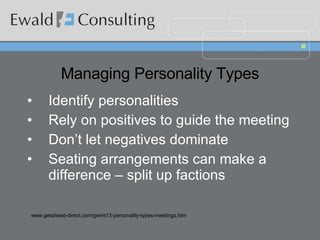
Managing Personality Types Identify personalities  Rely on positives to guide the meeting Don’t let negatives dominate Seating arrangements can make a difference – split up factions www.getahead-direct.com/gwmt13-personality-types-meetings.htm
Strategic Boards Get Results Positive Outcomes  in issues that are important to members. Member Engagement  Clear vision draws members to get involved.  Specific Direction  for the organization and for the industry’s future.
Governance Approaches “ Working” Board Model  Policy Board Model Balanced Scorecard Model
“ Working” Board Model Board member responsibilities match functional areas Acute knowledge of the association Detailed knowledge of association initiatives
Policy Board Model Big Picture thinking Delegation with limitations Implementation by staff & volunteers Clarity of board/staff roles
Balanced Scorecard Model Focus on strategic planning and action Emphasize monitoring & evaluation Highly structured
Robert’s Rules of Order Four basic types of motions: 1. Main motion: introduce items for consideration. Can’t be made when any other motion is on the floor. 2. Subsidiary motion: change how a main motion is handled and is voted on before a main motion.
Four Motions (cont.) 3. Privileged motion: bring up items that are urgent about special or important matters unrelated to pending business. 4. Incidental motion: provide a means of questioning procedure concerning other motions  www. robert srules.org/rulesintro.htm
Consent Agenda Reduces discussion of details during the meeting Maximizes time for strategic matters Requires thorough preparation in advance of the meeting
The Next Step… Facing Your Top Three Issues
Questions? Paul Hanscom, CAE  paulh@ewald.com  651-290-6274 Kathie Pugaczewski, CAE [email_address] 651-265-7859

Effective Board Meetings

  • 1.
    Effective Board MeetingsPaul Hanscom, CAE Kathie Pugaczewski, CAE
  • 2.
    Exercises: 1. List the top three issues facing your members 2. Board Self-evaluation
  • 3.
    Ewald Consulting Associationmanagement and government relations firm: 25+ years Variety of client associations include: psychologists, economic developers, property managers, cardiologists, researchers, publishers, child care, trainers, fleet leasing dealers, well drillers…
  • 4.
    Common Attributes of Effective Boards Buy-in to mission of organization Come to meeting prepared - read Understand role of staff and board Respect each other and keep each other accountable Stay strategic and out of the day-to-day Focus on relevant issues
  • 5.
    “ People onlychange when confronted with strong leadership, crisis, or both. Therefore, unless you are willing to be at the whim of crises, strong leadership is the only reliable change force you have.” – Thomas Gibson
  • 6.
    Realities of theBusiness Environment Time – People are busy/multiple priorities Attention economy – rapid growth of information causes scarcity of attention Technology – BlackBerries, blogs, MySpace, Facebook, instant messaging, LinkedIn…What’s next?
  • 7.
    Given these realities,association leaders need to… Focus on relevant issues Plan effectively and efficiently Make the most of in-person meetings Connect between meetings Be accountable – don’t over commit Develop future leaders – mentorship
  • 8.
    Generational Realities: DevelopingFuture Leaders We need to engage Gen X and Y differently Mentoring Gen Y – participation episodic Invite Gen X and Gen Y on board even if they haven’t “paid their dues” Young Professional Groups Shorter and focused meetings…
  • 9.
    Why Do WeMeet? Make decisions Share information Plan work Learn from one another Create buy-in Solve problems From Basic Facilitation Skills, American Society for Quality, Association for Quality and Participation, International Association of Facilitators, May 2002 Americans participate in an average of 25 million meetings every day.* * Doyle & Straus Study as featured by Sauer, Patrick J. Escape from Meeting Hell. Inc. Magazine. May 2004.
  • 10.
    Why are MeetingsSo Unbearable? Surveyed professionals who participate in meetings on a regular basis responded… Disorganization (27%) Peers who Interrupt (17%) Cell phone interruptions (16%) Sleeping in the meeting (9%) No bathroom breaks (8%) Peers leaving early/arriving late (5%) Others checking email (5%) Meetings that start late (4%) No written recap sent (4%) “ Ouch Point” study by Opinion Research USA featured by Schweitzer, Tamara. New Study Reveals Why Meetings Are So Unbearable. Inc. Magazine. May 2007.
  • 11.
    “ 7 Sinsof a Deadly Meeting” Arriving late and leaving early Meetings that are too long Getting off-topic Poor follow-through Diluted opinion sharing Insufficient preparation Stagnant/stale content Matson, Eric. The Seven Sins of Deadly Meetings. Fast Company. Issue 2. April 1996. Pg 122.
  • 12.
    The Effect ofUnproductive Meetings Surveyed professionals who frequently participate in meetings admit to... Daydreaming (91%) Missing meetings (96%) parts of meetings (95%) Bringing other work along (73%) Sleeping (39%) Network MCI Conferencing White Paper. Meetings in America: A study of trends, costs and attitudes toward business travel, teleconferencing, and their impact on productivity (Greenwich, CT: INFOCOMM, 1998), 3. on www.effectivemeetings.com
  • 13.
    How to Ensurea Successful Meeting Good reason to meet Firm start and finish times Clear expectations of participants Timed agenda with stimulating discussion items Skilled facilitation Walters, Jamie. Meetings 101: Was That a Good Meeting, or a Bad One? Inc. Magazine. January 2003.
  • 14.
    Attributes of anEffective Facilitator Openness Honesty & fairness Consistency in actions Focus Active listening Accessibility Flexibility Assertiveness Enthusiasm From Basic Facilitation Skills, American Society for Quality, Association for Quality and Participation, International Association of Facilitators, May 2002 “ A facilitator focuses on effective processes (meeting dynamics) allowing the participants to focus on the content or the substance of their work together.”
  • 15.
    7 Common GroundRules Attend all meetings and be on time ACTIVELY listen to and show respect for the opinions of others Follow the agenda – stay on track The only stupid question is the one that isn’t asked Ensure that credit is given to those to whom it is due No disruptive side conversations Cell phones, BlackBerries, and pagers off From Basic Facilitation Skills, American Society for Quality, Association for Quality and Participation, International Association of Facilitators, May 2002
  • 16.
    4 Positive Personalities Initiator – gets things started Reconciler –diffuses conflict Pathfinder – refocuses the attention of the group Supporter – finds the positive side www.getahead-direct.com/gwmt13-personality-types-meetings.htm
  • 17.
    3 Negative PersonalitiesAggressor – questions and challenges everything Interrupter – like to hear their own voice Hijacker – brings a personal agenda www.getahead-direct.com/gwmt13-personality-types-meetings.htm
  • 18.
    4 Neutral PersonalitiesSilent Participant – doesn’t contribute Talker – side conversations Joker – distracts others Instant Expert – manipulates conversation to gain control www.getahead-direct.com/gwmt13-personality-types-meetings.htm
  • 19.
    Managing Personality TypesIdentify personalities Rely on positives to guide the meeting Don’t let negatives dominate Seating arrangements can make a difference – split up factions www.getahead-direct.com/gwmt13-personality-types-meetings.htm
  • 20.
    Strategic Boards GetResults Positive Outcomes in issues that are important to members. Member Engagement Clear vision draws members to get involved. Specific Direction for the organization and for the industry’s future.
  • 21.
    Governance Approaches “Working” Board Model Policy Board Model Balanced Scorecard Model
  • 22.
    “ Working” BoardModel Board member responsibilities match functional areas Acute knowledge of the association Detailed knowledge of association initiatives
  • 23.
    Policy Board ModelBig Picture thinking Delegation with limitations Implementation by staff & volunteers Clarity of board/staff roles
  • 24.
    Balanced Scorecard ModelFocus on strategic planning and action Emphasize monitoring & evaluation Highly structured
  • 25.
    Robert’s Rules ofOrder Four basic types of motions: 1. Main motion: introduce items for consideration. Can’t be made when any other motion is on the floor. 2. Subsidiary motion: change how a main motion is handled and is voted on before a main motion.
  • 26.
    Four Motions (cont.)3. Privileged motion: bring up items that are urgent about special or important matters unrelated to pending business. 4. Incidental motion: provide a means of questioning procedure concerning other motions www. robert srules.org/rulesintro.htm
  • 27.
    Consent Agenda Reducesdiscussion of details during the meeting Maximizes time for strategic matters Requires thorough preparation in advance of the meeting
  • 28.
    The Next Step…Facing Your Top Three Issues
  • 29.
    Questions? Paul Hanscom,CAE paulh@ewald.com 651-290-6274 Kathie Pugaczewski, CAE [email_address] 651-265-7859