International Research Journal of Engineering and Technology (IRJET) e-ISSN: 2395-0056
Volume: 04 Issue: 07 | July -2017 www.irjet.net p-ISSN: 2395-0072
© 2017, IRJET | Impact Factor value: 5.181 | ISO 9001:2008 Certified Journal | Page 659
OUTCOME BASED EDUCATION – A REVIEW
CM.VIVEK1
1 Assistant professor, Department of Mechanical engineering, Periyar Maniammai University,
vallam ,Tamil Nadu, India
---------------------------------------------------------------------***---------------------------------------------------------------------
Abstract - The aim of this paper is to highlight the areas
where the current education system is lacking and how
outcome based education system can be successfully
implemented to prevent that area where focus is needed.
This paper specifically focuses on engineering educational
system, how balance between knowledge and practical skill
set can be given focus for betterment of educational system
and learning
Key Words: Outcome based education, Educational
system, Rubrics,
1. INTRODUCTION
The main purpose of an educational system is
imparting knowledge to learning community. A good
educational practice should provide flexibility for various
types learning community. However traditional education
system offers no such flexibility. Students who are
adapting to the system get better results, while others
don’t. In general, after successfully graduating a course a
student becomes smart enough to repeat the orders what
their superiors told to do so. But the fact is people who
are literate can follow orders if properly guided. The
modern learning community finds the traditional
educational system as dry due to technological
advancements and societal changes. The modern learning
community wants to attend a specific course or topic for
time period, which they might already learned or not
interested. They need a facilitator who can create such an
environment in which the learning community has all the
tools for attaining the course outcomes. Outcome based
education creates a clarity for the learning community
what they should accomplish at successful completion of
course. The OBE system should be capable of measuring
each and every assessment which is done by the learning
community.
2. Existing Education system
In general most of the engineering educational
institutions in India has set a standard marks for
identifying students who are pass/ fail. In most of the case
scoring 35 % of marks means he/she getting pass in their
respective course. For example we shall consider a course
in engineering program which contains five chapters. For
the evaluation of the course assessment each chapter has
equal weight age of 20% marks has been awarded. If a
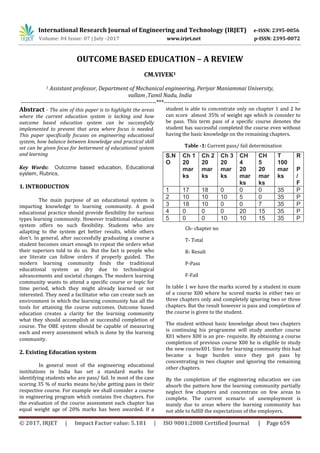
student is able to concentrate only on chapter 1 and 2 he
can score almost 35% of weight age which is consider to
be pass. This term pass of a specific course denotes the
student has successful completed the course even without
having the basic knowledge on the remaining chapters.
Table -1: Current pass/ fail determination
S.N
O
Ch 1
20
mar
ks
Ch 2
20
mar
ks
Ch 3
20
mar
ks
CH
4
20
mar
ks
CH
5
20
mar
ks
T
100
mar
ks
R
P
/
F
1 17 18 0 0 0 35 P
2 10 10 10 5 0 35 P
3 18 10 0 0 7 35 P
4 0 0 0 20 15 35 P
5 0 0 10 10 15 35 P
Ch- chapter no
T- Total
R- Result
P-Pass
F-Fail
In table 1 we have the marks scored by a student in exam
of a course X00 where he scored marks in either two or
three chapters only and completely ignoring two or three
chapters. But the result however is pass and completion of
the course is given to the student.
The student without basic knowledge about two chapters
is continuing his programme will study another course
X01 where X00 is an pre- requisite. By obtaining a course
completion of previous course X00 he is eligible to study
the new courseX01. Since for learning community this had
became a huge burden since they got pass by
concentrating in two chapter and ignoring the remaining
other chapters.
By the completion of the engineering education we can
absorb the pattern how the learning community partially
neglect few chapters and concentrate on few areas to
complete. The current scenario of unemployment is
mainly due to areas where the learning community has
not able to fulfill the expectations of the employers.
International Research Journal of Engineering and Technology (IRJET) e-ISSN: 2395-0056
Volume: 04 Issue: 07 | July -2017 www.irjet.net p-ISSN: 2395-0072
© 2017, IRJET | Impact Factor value: 5.181 | ISO 9001:2008 Certified Journal | Page 660
3. Outcome based education
There is huge concern in current educational system
because it doesn’t adequately prepare students for life and
work has prompted a review of education. For the
problems mentioned above the proposed system can able
to rectify it. Instead of using total marks for measuring
pass or fail we can set course outcome for a course to
determine whether the student has attained it or not.
Course outcomes generally refer to traits,
knowledge, skill set that a student attains after completing
the course successfully. For a student to complete his
course successfully he/she need to attain the course
outcomes. For setting the course outcome, one should
refer the three domains of learning. The three domains of
learning are cognitive, psychomotor and affective domain.
Each domain has levels which are used while developing
the course. By using these domains the course outcomes
can be set accordingly.
In engineering education, for a specific course we
can develop number of course outcomes and we can give
weightage for them based on their importance. For
example consider a course p00 where the course
outcomes are (i) outcome based on the knowledge they
gained (ii) outcome based on their application (iii)
outcome based on the skill they developed. For successful
completion of course one must attain all these outcomes
with minimum % of weightage say 40 % . If student
secured above 40 % in each course outcome then only he
can complete his course.
Consider a course X005. The course has five course
outcomes. Each course outcome carries 20 % of
weightage. The Minimum % set for each course outcome is
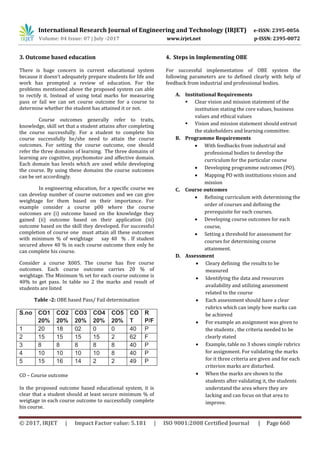
40% to get pass. In table no 2 the marks and result of
students are listed
Table -2: OBE based Pass/ Fail determination
S.no CO1
20%
CO2
20%
CO3
20%
CO4
20%
CO5
20%
CO
T
R
P/F
1 20 18 02 0 0 40 P
2 15 15 15 15 2 62 F
3 8 8 8 8 8 40 P
4 10 10 10 10 8 40 P
5 15 16 14 2 2 49 P
CO – Course outcome
In the proposed outcome based educational system, it is
clear that a student should at least secure minimum % of
weigtage in each course outcome to successfully complete
his course.
4. Steps in Implementing OBE
For successful implementation of OBE system the
following parameters are to defined clearly with help of
feedback from industrial and professional bodies.
A. Institutional Requirements
 Clear vision and mission statement of the
institution stating the core values, business
values and ethical values
 Vision and mission statement should entrust
the stakeholders and learning committee.
B. Programme Requirements
 With feedbacks from industrial and
professional bodies to develop the
curriculum for the particular course
 Developing programme outcomes (PO).
 Mapping PO with institutions vision and
mission
C. Course outcomes
 Refining curriculum with determining the
order of courses and defining the
prerequisite for each courses.
 Developing course outcomes for each
course,
 Setting a threshold for assessment for
courses for determining course
attainment.
D. Assessment
 Cleary defining the results to be
measured
 Identifying the data and resources
availability and utilizing assessment
related to the course
 Each assessment should have a clear
rubrics which can imply how marks can
be achieved
 For example an assignment was given to
the students , the criteria needed to be
clearly stated
 Example, table no 3 shows simple rubrics
for assignment. For validating the marks
for it three criteria are given and for each
criterion marks are disturbed.
 When the marks are shown to the
students after validating it, the students
understand the area where they are
lacking and can focus on that area to
improve.
International Research Journal of Engineering and Technology (IRJET) e-ISSN: 2395-0056
Volume: 04 Issue: 07 | July -2017 www.irjet.net p-ISSN: 2395-0072
© 2017, IRJET | Impact Factor value: 5.181 | ISO 9001:2008 Certified Journal | Page 661
Table -3: OBE Rubrics for assignment
5. Conclusion
To conclude this paper, it is evident that proposed
changes to the education will make the learning
community more efficient and can eradicate the problem
of underemployment. The students on their successful
completion of the program will have at least minimum
level of knowledge and skills. The course outcomes of
various course will be met by the students. No topic or
course contents will be deserted making students
expertise in areas which are designed in the curriculum.
ACKNOWLEDGEMENT
I thank Periyar Maniammai University and department of
mechanical engineering for providing me to the
opportunity to work on outcome based education related
activities.
[1] Outcome Based Education (OBE) - Trend Review
RashaEldeeb and NishaShatakumari Department of
Physiology, Gulf Medical University (GMU), Ajman,
UAE.
[2] Outcome-based education and student learning in
managerial accounting in Hong Kong Gladie Lui
Lingnan University
BIOGRAPHIES
CM.VIVEK
ASSISTANT PROFESSOR,
DEPARTMENT OF
MECHANICAL
ENGINEERING
PERIYAR MANIAMMAI
UNIVERSITY,
VALLAM,THANJAVUR
TAMIL NADU,INDIA
S.No Criteria
Scale
(10)
Domain
and levels
1 Presentation 4 Cognitive
2 Content 4 Cognitive
3 Date of
Submission
2 Affective
REFERENCES

Outcome Based Education – A Review

  • 1.
    International Research Journalof Engineering and Technology (IRJET) e-ISSN: 2395-0056 Volume: 04 Issue: 07 | July -2017 www.irjet.net p-ISSN: 2395-0072 © 2017, IRJET | Impact Factor value: 5.181 | ISO 9001:2008 Certified Journal | Page 659 OUTCOME BASED EDUCATION – A REVIEW CM.VIVEK1 1 Assistant professor, Department of Mechanical engineering, Periyar Maniammai University, vallam ,Tamil Nadu, India ---------------------------------------------------------------------***--------------------------------------------------------------------- Abstract - The aim of this paper is to highlight the areas where the current education system is lacking and how outcome based education system can be successfully implemented to prevent that area where focus is needed. This paper specifically focuses on engineering educational system, how balance between knowledge and practical skill set can be given focus for betterment of educational system and learning Key Words: Outcome based education, Educational system, Rubrics, 1. INTRODUCTION The main purpose of an educational system is imparting knowledge to learning community. A good educational practice should provide flexibility for various types learning community. However traditional education system offers no such flexibility. Students who are adapting to the system get better results, while others don’t. In general, after successfully graduating a course a student becomes smart enough to repeat the orders what their superiors told to do so. But the fact is people who are literate can follow orders if properly guided. The modern learning community finds the traditional educational system as dry due to technological advancements and societal changes. The modern learning community wants to attend a specific course or topic for time period, which they might already learned or not interested. They need a facilitator who can create such an environment in which the learning community has all the tools for attaining the course outcomes. Outcome based education creates a clarity for the learning community what they should accomplish at successful completion of course. The OBE system should be capable of measuring each and every assessment which is done by the learning community. 2. Existing Education system In general most of the engineering educational institutions in India has set a standard marks for identifying students who are pass/ fail. In most of the case scoring 35 % of marks means he/she getting pass in their respective course. For example we shall consider a course in engineering program which contains five chapters. For the evaluation of the course assessment each chapter has equal weight age of 20% marks has been awarded. If a student is able to concentrate only on chapter 1 and 2 he can score almost 35% of weight age which is consider to be pass. This term pass of a specific course denotes the student has successful completed the course even without having the basic knowledge on the remaining chapters. Table -1: Current pass/ fail determination S.N O Ch 1 20 mar ks Ch 2 20 mar ks Ch 3 20 mar ks CH 4 20 mar ks CH 5 20 mar ks T 100 mar ks R P / F 1 17 18 0 0 0 35 P 2 10 10 10 5 0 35 P 3 18 10 0 0 7 35 P 4 0 0 0 20 15 35 P 5 0 0 10 10 15 35 P Ch- chapter no T- Total R- Result P-Pass F-Fail In table 1 we have the marks scored by a student in exam of a course X00 where he scored marks in either two or three chapters only and completely ignoring two or three chapters. But the result however is pass and completion of the course is given to the student. The student without basic knowledge about two chapters is continuing his programme will study another course X01 where X00 is an pre- requisite. By obtaining a course completion of previous course X00 he is eligible to study the new courseX01. Since for learning community this had became a huge burden since they got pass by concentrating in two chapter and ignoring the remaining other chapters. By the completion of the engineering education we can absorb the pattern how the learning community partially neglect few chapters and concentrate on few areas to complete. The current scenario of unemployment is mainly due to areas where the learning community has not able to fulfill the expectations of the employers.
  • 2.
    International Research Journalof Engineering and Technology (IRJET) e-ISSN: 2395-0056 Volume: 04 Issue: 07 | July -2017 www.irjet.net p-ISSN: 2395-0072 © 2017, IRJET | Impact Factor value: 5.181 | ISO 9001:2008 Certified Journal | Page 660 3. Outcome based education There is huge concern in current educational system because it doesn’t adequately prepare students for life and work has prompted a review of education. For the problems mentioned above the proposed system can able to rectify it. Instead of using total marks for measuring pass or fail we can set course outcome for a course to determine whether the student has attained it or not. Course outcomes generally refer to traits, knowledge, skill set that a student attains after completing the course successfully. For a student to complete his course successfully he/she need to attain the course outcomes. For setting the course outcome, one should refer the three domains of learning. The three domains of learning are cognitive, psychomotor and affective domain. Each domain has levels which are used while developing the course. By using these domains the course outcomes can be set accordingly. In engineering education, for a specific course we can develop number of course outcomes and we can give weightage for them based on their importance. For example consider a course p00 where the course outcomes are (i) outcome based on the knowledge they gained (ii) outcome based on their application (iii) outcome based on the skill they developed. For successful completion of course one must attain all these outcomes with minimum % of weightage say 40 % . If student secured above 40 % in each course outcome then only he can complete his course. Consider a course X005. The course has five course outcomes. Each course outcome carries 20 % of weightage. The Minimum % set for each course outcome is 40% to get pass. In table no 2 the marks and result of students are listed Table -2: OBE based Pass/ Fail determination S.no CO1 20% CO2 20% CO3 20% CO4 20% CO5 20% CO T R P/F 1 20 18 02 0 0 40 P 2 15 15 15 15 2 62 F 3 8 8 8 8 8 40 P 4 10 10 10 10 8 40 P 5 15 16 14 2 2 49 P CO – Course outcome In the proposed outcome based educational system, it is clear that a student should at least secure minimum % of weigtage in each course outcome to successfully complete his course. 4. Steps in Implementing OBE For successful implementation of OBE system the following parameters are to defined clearly with help of feedback from industrial and professional bodies. A. Institutional Requirements  Clear vision and mission statement of the institution stating the core values, business values and ethical values  Vision and mission statement should entrust the stakeholders and learning committee. B. Programme Requirements  With feedbacks from industrial and professional bodies to develop the curriculum for the particular course  Developing programme outcomes (PO).  Mapping PO with institutions vision and mission C. Course outcomes  Refining curriculum with determining the order of courses and defining the prerequisite for each courses.  Developing course outcomes for each course,  Setting a threshold for assessment for courses for determining course attainment. D. Assessment  Cleary defining the results to be measured  Identifying the data and resources availability and utilizing assessment related to the course  Each assessment should have a clear rubrics which can imply how marks can be achieved  For example an assignment was given to the students , the criteria needed to be clearly stated  Example, table no 3 shows simple rubrics for assignment. For validating the marks for it three criteria are given and for each criterion marks are disturbed.  When the marks are shown to the students after validating it, the students understand the area where they are lacking and can focus on that area to improve.
  • 3.
    International Research Journalof Engineering and Technology (IRJET) e-ISSN: 2395-0056 Volume: 04 Issue: 07 | July -2017 www.irjet.net p-ISSN: 2395-0072 © 2017, IRJET | Impact Factor value: 5.181 | ISO 9001:2008 Certified Journal | Page 661 Table -3: OBE Rubrics for assignment 5. Conclusion To conclude this paper, it is evident that proposed changes to the education will make the learning community more efficient and can eradicate the problem of underemployment. The students on their successful completion of the program will have at least minimum level of knowledge and skills. The course outcomes of various course will be met by the students. No topic or course contents will be deserted making students expertise in areas which are designed in the curriculum. ACKNOWLEDGEMENT I thank Periyar Maniammai University and department of mechanical engineering for providing me to the opportunity to work on outcome based education related activities. [1] Outcome Based Education (OBE) - Trend Review RashaEldeeb and NishaShatakumari Department of Physiology, Gulf Medical University (GMU), Ajman, UAE. [2] Outcome-based education and student learning in managerial accounting in Hong Kong Gladie Lui Lingnan University BIOGRAPHIES CM.VIVEK ASSISTANT PROFESSOR, DEPARTMENT OF MECHANICAL ENGINEERING PERIYAR MANIAMMAI UNIVERSITY, VALLAM,THANJAVUR TAMIL NADU,INDIA S.No Criteria Scale (10) Domain and levels 1 Presentation 4 Cognitive 2 Content 4 Cognitive 3 Date of Submission 2 Affective REFERENCES