Green University of Bangladesh
Department of Electrical and Electronic Engineering
EEE-214
Electronics Laboratory Manual
Student ID
Student Name
Section
Name of the Program
Name of the Department
Page | 1
Page | 2
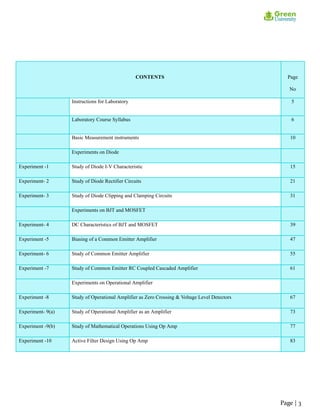
CONTENTS Page
No
Instructions for Laboratory 5
Laboratory Course Syllabus 6
Basic Measurement instruments 10
Experiments on Diode
Experiment -1 Study of Diode I-V Characteristic 15
Experiment- 2 Study of Diode Rectifier Circuits 21
Experiment- 3 Study of Diode Clipping and Clamping Circuits 31
Experiments on BJT and MOSFET
Experiment- 4 DC Characteristics of BJT and MOSFET 39
Experiment -5 Biasing of a Common Emitter Amplifier 47
Experiment- 6 Study of Common Emitter Amplifier 55
Experiment -7 Study of Common Emitter RC Coupled Cascaded Amplifier 61
Experiments on Operational Amplifier
Experiment -8 Study of Operational Amplifier as Zero Crossing & Voltage Level Detectors 67
Experiment- 9(a) Study of Operational Amplifier as an Amplifier 73
Experiment -9(b) Study of Mathematical Operations Using Op Amp 77
Experiment -10 Active Filter Design Using Op Amp 83
Page | 3
INSTRUCTIONS FOR LABORATORY
Page | 4
​ The experiments are designed to illustrate about different areas of electronic devices, circuits and
applications. Conduct the experiments with interest and an attitude of learning.
​ Students should come with thorough preparation for the experiment to be conducted.
​ Students should come with proper dress code.
​ Students will not be permitted to attend the laboratory unless they bring the practical record fully
completed in all respects pertaining to the experiment conducted in the previous class.
​ Work quietly and carefully (the whole purpose of experimentation is to make reliable measurements!)
and equally share the work with your partners.
​ Be honest in recording and representing your data. If a particular reading appears wrong repeat the
measurement carefully.
​ All presentations of data, tables and graphs calculations should be neatly and carefully done.
​ Graphs should be neatly drawn with pencil. Always label graphs and the axes and display units.
​ If you finish early, spend the remaining time to complete the laboratory report writing. Come equipped
with calculator, scales, pencils etc.
​ Handle instruments with care. Report any breakage to the Instructor. Return all the equipment you have
signed out for the purpose of your experiment.
GREEN UNIVERSITY OF BANGLADESH (GUB)
Page | 5
COURSE SYLLABUS
1 Faculty Faculty of Science & Engineering
2 Department Department of EEE
3 Programme BSEEE [BSc in Electrical & Electronic Engineering]
4 Name of Course Electronics Lab
5 Course Code EEE 314
6
Trimester and
Year
7 Pre-requisites Electronics I (EEE 201) and Electronics II (EEE 209)
8 Status Core EEE Course
9 Credit Hours 1.5
10 Section
11 Class Hours
12 Class Location Room: 901, Building 2
13 Course website
14
Name (s) of
Academic staff
/ Instructor(s)
15 Contact
16 Office
17 Counseling Hours
18 Text Book
1. “Microelectronics Circuits” (5th or 6th Edition) – by Adel S. Sedra &
Kenneth C. Smith. Published by Oxford University Press.
19 Reference 1. “Microelectronics Circuit Analysis and Design” (4th Edition) -
by Donald A. Neamen. Published by McGraw Hill Higher Education.
20 Equipment & Aids Electronic Hardware Equipment, Oscilloscope, Graph Paper
Page | 6
21 Course Rationale
With the ubiquitous use of electronic devices, e.g. Computers, Gadgets, TV
demand a great, concise, and clear knowledge about the main component of
such devices which is Integrated Circuits (IC). These ICs contain millions of
basic components like Diodes, Operational Amplifiers, Metal Oxide
Semiconductor Field Effect Transistors, and Bipolar Junction Transistors. So,
studying and practically demonstrating such electronic components are quite
mandatory for the better understanding of trendy devices.
22 Course Description
For an electrical engineer the knowledge of electronics is elementary. Because
in every aspect of electrical engineering electronics is present. This course is
the first step in the exciting and evolving area of electronics which is now a
governing engineering study of Electrical and Electronic Engineering. This
course will focus on the practical demonstration of the very basic and
primitive electronics devices.
23 Course Objectives
The objective of this course is to
1. Show the students the real characteristics of the electronic devices like
diode, transistor, amplifier
2. Clear their concepts on the applications and limitations of these
devices
3. Give them an idea about how to design an electronic system
to serve certain purpose.
24 Learning Outcomes
After the end of this course, the students will be able to:
1. Compare the performance of different devices under different
conditions.
2. Explain the characteristics of different electronic devices
3. Design an electronic system to serve certain purpose
25 Teaching Methods Lecture, Laboratory hardware and software experiments, Project
Developments.
26 Topic Outline
Class
Topics Or
Assignments
CLOs Reading
Reference
Activities
1
Introductory
overview on
the course
1,2
Lecture,
Question-answer
2
Study of diode
I-V characteristics
with schematics
1-3
Laboratory
Experiment
3
Study of
diode
rectifier
circuits
1-3
Laboratory
Experiment
Page | 7
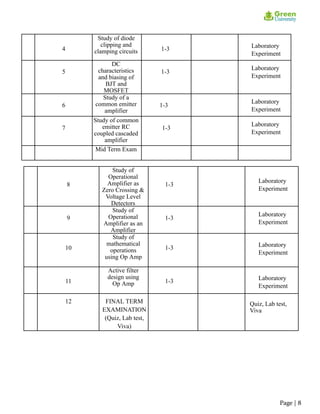
4
Study of diode
clipping and
clamping circuits 1-3 Laboratory
Experiment
5
DC
characteristics
and biasing of
BJT and
MOSFET
1-3
Laboratory
Experiment
6
Study of a
common emitter
amplifier
1-3
Laboratory
Experiment
7
Study of common
emitter RC
coupled cascaded
amplifier
1-3
Laboratory
Experiment
Mid Term Exam
8
Study of
Operational
Amplifier as
Zero Crossing &
Voltage Level
Detectors
1-3
Laboratory
Experiment
9
Study of
Operational
Amplifier as an
Amplifier
1-3
Laboratory
Experiment
10
Study of
mathematical
operations
using Op Amp
1-3 Laboratory
Experiment
11
Active filter
design using
Op Amp 1-3 Laboratory
Experiment
12 FINAL TERM
EXAMINATION
(Quiz, Lab test,
Viva)
Quiz, Lab test,
Viva
Page | 8
27 Assessment Methods
Assessment Types Marks
Attendance and Participation 10%
Lab Report 20%
Lab Viva 15%
Lab Test 25%
Lab Final Quiz + Mid Term Exam 30%
Total 100%
28 Grading Policy
Letter
Grade
Marks
%
Grade
Point
Letter
Grade
Marks
%
Grade
Point
A+ (Plus) 80-100 4.00 C+ (Plus) 50-54 2.50
A (Plain) 75-79 3.75 C (Plain) 45-49 2.25
A- (Minus) 70-74 3.50 D (Plain) 40-44 2.00
B+ (Plus) 65-69 3.25 F (Fail) <40 0.00
B (Plain) 60-64 3.00 I* - Incomplete
B- (Minus) 55-59 2.75 W* - Withdrawal
1. 1. Lab Reports:
Report on previous Experiment must be submitted before the beginning of new
experiment. A bonus may be obtained if a student submits a neat, clean and complete
lab report.
2. 2. Examination:
There will be a mid-term exam and final exam both of which will be closed book.
3. 3. Unfair means policy:
In case of copying/plagiarism in any of the assessments, the students involved will
receive zero marks. Zero Tolerance will be shown in this regard. In case of severe
offences, actions will be taken as per university rule.
4. 4. Counseling:
Students are expected to follow the counseling hours posted. In case of
emergency/unavoidable situations, students can e-mail me to make an appointment.
5. 5. Policy for Absence in Class/Exam:
If a student is absent in the class for anything other than medical reasons, he/she will
not receive attendance. If a student misses a class for genuine medical reasons, he/she
must submit an application with the supporting documents (prescription/medical
report). He/she will then have to follow the instructions given by the instructor for
make-up.
In case of absence in the mid/final exam for medical grounds, the student must also
get his/her application forwarded by the head of the department before a make-up
exam can be taken.
It is recommended that the students inform the instructor beforehand through mail if
they feel that they will miss a class/evaluation due to medical reasons.
Page | 9
a. Academic Calendar Fall 2017:
http://www.green.edu.bd/academics/academic-calendar
b. Academic Information and Policies:
http://www.green.edu.bd/academics/academic-rules-a-regulations
c. Grading and Performance Evaluation:
http://www.green.edu.bd/academics/academic-rules-a-regulations
d. Proctorial Rules: http://www.green.edu.bd/administrator/proctors-office
Page | 10
BASIC MEASUREMENT INSTRUMENTS
1. Breadboard
2. Transistor and Op-Amp Pin Details
3. Oscilloscope
4. Multimeter
1. Breadboard:
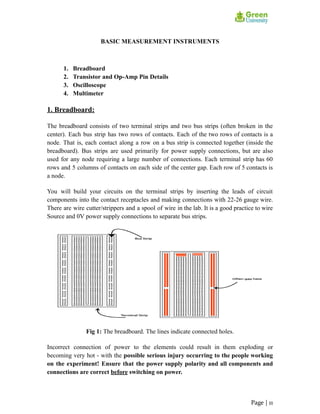
The breadboard consists of two terminal strips and two bus strips (often broken in the
center). Each bus strip has two rows of contacts. Each of the two rows of contacts is a
node. That is, each contact along a row on a bus strip is connected together (inside the
breadboard). Bus strips are used primarily for power supply connections, but are also
used for any node requiring a large number of connections. Each terminal strip has 60
rows and 5 columns of contacts on each side of the center gap. Each row of 5 contacts is
a node.
You will build your circuits on the terminal strips by inserting the leads of circuit
components into the contact receptacles and making connections with 22-26 gauge wire.
There are wire cutter/strippers and a spool of wire in the lab. It is a good practice to wire
Source and 0V power supply connections to separate bus strips.
Fig 1: The breadboard. The lines indicate connected holes.
Incorrect connection of power to the elements could result in them exploding or
becoming very hot - with the possible serious injury occurring to the people working
on the experiment! Ensure that the power supply polarity and all components and
connections are correct before switching on power.
Page | 11
Building the Circuit:
Throughout these experiments we will use basic circuit elements like resistor, capacitor,
BJT, MOSFET Op-Amp etc. to build circuits. The steps for wiring a circuit should be
completed in the order described below:
1. Make sure the power is off before you build anything!
2. Read the theory carefully before starting connection so that there is no
confusion about what to build.
3. Connect Source and GND pins of each chip to the power and ground bus strips
on the breadboard.
4. Make sure that all the connections you have given are not loose and there is no
short circuit in the external connection. Match your connection with the
connection diagram provided in the lab sheet.
5. Get one of your group members to check the connections, before you turn the
power on.
6. If an error is made and is not spotted before you turn the power on. Turn the
power off immediately before you begin to rewire the circuit.
7. At the end of the laboratory session, collect you hook-up wires, chips and all
equipment and return them to the demonstrator.
8. Tidy the area that you were working in and leave it in the same condition as it
was before you started.
Common Causes of Problems:
1. Not connecting the ground and/or power pins.
2. Not turning on the power supply before checking the operation of the circuit.
3. Leaving out wires.
4. Plugging wires into the wrong holes.
5. Not checking whether the device is faulty or not.
6. Modifying the circuit with the power on.
In all experiments, you will be expected to obtain all instruments, leads, components at
the start of the experiment and return them to their proper place after you have finished
the experiment. Please inform the demonstrator or technician if you locate faulty
equipment. If you damage an element, inform a demonstrator, don't put it back in the box
of elements for somebody else to use.
Page | 12
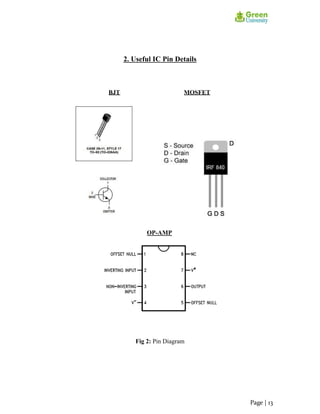
2. Useful IC Pin Details
BJT MOSFET
OP-AMP
Fig 2: Pin Diagram
Page | 13
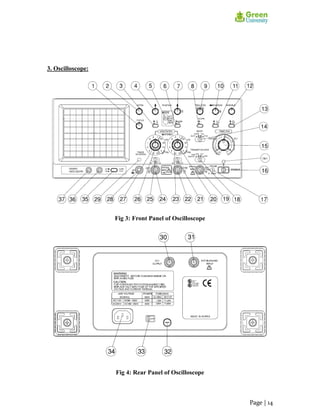
3. Oscilloscope:
Fig 3: Front Panel of Oscilloscope
Fig 4: Rear Panel of Oscilloscope
Page | 14
Page | 15
Experiment no 1:
Name of the Experiment: Study of Diode I-V Characteristic
Objectives:
1. To study the diode I-V characteristics
2. To observe the output of a simple circuit with a diode using AC input
Learning Outcome: After completing this experiment the students will be able to:
1. Understand the working principle of a diode.
2. Explain the characteristics of a diode for both DC and AC voltage.
Theory:
Diode:
A p-n junction diode is a two-terminal device that acts as a one-way conductor. That
means it permits the passage of electrical current in only one way and prevents if the
current is passed from the other terminal.
Circuit Connection:
A diode can be connected in a circuit in two configurations.
1. Forward Biased Configuration
2. Reverse Biased Configuration
When the voltage at the p-side of a p-n diode is higher than that of its n-side, then the
diode is called forward biased. On the other hand, when the voltage across diode
exceeds its cut-in voltage (Vt = 0.5V for Si diode) the diode starts conducting. In
forward biased connection, the diode acts like a switch that is ON. The diode permits
the passage of electrical current thorough it.
When a diode gets negative voltage across it then it is in reversed bias connection. In
this connection an insignificant amount of current will flow through the diode, and in
most cases, it is neglected. Practically, the diode does not permit any flow of current
and it acts like a switch that is OFF.
Page | 16
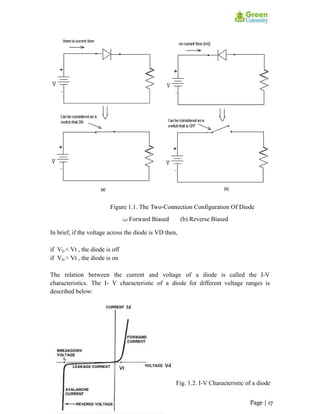
Figure 1.1. The Two-Connection Configuration Of Diode
(a) Forward Biased (b) Reverse Biased
In brief, if the voltage across the diode is VD then,
if VD < Vt , the diode is off
if VD > Vt , the diode is on
The relation between the current and voltage of a diode is called the I-V
characteristics. The I- V characteristic of a diode for different voltage ranges is
described below:
Fig. 1.2. I-V Characteristic of a diode
Page | 17
▪ When the diode voltage (Vd) is negative, the diode does not permit the flow of
current (OFF state). In fact, almost zero current (around pA) flows through the
diode. This current is called reverse saturation current (Is). However, a diode
permits this flow of current up to a certain amount of voltage, but after that
particular voltage a large amount of current will begin to flow. This voltage is
called Reverse Breakdown Voltage. There will be a rush of current at that time
and that current is called Avalanche Current. In most of the cases the diode
gets damaged in this situation. So, care must be taken so that this voltage range
is not reached.
▪ When the diode voltage (Vd) is greater than zero but less than the threshold
voltage (Vt) the diode will still remain OFF.
▪ When diode voltage is greater than Vt, the diode will act as a simple conductor
that means will be in ON state and permit the flow of current.
AC Characteristics of a Diode
An AC source supplies positive voltage in one cycle and negative voltage in the other
cycle with respect to its neutral. If an AC source is connected to a diode circuit, then
the following phenomena happens.
During the positive cycle of the AC source,
✔ The diode is forward biased, the diode acts like a sorted path.
✔ Current flows through the circuit.
✔ As current flows there will be voltage drop across the resistor.
During the negative cycle of the AC source,
✔ The diode is reversed biased, the diode acts like an open path.
✔ No current flows, there is no voltage drop across the resistor.
✔ The source voltage comes across the diode.
List of Equipment:
● Project Board 1 piece
● Diode (D1N4002, D1N750) 4 pieces
● Resistor (1K) 1 piece
● Multimeter 1 unit
● Signal generator 1 piece
● Oscilloscope 1 unit
● Chords and wire lot
Page | 18
Procedure:
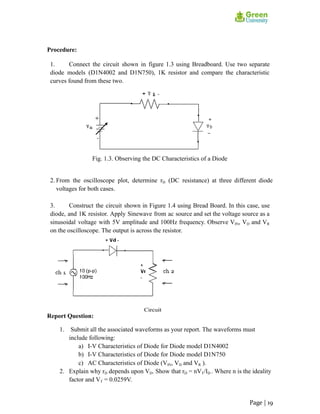
1. Connect the circuit shown in figure 1.3 using Breadboard. Use two separate
diode models (D1N4002 and D1N750), 1K resistor and compare the characteristic
curves found from these two.
Fig. 1.3. Observing the DC Characteristics of a Diode
2. From the oscilloscope plot, determine rD (DC resistance) at three different diode
voltages for both cases.
3. Construct the circuit shown in Figure 1.4 using Bread Board. In this case, use
diode, and 1K resistor. Apply Sinewave from ac source and set the voltage source as a
sinusoidal voltage with 5V amplitude and 100Hz frequency. Observe VIN, VD and VR
on the oscilloscope. The output is across the resistor.
Report Question:
1. Submit all the associated waveforms as your report. The waveforms must
include following:
a) I-V Characteristics of Diode for Diode model D1N4002
b) I-V Characteristics of Diode for Diode model D1N750
c) AC Characteristics of Diode (VIN, VD and VR ).
2. Explain why rD depends upon VD. Show that rD = nVT/ID . Where n is the ideality
factor and VT = 0.0259V.
Page | 19
Observation Sheet
Graph 1.1: I-V characteristics of diode D1N4002
Graph 1.2: I-V characteristics of diode D1N750
Graph 1.3: Vin for the circuit in Fig 1.4
Page | 20
Graph 1.4: VD for the circuit in Fig 1.4
Graph 1.5: VR for the circuit in Fig 1.4
Page | 21
Experiment no 2:
Name of the Experiment: Study of Diode Rectifier Circuits
Objectives:
1. To understand principle of diode in converting ac into dc
2. To study different diode rectifier circuits.
Learning Outcome: After completing this experiment the students will be able to:
1. Understand the working principle of a half wave rectifier and full wave rectifier
2. Compare the performance of a half and full wave rectifier and decide which one is
better.
3. Explain the role of capacitor and Zener diode in rectifying.
Theory:
In electrical systems AC to DC conversion is one of the most essential factors. In any
electronic device, generally all the electronic components and IC operate on DC power
supply. Even in large industrial systems, where high voltage is used, the AC to DC
conversion is an important factor.
The component that is widely used as a rectifier is the diode. Diode is a two-terminal
device that permits the flow of current in only one direction. (The details of the study
of diode is discussed in the previous experiment). The process of converting an AC
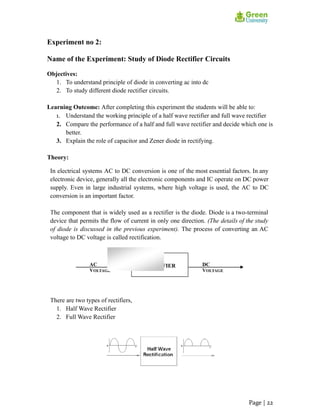
voltage to DC voltage is called rectification.
There are two types of rectifiers,
1. Half Wave Rectifier
2. Full Wave Rectifier
Page | 22
In a half wave rectifier circuit, only one cycle (positive cycle) of the input wave is
transmitted to the output. The negative cycle is eliminated at the output. During the
positive cycle of the input, the diode is forward biased and it lets the current to flow
through. Due to the current flow, there is a drop across the resistor or the output. That
means the output follows the input. During the negative cycle of the input, the diode is
reversed biased and it does not let the current to flow through it. That means there is no
voltage drop or output.
Use of the Capacitor:
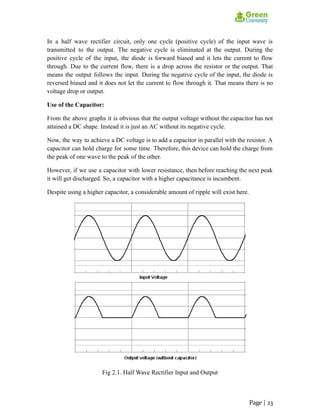
From the above graphs it is obvious that the output voltage without the capacitor has not
attained a DC shape. Instead it is just an AC without its negative cycle.
Now, the way to achieve a DC voltage is to add a capacitor in parallel with the resistor. A
capacitor can hold charge for some time. Therefore, this device can hold the charge from
the peak of one wave to the peak of the other.
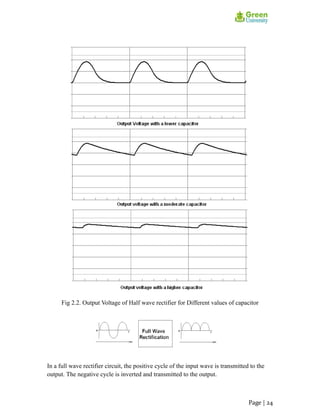
However, if we use a capacitor with lower resistance, then before reaching the next peak
it will get discharged. So, a capacitor with a higher capacitance is incumbent.
Despite using a higher capacitor, a considerable amount of ripple will exist here.
Fig 2.1. Half Wave Rectifier Input and Output
Page | 23
Fig 2.2. Output Voltage of Half wave rectifier for Different values of capacitor
In a full wave rectifier circuit, the positive cycle of the input wave is transmitted to the
output. The negative cycle is inverted and transmitted to the output.
Page | 24
List of Equipment:
● Project Board 1 piece
● p-n junction diode(1N4007) 4 pieces
● Resistor (1K) 1 piece
● Zener diode (4.7 V) 1 piece
● Capacitor (1µF, 10µF) 1 piece each
● Multimeter 1 unit
● Signal generator 1 piece
● Oscilloscope 1 unit
● Chords and wire lot
Procedure:
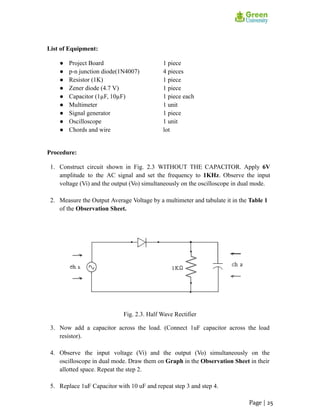
1. Construct circuit shown in Fig. 2.3 WITHOUT THE CAPACITOR. Apply 6V
amplitude to the AC signal and set the frequency to 1KHz. Observe the input
voltage (Vi) and the output (Vo) simultaneously on the oscilloscope in dual mode.
2. Measure the Output Average Voltage by a multimeter and tabulate it in the Table 1
of the Observation Sheet.
Fig. 2.3. Half Wave Rectifier
3. Now add a capacitor across the load. (Connect 1uF capacitor across the load
resistor).
4. Observe the input voltage (Vi) and the output (Vo) simultaneously on the
oscilloscope in dual mode. Draw them on Graph in the Observation Sheet in their
allotted space. Repeat the step 2.
5. Replace 1uF Capacitor with 10 uF and repeat step 3 and step 4.
Page | 25
Add a zener diode (4.7 Volts) in series with the 1K resistor and observe the voltage across
the zener diode only. Use the 10 uF capacitor for this circuit. Observe and draw the input
and output voltage (across the zener diode) in dual mode. Measure the output voltage
with a Multimeter in DC mode.
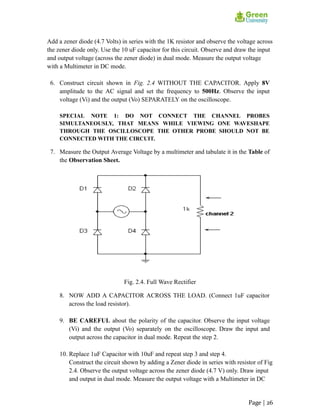
6. Construct circuit shown in Fig. 2.4 WITHOUT THE CAPACITOR. Apply 8V
amplitude to the AC signal and set the frequency to 500Hz. Observe the input
voltage (Vi) and the output (Vo) SEPARATELY on the oscilloscope.
SPECIAL NOTE 1: DO NOT CONNECT THE CHANNEL PROBES
SIMULTANEOUSLY, THAT MEANS WHILE VIEWING ONE WAVESHAPE
THROUGH THE OSCILLOSCOPE THE OTHER PROBE SHOULD NOT BE
CONNECTED WITH THE CIRCUIT.
7. Measure the Output Average Voltage by a multimeter and tabulate it in the Table of
the Observation Sheet.
Fig. 2.4. Full Wave Rectifier
8. NOW ADD A CAPACITOR ACROSS THE LOAD. (Connect 1uF capacitor
across the load resistor).
9. BE CAREFUL about the polarity of the capacitor. Observe the input voltage
(Vi) and the output (Vo) separately on the oscilloscope. Draw the input and
output across the capacitor in dual mode. Repeat the step 2.
10. Replace 1uF Capacitor with 10uF and repeat step 3 and step 4.
Construct the circuit shown by adding a Zener diode in series with resistor of Fig
2.4. Observe the output voltage across the zener diode (4.7 V) only. Draw input
and output in dual mode. Measure the output voltage with a Multimeter in DC
Page | 26
Report Question:
1. Submit all the associated waveforms as your report. The waveforms must
include following:
a) Input and Output Waveforms of Half Wave Rectifier
b) Input and Output Waveforms of Full Wave Rectifier
2. What is time constant? Why do you think that the increasing value of capacitor is
reducing the ripple?
Page | 27
Observation Sheet
Graph 2.1: Vin and Vout without capacitor (Half Wave Rectifier)
Graph 2.2: Vin and Vout with 1uF capacitor (Half Wave Rectifier)
Graph 2.3: Vin and Vout with 10uF capacitor (Half Wave Rectifier)
Page | 28
Graph 2.4: Vin and Vout (Zener Diode) added (Half Wave Rectifier)
Graph 2.5: Vin and Vout without capacitor (Full Wave Rectifier)
Graph 2.6: Vin and Vout with 1uF capacitor (Full Wave Rectifier)
Page | 29
Graph 2.7: Vin and Vout with 10uF capacitor (Full Wave Rectifier)
Graph 2.8: Vin and Vout (Zener Diode added) (Full Wave Rectifier)
Table 2.1: Output Voltage Measurement
Rectifier Output Voltage Theoretical
Value
(in volts)
Experimental Values (Measured by
multimeter in DC mode)
Without
Capacitor
With
Capacitor
1uF
With
Capacitor
10uF
Half Wave Average
(measured by multimeter in DC
mode)
.. .. .. .. .. .. .. .. .. .. .. .. .. .. ..
Page | 30
Full Wave Average
(measured by multimeter in DC
mode)
.. .. .. .. .. .. .. .. .. .. .. .. .. .. ..
Page | 31
Experiment no 3:
Name of the Experiment: Study of Diode Clipping and Clamping
Circuits
Objectives:
1. To study the application of diodes in different clipping and clamping circuits.
2. To test the performance of student’s proposed voltage doubler circuit.
Learning Outcome: After completing this experiment the students will be able to:
1. Understand the working principle of clipping and clamping circuits.
2. Design a voltage doubler circuit
Theory:
Limiter/Clipper
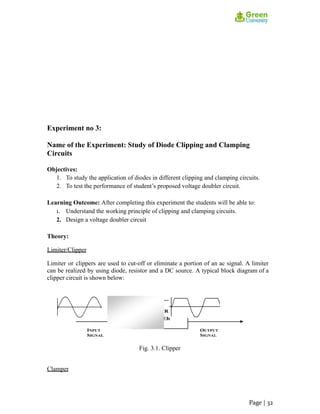
Limiter or clippers are used to cut-off or eliminate a portion of an ac signal. A limiter
can be realized by using diode, resistor and a DC source. A typical block diagram of a
clipper circuit is shown below:
Fig. 3.1. Clipper
Clamper
Page | 32
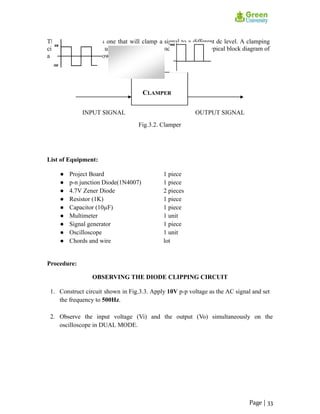
The clamper circuit is one that will clamp a signal to a different dc level. A clamping
circuit can be realized using a diode, resistor and a capacitor. A typical block diagram of
a clamper circuit is shown below:
INPUT SIGNAL OUTPUT SIGNAL
Fig.3.2. Clamper
List of Equipment:
● Project Board 1 piece
● p-n junction Diode(1N4007) 1 piece
● 4.7V Zener Diode 2 pieces
● Resistor (1K) 1 piece
● Capacitor (10µF) 1 piece
● Multimeter 1 unit
● Signal generator 1 piece
● Oscilloscope 1 unit
● Chords and wire lot
Procedure:
OBSERVING THE DIODE CLIPPING CIRCUIT
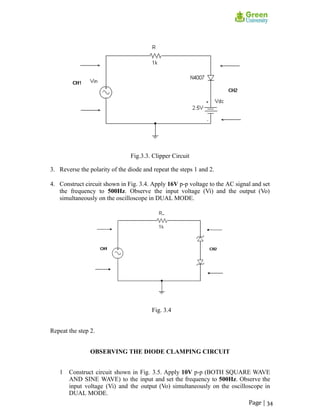
1. Construct circuit shown in Fig.3.3. Apply 10V p-p voltage as the AC signal and set
the frequency to 500Hz.
2. Observe the input voltage (Vi) and the output (Vo) simultaneously on the
oscilloscope in DUAL MODE.
Page | 33
Fig.3.3. Clipper Circuit
3. Reverse the polarity of the diode and repeat the steps 1 and 2.
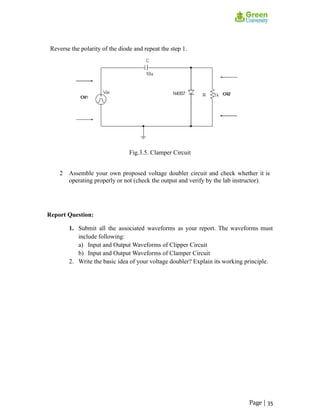
4. Construct circuit shown in Fig. 3.4. Apply 16V p-p voltage to the AC signal and set
the frequency to 500Hz. Observe the input voltage (Vi) and the output (Vo)
simultaneously on the oscilloscope in DUAL MODE.
Fig. 3.4
Repeat the step 2.
OBSERVING THE DIODE CLAMPING CIRCUIT
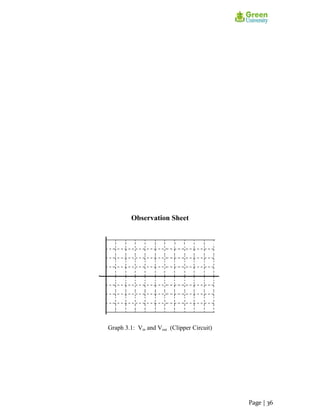
1 Construct circuit shown in Fig. 3.5. Apply 10V p-p (BOTH SQUARE WAVE
AND SINE WAVE) to the input and set the frequency to 500Hz. Observe the
input voltage (Vi) and the output (Vo) simultaneously on the oscilloscope in
DUAL MODE.
Page | 34
Reverse the polarity of the diode and repeat the step 1.
Fig.3.5. Clamper Circuit
2 Assemble your own proposed voltage doubler circuit and check whether it is
operating properly or not (check the output and verify by the lab instructor).
Report Question:
1. Submit all the associated waveforms as your report. The waveforms must
include following:
a) Input and Output Waveforms of Clipper Circuit
b) Input and Output Waveforms of Clamper Circuit
2. Write the basic idea of your voltage doubler? Explain its working principle.
Page | 35
Observation Sheet
Graph 3.1: Vin and Vout (Clipper Circuit)
Page | 36
Graph 3.2: Vin and Vout (Diode Reversed) (Clipper Circuit)
Graph 3.3: Vin and Vout (Zener diode added) (Clipper Circuit)
Graph 3.4: Vin and Vout (Sine Wave Input) (Clamper Circuit)
Page | 37
Graph 3.5: Vin and Vout (Sine Wave Input – diode reversed) (Clamper Circuit)
Graph 3.6: Vin and Vout (Square Wave Input) (Clamper Circuit)
Graph 3.7: Vin and Vout (Square Wave Input – diode reversed) (Clamper Circuit)
Page | 38
Page | 39
Experiment no 4:
Name of the Experiment: DC Characteristics of BJT and MOSFET
Objectives:
1. To understand the principle of operation of BJT and MOSFETs
2. To study input and output DC characteristics of BJT and MOSFET
Learning Outcome: After completing this experiment the students will be able to:
1. Explain the working principle of BJT and MOSFET.
2. Understand the response of BJT and MOSFET under DC voltage
Page | 40
Theory:
BJT
Transistor has two p-n junctions (see figure below). One junction is called emitter
junction and other is called collector junction. When transistor is used as an amplifier, it
is operated in active mode. In active mode, emitter junction is forward biased and
collector junction is reverse biased.
Figure 4.1
Emitter current is given by
IE = InE + IpE
We can also write
IE = IC + IB = [(1 + β)/β]IC
Where β = IC /IB is called common emitter short circuit current gain.
For a good transistor, IC>>IB i.e. β>>1. IC can also be expressed as IC = α IE. Where, α = β/
(1+β). The factor α is called common base short circuit current gain. For good
transistor, α is close to unity.
Proper dc biasing of a transistor is a prerequisite for proper operation as an amplifier.
The purpose of the biasing is to fix the IC (dc) and VCE (dc). But IC is a function of
temperature, VBE and β. It is always desirable to design a biasing circuit where IC is
insensitive to change in β.
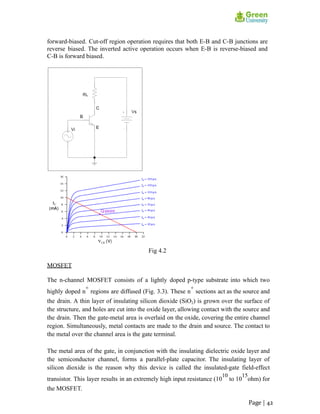
When E-B junction is forward biased and C-B junction is reverse biased, the transistor
operates in active mode. For saturation mode of operation, both junctions are
Page | 41
forward-biased. Cut-off region operation requires that both E-B and C-B junctions are
reverse biased. The inverted active operation occurs when E-B is reverse-biased and
C-B is forward biased.
Fig 4.2
MOSFET
The n-channel MOSFET consists of a lightly doped p-type substrate into which two
highly doped n
+
regions are diffused (Fig. 3.3). These n
+
sections act as the source and
the drain. A thin layer of insulating silicon dioxide (SiO2) is grown over the surface of
the structure, and holes are cut into the oxide layer, allowing contact with the source and
the drain. Then the gate-metal area is overlaid on the oxide, covering the entire channel
region. Simultaneously, metal contacts are made to the drain and source. The contact to
the metal over the channel area is the gate terminal.
The metal area of the gate, in conjunction with the insulating dielectric oxide layer and
the semiconductor channel, forms a parallel-plate capacitor. The insulating layer of
silicon dioxide is the reason why this device is called the insulated-gate field-effect
transistor. This layer results in an extremely high input resistance (10
10
to 10
15
ohm) for
the MOSFET.
Page | 42
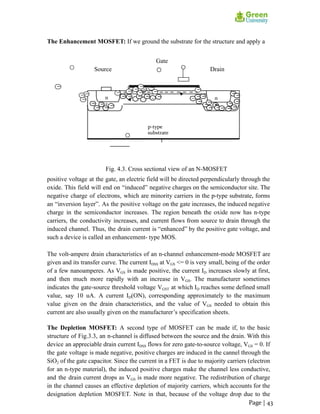
The Enhancement MOSFET: If we ground the substrate for the structure and apply a
Gate
Source Drain
Fig. 4.3. Cross sectional view of an N-MOSFET
positive voltage at the gate, an electric field will be directed perpendicularly through the
oxide. This field will end on “induced” negative charges on the semiconductor site. The
negative charge of electrons, which are minority carriers in the p-type substrate, forms
an “inversion layer”. As the positive voltage on the gate increases, the induced negative
charge in the semiconductor increases. The region beneath the oxide now has n-type
carriers, the conductivity increases, and current flows from source to drain through the
induced channel. Thus, the drain current is “enhanced” by the positive gate voltage, and
such a device is called an enhancement- type MOS.
The volt-ampere drain characteristics of an n-channel enhancement-mode MOSFET are
given and its transfer curve. The current IDSS at VGS <= 0 is very small, being of the order
of a few nanoamperes. As VGS is made positive, the current ID increases slowly at first,
and then much more rapidly with an increase in VGS. The manufacturer sometimes
indicates the gate-source threshold voltage VGST at which ID reaches some defined small
value, say 10 uA. A current ID(ON), corresponding approximately to the maximum
value given on the drain characteristics, and the value of VGS needed to obtain this
current are also usually given on the manufacturer’s specification sheets.
The Depletion MOSFET: A second type of MOSFET can be made if, to the basic
structure of Fig.3.3, an n-channel is diffused between the source and the drain. With this
device an appreciable drain current IDSS flows for zero gate-to-source voltage, VGS = 0. If
the gate voltage is made negative, positive charges are induced in the cannel through the
SiO2 of the gate capacitor. Since the current in a FET is due to majority carriers (electron
for an n-type material), the induced positive charges make the channel less conductive,
and the drain current drops as VGS is made more negative. The redistribution of charge
in the channel causes an effective depletion of majority carriers, which accounts for the
designation depletion MOSFET. Note in that, because of the voltage drop due to the
Page | 43
drain current, the channel region nearest the drain is more depleted than is the volume
near the source. A MOSFET of the depletion type may also be operated in an
enhancement mode. It is only necessary to apply a positive gate voltage so that negative
charges are induced into the n-type channel. In this manner the conductivity of the
channel increases and the current rises above IDSS. The volt-ampere characteristics of this
device are indicated and the transfer curve is given. The depletion and enhancement
regions, corresponding to VGS negative and positive, respectively, should be noted. The
manufacturer sometimes indicates the gate-source cutoff voltage VGS (OFF), at which ID
is reduced to some specified negligible value at a recommended VDS. This gate voltage
is called threshold voltage Vt. At the onset of inversion, ns (electron concentration near
the surface) = Na for nMOSFET.
List of Equipment:
● Project Board 1 piece
● npn transistors (Q2N2222) 1 piece
● MOSFET 1 piece
● Resistor (10k, 500Ω, 100Ω) 2 pieces each
● Potentiometer (500kΩ) 1 piece
● DC Power Supply 1 unit
● Multimeter 1 unit
● Chords and wire lot
Procedure:
DC Characteristics of BJT Q2N2222
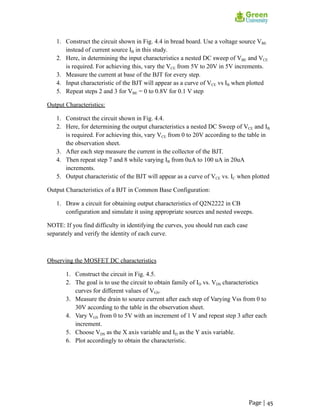
Fig. 4.4. Circuit for Studying DC Output Characteristics of BJT in CE configuration
Input Characteristics:
Page | 44
1. Construct the circuit shown in Fig. 4.4 in bread board. Use a voltage source VBE
instead of current source IB in this study.
2. Here, in determining the input characteristics a nested DC sweep of VBE and VCE
is required. For achieving this, vary the VCE from 5V to 20V in 5V increments.
3. Measure the current at base of the BJT for every step.
4. Input characteristic of the BJT will appear as a curve of VCE vs IB when plotted
5. Repeat steps 2 and 3 for VBE = 0 to 0.8V for 0.1 V step
Output Characteristics:
1. Construct the circuit shown in Fig. 4.4.
2. Here, for determining the output characteristics a nested DC Sweep of VCE and IB
is required. For achieving this, vary VCE from 0 to 20V according to the table in
the observation sheet.
3. After each step measure the current in the collector of the BJT.
4. Then repeat step 7 and 8 while varying IB from 0uA to 100 uA in 20uA
increments.
5. Output characteristic of the BJT will appear as a curve of VCE vs. IC when plotted
Output Characteristics of a BJT in Common Base Configuration:
1. Draw a circuit for obtaining output characteristics of Q2N2222 in CB
configuration and simulate it using appropriate sources and nested sweeps.
NOTE: If you find difficulty in identifying the curves, you should run each case
separately and verify the identity of each curve.
Observing the MOSFET DC characteristics
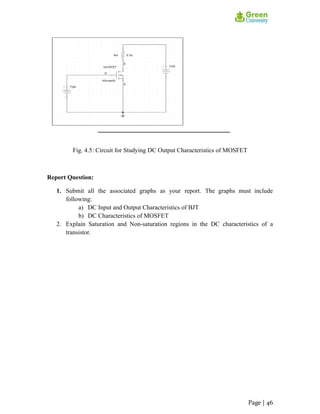
1. Construct the circuit in Fig. 4.5.
2. The goal is to use the circuit to obtain family of ID vs. VDS characteristics
curves for different values of VGS.
3. Measure the drain to source current after each step of Varying Vss from 0 to
30V according to the table in the observation sheet.
4. Vary VGS from 0 to 5V with an increment of 1 V and repeat step 3 after each
increment.
5. Choose VDS as the X axis variable and ID as the Y axis variable.
6. Plot accordingly to obtain the characteristic.
Page | 45
Fig. 4.5: Circuit for Studying DC Output Characteristics of MOSFET
Report Question:
1. Submit all the associated graphs as your report. The graphs must include
following:
a) DC Input and Output Characteristics of BJT
b) DC Characteristics of MOSFET
2. Explain Saturation and Non-saturation regions in the DC characteristics of a
transistor.
Page | 46
Observation Sheet
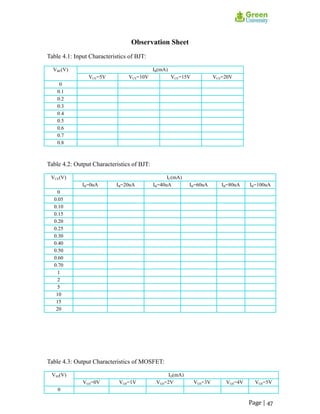
Table 4.1: Input Characteristics of BJT:
VBE(V) IB(mA)
VCE=5V VCE=10V VCE=15V VCE=20V
0
0.1
0.2
0.3
0.4
0.5
0.6
0.7
0.8
Table 4.2: Output Characteristics of BJT:
VCE(V) IC(mA)
IB=0uA IB=20uA IB=40uA IB=60uA IB=80uA IB=100uA
0
0.05
0.10
0.15
0.20
0.25
0.30
0.40
0.50
0.60
0.70
1
2
5
10
15
20
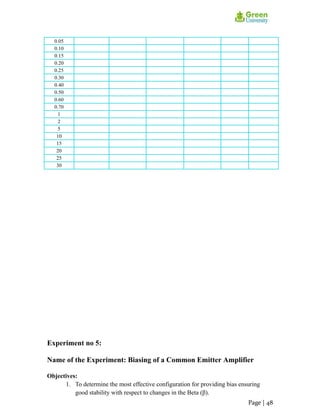
Table 4.3: Output Characteristics of MOSFET:
VSS(V) ID(mA)
VGS=0V VGS=1V VGS=2V VGS=3V VGS=4V VGS=5V
0
Page | 47
0.05
0.10
0.15
0.20
0.25
0.30
0.40
0.50
0.60
0.70
1
2
5
10
15
20
25
30
Experiment no 5:
Name of the Experiment: Biasing of a Common Emitter Amplifier
Objectives:
1. To determine the most effective configuration for providing bias ensuring
good stability with respect to changes in the Beta (β).
Page | 48
2. To understand how the change of β in a transistor circuit can change the
Q-point of the circuit.
Learning Outcome: After completing this experiment the students will be able to:
1. Compare different biasing techniques and explain their merits.
2. Set the Q point of the transistor to have a proper small signal swing.
Theory:
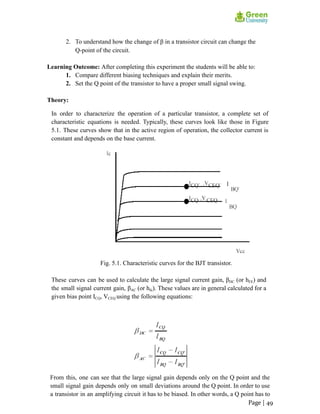
In order to characterize the operation of a particular transistor, a complete set of
characteristic equations is needed. Typically, these curves look like those in Figure
5.1. These curves show that in the active region of operation, the collector current is
constant and depends on the base current.
Fig. 5.1. Characteristic curves for the BJT transistor.
These curves can be used to calculate the large signal current gain, βDC (or hFE) and
the small signal current gain, βAC (or hfe). These values are in general calculated for a
given bias point ICQ, VCEQ using the following equations:
From this, one can see that the large signal gain depends only on the Q point and the
small signal gain depends only on small deviations around the Q point. In order to use
a transistor in an amplifying circuit it has to be biased. In other words, a Q point has to
Page | 49
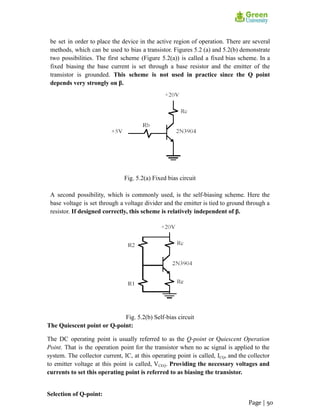
be set in order to place the device in the active region of operation. There are several
methods, which can be used to bias a transistor. Figures 5.2 (a) and 5.2(b) demonstrate
two possibilities. The first scheme (Figure 5.2(a)) is called a fixed bias scheme. In a
fixed biasing the base current is set through a base resistor and the emitter of the
transistor is grounded. This scheme is not used in practice since the Q point
depends very strongly on β.
Fig. 5.2(a) Fixed bias circuit
A second possibility, which is commonly used, is the self-biasing scheme. Here the
base voltage is set through a voltage divider and the emitter is tied to ground through a
resistor. If designed correctly, this scheme is relatively independent of β.
Fig. 5.2(b) Self-bias circuit
The Quiescent point or Q-point:
The DC operating point is usually referred to as the Q-point or Quiescent Operation
Point. That is the operation point for the transistor when no ac signal is applied to the
system. The collector current, IC, at this operating point is called, ICQ, and the collector
to emitter voltage at this point is called, VCEQ. Providing the necessary voltages and
currents to set this operating point is referred to as biasing the transistor.
Selection of Q-point:
Page | 50
To select an appropriate Q-point, it is necessary to set it in such a point so that a wide
range of input signal can be applied. Generally, the Q-point is set at half the value
of VCC.
Need for stabilization:
Only the fixing of a suitable operating point is not sufficient. It must also be ensured
that it remains where it was fixed. Unfortunately, in transistor circuits the operating
point shifts with the use of the circuit. Such a shift of operating point may drive the
transistor into an undesirable region. Consequently, the amplifier becomes useless.
There are two reasons, for which Q-point may shift,
Firstly, the transistor parameters are temperature dependent, so the operating point
may change with the temperature.
Secondly, the current gain, β vary from unit to unit. For example, the β of a C828
transistor may vary with that of another C828 transistor.
List of Equipment:
● Project Board 1 piece
● npn transistors (Q2N2222) 1 piece
● npn transistors (Q2N3904) 1 piece
● Resistor (10k, 500Ω, 100Ω) 2 pieces each
● Potentiometer (500kΩ) 1 piece
● DC Power Supply 1 unit
● Multimeter 1 unit
● Chords and wire lot
Procedure:
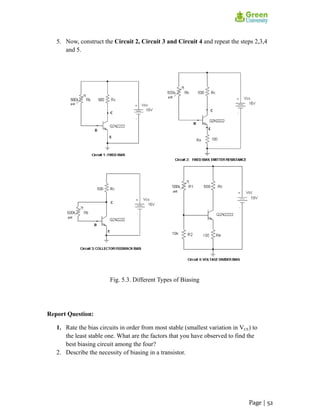
1. Construct the Circuit 1: Fixed Bias with a Q2N2222 transistor as shown in the
Fig. 5.3.
2. By adjusting the 500k potentiometer set VCE = 7.5V.
3. Now record the various values in the allotted table in the Data Collection &
Observation Sheet.
4. DON’T CHANGE THE POTENTIOMETER VALUE. Replace transistor
Q2N2222 by transistor Q2N3904 and repeat step 3.
Page | 51
5. Now, construct the Circuit 2, Circuit 3 and Circuit 4 and repeat the steps 2,3,4
and 5.
Fig. 5.3. Different Types of Biasing
Report Question:
1. Rate the bias circuits in order from most stable (smallest variation in VCE) to
the least stable one. What are the factors that you have observed to find the
best biasing circuit among the four?
2. Describe the necessity of biasing in a transistor.
Page | 52
Observation Sheet:
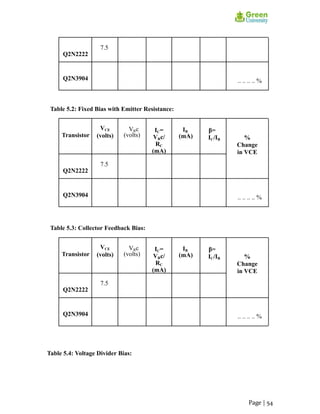
Table 5.1: Fixed Bias:
Transistor
VCE
(volts)
VRc
(volts)
IC=
VRc/
RC
(mA)
IB
(mA)
β=
IC/IB %
Change
in VCE
Page | 53
Q2N2222
7.5
Q2N3904 .. .. .. .. %
Table 5.2: Fixed Bias with Emitter Resistance:
Transistor
VCE
(volts)
VRc
(volts)
IC=
VRc/
RC
(mA)
IB
(mA)
β=
IC/IB %
Change
in VCE
Q2N2222
7.5
Q2N3904 .. .. .. .. %
Table 5.3: Collector Feedback Bias:
Transistor
VCE
(volts)
VRc
(volts)
IC=
VRc/
RC
(mA)
IB
(mA)
β=
IC/IB %
Change
in VCE
Q2N2222
7.5
Q2N3904 .. .. .. .. %
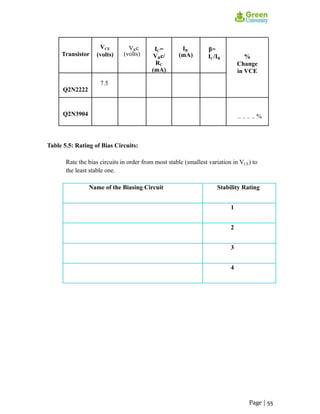
Table 5.4: Voltage Divider Bias:
Page | 54
Transistor
VCE
(volts)
VRc
(volts)
IC=
VRc/
RC
(mA)
IB
(mA)
β=
IC/IB %
Change
in VCE
Q2N2222
7.5
Q2N3904 .. .. .. .. %
Table 5.5: Rating of Bias Circuits:
Rate the bias circuits in order from most stable (smallest variation in VCE) to
the least stable one.
Name of the Biasing Circuit Stability Rating
1
2
3
4
Page | 55
Experiment no 6:
Page | 56
Name of the Experiment: Study of Common Emitter Amplifier
Objectives:
1. To be able to determine the maximum output available from a basic CE amplifier.
2. To examine the effect of adding an emitter bypass capacitor to the amplifier circuit
3. To examine its frequency response.
Learning Outcome: After completing this experiment the students will be able to:
1. Understand the working principle of common emitter amplifier.
2. Explain the frequency characteristics of CE amplifier.
Theory:
Considering the gain, input impedance and the output impedance, the common emitter
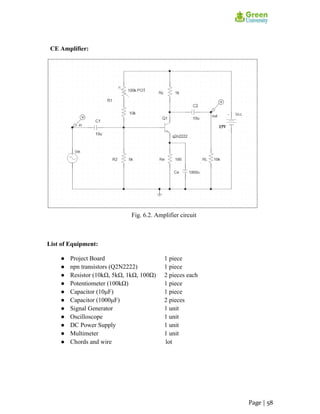
(CE) amplifier is the most popular BJT amplifier configuration. Figure 6.2 shows a
typical CE configuration. Before applying as an amplifier, the BJT should be biased
with a stable biasing network. Voltage Divider Biasing Network is the most stable
network that can be used.
Before applying an AC voltage signal, the input and output should be separated by two
blocking capacitors C1 and C2 so that any DC component cannot pass to the input or
the output stages.
The emitter resistance RE is used as a part in increasing the stability, however this
resistance creates a feedback to the input and decreases the overall gain. To eliminate
this problem a bypass capacitor CE is used that will act as open branch for DC
component and a short path for AC components.
The frequency response of a CE amplifier exhibits that the gain is less than the expected
in the low frequency and high frequency range.
Fig. 6.1. Frequency Response of CE Amplifier
In order to get a better frequency response, the value of CE, C1 and C2
should be sufficiently large.
Page | 57
CE Amplifier:
Fig. 6.2. Amplifier circuit
List of Equipment:
● Project Board 1 piece
● npn transistors (Q2N2222) 1 piece
● Resistor (10kΩ, 5kΩ, 1kΩ, 100Ω) 2 pieces each
● Potentiometer (100kΩ) 1 piece
● Capacitor (10μF) 1 piece
● Capacitor (1000μF) 2 pieces
● Signal Generator 1 unit
● Oscilloscope 1 unit
● DC Power Supply 1 unit
● Multimeter 1 unit
● Chords and wire lot
Page | 58
Procedure:
1. Construct the circuit shown in Circuit diagram 6.2.
Important Note: Use 10k resistors for each of the stages. Otherwise the 100 ohm resistors
may burn out.
2. By adjusting the 100k potentiometer set VCE= 7.5 V for both the stages.
3. With no ac signal input to the circuit, measure all the DC node voltages
VCC, VC, VB, & VE and calculate the actual Q-point current, ICQ = (VCC -
VC)/ RC, and voltage VCEQ = VC – VE for both the stages.
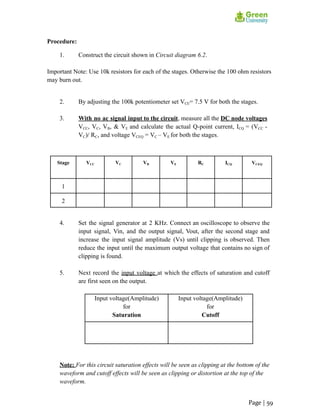
Stage VCC VC VB VE RC ICQ VCEQ
1
2
4. Set the signal generator at 2 KHz. Connect an oscilloscope to observe the
input signal, Vin, and the output signal, Vout, after the second stage and
increase the input signal amplitude (Vs) until clipping is observed. Then
reduce the input until the maximum output voltage that contains no sign of
clipping is found.
5. Next record the input voltage at which the effects of saturation and cutoff
are first seen on the output.
Input voltage(Amplitude)
for
Saturation
Input voltage(Amplitude)
for
Cutoff
Note: For this circuit saturation effects will be seen as clipping at the bottom of the
waveform and cutoff effects will be seen as clipping or distortion at the top of the
waveform.
Page | 59
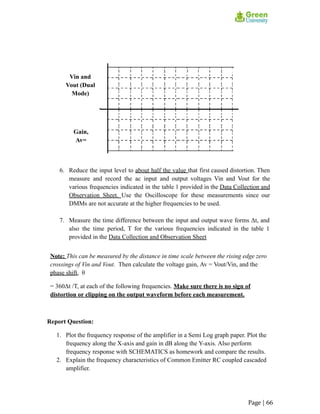
Vin and
Vout (Dual
Mode)
Gain,
Av=
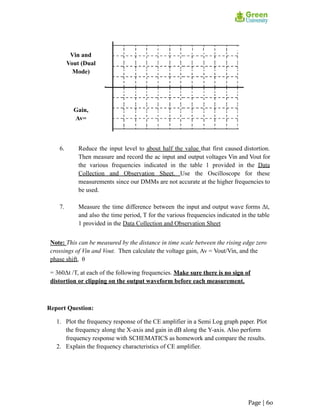
6. Reduce the input level to about half the value that first caused distortion.
Then measure and record the ac input and output voltages Vin and Vout for
the various frequencies indicated in the table 1 provided in the Data
Collection and Observation Sheet. Use the Oscilloscope for these
measurements since our DMMs are not accurate at the higher frequencies to
be used.
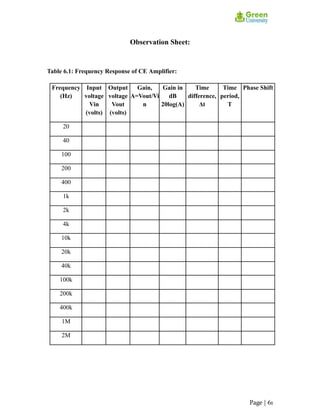
7. Measure the time difference between the input and output wave forms Δt,
and also the time period, T for the various frequencies indicated in the table
1 provided in the Data Collection and Observation Sheet
Note: This can be measured by the distance in time scale between the rising edge zero
crossings of Vin and Vout. Then calculate the voltage gain, Av = Vout/Vin, and the
phase shift, θ
= 360Δt /T, at each of the following frequencies. Make sure there is no sign of
distortion or clipping on the output waveform before each measurement.
Report Question:
1. Plot the frequency response of the CE amplifier in a Semi Log graph paper. Plot
the frequency along the X-axis and gain in dB along the Y-axis. Also perform
frequency response with SCHEMATICS as homework and compare the results.
2. Explain the frequency characteristics of CE amplifier.
Page | 60
Observation Sheet:
Table 6.1: Frequency Response of CE Amplifier:
Frequency
(Hz)
Input
voltage
Vin
(volts)
Output
voltage
Vout
(volts)
Gain,
A=Vout/Vi
n
Gain in
dB
20log(A)
Time
difference,
Δt
Time
period,
T
Phase Shift
20
40
100
200
400
1k
2k
4k
10k
20k
40k
100k
200k
400k
1M
2M
Page | 61
Experiment no 7:
Page | 62
Name of the Experiment: Study of Common Emitter RC Coupled
Cascaded Amplifier
Objectives:
1. To understand the operational characteristics of a common emitter (CE) RC coupled
cascaded amplifier.
2. To examine its frequency response.
Learning Outcome: After completing this experiment the students will be able to:
1. Explain the operational characteristics of a common emitter (CE) RC coupled
cascaded amplifier.
2. Explain the frequency response of a CE RC coupled amplifier
Theory:
Considering the gain, input impedance and the output impedance, the common emitter
(CE) amplifier is the most popular BJT amplifier configuration. Figure 7.2 shows a
typical CE RC coupled cascaded amplifier configuration. Here two CE amplifiers are
cascaded together with a resistor and a capacitor so that the voltage gain of the
amplifier is increased. Before applying as an amplifier, the BJTs should be biased with
a stable biasing network. Voltage Divider Biasing Network is the most stable network
that can be used.
Before applying an AC voltage signal, the input and output should be separated by
blocking capacitors so that any DC component cannot pass to the input or the output
stages.
The emitter resistances are used as a part in increasing the stability; however these
resistors create a feedback to the input and decreases the overall gain. To eliminate this
problem bypass capacitors are used that will act as open branch for DC component
and a short path for AC components.
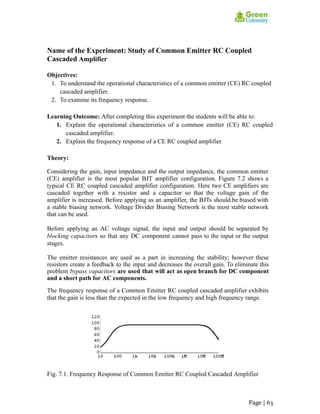
The frequency response of a Common Emitter RC coupled cascaded amplifier exhibits
that the gain is less than the expected in the low frequency and high frequency range.
Fig. 7.1. Frequency Response of Common Emitter RC Coupled Cascaded Amplifier
Page | 63
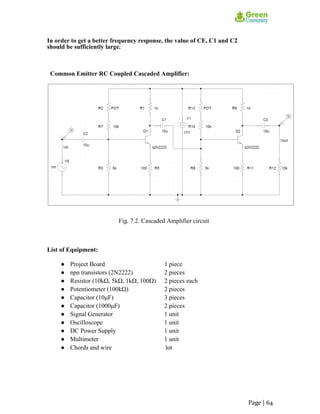
In order to get a better frequency response, the value of CE, C1 and C2
should be sufficiently large.
Common Emitter RC Coupled Cascaded Amplifier:
Fig. 7.2. Cascaded Amplifier circuit
List of Equipment:
● Project Board 1 piece
● npn transistors (2N2222) 2 pieces
● Resistor (10kΩ, 5kΩ, 1kΩ, 100Ω) 2 pieces each
● Potentiometer (100kΩ) 2 pieces
● Capacitor (10μF) 3 pieces
● Capacitor (1000μF) 2 pieces
● Signal Generator 1 unit
● Oscilloscope 1 unit
● DC Power Supply 1 unit
● Multimeter 1 unit
● Chords and wire lot
Page | 64
Procedure:
1. Construct the circuit shown in Circuit diagram 7.2.
Important Note: Use 10k resistors for each of the stages. Otherwise the 100 ohm resistors
may burn out.
2. By adjusting the 100k potentiometer set VCE= 7.5 V for both the stages.
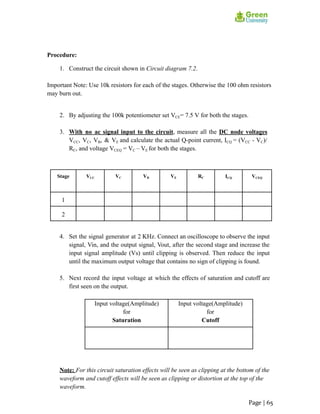
3. With no ac signal input to the circuit, measure all the DC node voltages
VCC, VC, VB, & VE and calculate the actual Q-point current, ICQ = (VCC - VC)/
RC, and voltage VCEQ = VC – VE for both the stages.
Stage VCC VC VB VE RC ICQ VCEQ
1
2
4. Set the signal generator at 2 KHz. Connect an oscilloscope to observe the input
signal, Vin, and the output signal, Vout, after the second stage and increase the
input signal amplitude (Vs) until clipping is observed. Then reduce the input
until the maximum output voltage that contains no sign of clipping is found.
5. Next record the input voltage at which the effects of saturation and cutoff are
first seen on the output.
Input voltage(Amplitude)
for
Saturation
Input voltage(Amplitude)
for
Cutoff
Note: For this circuit saturation effects will be seen as clipping at the bottom of the
waveform and cutoff effects will be seen as clipping or distortion at the top of the
waveform.
Page | 65
Vin and
Vout (Dual
Mode)
Gain,
Av=
6. Reduce the input level to about half the value that first caused distortion. Then
measure and record the ac input and output voltages Vin and Vout for the
various frequencies indicated in the table 1 provided in the Data Collection and
Observation Sheet. Use the Oscilloscope for these measurements since our
DMMs are not accurate at the higher frequencies to be used.
7. Measure the time difference between the input and output wave forms Δt, and
also the time period, T for the various frequencies indicated in the table 1
provided in the Data Collection and Observation Sheet
Note: This can be measured by the distance in time scale between the rising edge zero
crossings of Vin and Vout. Then calculate the voltage gain, Av = Vout/Vin, and the
phase shift, θ
= 360Δt /T, at each of the following frequencies. Make sure there is no sign of
distortion or clipping on the output waveform before each measurement.
Report Question:
1. Plot the frequency response of the amplifier in a Semi Log graph paper. Plot the
frequency along the X-axis and gain in dB along the Y-axis. Also perform
frequency response with SCHEMATICS as homework and compare the results.
2. Explain the frequency characteristics of Common Emitter RC coupled cascaded
amplifier.
Page | 66
Observation Sheet:
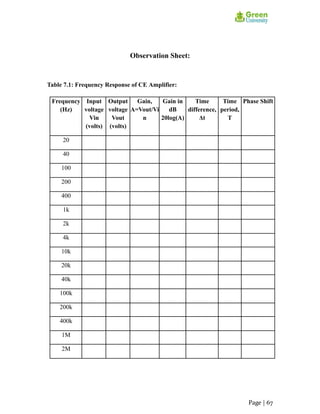
Table 7.1: Frequency Response of CE Amplifier:
Frequency
(Hz)
Input
voltage
Vin
(volts)
Output
voltage
Vout
(volts)
Gain,
A=Vout/Vi
n
Gain in
dB
20log(A)
Time
difference,
Δt
Time
period,
T
Phase Shift
20
40
100
200
400
1k
2k
4k
10k
20k
40k
100k
200k
400k
1M
2M
Page | 67
Page | 68
Experiment no 8:
Name of the Experiment: Study of Operational Amplifier as Zero
Crossing & Voltage Level Detectors
Objectives:
1. To get familiarized with Operational Amplifier.
2. To study OP-AMP as a comparator.
Learning Outcome: After completing this experiment the students will be able to:
1. Explain the basic characteristics of an OP-AMP
2. Understand the use of OP-AMP as a comparator
Theory:
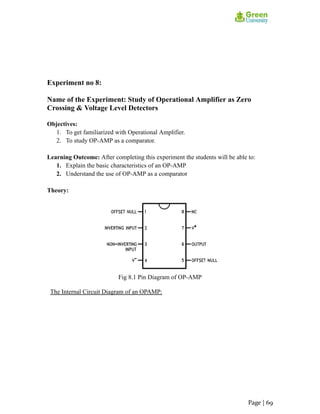
Fig 8.1 Pin Diagram of OP-AMP
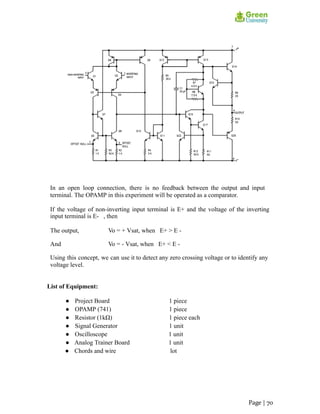
The Internal Circuit Diagram of an OPAMP:
Page | 69
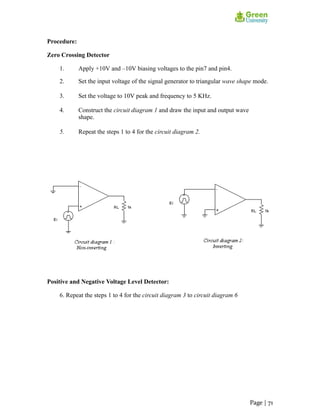
In an open loop connection, there is no feedback between the output and input
terminal. The OPAMP in this experiment will be operated as a comparator.
If the voltage of non-inverting input terminal is E+ and the voltage of the inverting
input terminal is E- , then
The output, Vo = + Vsat, when E+ > E -
And Vo = - Vsat, when E+ < E -
Using this concept, we can use it to detect any zero crossing voltage or to identify any
voltage level.
List of Equipment:
● Project Board 1 piece
● OPAMP (741) 1 piece
● Resistor (1kΩ) 1 piece each
● Signal Generator 1 unit
● Oscilloscope 1 unit
● Analog Trainer Board 1 unit
● Chords and wire lot
Page | 70
Procedure:
Zero Crossing Detector
1. Apply +10V and –10V biasing voltages to the pin7 and pin4.
2. Set the input voltage of the signal generator to triangular wave shape mode.
3. Set the voltage to 10V peak and frequency to 5 KHz.
4. Construct the circuit diagram 1 and draw the input and output wave
shape.
5. Repeat the steps 1 to 4 for the circuit diagram 2.
Positive and Negative Voltage Level Detector:
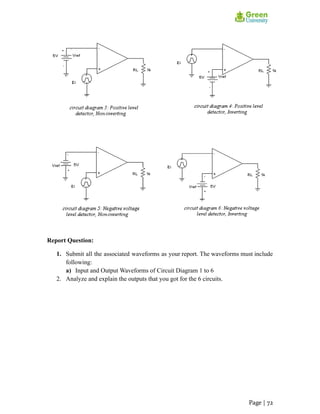
6. Repeat the steps 1 to 4 for the circuit diagram 3 to circuit diagram 6
Page | 71
Report Question:
1. Submit all the associated waveforms as your report. The waveforms must include
following:
a) Input and Output Waveforms of Circuit Diagram 1 to 6
2. Analyze and explain the outputs that you got for the 6 circuits.
Page | 72
Observation Sheet
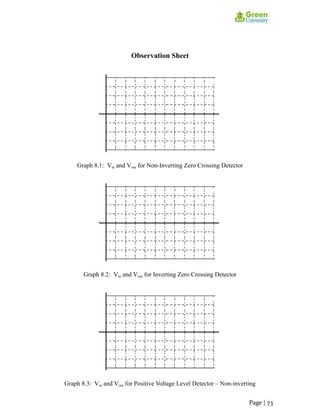
Graph 8.1: Vin and Vout for Non-Inverting Zero Crossing Detector
Graph 8.2: Vin and Vout for Inverting Zero Crossing Detector
Graph 8.3: Vin and Vout for Positive Voltage Level Detector – Non-inverting
Page | 73
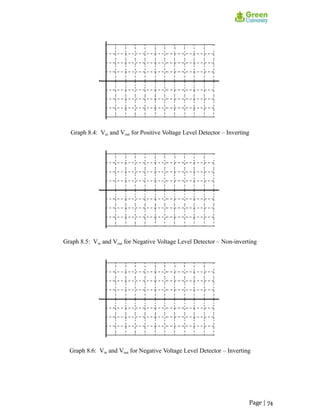
Graph 8.4: Vin and Vout for Positive Voltage Level Detector – Inverting
Graph 8.5: Vin and Vout for Negative Voltage Level Detector – Non-inverting
Graph 8.6: Vin and Vout for Negative Voltage Level Detector – Inverting
Page | 74
Experiment no 9 (a):
Name of the Experiment: Study of Operational Amplifier as an
Amplifier
Objectives:
1. To get familiarized with the use of Op-Amp as amplifiers
2. To study the behavior of inverting and non-inverting amplifiers
Learning Outcome: After completing this experiment the students will be able to:
1. Explain the operation of Op-amp as an amplifier
2. Point out the difference of behaviour of the inverting and non-inverting
amplifiers.
Theory:
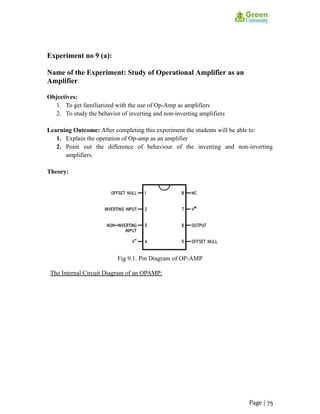
Fig 9.1. Pin Diagram of OP-AMP
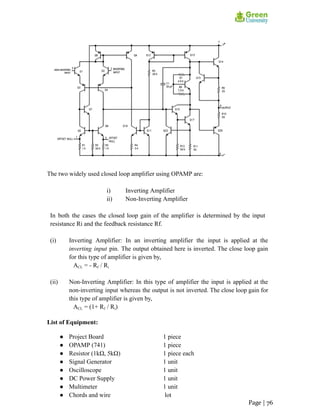
The Internal Circuit Diagram of an OPAMP:
Page | 75
The two widely used closed loop amplifier using OPAMP are:
i) Inverting Amplifier
ii) Non-Inverting Amplifier
In both the cases the closed loop gain of the amplifier is determined by the input
resistance Ri and the feedback resistance Rf.
(i) Inverting Amplifier: In an inverting amplifier the input is applied at the
inverting input pin. The output obtained here is inverted. The close loop gain
for this type of amplifier is given by,
ACL = - Rf / Ri
(ii) Non-Inverting Amplifier: In this type of amplifier the input is applied at the
non-inverting input whereas the output is not inverted. The close loop gain for
this type of amplifier is given by,
ACL = (1+ Rf / Ri)
List of Equipment:
● Project Board 1 piece
● OPAMP (741) 1 piece
● Resistor (1kΩ, 5kΩ) 1 piece each
● Signal Generator 1 unit
● Oscilloscope 1 unit
● DC Power Supply 1 unit
● Multimeter 1 unit
● Chords and wire lot
Page | 76
Procedure:
1. Measure the resistances Ri and Rf by multimeter and record in spaces
provided.
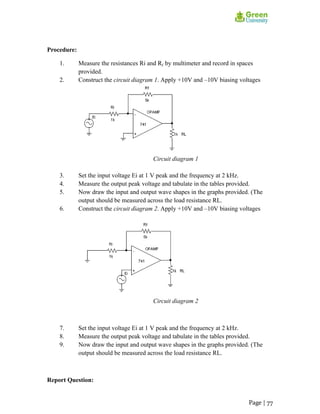
2. Construct the circuit diagram 1. Apply +10V and –10V biasing voltages
Circuit diagram 1
3. Set the input voltage Ei at 1 V peak and the frequency at 2 kHz.
4. Measure the output peak voltage and tabulate in the tables provided.
5. Now draw the input and output wave shapes in the graphs provided. (The
output should be measured across the load resistance RL.
6. Construct the circuit diagram 2. Apply +10V and –10V biasing voltages
Circuit diagram 2
7. Set the input voltage Ei at 1 V peak and the frequency at 2 kHz.
8. Measure the output peak voltage and tabulate in the tables provided.
9. Now draw the input and output wave shapes in the graphs provided. (The
output should be measured across the load resistance RL.
Report Question:
Page | 77
1. Submit all the associated waveforms as your report. The waveforms must include
following:
a) Input and Output Waveforms of Circuit Diagram 1 and 2.
2. Analyze and explain the outputs that you got for the 2 circuits.
Observation Sheet
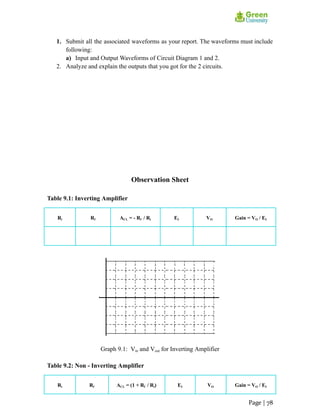
Table 9.1: Inverting Amplifier
Ri Rf ACL = - Rf / Ri EI VO Gain = VO / EI
Graph 9.1: Vin and Vout for Inverting Amplifier
Table 9.2: Non - Inverting Amplifier
Ri Rf ACL = (1 + Rf / Ri) EI VO Gain = VO / EI
Page | 78
Graph 9.2: Vin and Vout for Non-Inverting Amplifier
Experiment no 9 (b):
Name of the Experiment: Study of Mathematical Operations Using
OP-AMP
Objectives:
1. To study the use of operational amplifiers in different mathematical operations.
2. To study the behavior of inverting adder, differentiator and integrator.
Learning Outcome: After completing this experiment the students will be able to:
1. Use OP-AMPs in different mathematical operations.
2. Implement OP-AMP circuits in diverse systems to serve different purposes.
Theory:
The property of infinite impedance and infinite gain of an operational amplifier results in
a situation of zero voltage between the two input terminals (when configured in negative
feedback mode). The effect is known as a virtual ground. Due to this effect, the op-amp
can be used to perform some mathematical operations.
Addition: Using the concept of inverting amplifier, the op-amp can be used as an adder
(actually inverting adder) to sum up some input signals. In Fig. 9.2 the output of the
op-amps
𝑉0
= 𝑉1
+ 𝑉2
+ 𝑉3
Page | 79
Fig 9.2. Inverting Adder
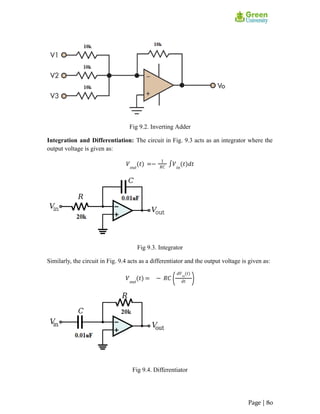
Integration and Differentiation: The circuit in Fig. 9.3 acts as an integrator where the
output voltage is given as:
𝑉𝑜𝑢𝑡
(𝑡) =−
1
𝑅𝐶
∫𝑉𝑖𝑛
(𝑡)𝑑𝑡
Fig 9.3. Integrator
Similarly, the circuit in Fig. 9.4 acts as a differentiator and the output voltage is given as:
𝑉𝑜𝑢𝑡
𝑡
( ) = − 𝑅𝐶
𝑑𝑉𝑖𝑛
𝑡
( )
𝑑𝑡
( )
Fig 9.4. Differentiator
Page | 80
List of Equipment:
● Project Board 1 piece
● OPAMP (741) 1 piece
● Resistor (10kΩ) 4 pieces
● Resistor (20kΩ,50kΩ) 1 piece
● Capacitor (0.01uF) 1 piece
● Signal Generator 1 unit
● Oscilloscope 1 unit
● DC Power Supply 1 unit
● Multimeter 1 unit
● Chords and wire lot
Procedure:
1. Construct the circuit in Fig. 9.2. Bias with +12V and -12V.
2. Give 1V DC supply as V1, 2V DC supply as V2 and 1.5V amplitude 1kHz
sinusoidal supply as V3.
3. Observe the output in oscilloscope. Change the values of the resistors and observe
the changes in the output waveforms.
4. Construct the circuit in Fig. 9.3. Bias with +12V and -12V.
5. Give 2V amplitude 1kHz sinusoidal supply as Vin.
6. Observe the output in oscilloscope. Change the values of the resistors and observe
the changes in the output waveforms.
7. Repeat step 6 for triangular and square wave supply as input.
8. Construct the circuit in Fig. 9.4. Bias with +12V and -12V.
9. Give 2V amplitude 1kHz sinusoidal supply as Vin.
10. Observe the output in oscilloscope. Change the values of the resistors and observe
the changes in the output waveforms.
11. Repeat step 10 for triangular and square wave supply as input.
Report Question:
1. Draw all associated wave shapes. Explain your findings separately for each of the
waves.
2. Design a circuit which will take two inputs V1(t) and V2(t); producing an
output of V0(t) = V1(t) +2V2 (t)
Page | 81
Observation Sheet
Graph 9.3: Vout for Inverting Adder
Page | 82
Graph 9.4: Vin and Vout for Integrator (Sinusoidal Input)
Graph 9.5: Vin and Vout for Integrator (Square Input)
Graph 9.6: Vin and Vout for Integrator (Triangular Input)
Page | 83
Graph 9.7: Vin and Vout for Differentiator (Sinusoidal Input)
Graph 9.8: Vin and Vout for Differentiator (Square Input)
Graph 9.9: Vin and Vout for Differentiator (Triangular Input)
Page | 84
Experiment no 10:
Name of the Experiment: Active Filter Design Using OP-AMP
Objectives:
1. To design and observe the frequency responses of low pass, high pass and band
pass filter.
Learning Outcome: After completing this experiment the students will be able to:
1. Design high pass, low pass and band pass filter using OP-AMP
2. Explain the frequency characteristics of each filter.
Theory:
Page | 85
Low- pass Filter: A low-pass filter is a filter that passes low-frequency signals but
attenuates (reduces the amplitude of) signals with frequencies higher than the cutoff
frequency. The actual amount of attenuation for each frequency varies from filter to filter.
High-pass Filter: A high-pass filter is a filter that passes high frequencies well, but
attenuates (or reduces) frequencies lower than the cutoff frequency. The actual amount of
attenuation for each frequency varies from filter to filter
Band – pass Filter: A band-pass filter is a device that passes frequencies within a
certain range and rejects (attenuates) frequencies outside that range. These filters can also
be created by combining a low-pass filter with a high-pass filter.
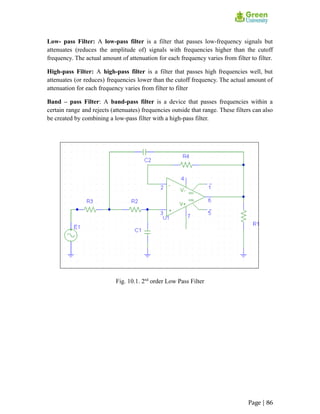
Fig. 10.1. 2nd
order Low Pass Filter
Page | 86
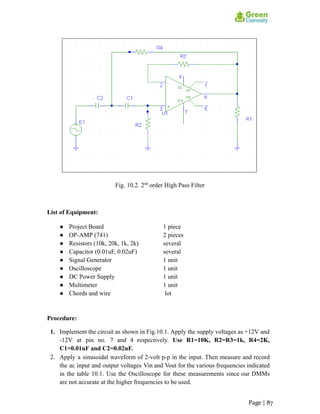
Fig. 10.2. 2nd
order High Pass Filter
List of Equipment:
● Project Board 1 piece
● OP-AMP (741) 2 pieces
● Resistors (10k, 20k, 1k, 2k) several
● Capacitor (0.01uF, 0.02uF) several
● Signal Generator 1 unit
● Oscilloscope 1 unit
● DC Power Supply 1 unit
● Multimeter 1 unit
● Chords and wire lot
Procedure:
1. Implement the circuit as shown in Fig.10.1. Apply the supply voltages as +12V and
-12V at pin no. 7 and 4 respectively. Use R1=10K, R2=R3=1k, R4=2K,
C1=0.01uF and C2=0.02uF.
2. Apply a sinusoidal waveform of 2-volt p-p in the input. Then measure and record
the ac input and output voltages Vin and Vout for the various frequencies indicated
in the table 10.1. Use the Oscilloscope for these measurements since our DMMs
are not accurate at the higher frequencies to be used.
Page | 87
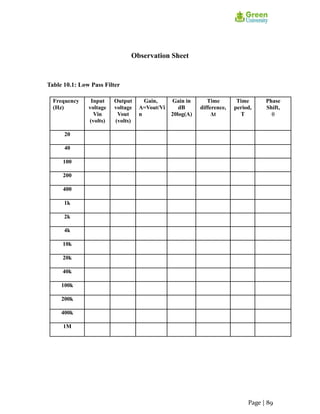
3. Measure the time difference between the input and output wave forms Δt, and also
the time period (T) for the various frequencies indicated in the table 1 provided in
the observation sheet.
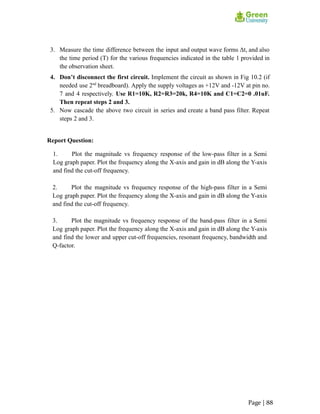
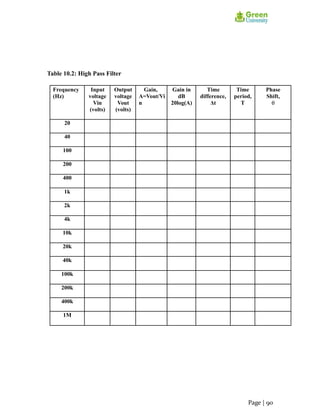
4. Don’t disconnect the first circuit. Implement the circuit as shown in Fig 10.2 (if
needed use 2nd
breadboard). Apply the supply voltages as +12V and -12V at pin no.
7 and 4 respectively. Use R1=10K, R2=R3=20k, R4=10K and C1=C2=0 .01uF.
Then repeat steps 2 and 3.
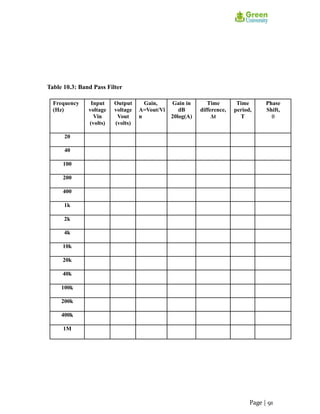
5. Now cascade the above two circuit in series and create a band pass filter. Repeat
steps 2 and 3.
Report Question:
1. Plot the magnitude vs frequency response of the low-pass filter in a Semi
Log graph paper. Plot the frequency along the X-axis and gain in dB along the Y-axis
and find the cut-off frequency.
2. Plot the magnitude vs frequency response of the high-pass filter in a Semi
Log graph paper. Plot the frequency along the X-axis and gain in dB along the Y-axis
and find the cut-off frequency.
3. Plot the magnitude vs frequency response of the band-pass filter in a Semi
Log graph paper. Plot the frequency along the X-axis and gain in dB along the Y-axis
and find the lower and upper cut-off frequencies, resonant frequency, bandwidth and
Q-factor.
Page | 88
Observation Sheet
Table 10.1: Low Pass Filter
Frequency
(Hz)
Input
voltage
Vin
(volts)
Output
voltage
Vout
(volts)
Gain,
A=Vout/Vi
n
Gain in
dB
20log(A)
Time
difference,
Δt
Time
period,
T
Phase
Shift,
θ
20
40
100
200
400
1k
2k
4k
10k
20k
40k
100k
200k
400k
1M
Page | 89
Table 10.2: High Pass Filter
Frequency
(Hz)
Input
voltage
Vin
(volts)
Output
voltage
Vout
(volts)
Gain,
A=Vout/Vi
n
Gain in
dB
20log(A)
Time
difference,
Δt
Time
period,
T
Phase
Shift,
θ
20
40
100
200
400
1k
2k
4k
10k
20k
40k
100k
200k
400k
1M
Page | 90
Table 10.3: Band Pass Filter
Frequency
(Hz)
Input
voltage
Vin
(volts)
Output
voltage
Vout
(volts)
Gain,
A=Vout/Vi
n
Gain in
dB
20log(A)
Time
difference,
Δt
Time
period,
T
Phase
Shift,
θ
20
40
100
200
400
1k
2k
4k
10k
20k
40k
100k
200k
400k
1M
Page | 91

EEE-214 Electronics Lab Manual.pdf

  • 1.
    Green University ofBangladesh Department of Electrical and Electronic Engineering EEE-214 Electronics Laboratory Manual Student ID Student Name Section Name of the Program Name of the Department Page | 1
  • 2.
  • 3.
    CONTENTS Page No Instructions forLaboratory 5 Laboratory Course Syllabus 6 Basic Measurement instruments 10 Experiments on Diode Experiment -1 Study of Diode I-V Characteristic 15 Experiment- 2 Study of Diode Rectifier Circuits 21 Experiment- 3 Study of Diode Clipping and Clamping Circuits 31 Experiments on BJT and MOSFET Experiment- 4 DC Characteristics of BJT and MOSFET 39 Experiment -5 Biasing of a Common Emitter Amplifier 47 Experiment- 6 Study of Common Emitter Amplifier 55 Experiment -7 Study of Common Emitter RC Coupled Cascaded Amplifier 61 Experiments on Operational Amplifier Experiment -8 Study of Operational Amplifier as Zero Crossing & Voltage Level Detectors 67 Experiment- 9(a) Study of Operational Amplifier as an Amplifier 73 Experiment -9(b) Study of Mathematical Operations Using Op Amp 77 Experiment -10 Active Filter Design Using Op Amp 83 Page | 3
  • 4.
  • 5.
    ​ The experimentsare designed to illustrate about different areas of electronic devices, circuits and applications. Conduct the experiments with interest and an attitude of learning. ​ Students should come with thorough preparation for the experiment to be conducted. ​ Students should come with proper dress code. ​ Students will not be permitted to attend the laboratory unless they bring the practical record fully completed in all respects pertaining to the experiment conducted in the previous class. ​ Work quietly and carefully (the whole purpose of experimentation is to make reliable measurements!) and equally share the work with your partners. ​ Be honest in recording and representing your data. If a particular reading appears wrong repeat the measurement carefully. ​ All presentations of data, tables and graphs calculations should be neatly and carefully done. ​ Graphs should be neatly drawn with pencil. Always label graphs and the axes and display units. ​ If you finish early, spend the remaining time to complete the laboratory report writing. Come equipped with calculator, scales, pencils etc. ​ Handle instruments with care. Report any breakage to the Instructor. Return all the equipment you have signed out for the purpose of your experiment. GREEN UNIVERSITY OF BANGLADESH (GUB) Page | 5
  • 6.
    COURSE SYLLABUS 1 FacultyFaculty of Science & Engineering 2 Department Department of EEE 3 Programme BSEEE [BSc in Electrical & Electronic Engineering] 4 Name of Course Electronics Lab 5 Course Code EEE 314 6 Trimester and Year 7 Pre-requisites Electronics I (EEE 201) and Electronics II (EEE 209) 8 Status Core EEE Course 9 Credit Hours 1.5 10 Section 11 Class Hours 12 Class Location Room: 901, Building 2 13 Course website 14 Name (s) of Academic staff / Instructor(s) 15 Contact 16 Office 17 Counseling Hours 18 Text Book 1. “Microelectronics Circuits” (5th or 6th Edition) – by Adel S. Sedra & Kenneth C. Smith. Published by Oxford University Press. 19 Reference 1. “Microelectronics Circuit Analysis and Design” (4th Edition) - by Donald A. Neamen. Published by McGraw Hill Higher Education. 20 Equipment & Aids Electronic Hardware Equipment, Oscilloscope, Graph Paper Page | 6
  • 7.
    21 Course Rationale Withthe ubiquitous use of electronic devices, e.g. Computers, Gadgets, TV demand a great, concise, and clear knowledge about the main component of such devices which is Integrated Circuits (IC). These ICs contain millions of basic components like Diodes, Operational Amplifiers, Metal Oxide Semiconductor Field Effect Transistors, and Bipolar Junction Transistors. So, studying and practically demonstrating such electronic components are quite mandatory for the better understanding of trendy devices. 22 Course Description For an electrical engineer the knowledge of electronics is elementary. Because in every aspect of electrical engineering electronics is present. This course is the first step in the exciting and evolving area of electronics which is now a governing engineering study of Electrical and Electronic Engineering. This course will focus on the practical demonstration of the very basic and primitive electronics devices. 23 Course Objectives The objective of this course is to 1. Show the students the real characteristics of the electronic devices like diode, transistor, amplifier 2. Clear their concepts on the applications and limitations of these devices 3. Give them an idea about how to design an electronic system to serve certain purpose. 24 Learning Outcomes After the end of this course, the students will be able to: 1. Compare the performance of different devices under different conditions. 2. Explain the characteristics of different electronic devices 3. Design an electronic system to serve certain purpose 25 Teaching Methods Lecture, Laboratory hardware and software experiments, Project Developments. 26 Topic Outline Class Topics Or Assignments CLOs Reading Reference Activities 1 Introductory overview on the course 1,2 Lecture, Question-answer 2 Study of diode I-V characteristics with schematics 1-3 Laboratory Experiment 3 Study of diode rectifier circuits 1-3 Laboratory Experiment Page | 7
  • 8.
    4 Study of diode clippingand clamping circuits 1-3 Laboratory Experiment 5 DC characteristics and biasing of BJT and MOSFET 1-3 Laboratory Experiment 6 Study of a common emitter amplifier 1-3 Laboratory Experiment 7 Study of common emitter RC coupled cascaded amplifier 1-3 Laboratory Experiment Mid Term Exam 8 Study of Operational Amplifier as Zero Crossing & Voltage Level Detectors 1-3 Laboratory Experiment 9 Study of Operational Amplifier as an Amplifier 1-3 Laboratory Experiment 10 Study of mathematical operations using Op Amp 1-3 Laboratory Experiment 11 Active filter design using Op Amp 1-3 Laboratory Experiment 12 FINAL TERM EXAMINATION (Quiz, Lab test, Viva) Quiz, Lab test, Viva Page | 8
  • 9.
    27 Assessment Methods AssessmentTypes Marks Attendance and Participation 10% Lab Report 20% Lab Viva 15% Lab Test 25% Lab Final Quiz + Mid Term Exam 30% Total 100% 28 Grading Policy Letter Grade Marks % Grade Point Letter Grade Marks % Grade Point A+ (Plus) 80-100 4.00 C+ (Plus) 50-54 2.50 A (Plain) 75-79 3.75 C (Plain) 45-49 2.25 A- (Minus) 70-74 3.50 D (Plain) 40-44 2.00 B+ (Plus) 65-69 3.25 F (Fail) <40 0.00 B (Plain) 60-64 3.00 I* - Incomplete B- (Minus) 55-59 2.75 W* - Withdrawal 1. 1. Lab Reports: Report on previous Experiment must be submitted before the beginning of new experiment. A bonus may be obtained if a student submits a neat, clean and complete lab report. 2. 2. Examination: There will be a mid-term exam and final exam both of which will be closed book. 3. 3. Unfair means policy: In case of copying/plagiarism in any of the assessments, the students involved will receive zero marks. Zero Tolerance will be shown in this regard. In case of severe offences, actions will be taken as per university rule. 4. 4. Counseling: Students are expected to follow the counseling hours posted. In case of emergency/unavoidable situations, students can e-mail me to make an appointment. 5. 5. Policy for Absence in Class/Exam: If a student is absent in the class for anything other than medical reasons, he/she will not receive attendance. If a student misses a class for genuine medical reasons, he/she must submit an application with the supporting documents (prescription/medical report). He/she will then have to follow the instructions given by the instructor for make-up. In case of absence in the mid/final exam for medical grounds, the student must also get his/her application forwarded by the head of the department before a make-up exam can be taken. It is recommended that the students inform the instructor beforehand through mail if they feel that they will miss a class/evaluation due to medical reasons. Page | 9
  • 10.
    a. Academic CalendarFall 2017: http://www.green.edu.bd/academics/academic-calendar b. Academic Information and Policies: http://www.green.edu.bd/academics/academic-rules-a-regulations c. Grading and Performance Evaluation: http://www.green.edu.bd/academics/academic-rules-a-regulations d. Proctorial Rules: http://www.green.edu.bd/administrator/proctors-office Page | 10
  • 11.
    BASIC MEASUREMENT INSTRUMENTS 1.Breadboard 2. Transistor and Op-Amp Pin Details 3. Oscilloscope 4. Multimeter 1. Breadboard: The breadboard consists of two terminal strips and two bus strips (often broken in the center). Each bus strip has two rows of contacts. Each of the two rows of contacts is a node. That is, each contact along a row on a bus strip is connected together (inside the breadboard). Bus strips are used primarily for power supply connections, but are also used for any node requiring a large number of connections. Each terminal strip has 60 rows and 5 columns of contacts on each side of the center gap. Each row of 5 contacts is a node. You will build your circuits on the terminal strips by inserting the leads of circuit components into the contact receptacles and making connections with 22-26 gauge wire. There are wire cutter/strippers and a spool of wire in the lab. It is a good practice to wire Source and 0V power supply connections to separate bus strips. Fig 1: The breadboard. The lines indicate connected holes. Incorrect connection of power to the elements could result in them exploding or becoming very hot - with the possible serious injury occurring to the people working on the experiment! Ensure that the power supply polarity and all components and connections are correct before switching on power. Page | 11
  • 12.
    Building the Circuit: Throughoutthese experiments we will use basic circuit elements like resistor, capacitor, BJT, MOSFET Op-Amp etc. to build circuits. The steps for wiring a circuit should be completed in the order described below: 1. Make sure the power is off before you build anything! 2. Read the theory carefully before starting connection so that there is no confusion about what to build. 3. Connect Source and GND pins of each chip to the power and ground bus strips on the breadboard. 4. Make sure that all the connections you have given are not loose and there is no short circuit in the external connection. Match your connection with the connection diagram provided in the lab sheet. 5. Get one of your group members to check the connections, before you turn the power on. 6. If an error is made and is not spotted before you turn the power on. Turn the power off immediately before you begin to rewire the circuit. 7. At the end of the laboratory session, collect you hook-up wires, chips and all equipment and return them to the demonstrator. 8. Tidy the area that you were working in and leave it in the same condition as it was before you started. Common Causes of Problems: 1. Not connecting the ground and/or power pins. 2. Not turning on the power supply before checking the operation of the circuit. 3. Leaving out wires. 4. Plugging wires into the wrong holes. 5. Not checking whether the device is faulty or not. 6. Modifying the circuit with the power on. In all experiments, you will be expected to obtain all instruments, leads, components at the start of the experiment and return them to their proper place after you have finished the experiment. Please inform the demonstrator or technician if you locate faulty equipment. If you damage an element, inform a demonstrator, don't put it back in the box of elements for somebody else to use. Page | 12
  • 13.
    2. Useful ICPin Details BJT MOSFET OP-AMP Fig 2: Pin Diagram Page | 13
  • 14.
    3. Oscilloscope: Fig 3:Front Panel of Oscilloscope Fig 4: Rear Panel of Oscilloscope Page | 14
  • 15.
  • 16.
    Experiment no 1: Nameof the Experiment: Study of Diode I-V Characteristic Objectives: 1. To study the diode I-V characteristics 2. To observe the output of a simple circuit with a diode using AC input Learning Outcome: After completing this experiment the students will be able to: 1. Understand the working principle of a diode. 2. Explain the characteristics of a diode for both DC and AC voltage. Theory: Diode: A p-n junction diode is a two-terminal device that acts as a one-way conductor. That means it permits the passage of electrical current in only one way and prevents if the current is passed from the other terminal. Circuit Connection: A diode can be connected in a circuit in two configurations. 1. Forward Biased Configuration 2. Reverse Biased Configuration When the voltage at the p-side of a p-n diode is higher than that of its n-side, then the diode is called forward biased. On the other hand, when the voltage across diode exceeds its cut-in voltage (Vt = 0.5V for Si diode) the diode starts conducting. In forward biased connection, the diode acts like a switch that is ON. The diode permits the passage of electrical current thorough it. When a diode gets negative voltage across it then it is in reversed bias connection. In this connection an insignificant amount of current will flow through the diode, and in most cases, it is neglected. Practically, the diode does not permit any flow of current and it acts like a switch that is OFF. Page | 16
  • 17.
    Figure 1.1. TheTwo-Connection Configuration Of Diode (a) Forward Biased (b) Reverse Biased In brief, if the voltage across the diode is VD then, if VD < Vt , the diode is off if VD > Vt , the diode is on The relation between the current and voltage of a diode is called the I-V characteristics. The I- V characteristic of a diode for different voltage ranges is described below: Fig. 1.2. I-V Characteristic of a diode Page | 17
  • 18.
    ▪ When thediode voltage (Vd) is negative, the diode does not permit the flow of current (OFF state). In fact, almost zero current (around pA) flows through the diode. This current is called reverse saturation current (Is). However, a diode permits this flow of current up to a certain amount of voltage, but after that particular voltage a large amount of current will begin to flow. This voltage is called Reverse Breakdown Voltage. There will be a rush of current at that time and that current is called Avalanche Current. In most of the cases the diode gets damaged in this situation. So, care must be taken so that this voltage range is not reached. ▪ When the diode voltage (Vd) is greater than zero but less than the threshold voltage (Vt) the diode will still remain OFF. ▪ When diode voltage is greater than Vt, the diode will act as a simple conductor that means will be in ON state and permit the flow of current. AC Characteristics of a Diode An AC source supplies positive voltage in one cycle and negative voltage in the other cycle with respect to its neutral. If an AC source is connected to a diode circuit, then the following phenomena happens. During the positive cycle of the AC source, ✔ The diode is forward biased, the diode acts like a sorted path. ✔ Current flows through the circuit. ✔ As current flows there will be voltage drop across the resistor. During the negative cycle of the AC source, ✔ The diode is reversed biased, the diode acts like an open path. ✔ No current flows, there is no voltage drop across the resistor. ✔ The source voltage comes across the diode. List of Equipment: ● Project Board 1 piece ● Diode (D1N4002, D1N750) 4 pieces ● Resistor (1K) 1 piece ● Multimeter 1 unit ● Signal generator 1 piece ● Oscilloscope 1 unit ● Chords and wire lot Page | 18
  • 19.
    Procedure: 1. Connect thecircuit shown in figure 1.3 using Breadboard. Use two separate diode models (D1N4002 and D1N750), 1K resistor and compare the characteristic curves found from these two. Fig. 1.3. Observing the DC Characteristics of a Diode 2. From the oscilloscope plot, determine rD (DC resistance) at three different diode voltages for both cases. 3. Construct the circuit shown in Figure 1.4 using Bread Board. In this case, use diode, and 1K resistor. Apply Sinewave from ac source and set the voltage source as a sinusoidal voltage with 5V amplitude and 100Hz frequency. Observe VIN, VD and VR on the oscilloscope. The output is across the resistor. Report Question: 1. Submit all the associated waveforms as your report. The waveforms must include following: a) I-V Characteristics of Diode for Diode model D1N4002 b) I-V Characteristics of Diode for Diode model D1N750 c) AC Characteristics of Diode (VIN, VD and VR ). 2. Explain why rD depends upon VD. Show that rD = nVT/ID . Where n is the ideality factor and VT = 0.0259V. Page | 19
  • 20.
    Observation Sheet Graph 1.1:I-V characteristics of diode D1N4002 Graph 1.2: I-V characteristics of diode D1N750 Graph 1.3: Vin for the circuit in Fig 1.4 Page | 20
  • 21.
    Graph 1.4: VDfor the circuit in Fig 1.4 Graph 1.5: VR for the circuit in Fig 1.4 Page | 21
  • 22.
    Experiment no 2: Nameof the Experiment: Study of Diode Rectifier Circuits Objectives: 1. To understand principle of diode in converting ac into dc 2. To study different diode rectifier circuits. Learning Outcome: After completing this experiment the students will be able to: 1. Understand the working principle of a half wave rectifier and full wave rectifier 2. Compare the performance of a half and full wave rectifier and decide which one is better. 3. Explain the role of capacitor and Zener diode in rectifying. Theory: In electrical systems AC to DC conversion is one of the most essential factors. In any electronic device, generally all the electronic components and IC operate on DC power supply. Even in large industrial systems, where high voltage is used, the AC to DC conversion is an important factor. The component that is widely used as a rectifier is the diode. Diode is a two-terminal device that permits the flow of current in only one direction. (The details of the study of diode is discussed in the previous experiment). The process of converting an AC voltage to DC voltage is called rectification. There are two types of rectifiers, 1. Half Wave Rectifier 2. Full Wave Rectifier Page | 22
  • 23.
    In a halfwave rectifier circuit, only one cycle (positive cycle) of the input wave is transmitted to the output. The negative cycle is eliminated at the output. During the positive cycle of the input, the diode is forward biased and it lets the current to flow through. Due to the current flow, there is a drop across the resistor or the output. That means the output follows the input. During the negative cycle of the input, the diode is reversed biased and it does not let the current to flow through it. That means there is no voltage drop or output. Use of the Capacitor: From the above graphs it is obvious that the output voltage without the capacitor has not attained a DC shape. Instead it is just an AC without its negative cycle. Now, the way to achieve a DC voltage is to add a capacitor in parallel with the resistor. A capacitor can hold charge for some time. Therefore, this device can hold the charge from the peak of one wave to the peak of the other. However, if we use a capacitor with lower resistance, then before reaching the next peak it will get discharged. So, a capacitor with a higher capacitance is incumbent. Despite using a higher capacitor, a considerable amount of ripple will exist here. Fig 2.1. Half Wave Rectifier Input and Output Page | 23
  • 24.
    Fig 2.2. OutputVoltage of Half wave rectifier for Different values of capacitor In a full wave rectifier circuit, the positive cycle of the input wave is transmitted to the output. The negative cycle is inverted and transmitted to the output. Page | 24
  • 25.
    List of Equipment: ●Project Board 1 piece ● p-n junction diode(1N4007) 4 pieces ● Resistor (1K) 1 piece ● Zener diode (4.7 V) 1 piece ● Capacitor (1µF, 10µF) 1 piece each ● Multimeter 1 unit ● Signal generator 1 piece ● Oscilloscope 1 unit ● Chords and wire lot Procedure: 1. Construct circuit shown in Fig. 2.3 WITHOUT THE CAPACITOR. Apply 6V amplitude to the AC signal and set the frequency to 1KHz. Observe the input voltage (Vi) and the output (Vo) simultaneously on the oscilloscope in dual mode. 2. Measure the Output Average Voltage by a multimeter and tabulate it in the Table 1 of the Observation Sheet. Fig. 2.3. Half Wave Rectifier 3. Now add a capacitor across the load. (Connect 1uF capacitor across the load resistor). 4. Observe the input voltage (Vi) and the output (Vo) simultaneously on the oscilloscope in dual mode. Draw them on Graph in the Observation Sheet in their allotted space. Repeat the step 2. 5. Replace 1uF Capacitor with 10 uF and repeat step 3 and step 4. Page | 25
  • 26.
    Add a zenerdiode (4.7 Volts) in series with the 1K resistor and observe the voltage across the zener diode only. Use the 10 uF capacitor for this circuit. Observe and draw the input and output voltage (across the zener diode) in dual mode. Measure the output voltage with a Multimeter in DC mode. 6. Construct circuit shown in Fig. 2.4 WITHOUT THE CAPACITOR. Apply 8V amplitude to the AC signal and set the frequency to 500Hz. Observe the input voltage (Vi) and the output (Vo) SEPARATELY on the oscilloscope. SPECIAL NOTE 1: DO NOT CONNECT THE CHANNEL PROBES SIMULTANEOUSLY, THAT MEANS WHILE VIEWING ONE WAVESHAPE THROUGH THE OSCILLOSCOPE THE OTHER PROBE SHOULD NOT BE CONNECTED WITH THE CIRCUIT. 7. Measure the Output Average Voltage by a multimeter and tabulate it in the Table of the Observation Sheet. Fig. 2.4. Full Wave Rectifier 8. NOW ADD A CAPACITOR ACROSS THE LOAD. (Connect 1uF capacitor across the load resistor). 9. BE CAREFUL about the polarity of the capacitor. Observe the input voltage (Vi) and the output (Vo) separately on the oscilloscope. Draw the input and output across the capacitor in dual mode. Repeat the step 2. 10. Replace 1uF Capacitor with 10uF and repeat step 3 and step 4. Construct the circuit shown by adding a Zener diode in series with resistor of Fig 2.4. Observe the output voltage across the zener diode (4.7 V) only. Draw input and output in dual mode. Measure the output voltage with a Multimeter in DC Page | 26
  • 27.
    Report Question: 1. Submitall the associated waveforms as your report. The waveforms must include following: a) Input and Output Waveforms of Half Wave Rectifier b) Input and Output Waveforms of Full Wave Rectifier 2. What is time constant? Why do you think that the increasing value of capacitor is reducing the ripple? Page | 27
  • 28.
    Observation Sheet Graph 2.1:Vin and Vout without capacitor (Half Wave Rectifier) Graph 2.2: Vin and Vout with 1uF capacitor (Half Wave Rectifier) Graph 2.3: Vin and Vout with 10uF capacitor (Half Wave Rectifier) Page | 28
  • 29.
    Graph 2.4: Vinand Vout (Zener Diode) added (Half Wave Rectifier) Graph 2.5: Vin and Vout without capacitor (Full Wave Rectifier) Graph 2.6: Vin and Vout with 1uF capacitor (Full Wave Rectifier) Page | 29
  • 30.
    Graph 2.7: Vinand Vout with 10uF capacitor (Full Wave Rectifier) Graph 2.8: Vin and Vout (Zener Diode added) (Full Wave Rectifier) Table 2.1: Output Voltage Measurement Rectifier Output Voltage Theoretical Value (in volts) Experimental Values (Measured by multimeter in DC mode) Without Capacitor With Capacitor 1uF With Capacitor 10uF Half Wave Average (measured by multimeter in DC mode) .. .. .. .. .. .. .. .. .. .. .. .. .. .. .. Page | 30
  • 31.
    Full Wave Average (measuredby multimeter in DC mode) .. .. .. .. .. .. .. .. .. .. .. .. .. .. .. Page | 31
  • 32.
    Experiment no 3: Nameof the Experiment: Study of Diode Clipping and Clamping Circuits Objectives: 1. To study the application of diodes in different clipping and clamping circuits. 2. To test the performance of student’s proposed voltage doubler circuit. Learning Outcome: After completing this experiment the students will be able to: 1. Understand the working principle of clipping and clamping circuits. 2. Design a voltage doubler circuit Theory: Limiter/Clipper Limiter or clippers are used to cut-off or eliminate a portion of an ac signal. A limiter can be realized by using diode, resistor and a DC source. A typical block diagram of a clipper circuit is shown below: Fig. 3.1. Clipper Clamper Page | 32
  • 33.
    The clamper circuitis one that will clamp a signal to a different dc level. A clamping circuit can be realized using a diode, resistor and a capacitor. A typical block diagram of a clamper circuit is shown below: INPUT SIGNAL OUTPUT SIGNAL Fig.3.2. Clamper List of Equipment: ● Project Board 1 piece ● p-n junction Diode(1N4007) 1 piece ● 4.7V Zener Diode 2 pieces ● Resistor (1K) 1 piece ● Capacitor (10µF) 1 piece ● Multimeter 1 unit ● Signal generator 1 piece ● Oscilloscope 1 unit ● Chords and wire lot Procedure: OBSERVING THE DIODE CLIPPING CIRCUIT 1. Construct circuit shown in Fig.3.3. Apply 10V p-p voltage as the AC signal and set the frequency to 500Hz. 2. Observe the input voltage (Vi) and the output (Vo) simultaneously on the oscilloscope in DUAL MODE. Page | 33
  • 34.
    Fig.3.3. Clipper Circuit 3.Reverse the polarity of the diode and repeat the steps 1 and 2. 4. Construct circuit shown in Fig. 3.4. Apply 16V p-p voltage to the AC signal and set the frequency to 500Hz. Observe the input voltage (Vi) and the output (Vo) simultaneously on the oscilloscope in DUAL MODE. Fig. 3.4 Repeat the step 2. OBSERVING THE DIODE CLAMPING CIRCUIT 1 Construct circuit shown in Fig. 3.5. Apply 10V p-p (BOTH SQUARE WAVE AND SINE WAVE) to the input and set the frequency to 500Hz. Observe the input voltage (Vi) and the output (Vo) simultaneously on the oscilloscope in DUAL MODE. Page | 34
  • 35.
    Reverse the polarityof the diode and repeat the step 1. Fig.3.5. Clamper Circuit 2 Assemble your own proposed voltage doubler circuit and check whether it is operating properly or not (check the output and verify by the lab instructor). Report Question: 1. Submit all the associated waveforms as your report. The waveforms must include following: a) Input and Output Waveforms of Clipper Circuit b) Input and Output Waveforms of Clamper Circuit 2. Write the basic idea of your voltage doubler? Explain its working principle. Page | 35
  • 36.
    Observation Sheet Graph 3.1:Vin and Vout (Clipper Circuit) Page | 36
  • 37.
    Graph 3.2: Vinand Vout (Diode Reversed) (Clipper Circuit) Graph 3.3: Vin and Vout (Zener diode added) (Clipper Circuit) Graph 3.4: Vin and Vout (Sine Wave Input) (Clamper Circuit) Page | 37
  • 38.
    Graph 3.5: Vinand Vout (Sine Wave Input – diode reversed) (Clamper Circuit) Graph 3.6: Vin and Vout (Square Wave Input) (Clamper Circuit) Graph 3.7: Vin and Vout (Square Wave Input – diode reversed) (Clamper Circuit) Page | 38
  • 39.
  • 40.
    Experiment no 4: Nameof the Experiment: DC Characteristics of BJT and MOSFET Objectives: 1. To understand the principle of operation of BJT and MOSFETs 2. To study input and output DC characteristics of BJT and MOSFET Learning Outcome: After completing this experiment the students will be able to: 1. Explain the working principle of BJT and MOSFET. 2. Understand the response of BJT and MOSFET under DC voltage Page | 40
  • 41.
    Theory: BJT Transistor has twop-n junctions (see figure below). One junction is called emitter junction and other is called collector junction. When transistor is used as an amplifier, it is operated in active mode. In active mode, emitter junction is forward biased and collector junction is reverse biased. Figure 4.1 Emitter current is given by IE = InE + IpE We can also write IE = IC + IB = [(1 + β)/β]IC Where β = IC /IB is called common emitter short circuit current gain. For a good transistor, IC>>IB i.e. β>>1. IC can also be expressed as IC = α IE. Where, α = β/ (1+β). The factor α is called common base short circuit current gain. For good transistor, α is close to unity. Proper dc biasing of a transistor is a prerequisite for proper operation as an amplifier. The purpose of the biasing is to fix the IC (dc) and VCE (dc). But IC is a function of temperature, VBE and β. It is always desirable to design a biasing circuit where IC is insensitive to change in β. When E-B junction is forward biased and C-B junction is reverse biased, the transistor operates in active mode. For saturation mode of operation, both junctions are Page | 41
  • 42.
    forward-biased. Cut-off regionoperation requires that both E-B and C-B junctions are reverse biased. The inverted active operation occurs when E-B is reverse-biased and C-B is forward biased. Fig 4.2 MOSFET The n-channel MOSFET consists of a lightly doped p-type substrate into which two highly doped n + regions are diffused (Fig. 3.3). These n + sections act as the source and the drain. A thin layer of insulating silicon dioxide (SiO2) is grown over the surface of the structure, and holes are cut into the oxide layer, allowing contact with the source and the drain. Then the gate-metal area is overlaid on the oxide, covering the entire channel region. Simultaneously, metal contacts are made to the drain and source. The contact to the metal over the channel area is the gate terminal. The metal area of the gate, in conjunction with the insulating dielectric oxide layer and the semiconductor channel, forms a parallel-plate capacitor. The insulating layer of silicon dioxide is the reason why this device is called the insulated-gate field-effect transistor. This layer results in an extremely high input resistance (10 10 to 10 15 ohm) for the MOSFET. Page | 42
  • 43.
    The Enhancement MOSFET:If we ground the substrate for the structure and apply a Gate Source Drain Fig. 4.3. Cross sectional view of an N-MOSFET positive voltage at the gate, an electric field will be directed perpendicularly through the oxide. This field will end on “induced” negative charges on the semiconductor site. The negative charge of electrons, which are minority carriers in the p-type substrate, forms an “inversion layer”. As the positive voltage on the gate increases, the induced negative charge in the semiconductor increases. The region beneath the oxide now has n-type carriers, the conductivity increases, and current flows from source to drain through the induced channel. Thus, the drain current is “enhanced” by the positive gate voltage, and such a device is called an enhancement- type MOS. The volt-ampere drain characteristics of an n-channel enhancement-mode MOSFET are given and its transfer curve. The current IDSS at VGS <= 0 is very small, being of the order of a few nanoamperes. As VGS is made positive, the current ID increases slowly at first, and then much more rapidly with an increase in VGS. The manufacturer sometimes indicates the gate-source threshold voltage VGST at which ID reaches some defined small value, say 10 uA. A current ID(ON), corresponding approximately to the maximum value given on the drain characteristics, and the value of VGS needed to obtain this current are also usually given on the manufacturer’s specification sheets. The Depletion MOSFET: A second type of MOSFET can be made if, to the basic structure of Fig.3.3, an n-channel is diffused between the source and the drain. With this device an appreciable drain current IDSS flows for zero gate-to-source voltage, VGS = 0. If the gate voltage is made negative, positive charges are induced in the cannel through the SiO2 of the gate capacitor. Since the current in a FET is due to majority carriers (electron for an n-type material), the induced positive charges make the channel less conductive, and the drain current drops as VGS is made more negative. The redistribution of charge in the channel causes an effective depletion of majority carriers, which accounts for the designation depletion MOSFET. Note in that, because of the voltage drop due to the Page | 43
  • 44.
    drain current, thechannel region nearest the drain is more depleted than is the volume near the source. A MOSFET of the depletion type may also be operated in an enhancement mode. It is only necessary to apply a positive gate voltage so that negative charges are induced into the n-type channel. In this manner the conductivity of the channel increases and the current rises above IDSS. The volt-ampere characteristics of this device are indicated and the transfer curve is given. The depletion and enhancement regions, corresponding to VGS negative and positive, respectively, should be noted. The manufacturer sometimes indicates the gate-source cutoff voltage VGS (OFF), at which ID is reduced to some specified negligible value at a recommended VDS. This gate voltage is called threshold voltage Vt. At the onset of inversion, ns (electron concentration near the surface) = Na for nMOSFET. List of Equipment: ● Project Board 1 piece ● npn transistors (Q2N2222) 1 piece ● MOSFET 1 piece ● Resistor (10k, 500Ω, 100Ω) 2 pieces each ● Potentiometer (500kΩ) 1 piece ● DC Power Supply 1 unit ● Multimeter 1 unit ● Chords and wire lot Procedure: DC Characteristics of BJT Q2N2222 Fig. 4.4. Circuit for Studying DC Output Characteristics of BJT in CE configuration Input Characteristics: Page | 44
  • 45.
    1. Construct thecircuit shown in Fig. 4.4 in bread board. Use a voltage source VBE instead of current source IB in this study. 2. Here, in determining the input characteristics a nested DC sweep of VBE and VCE is required. For achieving this, vary the VCE from 5V to 20V in 5V increments. 3. Measure the current at base of the BJT for every step. 4. Input characteristic of the BJT will appear as a curve of VCE vs IB when plotted 5. Repeat steps 2 and 3 for VBE = 0 to 0.8V for 0.1 V step Output Characteristics: 1. Construct the circuit shown in Fig. 4.4. 2. Here, for determining the output characteristics a nested DC Sweep of VCE and IB is required. For achieving this, vary VCE from 0 to 20V according to the table in the observation sheet. 3. After each step measure the current in the collector of the BJT. 4. Then repeat step 7 and 8 while varying IB from 0uA to 100 uA in 20uA increments. 5. Output characteristic of the BJT will appear as a curve of VCE vs. IC when plotted Output Characteristics of a BJT in Common Base Configuration: 1. Draw a circuit for obtaining output characteristics of Q2N2222 in CB configuration and simulate it using appropriate sources and nested sweeps. NOTE: If you find difficulty in identifying the curves, you should run each case separately and verify the identity of each curve. Observing the MOSFET DC characteristics 1. Construct the circuit in Fig. 4.5. 2. The goal is to use the circuit to obtain family of ID vs. VDS characteristics curves for different values of VGS. 3. Measure the drain to source current after each step of Varying Vss from 0 to 30V according to the table in the observation sheet. 4. Vary VGS from 0 to 5V with an increment of 1 V and repeat step 3 after each increment. 5. Choose VDS as the X axis variable and ID as the Y axis variable. 6. Plot accordingly to obtain the characteristic. Page | 45
  • 46.
    Fig. 4.5: Circuitfor Studying DC Output Characteristics of MOSFET Report Question: 1. Submit all the associated graphs as your report. The graphs must include following: a) DC Input and Output Characteristics of BJT b) DC Characteristics of MOSFET 2. Explain Saturation and Non-saturation regions in the DC characteristics of a transistor. Page | 46
  • 47.
    Observation Sheet Table 4.1:Input Characteristics of BJT: VBE(V) IB(mA) VCE=5V VCE=10V VCE=15V VCE=20V 0 0.1 0.2 0.3 0.4 0.5 0.6 0.7 0.8 Table 4.2: Output Characteristics of BJT: VCE(V) IC(mA) IB=0uA IB=20uA IB=40uA IB=60uA IB=80uA IB=100uA 0 0.05 0.10 0.15 0.20 0.25 0.30 0.40 0.50 0.60 0.70 1 2 5 10 15 20 Table 4.3: Output Characteristics of MOSFET: VSS(V) ID(mA) VGS=0V VGS=1V VGS=2V VGS=3V VGS=4V VGS=5V 0 Page | 47
  • 48.
    0.05 0.10 0.15 0.20 0.25 0.30 0.40 0.50 0.60 0.70 1 2 5 10 15 20 25 30 Experiment no 5: Nameof the Experiment: Biasing of a Common Emitter Amplifier Objectives: 1. To determine the most effective configuration for providing bias ensuring good stability with respect to changes in the Beta (β). Page | 48
  • 49.
    2. To understandhow the change of β in a transistor circuit can change the Q-point of the circuit. Learning Outcome: After completing this experiment the students will be able to: 1. Compare different biasing techniques and explain their merits. 2. Set the Q point of the transistor to have a proper small signal swing. Theory: In order to characterize the operation of a particular transistor, a complete set of characteristic equations is needed. Typically, these curves look like those in Figure 5.1. These curves show that in the active region of operation, the collector current is constant and depends on the base current. Fig. 5.1. Characteristic curves for the BJT transistor. These curves can be used to calculate the large signal current gain, βDC (or hFE) and the small signal current gain, βAC (or hfe). These values are in general calculated for a given bias point ICQ, VCEQ using the following equations: From this, one can see that the large signal gain depends only on the Q point and the small signal gain depends only on small deviations around the Q point. In order to use a transistor in an amplifying circuit it has to be biased. In other words, a Q point has to Page | 49
  • 50.
    be set inorder to place the device in the active region of operation. There are several methods, which can be used to bias a transistor. Figures 5.2 (a) and 5.2(b) demonstrate two possibilities. The first scheme (Figure 5.2(a)) is called a fixed bias scheme. In a fixed biasing the base current is set through a base resistor and the emitter of the transistor is grounded. This scheme is not used in practice since the Q point depends very strongly on β. Fig. 5.2(a) Fixed bias circuit A second possibility, which is commonly used, is the self-biasing scheme. Here the base voltage is set through a voltage divider and the emitter is tied to ground through a resistor. If designed correctly, this scheme is relatively independent of β. Fig. 5.2(b) Self-bias circuit The Quiescent point or Q-point: The DC operating point is usually referred to as the Q-point or Quiescent Operation Point. That is the operation point for the transistor when no ac signal is applied to the system. The collector current, IC, at this operating point is called, ICQ, and the collector to emitter voltage at this point is called, VCEQ. Providing the necessary voltages and currents to set this operating point is referred to as biasing the transistor. Selection of Q-point: Page | 50
  • 51.
    To select anappropriate Q-point, it is necessary to set it in such a point so that a wide range of input signal can be applied. Generally, the Q-point is set at half the value of VCC. Need for stabilization: Only the fixing of a suitable operating point is not sufficient. It must also be ensured that it remains where it was fixed. Unfortunately, in transistor circuits the operating point shifts with the use of the circuit. Such a shift of operating point may drive the transistor into an undesirable region. Consequently, the amplifier becomes useless. There are two reasons, for which Q-point may shift, Firstly, the transistor parameters are temperature dependent, so the operating point may change with the temperature. Secondly, the current gain, β vary from unit to unit. For example, the β of a C828 transistor may vary with that of another C828 transistor. List of Equipment: ● Project Board 1 piece ● npn transistors (Q2N2222) 1 piece ● npn transistors (Q2N3904) 1 piece ● Resistor (10k, 500Ω, 100Ω) 2 pieces each ● Potentiometer (500kΩ) 1 piece ● DC Power Supply 1 unit ● Multimeter 1 unit ● Chords and wire lot Procedure: 1. Construct the Circuit 1: Fixed Bias with a Q2N2222 transistor as shown in the Fig. 5.3. 2. By adjusting the 500k potentiometer set VCE = 7.5V. 3. Now record the various values in the allotted table in the Data Collection & Observation Sheet. 4. DON’T CHANGE THE POTENTIOMETER VALUE. Replace transistor Q2N2222 by transistor Q2N3904 and repeat step 3. Page | 51
  • 52.
    5. Now, constructthe Circuit 2, Circuit 3 and Circuit 4 and repeat the steps 2,3,4 and 5. Fig. 5.3. Different Types of Biasing Report Question: 1. Rate the bias circuits in order from most stable (smallest variation in VCE) to the least stable one. What are the factors that you have observed to find the best biasing circuit among the four? 2. Describe the necessity of biasing in a transistor. Page | 52
  • 53.
    Observation Sheet: Table 5.1:Fixed Bias: Transistor VCE (volts) VRc (volts) IC= VRc/ RC (mA) IB (mA) β= IC/IB % Change in VCE Page | 53
  • 54.
    Q2N2222 7.5 Q2N3904 .. .... .. % Table 5.2: Fixed Bias with Emitter Resistance: Transistor VCE (volts) VRc (volts) IC= VRc/ RC (mA) IB (mA) β= IC/IB % Change in VCE Q2N2222 7.5 Q2N3904 .. .. .. .. % Table 5.3: Collector Feedback Bias: Transistor VCE (volts) VRc (volts) IC= VRc/ RC (mA) IB (mA) β= IC/IB % Change in VCE Q2N2222 7.5 Q2N3904 .. .. .. .. % Table 5.4: Voltage Divider Bias: Page | 54
  • 55.
    Transistor VCE (volts) VRc (volts) IC= VRc/ RC (mA) IB (mA) β= IC/IB % Change in VCE Q2N2222 7.5 Q2N3904.. .. .. .. % Table 5.5: Rating of Bias Circuits: Rate the bias circuits in order from most stable (smallest variation in VCE) to the least stable one. Name of the Biasing Circuit Stability Rating 1 2 3 4 Page | 55
  • 56.
  • 57.
    Name of theExperiment: Study of Common Emitter Amplifier Objectives: 1. To be able to determine the maximum output available from a basic CE amplifier. 2. To examine the effect of adding an emitter bypass capacitor to the amplifier circuit 3. To examine its frequency response. Learning Outcome: After completing this experiment the students will be able to: 1. Understand the working principle of common emitter amplifier. 2. Explain the frequency characteristics of CE amplifier. Theory: Considering the gain, input impedance and the output impedance, the common emitter (CE) amplifier is the most popular BJT amplifier configuration. Figure 6.2 shows a typical CE configuration. Before applying as an amplifier, the BJT should be biased with a stable biasing network. Voltage Divider Biasing Network is the most stable network that can be used. Before applying an AC voltage signal, the input and output should be separated by two blocking capacitors C1 and C2 so that any DC component cannot pass to the input or the output stages. The emitter resistance RE is used as a part in increasing the stability, however this resistance creates a feedback to the input and decreases the overall gain. To eliminate this problem a bypass capacitor CE is used that will act as open branch for DC component and a short path for AC components. The frequency response of a CE amplifier exhibits that the gain is less than the expected in the low frequency and high frequency range. Fig. 6.1. Frequency Response of CE Amplifier In order to get a better frequency response, the value of CE, C1 and C2 should be sufficiently large. Page | 57
  • 58.
    CE Amplifier: Fig. 6.2.Amplifier circuit List of Equipment: ● Project Board 1 piece ● npn transistors (Q2N2222) 1 piece ● Resistor (10kΩ, 5kΩ, 1kΩ, 100Ω) 2 pieces each ● Potentiometer (100kΩ) 1 piece ● Capacitor (10μF) 1 piece ● Capacitor (1000μF) 2 pieces ● Signal Generator 1 unit ● Oscilloscope 1 unit ● DC Power Supply 1 unit ● Multimeter 1 unit ● Chords and wire lot Page | 58
  • 59.
    Procedure: 1. Construct thecircuit shown in Circuit diagram 6.2. Important Note: Use 10k resistors for each of the stages. Otherwise the 100 ohm resistors may burn out. 2. By adjusting the 100k potentiometer set VCE= 7.5 V for both the stages. 3. With no ac signal input to the circuit, measure all the DC node voltages VCC, VC, VB, & VE and calculate the actual Q-point current, ICQ = (VCC - VC)/ RC, and voltage VCEQ = VC – VE for both the stages. Stage VCC VC VB VE RC ICQ VCEQ 1 2 4. Set the signal generator at 2 KHz. Connect an oscilloscope to observe the input signal, Vin, and the output signal, Vout, after the second stage and increase the input signal amplitude (Vs) until clipping is observed. Then reduce the input until the maximum output voltage that contains no sign of clipping is found. 5. Next record the input voltage at which the effects of saturation and cutoff are first seen on the output. Input voltage(Amplitude) for Saturation Input voltage(Amplitude) for Cutoff Note: For this circuit saturation effects will be seen as clipping at the bottom of the waveform and cutoff effects will be seen as clipping or distortion at the top of the waveform. Page | 59
  • 60.
    Vin and Vout (Dual Mode) Gain, Av= 6.Reduce the input level to about half the value that first caused distortion. Then measure and record the ac input and output voltages Vin and Vout for the various frequencies indicated in the table 1 provided in the Data Collection and Observation Sheet. Use the Oscilloscope for these measurements since our DMMs are not accurate at the higher frequencies to be used. 7. Measure the time difference between the input and output wave forms Δt, and also the time period, T for the various frequencies indicated in the table 1 provided in the Data Collection and Observation Sheet Note: This can be measured by the distance in time scale between the rising edge zero crossings of Vin and Vout. Then calculate the voltage gain, Av = Vout/Vin, and the phase shift, θ = 360Δt /T, at each of the following frequencies. Make sure there is no sign of distortion or clipping on the output waveform before each measurement. Report Question: 1. Plot the frequency response of the CE amplifier in a Semi Log graph paper. Plot the frequency along the X-axis and gain in dB along the Y-axis. Also perform frequency response with SCHEMATICS as homework and compare the results. 2. Explain the frequency characteristics of CE amplifier. Page | 60
  • 61.
    Observation Sheet: Table 6.1:Frequency Response of CE Amplifier: Frequency (Hz) Input voltage Vin (volts) Output voltage Vout (volts) Gain, A=Vout/Vi n Gain in dB 20log(A) Time difference, Δt Time period, T Phase Shift 20 40 100 200 400 1k 2k 4k 10k 20k 40k 100k 200k 400k 1M 2M Page | 61
  • 62.
  • 63.
    Name of theExperiment: Study of Common Emitter RC Coupled Cascaded Amplifier Objectives: 1. To understand the operational characteristics of a common emitter (CE) RC coupled cascaded amplifier. 2. To examine its frequency response. Learning Outcome: After completing this experiment the students will be able to: 1. Explain the operational characteristics of a common emitter (CE) RC coupled cascaded amplifier. 2. Explain the frequency response of a CE RC coupled amplifier Theory: Considering the gain, input impedance and the output impedance, the common emitter (CE) amplifier is the most popular BJT amplifier configuration. Figure 7.2 shows a typical CE RC coupled cascaded amplifier configuration. Here two CE amplifiers are cascaded together with a resistor and a capacitor so that the voltage gain of the amplifier is increased. Before applying as an amplifier, the BJTs should be biased with a stable biasing network. Voltage Divider Biasing Network is the most stable network that can be used. Before applying an AC voltage signal, the input and output should be separated by blocking capacitors so that any DC component cannot pass to the input or the output stages. The emitter resistances are used as a part in increasing the stability; however these resistors create a feedback to the input and decreases the overall gain. To eliminate this problem bypass capacitors are used that will act as open branch for DC component and a short path for AC components. The frequency response of a Common Emitter RC coupled cascaded amplifier exhibits that the gain is less than the expected in the low frequency and high frequency range. Fig. 7.1. Frequency Response of Common Emitter RC Coupled Cascaded Amplifier Page | 63
  • 64.
    In order toget a better frequency response, the value of CE, C1 and C2 should be sufficiently large. Common Emitter RC Coupled Cascaded Amplifier: Fig. 7.2. Cascaded Amplifier circuit List of Equipment: ● Project Board 1 piece ● npn transistors (2N2222) 2 pieces ● Resistor (10kΩ, 5kΩ, 1kΩ, 100Ω) 2 pieces each ● Potentiometer (100kΩ) 2 pieces ● Capacitor (10μF) 3 pieces ● Capacitor (1000μF) 2 pieces ● Signal Generator 1 unit ● Oscilloscope 1 unit ● DC Power Supply 1 unit ● Multimeter 1 unit ● Chords and wire lot Page | 64
  • 65.
    Procedure: 1. Construct thecircuit shown in Circuit diagram 7.2. Important Note: Use 10k resistors for each of the stages. Otherwise the 100 ohm resistors may burn out. 2. By adjusting the 100k potentiometer set VCE= 7.5 V for both the stages. 3. With no ac signal input to the circuit, measure all the DC node voltages VCC, VC, VB, & VE and calculate the actual Q-point current, ICQ = (VCC - VC)/ RC, and voltage VCEQ = VC – VE for both the stages. Stage VCC VC VB VE RC ICQ VCEQ 1 2 4. Set the signal generator at 2 KHz. Connect an oscilloscope to observe the input signal, Vin, and the output signal, Vout, after the second stage and increase the input signal amplitude (Vs) until clipping is observed. Then reduce the input until the maximum output voltage that contains no sign of clipping is found. 5. Next record the input voltage at which the effects of saturation and cutoff are first seen on the output. Input voltage(Amplitude) for Saturation Input voltage(Amplitude) for Cutoff Note: For this circuit saturation effects will be seen as clipping at the bottom of the waveform and cutoff effects will be seen as clipping or distortion at the top of the waveform. Page | 65
  • 66.
    Vin and Vout (Dual Mode) Gain, Av= 6.Reduce the input level to about half the value that first caused distortion. Then measure and record the ac input and output voltages Vin and Vout for the various frequencies indicated in the table 1 provided in the Data Collection and Observation Sheet. Use the Oscilloscope for these measurements since our DMMs are not accurate at the higher frequencies to be used. 7. Measure the time difference between the input and output wave forms Δt, and also the time period, T for the various frequencies indicated in the table 1 provided in the Data Collection and Observation Sheet Note: This can be measured by the distance in time scale between the rising edge zero crossings of Vin and Vout. Then calculate the voltage gain, Av = Vout/Vin, and the phase shift, θ = 360Δt /T, at each of the following frequencies. Make sure there is no sign of distortion or clipping on the output waveform before each measurement. Report Question: 1. Plot the frequency response of the amplifier in a Semi Log graph paper. Plot the frequency along the X-axis and gain in dB along the Y-axis. Also perform frequency response with SCHEMATICS as homework and compare the results. 2. Explain the frequency characteristics of Common Emitter RC coupled cascaded amplifier. Page | 66
  • 67.
    Observation Sheet: Table 7.1:Frequency Response of CE Amplifier: Frequency (Hz) Input voltage Vin (volts) Output voltage Vout (volts) Gain, A=Vout/Vi n Gain in dB 20log(A) Time difference, Δt Time period, T Phase Shift 20 40 100 200 400 1k 2k 4k 10k 20k 40k 100k 200k 400k 1M 2M Page | 67
  • 68.
  • 69.
    Experiment no 8: Nameof the Experiment: Study of Operational Amplifier as Zero Crossing & Voltage Level Detectors Objectives: 1. To get familiarized with Operational Amplifier. 2. To study OP-AMP as a comparator. Learning Outcome: After completing this experiment the students will be able to: 1. Explain the basic characteristics of an OP-AMP 2. Understand the use of OP-AMP as a comparator Theory: Fig 8.1 Pin Diagram of OP-AMP The Internal Circuit Diagram of an OPAMP: Page | 69
  • 70.
    In an openloop connection, there is no feedback between the output and input terminal. The OPAMP in this experiment will be operated as a comparator. If the voltage of non-inverting input terminal is E+ and the voltage of the inverting input terminal is E- , then The output, Vo = + Vsat, when E+ > E - And Vo = - Vsat, when E+ < E - Using this concept, we can use it to detect any zero crossing voltage or to identify any voltage level. List of Equipment: ● Project Board 1 piece ● OPAMP (741) 1 piece ● Resistor (1kΩ) 1 piece each ● Signal Generator 1 unit ● Oscilloscope 1 unit ● Analog Trainer Board 1 unit ● Chords and wire lot Page | 70
  • 71.
    Procedure: Zero Crossing Detector 1.Apply +10V and –10V biasing voltages to the pin7 and pin4. 2. Set the input voltage of the signal generator to triangular wave shape mode. 3. Set the voltage to 10V peak and frequency to 5 KHz. 4. Construct the circuit diagram 1 and draw the input and output wave shape. 5. Repeat the steps 1 to 4 for the circuit diagram 2. Positive and Negative Voltage Level Detector: 6. Repeat the steps 1 to 4 for the circuit diagram 3 to circuit diagram 6 Page | 71
  • 72.
    Report Question: 1. Submitall the associated waveforms as your report. The waveforms must include following: a) Input and Output Waveforms of Circuit Diagram 1 to 6 2. Analyze and explain the outputs that you got for the 6 circuits. Page | 72
  • 73.
    Observation Sheet Graph 8.1:Vin and Vout for Non-Inverting Zero Crossing Detector Graph 8.2: Vin and Vout for Inverting Zero Crossing Detector Graph 8.3: Vin and Vout for Positive Voltage Level Detector – Non-inverting Page | 73
  • 74.
    Graph 8.4: Vinand Vout for Positive Voltage Level Detector – Inverting Graph 8.5: Vin and Vout for Negative Voltage Level Detector – Non-inverting Graph 8.6: Vin and Vout for Negative Voltage Level Detector – Inverting Page | 74
  • 75.
    Experiment no 9(a): Name of the Experiment: Study of Operational Amplifier as an Amplifier Objectives: 1. To get familiarized with the use of Op-Amp as amplifiers 2. To study the behavior of inverting and non-inverting amplifiers Learning Outcome: After completing this experiment the students will be able to: 1. Explain the operation of Op-amp as an amplifier 2. Point out the difference of behaviour of the inverting and non-inverting amplifiers. Theory: Fig 9.1. Pin Diagram of OP-AMP The Internal Circuit Diagram of an OPAMP: Page | 75
  • 76.
    The two widelyused closed loop amplifier using OPAMP are: i) Inverting Amplifier ii) Non-Inverting Amplifier In both the cases the closed loop gain of the amplifier is determined by the input resistance Ri and the feedback resistance Rf. (i) Inverting Amplifier: In an inverting amplifier the input is applied at the inverting input pin. The output obtained here is inverted. The close loop gain for this type of amplifier is given by, ACL = - Rf / Ri (ii) Non-Inverting Amplifier: In this type of amplifier the input is applied at the non-inverting input whereas the output is not inverted. The close loop gain for this type of amplifier is given by, ACL = (1+ Rf / Ri) List of Equipment: ● Project Board 1 piece ● OPAMP (741) 1 piece ● Resistor (1kΩ, 5kΩ) 1 piece each ● Signal Generator 1 unit ● Oscilloscope 1 unit ● DC Power Supply 1 unit ● Multimeter 1 unit ● Chords and wire lot Page | 76
  • 77.
    Procedure: 1. Measure theresistances Ri and Rf by multimeter and record in spaces provided. 2. Construct the circuit diagram 1. Apply +10V and –10V biasing voltages Circuit diagram 1 3. Set the input voltage Ei at 1 V peak and the frequency at 2 kHz. 4. Measure the output peak voltage and tabulate in the tables provided. 5. Now draw the input and output wave shapes in the graphs provided. (The output should be measured across the load resistance RL. 6. Construct the circuit diagram 2. Apply +10V and –10V biasing voltages Circuit diagram 2 7. Set the input voltage Ei at 1 V peak and the frequency at 2 kHz. 8. Measure the output peak voltage and tabulate in the tables provided. 9. Now draw the input and output wave shapes in the graphs provided. (The output should be measured across the load resistance RL. Report Question: Page | 77
  • 78.
    1. Submit allthe associated waveforms as your report. The waveforms must include following: a) Input and Output Waveforms of Circuit Diagram 1 and 2. 2. Analyze and explain the outputs that you got for the 2 circuits. Observation Sheet Table 9.1: Inverting Amplifier Ri Rf ACL = - Rf / Ri EI VO Gain = VO / EI Graph 9.1: Vin and Vout for Inverting Amplifier Table 9.2: Non - Inverting Amplifier Ri Rf ACL = (1 + Rf / Ri) EI VO Gain = VO / EI Page | 78
  • 79.
    Graph 9.2: Vinand Vout for Non-Inverting Amplifier Experiment no 9 (b): Name of the Experiment: Study of Mathematical Operations Using OP-AMP Objectives: 1. To study the use of operational amplifiers in different mathematical operations. 2. To study the behavior of inverting adder, differentiator and integrator. Learning Outcome: After completing this experiment the students will be able to: 1. Use OP-AMPs in different mathematical operations. 2. Implement OP-AMP circuits in diverse systems to serve different purposes. Theory: The property of infinite impedance and infinite gain of an operational amplifier results in a situation of zero voltage between the two input terminals (when configured in negative feedback mode). The effect is known as a virtual ground. Due to this effect, the op-amp can be used to perform some mathematical operations. Addition: Using the concept of inverting amplifier, the op-amp can be used as an adder (actually inverting adder) to sum up some input signals. In Fig. 9.2 the output of the op-amps 𝑉0 = 𝑉1 + 𝑉2 + 𝑉3 Page | 79
  • 80.
    Fig 9.2. InvertingAdder Integration and Differentiation: The circuit in Fig. 9.3 acts as an integrator where the output voltage is given as: 𝑉𝑜𝑢𝑡 (𝑡) =− 1 𝑅𝐶 ∫𝑉𝑖𝑛 (𝑡)𝑑𝑡 Fig 9.3. Integrator Similarly, the circuit in Fig. 9.4 acts as a differentiator and the output voltage is given as: 𝑉𝑜𝑢𝑡 𝑡 ( ) = − 𝑅𝐶 𝑑𝑉𝑖𝑛 𝑡 ( ) 𝑑𝑡 ( ) Fig 9.4. Differentiator Page | 80
  • 81.
    List of Equipment: ●Project Board 1 piece ● OPAMP (741) 1 piece ● Resistor (10kΩ) 4 pieces ● Resistor (20kΩ,50kΩ) 1 piece ● Capacitor (0.01uF) 1 piece ● Signal Generator 1 unit ● Oscilloscope 1 unit ● DC Power Supply 1 unit ● Multimeter 1 unit ● Chords and wire lot Procedure: 1. Construct the circuit in Fig. 9.2. Bias with +12V and -12V. 2. Give 1V DC supply as V1, 2V DC supply as V2 and 1.5V amplitude 1kHz sinusoidal supply as V3. 3. Observe the output in oscilloscope. Change the values of the resistors and observe the changes in the output waveforms. 4. Construct the circuit in Fig. 9.3. Bias with +12V and -12V. 5. Give 2V amplitude 1kHz sinusoidal supply as Vin. 6. Observe the output in oscilloscope. Change the values of the resistors and observe the changes in the output waveforms. 7. Repeat step 6 for triangular and square wave supply as input. 8. Construct the circuit in Fig. 9.4. Bias with +12V and -12V. 9. Give 2V amplitude 1kHz sinusoidal supply as Vin. 10. Observe the output in oscilloscope. Change the values of the resistors and observe the changes in the output waveforms. 11. Repeat step 10 for triangular and square wave supply as input. Report Question: 1. Draw all associated wave shapes. Explain your findings separately for each of the waves. 2. Design a circuit which will take two inputs V1(t) and V2(t); producing an output of V0(t) = V1(t) +2V2 (t) Page | 81
  • 82.
    Observation Sheet Graph 9.3:Vout for Inverting Adder Page | 82
  • 83.
    Graph 9.4: Vinand Vout for Integrator (Sinusoidal Input) Graph 9.5: Vin and Vout for Integrator (Square Input) Graph 9.6: Vin and Vout for Integrator (Triangular Input) Page | 83
  • 84.
    Graph 9.7: Vinand Vout for Differentiator (Sinusoidal Input) Graph 9.8: Vin and Vout for Differentiator (Square Input) Graph 9.9: Vin and Vout for Differentiator (Triangular Input) Page | 84
  • 85.
    Experiment no 10: Nameof the Experiment: Active Filter Design Using OP-AMP Objectives: 1. To design and observe the frequency responses of low pass, high pass and band pass filter. Learning Outcome: After completing this experiment the students will be able to: 1. Design high pass, low pass and band pass filter using OP-AMP 2. Explain the frequency characteristics of each filter. Theory: Page | 85
  • 86.
    Low- pass Filter:A low-pass filter is a filter that passes low-frequency signals but attenuates (reduces the amplitude of) signals with frequencies higher than the cutoff frequency. The actual amount of attenuation for each frequency varies from filter to filter. High-pass Filter: A high-pass filter is a filter that passes high frequencies well, but attenuates (or reduces) frequencies lower than the cutoff frequency. The actual amount of attenuation for each frequency varies from filter to filter Band – pass Filter: A band-pass filter is a device that passes frequencies within a certain range and rejects (attenuates) frequencies outside that range. These filters can also be created by combining a low-pass filter with a high-pass filter. Fig. 10.1. 2nd order Low Pass Filter Page | 86
  • 87.
    Fig. 10.2. 2nd orderHigh Pass Filter List of Equipment: ● Project Board 1 piece ● OP-AMP (741) 2 pieces ● Resistors (10k, 20k, 1k, 2k) several ● Capacitor (0.01uF, 0.02uF) several ● Signal Generator 1 unit ● Oscilloscope 1 unit ● DC Power Supply 1 unit ● Multimeter 1 unit ● Chords and wire lot Procedure: 1. Implement the circuit as shown in Fig.10.1. Apply the supply voltages as +12V and -12V at pin no. 7 and 4 respectively. Use R1=10K, R2=R3=1k, R4=2K, C1=0.01uF and C2=0.02uF. 2. Apply a sinusoidal waveform of 2-volt p-p in the input. Then measure and record the ac input and output voltages Vin and Vout for the various frequencies indicated in the table 10.1. Use the Oscilloscope for these measurements since our DMMs are not accurate at the higher frequencies to be used. Page | 87
  • 88.
    3. Measure thetime difference between the input and output wave forms Δt, and also the time period (T) for the various frequencies indicated in the table 1 provided in the observation sheet. 4. Don’t disconnect the first circuit. Implement the circuit as shown in Fig 10.2 (if needed use 2nd breadboard). Apply the supply voltages as +12V and -12V at pin no. 7 and 4 respectively. Use R1=10K, R2=R3=20k, R4=10K and C1=C2=0 .01uF. Then repeat steps 2 and 3. 5. Now cascade the above two circuit in series and create a band pass filter. Repeat steps 2 and 3. Report Question: 1. Plot the magnitude vs frequency response of the low-pass filter in a Semi Log graph paper. Plot the frequency along the X-axis and gain in dB along the Y-axis and find the cut-off frequency. 2. Plot the magnitude vs frequency response of the high-pass filter in a Semi Log graph paper. Plot the frequency along the X-axis and gain in dB along the Y-axis and find the cut-off frequency. 3. Plot the magnitude vs frequency response of the band-pass filter in a Semi Log graph paper. Plot the frequency along the X-axis and gain in dB along the Y-axis and find the lower and upper cut-off frequencies, resonant frequency, bandwidth and Q-factor. Page | 88
  • 89.
    Observation Sheet Table 10.1:Low Pass Filter Frequency (Hz) Input voltage Vin (volts) Output voltage Vout (volts) Gain, A=Vout/Vi n Gain in dB 20log(A) Time difference, Δt Time period, T Phase Shift, θ 20 40 100 200 400 1k 2k 4k 10k 20k 40k 100k 200k 400k 1M Page | 89
  • 90.
    Table 10.2: HighPass Filter Frequency (Hz) Input voltage Vin (volts) Output voltage Vout (volts) Gain, A=Vout/Vi n Gain in dB 20log(A) Time difference, Δt Time period, T Phase Shift, θ 20 40 100 200 400 1k 2k 4k 10k 20k 40k 100k 200k 400k 1M Page | 90
  • 91.
    Table 10.3: BandPass Filter Frequency (Hz) Input voltage Vin (volts) Output voltage Vout (volts) Gain, A=Vout/Vi n Gain in dB 20log(A) Time difference, Δt Time period, T Phase Shift, θ 20 40 100 200 400 1k 2k 4k 10k 20k 40k 100k 200k 400k 1M Page | 91