Department of ECE
MLRITM MPMC – Unit I
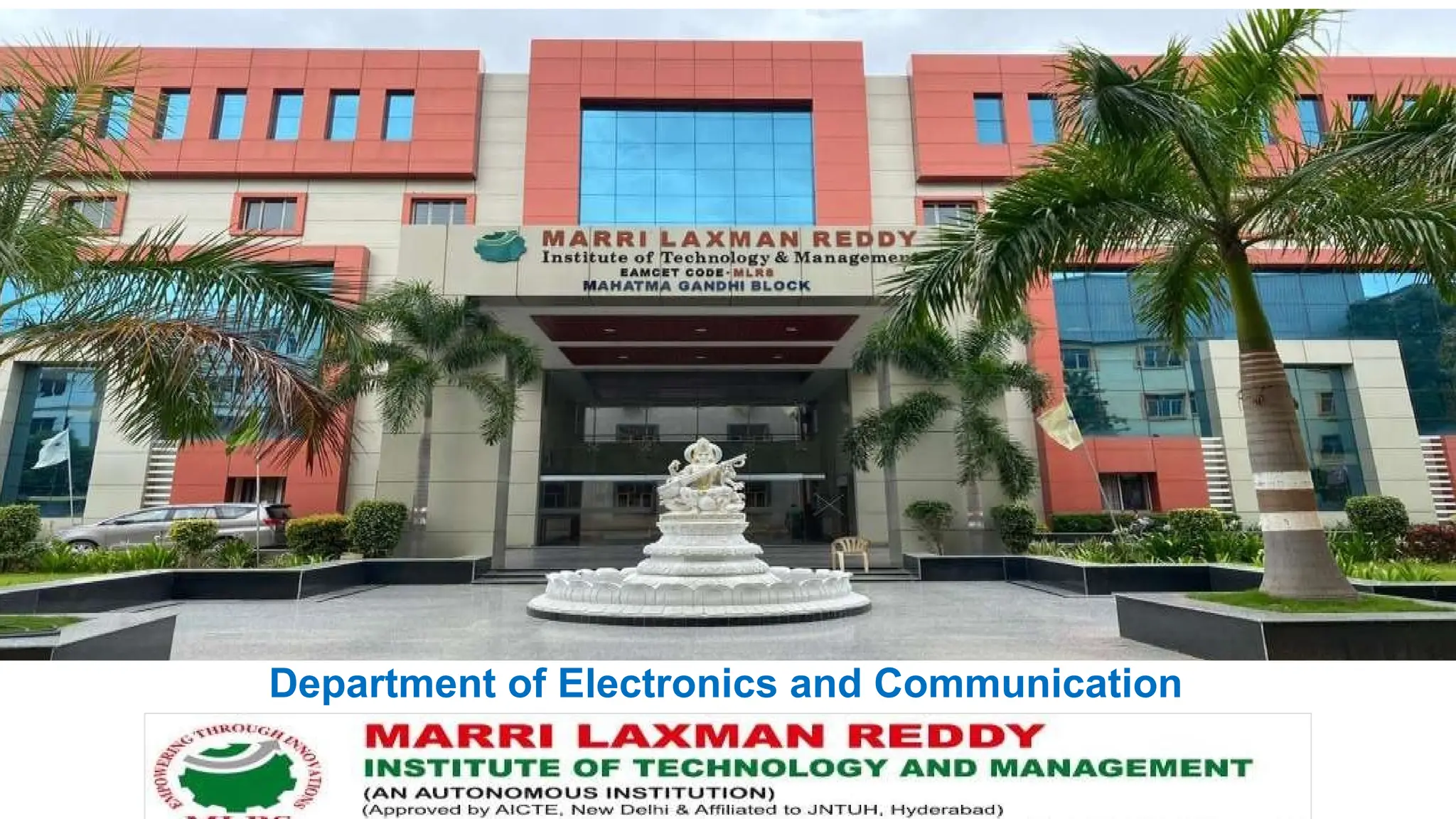
Department of Electronics and Communication
Engineering
BASICS OF ELECTRONIC DEVICES AND
CIRCUITS
B. Tech. I-Year, II-Semester
2220401: BASICS OF ELECTRONIC DEVICES AND CIRCUITS
Course Objectives:
To introduce components such as diodes, BJTs and FETs.
To know the applications of devices.
To know the switching characteristics of devices.
To understand the various types of transistor configurations
To study the special purpose devices
2220401: BASICS OF ELECTRONIC DEVICES AND CIRCUITS
At the end of this course, students will demonstrate the ability to
Understand the utilization of various semiconductor components
Acquire the knowledge of various electronic devices and their
use
on real life.
Understand the applications of various devices.
Acquire the knowledge about the role of special purpose devices.
Analyze different types of transistor characteristics
Course
Outcomes:
Diode - Static and Dynamic resistances, Equivalent circuit, Diffusion and Transition
Capacitances, V-I Characteristics, Diode as a switch- switching times.
Learning Outcomes: At the end of this unit, the student will be able to
Understand the physics of semiconductor materials
Learn the basic semiconductor device operation
Analyze the diode applications
SYLLABUS
UNIT – I : Diodes
Rectifier - Half Wave Rectifier, Full Wave Rectifier, Bridge Rectifier, Rectifiers with
Capacitive and Inductive Filters, Clippers-Clipping at two independent levels, Clamper-
Clamping Circuit Theorem, Clamping Operation, Types of Clampers equivalent circuit,
Diffusion and Transition Capacitances, V-I Characteristics, Diode as a switch- switching
times.
Learning Outcomes: At the end of this unit, the student will be able to
 Analyze the diode applications
 Understand the operation of filters, clippers, and clampers
 Understand and operation of Rectifiers
SYLLABUS
UNIT – II : Diode Applications
Principle of Operation, Common Emitter, Common Base and Common
Collector Configurations, Transistor as a switch, switching times
Learning Outcomes: At the end of this unit, the student will be able to
 Understand the operation of BJT
 Understand and analyze the various BJT configurations
 Analyze the Transistor application
SYLLABUS
UNIT – III : Bipolar Junction Transistor (BJT)
Construction, Principle of Operation, Pinch-Off Voltage, Volt- Ampere Characteristic,
Comparison of BJT and FET, FET as Voltage Variable Resistor, MOSFET, MOSTET
as a capacitor.
Learning Outcomes: At the end of this unit, the student will be able to
 Understand the operation and volt-amperes characteristics of a JFET
 Understand the MOSFET characteristics
 Analyze the FET applications
SYLLABUS
UNIT – IV : Field Effect Transistor (FET)
Zener Diode - Characteristics, Zener diode as Voltage Regulator, Principle of
Operation - SCR, Tunnel diode, UJT, Varactor Diode, Photo diode, Solar cell, LED,
Schottky diode.
Learning Outcomes: At the end of this unit, the student will be able to
 Understand the basic concepts of special purpose devices
 Analyze applications of special purpose devices
 Understand operations of special purpose devices
SYLLABUS
UNIT – V : Special Purpose Devices
TEXT BOOKS:
1.Jacob Millman, Christos C. Halkias, and Satyabrata Jit, “Electronic Devices and
Circuits”, 3rd
Edition., Mc-Graw Hill Education, 2010.
2.Robert L. Boylestad, Louis Nashelsky, “Electronic Devices and Circuits theory” 11th
Edition, Pearson, 2013.
REFERENCES:
1.Donald Neamen, Dhrubes Biswas, “Semiconductor Physics and Devices” 4th
Edition, McGraw Hill Education, 2017.
2.Steven T. Karris, “Electronic Devices and Amplifier Circuits with MATLAB
Applications” Orchard Publications, 3rd Edition 2005.
3.Paul Horowitz, Winfield Hill, “The Art of Electronics” 3rd Edition Cambridge
University Press, 1994.
BEDC UNIT – I introduction about diode and syallabys

  • 1.
    Department of ECE MLRITMMPMC – Unit I Department of Electronics and Communication Engineering
  • 2.
    BASICS OF ELECTRONICDEVICES AND CIRCUITS B. Tech. I-Year, II-Semester
  • 3.
    2220401: BASICS OFELECTRONIC DEVICES AND CIRCUITS Course Objectives: To introduce components such as diodes, BJTs and FETs. To know the applications of devices. To know the switching characteristics of devices. To understand the various types of transistor configurations To study the special purpose devices
  • 4.
    2220401: BASICS OFELECTRONIC DEVICES AND CIRCUITS At the end of this course, students will demonstrate the ability to Understand the utilization of various semiconductor components Acquire the knowledge of various electronic devices and their use on real life. Understand the applications of various devices. Acquire the knowledge about the role of special purpose devices. Analyze different types of transistor characteristics Course Outcomes:
  • 5.
    Diode - Staticand Dynamic resistances, Equivalent circuit, Diffusion and Transition Capacitances, V-I Characteristics, Diode as a switch- switching times. Learning Outcomes: At the end of this unit, the student will be able to Understand the physics of semiconductor materials Learn the basic semiconductor device operation Analyze the diode applications SYLLABUS UNIT – I : Diodes
  • 6.
    Rectifier - HalfWave Rectifier, Full Wave Rectifier, Bridge Rectifier, Rectifiers with Capacitive and Inductive Filters, Clippers-Clipping at two independent levels, Clamper- Clamping Circuit Theorem, Clamping Operation, Types of Clampers equivalent circuit, Diffusion and Transition Capacitances, V-I Characteristics, Diode as a switch- switching times. Learning Outcomes: At the end of this unit, the student will be able to  Analyze the diode applications  Understand the operation of filters, clippers, and clampers  Understand and operation of Rectifiers SYLLABUS UNIT – II : Diode Applications
  • 7.
    Principle of Operation,Common Emitter, Common Base and Common Collector Configurations, Transistor as a switch, switching times Learning Outcomes: At the end of this unit, the student will be able to  Understand the operation of BJT  Understand and analyze the various BJT configurations  Analyze the Transistor application SYLLABUS UNIT – III : Bipolar Junction Transistor (BJT)
  • 8.
    Construction, Principle ofOperation, Pinch-Off Voltage, Volt- Ampere Characteristic, Comparison of BJT and FET, FET as Voltage Variable Resistor, MOSFET, MOSTET as a capacitor. Learning Outcomes: At the end of this unit, the student will be able to  Understand the operation and volt-amperes characteristics of a JFET  Understand the MOSFET characteristics  Analyze the FET applications SYLLABUS UNIT – IV : Field Effect Transistor (FET)
  • 9.
    Zener Diode -Characteristics, Zener diode as Voltage Regulator, Principle of Operation - SCR, Tunnel diode, UJT, Varactor Diode, Photo diode, Solar cell, LED, Schottky diode. Learning Outcomes: At the end of this unit, the student will be able to  Understand the basic concepts of special purpose devices  Analyze applications of special purpose devices  Understand operations of special purpose devices SYLLABUS UNIT – V : Special Purpose Devices
  • 10.
    TEXT BOOKS: 1.Jacob Millman,Christos C. Halkias, and Satyabrata Jit, “Electronic Devices and Circuits”, 3rd Edition., Mc-Graw Hill Education, 2010. 2.Robert L. Boylestad, Louis Nashelsky, “Electronic Devices and Circuits theory” 11th Edition, Pearson, 2013. REFERENCES: 1.Donald Neamen, Dhrubes Biswas, “Semiconductor Physics and Devices” 4th Edition, McGraw Hill Education, 2017. 2.Steven T. Karris, “Electronic Devices and Amplifier Circuits with MATLAB Applications” Orchard Publications, 3rd Edition 2005. 3.Paul Horowitz, Winfield Hill, “The Art of Electronics” 3rd Edition Cambridge University Press, 1994.