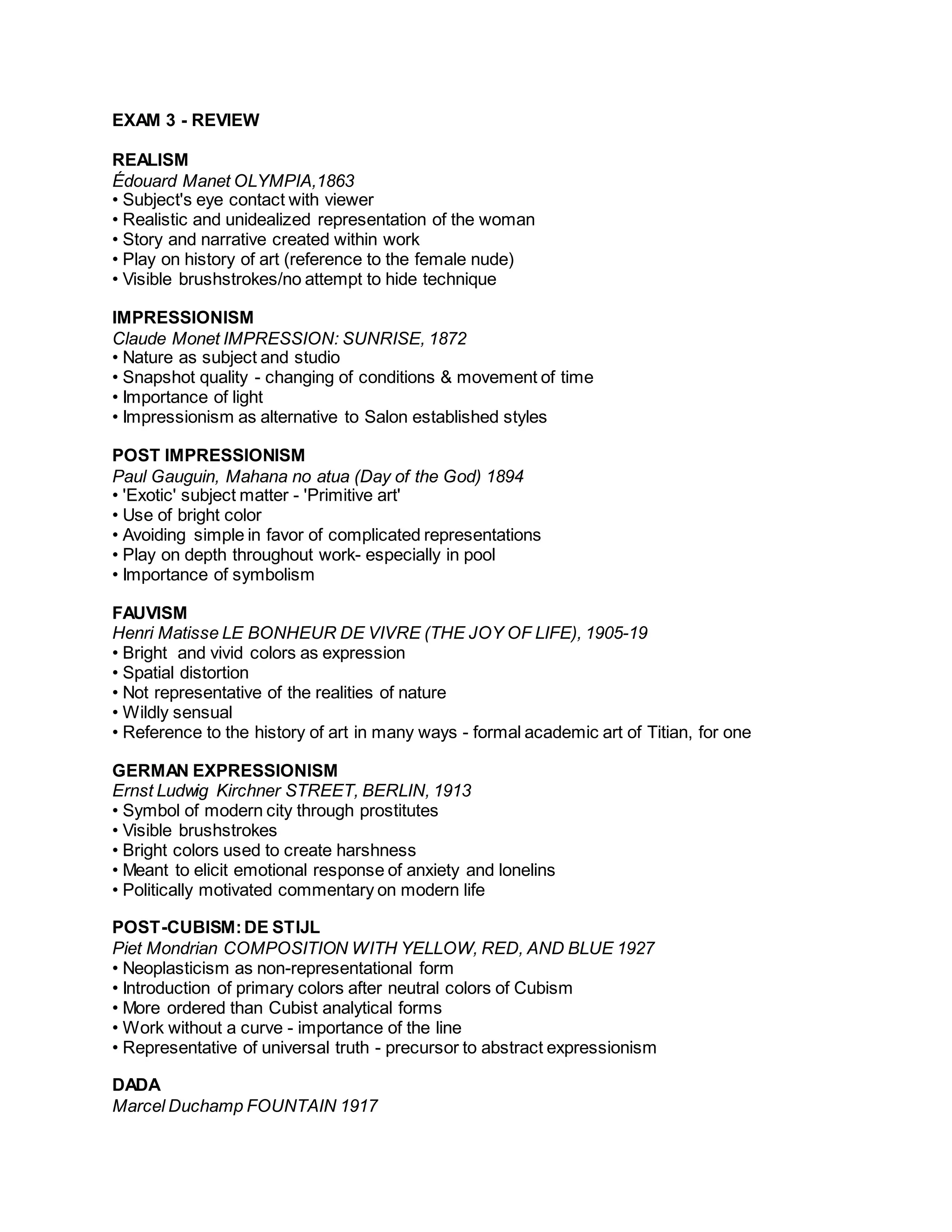
EXAM 3 - REVIEW
REALISM
Édouard Manet OLYMPIA,1863
• Subject's eye contact with viewer
• Realistic and unidealized representation of the woman
• Story and narrative created within work
• Play on history of art (reference to the female nude)
• Visible brushstrokes/no attempt to hide technique
IMPRESSIONISM
Claude Monet IMPRESSION: SUNRISE, 1872
• Nature as subject and studio
• Snapshot quality - changing of conditions & movement of time
• Importance of light
• Impressionism as alternative to Salon established styles
POST IMPRESSIONISM
Paul Gauguin, Mahana no atua (Day of the God) 1894
• 'Exotic' subject matter - 'Primitive art'
• Use of bright color
• Avoiding simple in favor of complicated representations
• Play on depth throughout work- especially in pool
• Importance of symbolism
FAUVISM
Henri Matisse LE BONHEUR DE VIVRE (THE JOY OF LIFE), 1905-19
• Bright and vivid colors as expression
• Spatial distortion
• Not representative of the realities of nature
• Wildly sensual
• Reference to the history of art in many ways - formal academic art of Titian, for one
GERMAN EXPRESSIONISM
Ernst Ludwig Kirchner STREET, BERLIN, 1913
• Symbol of modern city through prostitutes
• Visible brushstrokes
• Bright colors used to create harshness
• Meant to elicit emotional response of anxiety and lonelins
• Politically motivated commentary on modern life
POST-CUBISM:DE STIJL
Piet Mondrian COMPOSITION WITH YELLOW, RED, AND BLUE 1927
• Neoplasticism as non-representational form
• Introduction of primary colors after neutral colors of Cubism
• More ordered than Cubist analytical forms
• Work without a curve - importance of the line
• Representative of universal truth - precursor to abstract expressionism
DADA
Marcel Duchamp FOUNTAIN 1917
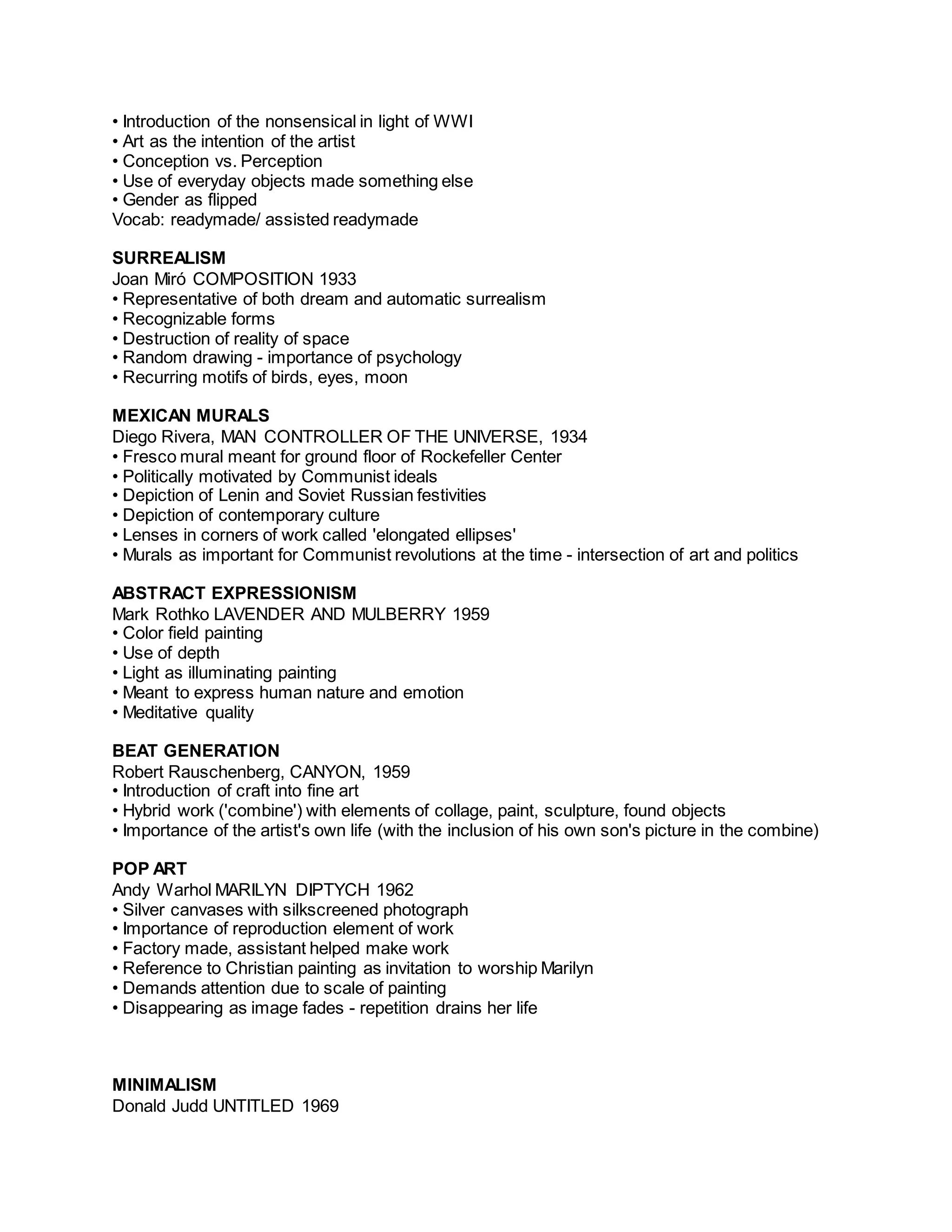
• Introduction of the nonsensical in light of WWI
• Art as the intention of the artist
• Conception vs. Perception
• Use of everyday objects made something else
• Gender as flipped
Vocab: readymade/ assisted readymade
SURREALISM
Joan Miró COMPOSITION 1933
• Representative of both dream and automatic surrealism
• Recognizable forms
• Destruction of reality of space
• Random drawing - importance of psychology
• Recurring motifs of birds, eyes, moon
MEXICAN MURALS
Diego Rivera, MAN CONTROLLER OF THE UNIVERSE, 1934
• Fresco mural meant for ground floor of Rockefeller Center
• Politically motivated by Communist ideals
• Depiction of Lenin and Soviet Russian festivities
• Depiction of contemporary culture
• Lenses in corners of work called 'elongated ellipses'
• Murals as important for Communist revolutions at the time - intersection of art and politics
ABSTRACT EXPRESSIONISM
Mark Rothko LAVENDER AND MULBERRY 1959
• Color field painting
• Use of depth
• Light as illuminating painting
• Meant to express human nature and emotion
• Meditative quality
BEAT GENERATION
Robert Rauschenberg, CANYON, 1959
• Introduction of craft into fine art
• Hybrid work ('combine') with elements of collage, paint, sculpture, found objects
• Importance of the artist's own life (with the inclusion of his own son's picture in the combine)
POP ART
Andy Warhol MARILYN DIPTYCH 1962
• Silver canvases with silkscreened photograph
• Importance of reproduction element of work
• Factory made, assistant helped make work
• Reference to Christian painting as invitation to worship Marilyn
• Demands attention due to scale of painting
• Disappearing as image fades - repetition drains her life
MINIMALISM
Donald Judd UNTITLED 1969
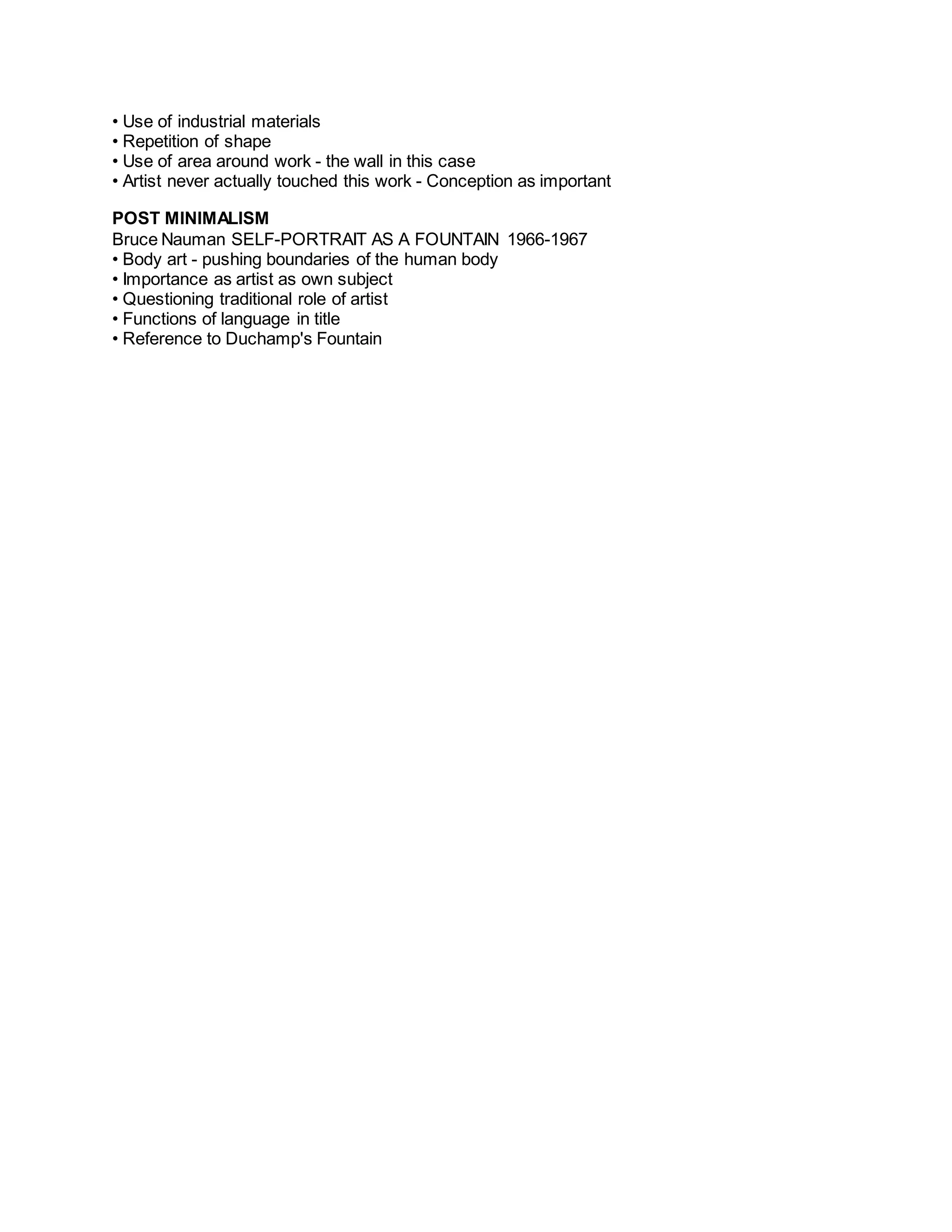
• Use of industrial materials
• Repetition of shape
• Use of area around work - the wall in this case
• Artist never actually touched this work - Conception as important
POST MINIMALISM
Bruce Nauman SELF-PORTRAIT AS A FOUNTAIN 1966-1967
• Body art - pushing boundaries of the human body
• Importance as artist as own subject
• Questioning traditional role of artist
• Functions of language in title
• Reference to Duchamp's Fountain

Exam 3 Handout

  • 1.
    EXAM 3 -REVIEW REALISM Édouard Manet OLYMPIA,1863 • Subject's eye contact with viewer • Realistic and unidealized representation of the woman • Story and narrative created within work • Play on history of art (reference to the female nude) • Visible brushstrokes/no attempt to hide technique IMPRESSIONISM Claude Monet IMPRESSION: SUNRISE, 1872 • Nature as subject and studio • Snapshot quality - changing of conditions & movement of time • Importance of light • Impressionism as alternative to Salon established styles POST IMPRESSIONISM Paul Gauguin, Mahana no atua (Day of the God) 1894 • 'Exotic' subject matter - 'Primitive art' • Use of bright color • Avoiding simple in favor of complicated representations • Play on depth throughout work- especially in pool • Importance of symbolism FAUVISM Henri Matisse LE BONHEUR DE VIVRE (THE JOY OF LIFE), 1905-19 • Bright and vivid colors as expression • Spatial distortion • Not representative of the realities of nature • Wildly sensual • Reference to the history of art in many ways - formal academic art of Titian, for one GERMAN EXPRESSIONISM Ernst Ludwig Kirchner STREET, BERLIN, 1913 • Symbol of modern city through prostitutes • Visible brushstrokes • Bright colors used to create harshness • Meant to elicit emotional response of anxiety and lonelins • Politically motivated commentary on modern life POST-CUBISM:DE STIJL Piet Mondrian COMPOSITION WITH YELLOW, RED, AND BLUE 1927 • Neoplasticism as non-representational form • Introduction of primary colors after neutral colors of Cubism • More ordered than Cubist analytical forms • Work without a curve - importance of the line • Representative of universal truth - precursor to abstract expressionism DADA Marcel Duchamp FOUNTAIN 1917
  • 2.
    • Introduction ofthe nonsensical in light of WWI • Art as the intention of the artist • Conception vs. Perception • Use of everyday objects made something else • Gender as flipped Vocab: readymade/ assisted readymade SURREALISM Joan Miró COMPOSITION 1933 • Representative of both dream and automatic surrealism • Recognizable forms • Destruction of reality of space • Random drawing - importance of psychology • Recurring motifs of birds, eyes, moon MEXICAN MURALS Diego Rivera, MAN CONTROLLER OF THE UNIVERSE, 1934 • Fresco mural meant for ground floor of Rockefeller Center • Politically motivated by Communist ideals • Depiction of Lenin and Soviet Russian festivities • Depiction of contemporary culture • Lenses in corners of work called 'elongated ellipses' • Murals as important for Communist revolutions at the time - intersection of art and politics ABSTRACT EXPRESSIONISM Mark Rothko LAVENDER AND MULBERRY 1959 • Color field painting • Use of depth • Light as illuminating painting • Meant to express human nature and emotion • Meditative quality BEAT GENERATION Robert Rauschenberg, CANYON, 1959 • Introduction of craft into fine art • Hybrid work ('combine') with elements of collage, paint, sculpture, found objects • Importance of the artist's own life (with the inclusion of his own son's picture in the combine) POP ART Andy Warhol MARILYN DIPTYCH 1962 • Silver canvases with silkscreened photograph • Importance of reproduction element of work • Factory made, assistant helped make work • Reference to Christian painting as invitation to worship Marilyn • Demands attention due to scale of painting • Disappearing as image fades - repetition drains her life MINIMALISM Donald Judd UNTITLED 1969
  • 3.
    • Use ofindustrial materials • Repetition of shape • Use of area around work - the wall in this case • Artist never actually touched this work - Conception as important POST MINIMALISM Bruce Nauman SELF-PORTRAIT AS A FOUNTAIN 1966-1967 • Body art - pushing boundaries of the human body • Importance as artist as own subject • Questioning traditional role of artist • Functions of language in title • Reference to Duchamp's Fountain