HOPPER
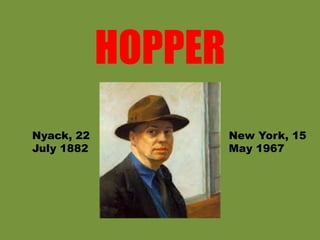
Nyack, 22
July 1882
New York, 15
May 1967
A BIT OF HIS LIFE…
• Edward Hopper (1882-1967) was born in Nyack and lived all his life in New
York. Born into a modest, middle-class family, Hopper’s interest in painting
revealed itself at a very young age. He studied commercial illustration for a
year then enrolled in the painting classes at the New York School of Art.
There Hopper joined the studio of Robert Henri, a teacher who promoted
a realism that focused on the depiction of every day American life. Having
completed his studies Hopper went to Paris where he spent an academic
year, returning there for shorter periods in the future. After that date, he
only left the United States to make a couple of short trips to Mexico.
A BIT OF HIS LIFE…
• Hopper worked formany years
as a commercial ilustrator but
from 1918 began to acquire a
reputation as a printmaker. His
Real change of fortunes, howe-
ver, came about in 1925 when
an exhibition of his watercolours at the Rehn Gallery
was completely sold out. This success allowed him to
dedicate himself entirely to painting.
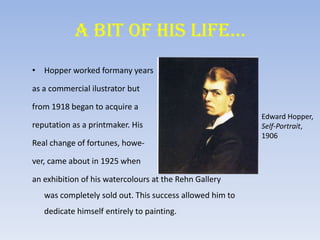
Edward Hopper,
Self-Portrait,
1906
HOW HE PAINTED
• Hopper began painting urban and architectural scenes in a dark
palette. Then he shifted to the lighter palette of the Impressionists
before returning to the darker palette with which he was
comfortable. Hopper later said, "I got over that and later things
done in Paris were more the kind of things I do now.”Hopper spent
much of his time drawing street and café scenes, and going to the
theater and opera. Unlike many of his contemporaries who imitated
the abstract cubists experiments, Hopper was attracted realist art.
HOW HE PAINTED
• Edward Hopper painted American landscapes and cityscapes
with a disturbing truth, expressing the world around him as a
chilling, alienating, and often vacuous place. Everybody in a
Hopper picture appears terribly alone. Hopper soon gained a
widespread reputation as the artist who gave visual form to
the loneliness and boredom of life in the big city. This was
something new in art, perhaps an expression of the sense of
human hopelessness that characterized the Great Depression
of the 1930s.
Road In
Maine (1914)
Queensborough
Bridge (1913)
Notre Dame de
Paris (1907)
Manhattan Bridge
Loop (1928)
Corn Hill (1930)
Sunday (1926)
Gas (1940)
• Chop Suey (1929)
Office in a Small City
(1953)
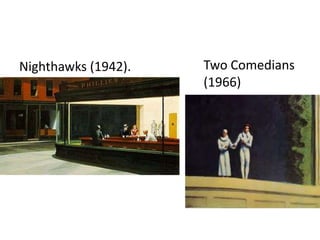
Nighthawks (1942). Two Comedians
(1966)
• Four Lane Road (1956)
Morning in a City (1944)
Hotel Room
Automat
Morning Sun
(1927)
(1931)
(1952)
• Carolina Morning
New York Movie
(1955)
(1939)
Soir Bleu (1914)
Room in New York (1932)
CURIOSITIES
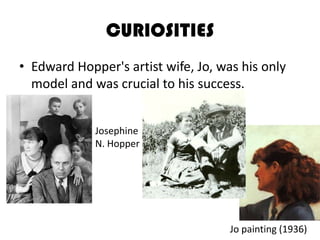
• Edward Hopper's artist wife, Jo, was his only
model and was crucial to his success.
Josephine
N. Hopper
Jo painting (1936)
CURIOSITIES
Intermission (1963)
Jo in Wyoming (1946)
CURIOSITIES
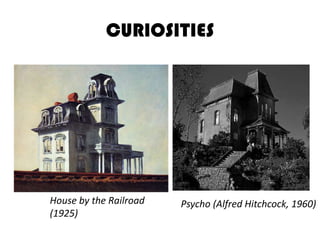
House by the Railroad
(1925)
Psycho (Alfred Hitchcock, 1960)
A bit of his life
• Hopper died the 15th of May 1967 in his
studio in NYC near Washington Square. His
wife, who died 10 months later, bequeathed
their joint collection of over three thousand
works to the Whitney Museum of American
Art. He is buried with his wife Jo in the Oak
Hill Cemetery in Nyack, the place where he
was born.

Hopper exhibition

  • 1.
  • 2.
    A BIT OFHIS LIFE… • Edward Hopper (1882-1967) was born in Nyack and lived all his life in New York. Born into a modest, middle-class family, Hopper’s interest in painting revealed itself at a very young age. He studied commercial illustration for a year then enrolled in the painting classes at the New York School of Art. There Hopper joined the studio of Robert Henri, a teacher who promoted a realism that focused on the depiction of every day American life. Having completed his studies Hopper went to Paris where he spent an academic year, returning there for shorter periods in the future. After that date, he only left the United States to make a couple of short trips to Mexico.
  • 3.
    A BIT OFHIS LIFE… • Hopper worked formany years as a commercial ilustrator but from 1918 began to acquire a reputation as a printmaker. His Real change of fortunes, howe- ver, came about in 1925 when an exhibition of his watercolours at the Rehn Gallery was completely sold out. This success allowed him to dedicate himself entirely to painting. Edward Hopper, Self-Portrait, 1906
  • 5.
    HOW HE PAINTED •Hopper began painting urban and architectural scenes in a dark palette. Then he shifted to the lighter palette of the Impressionists before returning to the darker palette with which he was comfortable. Hopper later said, "I got over that and later things done in Paris were more the kind of things I do now.”Hopper spent much of his time drawing street and café scenes, and going to the theater and opera. Unlike many of his contemporaries who imitated the abstract cubists experiments, Hopper was attracted realist art.
  • 6.
    HOW HE PAINTED •Edward Hopper painted American landscapes and cityscapes with a disturbing truth, expressing the world around him as a chilling, alienating, and often vacuous place. Everybody in a Hopper picture appears terribly alone. Hopper soon gained a widespread reputation as the artist who gave visual form to the loneliness and boredom of life in the big city. This was something new in art, perhaps an expression of the sense of human hopelessness that characterized the Great Depression of the 1930s.
  • 7.
    Road In Maine (1914) Queensborough Bridge(1913) Notre Dame de Paris (1907) Manhattan Bridge Loop (1928)
  • 8.
    Corn Hill (1930) Sunday(1926) Gas (1940)
  • 9.
    • Chop Suey(1929) Office in a Small City (1953)
  • 10.
    Nighthawks (1942). TwoComedians (1966)
  • 11.
    • Four LaneRoad (1956) Morning in a City (1944)
  • 12.
  • 13.
    • Carolina Morning NewYork Movie (1955) (1939)
  • 14.
    Soir Bleu (1914) Roomin New York (1932)
  • 15.
    CURIOSITIES • Edward Hopper'sartist wife, Jo, was his only model and was crucial to his success. Josephine N. Hopper Jo painting (1936)
  • 16.
  • 17.
    CURIOSITIES House by theRailroad (1925) Psycho (Alfred Hitchcock, 1960)
  • 18.
    A bit ofhis life • Hopper died the 15th of May 1967 in his studio in NYC near Washington Square. His wife, who died 10 months later, bequeathed their joint collection of over three thousand works to the Whitney Museum of American Art. He is buried with his wife Jo in the Oak Hill Cemetery in Nyack, the place where he was born.