FHO Fachhochschule Ostschweiz
EduID Mobile App
Use-cases, Concepts, Implementation
@phish108 @htwblc
Part I
Use Cases and Concepts
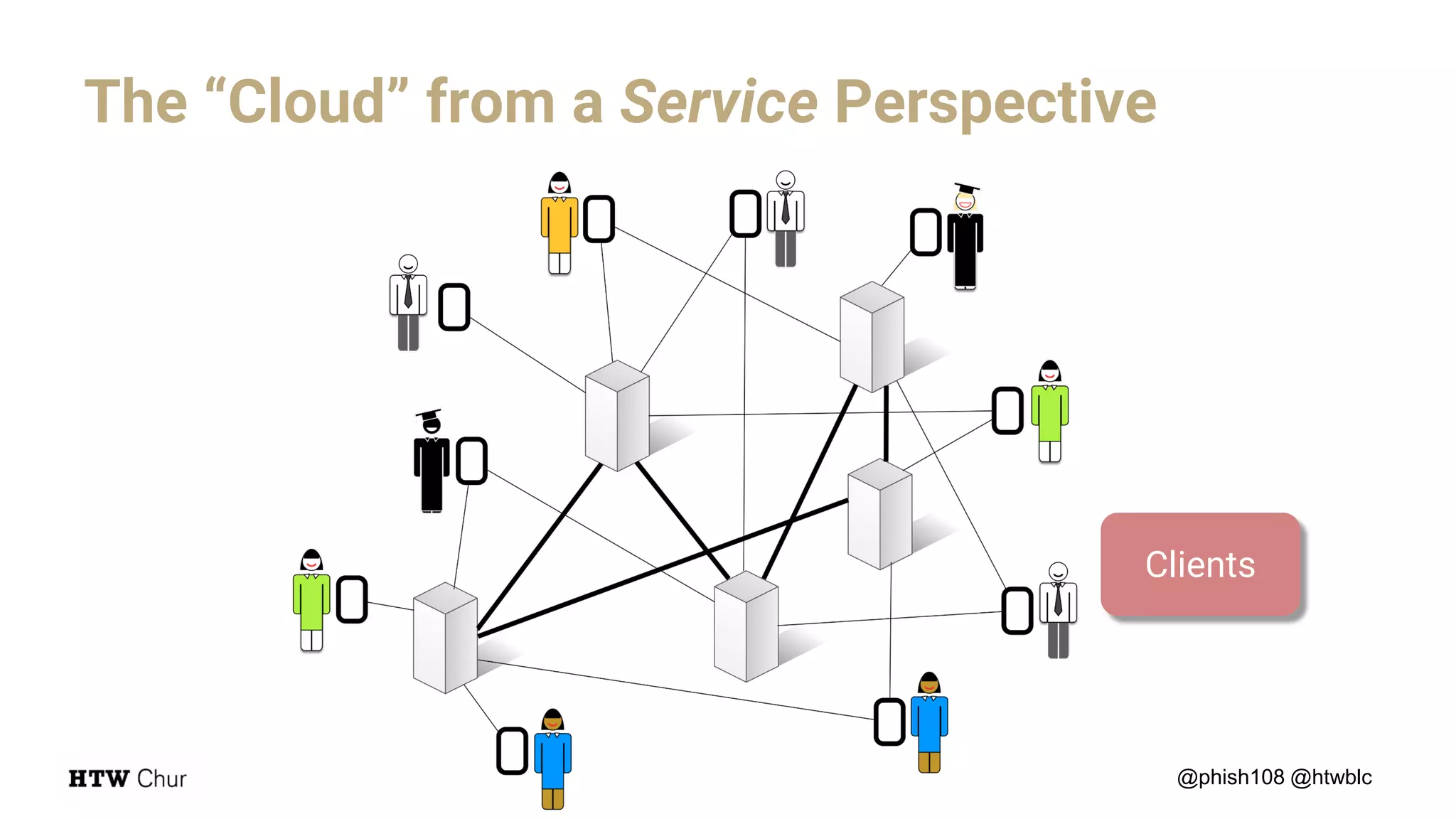
The “Cloud” from a Service Perspective
Clients
@phish108 @htwblc
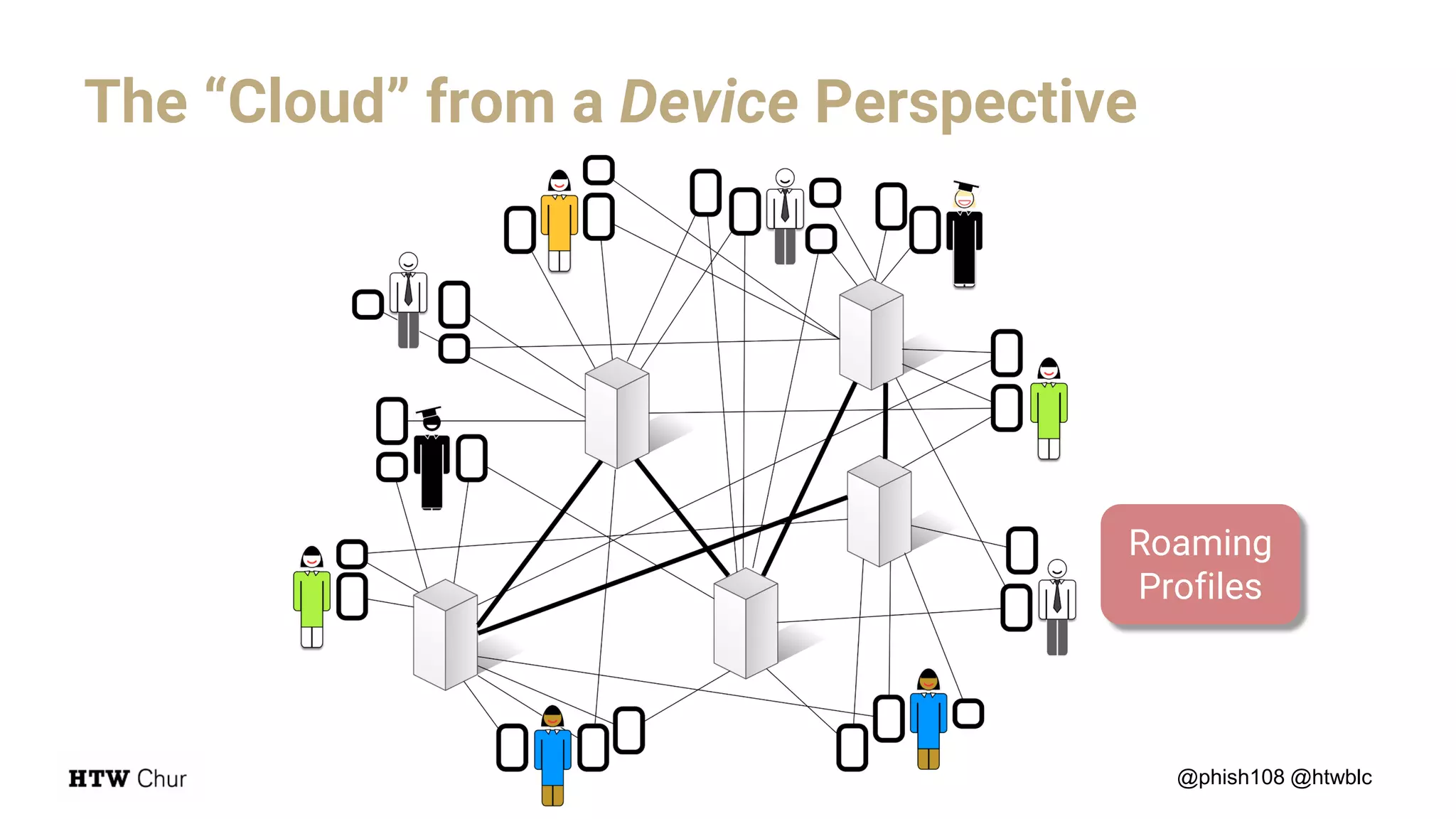
The “Cloud” from a Device Perspective
Roaming
Profiles
@phish108 @htwblc
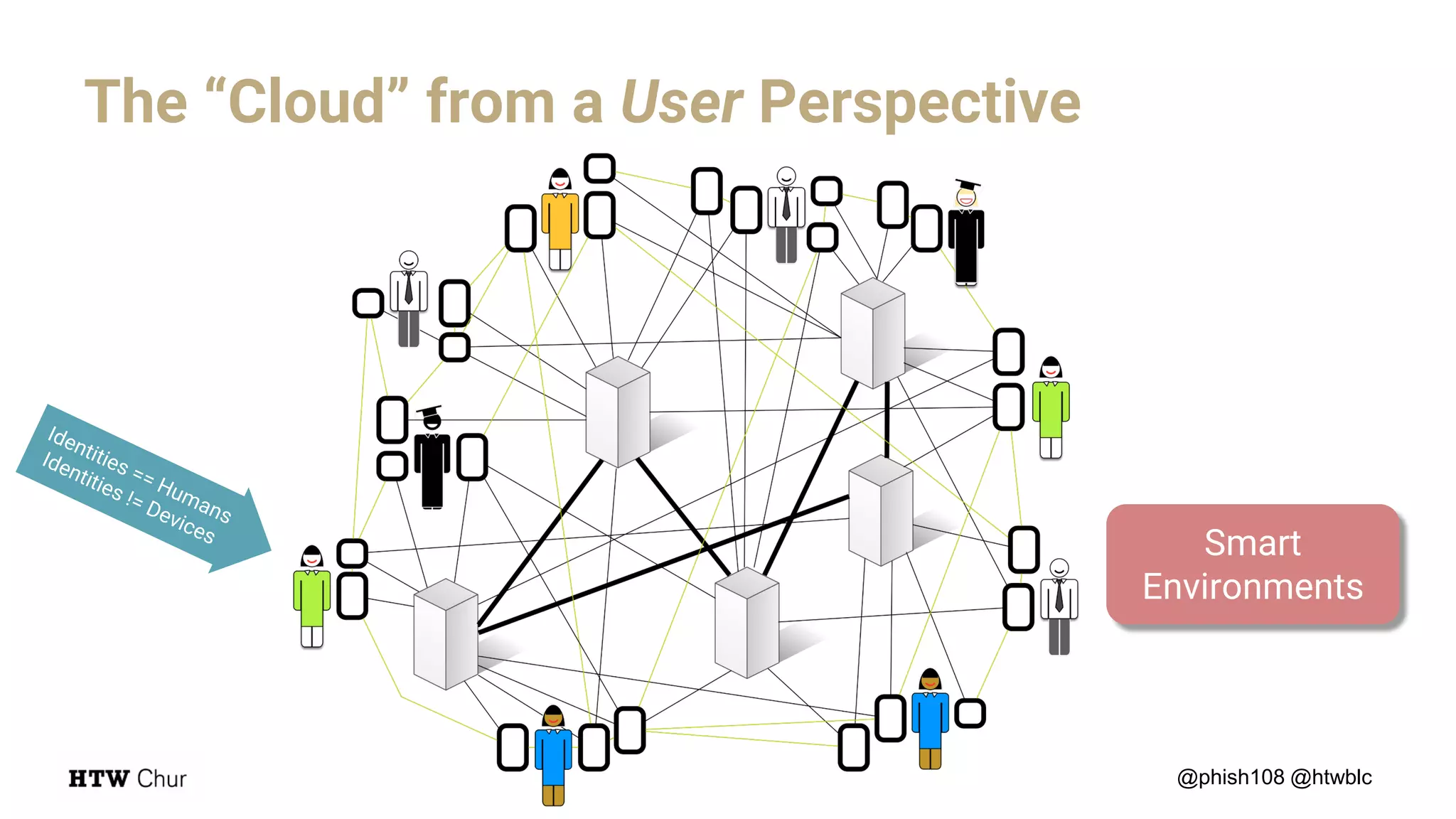
The “Cloud” from a User Perspective
Smart
Environments
@phish108 @htwblc
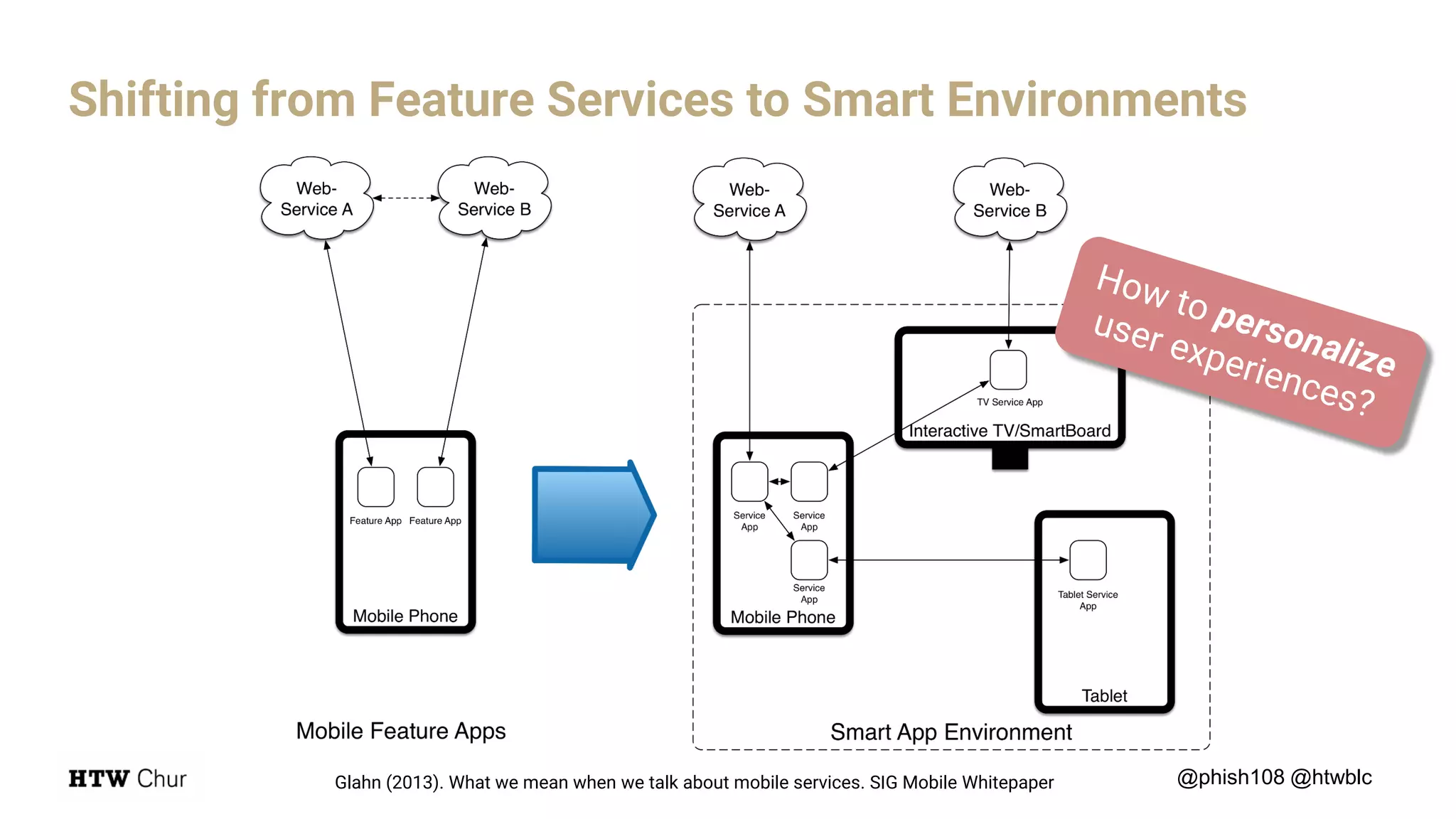
Shifting from Feature Services to Smart Environments
Glahn (2013). What we mean when we talk about mobile services. SIG Mobile Whitepaper @phish108 @htwblc
Personalization requires Authorization
Seite 6
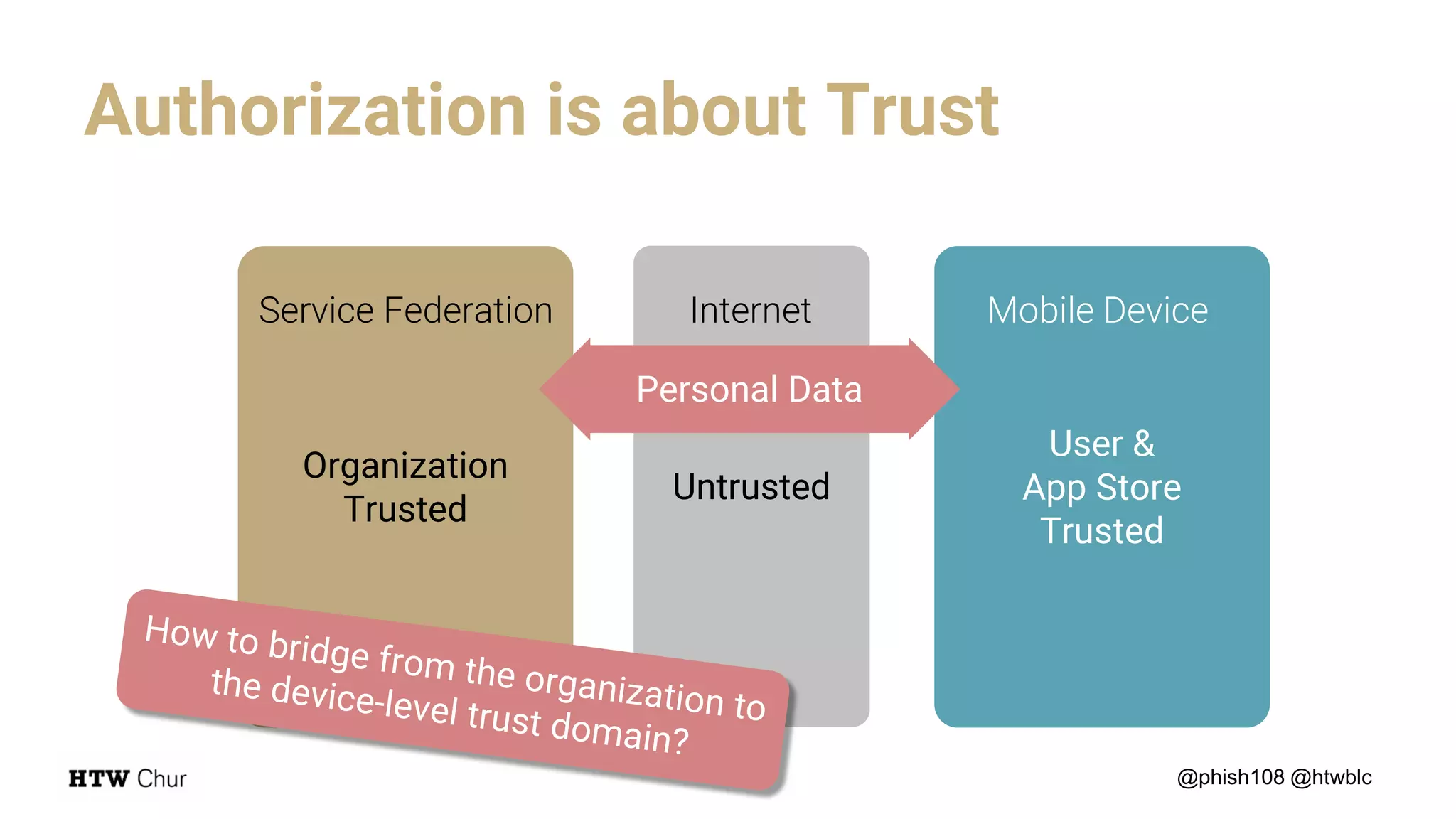
Authorization is about Trust
Organization
Trusted
User &
App Store
Trusted
Mobile DeviceService Federation
Untrusted
Personal Data
Internet
@phish108 @htwblc
1. OIDC for Responsive Web-Apps
2. AppAuth for tightly integrated native mobile apps
3. Token Agent Authorization for loosely coupled native apps
@phish108 @htwblc
3 Approaches
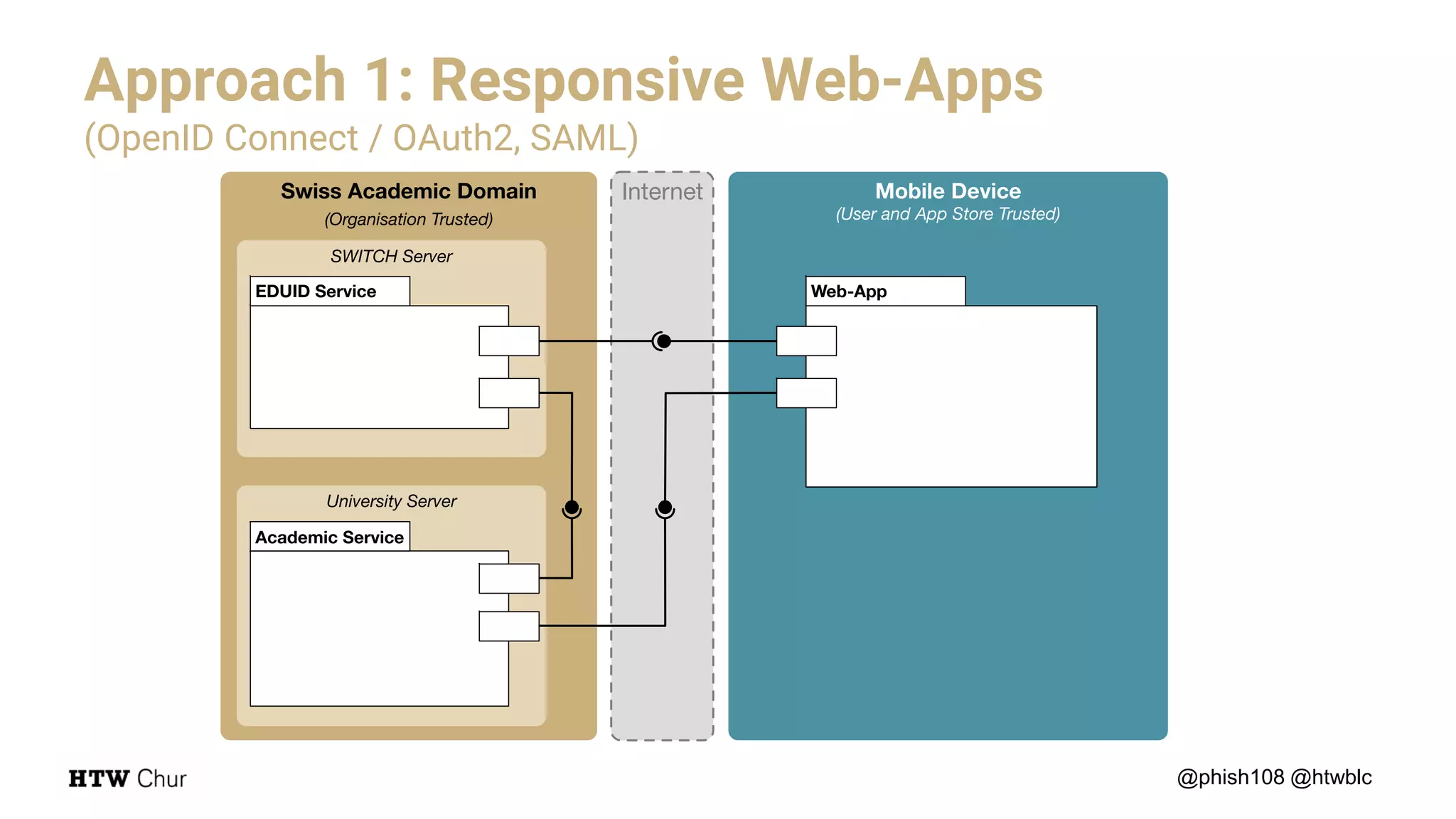
Approach 1: Responsive Web-Apps
(OpenID Connect / OAuth2, SAML)
@phish108 @htwblc
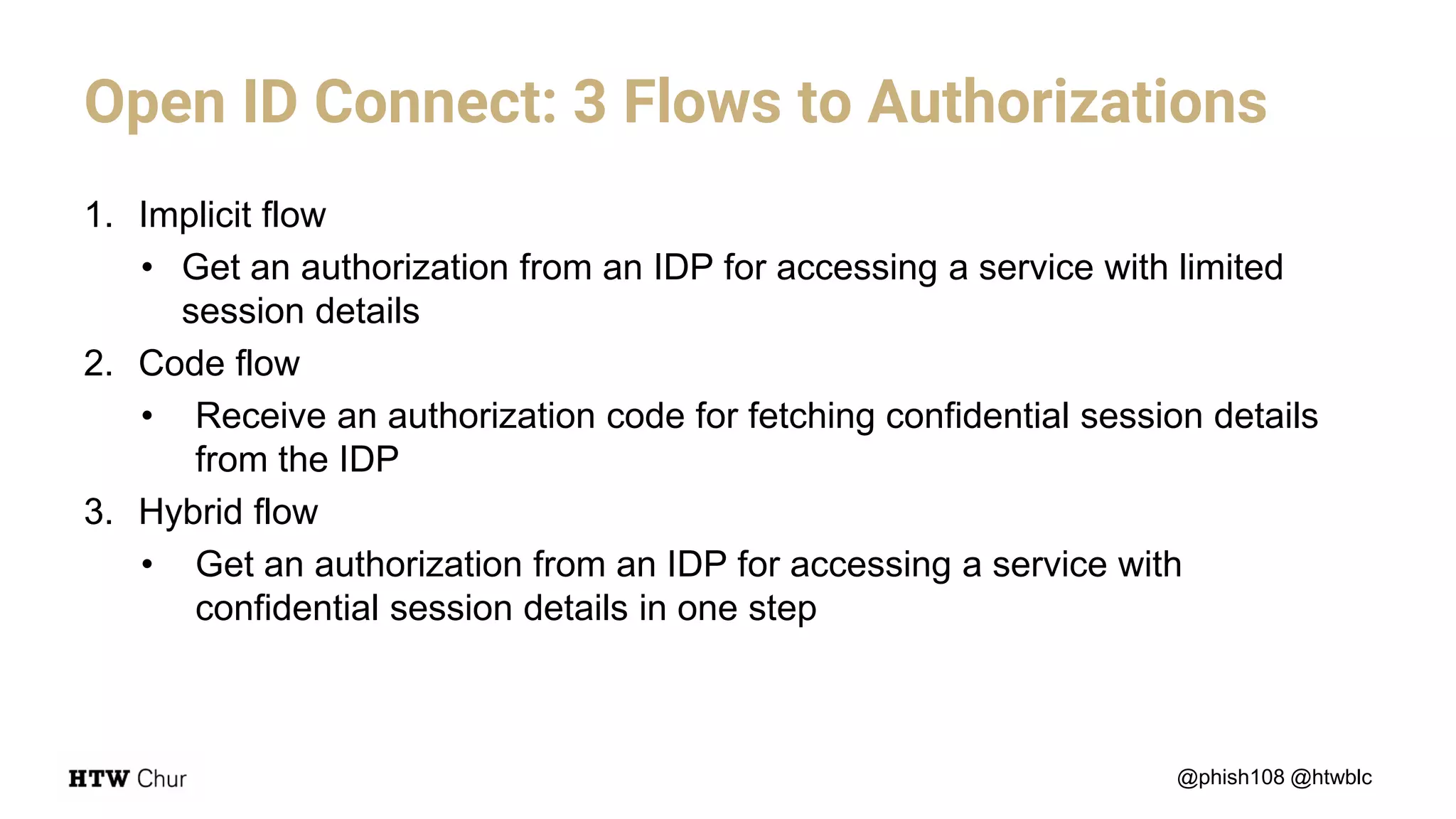
Open ID Connect: 3 Flows to Authorizations
@phish108 @htwblc
1. Implicit flow
• Get an authorization from an IDP for accessing a service with limited
session details
2. Code flow
• Receive an authorization code for fetching confidential session details
from the IDP
3. Hybrid flow
• Get an authorization from an IDP for accessing a service with
confidential session details in one step
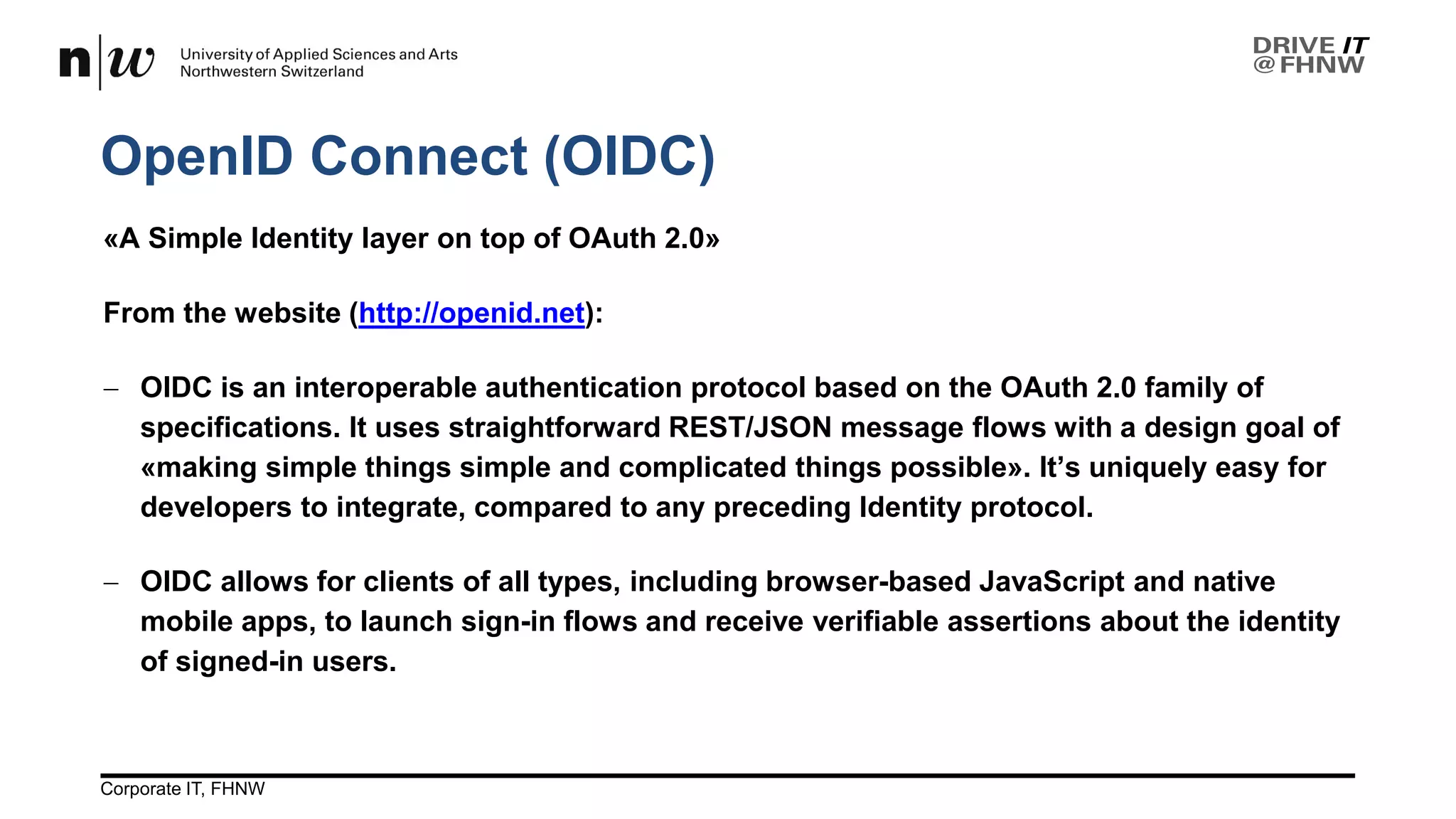
OpenID Connect (OIDC)
26.04.2017Corporate IT, FHNW 11
«A Simple Identity layer on top of OAuth 2.0»
From the website (http://openid.net):
− OIDC is an interoperable authentication protocol based on the OAuth 2.0 family of
specifications. It uses straightforward REST/JSON message flows with a design goal of
«making simple things simple and complicated things possible». It’s uniquely easy for
developers to integrate, compared to any preceding Identity protocol.
− OIDC allows for clients of all types, including browser-based JavaScript and native
mobile apps, to launch sign-in flows and receive verifiable assertions about the identity
of signed-in users.
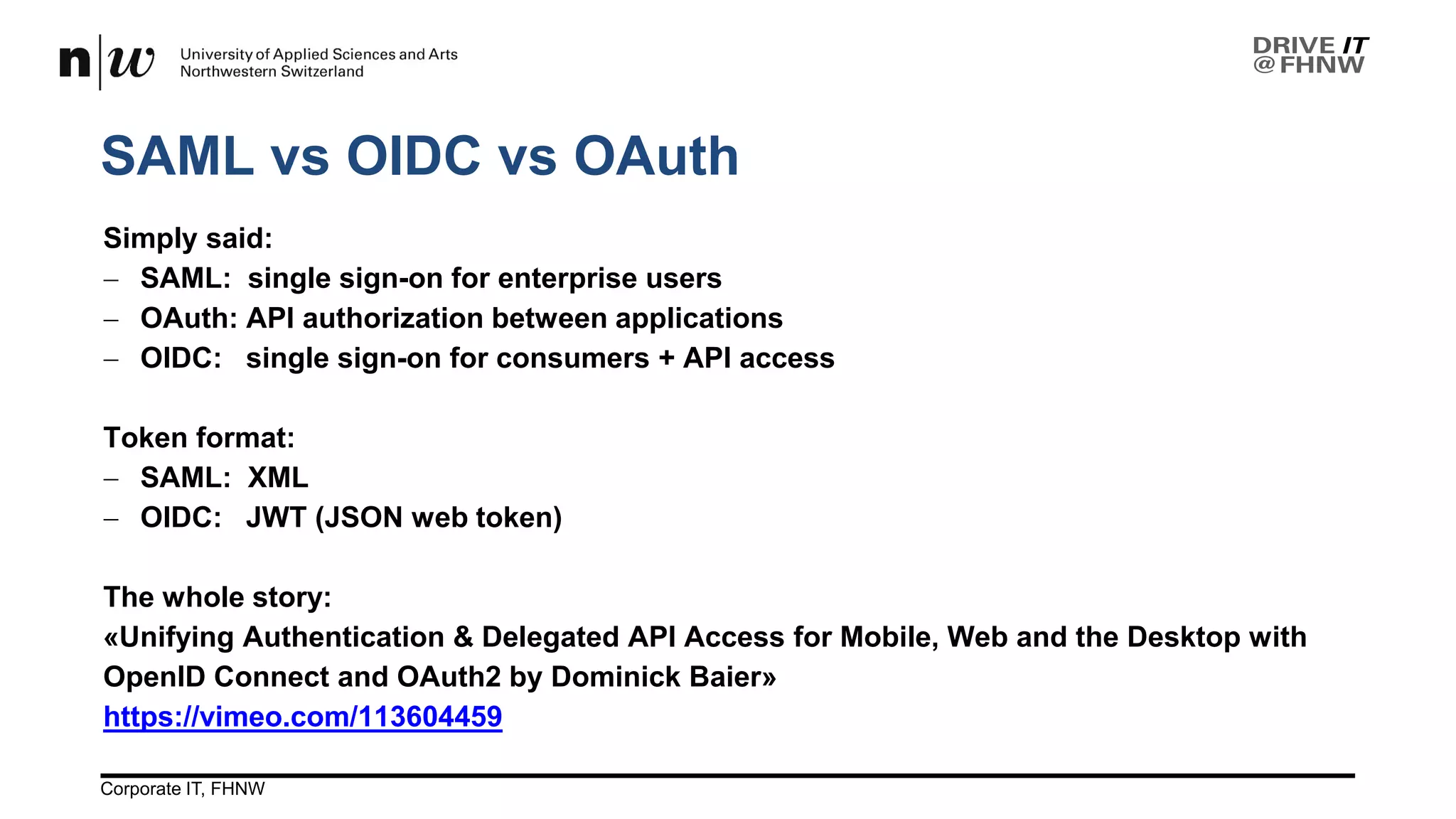
SAML vs OIDC vs OAuth
26.04.2017Corporate IT, FHNW 12
Simply said:
− SAML: single sign-on for enterprise users
− OAuth: API authorization between applications
− OIDC: single sign-on for consumers + API access
Token format:
− SAML: XML
− OIDC: JWT (JSON web token)
The whole story:
«Unifying Authentication & Delegated API Access for Mobile, Web and the Desktop with
OpenID Connect and OAuth2 by Dominick Baier»
https://vimeo.com/113604459
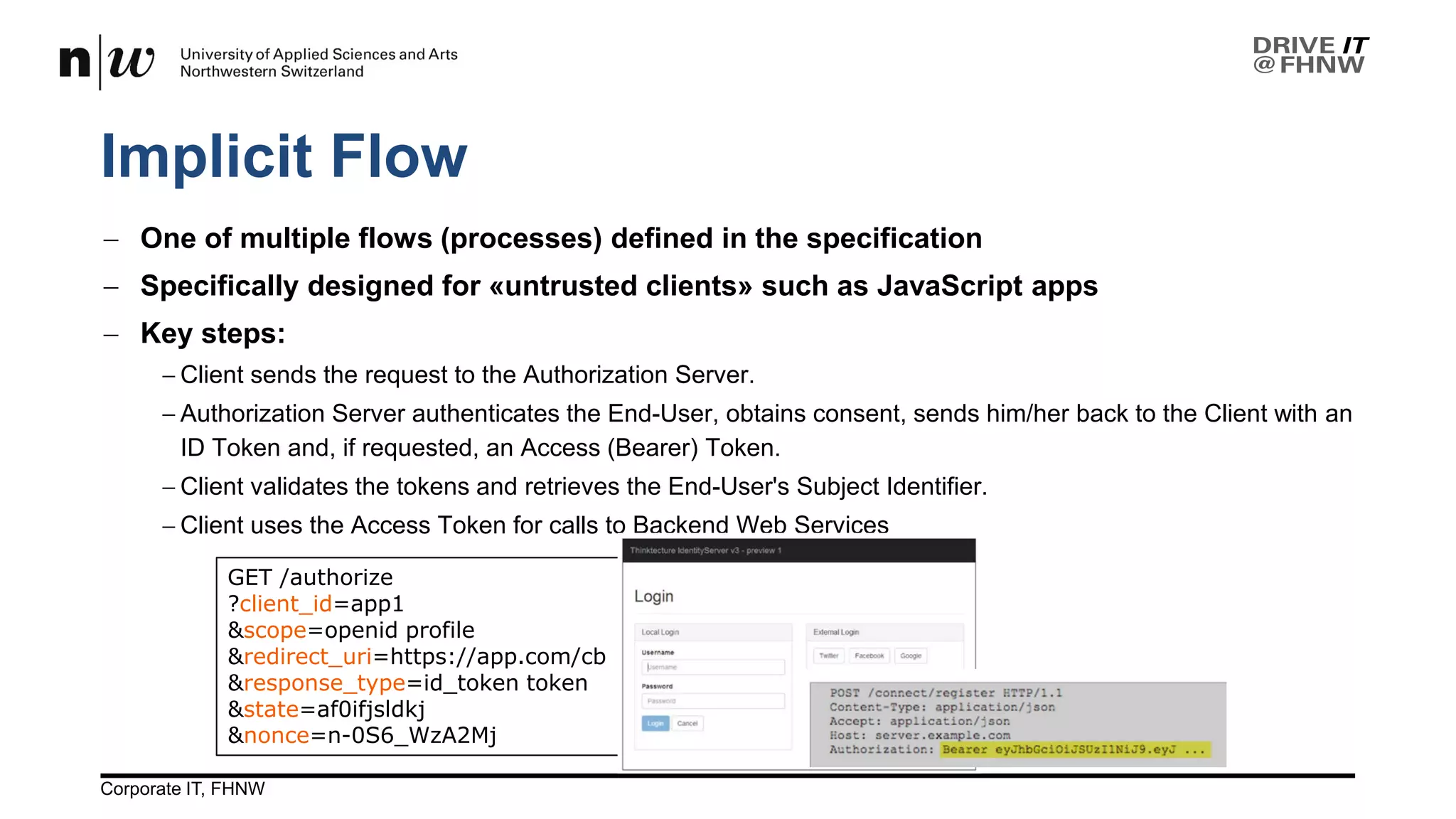
GET /authorize
?client_id=app1
&scope=openid profile
&redirect_uri=https://app.com/cb
&response_type=id_token token
&state=af0ifjsldkj
&nonce=n-0S6_WzA2Mj
Implicit Flow
26.04.2017Corporate IT, FHNW 13
− One of multiple flows (processes) defined in the specification
− Specifically designed for «untrusted clients» such as JavaScript apps
− Key steps:
− Client sends the request to the Authorization Server.
− Authorization Server authenticates the End-User, obtains consent, sends him/her back to the Client with an
ID Token and, if requested, an Access (Bearer) Token.
− Client validates the tokens and retrieves the End-User's Subject Identifier.
− Client uses the Access Token for calls to Backend Web Services
@phish108 @htwblc
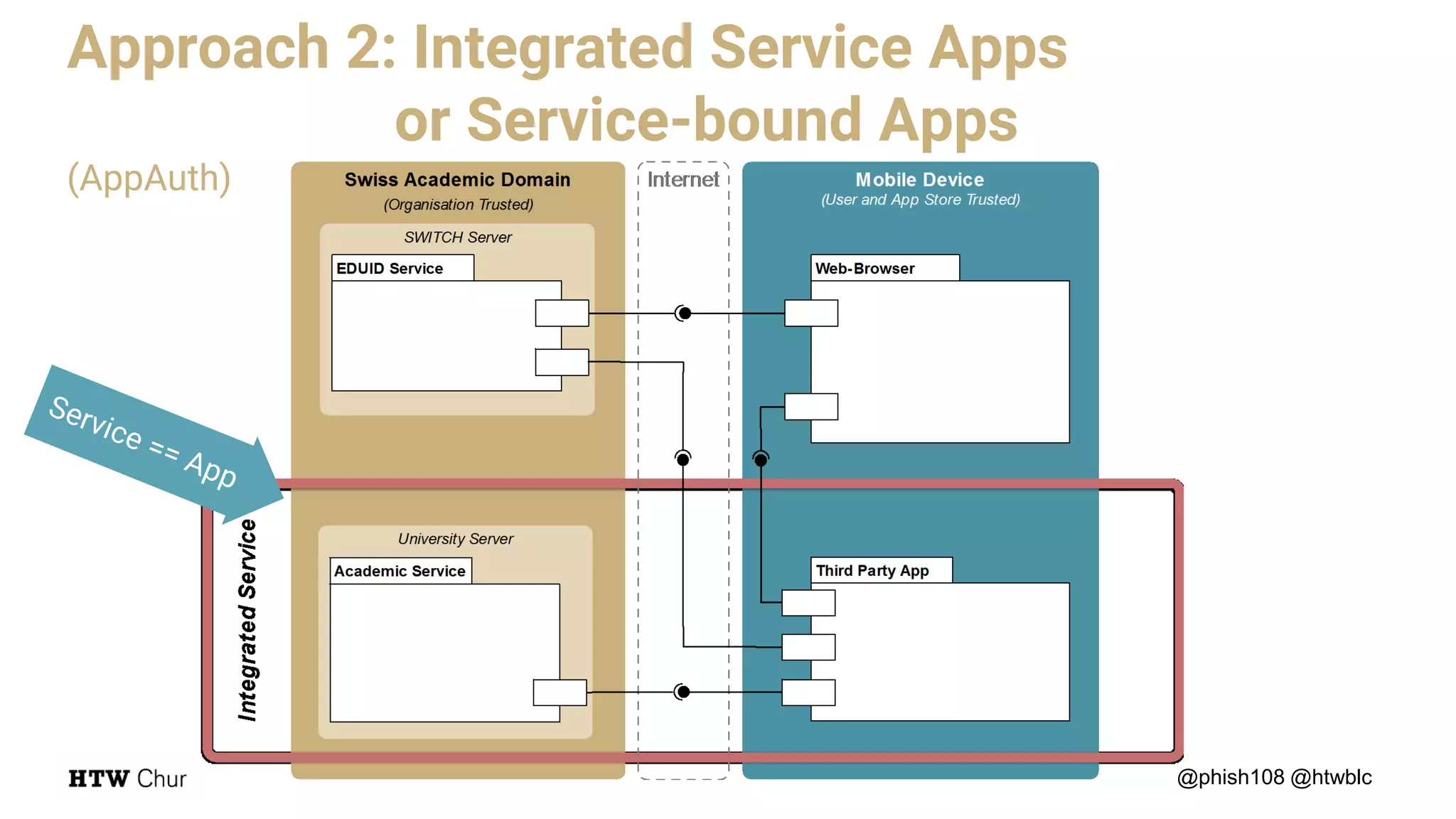
Approach 2: Integrated Service Apps
or Service-bound Apps
(AppAuth)
© 2017 SWITCH | 15
Startseite Untertitel
Unternehmenspräsentation
Christoph Graf, Rolf Brugger
swisseduid@switch.ch
SIG Mobile, 25.4.2017 @SWITCH
Use case of a “Service-bound Mobile App”
SWITCHdrive App
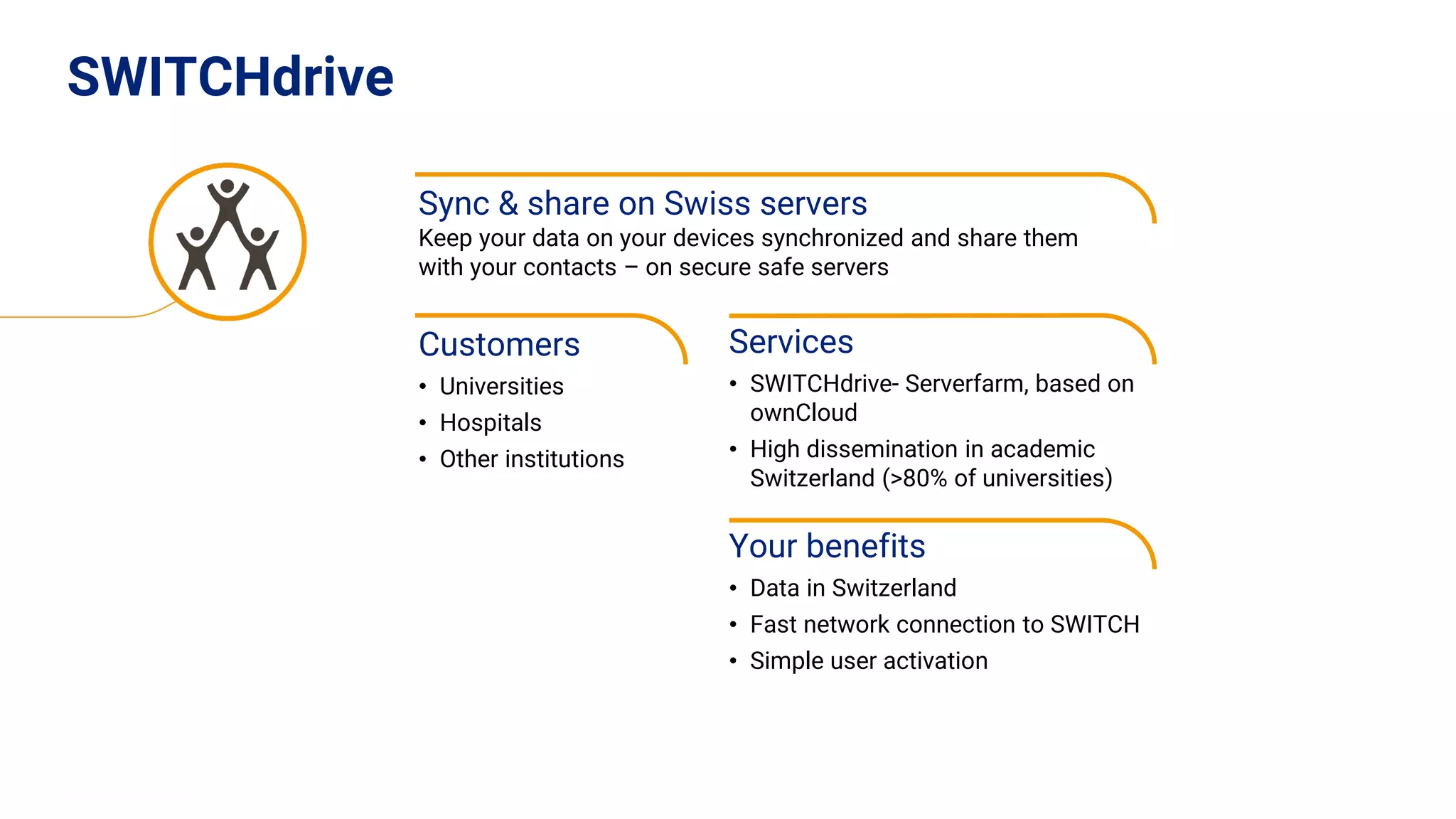
SWITCHdrive
Sync & share on Swiss servers
Keep your data on your devices synchronized and share them
with your contacts – on secure safe servers
Your benefits
• Data in Switzerland
• Fast network connection to SWITCH
• Simple user activation
Customers
• Universities
• Hospitals
• Other institutions
Services
• SWITCHdrive- Serverfarm, based on
ownCloud
• High dissemination in academic
Switzerland (>80% of universities)
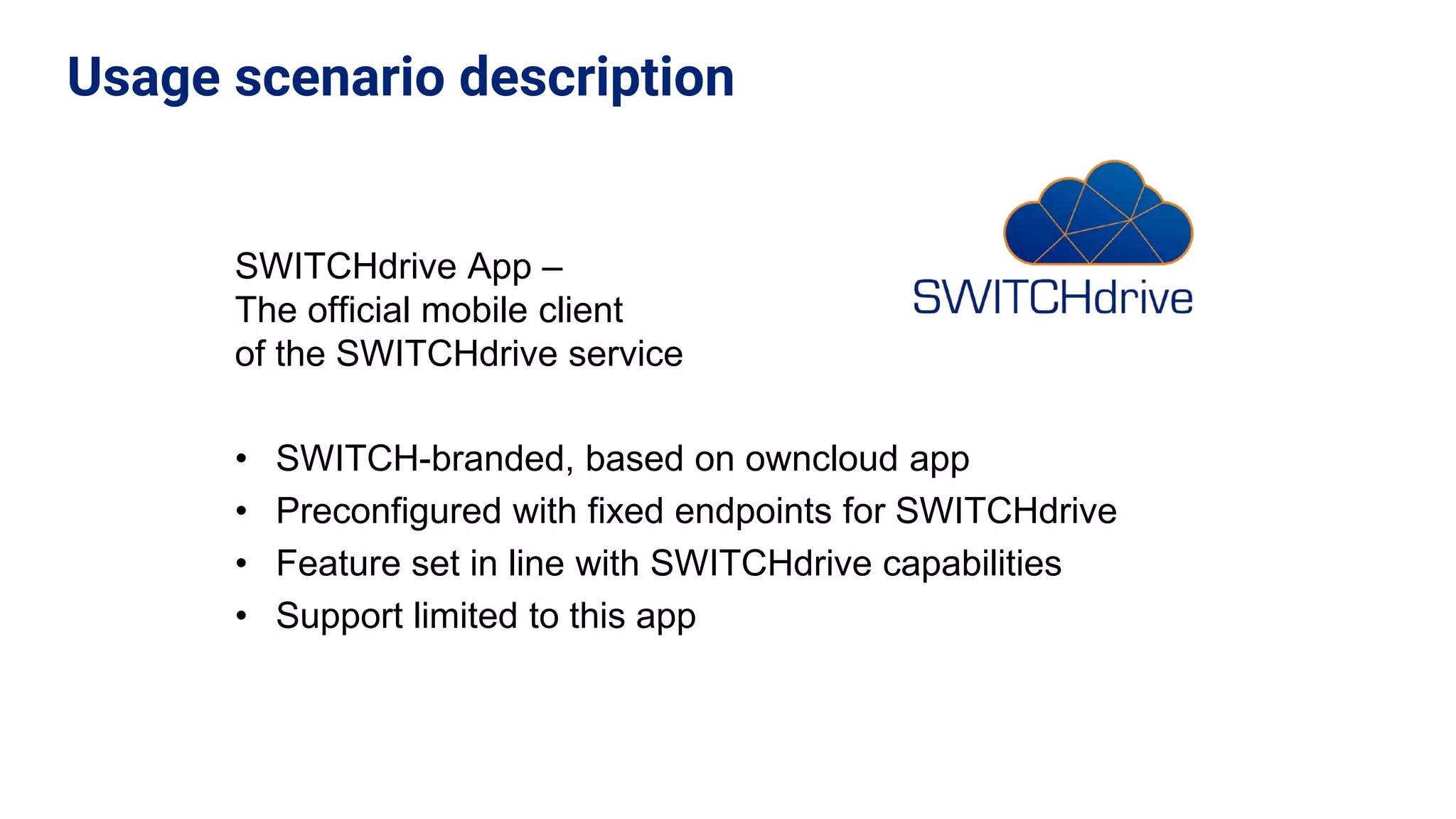
SWITCHdrive App –
The official mobile client
of the SWITCHdrive service
• SWITCH-branded, based on owncloud app
• Preconfigured with fixed endpoints for SWITCHdrive
• Feature set in line with SWITCHdrive capabilities
• Support limited to this app
Usage scenario description
• Controlling the user experience end-to-end
• Service branding opportunity (CI/CD)
• Needs to maintain an app
(development/adaptation/preconfiguration/testing,
mobile martketplaces, etc.)
• One single app to document and support
• No re-use opportunity of potentially compatible app
Service operator perspective
• Opportunity to develop, adapt, brand, preconfigure or
support app exclusively for specific services as a
contractor to service operator
• (Probably) no opportunity to offer alternatives to users
bypassing service operator
• Uses standard authentication mechanisms (AppAuth,
OAuth2, OIDC): availability of libraries, development
and testing tools, tutorials.
App developer perspective
www.switch.ch/30years
SWITCH – an integral part of the Swiss
academic community since 1987.
@phish108 @htwblc
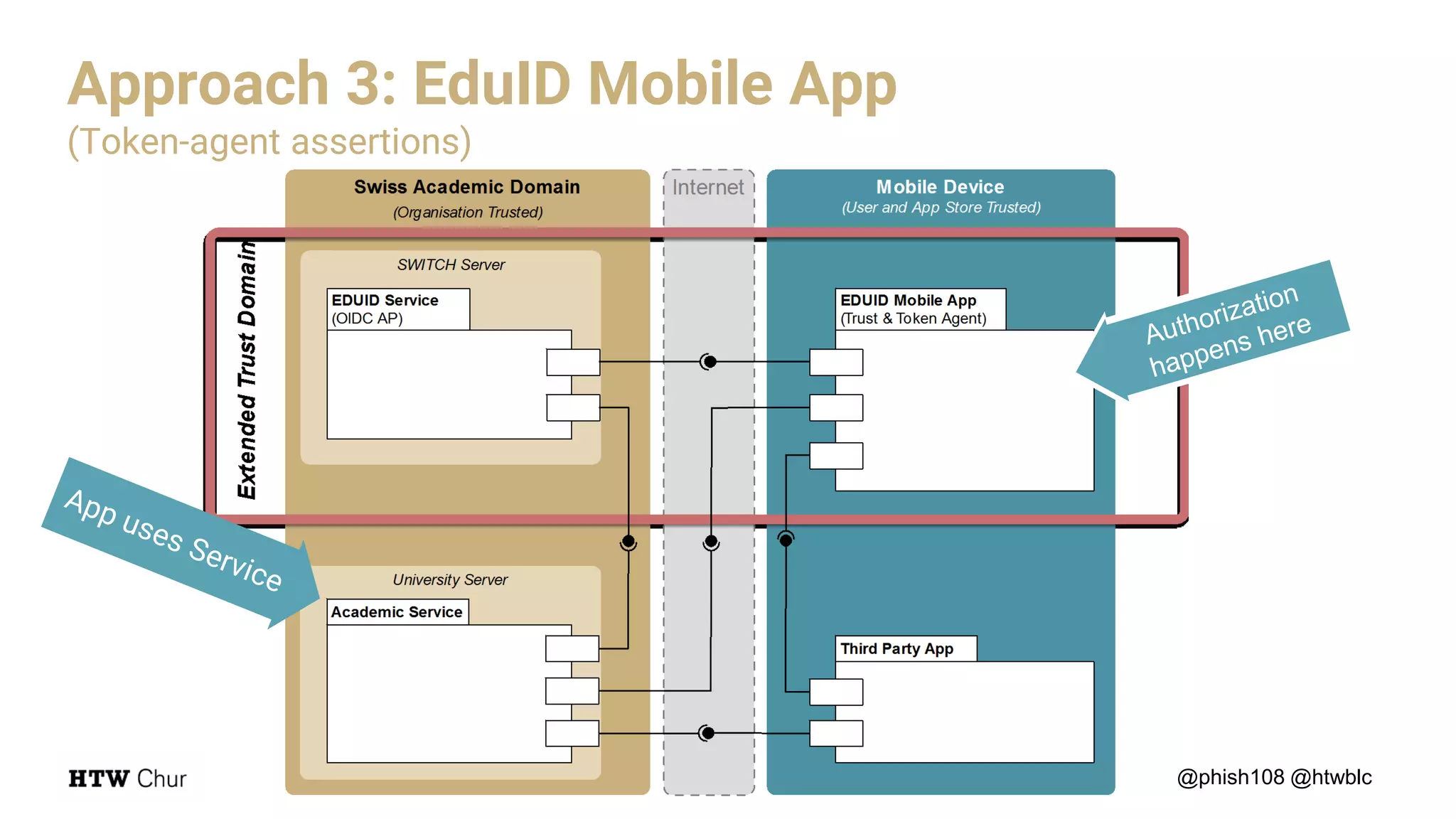
Approach 3: EduID Mobile App
(Token-agent assertions)
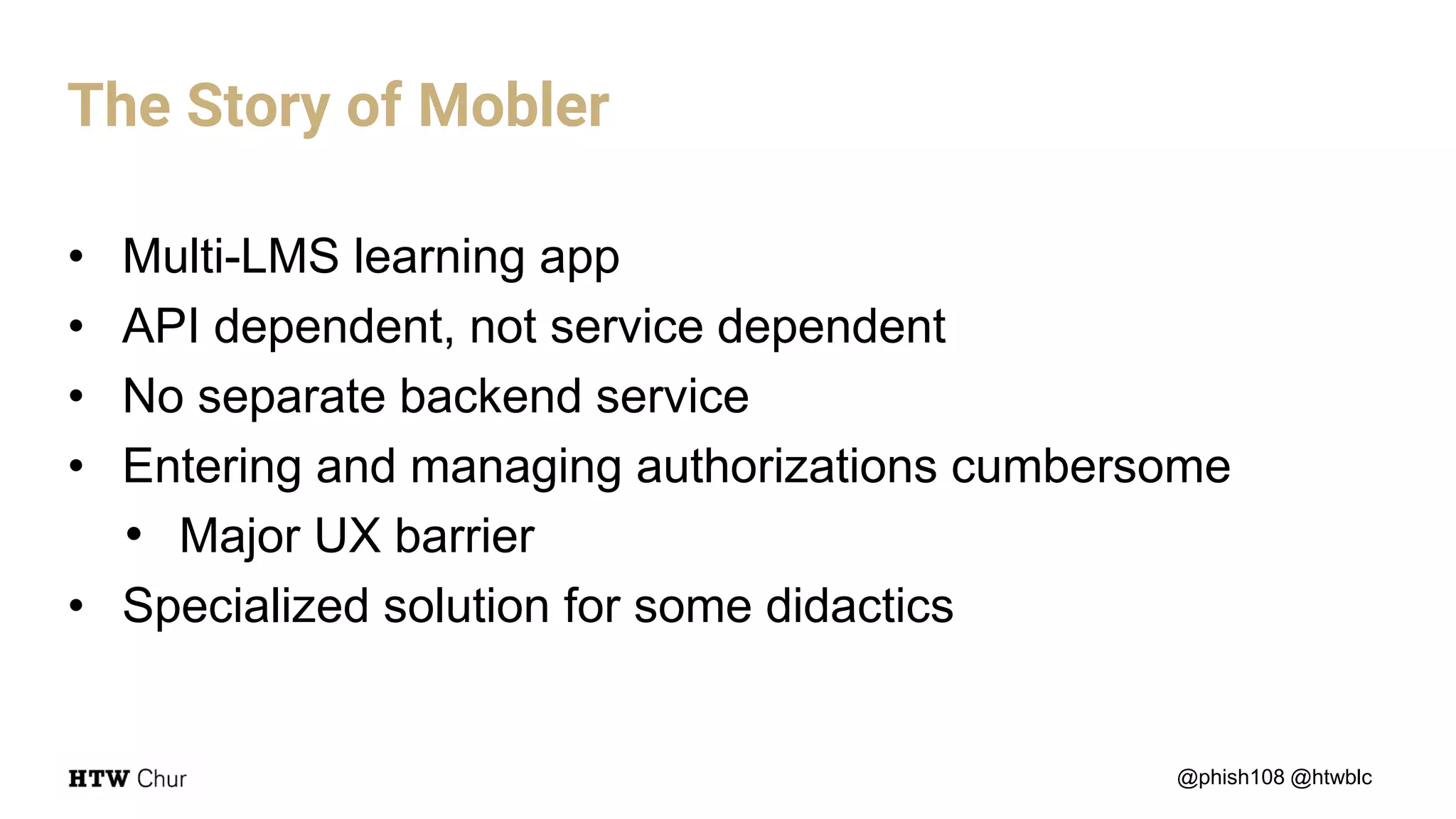
• Multi-LMS learning app
• API dependent, not service dependent
• No separate backend service
• Entering and managing authorizations cumbersome
• Major UX barrier
• Specialized solution for some didactics
@phish108 @htwblc
The Story of Mobler
@phish108 @htwblc
How relevant are these cases for
your institution?
@phish108 @htwblc
Part II
EduID Mobile App Architecture
@phish108 @htwblc
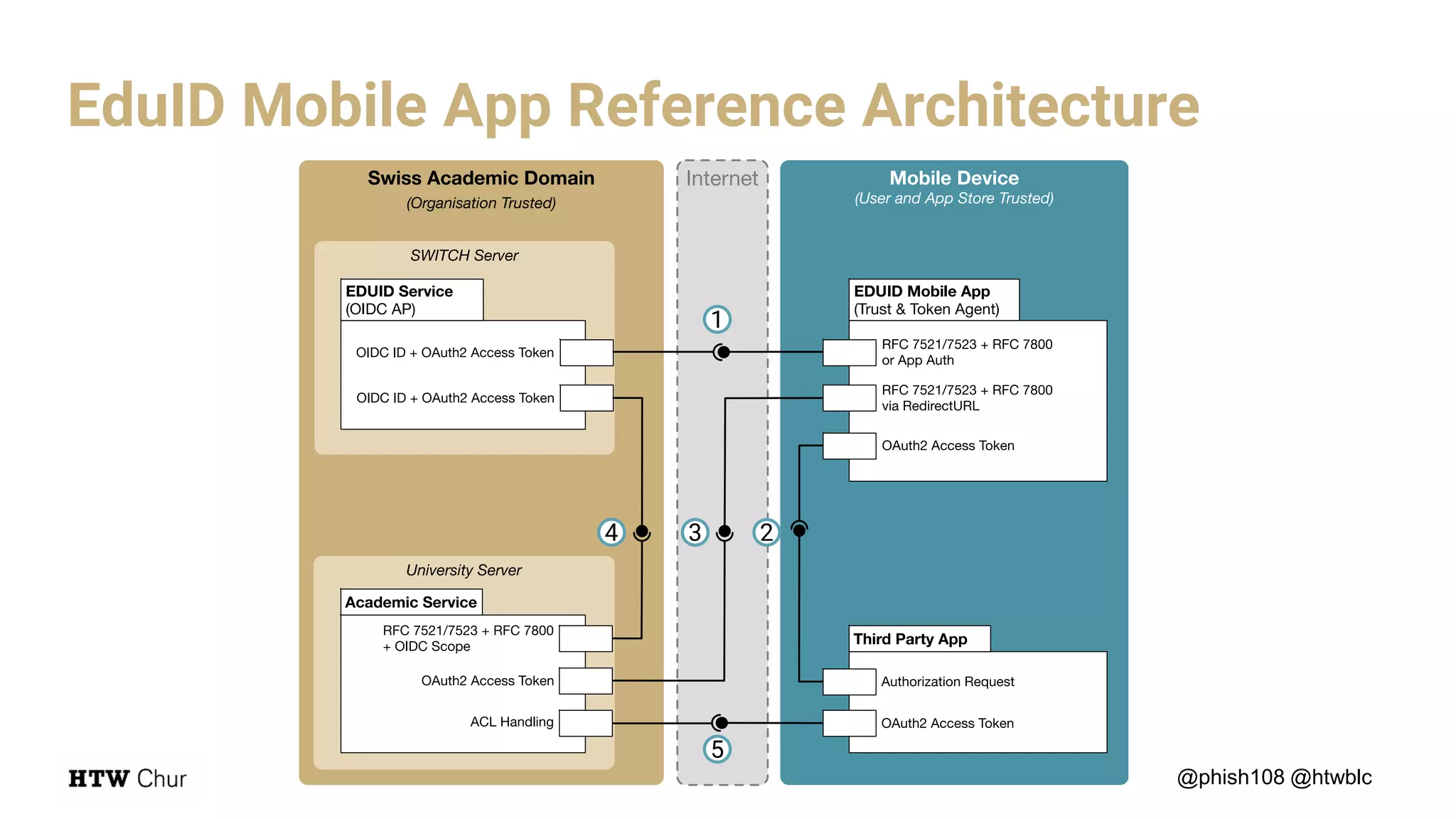
EduID Mobile App Reference Architecture
1
234
5
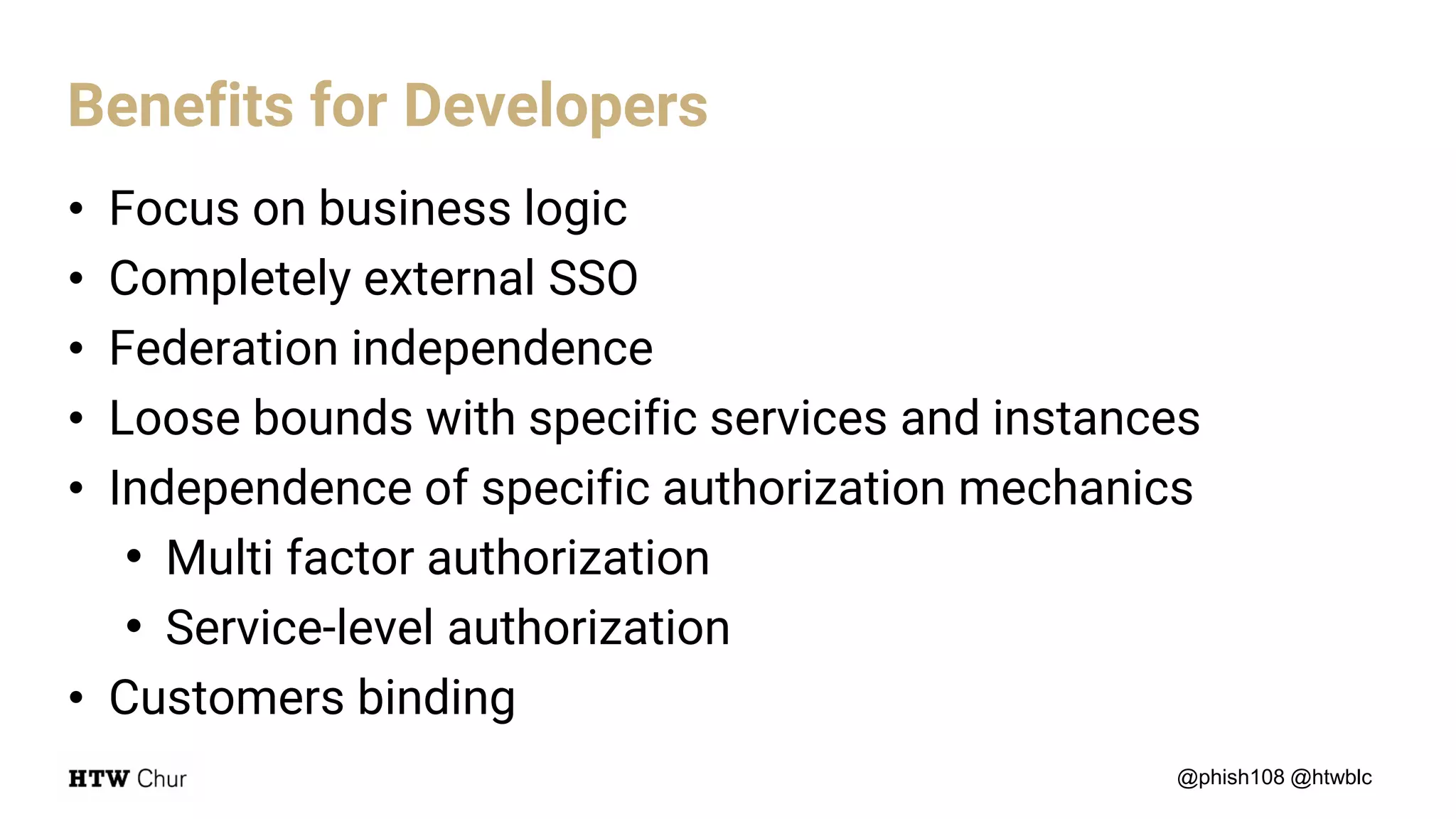
• Focus on business logic
• Completely external SSO
• Federation independence
• Loose bounds with specific services and instances
• Independence of specific authorization mechanics
• Multi factor authorization
• Service-level authorization
• Customers binding
@phish108 @htwblc
Benefits for Developers
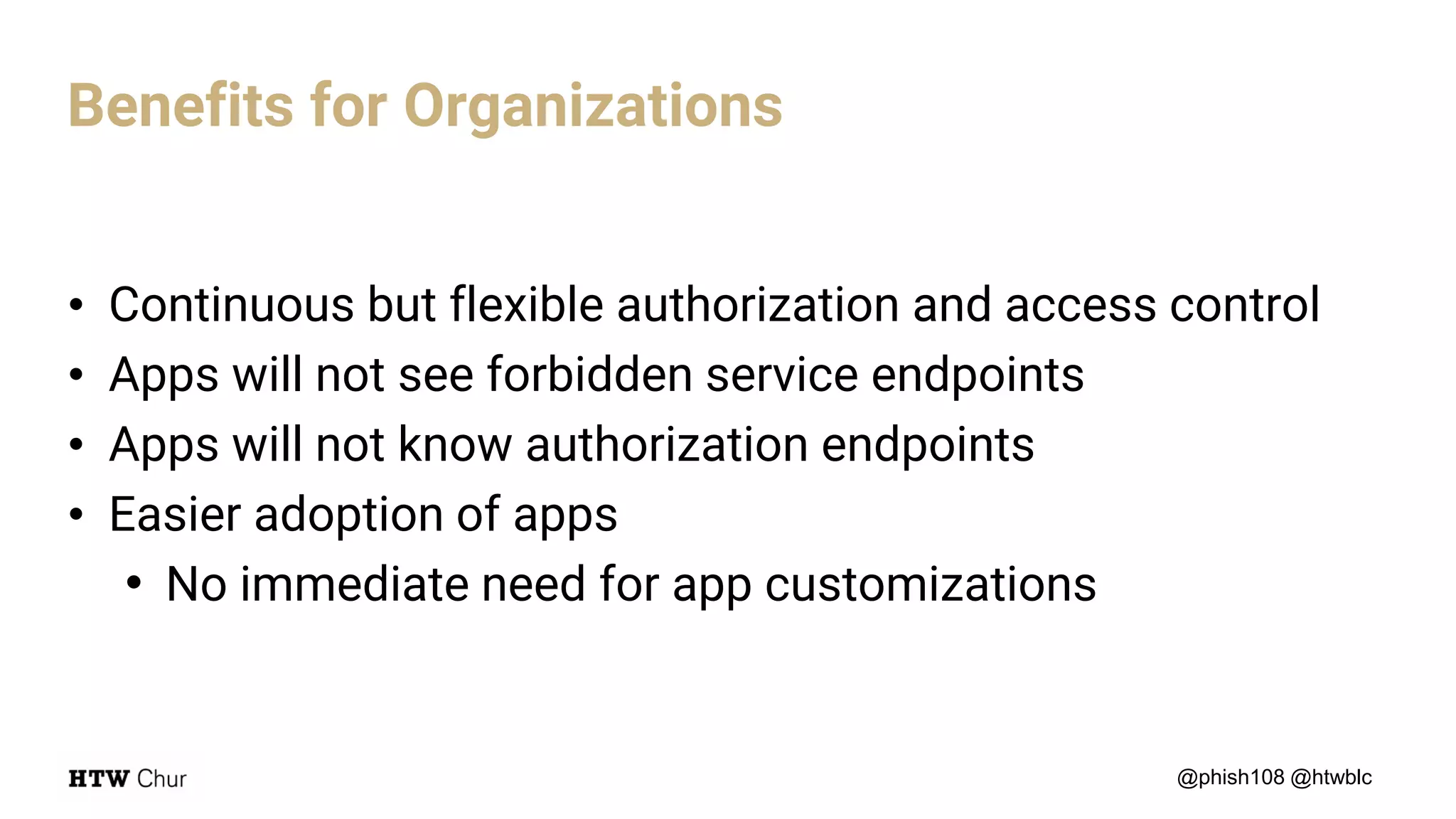
• Continuous but flexible authorization and access control
• Apps will not see forbidden service endpoints
• Apps will not know authorization endpoints
• Easier adoption of apps
• No immediate need for app customizations
@phish108 @htwblc
Benefits for Organizations
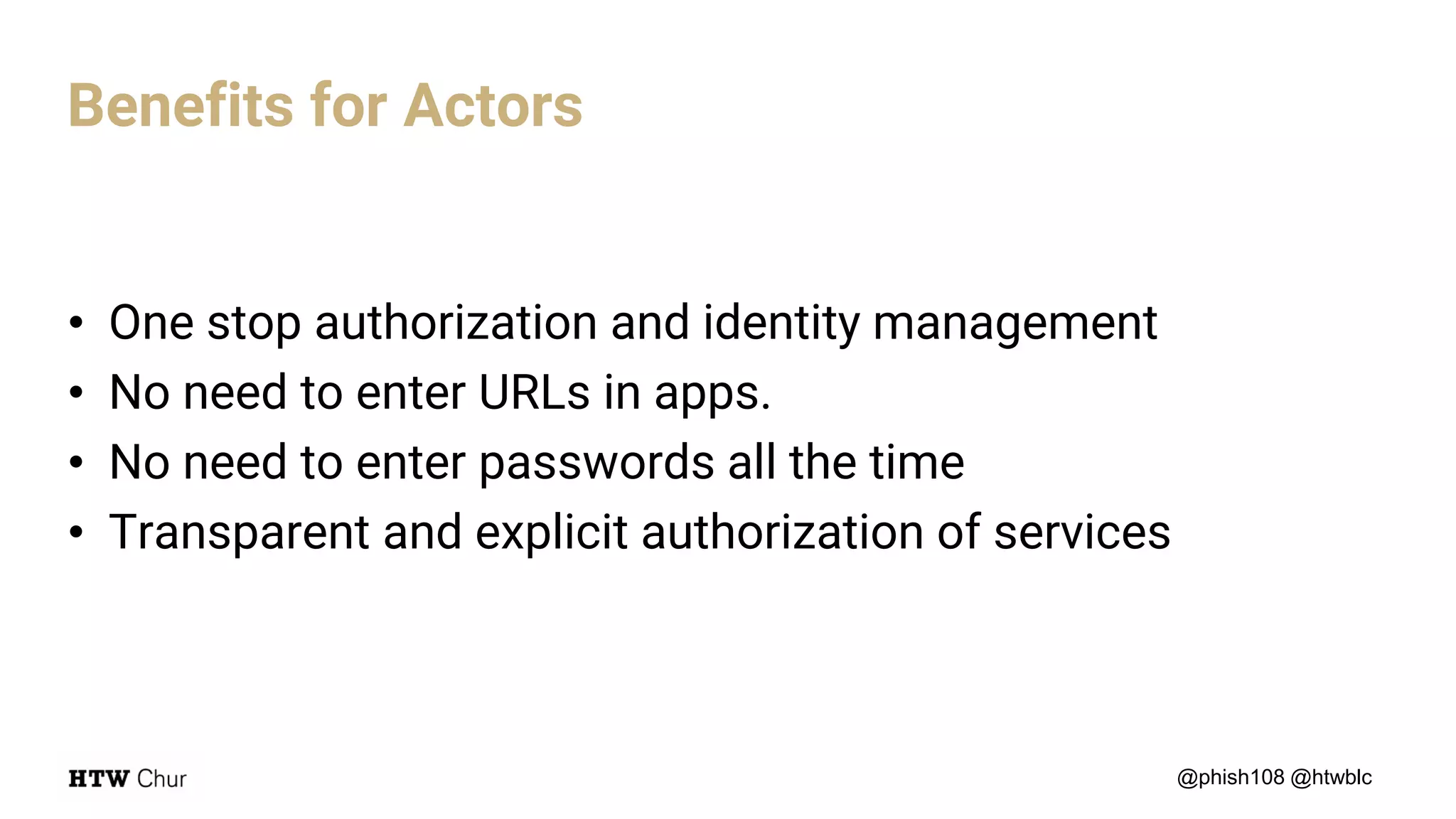
• One stop authorization and identity management
• No need to enter URLs in apps.
• No need to enter passwords all the time
• Transparent and explicit authorization of services
@phish108 @htwblc
Benefits for Actors
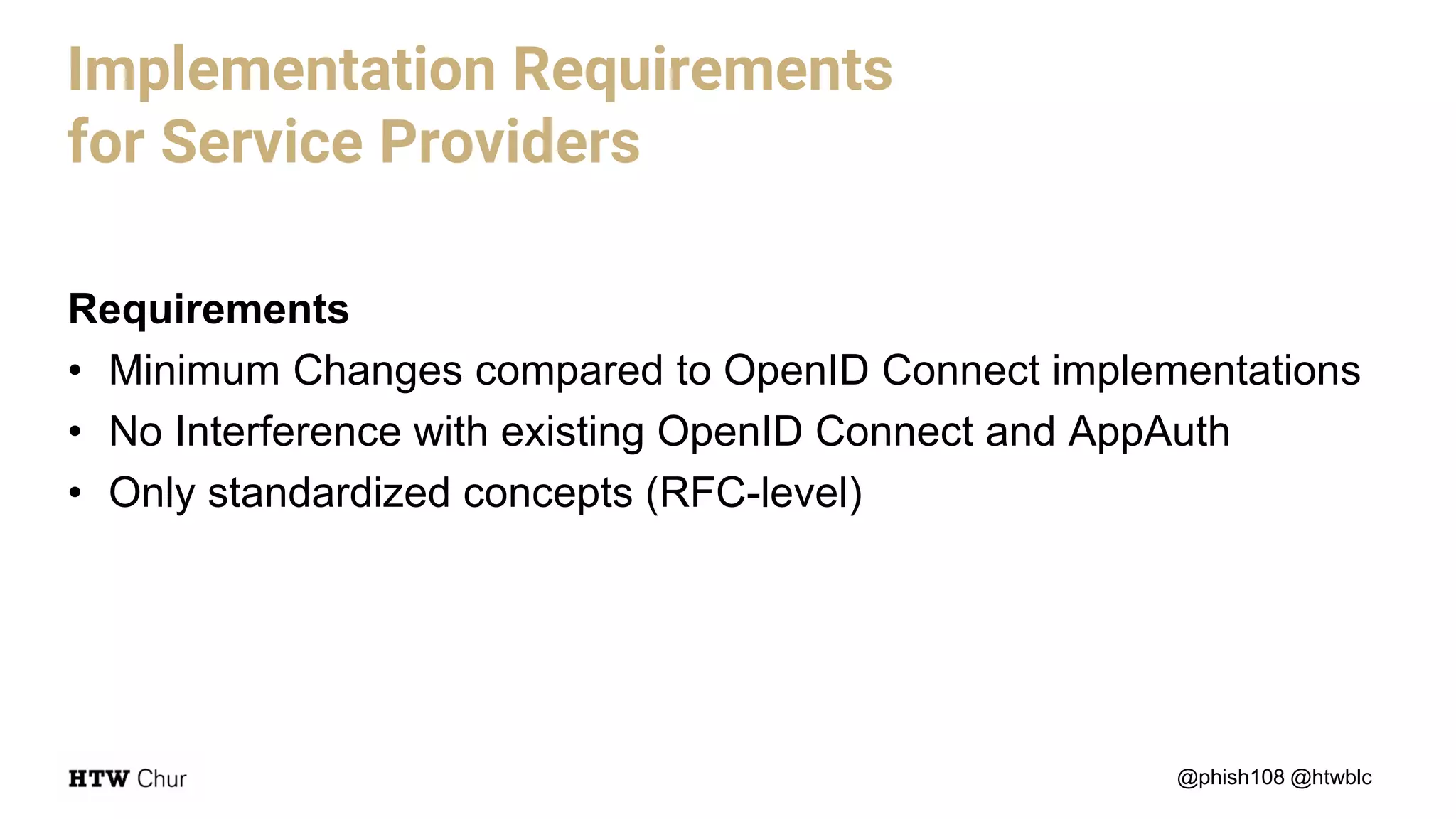
Requirements
• Minimum Changes compared to OpenID Connect implementations
• No Interference with existing OpenID Connect and AppAuth
• Only standardized concepts (RFC-level)
@phish108 @htwblc
Implementation Requirements
for Service Providers
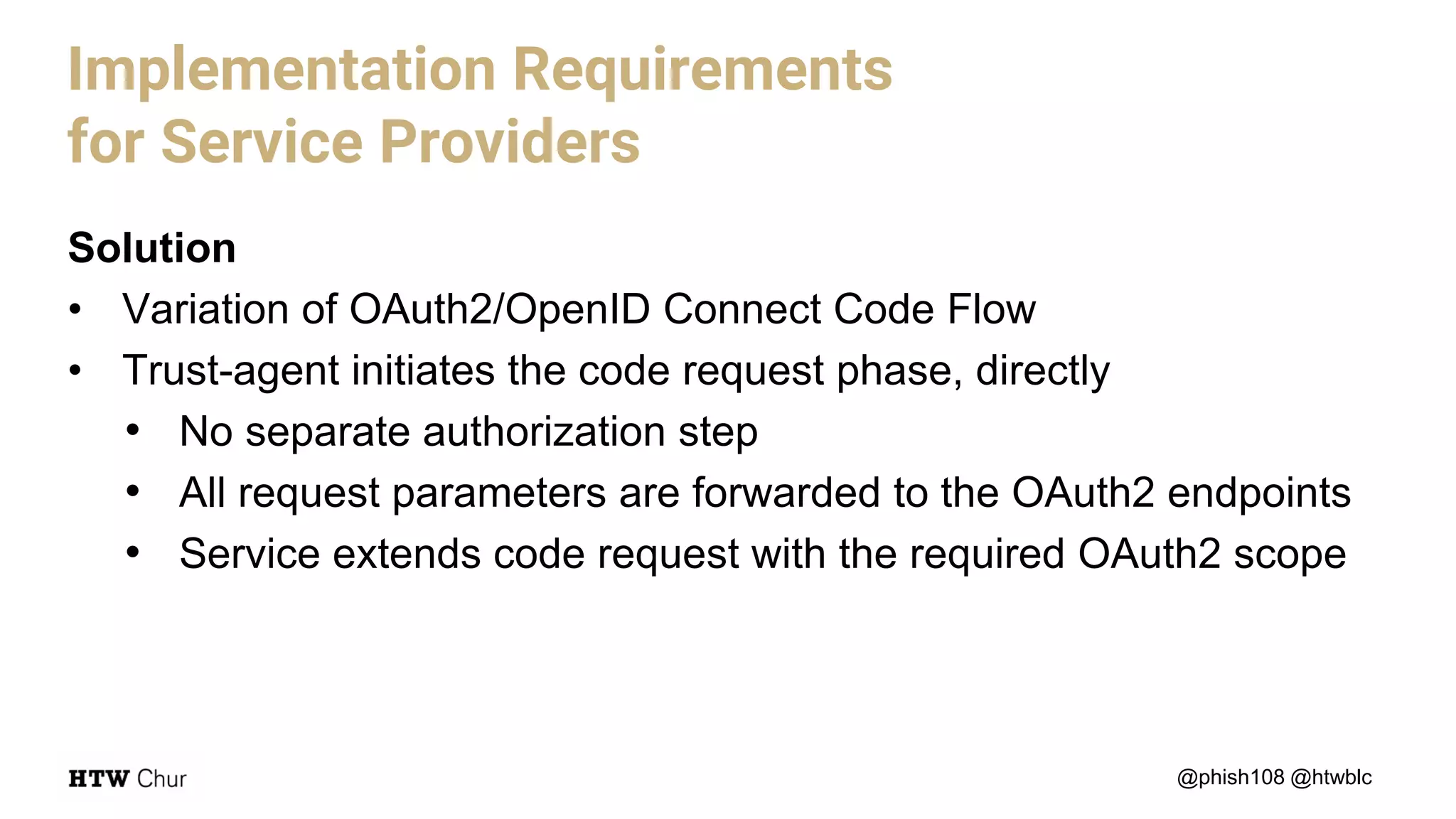
Solution
• Variation of OAuth2/OpenID Connect Code Flow
• Trust-agent initiates the code request phase, directly
• No separate authorization step
• All request parameters are forwarded to the OAuth2 endpoints
• Service extends code request with the required OAuth2 scope
@phish108 @htwblc
Implementation Requirements
for Service Providers
@phish108 @htwblc
PHP-CodefromtheMoodleImplementation
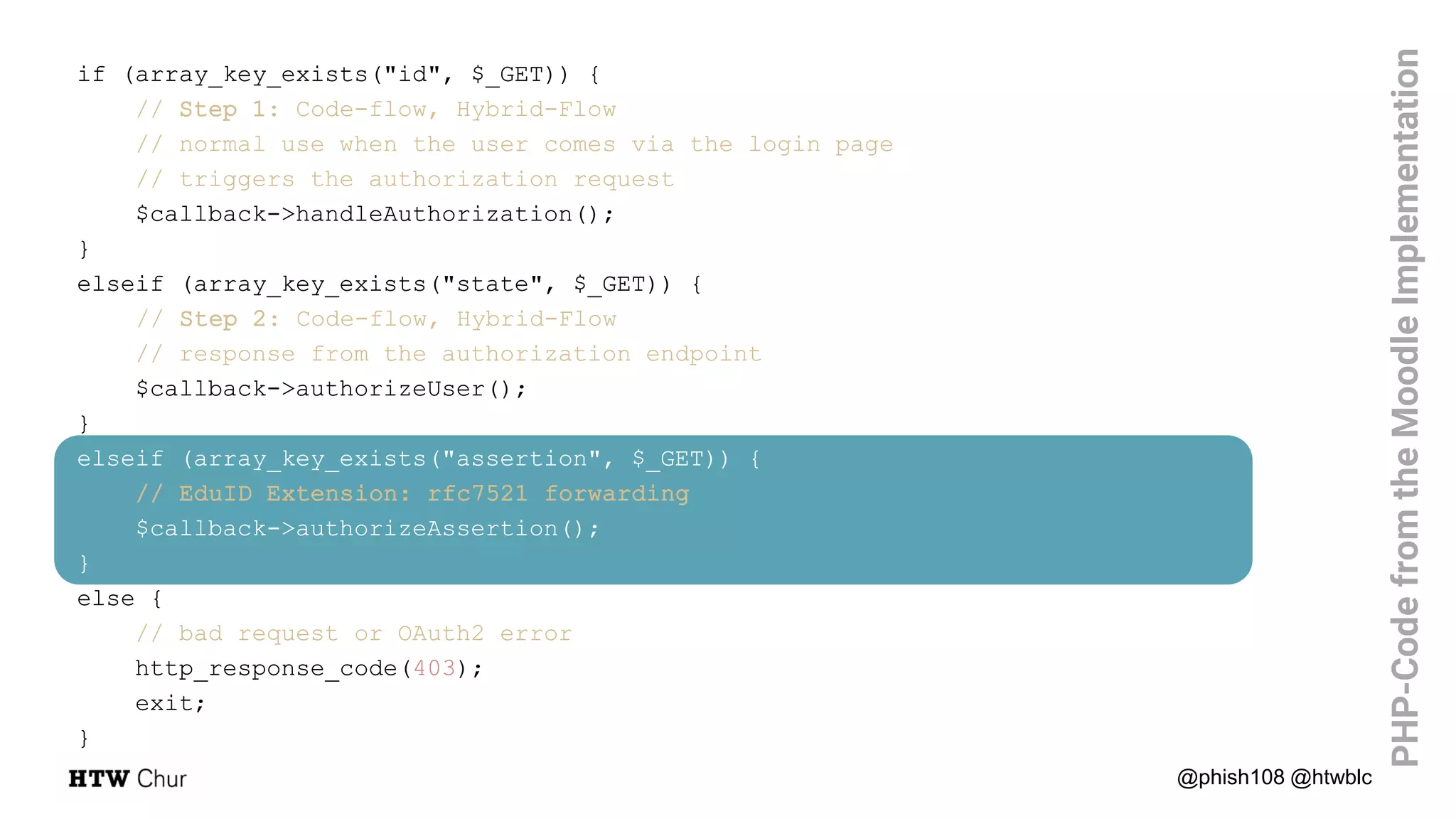
if (array_key_exists("id", $_GET)) {
// Step 1: Code-flow, Hybrid-Flow
// normal use when the user comes via the login page
// triggers the authorization request
$callback->handleAuthorization();
}
elseif (array_key_exists("state", $_GET)) {
// Step 2: Code-flow, Hybrid-Flow
// response from the authorization endpoint
$callback->authorizeUser();
}
elseif (array_key_exists("assertion", $_GET)) {
// EduID Extension: rfc7521 forwarding
$callback->authorizeAssertion();
}
else {
// bad request or OAuth2 error
http_response_code(403);
exit;
}
public function authorizeAssertion() {
// rfc7521 forwarding: extend the incoming assertion parameters
$param = array_merge($_GET, ["scope"=> "openid profile email"]);
// Fetch the access-token and user–information
// - this is the same call as in step 2 of the Code Flow
$res = $this->callTokenEndpoint($param);
if (!$this->handleToken($res)) {
http_response_code(403);
}
}
@phish108 @htwblc
PHP-CodefromtheMoodleImplementation
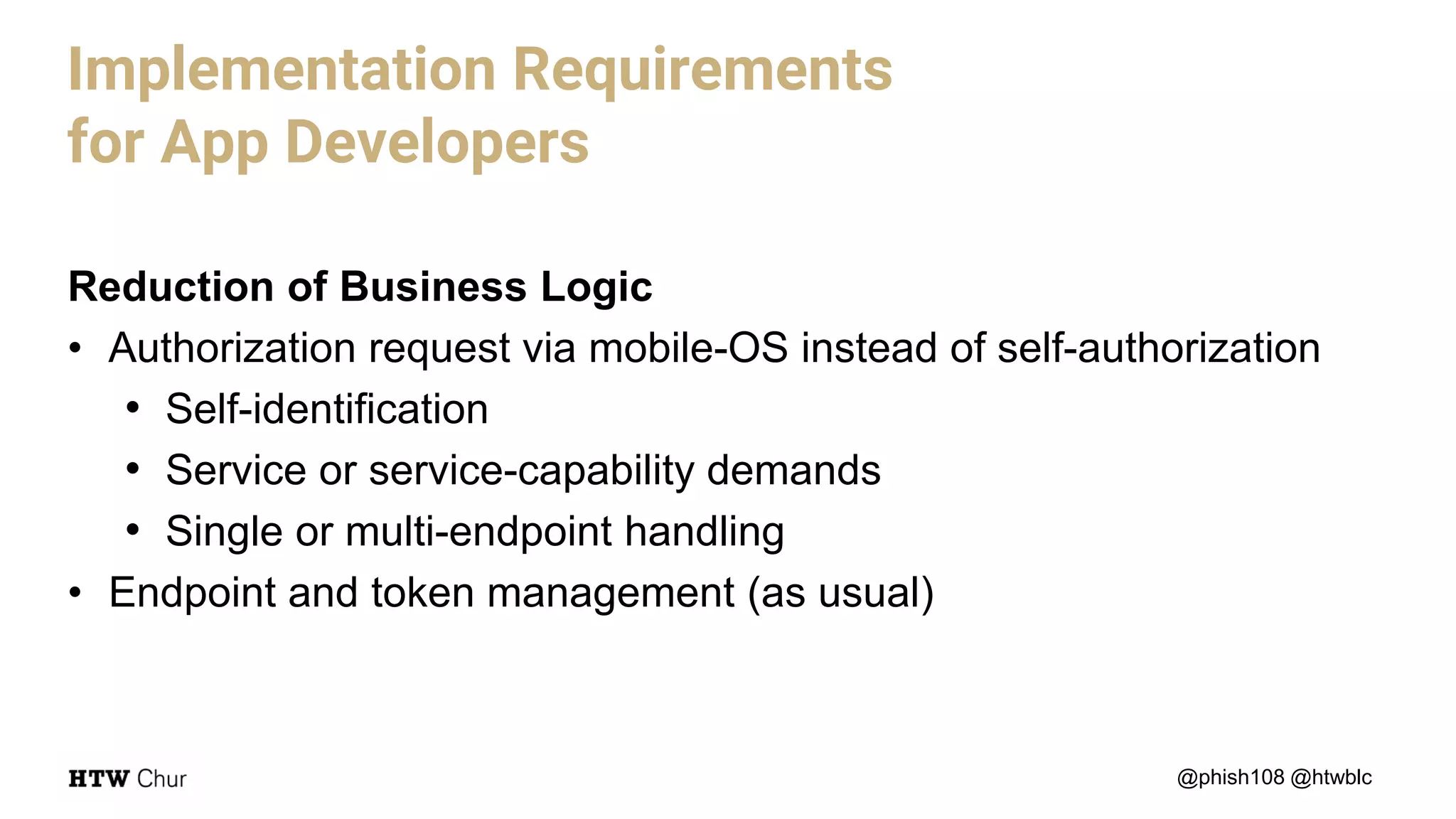
Reduction of Business Logic
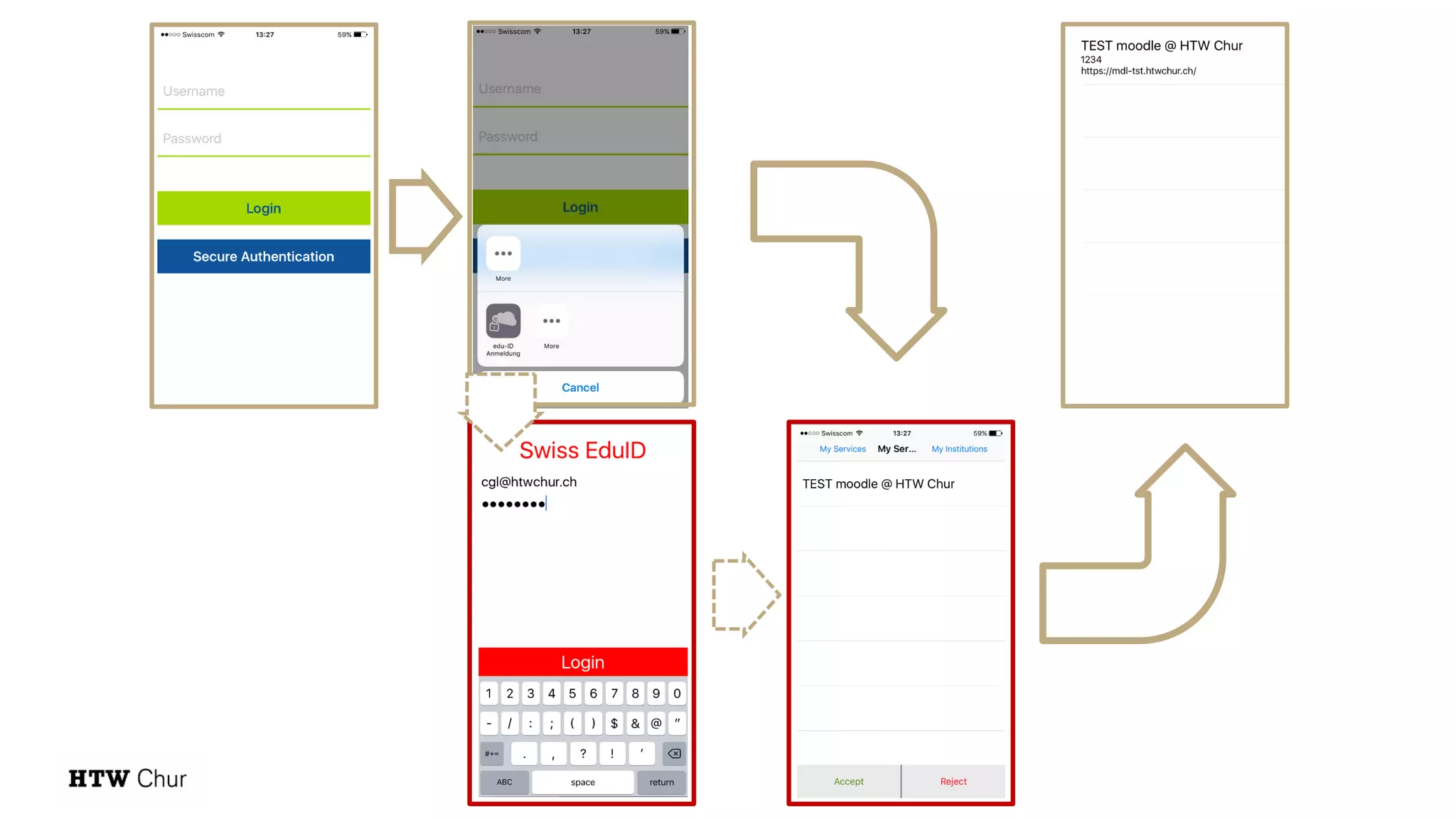
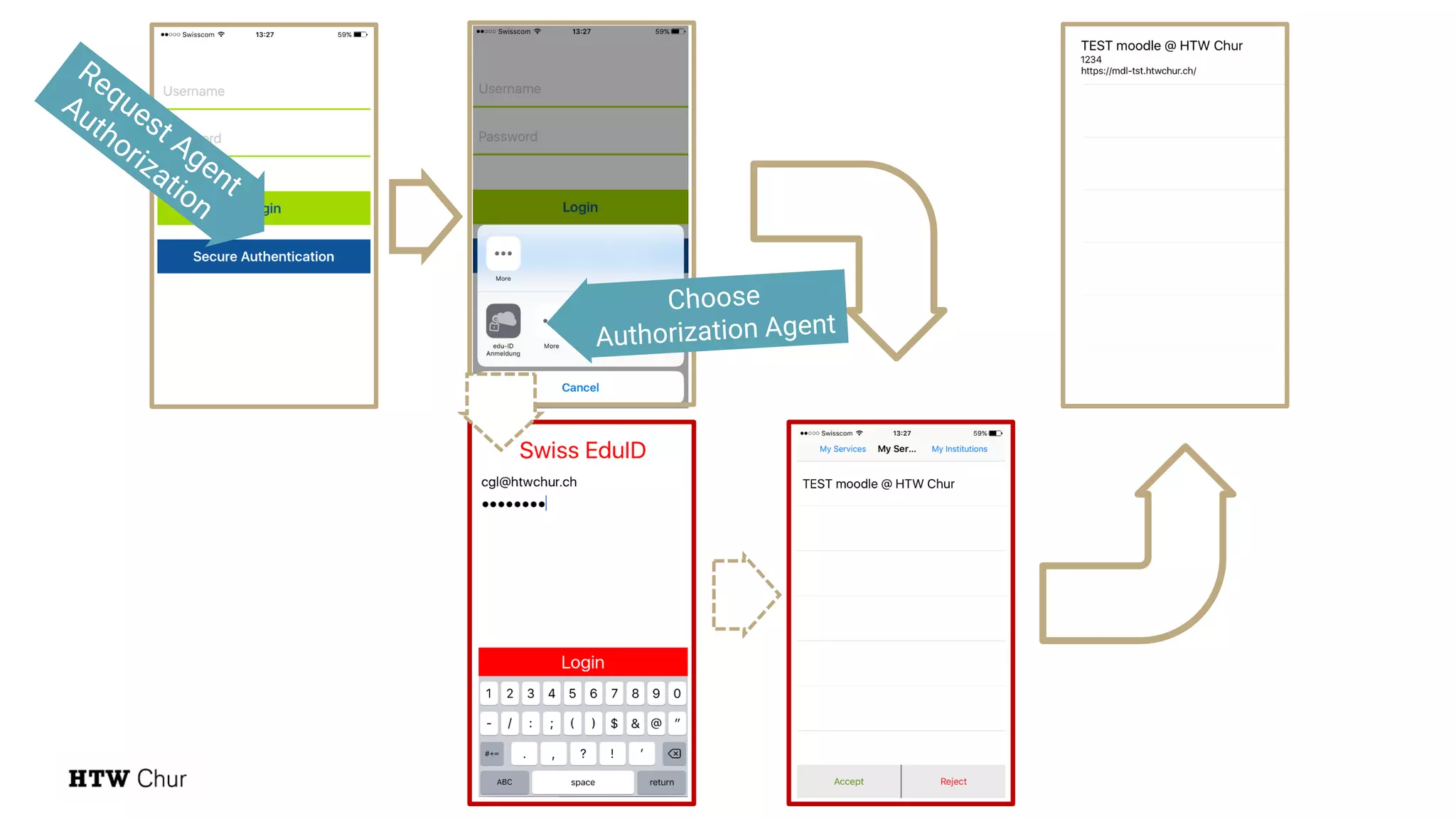
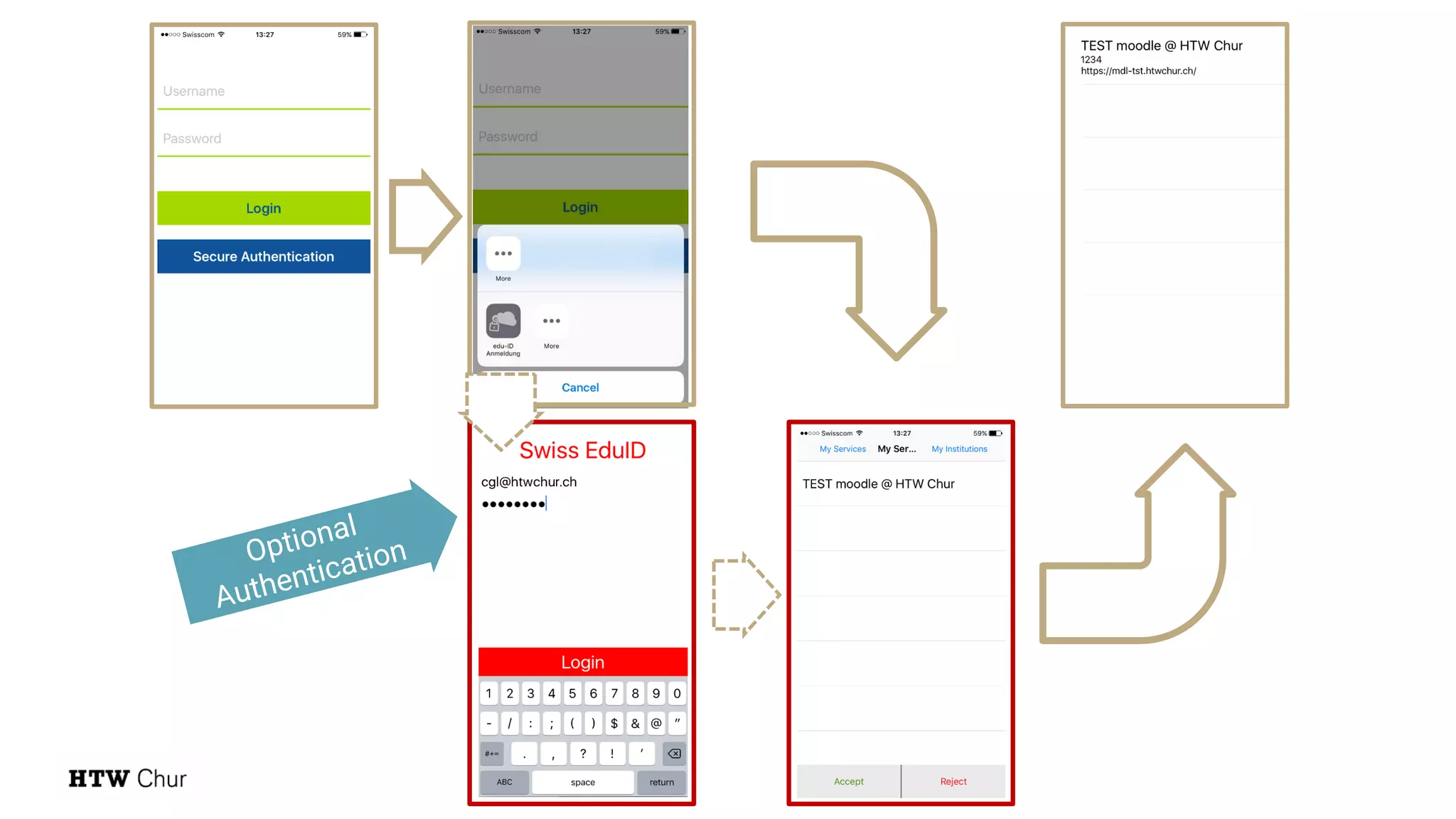
• Authorization request via mobile-OS instead of self-authorization
• Self-identification
• Service or service-capability demands
• Single or multi-endpoint handling
• Endpoint and token management (as usual)
@phish108 @htwblc
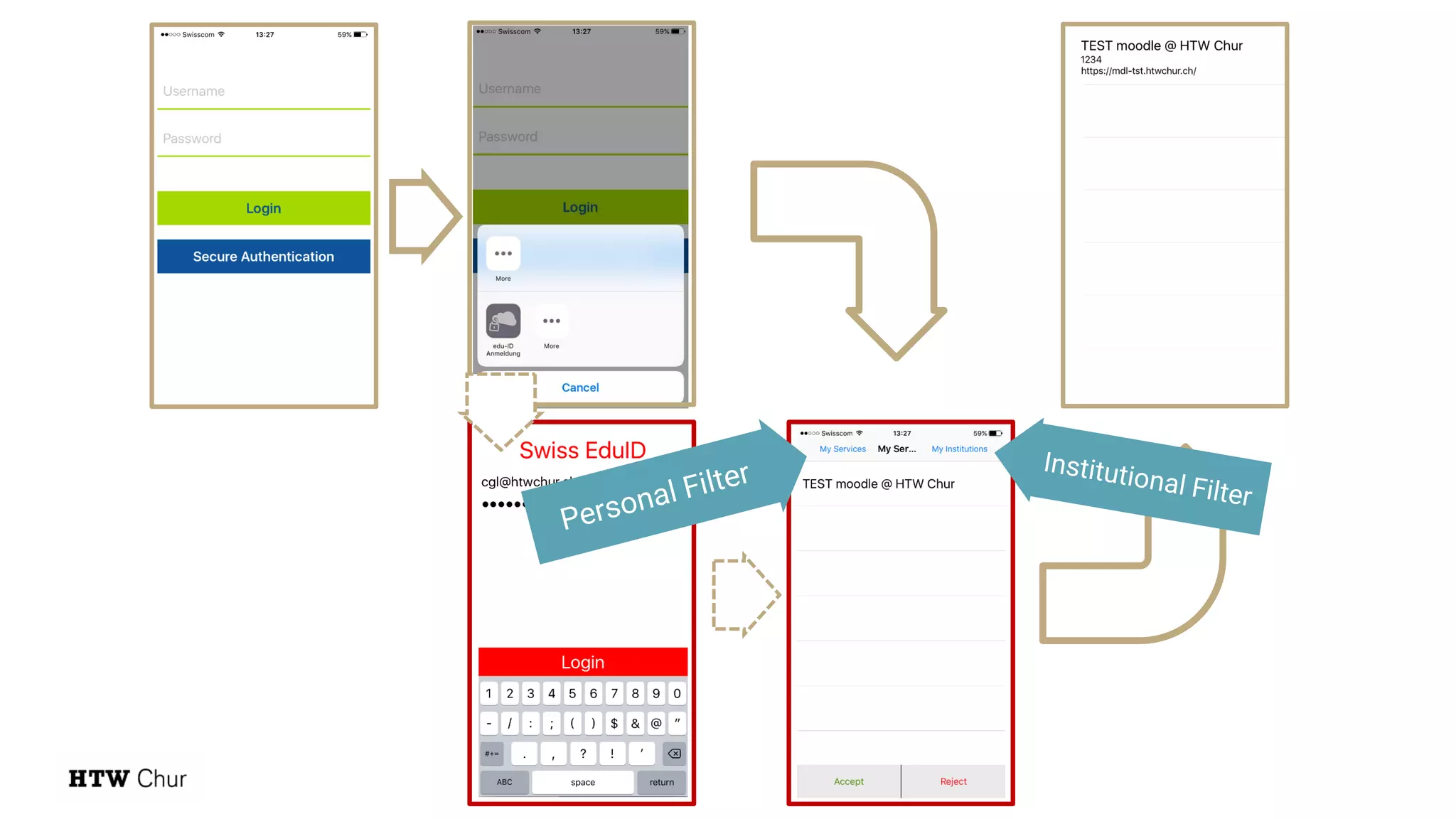
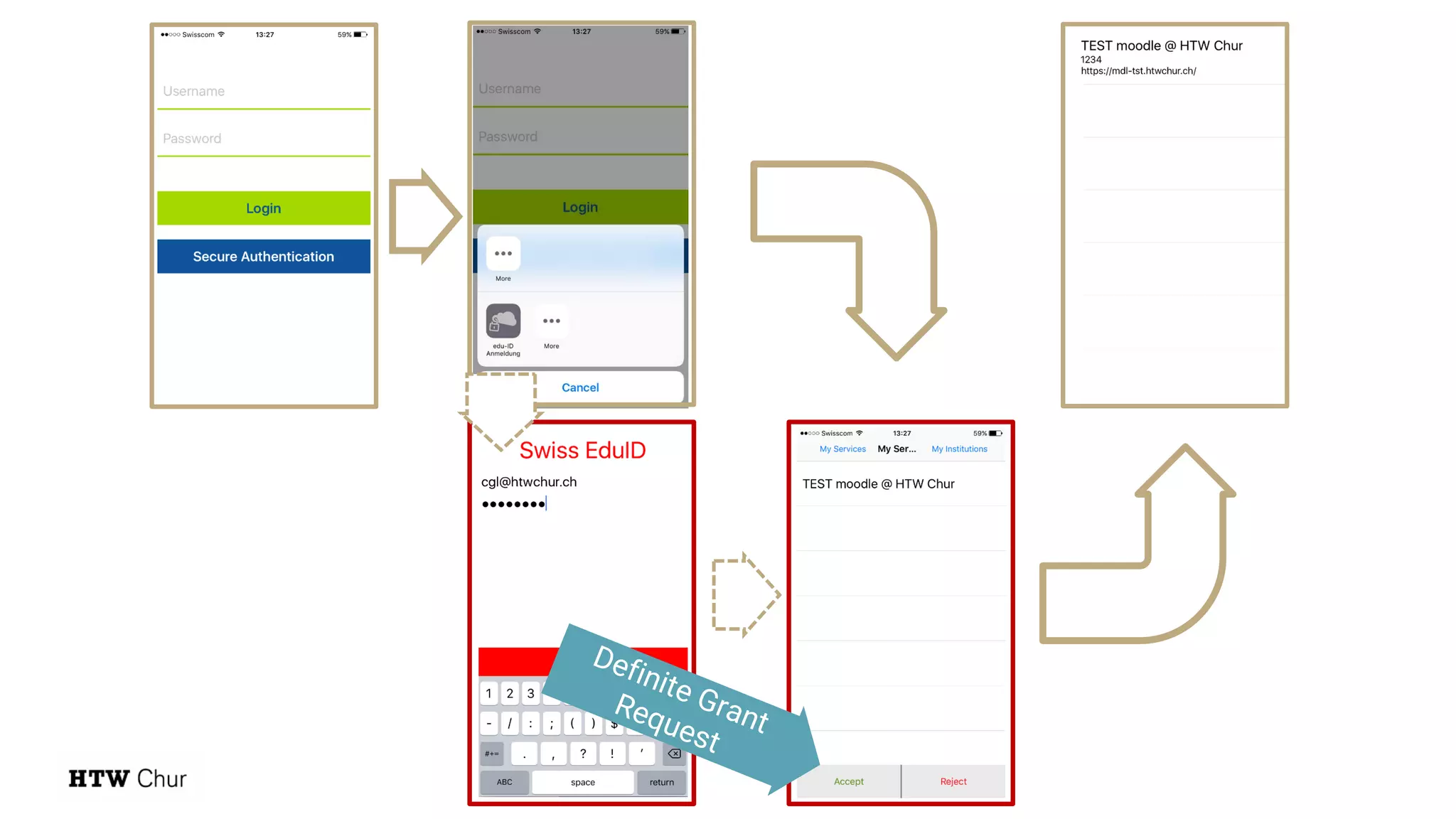
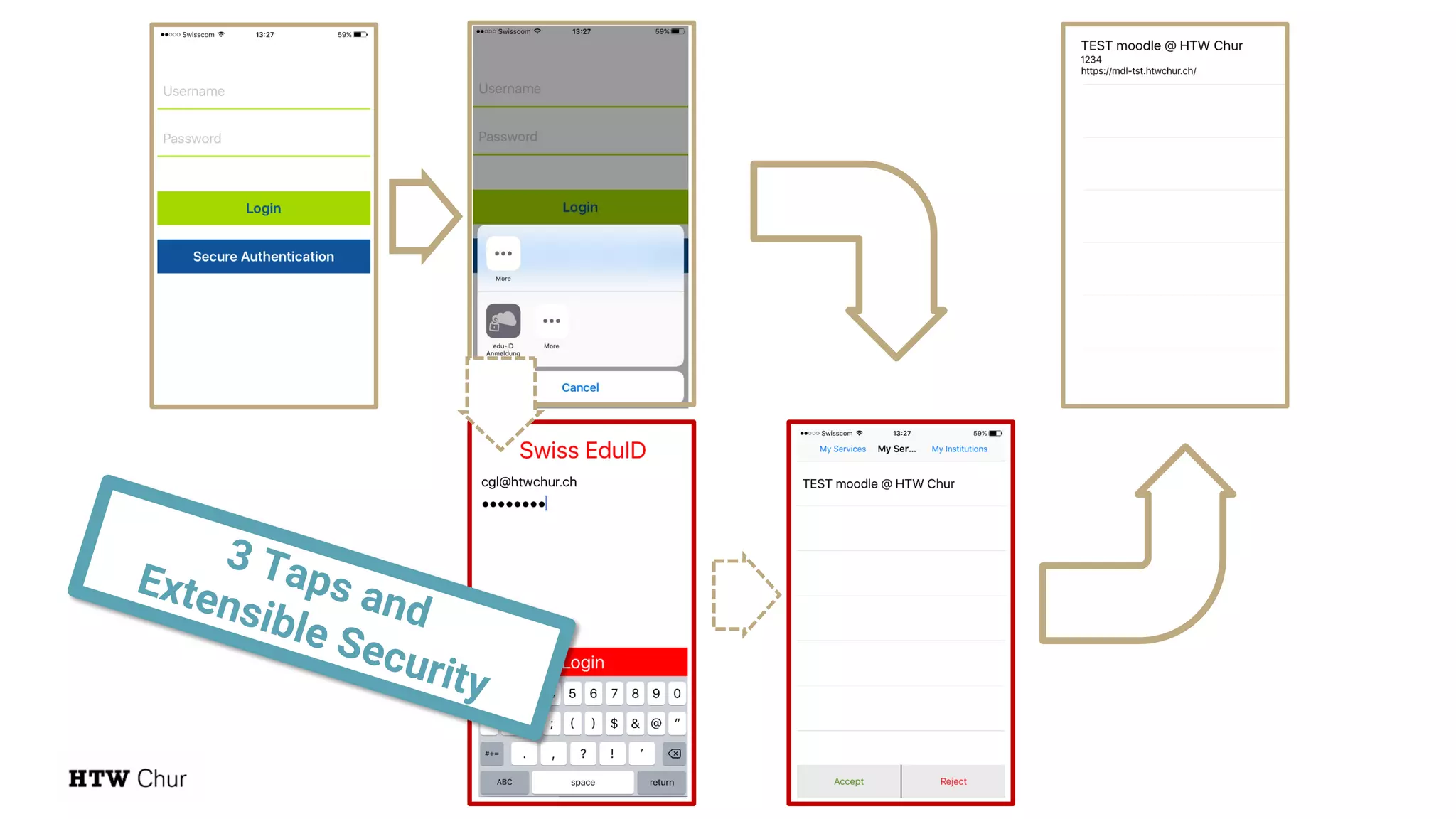
Implementation Requirements
for App Developers
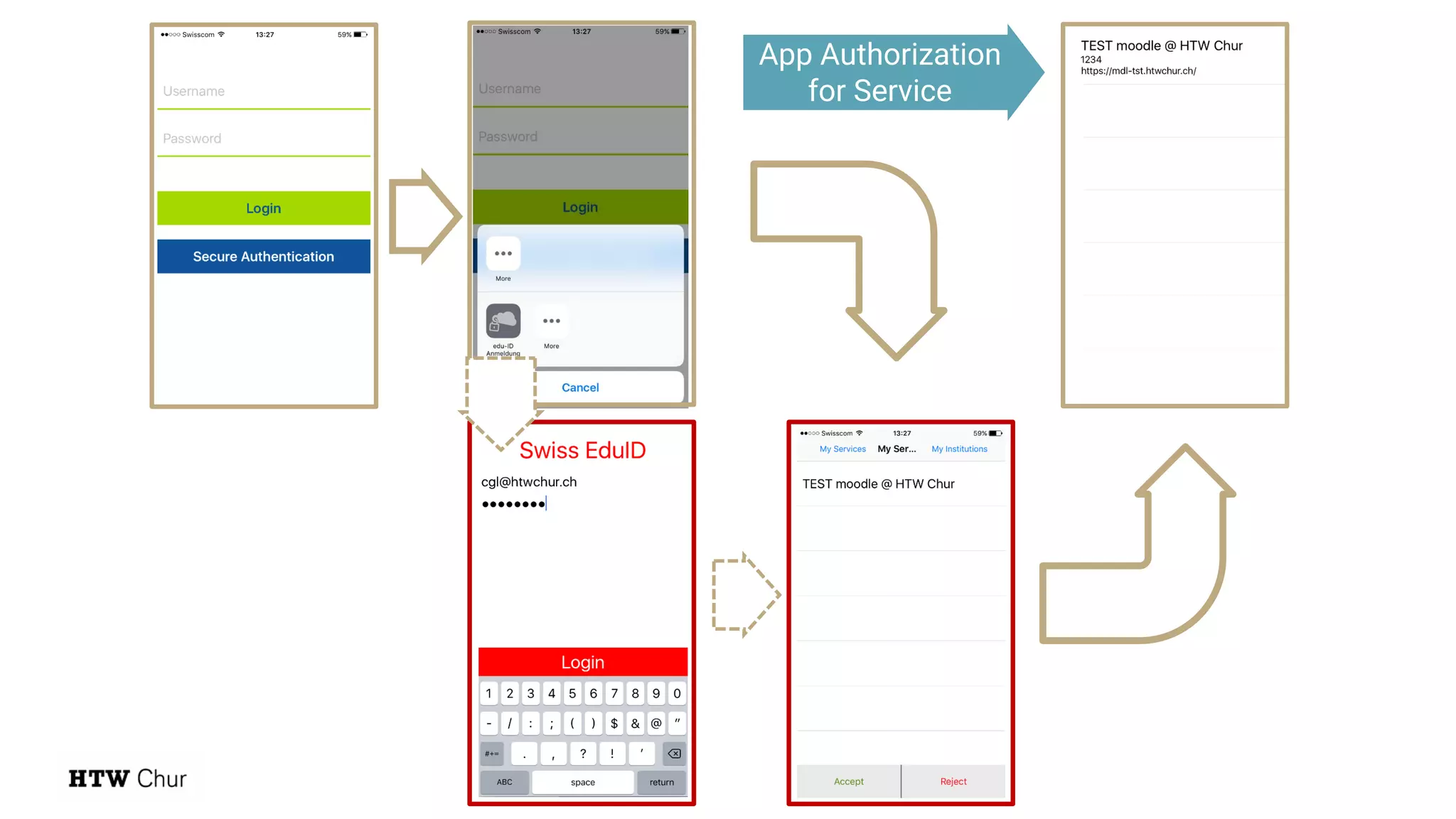
App Authorization
for Service
Further reading http://htw.ac/eduid-mobile
@htwblc
http://htw.ac/blc-blog
FHO Fachhochschule Ostschweiz

EduID Mobile App - Use-Cases, Concepts and Implementation

  • 1.
    FHO Fachhochschule Ostschweiz EduIDMobile App Use-cases, Concepts, Implementation
  • 2.
    @phish108 @htwblc Part I UseCases and Concepts
  • 3.
    The “Cloud” froma Service Perspective Clients @phish108 @htwblc
  • 4.
    The “Cloud” froma Device Perspective Roaming Profiles @phish108 @htwblc
  • 5.
    The “Cloud” froma User Perspective Smart Environments @phish108 @htwblc
  • 6.
    Shifting from FeatureServices to Smart Environments Glahn (2013). What we mean when we talk about mobile services. SIG Mobile Whitepaper @phish108 @htwblc
  • 7.
  • 8.
    Authorization is aboutTrust Organization Trusted User & App Store Trusted Mobile DeviceService Federation Untrusted Personal Data Internet @phish108 @htwblc
  • 9.
    1. OIDC forResponsive Web-Apps 2. AppAuth for tightly integrated native mobile apps 3. Token Agent Authorization for loosely coupled native apps @phish108 @htwblc 3 Approaches
  • 10.
    Approach 1: ResponsiveWeb-Apps (OpenID Connect / OAuth2, SAML) @phish108 @htwblc
  • 11.
    Open ID Connect:3 Flows to Authorizations @phish108 @htwblc 1. Implicit flow • Get an authorization from an IDP for accessing a service with limited session details 2. Code flow • Receive an authorization code for fetching confidential session details from the IDP 3. Hybrid flow • Get an authorization from an IDP for accessing a service with confidential session details in one step
  • 12.
    OpenID Connect (OIDC) 26.04.2017CorporateIT, FHNW 11 «A Simple Identity layer on top of OAuth 2.0» From the website (http://openid.net): − OIDC is an interoperable authentication protocol based on the OAuth 2.0 family of specifications. It uses straightforward REST/JSON message flows with a design goal of «making simple things simple and complicated things possible». It’s uniquely easy for developers to integrate, compared to any preceding Identity protocol. − OIDC allows for clients of all types, including browser-based JavaScript and native mobile apps, to launch sign-in flows and receive verifiable assertions about the identity of signed-in users.
  • 13.
    SAML vs OIDCvs OAuth 26.04.2017Corporate IT, FHNW 12 Simply said: − SAML: single sign-on for enterprise users − OAuth: API authorization between applications − OIDC: single sign-on for consumers + API access Token format: − SAML: XML − OIDC: JWT (JSON web token) The whole story: «Unifying Authentication & Delegated API Access for Mobile, Web and the Desktop with OpenID Connect and OAuth2 by Dominick Baier» https://vimeo.com/113604459
  • 14.
    GET /authorize ?client_id=app1 &scope=openid profile &redirect_uri=https://app.com/cb &response_type=id_tokentoken &state=af0ifjsldkj &nonce=n-0S6_WzA2Mj Implicit Flow 26.04.2017Corporate IT, FHNW 13 − One of multiple flows (processes) defined in the specification − Specifically designed for «untrusted clients» such as JavaScript apps − Key steps: − Client sends the request to the Authorization Server. − Authorization Server authenticates the End-User, obtains consent, sends him/her back to the Client with an ID Token and, if requested, an Access (Bearer) Token. − Client validates the tokens and retrieves the End-User's Subject Identifier. − Client uses the Access Token for calls to Backend Web Services
  • 15.
    @phish108 @htwblc Approach 2:Integrated Service Apps or Service-bound Apps (AppAuth)
  • 16.
    © 2017 SWITCH| 15 Startseite Untertitel Unternehmenspräsentation Christoph Graf, Rolf Brugger swisseduid@switch.ch SIG Mobile, 25.4.2017 @SWITCH Use case of a “Service-bound Mobile App” SWITCHdrive App
  • 17.
    SWITCHdrive Sync & shareon Swiss servers Keep your data on your devices synchronized and share them with your contacts – on secure safe servers Your benefits • Data in Switzerland • Fast network connection to SWITCH • Simple user activation Customers • Universities • Hospitals • Other institutions Services • SWITCHdrive- Serverfarm, based on ownCloud • High dissemination in academic Switzerland (>80% of universities)
  • 18.
    SWITCHdrive App – Theofficial mobile client of the SWITCHdrive service • SWITCH-branded, based on owncloud app • Preconfigured with fixed endpoints for SWITCHdrive • Feature set in line with SWITCHdrive capabilities • Support limited to this app Usage scenario description
  • 19.
    • Controlling theuser experience end-to-end • Service branding opportunity (CI/CD) • Needs to maintain an app (development/adaptation/preconfiguration/testing, mobile martketplaces, etc.) • One single app to document and support • No re-use opportunity of potentially compatible app Service operator perspective
  • 20.
    • Opportunity todevelop, adapt, brand, preconfigure or support app exclusively for specific services as a contractor to service operator • (Probably) no opportunity to offer alternatives to users bypassing service operator • Uses standard authentication mechanisms (AppAuth, OAuth2, OIDC): availability of libraries, development and testing tools, tutorials. App developer perspective
  • 21.
    www.switch.ch/30years SWITCH – anintegral part of the Swiss academic community since 1987.
  • 22.
    @phish108 @htwblc Approach 3:EduID Mobile App (Token-agent assertions)
  • 23.
    • Multi-LMS learningapp • API dependent, not service dependent • No separate backend service • Entering and managing authorizations cumbersome • Major UX barrier • Specialized solution for some didactics @phish108 @htwblc The Story of Mobler
  • 24.
    @phish108 @htwblc How relevantare these cases for your institution?
  • 25.
    @phish108 @htwblc Part II EduIDMobile App Architecture
  • 26.
    @phish108 @htwblc EduID MobileApp Reference Architecture 1 234 5
  • 27.
    • Focus onbusiness logic • Completely external SSO • Federation independence • Loose bounds with specific services and instances • Independence of specific authorization mechanics • Multi factor authorization • Service-level authorization • Customers binding @phish108 @htwblc Benefits for Developers
  • 28.
    • Continuous butflexible authorization and access control • Apps will not see forbidden service endpoints • Apps will not know authorization endpoints • Easier adoption of apps • No immediate need for app customizations @phish108 @htwblc Benefits for Organizations
  • 29.
    • One stopauthorization and identity management • No need to enter URLs in apps. • No need to enter passwords all the time • Transparent and explicit authorization of services @phish108 @htwblc Benefits for Actors
  • 30.
    Requirements • Minimum Changescompared to OpenID Connect implementations • No Interference with existing OpenID Connect and AppAuth • Only standardized concepts (RFC-level) @phish108 @htwblc Implementation Requirements for Service Providers
  • 31.
    Solution • Variation ofOAuth2/OpenID Connect Code Flow • Trust-agent initiates the code request phase, directly • No separate authorization step • All request parameters are forwarded to the OAuth2 endpoints • Service extends code request with the required OAuth2 scope @phish108 @htwblc Implementation Requirements for Service Providers
  • 32.
    @phish108 @htwblc PHP-CodefromtheMoodleImplementation if (array_key_exists("id",$_GET)) { // Step 1: Code-flow, Hybrid-Flow // normal use when the user comes via the login page // triggers the authorization request $callback->handleAuthorization(); } elseif (array_key_exists("state", $_GET)) { // Step 2: Code-flow, Hybrid-Flow // response from the authorization endpoint $callback->authorizeUser(); } elseif (array_key_exists("assertion", $_GET)) { // EduID Extension: rfc7521 forwarding $callback->authorizeAssertion(); } else { // bad request or OAuth2 error http_response_code(403); exit; }
  • 33.
    public function authorizeAssertion(){ // rfc7521 forwarding: extend the incoming assertion parameters $param = array_merge($_GET, ["scope"=> "openid profile email"]); // Fetch the access-token and user–information // - this is the same call as in step 2 of the Code Flow $res = $this->callTokenEndpoint($param); if (!$this->handleToken($res)) { http_response_code(403); } } @phish108 @htwblc PHP-CodefromtheMoodleImplementation
  • 34.
    Reduction of BusinessLogic • Authorization request via mobile-OS instead of self-authorization • Self-identification • Service or service-capability demands • Single or multi-endpoint handling • Endpoint and token management (as usual) @phish108 @htwblc Implementation Requirements for App Developers
  • 40.
  • 42.