Ethical leadership in education is the practice of
guiding and influencing others within an educational
setting through a foundation of moral principles and
values. It involves demonstrating integrity, fairness,
and respect in all decisions and actions. Ethical
leaders prioritize the well-being and development of
students, create inclusive and supportive
environments, and serve as role models for ethical
behavior. By fostering trust and promoting a positive
school culture, ethical leadership ensures that
educational practices align with the core values of
honesty, responsibility, and equity, ultimately
enhancing the overall quality and effectiveness of
education.
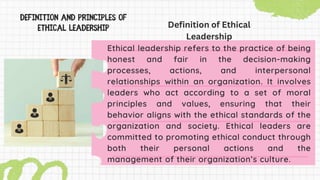
Ethical leadership refers to the practice of being
honest and fair in the decision-making
processes, actions, and interpersonal
relationships within an organization. It involves
leaders who act according to a set of moral
principles and values, ensuring that their
behavior aligns with the ethical standards of the
organization and society. Ethical leaders are
committed to promoting ethical conduct through
both their personal actions and the
management of their organization’s culture.
Definition of Ethical
Leadership
1. Integrity: Ethical leaders consistently demonstrate honesty and
strong moral principles. They make decisions based on what is
right, rather than what is easy or beneficial to themselves.
2.Fairness: Ethical leaders treat all employees and stakeholders
justly. They make impartial decisions and avoid favoritism and
discrimination.
3.Transparency: Ethical leaders operate in an open and clear
manner. They communicate effectively, providing necessary
information and explaining their decisions and actions.
4.Accountability: Ethical leaders take responsibility for their
actions and decisions. They hold themselves and their team
accountable for achieving ethical standards and organizational
goals.
5. Respect for Others: Ethical leaders show respect and
consideration for others' rights, dignity, and
perspectives. They value diversity and promote an
inclusive environment.
6. Leadership by Example: Ethical leaders model the
behavior they expect from others. They embody the
values and standards they promote, setting a positive
example for their team.
7. Commitment to Ethical Behavior: Ethical leaders are
dedicated to fostering an environment where ethical
behavior is encouraged and rewarded. They implement
policies and practices that promote ethical conduct.
8. Empathy and Compassion: Ethical leaders demonstrate
empathy and compassion towards others. They understand
and appreciate the challenges and needs of their employees
and stakeholders.
9. Long-term Perspective: Ethical leaders focus on sustainable
success rather than short-term gains. They consider the long-
term impact of their decisions on the organization and society.
10. Stakeholder Orientation: Ethical leaders consider the
interests and well-being of all stakeholders, including
employees, customers, suppliers, and the community. They
strive to balance various interests and act in the common
good.
Ethical leadership in education is crucial for the
development of a positive, effective, and nurturing
learning environment. It impacts not only the
academic success of students but also their moral
and social development. Here are several key
reasons why ethical leadership is vital in the
educational sector:
1. Creating a Positive School Culture:Ethical leadership
fosters a culture of trust, respect, and integrity within
the school. This positive environment is essential for
both students and staff to feel safe, valued, and
motivated.
2. Role Modeling: Educators and administrators serve as role
models for students. Ethical leaders demonstrate the importance
of moral behavior, honesty, and integrity, influencing students to
adopt these values in their own lives.
3. Promoting Equity and Inclusion: Ethical leaders ensure that all
students have equal opportunities to succeed, regardless of their
background. They work to eliminate biases and discrimination,
creating an inclusive environment where every student can thrive.
4. Enhancing Student Development: Ethical leadership contributes
to the holistic development of students, including their character,
citizenship, and ethical reasoning skills. This prepares them not
only for academic success but also for responsible participation in
society.
5. Building Trust and Confidence: Trust between educators, students,
parents, and the community is foundational for a successful
educational institution. Ethical leadership helps build and maintain this
trust, ensuring that all stakeholders feel confident in the school’s
mission and practices.
6. Ensuring Accountability and Transparency: Ethical leaders are
accountable for their decisions and actions. They maintain
transparency in school operations, which helps in gaining the trust of
parents and the wider community, and ensures that resources are used
effectively and ethically.
7. Fostering Professional Development and Collaboration: By
promoting ethical standards, leaders encourage a culture of
continuous improvement and professional development among staff.
This collaborative environment enhances teaching quality and student
outcomes.
8. Improving Decision-Making: Ethical leadership involves making
decisions based on moral principles and the best interest of
students and staff. This leads to fair, just, and well-considered
policies and practices within the educational institution.
9. Navigating Ethical Dilemmas: Schools often face complex
ethical dilemmas. Ethical leaders are better equipped to navigate
these challenges, ensuring that decisions uphold the values and
ethical standards of the institution.
10. Enhancing Reputation and Community Support: Schools led by
ethical leaders are more likely to gain the respect and support of
the community. A strong reputation for integrity and fairness can
attract students, staff, and resources, contributing to the
school’s overall success.
Ethical leadership in education is indispensable for
creating a learning environment that is equitable,
supportive, and conducive to the development of well-
rounded individuals. By prioritizing ethical principles,
educational leaders can profoundly impact students'
lives, foster a positive school culture, and build trust and
respect within the community. This, in turn, leads to
improved educational outcomes and prepares students
to become responsible, ethical members of society.
Educational leaders play a crucial role in promoting ethical
behavior within their institutions. Here are 8 key ways they
do this:
1. Modeling Ethical Behavior: Demonstrate integrity,
fairness, and respect in their actions, serving as role models
for students and staff.
2. Establishing Clear Ethical Guidelines: Develop and
enforce codes of conduct and ethical policies that outline
expected behaviors and consequences for violations.
3. Creating a Positive School Culture: Foster an environment
of trust, inclusivity, and respect, where ethical behavior is
encouraged and valued.
4. Providing Ethical Education: Integrate ethical discussions
and decision-making processes into the curriculum, helping
students develop moral reasoning skills.
5. Encouraging Open Communication: Promote
transparency and open dialogue, allowing students and
staff to express concerns and report unethical behavior
without fear of retribution.
6. Supporting Professional Development: Offer training and
resources for staff to enhance their understanding and
implementation of ethical practices.
7.Recognizing and Rewarding Ethical Behavior: Acknowledge
and reward individuals who demonstrate exemplary ethical
behavior, reinforcing the importance of integrity.
8. Engaging with the Community: Involve parents and the
community in promoting ethical standards, creating a unified
approach to ethical behavior.
Here are three concise and widely-used ethical
decision-making frameworks:
1. Utilitarian Approach
• Focus: Outcomes and consequences.
• Principle: Choose the action that maximizes
overall happiness or minimizes overall harm.
• Steps:
1. Identify the possible actions.
2.Evaluate the consequences of each action.
3.Choose the action that results in the greatest
good for the greatest number
2. Deontological Approach (Duty-Based)
• Focus: Adherence to rules and duties.
• Principle: Act according to a set of moral rules
or duties, regardless of the outcome.
• Steps:
a. Identify the relevant duties and principles.
b. Determine which duties apply to the
situation.
c. Choose the action that fulfills the most
important duties.
3. Virtue Ethics Approach
• Focus: Character and virtues.
• Principle: Choose actions that are consistent with
virtuous qualities (e.g., honesty, courage).
• Steps:
a. Identify the virtues relevant to the situation.
b. Consider what a virtuous person would do.
c. Choose the action that aligns with virtuous
behavior.
These frameworks help guide individuals through
ethical dilemmas by focusing on different aspects
of morality: outcomes, duties, and virtues.
Educational-Leadership-Presentation (1).pptx

Educational-Leadership-Presentation (1).pptx

  • 3.
    Ethical leadership ineducation is the practice of guiding and influencing others within an educational setting through a foundation of moral principles and values. It involves demonstrating integrity, fairness, and respect in all decisions and actions. Ethical leaders prioritize the well-being and development of students, create inclusive and supportive environments, and serve as role models for ethical behavior. By fostering trust and promoting a positive school culture, ethical leadership ensures that educational practices align with the core values of honesty, responsibility, and equity, ultimately enhancing the overall quality and effectiveness of education.
  • 4.
    Ethical leadership refersto the practice of being honest and fair in the decision-making processes, actions, and interpersonal relationships within an organization. It involves leaders who act according to a set of moral principles and values, ensuring that their behavior aligns with the ethical standards of the organization and society. Ethical leaders are committed to promoting ethical conduct through both their personal actions and the management of their organization’s culture. Definition of Ethical Leadership
  • 5.
    1. Integrity: Ethicalleaders consistently demonstrate honesty and strong moral principles. They make decisions based on what is right, rather than what is easy or beneficial to themselves. 2.Fairness: Ethical leaders treat all employees and stakeholders justly. They make impartial decisions and avoid favoritism and discrimination. 3.Transparency: Ethical leaders operate in an open and clear manner. They communicate effectively, providing necessary information and explaining their decisions and actions. 4.Accountability: Ethical leaders take responsibility for their actions and decisions. They hold themselves and their team accountable for achieving ethical standards and organizational goals.
  • 6.
    5. Respect forOthers: Ethical leaders show respect and consideration for others' rights, dignity, and perspectives. They value diversity and promote an inclusive environment. 6. Leadership by Example: Ethical leaders model the behavior they expect from others. They embody the values and standards they promote, setting a positive example for their team. 7. Commitment to Ethical Behavior: Ethical leaders are dedicated to fostering an environment where ethical behavior is encouraged and rewarded. They implement policies and practices that promote ethical conduct.
  • 7.
    8. Empathy andCompassion: Ethical leaders demonstrate empathy and compassion towards others. They understand and appreciate the challenges and needs of their employees and stakeholders. 9. Long-term Perspective: Ethical leaders focus on sustainable success rather than short-term gains. They consider the long- term impact of their decisions on the organization and society. 10. Stakeholder Orientation: Ethical leaders consider the interests and well-being of all stakeholders, including employees, customers, suppliers, and the community. They strive to balance various interests and act in the common good.
  • 8.
    Ethical leadership ineducation is crucial for the development of a positive, effective, and nurturing learning environment. It impacts not only the academic success of students but also their moral and social development. Here are several key reasons why ethical leadership is vital in the educational sector: 1. Creating a Positive School Culture:Ethical leadership fosters a culture of trust, respect, and integrity within the school. This positive environment is essential for both students and staff to feel safe, valued, and motivated.
  • 9.
    2. Role Modeling:Educators and administrators serve as role models for students. Ethical leaders demonstrate the importance of moral behavior, honesty, and integrity, influencing students to adopt these values in their own lives. 3. Promoting Equity and Inclusion: Ethical leaders ensure that all students have equal opportunities to succeed, regardless of their background. They work to eliminate biases and discrimination, creating an inclusive environment where every student can thrive. 4. Enhancing Student Development: Ethical leadership contributes to the holistic development of students, including their character, citizenship, and ethical reasoning skills. This prepares them not only for academic success but also for responsible participation in society.
  • 10.
    5. Building Trustand Confidence: Trust between educators, students, parents, and the community is foundational for a successful educational institution. Ethical leadership helps build and maintain this trust, ensuring that all stakeholders feel confident in the school’s mission and practices. 6. Ensuring Accountability and Transparency: Ethical leaders are accountable for their decisions and actions. They maintain transparency in school operations, which helps in gaining the trust of parents and the wider community, and ensures that resources are used effectively and ethically. 7. Fostering Professional Development and Collaboration: By promoting ethical standards, leaders encourage a culture of continuous improvement and professional development among staff. This collaborative environment enhances teaching quality and student outcomes.
  • 11.
    8. Improving Decision-Making:Ethical leadership involves making decisions based on moral principles and the best interest of students and staff. This leads to fair, just, and well-considered policies and practices within the educational institution. 9. Navigating Ethical Dilemmas: Schools often face complex ethical dilemmas. Ethical leaders are better equipped to navigate these challenges, ensuring that decisions uphold the values and ethical standards of the institution. 10. Enhancing Reputation and Community Support: Schools led by ethical leaders are more likely to gain the respect and support of the community. A strong reputation for integrity and fairness can attract students, staff, and resources, contributing to the school’s overall success.
  • 12.
    Ethical leadership ineducation is indispensable for creating a learning environment that is equitable, supportive, and conducive to the development of well- rounded individuals. By prioritizing ethical principles, educational leaders can profoundly impact students' lives, foster a positive school culture, and build trust and respect within the community. This, in turn, leads to improved educational outcomes and prepares students to become responsible, ethical members of society.
  • 13.
    Educational leaders playa crucial role in promoting ethical behavior within their institutions. Here are 8 key ways they do this: 1. Modeling Ethical Behavior: Demonstrate integrity, fairness, and respect in their actions, serving as role models for students and staff. 2. Establishing Clear Ethical Guidelines: Develop and enforce codes of conduct and ethical policies that outline expected behaviors and consequences for violations.
  • 14.
    3. Creating aPositive School Culture: Foster an environment of trust, inclusivity, and respect, where ethical behavior is encouraged and valued. 4. Providing Ethical Education: Integrate ethical discussions and decision-making processes into the curriculum, helping students develop moral reasoning skills. 5. Encouraging Open Communication: Promote transparency and open dialogue, allowing students and staff to express concerns and report unethical behavior without fear of retribution.
  • 15.
    6. Supporting ProfessionalDevelopment: Offer training and resources for staff to enhance their understanding and implementation of ethical practices. 7.Recognizing and Rewarding Ethical Behavior: Acknowledge and reward individuals who demonstrate exemplary ethical behavior, reinforcing the importance of integrity. 8. Engaging with the Community: Involve parents and the community in promoting ethical standards, creating a unified approach to ethical behavior.
  • 16.
    Here are threeconcise and widely-used ethical decision-making frameworks: 1. Utilitarian Approach • Focus: Outcomes and consequences. • Principle: Choose the action that maximizes overall happiness or minimizes overall harm. • Steps: 1. Identify the possible actions. 2.Evaluate the consequences of each action. 3.Choose the action that results in the greatest good for the greatest number
  • 17.
    2. Deontological Approach(Duty-Based) • Focus: Adherence to rules and duties. • Principle: Act according to a set of moral rules or duties, regardless of the outcome. • Steps: a. Identify the relevant duties and principles. b. Determine which duties apply to the situation. c. Choose the action that fulfills the most important duties.
  • 18.
    3. Virtue EthicsApproach • Focus: Character and virtues. • Principle: Choose actions that are consistent with virtuous qualities (e.g., honesty, courage). • Steps: a. Identify the virtues relevant to the situation. b. Consider what a virtuous person would do. c. Choose the action that aligns with virtuous behavior. These frameworks help guide individuals through ethical dilemmas by focusing on different aspects of morality: outcomes, duties, and virtues.