EDUCATIONAL ADMINISTRATION AND FINANCE
• Outline……….
• Background of the study
• Statement of the Problem
• Purpose of the study
• Significant of the study
• Data analysis of the study
• Conclusion of the study
• Reference……………..
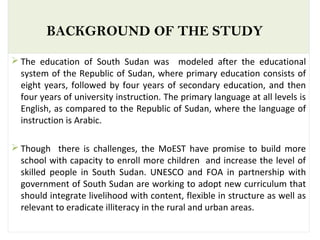
BACKGROUND OF THE STUDY
 The education of South Sudan was modeled after the educational
system of the Republic of Sudan, where primary education consists of
eight years, followed by four years of secondary education, and then
four years of university instruction. The primary language at all levels is
English, as compared to the Republic of Sudan, where the language of
instruction is Arabic.
 Though there is challenges, the MoEST have promise to build more
school with capacity to enroll more children and increase the level of
skilled people in South Sudan. UNESCO and FOA in partnership with
government of South Sudan are working to adopt new curriculum that
should integrate livelihood with content, flexible in structure as well as
relevant to eradicate illiteracy in the rural and urban areas.
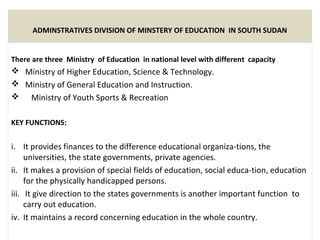
ADMINSTRATIVES DIVISION OF MINSTERY OF EDUCATION IN SOUTH SUDAN
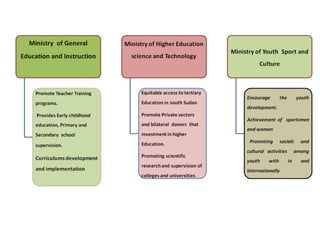
There are three Ministry of Education in national level with different capacity .
 Ministry of Higher Education, Science & Technology.
 Ministry of General Education and Instruction.
 Ministry of Youth Sports & Recreation
KEY FUNCTIONS:
i. It provides finances to the difference educational organiza­tions, the
universities, the state governments, private agencies.
ii. It makes a provision of special fields of education, social educa­tion, education
for the physically handicapped persons.
iii. It give direction to the states governments is another important function to
carry out education.
iv. It maintains a record concerning education in the whole country.
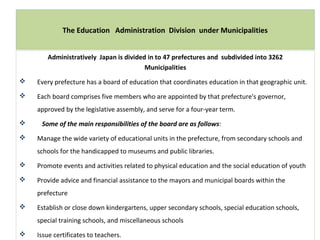
Administratively Japan is divided in to 47 prefectures and subdivided into 3262
Municipalities
 Every prefecture has a board of education that coordinates education in that geographic unit.
 Each board comprises five members who are appointed by that prefecture's governor,
approved by the legislative assembly, and serve for a four-year term.
 Some of the main responsibilities of the board are as follows:
 Manage the wide variety of educational units in the prefecture, from secondary schools and
schools for the handicapped to museums and public libraries.
 Promote events and activities related to physical education and the social education of youth
 Provide advice and financial assistance to the mayors and municipal boards within the
prefecture
 Establish or close down kindergartens, upper secondary schools, special education schools,
special training schools, and miscellaneous schools
 Issue certificates to teachers.
The Education Administration Division under Municipalities
Source of Schools fund
 Finances: There are three main entities share financial responsibility for
supporting public education: the national, prefectural, and municipal
governments.
 Through the use of taxes and other means of acquiring income, each of these
units funds a diverse array of educational programs at its level.
 Public schools are funded by a combination of support from the national,
municipal and prefectural governments.
 Public upper secondary school did require tuition Private schools also receive a
great deal of public funding, with the Japanese government paying 50% of
private school teachers’ salaries.
 Other forms of funding are capital grants, which go to private schools for
specific costs, including new buildings and equipment
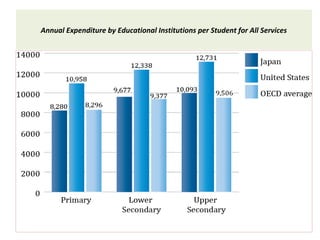
Annual Expenditure by Educational Institutions per Student for All Services
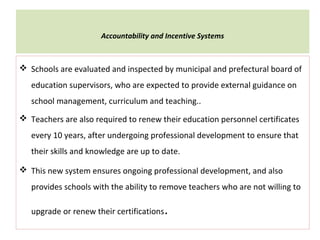
Accountability and Incentive Systems
 Schools are evaluated and inspected by municipal and prefectural board of
education supervisors, who are expected to provide external guidance on
school management, curriculum and teaching..
 Teachers are also required to renew their education personnel certificates
every 10 years, after undergoing professional development to ensure that
their skills and knowledge are up to date.
 This new system ensures ongoing professional development, and also
provides schools with the ability to remove teachers who are not willing to
upgrade or renew their certifications.
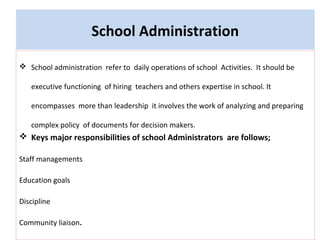
School Administration
 School administration refer to daily operations of school Activities. It should be
executive functioning of hiring teachers and others expertise in school. It
encompasses more than leadership it involves the work of analyzing and preparing
complex policy of documents for decision makers.
 Keys major responsibilities of school Administrators are follows;
Staff managements
Education goals
Discipline
Community liaison.
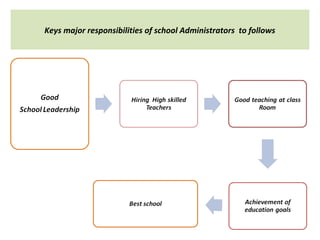
Keys major responsibilities of school Administrators to follows
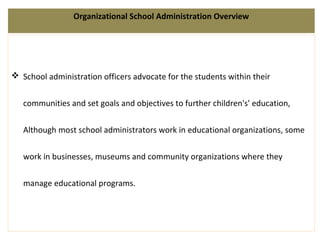
Organizational School Administration Overview
 School administration officers advocate for the students within their
communities and set goals and objectives to further children's' education,
Although most school administrators work in educational organizations, some
work in businesses, museums and community organizations where they
manage educational programs.
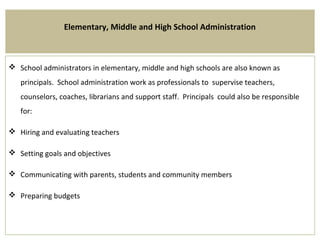
Elementary, Middle and High School Administration
 School administrators in elementary, middle and high schools are also known as
principals. School administration work as professionals to supervise teachers,
counselors, coaches, librarians and support staff. Principals could also be responsible
for:
 Hiring and evaluating teachers
 Setting goals and objectives
 Communicating with parents, students and community members
 Preparing budgets
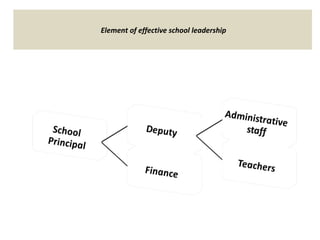
Element of effective school leadership
Good School Leadership can produce good quality students and in other ways can increase enrollment
in universities and colleges according to research by Leithwood & Jantzi (2000)
And considering this relationships, therefore; the schools Principals should improved their leadership
through :
 working directly with teachers to improve effectiveness in the classroom
 providing resources and professional development to improve instruction.
 regularly monitoring teaching and student progress,
 participating in discussions on educational issues, and
 Promoting parental and community involvement in the school
Element of effective school leadership

Educational administration and finance juba

  • 1.
    EDUCATIONAL ADMINISTRATION ANDFINANCE • Outline………. • Background of the study • Statement of the Problem • Purpose of the study • Significant of the study • Data analysis of the study • Conclusion of the study • Reference……………..
  • 2.
    BACKGROUND OF THESTUDY  The education of South Sudan was modeled after the educational system of the Republic of Sudan, where primary education consists of eight years, followed by four years of secondary education, and then four years of university instruction. The primary language at all levels is English, as compared to the Republic of Sudan, where the language of instruction is Arabic.  Though there is challenges, the MoEST have promise to build more school with capacity to enroll more children and increase the level of skilled people in South Sudan. UNESCO and FOA in partnership with government of South Sudan are working to adopt new curriculum that should integrate livelihood with content, flexible in structure as well as relevant to eradicate illiteracy in the rural and urban areas.
  • 3.
    ADMINSTRATIVES DIVISION OFMINSTERY OF EDUCATION IN SOUTH SUDAN There are three Ministry of Education in national level with different capacity .  Ministry of Higher Education, Science & Technology.  Ministry of General Education and Instruction.  Ministry of Youth Sports & Recreation KEY FUNCTIONS: i. It provides finances to the difference educational organiza­tions, the universities, the state governments, private agencies. ii. It makes a provision of special fields of education, social educa­tion, education for the physically handicapped persons. iii. It give direction to the states governments is another important function to carry out education. iv. It maintains a record concerning education in the whole country.
  • 5.
    Administratively Japan isdivided in to 47 prefectures and subdivided into 3262 Municipalities  Every prefecture has a board of education that coordinates education in that geographic unit.  Each board comprises five members who are appointed by that prefecture's governor, approved by the legislative assembly, and serve for a four-year term.  Some of the main responsibilities of the board are as follows:  Manage the wide variety of educational units in the prefecture, from secondary schools and schools for the handicapped to museums and public libraries.  Promote events and activities related to physical education and the social education of youth  Provide advice and financial assistance to the mayors and municipal boards within the prefecture  Establish or close down kindergartens, upper secondary schools, special education schools, special training schools, and miscellaneous schools  Issue certificates to teachers. The Education Administration Division under Municipalities
  • 6.
    Source of Schoolsfund  Finances: There are three main entities share financial responsibility for supporting public education: the national, prefectural, and municipal governments.  Through the use of taxes and other means of acquiring income, each of these units funds a diverse array of educational programs at its level.  Public schools are funded by a combination of support from the national, municipal and prefectural governments.  Public upper secondary school did require tuition Private schools also receive a great deal of public funding, with the Japanese government paying 50% of private school teachers’ salaries.  Other forms of funding are capital grants, which go to private schools for specific costs, including new buildings and equipment
  • 7.
    Annual Expenditure byEducational Institutions per Student for All Services
  • 8.
    Accountability and IncentiveSystems  Schools are evaluated and inspected by municipal and prefectural board of education supervisors, who are expected to provide external guidance on school management, curriculum and teaching..  Teachers are also required to renew their education personnel certificates every 10 years, after undergoing professional development to ensure that their skills and knowledge are up to date.  This new system ensures ongoing professional development, and also provides schools with the ability to remove teachers who are not willing to upgrade or renew their certifications.
  • 9.
    School Administration  Schooladministration refer to daily operations of school Activities. It should be executive functioning of hiring teachers and others expertise in school. It encompasses more than leadership it involves the work of analyzing and preparing complex policy of documents for decision makers.  Keys major responsibilities of school Administrators are follows; Staff managements Education goals Discipline Community liaison.
  • 10.
    Keys major responsibilitiesof school Administrators to follows
  • 11.
    Organizational School AdministrationOverview  School administration officers advocate for the students within their communities and set goals and objectives to further children's' education, Although most school administrators work in educational organizations, some work in businesses, museums and community organizations where they manage educational programs.
  • 12.
    Elementary, Middle andHigh School Administration  School administrators in elementary, middle and high schools are also known as principals. School administration work as professionals to supervise teachers, counselors, coaches, librarians and support staff. Principals could also be responsible for:  Hiring and evaluating teachers  Setting goals and objectives  Communicating with parents, students and community members  Preparing budgets
  • 13.
    Element of effectiveschool leadership Good School Leadership can produce good quality students and in other ways can increase enrollment in universities and colleges according to research by Leithwood & Jantzi (2000) And considering this relationships, therefore; the schools Principals should improved their leadership through :  working directly with teachers to improve effectiveness in the classroom  providing resources and professional development to improve instruction.  regularly monitoring teaching and student progress,  participating in discussions on educational issues, and  Promoting parental and community involvement in the school
  • 14.
    Element of effectiveschool leadership