Generalitat de Catalunya
Departament d’Educació


            THE EDUCATIONAL SYSTEM IN CATALONIA
                                     BASIC ASPECTS


1. How is the Catalan Educational System organised?

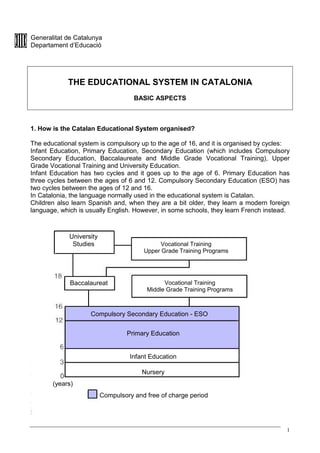
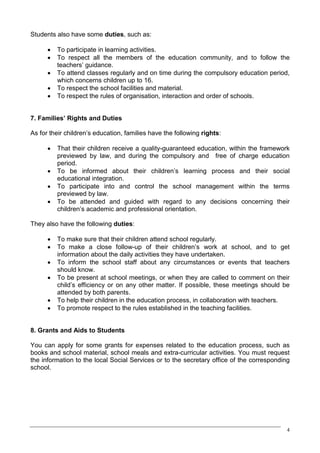
The educational system is compulsory up to the age of 16, and it is organised by cycles:
Infant Education, Primary Education, Secondary Education (which includes Compulsory
Secondary Education, Baccalaureate and Middle Grade Vocational Training), Upper
Grade Vocational Training and University Education.
Infant Education has two cycles and it goes up to the age of 6. Primary Education has
three cycles between the ages of 6 and 12. Compulsory Secondary Education (ESO) has
two cycles between the ages of 12 and 16.
In Catalonia, the language normally used in the educational system is Catalan.
Children also learn Spanish and, when they are a bit older, they learn a modern foreign
language, which is usually English. However, in some schools, they learn French instead.


             University
              Studies                        Vocational Training
                                        Upper Grade Training Programs


             Baccalaureat                      Vocational Training
                                         Middle Grade Training Programs


                    Compulsory Secondary Education - ESO


                                   Primary Education


                                    Infant Education

                                        Nursery
       (years)
                          Compulsory and free of charge period


                                                                                       1
2. What kind of teaching facilities are there?

Teaching facilities can be public, private but subsidised with public funds (“grant
maintained” facilities), and private. All the information below basically refers to public and
grant maintained facilities.


3. What formalities must be completed to formalise the school registration?

   Pre-registration:
   1. Ask for the pre-registration application form to the school and fill it out. You can also
      request it at the city hall where the school is located, or at the corresponding
      Territorial Services of Education.
   2. Submit the application form and the following documentation to the school chosen
      as first option.
        Documentation that must be submitted together with the application form:
            · Photocopy of the family book or any document concerning the marital status.
            · Photocopy of DNI, passport or any other identity card of father, mother or guardian.
            · Vaccination card or equivalent certification.
            · Documentation accrediting family address.
            · Copy of the document accrediting that the father, mother or guardian is the beneficiary of
               some benefits for basic income.
            · Photocopy of the student’s DNI, or any other identity card if the student is aged over 14.

   3. This documentation can also be submitted at the city hall where the school is
      located, or at the corresponding Territorial Services of Education before the pre-
      registration period is over. These organisms will submit the documentation to the
      school chosen as first option.
   4. Ask for a dated and sealed copy of the application form.

  Publication and Claims:
   5. The school will publish a list of students and the corresponding registration scale.
      Then, the school will open a period for claims. All the information will be posted at
      school announcement boards.

  Registration:
   6. Submit any documentation that has not been previously submitted.
   7. The school’s director will have an informative interview with the parents or guardian
      of those students registering to the school for the first time.


Please note!: All the formalities above must be completed on certain dates. You must pay
attention to the registration periods. Pre-registration usually starts in April.


                                                                                                      2
4. What should you do if there is some documentation missing?

In some extraordinary cases, alternative documents or reports made by the corresponding
social services will be accepted.


5. Organisation of schools

People who work for the education of students at schools are numerous, and they have
various tasks.

      Every school has a directive board constituted by:
      ·   Director: he/she is the person with the most authority and responsibilities in the
          school.
      ·   Tutor: he/she is responsible for every group of students. He/she must collaborate
          with families during the students’ education and training processes.
      ·   Hosting Tutor: he/she is the initial reference person for newcomer students.
          He/she shares the tutoring with the tutor of the reference group until newcomer
          students are totally integrated to the group.
      ·   Pedagogical Team: it is constituted by all teachers, who are in charge of deciding
          the school’s pedagogical matters.
      ·   Teacher: he/she is responsible for the students’ academic subjects, as well as
          the school regulations.
      ·   Secretary: he/she is responsible for the administration and finances (aids, grants,
          registrations, etc.).
      ·   Non-teaching Staff: other people who work in various services within the school,
          but they do not teach.
      ·   School Council: it is constituted by a certain number of teachers, students’
          parents, services staff and people representing the local administration. The
          school council participates in the control of the school management.
      ·   Parents’ Association: their mission is to promote the collaboration between
          families and schools for their good functioning. The association is also
          responsible for the organisation of the various extra-curricular activities. The
          participation of parents is always necessary because their collaboration is
          important in the education process of their children.


6. Students’ Rights and Duties

Every child has the right to education, no matter their place of origin or their place of
residence. This right is independent from their and their families’ administrative situation,
even if they have no residence permit.

Every student has, among others, the following rights:
     · To receive an education enabling the development of their personality.
     · That their particular education needs are taken into account.
     · That their freedom of consciousness, their moral and religious beliefs, their
         language, their culture and their personal dignity are respected.
     · To receive academic and professional guidance.


                                                                                            3
Students also have some duties, such as:

      ·   To participate in learning activities.
      ·   To respect all the members of the education community, and to follow the
          teachers’ guidance.
      ·   To attend classes regularly and on time during the compulsory education period,
          which concerns children up to 16.
      ·   To respect the school facilities and material.
      ·   To respect the rules of organisation, interaction and order of schools.


7. Families’ Rights and Duties

As for their children’s education, families have the following rights:

      ·   That their children receive a quality-guaranteed education, within the framework
          previewed by law, and during the compulsory and free of charge education
          period.
      ·   To be informed about their children’s learning process and their social
          educational integration.
      ·   To participate into and control the school management within the terms
          previewed by law.
      ·   To be attended and guided with regard to any decisions concerning their
          children’s academic and professional orientation.

They also have the following duties:

      ·   To make sure that their children attend school regularly.
      ·   To make a close follow-up of their children’s work at school, and to get
          information about the daily activities they have undertaken.
      ·   To inform the school staff about any circumstances or events that teachers
          should know.
      ·   To be present at school meetings, or when they are called to comment on their
          child’s efficiency or on any other matter. If possible, these meetings should be
          attended by both parents.
      ·   To help their children in the education process, in collaboration with teachers.
      ·   To promote respect to the rules established in the teaching facilities.


8. Grants and Aids to Students

You can apply for some grants for expenses related to the education process, such as
books and school material, school meals and extra-curricular activities. You must request
the information to the local Social Services or to the secretary office of the corresponding
school.


                                                                                           4
9. School Calendar

The school year runs from September to June. It is divided by three calendar quarters.

       ·   The first quarter runs from September to Christmas holidays, which last 15
           days.
       ·   The second quarter runs from January to Easter holidays, which last 10 days.
       ·   The third quarter runs from Easter holidays to the end of June.
       ·   Summer holidays include the months of July, August and the first week of
           September.


10. Translation Service

The Department of Education has a translation/interpreting service at the disposal of
education commissions and teaching facilities registering students for the first time in
Catalonia, in order to enable the communication between schools and families.


                                                                                         5
11. Addresses of Interest

                       Adress            Telephone No.   Fax No.

    Department of Education
                                           934006900     934006980
    Via Augusta, 202 – 226
    08021 Barcelona (Barcelonès)

    Territorial Services of Education

    Baix Llobregat - Anoia
                                           936859450     936859460
    Laureà Miró, 328-330
    08980 Sant Feliu de Llobregat

    Barcelona 1 (city)
                                           934439500     934439544
    Paral·lel, 71-73
    08010 Barcelona (Barcelonès)

    Barcelona 2 (regional)
                                           934816000     934816033
    Casp, 15
    08010 Barcelona ( Barcelonès)

    Girona
                                           972488300     972214216
    Ultònia, 13
    17002 Girona (Gironès)

    Lleida
                                           973279999     973279997
    Pica d’Estats, 2
    25006 Lleida (Segrià)

    Tarragona
                                           977251440     977251450
    Sant Francesc, 7
    43003 Tarragona (Tarragonès)

    Terres de l’Ebre
                                           977448711     977448718
    Providència, 7-9
    43500 Tortosa (Baix Ebre)

    Vallès Occidental
                                           937484455     937484453
    Marquès de Comillas, 67-69
    08282 Sabadell (Vallès Occidental)


                                                                     6

Angles

  • 1.
    Generalitat de Catalunya Departamentd’Educació THE EDUCATIONAL SYSTEM IN CATALONIA BASIC ASPECTS 1. How is the Catalan Educational System organised? The educational system is compulsory up to the age of 16, and it is organised by cycles: Infant Education, Primary Education, Secondary Education (which includes Compulsory Secondary Education, Baccalaureate and Middle Grade Vocational Training), Upper Grade Vocational Training and University Education. Infant Education has two cycles and it goes up to the age of 6. Primary Education has three cycles between the ages of 6 and 12. Compulsory Secondary Education (ESO) has two cycles between the ages of 12 and 16. In Catalonia, the language normally used in the educational system is Catalan. Children also learn Spanish and, when they are a bit older, they learn a modern foreign language, which is usually English. However, in some schools, they learn French instead. University Studies Vocational Training Upper Grade Training Programs Baccalaureat Vocational Training Middle Grade Training Programs Compulsory Secondary Education - ESO Primary Education Infant Education Nursery (years) Compulsory and free of charge period 1
  • 2.
    2. What kindof teaching facilities are there? Teaching facilities can be public, private but subsidised with public funds (“grant maintained” facilities), and private. All the information below basically refers to public and grant maintained facilities. 3. What formalities must be completed to formalise the school registration? Pre-registration: 1. Ask for the pre-registration application form to the school and fill it out. You can also request it at the city hall where the school is located, or at the corresponding Territorial Services of Education. 2. Submit the application form and the following documentation to the school chosen as first option. Documentation that must be submitted together with the application form: · Photocopy of the family book or any document concerning the marital status. · Photocopy of DNI, passport or any other identity card of father, mother or guardian. · Vaccination card or equivalent certification. · Documentation accrediting family address. · Copy of the document accrediting that the father, mother or guardian is the beneficiary of some benefits for basic income. · Photocopy of the student’s DNI, or any other identity card if the student is aged over 14. 3. This documentation can also be submitted at the city hall where the school is located, or at the corresponding Territorial Services of Education before the pre- registration period is over. These organisms will submit the documentation to the school chosen as first option. 4. Ask for a dated and sealed copy of the application form. Publication and Claims: 5. The school will publish a list of students and the corresponding registration scale. Then, the school will open a period for claims. All the information will be posted at school announcement boards. Registration: 6. Submit any documentation that has not been previously submitted. 7. The school’s director will have an informative interview with the parents or guardian of those students registering to the school for the first time. Please note!: All the formalities above must be completed on certain dates. You must pay attention to the registration periods. Pre-registration usually starts in April. 2
  • 3.
    4. What shouldyou do if there is some documentation missing? In some extraordinary cases, alternative documents or reports made by the corresponding social services will be accepted. 5. Organisation of schools People who work for the education of students at schools are numerous, and they have various tasks. Every school has a directive board constituted by: · Director: he/she is the person with the most authority and responsibilities in the school. · Tutor: he/she is responsible for every group of students. He/she must collaborate with families during the students’ education and training processes. · Hosting Tutor: he/she is the initial reference person for newcomer students. He/she shares the tutoring with the tutor of the reference group until newcomer students are totally integrated to the group. · Pedagogical Team: it is constituted by all teachers, who are in charge of deciding the school’s pedagogical matters. · Teacher: he/she is responsible for the students’ academic subjects, as well as the school regulations. · Secretary: he/she is responsible for the administration and finances (aids, grants, registrations, etc.). · Non-teaching Staff: other people who work in various services within the school, but they do not teach. · School Council: it is constituted by a certain number of teachers, students’ parents, services staff and people representing the local administration. The school council participates in the control of the school management. · Parents’ Association: their mission is to promote the collaboration between families and schools for their good functioning. The association is also responsible for the organisation of the various extra-curricular activities. The participation of parents is always necessary because their collaboration is important in the education process of their children. 6. Students’ Rights and Duties Every child has the right to education, no matter their place of origin or their place of residence. This right is independent from their and their families’ administrative situation, even if they have no residence permit. Every student has, among others, the following rights: · To receive an education enabling the development of their personality. · That their particular education needs are taken into account. · That their freedom of consciousness, their moral and religious beliefs, their language, their culture and their personal dignity are respected. · To receive academic and professional guidance. 3
  • 4.
    Students also havesome duties, such as: · To participate in learning activities. · To respect all the members of the education community, and to follow the teachers’ guidance. · To attend classes regularly and on time during the compulsory education period, which concerns children up to 16. · To respect the school facilities and material. · To respect the rules of organisation, interaction and order of schools. 7. Families’ Rights and Duties As for their children’s education, families have the following rights: · That their children receive a quality-guaranteed education, within the framework previewed by law, and during the compulsory and free of charge education period. · To be informed about their children’s learning process and their social educational integration. · To participate into and control the school management within the terms previewed by law. · To be attended and guided with regard to any decisions concerning their children’s academic and professional orientation. They also have the following duties: · To make sure that their children attend school regularly. · To make a close follow-up of their children’s work at school, and to get information about the daily activities they have undertaken. · To inform the school staff about any circumstances or events that teachers should know. · To be present at school meetings, or when they are called to comment on their child’s efficiency or on any other matter. If possible, these meetings should be attended by both parents. · To help their children in the education process, in collaboration with teachers. · To promote respect to the rules established in the teaching facilities. 8. Grants and Aids to Students You can apply for some grants for expenses related to the education process, such as books and school material, school meals and extra-curricular activities. You must request the information to the local Social Services or to the secretary office of the corresponding school. 4
  • 5.
    9. School Calendar Theschool year runs from September to June. It is divided by three calendar quarters. · The first quarter runs from September to Christmas holidays, which last 15 days. · The second quarter runs from January to Easter holidays, which last 10 days. · The third quarter runs from Easter holidays to the end of June. · Summer holidays include the months of July, August and the first week of September. 10. Translation Service The Department of Education has a translation/interpreting service at the disposal of education commissions and teaching facilities registering students for the first time in Catalonia, in order to enable the communication between schools and families. 5
  • 6.
    11. Addresses ofInterest Adress Telephone No. Fax No. Department of Education 934006900 934006980 Via Augusta, 202 – 226 08021 Barcelona (Barcelonès) Territorial Services of Education Baix Llobregat - Anoia 936859450 936859460 Laureà Miró, 328-330 08980 Sant Feliu de Llobregat Barcelona 1 (city) 934439500 934439544 Paral·lel, 71-73 08010 Barcelona (Barcelonès) Barcelona 2 (regional) 934816000 934816033 Casp, 15 08010 Barcelona ( Barcelonès) Girona 972488300 972214216 Ultònia, 13 17002 Girona (Gironès) Lleida 973279999 973279997 Pica d’Estats, 2 25006 Lleida (Segrià) Tarragona 977251440 977251450 Sant Francesc, 7 43003 Tarragona (Tarragonès) Terres de l’Ebre 977448711 977448718 Providència, 7-9 43500 Tortosa (Baix Ebre) Vallès Occidental 937484455 937484453 Marquès de Comillas, 67-69 08282 Sabadell (Vallès Occidental) 6