Educational System in Russia
EDU 430
Turkish Educational System & School
Administration
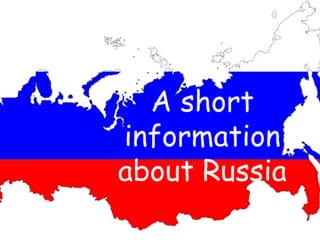
A short
information
about Russia
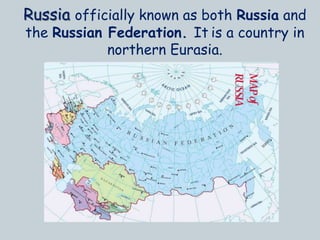
Russia officially known as both Russia and
the Russian Federation. It is a country in
northern Eurasia.
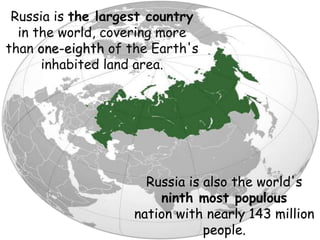
Russia is the largest country
in the world, covering more
than one-eighth of the Earth's
inhabited land area.
Russia is also the world's
ninth most populous
nation with nearly 143 million
people.
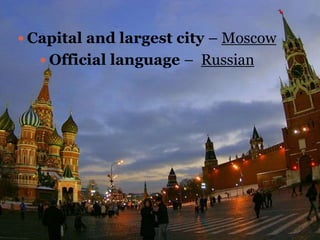
 Capital and largest city – Moscow
 Official language – Russian
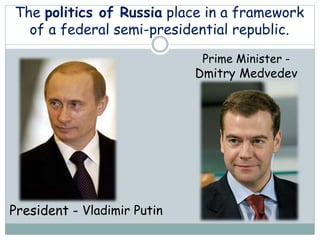
The politics of Russia place in a framework
of a federal semi-presidential republic.
President - Vladimir Putin
Prime Minister -
Dmitry Medvedev
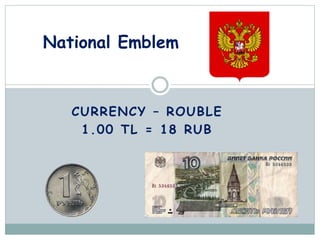
CURRENCY – ROUBLE
1.00 TL = 18 RUB
National Emblem
Educational System
 Education in Russia is provided predominantly by the
state and is regulated by the Ministry of Education
and Science.
 Russia has a long-standing tradition in high-quality
education for all citizens.
 It probably has also one of the best mass-education
systems in the world producing a literacy rate (98%)
exceeding most Western European countries.
 Education is split into a compulsory Basic Education,
and ongoing Higher Education.
Russia has a free education system, which is guaranteed
for all citizens by the Constitution.
Shortly about the Ministry
The Ministry of Education and Science of Russia is
a federal executive authority responsible for the
state policy development and normative and legal
regulation in the sphere of education, research,
scientific, technological and innovation activities,
nanotechnology, intellectual property, as well as in
the sphere of nurturing, social support and social
protection of students and pupils of educational
institutions.
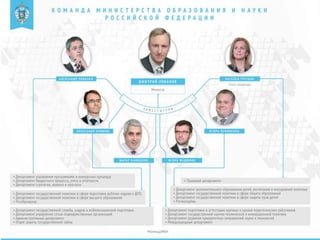
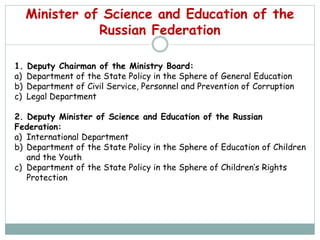
Minister of Science and Education of the
Russian Federation
1. Deputy Chairman of the Ministry Board:
a) Department of the State Policy in the Sphere of General Education
b) Department of Civil Service, Personnel and Prevention of Corruption
c) Legal Department
2. Deputy Minister of Science and Education of the Russian
Federation:
a) International Department
b) Department of the State Policy in the Sphere of Education of Children
and the Youth
c) Department of the State Policy in the Sphere of Children’s Rights
Protection
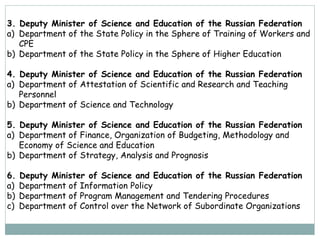
3. Deputy Minister of Science and Education of the Russian Federation
a) Department of the State Policy in the Sphere of Training of Workers and
CPE
b) Department of the State Policy in the Sphere of Higher Education
4. Deputy Minister of Science and Education of the Russian Federation
a) Department of Attestation of Scientific and Research and Teaching
Personnel
b) Department of Science and Technology
5. Deputy Minister of Science and Education of the Russian Federation
a) Department of Finance, Organization of Budgeting, Methodology and
Economy of Science and Education
b) Department of Strategy, Analysis and Prognosis
6. Deputy Minister of Science and Education of the Russian Federation
a) Department of Information Policy
b) Department of Program Management and Tendering Procedures
c) Department of Control over the Network of Subordinate Organizations
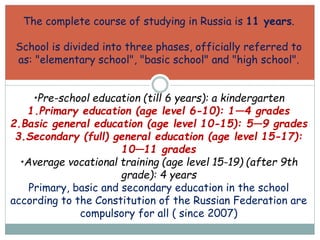
The complete course of studying in Russia is 11 years.
School is divided into three phases, officially referred to
as: "elementary school", "basic school" and "high school".
•Pre-school education (till 6 years): a kindergarten
1.Primary education (age level 6-10): 1—4 grades
2.Basic general education (age level 10-15): 5—9 grades
3.Secondary (full) general education (age level 15-17):
10—11 grades
•Average vocational training (age level 15-19) (after 9th
grade): 4 years
Primary, basic and secondary education in the school
according to the Constitution of the Russian Federation are
compulsory for all ( since 2007)
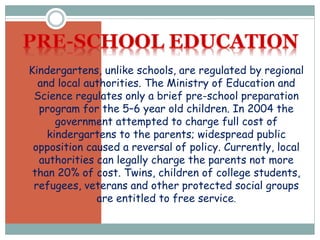
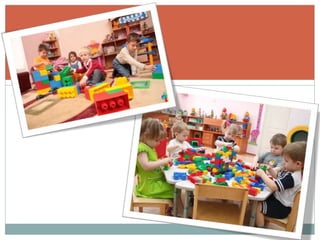
Kindergartens, unlike schools, are regulated by regional
and local authorities. The Ministry of Education and
Science regulates only a brief pre-school preparation
program for the 5–6 year old children. In 2004 the
government attempted to charge full cost of
kindergartens to the parents; widespread public
opposition caused a reversal of policy. Currently, local
authorities can legally charge the parents not more
than 20% of cost. Twins, children of college students,
refugees, veterans and other protected social groups
are entitled to free service.
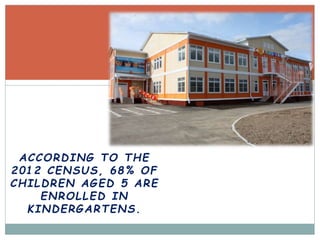
ACCORDING TO THE
2012 CENSUS, 68% OF
CHILDREN AGED 5 ARE
ENROLLED IN
KINDERGARTENS.
Elementary school lasts for 4 years — from 1st grade
to 4th grade. Its aim is to give a minimum base set of
knowledge and abilities necessary for life and any
work.
Subjects:
 Reading;
 Elementary Mathematics;
 Initial Labor Training;
 Music;
 Physical Education;
 ‘’World Around’’
 Foreign language
PRIMARY SCHOOL EDUCATION
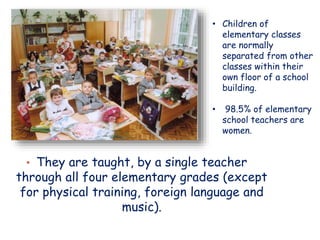
• They are taught, by a single teacher
through all four elementary grades (except
for physical training, foreign language and
music).
• Children of
elementary classes
are normally
separated from other
classes within their
own floor of a school
building.
• 98.5% of elementary
school teachers are
women.
For five years, from 5th to 9th grade, students study at
the basic school.
The high school gives basic knowledge on mainstreams of
sciences. Each training course is taught by different
teachers, specialized in the subject they teach.
All day students move from class to class.
The class teacher is chosen to a class — one of teachers
at school, which officially is responsible for a class,
solves administrative and organizational questions.
BASIC SCHOOL EDUCATION
Subjects:
• Algebra;
• Geometry;
• Physics;
• Chemistry;
• Biology;
• Russian Language;
• Russian Literature;
• History;
• Geography;
• A Foreign Language;
• Music;
• Labor Training;
• Physical Education.
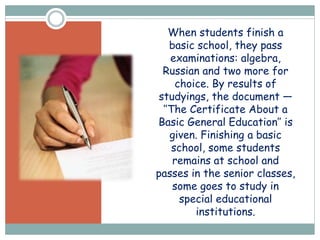
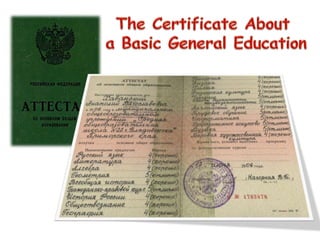
When students finish a
basic school, they pass
examinations: algebra,
Russian and two more for
choice. By results of
studyings, the document —
’’The Certificate About a
Basic General Education’’ is
given. Finishing a basic
school, some students
remains at school and
passes in the senior classes,
some goes to study in
special educational
institutions.
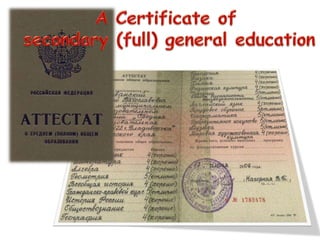
There are last two years of studying: 10th grade
and 11th grade
Basic purpose of the high school is preparation for
University.
The training course includes the further studying of
a part of the subjects studied earlier at the basic
school, and also a small amount of new subjects.
Students who successfully finish last two grades
receive ‘’A Certificate of secondary (full) general
education ‘’.
SECONDARY SCHOOL EDUCATION
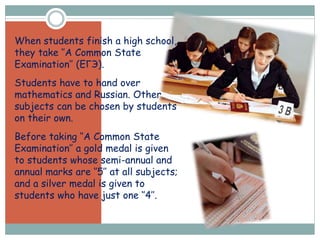
When students finish a high school,
they take ‘’A Common State
Examination’’ (ЕГЭ).
Students have to hand over
mathematics and Russian. Other
subjects can be chosen by students
on their own.
Before taking ‘’A Common State
Examination’’ a gold medal is given
to students whose semi-annual and
annual marks are ‘’5’’ at all subjects;
and a silver medal is given to
students who have just one ‘’4’’.
Upon completion of a nine-year program the
student has a choice of either completing the
remaining two years at normal school, or of a
transfer to a specialized professional training
schools. They provide students with a working
skill qualification and a high school certificate
equivalent to 11-year education in a normal
school; the program, due to its work training
component, extends to 3 years. In 2007–2008
there were 2,800 such institutions with 2,28
million students.
GENERAL
INFORMATION ABOUT
SCHOOLS
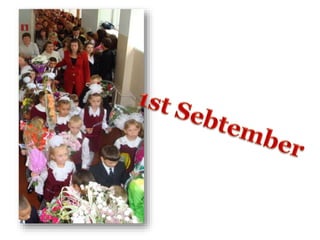
• • The school year begins on September 1 and ends in late may
or June.
• • There are two basic ways to divide the school year:
• 1. Division into four quarters.
• 2. Division into three terms.
• • At the end of each quarter or trimester, there is the total
score for all subjects and at the end of each year is the
annual mark. A student with poor grade can be left on the
second year or transferred to a class below.
• • Students are graded on a 5-step scale, ranging in practice
from 2 ("unacceptable") to 5 ("excellent");
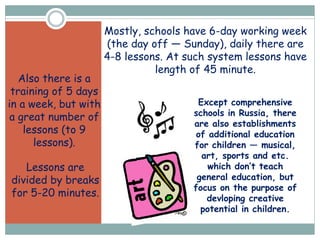
Except comprehensive
schools in Russia, there
are also establishments
of additional education
for children — musical,
art, sports and etc.
which don’t teach
general education, but
focus on the purpose of
devloping creative
potential in children.
Mostly, schools have 6-day working week
(the day off — Sunday), daily there are
4-8 lessons. At such system lessons have
length of 45 minute.
Also there is a
training of 5 days
in a week, but with
a great number of
lessons (to 9
lessons).
Lessons are
divided by breaks
for 5-20 minutes.
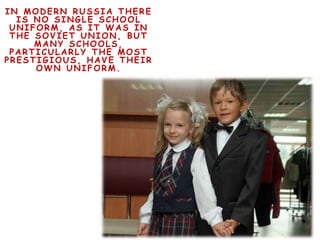
IN MODERN RUSSIA THERE
IS NO SINGLE SCHOOL
UNIFORM, AS IT WAS IN
THE SOVIET UNION, BUT
MANY SCHOOLS,
PARTICULARLY THE MOST
PRESTIGIOUS, HAVE THEIR
OWN UNIFORM.
• In Russia, there are 1 360 000 teachers and
13 360 000 students who are placed on 53 thousand
schools.
• There are 3 thousand Russian universities. Every
year, 110 000 students graduate from this
universities. The total number of university students
is 7 million. The total number of teachers in
universities is 341 000.
• There are also about 2 000 schools with 300 000
children. This schools are designed for disabled
children with special health needs and development.
About Private Schools
• There are about 700 private schools in Russia, of
which 250 are located in Moscow and about 50 more
in the Moscow Region.
• The advantages of private schools are numerous:
smaller class sizes (12 to 15 pupils on average) allow
for a more individualized approach to educating
children, including the so-called “problem cases,” as
well as full boarding programs and advanced study of
foreign languages and other popular subjects such as
math, economics and art.
University Education
 Bakalavr (Bachelor's) degree programmes last for 4 years
of full-time university-level study.
 The programmes are elaborated in accordance with the
State Educational Standards which regulate 50% of the
content, the other 50% being developed by the university.
The programmes include professional and special courses in
Science, the Humanities and Socioeconomic disciplines,
professional training, completion of final research
paper/project and sitting for State final exams.
 Having obtained the Bakalavr degree, students may apply to
enter the Magistr programmes or continue their studies in
the framework of the Specialist Diploma programmes.
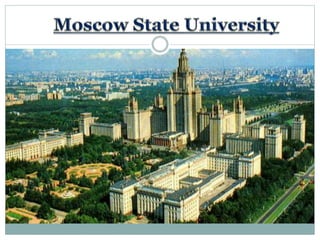
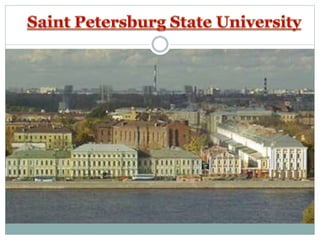
Photos of the oldest and
largest
Russian Universities
 http://en.wikipedia.org/wiki/Russia
 http://en.education.mon.gov.ru/Studying_in_russia
/to_know/
 https://academicexchange.wordpress.com/2013/08
/01/20-facts-about-the-education-system-of-russia/
 https://www.justlanded.com/english/Russia/Russia
-Guide/Education/Russian-Schools
Educational system in Russia

Educational system in Russia

  • 1.
    Educational System inRussia EDU 430 Turkish Educational System & School Administration
  • 2.
  • 3.
    Russia officially knownas both Russia and the Russian Federation. It is a country in northern Eurasia.
  • 4.
    Russia is thelargest country in the world, covering more than one-eighth of the Earth's inhabited land area. Russia is also the world's ninth most populous nation with nearly 143 million people.
  • 5.
     Capital andlargest city – Moscow  Official language – Russian
  • 6.
    The politics ofRussia place in a framework of a federal semi-presidential republic. President - Vladimir Putin Prime Minister - Dmitry Medvedev
  • 7.
    CURRENCY – ROUBLE 1.00TL = 18 RUB National Emblem
  • 8.
  • 9.
     Education inRussia is provided predominantly by the state and is regulated by the Ministry of Education and Science.  Russia has a long-standing tradition in high-quality education for all citizens.  It probably has also one of the best mass-education systems in the world producing a literacy rate (98%) exceeding most Western European countries.  Education is split into a compulsory Basic Education, and ongoing Higher Education. Russia has a free education system, which is guaranteed for all citizens by the Constitution.
  • 10.
    Shortly about theMinistry The Ministry of Education and Science of Russia is a federal executive authority responsible for the state policy development and normative and legal regulation in the sphere of education, research, scientific, technological and innovation activities, nanotechnology, intellectual property, as well as in the sphere of nurturing, social support and social protection of students and pupils of educational institutions.
  • 12.
    Minister of Scienceand Education of the Russian Federation 1. Deputy Chairman of the Ministry Board: a) Department of the State Policy in the Sphere of General Education b) Department of Civil Service, Personnel and Prevention of Corruption c) Legal Department 2. Deputy Minister of Science and Education of the Russian Federation: a) International Department b) Department of the State Policy in the Sphere of Education of Children and the Youth c) Department of the State Policy in the Sphere of Children’s Rights Protection
  • 13.
    3. Deputy Ministerof Science and Education of the Russian Federation a) Department of the State Policy in the Sphere of Training of Workers and CPE b) Department of the State Policy in the Sphere of Higher Education 4. Deputy Minister of Science and Education of the Russian Federation a) Department of Attestation of Scientific and Research and Teaching Personnel b) Department of Science and Technology 5. Deputy Minister of Science and Education of the Russian Federation a) Department of Finance, Organization of Budgeting, Methodology and Economy of Science and Education b) Department of Strategy, Analysis and Prognosis 6. Deputy Minister of Science and Education of the Russian Federation a) Department of Information Policy b) Department of Program Management and Tendering Procedures c) Department of Control over the Network of Subordinate Organizations
  • 14.
    The complete courseof studying in Russia is 11 years. School is divided into three phases, officially referred to as: "elementary school", "basic school" and "high school". •Pre-school education (till 6 years): a kindergarten 1.Primary education (age level 6-10): 1—4 grades 2.Basic general education (age level 10-15): 5—9 grades 3.Secondary (full) general education (age level 15-17): 10—11 grades •Average vocational training (age level 15-19) (after 9th grade): 4 years Primary, basic and secondary education in the school according to the Constitution of the Russian Federation are compulsory for all ( since 2007)
  • 15.
    Kindergartens, unlike schools,are regulated by regional and local authorities. The Ministry of Education and Science regulates only a brief pre-school preparation program for the 5–6 year old children. In 2004 the government attempted to charge full cost of kindergartens to the parents; widespread public opposition caused a reversal of policy. Currently, local authorities can legally charge the parents not more than 20% of cost. Twins, children of college students, refugees, veterans and other protected social groups are entitled to free service.
  • 16.
    ACCORDING TO THE 2012CENSUS, 68% OF CHILDREN AGED 5 ARE ENROLLED IN KINDERGARTENS.
  • 18.
    Elementary school lastsfor 4 years — from 1st grade to 4th grade. Its aim is to give a minimum base set of knowledge and abilities necessary for life and any work. Subjects:  Reading;  Elementary Mathematics;  Initial Labor Training;  Music;  Physical Education;  ‘’World Around’’  Foreign language PRIMARY SCHOOL EDUCATION
  • 19.
    • They aretaught, by a single teacher through all four elementary grades (except for physical training, foreign language and music). • Children of elementary classes are normally separated from other classes within their own floor of a school building. • 98.5% of elementary school teachers are women.
  • 20.
    For five years,from 5th to 9th grade, students study at the basic school. The high school gives basic knowledge on mainstreams of sciences. Each training course is taught by different teachers, specialized in the subject they teach. All day students move from class to class. The class teacher is chosen to a class — one of teachers at school, which officially is responsible for a class, solves administrative and organizational questions. BASIC SCHOOL EDUCATION
  • 21.
    Subjects: • Algebra; • Geometry; •Physics; • Chemistry; • Biology; • Russian Language; • Russian Literature; • History; • Geography; • A Foreign Language; • Music; • Labor Training; • Physical Education.
  • 22.
    When students finisha basic school, they pass examinations: algebra, Russian and two more for choice. By results of studyings, the document — ’’The Certificate About a Basic General Education’’ is given. Finishing a basic school, some students remains at school and passes in the senior classes, some goes to study in special educational institutions.
  • 24.
    There are lasttwo years of studying: 10th grade and 11th grade Basic purpose of the high school is preparation for University. The training course includes the further studying of a part of the subjects studied earlier at the basic school, and also a small amount of new subjects. Students who successfully finish last two grades receive ‘’A Certificate of secondary (full) general education ‘’. SECONDARY SCHOOL EDUCATION
  • 26.
    When students finisha high school, they take ‘’A Common State Examination’’ (ЕГЭ). Students have to hand over mathematics and Russian. Other subjects can be chosen by students on their own. Before taking ‘’A Common State Examination’’ a gold medal is given to students whose semi-annual and annual marks are ‘’5’’ at all subjects; and a silver medal is given to students who have just one ‘’4’’.
  • 28.
    Upon completion ofa nine-year program the student has a choice of either completing the remaining two years at normal school, or of a transfer to a specialized professional training schools. They provide students with a working skill qualification and a high school certificate equivalent to 11-year education in a normal school; the program, due to its work training component, extends to 3 years. In 2007–2008 there were 2,800 such institutions with 2,28 million students.
  • 29.
  • 30.
    • • Theschool year begins on September 1 and ends in late may or June. • • There are two basic ways to divide the school year: • 1. Division into four quarters. • 2. Division into three terms. • • At the end of each quarter or trimester, there is the total score for all subjects and at the end of each year is the annual mark. A student with poor grade can be left on the second year or transferred to a class below. • • Students are graded on a 5-step scale, ranging in practice from 2 ("unacceptable") to 5 ("excellent");
  • 32.
    Except comprehensive schools inRussia, there are also establishments of additional education for children — musical, art, sports and etc. which don’t teach general education, but focus on the purpose of devloping creative potential in children. Mostly, schools have 6-day working week (the day off — Sunday), daily there are 4-8 lessons. At such system lessons have length of 45 minute. Also there is a training of 5 days in a week, but with a great number of lessons (to 9 lessons). Lessons are divided by breaks for 5-20 minutes.
  • 34.
    IN MODERN RUSSIATHERE IS NO SINGLE SCHOOL UNIFORM, AS IT WAS IN THE SOVIET UNION, BUT MANY SCHOOLS, PARTICULARLY THE MOST PRESTIGIOUS, HAVE THEIR OWN UNIFORM.
  • 35.
    • In Russia,there are 1 360 000 teachers and 13 360 000 students who are placed on 53 thousand schools. • There are 3 thousand Russian universities. Every year, 110 000 students graduate from this universities. The total number of university students is 7 million. The total number of teachers in universities is 341 000. • There are also about 2 000 schools with 300 000 children. This schools are designed for disabled children with special health needs and development.
  • 36.
    About Private Schools •There are about 700 private schools in Russia, of which 250 are located in Moscow and about 50 more in the Moscow Region. • The advantages of private schools are numerous: smaller class sizes (12 to 15 pupils on average) allow for a more individualized approach to educating children, including the so-called “problem cases,” as well as full boarding programs and advanced study of foreign languages and other popular subjects such as math, economics and art.
  • 37.
    University Education  Bakalavr(Bachelor's) degree programmes last for 4 years of full-time university-level study.  The programmes are elaborated in accordance with the State Educational Standards which regulate 50% of the content, the other 50% being developed by the university. The programmes include professional and special courses in Science, the Humanities and Socioeconomic disciplines, professional training, completion of final research paper/project and sitting for State final exams.  Having obtained the Bakalavr degree, students may apply to enter the Magistr programmes or continue their studies in the framework of the Specialist Diploma programmes.
  • 38.
    Photos of theoldest and largest Russian Universities
  • 41.
     http://en.wikipedia.org/wiki/Russia  http://en.education.mon.gov.ru/Studying_in_russia /to_know/ https://academicexchange.wordpress.com/2013/08 /01/20-facts-about-the-education-system-of-russia/  https://www.justlanded.com/english/Russia/Russia -Guide/Education/Russian-Schools