
PLAN
 Sastric references
 Beyond academics
 Ideas
 Implementation tools
 Importance of Inquiry in Education
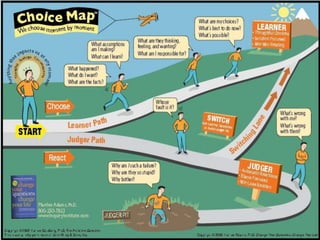
 The Choice Map, Q-Storming
 Proposals
SRILA PRABHUPADA
 “Real education means solving all life's problems.”
  - Teachings of Lord Kapila


 “Education means one becomes a gentleman.”
  - Lecture BG 4.14-19 New York 3 August 1966


 “Education means one is very gentle and learned. “
  - Lecture SB 1.2.6 Mauritius 5 October 1975
WHO IS LEARNED?
 matrvat para-daresu para-dravyesu lostra-vat
  atmavat sarva-bhutesu yah pasyati sa panditah

  "One who considers another's wife as his mother, another's
  possessions as a lump of dirt and treats all other living
  beings as he would himself, is considered to be learned.”
  - Canakya Pandita

  SB 9.10.27 Purport
STUDENTS SHOULD TEACH
 That is the way of Indian teaching, that there is one teacher, and how
  he's managing hundreds? That means there are groups. One who is
  elderly student, he's taking some beginners: "Write a or A like this."
  That he can teach. What he has learned, he can teach. Similarly, next
  group, next group.
 So in this way, one teacher can manage hundreds of students of
  different categories. This is organization. Not that everything I have to
  do. I cannot teach anybody to do it. That is not intelligence.
  Intelligence is that employ others to help you.
 Train assistant so that in your absence things can be done. So the
  elderly students, they could be ...
 Everyone should be teacher and student.


 Room Conversation -- July 31, 1976, New Mayapur (French farm)
MEEK AND HUMBLE
 As stated in the Bhagavad-gita, a person who is
  actually a brahmana and is very learned must
  automatically become very gentle also.
 If a person does not become meek and humble, all his
  studies of the Vedas and Puranas and his vast
  knowledge of the sastras are simply outward dress, like
  the costume of a theatrical artist dancing on the stage.

 Krsna Book 78
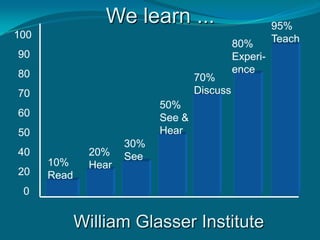
We learn ...                           95%
100                                                     Teach
                                              80%
90                                            Experi-
80                                            ence
                                    70%
70                                  Discuss
                            50%
60                          See &
50                          Hear
                      30%
40             20%    See
      10%      Hear
20    Read
 0


             William Glasser Institute
IDEAS
 Goals Beyond Academics
    Educating intelligence plus change of heart
    Character and competence
 Coaching and mentoring for students
 GITA Model (Goals – Ideas – Tests – Action)
 Students’ Mutual Coaching (Personal Questions,
  Feedforward, GITA Model)
 Learn by teaching (William Glasser Institute)
 Teach less for more
 Misuse of sastra for misbehavior
IMPLEMENTATION TOOLS
 Prepare – Perticipate - Perform
 Weekly Life Organizer (for goals and daily action)
 Personal Coaching (for personal empowerment and
  performance)
 The Learner/Teacher Approach and Three-Person
  Teaching (students should teach, “Eeach one teach
  one while being taught by one”)
 Win-Win-Win Agreements
 Inquiry
PREPARE
 Personal study and pre-work
 Establishing learning and service goals
 Identifying helpful resources and support systems
 Linking course content to your and ISKCON’s goals
PARTICIPATE
Participation in a course or a workshop can be a tremendous
catalyst for change. Such an experience provides:

 Focused concentration and immersion in a learning
    experience.
   Sharing among participants that facilitates
    implementation and service improvement.
   The creation of ongoing learning relationships among
    participants.
   A safe place to experiment and practice new behaviors.
   Exposure to other perspectives and active dialogue.
   Inspiration, motivation, and vision to change behavior.
PERFORM
 Weekly Life Organizer
 Personal Coaching
 Self-paced learning
 Web-based tools
 Renewal workshops
 Online learning networks
 Three-Person Teaching (“Each one teach one ... “)
 Follow Up Agreements
FOLLOW UP RESULTS
 Clear, written results


 How much knowledge has been converted into
  improved Vaisnava behavior and service?

 Vaisnava behavior and service is actively supported
  through effective tools, follow-up events, coaching,
  and other assistance.
FOLLOW UP AGREEMENTS
 Desired Results
 Guidelines
 Resources
 Accountability
 Consequences
IMPORTANCE OF INQUIRY
         IN EDUCATION
   Athato brahma jijnasa
   SB 1.2.5
   Better questions – better answers
   Intelligent student – intelligent questions
INQUIRY
 Great results begin with great questions
 A question not asked is a door not opened
 Better questions bring better answers
 Self-questions and interpersonal questions
 Problem-oriented or solution-oriented
 Negative Questions or Success Questions
ALBERT EINSTEIN
 “If I had an hour to solve a problem and my life
 depended on the solution, I would spend the first 55
 minutes determining the proper question to ask, for
 once I know the proper question, I could solve the
 problem in less than five minutes.”
Q-STORMING
 Rather than seeking new answers and solutions, create as
    many new questions as possible.
   Get the best answers and solutions by asking the best
    questions first.
   Questions open thinking.
   Empowers collaborative, creative and strategic thinking.
   A tool for moving beyond limitations in perception and
    thinking and advancing to new, extraordinary solutions
    and answers.
   Used to greatly improve decision making, problem solving,
    strategic planning, and innovation.
Q-STORMING
 Based on three premises:
  1) Great results begin with great questions
  2) Most problems can be solved with enough of the
      right questions
  3) The questions we ask ourselves often provide the most
      fruitful openings for new thinking and possibilities
Q-STORMING
 Done with a group or team of devotees, when exploring
  ideas and possibilities.
 In goal-oriented conversations between two devotees, for
  example, in coaching, leadership, management, or other
  departments.
 Can be done in person or online, with a global devotee
  team or a devotee in a different geographic location.
 Sharpens intelligence and memory
NEGATIVE QUESTIONS
1.   What’s wrong (with me/others)?
2.   Whose fault is it?
3.   How can I prove I’m right?
4.   Why is that person so stupid and frustrating?
5.   Haven’t we already been there, done that?
6.   How will this make things worse?
7.   How can I be in control?
8.   Why bother?
SUCCESS QUESTIONS
1.   What do I want?               8.  What can I learn:
2.   What assumptions am I              …from this person or
     making and what are the                 situation?
     facts?                             …from this mistake or
3.   What am I responsible for?              failure?
4.   What am I missing or               …from this success?
     avoiding?                     9. How else can I think about
                                       this?
5.   What is the other person
                                   10. How can I make this a win-
     thinking, feeling, wanting?
                                       win?
6.   What’s there to accept and    11. What’s possible?
     forgive in myself/others?
                                   12. What action steps make the
7.   What questions should I           most sense?
     ask myself and/or others?
KRSNA CONSCIOUS QUESTIONS
 What is the most Krsna conscious thing to do in this
    situation?
   How can I see this through the eyes of sastra?
   What would please Krsna here?
   What would Prabhupada do in this situation?
   What would I do now if Prabhupada was watching?
   What is the spiritual test that I have to pass here?
   What can I learn from this that will help me be more Krsna
    conscious?
   How is this an opportunity to surrender to Krsna?
SUMMARY
 Education is meant to improve character and competence
    of devotees
   Better to learn less but learn it, teach it and apply it well
   Skilled Inquiry could vastly improve learning and
    application
   Education is meant to create leaders, preachers and
    spiritual guides for devotees and other people
   Education with a Follow Up in the form of Personal
    Coaching, Inquiry, Mutual Coaching, Personal Planning
    and Three-Person Teaching could bring much greater
    results for all concerned
PROPOSALS
 Work to broaden our vision of education, based on Srila
    Prabhupada’s teachings
   Educational team makes a plan how to add Follow Up to
    education and take better, holistic care of the students
   Helping students succeed as devotees, family members and
    citizens become an important goal of education
   Involve devotees who could help with the enrichment of
    the educational programs
   How? (More details available)
THANK YOU KINDLY!


 http://gitacoaching.blogspot.com

       akrura@gmail.com

EDUCATION AND FOLLOW UP

  • 2.
    PLAN  Sastric references Beyond academics  Ideas  Implementation tools  Importance of Inquiry in Education  The Choice Map, Q-Storming  Proposals
  • 3.
    SRILA PRABHUPADA  “Realeducation means solving all life's problems.” - Teachings of Lord Kapila  “Education means one becomes a gentleman.” - Lecture BG 4.14-19 New York 3 August 1966  “Education means one is very gentle and learned. “ - Lecture SB 1.2.6 Mauritius 5 October 1975
  • 4.
    WHO IS LEARNED? matrvat para-daresu para-dravyesu lostra-vat atmavat sarva-bhutesu yah pasyati sa panditah "One who considers another's wife as his mother, another's possessions as a lump of dirt and treats all other living beings as he would himself, is considered to be learned.” - Canakya Pandita SB 9.10.27 Purport
  • 5.
    STUDENTS SHOULD TEACH That is the way of Indian teaching, that there is one teacher, and how he's managing hundreds? That means there are groups. One who is elderly student, he's taking some beginners: "Write a or A like this." That he can teach. What he has learned, he can teach. Similarly, next group, next group.  So in this way, one teacher can manage hundreds of students of different categories. This is organization. Not that everything I have to do. I cannot teach anybody to do it. That is not intelligence. Intelligence is that employ others to help you.  Train assistant so that in your absence things can be done. So the elderly students, they could be ...  Everyone should be teacher and student.  Room Conversation -- July 31, 1976, New Mayapur (French farm)
  • 6.
    MEEK AND HUMBLE As stated in the Bhagavad-gita, a person who is actually a brahmana and is very learned must automatically become very gentle also.  If a person does not become meek and humble, all his studies of the Vedas and Puranas and his vast knowledge of the sastras are simply outward dress, like the costume of a theatrical artist dancing on the stage.  Krsna Book 78
  • 7.
    We learn ... 95% 100 Teach 80% 90 Experi- 80 ence 70% 70 Discuss 50% 60 See & 50 Hear 30% 40 20% See 10% Hear 20 Read 0 William Glasser Institute
  • 8.
    IDEAS  Goals BeyondAcademics  Educating intelligence plus change of heart  Character and competence  Coaching and mentoring for students  GITA Model (Goals – Ideas – Tests – Action)  Students’ Mutual Coaching (Personal Questions, Feedforward, GITA Model)  Learn by teaching (William Glasser Institute)  Teach less for more  Misuse of sastra for misbehavior
  • 9.
    IMPLEMENTATION TOOLS  Prepare– Perticipate - Perform  Weekly Life Organizer (for goals and daily action)  Personal Coaching (for personal empowerment and performance)  The Learner/Teacher Approach and Three-Person Teaching (students should teach, “Eeach one teach one while being taught by one”)  Win-Win-Win Agreements  Inquiry
  • 10.
    PREPARE  Personal studyand pre-work  Establishing learning and service goals  Identifying helpful resources and support systems  Linking course content to your and ISKCON’s goals
  • 11.
    PARTICIPATE Participation in acourse or a workshop can be a tremendous catalyst for change. Such an experience provides:  Focused concentration and immersion in a learning experience.  Sharing among participants that facilitates implementation and service improvement.  The creation of ongoing learning relationships among participants.  A safe place to experiment and practice new behaviors.  Exposure to other perspectives and active dialogue.  Inspiration, motivation, and vision to change behavior.
  • 12.
    PERFORM  Weekly LifeOrganizer  Personal Coaching  Self-paced learning  Web-based tools  Renewal workshops  Online learning networks  Three-Person Teaching (“Each one teach one ... “)  Follow Up Agreements
  • 13.
    FOLLOW UP RESULTS Clear, written results  How much knowledge has been converted into improved Vaisnava behavior and service?  Vaisnava behavior and service is actively supported through effective tools, follow-up events, coaching, and other assistance.
  • 14.
    FOLLOW UP AGREEMENTS Desired Results  Guidelines  Resources  Accountability  Consequences
  • 15.
    IMPORTANCE OF INQUIRY IN EDUCATION  Athato brahma jijnasa  SB 1.2.5  Better questions – better answers  Intelligent student – intelligent questions
  • 16.
    INQUIRY  Great resultsbegin with great questions  A question not asked is a door not opened  Better questions bring better answers  Self-questions and interpersonal questions  Problem-oriented or solution-oriented  Negative Questions or Success Questions
  • 17.
    ALBERT EINSTEIN  “IfI had an hour to solve a problem and my life depended on the solution, I would spend the first 55 minutes determining the proper question to ask, for once I know the proper question, I could solve the problem in less than five minutes.”
  • 19.
    Q-STORMING  Rather thanseeking new answers and solutions, create as many new questions as possible.  Get the best answers and solutions by asking the best questions first.  Questions open thinking.  Empowers collaborative, creative and strategic thinking.  A tool for moving beyond limitations in perception and thinking and advancing to new, extraordinary solutions and answers.  Used to greatly improve decision making, problem solving, strategic planning, and innovation.
  • 20.
    Q-STORMING  Based onthree premises: 1) Great results begin with great questions 2) Most problems can be solved with enough of the right questions 3) The questions we ask ourselves often provide the most fruitful openings for new thinking and possibilities
  • 21.
    Q-STORMING  Done witha group or team of devotees, when exploring ideas and possibilities.  In goal-oriented conversations between two devotees, for example, in coaching, leadership, management, or other departments.  Can be done in person or online, with a global devotee team or a devotee in a different geographic location.  Sharpens intelligence and memory
  • 22.
    NEGATIVE QUESTIONS 1. What’s wrong (with me/others)? 2. Whose fault is it? 3. How can I prove I’m right? 4. Why is that person so stupid and frustrating? 5. Haven’t we already been there, done that? 6. How will this make things worse? 7. How can I be in control? 8. Why bother?
  • 23.
    SUCCESS QUESTIONS 1. What do I want? 8. What can I learn: 2. What assumptions am I …from this person or making and what are the situation? facts? …from this mistake or 3. What am I responsible for? failure? 4. What am I missing or …from this success? avoiding? 9. How else can I think about this? 5. What is the other person 10. How can I make this a win- thinking, feeling, wanting? win? 6. What’s there to accept and 11. What’s possible? forgive in myself/others? 12. What action steps make the 7. What questions should I most sense? ask myself and/or others?
  • 24.
    KRSNA CONSCIOUS QUESTIONS What is the most Krsna conscious thing to do in this situation?  How can I see this through the eyes of sastra?  What would please Krsna here?  What would Prabhupada do in this situation?  What would I do now if Prabhupada was watching?  What is the spiritual test that I have to pass here?  What can I learn from this that will help me be more Krsna conscious?  How is this an opportunity to surrender to Krsna?
  • 25.
    SUMMARY  Education ismeant to improve character and competence of devotees  Better to learn less but learn it, teach it and apply it well  Skilled Inquiry could vastly improve learning and application  Education is meant to create leaders, preachers and spiritual guides for devotees and other people  Education with a Follow Up in the form of Personal Coaching, Inquiry, Mutual Coaching, Personal Planning and Three-Person Teaching could bring much greater results for all concerned
  • 26.
    PROPOSALS  Work tobroaden our vision of education, based on Srila Prabhupada’s teachings  Educational team makes a plan how to add Follow Up to education and take better, holistic care of the students  Helping students succeed as devotees, family members and citizens become an important goal of education  Involve devotees who could help with the enrichment of the educational programs  How? (More details available)
  • 27.
    THANK YOU KINDLY! http://gitacoaching.blogspot.com akrura@gmail.com