When I started Didactics, I was overwhelmed by so much reading.
However, as I had never worked with very young children, I was
curious and eager to learn. When I started giving my first classes I
found it difficult to manage the unexpected things that come up in a
class. This subject’s notes have come in handy but my tutor’s help was
essential to overcome some obstacles. Had it not been for her, I would
not know how to face some issues and make up for the mistakes I
have made. No matter how stressed I felt at the beginning, now I know
it was worth it. I realized that “practice makes perfect” is not just a
saying when it comes to teaching. I am used to reading a lot about
education but “the proof of the pudding is the eating”; and as I have
never taught in kindergarten before, I found this particularly
challenging. And God knows how much I enjoy challenges- even when
I must make painstaking efforts to be able to achieve things. Now, that
I finished the practicum, I am not sure if I have what it takes to teach
little children. Going through this process of learning to teach young
learners has been stressful and demanding. This experience has really
pushed me to new unexplored territories and I can claim I enjoyed it.
Going beyond my comfort zone has always resulted in rewarding
experiencies.
The practicum has taught me that
teaching very young children requires a
holistic view on education. This implies
approaching children as complete beings
and think about their physical, emotional
and cognitive aspects all at once. And
more important, when preparing and
planning my lessons, I ‘ve learned I have
to resort to my inner child: going back at
that playful time was fun though trying to
integrate that with the knowledge now I
have about childhood represents a hard
task. I know this stand is crucial though
not easy; however, this internal work has
made me gain a deeper insight into
childhood teaching.
I have learnt that teaching young learners poses a set of
challenges to every teacher no matter how much
experience s/he has. The first challenge I have
encountered lies in the fact that the teacher is not simply
a language teacher but an educator encouraging
cognitive as well as linguistic development. Also, I find
that trying to socialize the child integrating him/her to
his/her own culture within a globalized world is not
simple in certain contexts. Though the biggest challenge
of teaching young learners, in my opinion, is working
with affect as the basis for all other work in the
kindergarten class. I am optimistic and I believe that
addressing these tasks in a thorough and thoughtful
manner can lead to numerous successes in a child’s
integral development that will guarantee the kid’s self-
realization in the future.
I am sure that joint efforts can create the necessary
synergy for achieving any goal in education.
Therefore, I feel that if we, teachers, leave aside
egos and work together, we can be an unstoppable
force that can change so many children’s worlds
and why not threaten systems that are harmful in
our society. Thus, teamwork is essential and when
working in education we need to be connected. This
connection can imply a never-ending self-reflection
work, and this may also mean receiving
constructive criticism about how we are doing our
job. We cannot grow as teachers otherwise.
Teaching cannot achieve its complex goals if
teachers are in isolation. Being part of an education
community paves the way for becoming better
teachers. In this sense, I believe that if we teachers
work together, we can spread these values and be
enlightened in the most positive way ever.
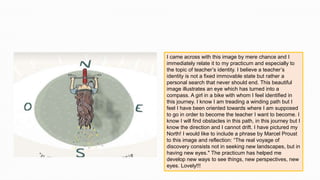
I came across with this image by mere chance and I
immediately relate it to my practicum and especially to
the topic of teacher’s identity. I believe a teacher’s
identity is not a fixed immovable state but rather a
personal search that never should end. This beautiful
image illustrates an eye which has turned into a
compass. A girl in a bike with whom I feel identified in
this journey. I know I am treading a winding path but I
feel I have been oriented towards where I am supposed
to go in order to become the teacher I want to become. I
know I will find obstacles in this path, in this journey but I
know the direction and I cannot drift. I have pictured my
North! I would like to include a phrase by Marcel Proust
to this image and reflection: “The real voyage of
discovery consists not in seeking new landscapes, but in
having new eyes." The practicum has helped me
develop new ways to see things, new perspectives, new
eyes. Lovely!!!

My teacher identity

  • 1.
    When I startedDidactics, I was overwhelmed by so much reading. However, as I had never worked with very young children, I was curious and eager to learn. When I started giving my first classes I found it difficult to manage the unexpected things that come up in a class. This subject’s notes have come in handy but my tutor’s help was essential to overcome some obstacles. Had it not been for her, I would not know how to face some issues and make up for the mistakes I have made. No matter how stressed I felt at the beginning, now I know it was worth it. I realized that “practice makes perfect” is not just a saying when it comes to teaching. I am used to reading a lot about education but “the proof of the pudding is the eating”; and as I have never taught in kindergarten before, I found this particularly challenging. And God knows how much I enjoy challenges- even when I must make painstaking efforts to be able to achieve things. Now, that I finished the practicum, I am not sure if I have what it takes to teach little children. Going through this process of learning to teach young learners has been stressful and demanding. This experience has really pushed me to new unexplored territories and I can claim I enjoyed it. Going beyond my comfort zone has always resulted in rewarding experiencies.
  • 2.
    The practicum hastaught me that teaching very young children requires a holistic view on education. This implies approaching children as complete beings and think about their physical, emotional and cognitive aspects all at once. And more important, when preparing and planning my lessons, I ‘ve learned I have to resort to my inner child: going back at that playful time was fun though trying to integrate that with the knowledge now I have about childhood represents a hard task. I know this stand is crucial though not easy; however, this internal work has made me gain a deeper insight into childhood teaching.
  • 3.
    I have learntthat teaching young learners poses a set of challenges to every teacher no matter how much experience s/he has. The first challenge I have encountered lies in the fact that the teacher is not simply a language teacher but an educator encouraging cognitive as well as linguistic development. Also, I find that trying to socialize the child integrating him/her to his/her own culture within a globalized world is not simple in certain contexts. Though the biggest challenge of teaching young learners, in my opinion, is working with affect as the basis for all other work in the kindergarten class. I am optimistic and I believe that addressing these tasks in a thorough and thoughtful manner can lead to numerous successes in a child’s integral development that will guarantee the kid’s self- realization in the future.
  • 4.
    I am surethat joint efforts can create the necessary synergy for achieving any goal in education. Therefore, I feel that if we, teachers, leave aside egos and work together, we can be an unstoppable force that can change so many children’s worlds and why not threaten systems that are harmful in our society. Thus, teamwork is essential and when working in education we need to be connected. This connection can imply a never-ending self-reflection work, and this may also mean receiving constructive criticism about how we are doing our job. We cannot grow as teachers otherwise. Teaching cannot achieve its complex goals if teachers are in isolation. Being part of an education community paves the way for becoming better teachers. In this sense, I believe that if we teachers work together, we can spread these values and be enlightened in the most positive way ever.
  • 5.
    I came acrosswith this image by mere chance and I immediately relate it to my practicum and especially to the topic of teacher’s identity. I believe a teacher’s identity is not a fixed immovable state but rather a personal search that never should end. This beautiful image illustrates an eye which has turned into a compass. A girl in a bike with whom I feel identified in this journey. I know I am treading a winding path but I feel I have been oriented towards where I am supposed to go in order to become the teacher I want to become. I know I will find obstacles in this path, in this journey but I know the direction and I cannot drift. I have pictured my North! I would like to include a phrase by Marcel Proust to this image and reflection: “The real voyage of discovery consists not in seeking new landscapes, but in having new eyes." The practicum has helped me develop new ways to see things, new perspectives, new eyes. Lovely!!!