Technology in
Education
Interactive Video LearningPritesh Jain
Sharmad Navelker
Abhijit Kande
Venkat Ramayya
Anubhav Mishra
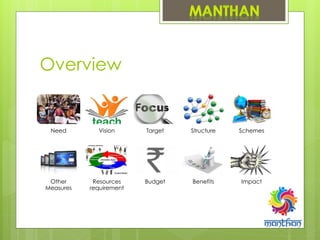
Overview
Need Vision Target Structure Schemes
Other
Measures
Resources
requirement
Budget Benefits Impact
Need
Education
•Poor reach of educational schemes in rural areas.
•Many of the rural schools fail to impart quality education. 'free and compulsory education' is the basic
literacy instruction dispensed by barely qualified 'para-teachers'.
•Even if the above problems are weeded out, we cannot give those students living in rural areas a good
exposure of the outside world.
•The absence of adequate school infrastructure like improper facilities and inefficient teaching staff is one
of the main factors affecting literacy in India.
•The fees of schools are have shored up very high in the past decade.
•All these factors account for the increasing number of dropouts as we go high up on the education
ladder
Unemployment
•India has a large pool of unemployed, unskilled and illiterate people.
•Various skills can be imparted to these people through videos.
•They can also be given basic necessary education.
•This will boost their confidence and encourage them to take up a job and earn themselves a living.
Unawareness
•Health and hygiene awareness can be spread through videos.
•The people can be made aware of the schemes made for them to help them reap maximum benefits of
the same.
•Messages of social and gender equality can be spread through videos to avert communal tensions.
Vision
Boost reach of Education through technology.
The aim of this project is to make Interactive
Video Lectures.
The videos be made accessible by distributing
CDs.
Equip all needy schools and other
beneficiaries with projectors.
Open a web portal to access all videos online.
Target
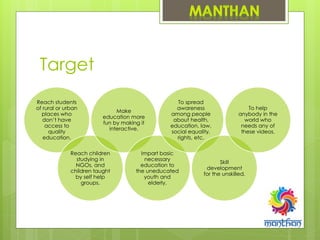
Reach students
of rural or urban
places who
don’t have
access to
quality
education.
Reach children
studying in
NGOs, and
children taught
by self help
groups.
Make
education more
fun by making it
interactive.
Impart basic
necessary
education to
the uneducated
youth and
elderly.
To spread
awareness
among people
about health,
education, law,
social equality,
rights, etc.
Skill
development
for the unskilled.
To help
anybody in the
world who
needs any of
these videos.
Structure
 A national level and state level bodies be setup to
make videos.
 The body be divided into Primary Education Group,
Secondary Education Group, Awareness Group, Skill
Development Group, Etc.
 Skilled teachers be appointed to make videos.
 Content makers be appointed to generate
interactive content including script writers and
picture and animation makers.
 A division to look after the distribution of content
including print, CD and online.
 A feedback team to collect feedback, suggestions,
content material, etc. from the volunteers.
Schemes
 A set of 5 projectors and computers and internet facility to around
10000 schools in every state. These facilities can be used to teach
students from class 1 to class 10 in two shifts.
 A skill impartment drive to teach youth to help them get employment.
The skills to be imparted vary from region to region depending on the
natural resources, market, etc.
 A basic education drive for the elderly people. Incentives can be
given to attract otherwise reluctant people.
 Health, hygiene and awareness videos.
 An online library for people to access all content for personal use as
well as for distribution; for suggesting and improving content. A forum
for educational enthusiasts.
 Stream the videos free of internet cost to Aakaash tablets.
 Make Android apps to stream educational videos, take online test,
play educational games and make education more interactive.
 Encourage self help groups to educate people using these videos.
Resources required
 An infrastructure for the entire department with
campus, computational facilities, library, video
cameras, classroom cum studios etc.
 Experienced teachers, content makers,
cameramen, editors, IT persons etc.
 Distribution system to provide CDs. Online portal
management and feedback team.
 Beneficiary schools and NGOs and other
beneficiaries need to be equipped with
projectors. Printers can also be provided to print
digital content and make people solve exercises.
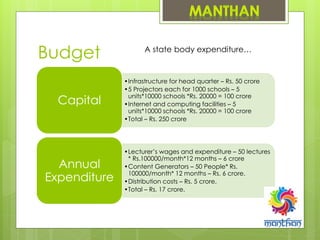
Budget
•Infrastructure for head quarter – Rs. 50 crore
•5 Projectors each for 1000 schools – 5
units*10000 schools *Rs. 20000 = 100 crore
•Internet and computing facilities – 5
units*10000 schools *Rs. 20000 = 100 crore
•Total – Rs. 250 crore
Capital
•Lecturer’s wages and expenditure – 50 lectures
* Rs.100000/month*12 months – 6 crore
•Content Generators – 50 People* Rs.
100000/month* 12 months – Rs. 6 crore.
•Distribution costs – Rs. 5 crore.
•Total – Rs. 17 crore.
Annual
Expenditure
A state body expenditure…
Challenges
 It will take some time to create a
comprehensive library and sizeable content
for the scheme to be implemented.
 Reluctance among grown ups to attend
classes.
 Rooms will be required to screen videos.
 An assessment method required to check
impact of scheme and performance of
students.
Benefits and Impact
 The scheme would benefit
students in places with schools
not having sufficient teachers.
 Besides regular education,
poor students will also build up
basic reading, writing and
other skills through a set of
dedicated videos.
 It will also benefit elders who
wish to get basic necessary
education.
 It will also help people learn
skills through a set of skill
building video lectures. NSDA
can take help of the scheme.
 Actual demonstration of
scientific experiments, pictures
of places and animals,
explanation of facts through
animation would drastically
increase the understanding
and exposure.
 10000 schools per state and 500
beneficiary students per school
would benefit a total of 5 million
students per state every year.
 A large mass of the rural elders
can be given basic education,
necessary conversational skill,
and other basic skills and
awareness. 10000 schools per
state*100 beneficiaries equals 1
million people per state every
year.
 Health and hygiene awareness
can save millions of lives every
year.
 A lot of people can be taught
about their rights and this will help
them a lot by keeping a tab on
officials and authorities.
 Awareness videos will help avoid
riots and communal tensions.

EducateToAlleviate

  • 1.
    Technology in Education Interactive VideoLearningPritesh Jain Sharmad Navelker Abhijit Kande Venkat Ramayya Anubhav Mishra
  • 2.
    Overview Need Vision TargetStructure Schemes Other Measures Resources requirement Budget Benefits Impact
  • 3.
    Need Education •Poor reach ofeducational schemes in rural areas. •Many of the rural schools fail to impart quality education. 'free and compulsory education' is the basic literacy instruction dispensed by barely qualified 'para-teachers'. •Even if the above problems are weeded out, we cannot give those students living in rural areas a good exposure of the outside world. •The absence of adequate school infrastructure like improper facilities and inefficient teaching staff is one of the main factors affecting literacy in India. •The fees of schools are have shored up very high in the past decade. •All these factors account for the increasing number of dropouts as we go high up on the education ladder Unemployment •India has a large pool of unemployed, unskilled and illiterate people. •Various skills can be imparted to these people through videos. •They can also be given basic necessary education. •This will boost their confidence and encourage them to take up a job and earn themselves a living. Unawareness •Health and hygiene awareness can be spread through videos. •The people can be made aware of the schemes made for them to help them reap maximum benefits of the same. •Messages of social and gender equality can be spread through videos to avert communal tensions.
  • 4.
    Vision Boost reach ofEducation through technology. The aim of this project is to make Interactive Video Lectures. The videos be made accessible by distributing CDs. Equip all needy schools and other beneficiaries with projectors. Open a web portal to access all videos online.
  • 5.
    Target Reach students of ruralor urban places who don’t have access to quality education. Reach children studying in NGOs, and children taught by self help groups. Make education more fun by making it interactive. Impart basic necessary education to the uneducated youth and elderly. To spread awareness among people about health, education, law, social equality, rights, etc. Skill development for the unskilled. To help anybody in the world who needs any of these videos.
  • 6.
    Structure  A nationallevel and state level bodies be setup to make videos.  The body be divided into Primary Education Group, Secondary Education Group, Awareness Group, Skill Development Group, Etc.  Skilled teachers be appointed to make videos.  Content makers be appointed to generate interactive content including script writers and picture and animation makers.  A division to look after the distribution of content including print, CD and online.  A feedback team to collect feedback, suggestions, content material, etc. from the volunteers.
  • 7.
    Schemes  A setof 5 projectors and computers and internet facility to around 10000 schools in every state. These facilities can be used to teach students from class 1 to class 10 in two shifts.  A skill impartment drive to teach youth to help them get employment. The skills to be imparted vary from region to region depending on the natural resources, market, etc.  A basic education drive for the elderly people. Incentives can be given to attract otherwise reluctant people.  Health, hygiene and awareness videos.  An online library for people to access all content for personal use as well as for distribution; for suggesting and improving content. A forum for educational enthusiasts.  Stream the videos free of internet cost to Aakaash tablets.  Make Android apps to stream educational videos, take online test, play educational games and make education more interactive.  Encourage self help groups to educate people using these videos.
  • 8.
    Resources required  Aninfrastructure for the entire department with campus, computational facilities, library, video cameras, classroom cum studios etc.  Experienced teachers, content makers, cameramen, editors, IT persons etc.  Distribution system to provide CDs. Online portal management and feedback team.  Beneficiary schools and NGOs and other beneficiaries need to be equipped with projectors. Printers can also be provided to print digital content and make people solve exercises.
  • 9.
    Budget •Infrastructure for headquarter – Rs. 50 crore •5 Projectors each for 1000 schools – 5 units*10000 schools *Rs. 20000 = 100 crore •Internet and computing facilities – 5 units*10000 schools *Rs. 20000 = 100 crore •Total – Rs. 250 crore Capital •Lecturer’s wages and expenditure – 50 lectures * Rs.100000/month*12 months – 6 crore •Content Generators – 50 People* Rs. 100000/month* 12 months – Rs. 6 crore. •Distribution costs – Rs. 5 crore. •Total – Rs. 17 crore. Annual Expenditure A state body expenditure…
  • 10.
    Challenges  It willtake some time to create a comprehensive library and sizeable content for the scheme to be implemented.  Reluctance among grown ups to attend classes.  Rooms will be required to screen videos.  An assessment method required to check impact of scheme and performance of students.
  • 11.
    Benefits and Impact The scheme would benefit students in places with schools not having sufficient teachers.  Besides regular education, poor students will also build up basic reading, writing and other skills through a set of dedicated videos.  It will also benefit elders who wish to get basic necessary education.  It will also help people learn skills through a set of skill building video lectures. NSDA can take help of the scheme.  Actual demonstration of scientific experiments, pictures of places and animals, explanation of facts through animation would drastically increase the understanding and exposure.  10000 schools per state and 500 beneficiary students per school would benefit a total of 5 million students per state every year.  A large mass of the rural elders can be given basic education, necessary conversational skill, and other basic skills and awareness. 10000 schools per state*100 beneficiaries equals 1 million people per state every year.  Health and hygiene awareness can save millions of lives every year.  A lot of people can be taught about their rights and this will help them a lot by keeping a tab on officials and authorities.  Awareness videos will help avoid riots and communal tensions.