Arunabh Banerjee
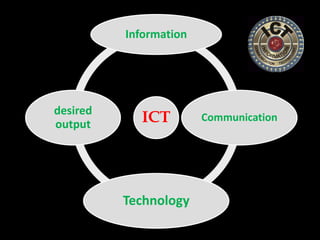
Information


desired
output      ICT         Communication


          Technology
Sarva Shiksha Abhiyan (SSA)           is a flagship programme of
the Government of India to support the states in
creating, developing, and strengthening the formal primary and
upper primary school systems to achieve the goal of Universal
Elementary Education.


     partnership program between the central and the
     state governments
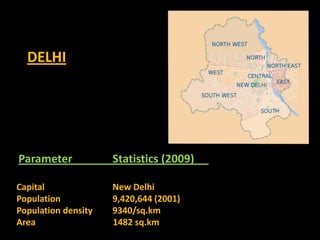
DELHI


Parameter            Statistics (2009)

Capital              New Delhi
Population           9,420,644 (2001)
Population density   9340/sq.km
Area                 1482 sq.km
DEPARTMENT OF EDUCATION
Department of education has the responsibility of
formulating, implementing policies, laws and regulation
for development of school education in the state.


In case of the state of Delhi the department manages
around 1,000 schools with 40,000 staff to cater to about
1.1 million children.


 It collaborated with NGOs and corporates with
Corporate Social Responsibility to leverage the use of ICT
to achieve the result
This saw the
implementation of ICT
in the Sarva Siksha
Abiyan in the state of
Delhi.


It became vital in
overcoming the barrier
and reach of education
increased.
OBJECTIVES


•Setting up computer kiosks in slum areas to attract children
toward using the computer by installing games and
multimedia-based content and then moving to knowledge-
based content


• Using busses as mobile classrooms in remote and slum
areas for the dissemination of information and increasing
awareness of education.
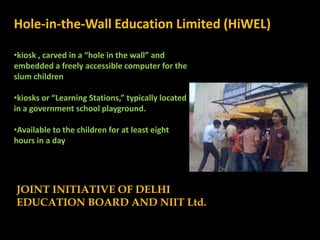
Hole-in-the-Wall Education Limited (HiWEL)

•kiosk , carved in a “hole in the wall” and
embedded a freely accessible computer for the
slum children

•kiosks or “Learning Stations,” typically located
in a government school playground.

•Available to the children for at least eight
hours in a day


JOINT INITIATIVE OF DELHI
EDUCATION BOARD AND NIIT Ltd.
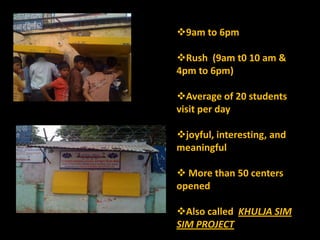
9am to 6pm

Rush (9am t0 10 am &
4pm to 6pm)

Average of 20 students
visit per day

joyful, interesting, and
meaningful

 More than 50 centers
opened

Also called KHULJA SIM
SIM PROJECT
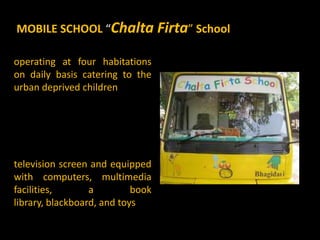
MOBILE SCHOOL “Chalta Firta” School

operating at four habitations
on daily basis catering to the
urban deprived children


television screen and equipped
with computers, multimedia
facilities,       a         book
library, blackboard, and toys
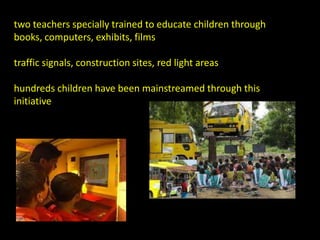
two teachers specially trained to educate children through
books, computers, exhibits, films

traffic signals, construction sites, red light areas

hundreds children have been mainstreamed through this
initiative
Computer-Aided      Learning   program
(CALP), in schools


CAL technology uses animation to learn
concepts, which results in increased
learner engagement as this method is
more fun, and visually appealing to
students than traditional methods.


CAL also provides students with the
opportunity to practice on their own.
WHAT IS THE OUTCOME
Reach of education increased

More students brought into mainstream

Dissipation of information was at faster
pace

Reduction in dropout rates

Generated employment technique

Ensuring a better future

Increasing the growth in various sectors
Limitation encountered

     Lack of quality teachers

     Lack in quality of content

     Lack in infrastructure

     Maintenance of hardware and
     software

     Psychological barriers
THANK YOU

Case ICT

  • 1.
  • 2.
    Information desired output ICT Communication Technology
  • 3.
    Sarva Shiksha Abhiyan(SSA) is a flagship programme of the Government of India to support the states in creating, developing, and strengthening the formal primary and upper primary school systems to achieve the goal of Universal Elementary Education. partnership program between the central and the state governments
  • 4.
    DELHI Parameter Statistics (2009) Capital New Delhi Population 9,420,644 (2001) Population density 9340/sq.km Area 1482 sq.km
  • 5.
    DEPARTMENT OF EDUCATION Departmentof education has the responsibility of formulating, implementing policies, laws and regulation for development of school education in the state. In case of the state of Delhi the department manages around 1,000 schools with 40,000 staff to cater to about 1.1 million children.  It collaborated with NGOs and corporates with Corporate Social Responsibility to leverage the use of ICT to achieve the result
  • 6.
    This saw the implementationof ICT in the Sarva Siksha Abiyan in the state of Delhi. It became vital in overcoming the barrier and reach of education increased.
  • 7.
    OBJECTIVES •Setting up computerkiosks in slum areas to attract children toward using the computer by installing games and multimedia-based content and then moving to knowledge- based content • Using busses as mobile classrooms in remote and slum areas for the dissemination of information and increasing awareness of education.
  • 8.
    Hole-in-the-Wall Education Limited(HiWEL) •kiosk , carved in a “hole in the wall” and embedded a freely accessible computer for the slum children •kiosks or “Learning Stations,” typically located in a government school playground. •Available to the children for at least eight hours in a day JOINT INITIATIVE OF DELHI EDUCATION BOARD AND NIIT Ltd.
  • 9.
    9am to 6pm Rush(9am t0 10 am & 4pm to 6pm) Average of 20 students visit per day joyful, interesting, and meaningful  More than 50 centers opened Also called KHULJA SIM SIM PROJECT
  • 10.
    MOBILE SCHOOL “ChaltaFirta” School operating at four habitations on daily basis catering to the urban deprived children television screen and equipped with computers, multimedia facilities, a book library, blackboard, and toys
  • 11.
    two teachers speciallytrained to educate children through books, computers, exhibits, films traffic signals, construction sites, red light areas hundreds children have been mainstreamed through this initiative
  • 12.
    Computer-Aided Learning program (CALP), in schools CAL technology uses animation to learn concepts, which results in increased learner engagement as this method is more fun, and visually appealing to students than traditional methods. CAL also provides students with the opportunity to practice on their own.
  • 13.
    WHAT IS THEOUTCOME Reach of education increased More students brought into mainstream Dissipation of information was at faster pace Reduction in dropout rates Generated employment technique Ensuring a better future Increasing the growth in various sectors
  • 14.
    Limitation encountered Lack of quality teachers Lack in quality of content Lack in infrastructure Maintenance of hardware and software Psychological barriers
  • 15.