OBJECTIVES:
• Discuss the various organizational leadership and
management theories
• Discuss the organizational structure and current
Educational reforms in Department of Education ;
• Discuss the function of school as an educational
organization.

Chapter 2 : School as an Organization ( Content)
• The function of a school ,its structure and its role in the
society
• Organization Theories, leadership and management
theories
• Basic educational reforms including the organizational
structure of Department of Education
Max Weber
• He is a German Sociologist known for BUREAUCRATIC THEORY of
Management and is considered as father of sociology
“ Weber believed that the most efficient way to set up an organization is
through bureaucracy which is way better than traditional structure.”
BUREACRACY
- An organizational structure that is characterized by many rules ,
standardized process , procedures and requirements , number of desk ,
meticulous division of labor and responsibility , clear hierarchy and
professional , almost impersonal interaction between employees.
Mulder (2017) and Lagaard (2006 highlighted the three types of
power that can be found in an organization based on Weber’s
Bureaucratic model and these are the following:
• Traditional authority – based on historically created legitimacy
where authority is a hereditary and based on dependent
subordinates.
• Legal, rule-oriented authority – the Bureaucratic type of
authority, based on normative rules of career, hierarchy; and
• Charismatic authority – the personal authority, based on a type
of “seduction "and hence, the devotion of supporters
Mulder (2017) also articulated the following elements that
support Fayol’s bureaucratic management:
• All regular activities with bureaucracy can be
regarded as official duties;
• Management has the authority to impose rules ; and
• Rules can be easily respected on the basis of
established methods
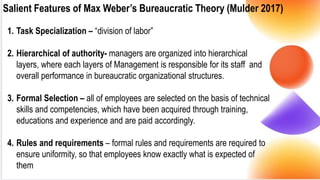
Salient Features of Max Weber’s Bureaucratic Theory (Mulder 2017)
1. Task Specialization – “division of labor”
2. Hierarchical of authority- managers are organized into hierarchical
layers, where each layers of Management is responsible for its staff and
overall performance in bureaucratic organizational structures.
3. Formal Selection – all of employees are selected on the basis of technical
skills and competencies, which have been acquired through training,
educations and experience and are paid accordingly.
4. Rules and requirements – formal rules and requirements are required to
ensure uniformity, so that employees know exactly what is expected of
them
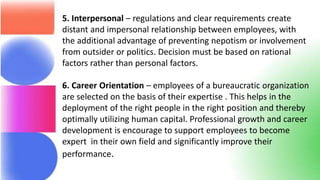
5. Interpersonal – regulations and clear requirements create
distant and impersonal relationship between employees, with
the additional advantage of preventing nepotism or involvement
from outsider or politics. Decision must be based on rational
factors rather than personal factors.
6. Career Orientation – employees of a bureaucratic organization
are selected on the basis of their expertise . This helps in the
deployment of the right people in the right position and thereby
optimally utilizing human capital. Professional growth and career
development is encourage to support employees to become
expert in their own field and significantly improve their
performance.
SAN KA
PUNTA ?
Organizational Structure of
Department of Education
• In 2001 through the passage of RA 9155 Department of
Education was restructured
• DECS renames as DepEd and shifted its mandates to Basic
Education by the virtue of executive order no. 366 series of
2004.
• DepEd initiate a rationalization plan which includes rationalized
structure and staffing pattern of offices in central, regional and
school division level. ( Department of Education, 2015)
• The newly DepEd organizational structure is a result of the thorough study conducted by the
DepEd Change Management Team ( CMT) via long term education reform.
• Consistent with pertinent provision of RA 9155 , DepEd also continued to adapt the
decentralization and shared governance to ensure accountability and relevance to the needs
and demands of its stakeholders.
• Organizational strands were also identified by the DepEd CMT that reflects the similarity of
functions and of offices.
• In an organizational structure, there one newly created offices while other existing offices
were renamed, merged, transferred , and some are abolished like the Bureau of Physical
Education.

• Under the office of the secretary (OSEC) there are 5 undersecretaries for curricula and
instructions governance and operations legal and legislative affairs, finance and
administration and chief of staff.
• The organizational structure of DepEd is an example of a typical
structure where there is hierarchy of the chain of command
• The person at the Top which is the DepEd Secretary oversee the
next level down which are the undersecretaries fir curriculum and
instruction, governance and operations , legal and legislative affairs,
finance and administration , and strategic management office
including field operations, attached office and coordinating councils.
• Undersecretaries which are the next level of managers to secretary
oversee the first line of managers who are in charge in different
departments that are broken down based on their specialization.

“ The part can never be well
unless the whole is well.”
-Plato
Thank you ❤️ God Bless!

CHAPTER-2-EDUC-8-Final-Presentation.pptx

  • 3.
    OBJECTIVES: • Discuss thevarious organizational leadership and management theories • Discuss the organizational structure and current Educational reforms in Department of Education ; • Discuss the function of school as an educational organization.

  • 4.

    Chapter 2 :School as an Organization ( Content) • The function of a school ,its structure and its role in the society • Organization Theories, leadership and management theories • Basic educational reforms including the organizational structure of Department of Education
  • 13.
    Max Weber • Heis a German Sociologist known for BUREAUCRATIC THEORY of Management and is considered as father of sociology “ Weber believed that the most efficient way to set up an organization is through bureaucracy which is way better than traditional structure.” BUREACRACY - An organizational structure that is characterized by many rules , standardized process , procedures and requirements , number of desk , meticulous division of labor and responsibility , clear hierarchy and professional , almost impersonal interaction between employees.
  • 14.
    Mulder (2017) andLagaard (2006 highlighted the three types of power that can be found in an organization based on Weber’s Bureaucratic model and these are the following: • Traditional authority – based on historically created legitimacy where authority is a hereditary and based on dependent subordinates. • Legal, rule-oriented authority – the Bureaucratic type of authority, based on normative rules of career, hierarchy; and • Charismatic authority – the personal authority, based on a type of “seduction "and hence, the devotion of supporters
  • 15.
    Mulder (2017) alsoarticulated the following elements that support Fayol’s bureaucratic management: • All regular activities with bureaucracy can be regarded as official duties; • Management has the authority to impose rules ; and • Rules can be easily respected on the basis of established methods
  • 16.
    Salient Features ofMax Weber’s Bureaucratic Theory (Mulder 2017) 1. Task Specialization – “division of labor” 2. Hierarchical of authority- managers are organized into hierarchical layers, where each layers of Management is responsible for its staff and overall performance in bureaucratic organizational structures. 3. Formal Selection – all of employees are selected on the basis of technical skills and competencies, which have been acquired through training, educations and experience and are paid accordingly. 4. Rules and requirements – formal rules and requirements are required to ensure uniformity, so that employees know exactly what is expected of them
  • 17.
    5. Interpersonal –regulations and clear requirements create distant and impersonal relationship between employees, with the additional advantage of preventing nepotism or involvement from outsider or politics. Decision must be based on rational factors rather than personal factors. 6. Career Orientation – employees of a bureaucratic organization are selected on the basis of their expertise . This helps in the deployment of the right people in the right position and thereby optimally utilizing human capital. Professional growth and career development is encourage to support employees to become expert in their own field and significantly improve their performance.
  • 51.
  • 52.
    Organizational Structure of Departmentof Education • In 2001 through the passage of RA 9155 Department of Education was restructured • DECS renames as DepEd and shifted its mandates to Basic Education by the virtue of executive order no. 366 series of 2004. • DepEd initiate a rationalization plan which includes rationalized structure and staffing pattern of offices in central, regional and school division level. ( Department of Education, 2015)
  • 53.
    • The newlyDepEd organizational structure is a result of the thorough study conducted by the DepEd Change Management Team ( CMT) via long term education reform. • Consistent with pertinent provision of RA 9155 , DepEd also continued to adapt the decentralization and shared governance to ensure accountability and relevance to the needs and demands of its stakeholders. • Organizational strands were also identified by the DepEd CMT that reflects the similarity of functions and of offices. • In an organizational structure, there one newly created offices while other existing offices were renamed, merged, transferred , and some are abolished like the Bureau of Physical Education. • Under the office of the secretary (OSEC) there are 5 undersecretaries for curricula and instructions governance and operations legal and legislative affairs, finance and administration and chief of staff.
  • 54.
    • The organizationalstructure of DepEd is an example of a typical structure where there is hierarchy of the chain of command • The person at the Top which is the DepEd Secretary oversee the next level down which are the undersecretaries fir curriculum and instruction, governance and operations , legal and legislative affairs, finance and administration , and strategic management office including field operations, attached office and coordinating councils. • Undersecretaries which are the next level of managers to secretary oversee the first line of managers who are in charge in different departments that are broken down based on their specialization.
  • 55.
    “ The partcan never be well unless the whole is well.” -Plato Thank you ❤️ God Bless!