Feature
WRITING
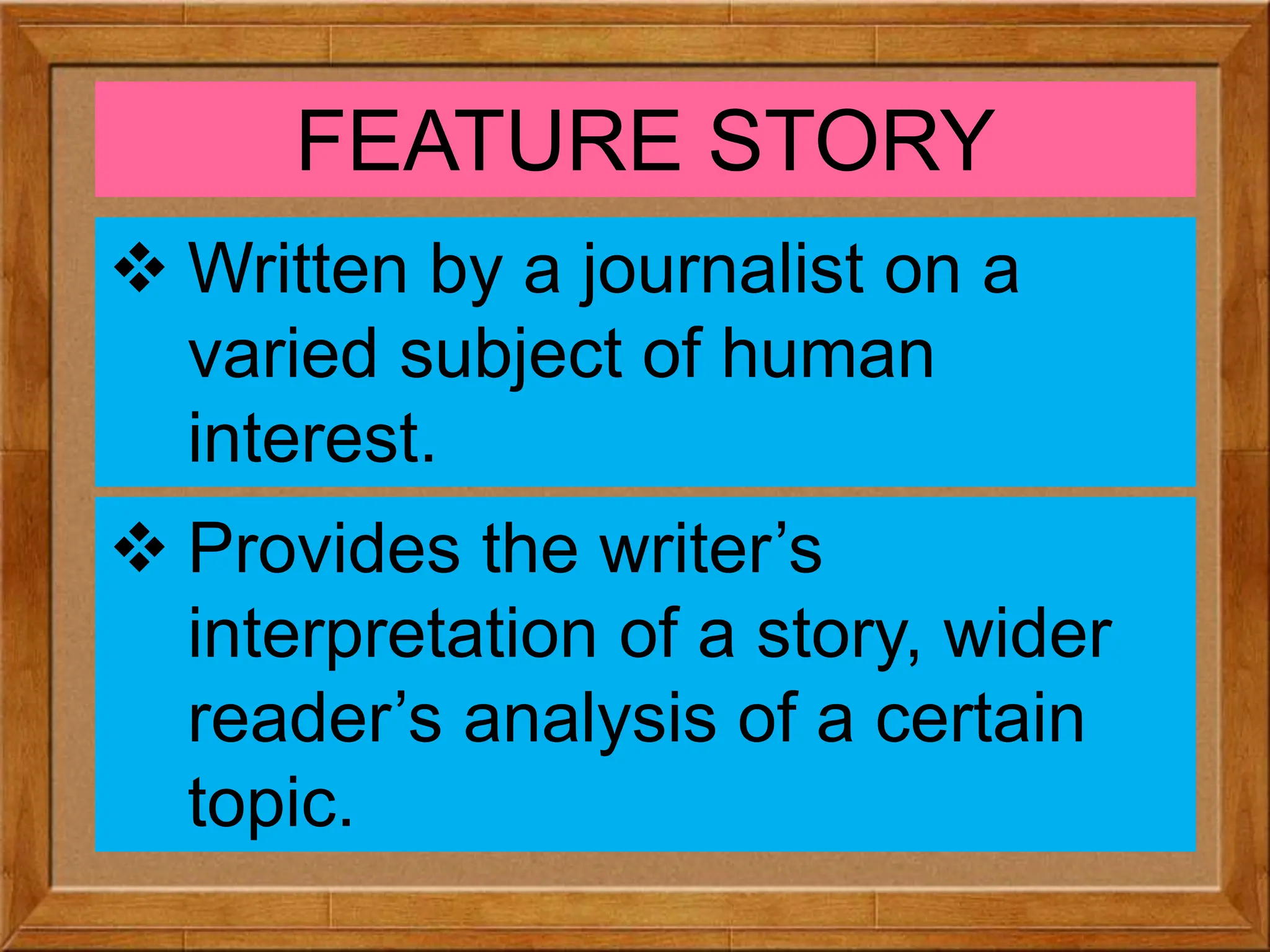
FEATURE STORY
 Written by a journalist on a
varied subject of human
interest.
 Provides the writer’s
interpretation of a story, wider
reader’s analysis of a certain
topic.
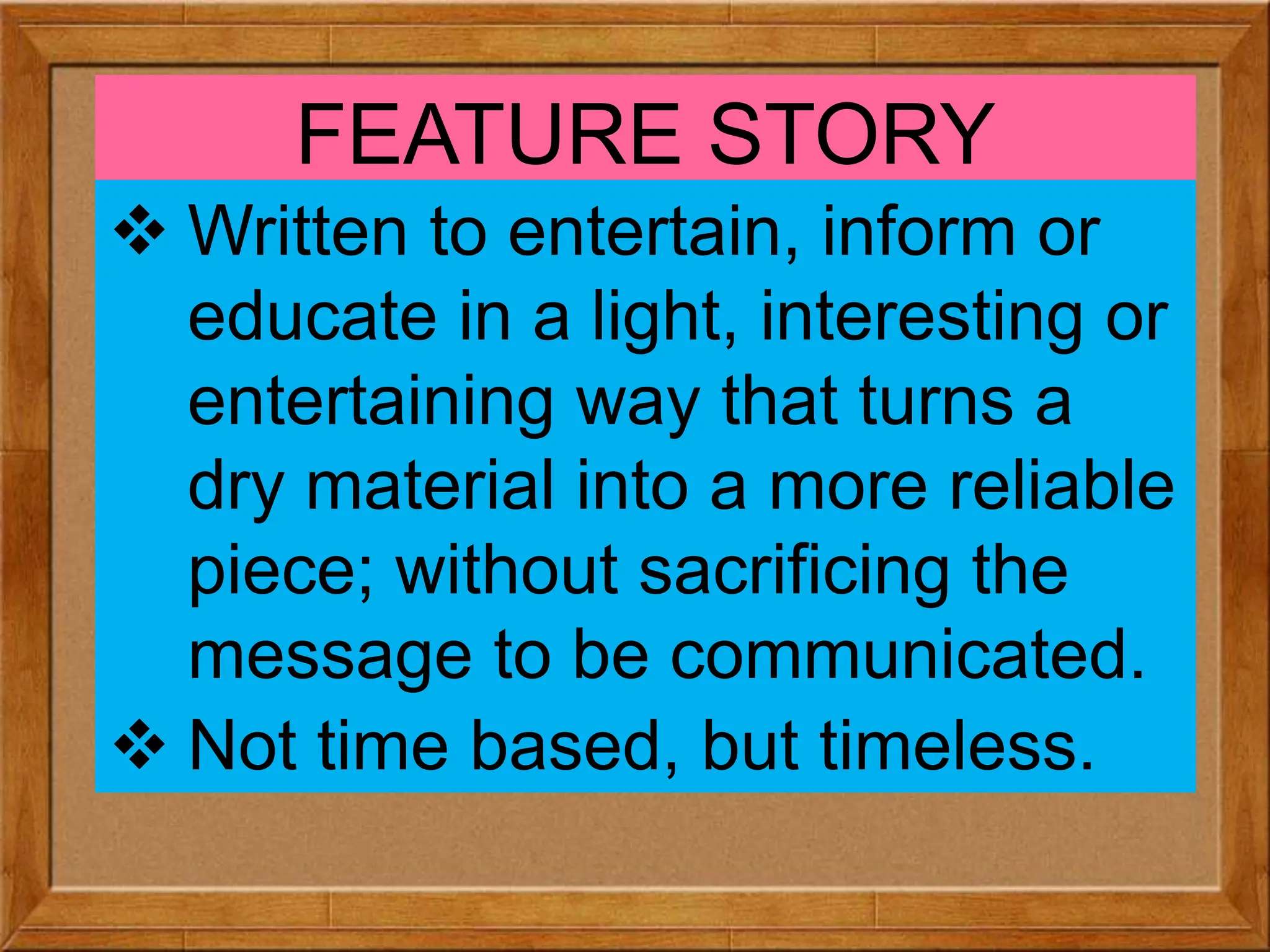
FEATURE STORY
 Written to entertain, inform or
educate in a light, interesting or
entertaining way that turns a
dry material into a more reliable
piece; without sacrificing the
message to be communicated.
 Not time based, but timeless.
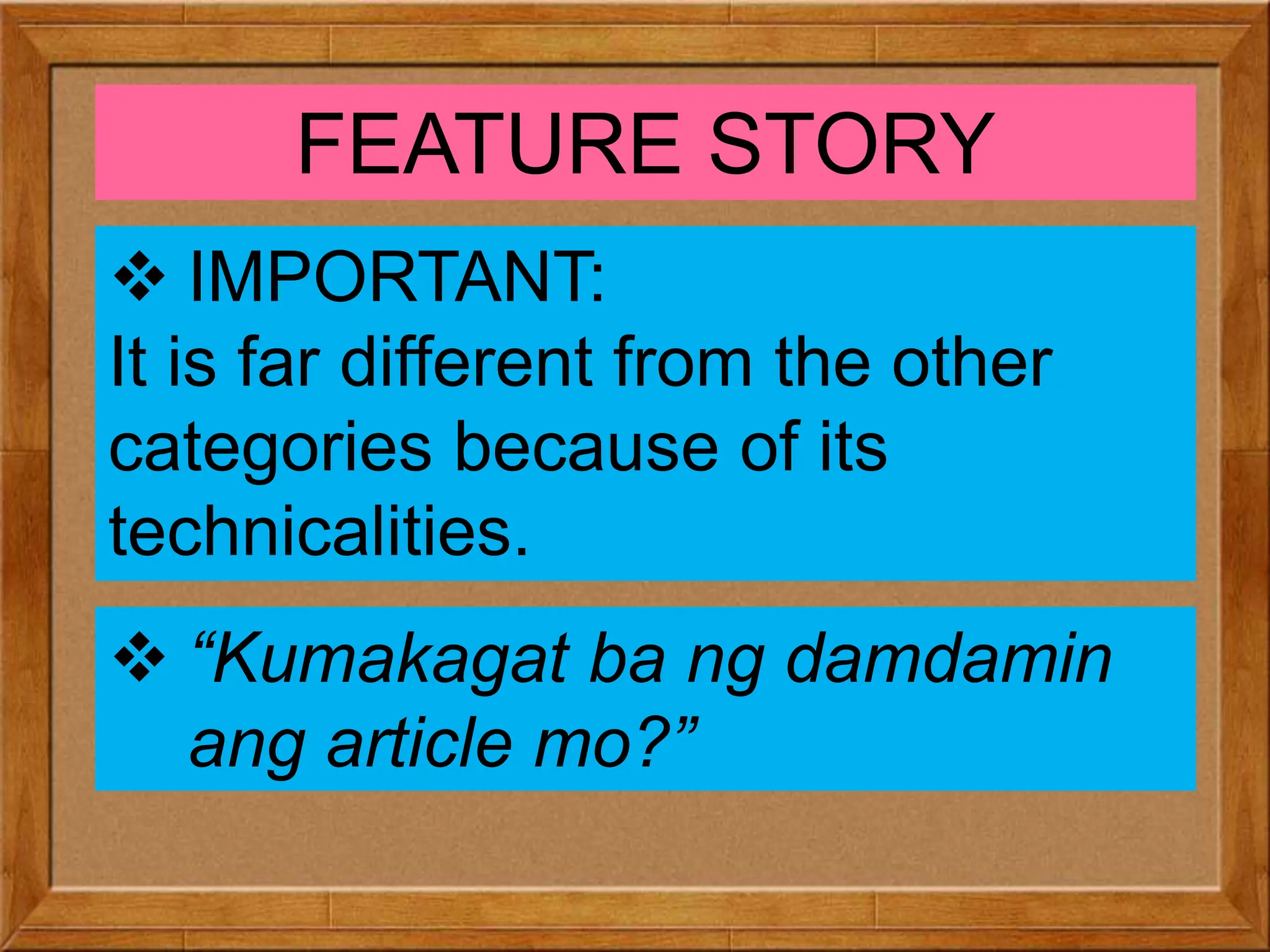
FEATURE STORY
 IMPORTANT:
It is far different from the other
categories because of its
technicalities.
 “Kumakagat ba ng damdamin
ang article mo?”
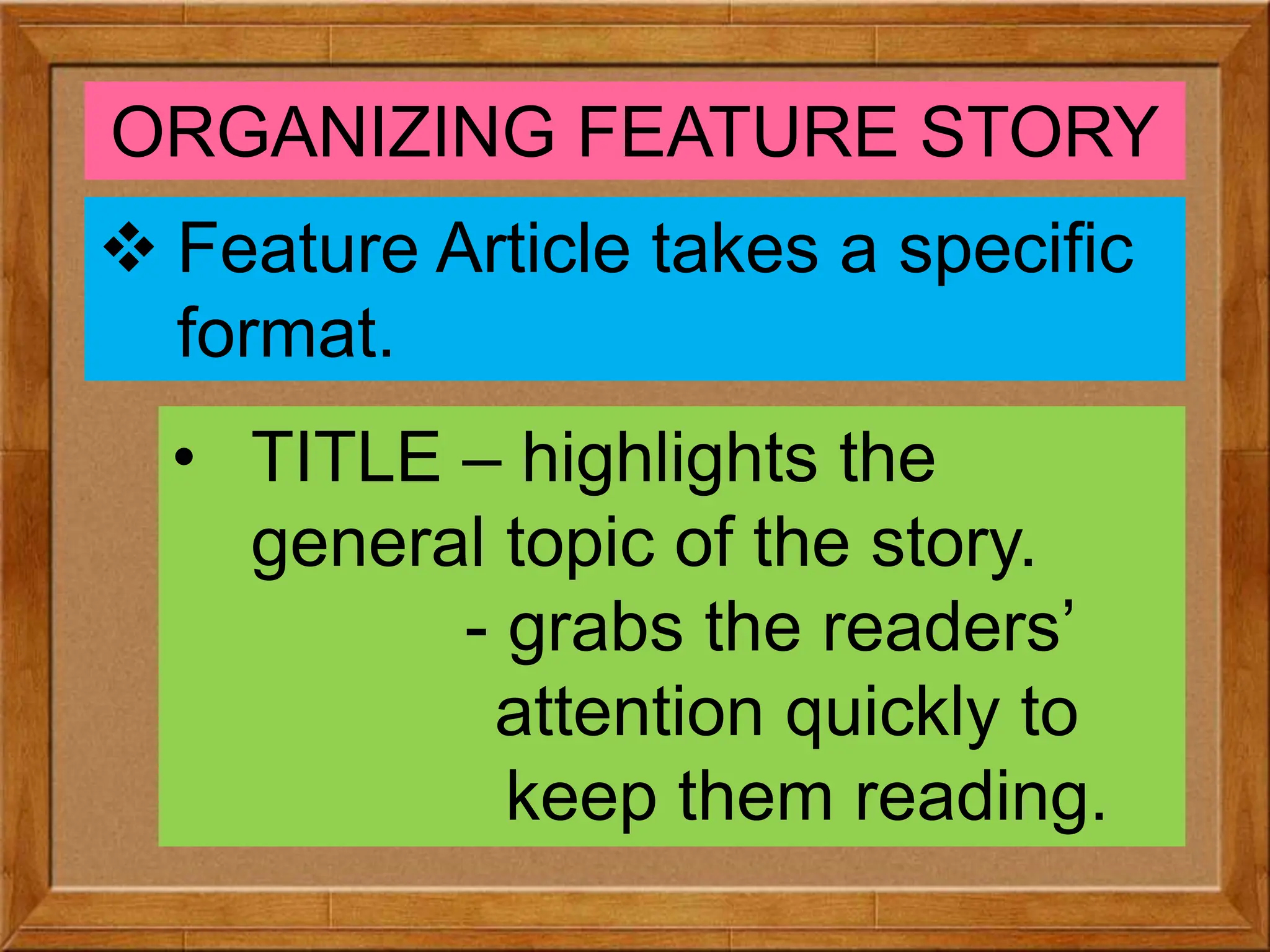
 Feature Article takes a specific
format.
ORGANIZING FEATURE STORY
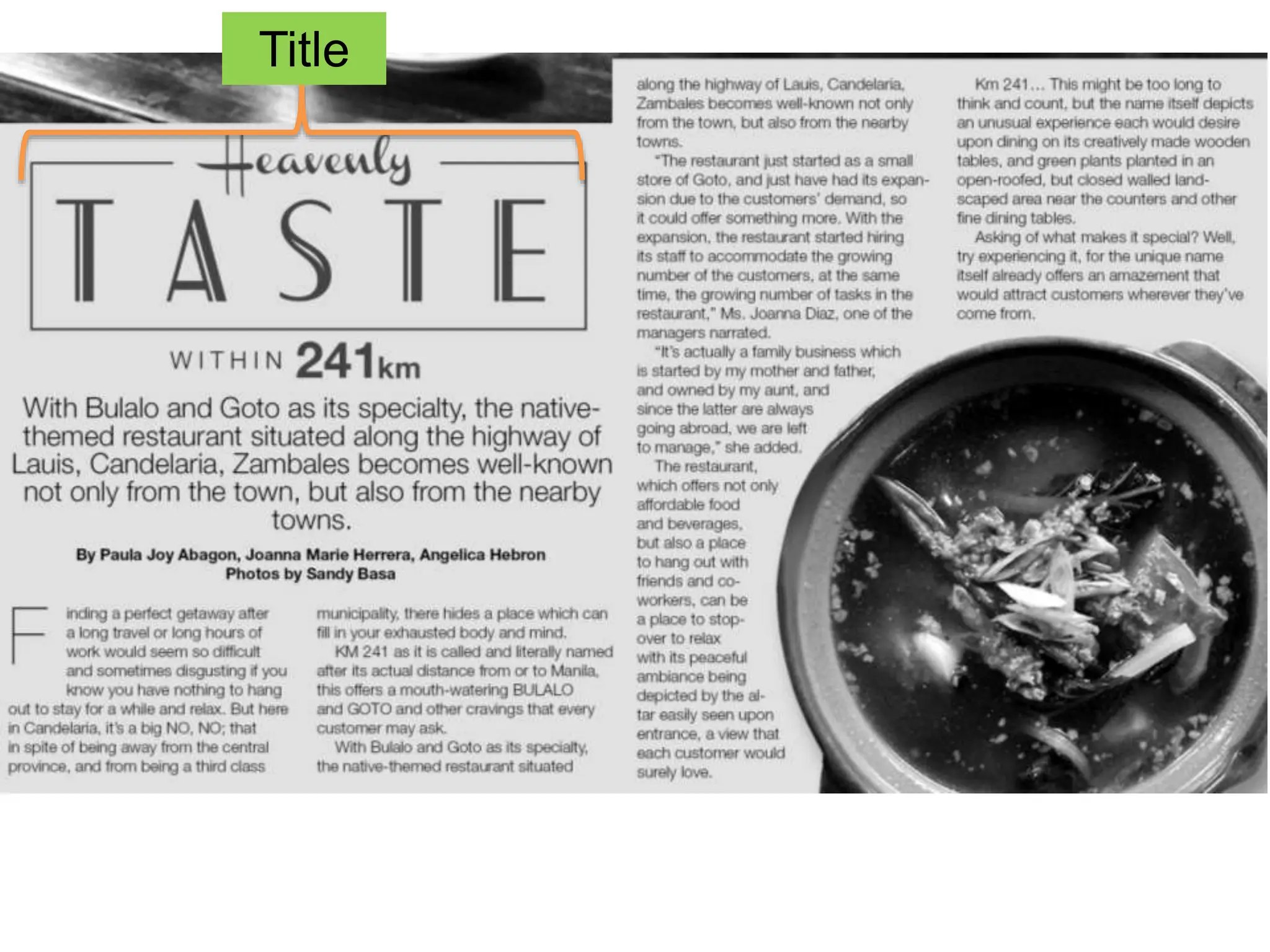
• TITLE – highlights the
general topic of the story.
- grabs the readers’
attention quickly to
keep them reading.
ORGANIZING FEATURE STORY
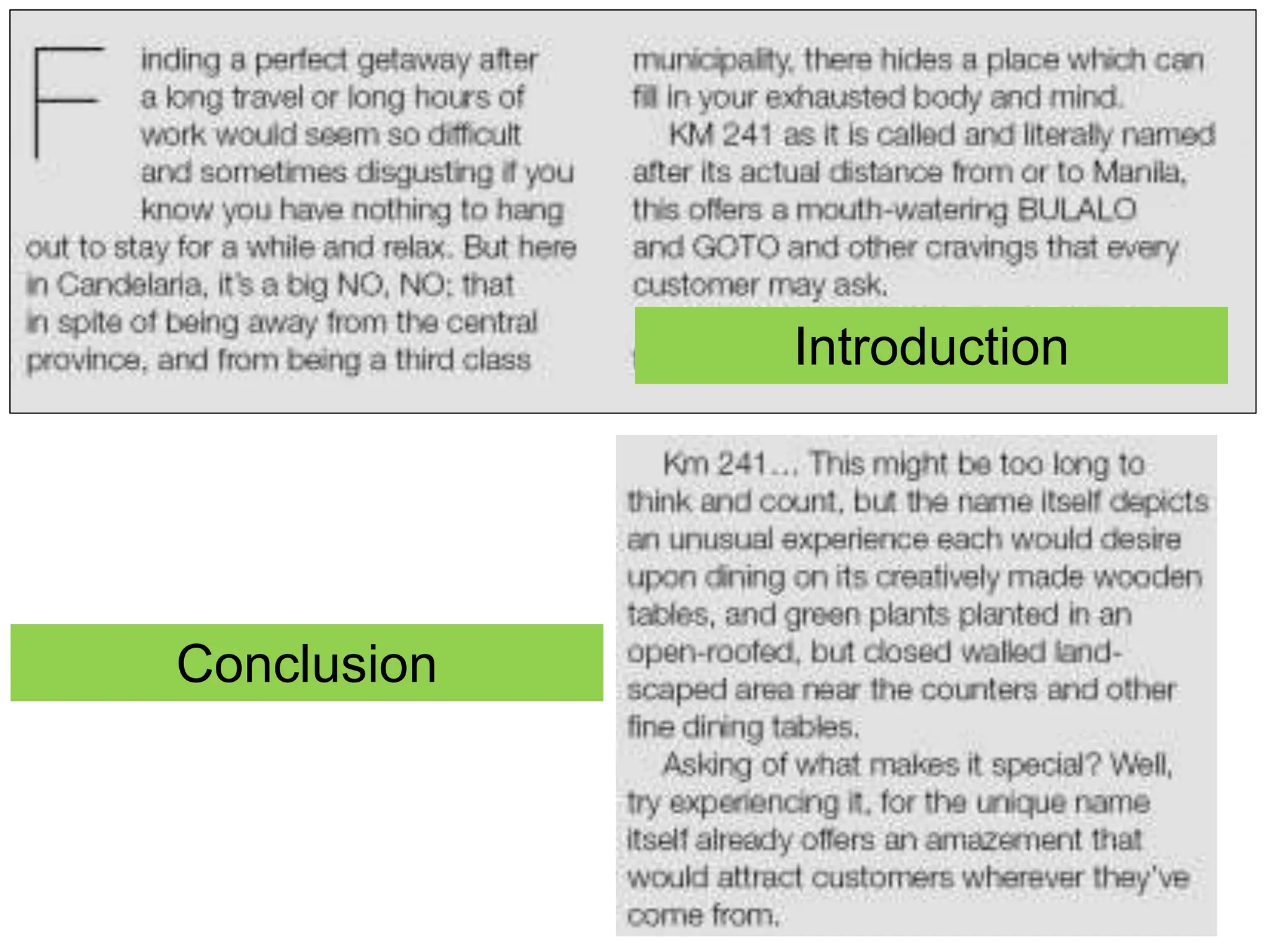
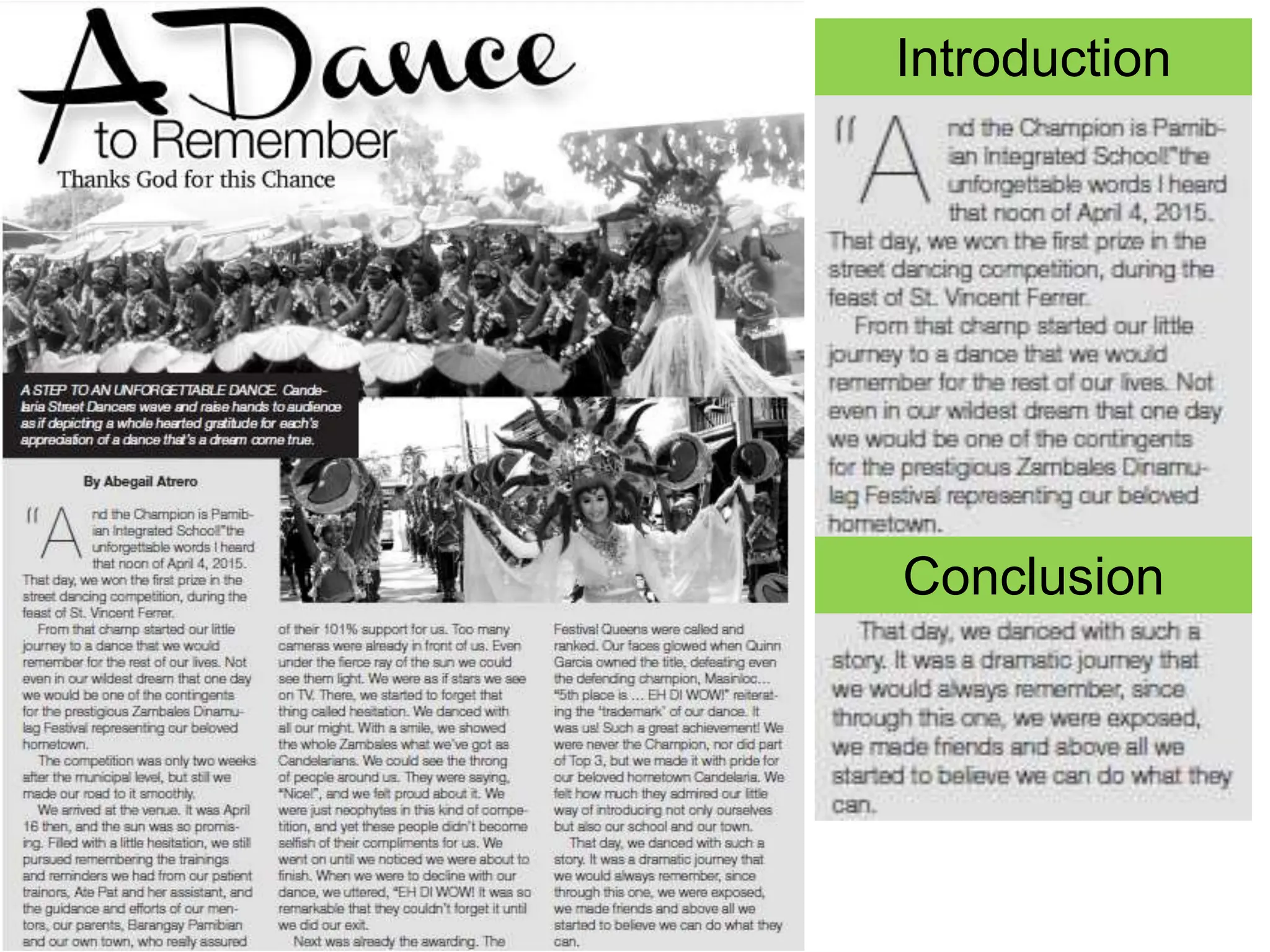
• INTRODUCTION – provides
any background information
relevant to the story, and
creates a relationship
between the writer and the
reader. Tone of the article is
also set in the introduction.
ORGANIZING FEATURE STORY
IMPORTANT REMINDERS!
Do not give all. Make it
suspense, for you to have
something to reveal at the end.
INTRO only gives a grasp of
your article.
ORGANIZING FEATURE STORY
• BODY – has most of the
details of the story.
- usually broken into
pieces with
subheadings for easy
organization.
ORGANIZING FEATURE STORY
IMPORTANT REMINDERS!
It should have the background information to
make the readers up to date.
It should have the thread of the story to make
its parts connected from the beginning up to
the end.
It should have the persona, the dialogue,
which may be used to keep the story moving
and the voice, which can be used in injecting
color, tone and emotion to the story.
ORGANIZING FEATURE STORY
• CONCLUSION – leaves a
lasting impression on the
reader and provokes some
sort of reaction.
Your feature should have:
-Logical Appeal (Logos)—Does the
author’s proposal make sense?
-Ethical Appeal (Ethos)– Is the author’s
proposal the right thing to do?
-Emotional Appeal (Pathos)—Will
accepting the author’s proposal make me
feel better?
Title
Introduction
Conclusion
Introduction
Conclusion
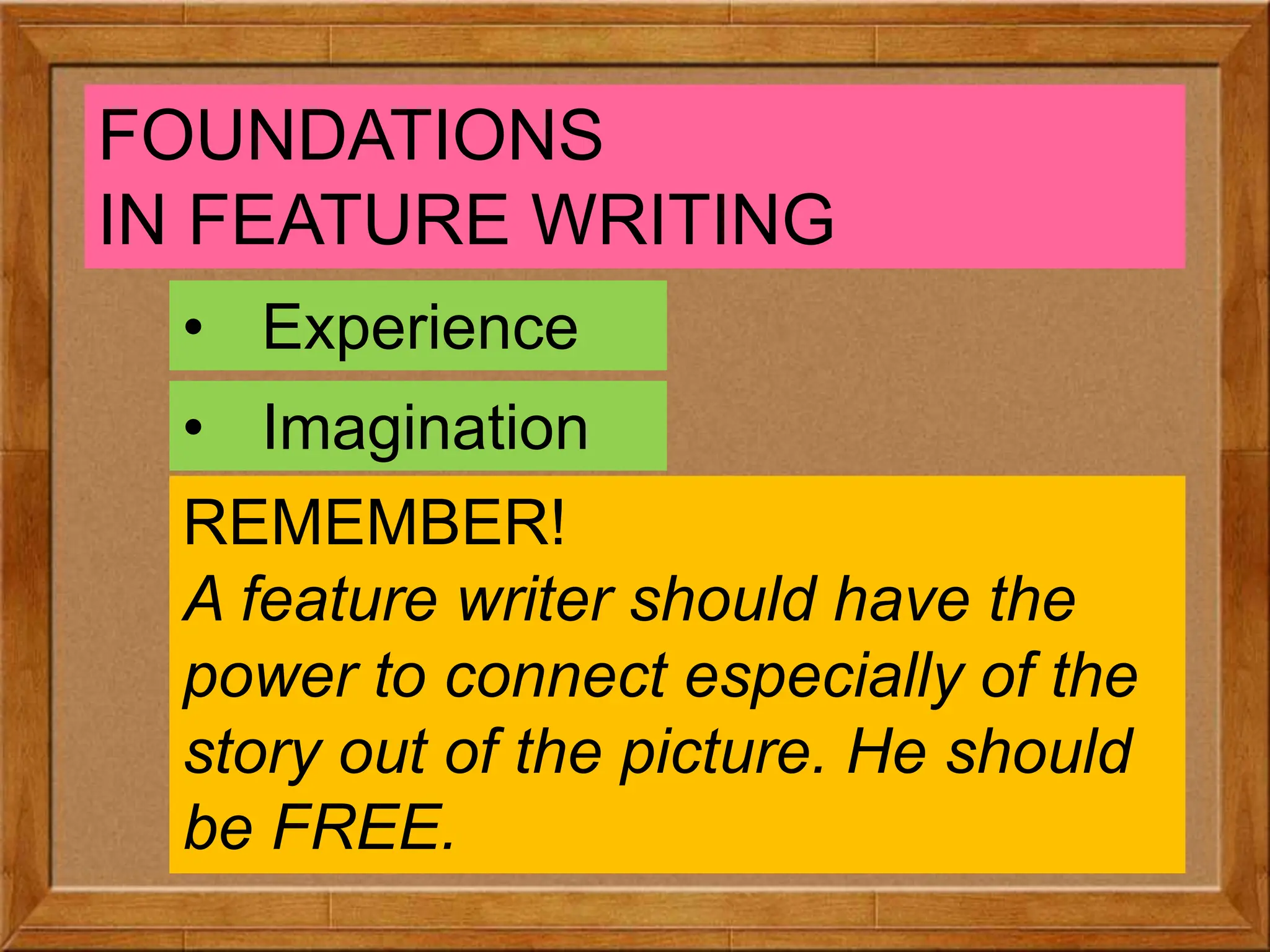
FOUNDATIONS
IN FEATURE WRITING
• Experience
• Imagination
REMEMBER!
A feature writer should have the
power to connect especially of the
story out of the picture. He should
be FREE.
TYPES OF FEATURE STORIES
 HUMAN INTEREST – issues
that impact people.
 PROFILE – focuses on a
specific individual’s
character or lifestyle.
 INSTRUCTIONAL – How-to-
feature.
TYPES OF FEATURE STORIES
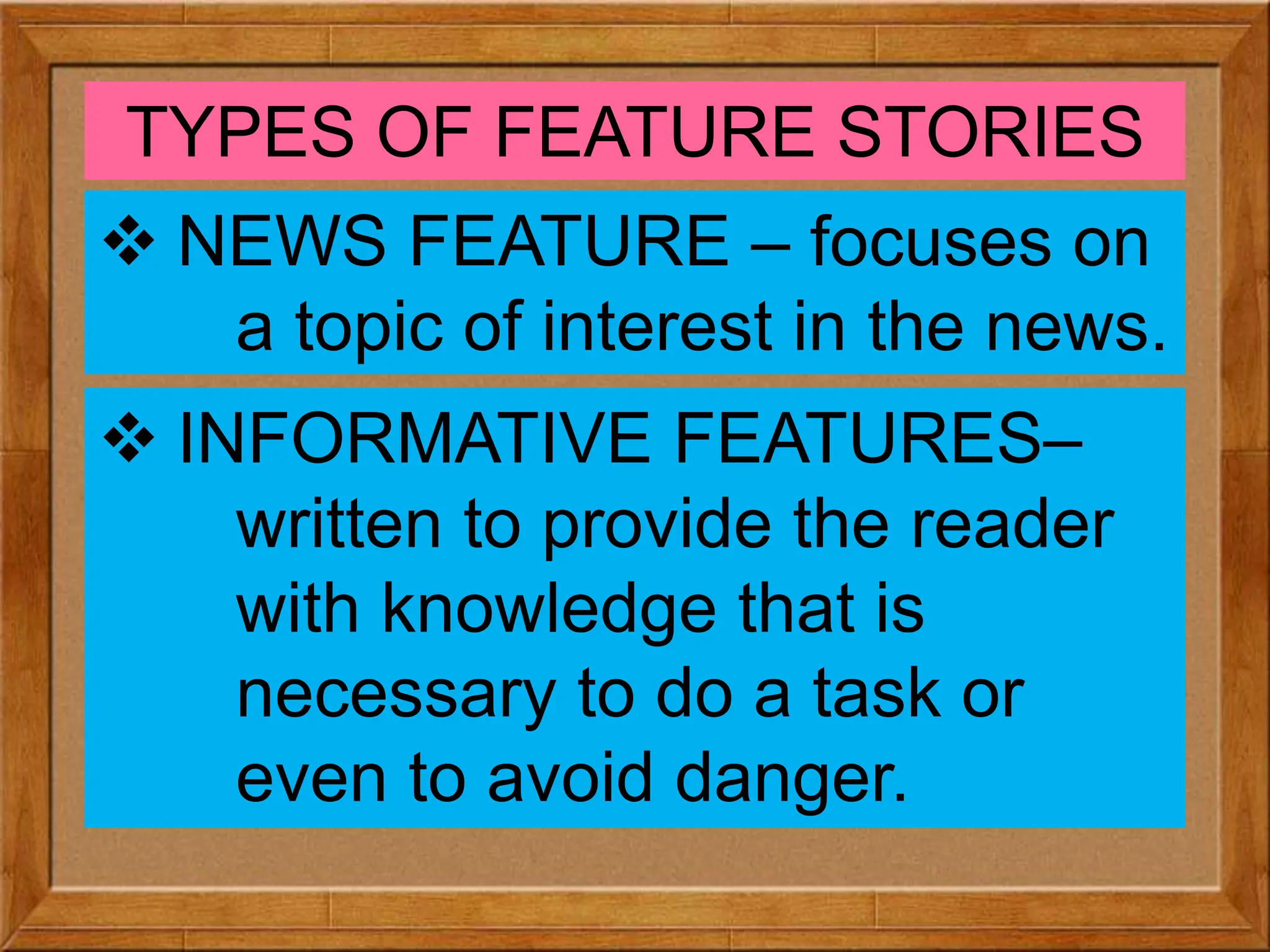
 NEWS FEATURE – focuses on
a topic of interest in the news.
 INFORMATIVE FEATURES–
written to provide the reader
with knowledge that is
necessary to do a task or
even to avoid danger.
TYPES OF FEATURE STORIES
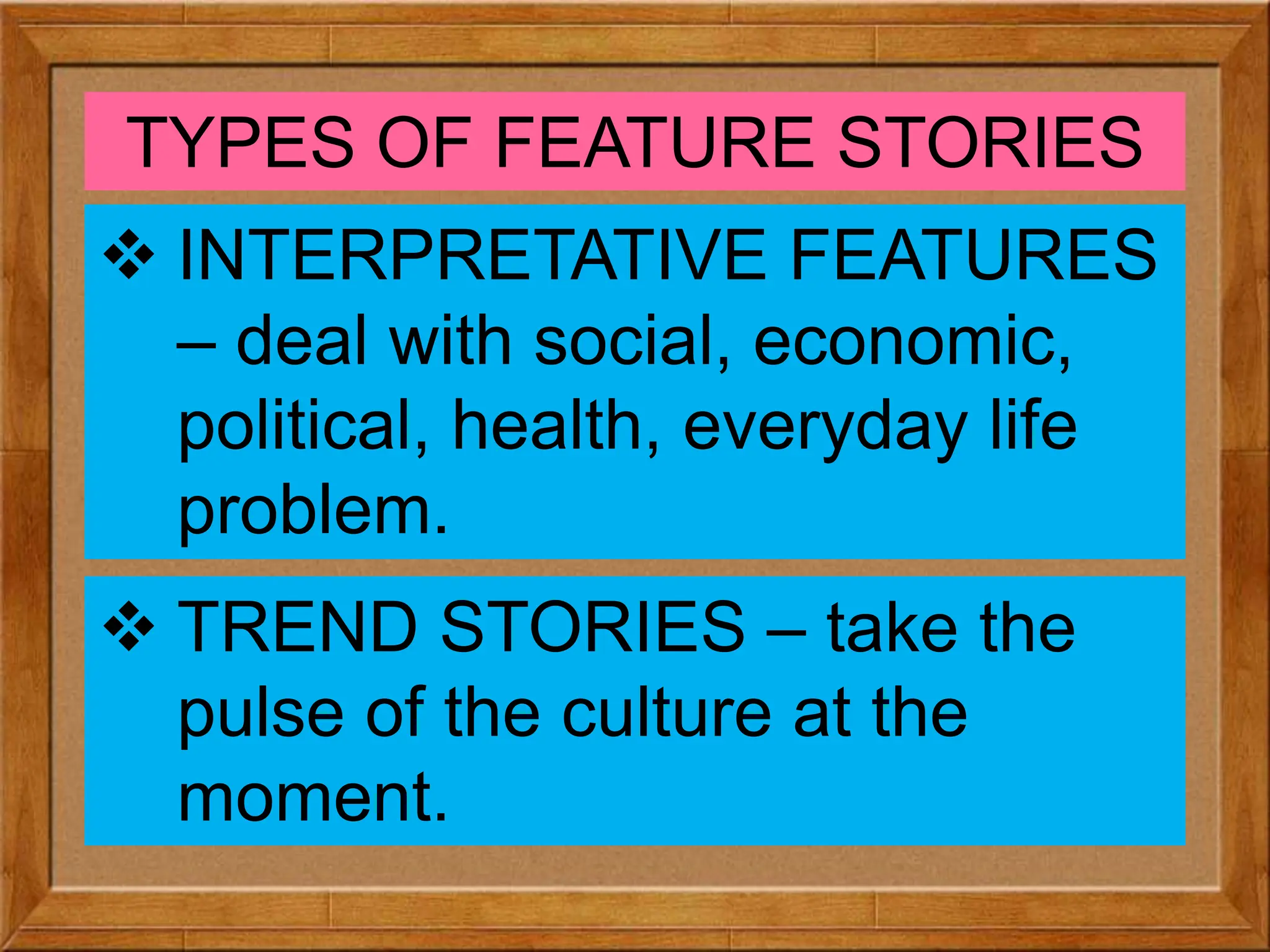
 INTERPRETATIVE FEATURES
– deal with social, economic,
political, health, everyday life
problem.
 TREND STORIES – take the
pulse of the culture at the
moment.
TYPES OF FEATURE STORIES
 LIVE-IN FEATURE – an in-
depth, often magazine-length
article that paints a picture of a
particular place and the people
who work or live there.
 PERSONAL ACCOUNT/
ACCOMPLISHMENT– deals with an unusual
experience or accomplishment of a person.
TYPES OF FEATURE STORIES
 SEASONAL FEATURE – story
that has relevance to the
season or festival the people
celebrate.
 INTERVIEW– obtains
observation about an issue that
a person is knowledgeable
about.
REMINDERS:
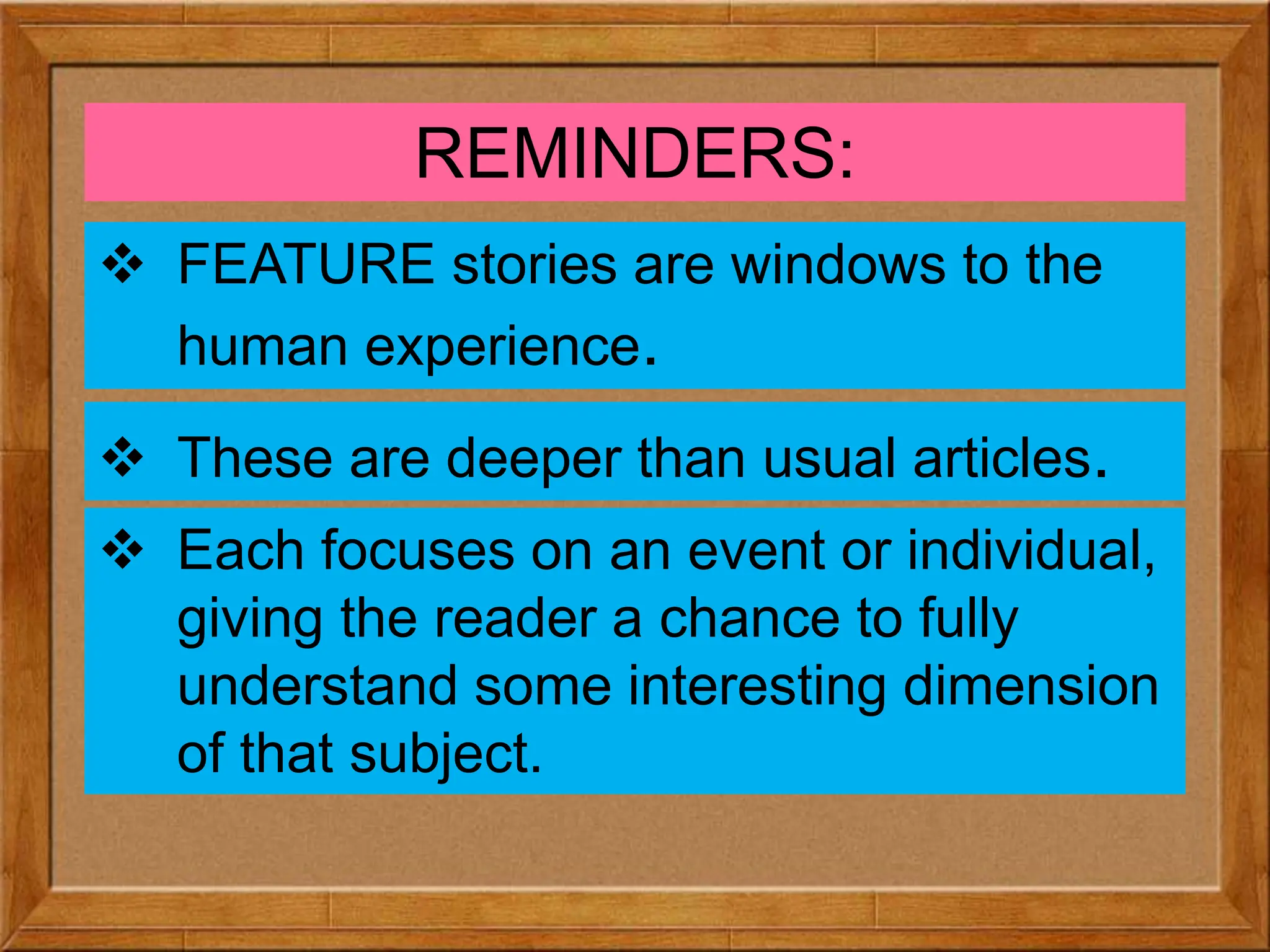
 FEATURE stories are windows to the
human experience.
 These are deeper than usual articles.
 Each focuses on an event or individual,
giving the reader a chance to fully
understand some interesting dimension
of that subject.
REMINDERS:
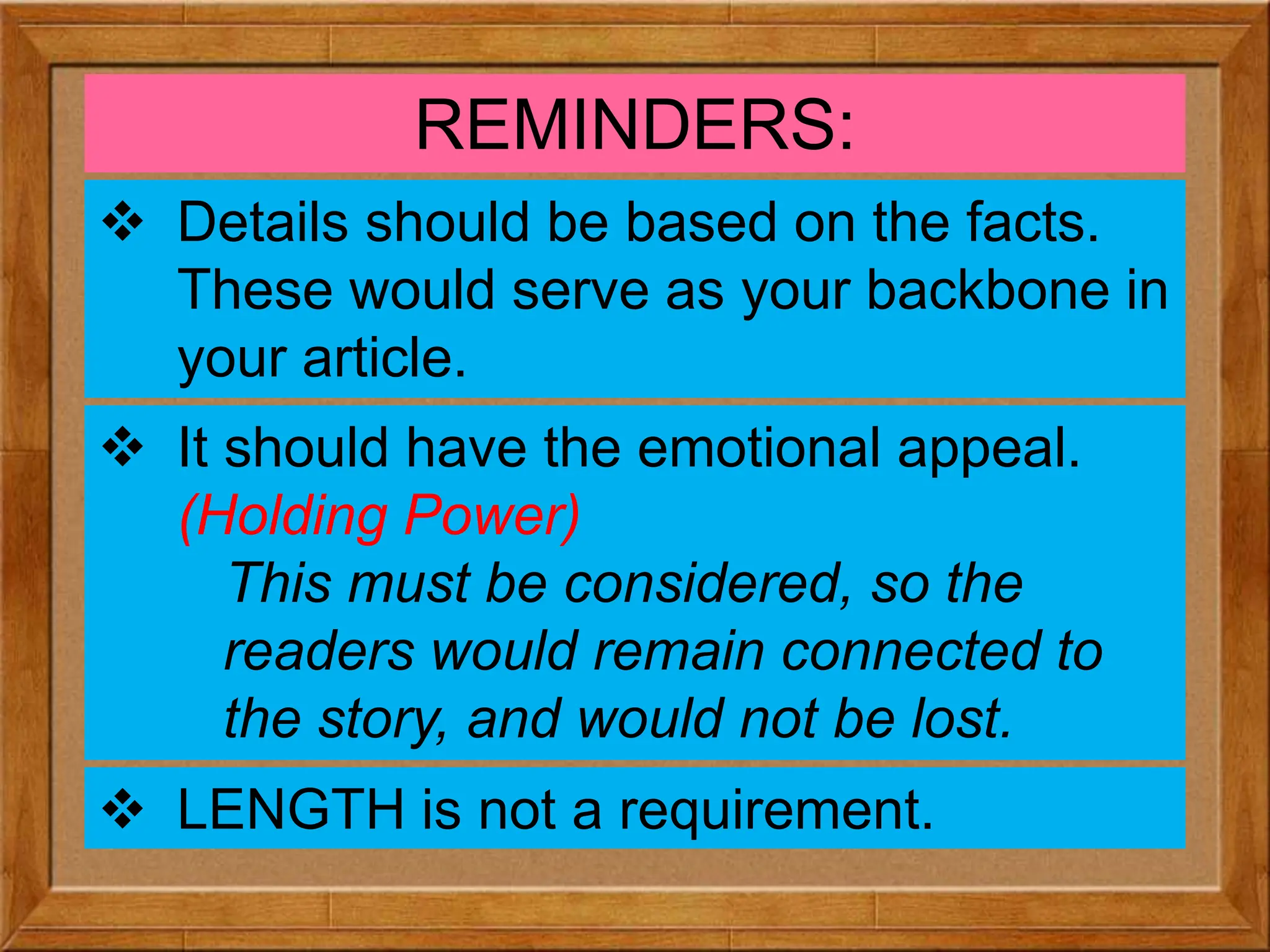
 Details should be based on the facts.
These would serve as your backbone in
your article.
 It should have the emotional appeal.
(Holding Power)
This must be considered, so the
readers would remain connected to
the story, and would not be lost.
 LENGTH is not a requirement.
A creative
REMINDERS:
 Consider the MECHANICS.
 Build a creative concept with unique
styles and techniques.
 Consider strong titles. Write powerful
beginning and ending.
 Social relevance.
 Do not forget CITATION and
ATTRIBUTION.
FEATURE PAGE
 Original articles
 Pictures of good quality
 Localized topics (Original)
 Good School Paper Layout
 Variation of stories
FORMULA TO WIN
NEVER GIVE UP!
Thank You
and God bless!

feature writing for campus journalism.pptx

  • 1.
  • 2.
    FEATURE STORY  Writtenby a journalist on a varied subject of human interest.  Provides the writer’s interpretation of a story, wider reader’s analysis of a certain topic.
  • 3.
    FEATURE STORY  Writtento entertain, inform or educate in a light, interesting or entertaining way that turns a dry material into a more reliable piece; without sacrificing the message to be communicated.  Not time based, but timeless.
  • 4.
    FEATURE STORY  IMPORTANT: Itis far different from the other categories because of its technicalities.  “Kumakagat ba ng damdamin ang article mo?”
  • 5.
     Feature Articletakes a specific format. ORGANIZING FEATURE STORY • TITLE – highlights the general topic of the story. - grabs the readers’ attention quickly to keep them reading.
  • 6.
    ORGANIZING FEATURE STORY •INTRODUCTION – provides any background information relevant to the story, and creates a relationship between the writer and the reader. Tone of the article is also set in the introduction.
  • 7.
    ORGANIZING FEATURE STORY IMPORTANTREMINDERS! Do not give all. Make it suspense, for you to have something to reveal at the end. INTRO only gives a grasp of your article.
  • 8.
    ORGANIZING FEATURE STORY •BODY – has most of the details of the story. - usually broken into pieces with subheadings for easy organization.
  • 9.
    ORGANIZING FEATURE STORY IMPORTANTREMINDERS! It should have the background information to make the readers up to date. It should have the thread of the story to make its parts connected from the beginning up to the end. It should have the persona, the dialogue, which may be used to keep the story moving and the voice, which can be used in injecting color, tone and emotion to the story.
  • 10.
    ORGANIZING FEATURE STORY •CONCLUSION – leaves a lasting impression on the reader and provokes some sort of reaction.
  • 11.
    Your feature shouldhave: -Logical Appeal (Logos)—Does the author’s proposal make sense? -Ethical Appeal (Ethos)– Is the author’s proposal the right thing to do? -Emotional Appeal (Pathos)—Will accepting the author’s proposal make me feel better?
  • 12.
  • 13.
  • 14.
  • 17.
    FOUNDATIONS IN FEATURE WRITING •Experience • Imagination REMEMBER! A feature writer should have the power to connect especially of the story out of the picture. He should be FREE.
  • 18.
    TYPES OF FEATURESTORIES  HUMAN INTEREST – issues that impact people.  PROFILE – focuses on a specific individual’s character or lifestyle.  INSTRUCTIONAL – How-to- feature.
  • 19.
    TYPES OF FEATURESTORIES  NEWS FEATURE – focuses on a topic of interest in the news.  INFORMATIVE FEATURES– written to provide the reader with knowledge that is necessary to do a task or even to avoid danger.
  • 20.
    TYPES OF FEATURESTORIES  INTERPRETATIVE FEATURES – deal with social, economic, political, health, everyday life problem.  TREND STORIES – take the pulse of the culture at the moment.
  • 21.
    TYPES OF FEATURESTORIES  LIVE-IN FEATURE – an in- depth, often magazine-length article that paints a picture of a particular place and the people who work or live there.  PERSONAL ACCOUNT/ ACCOMPLISHMENT– deals with an unusual experience or accomplishment of a person.
  • 22.
    TYPES OF FEATURESTORIES  SEASONAL FEATURE – story that has relevance to the season or festival the people celebrate.  INTERVIEW– obtains observation about an issue that a person is knowledgeable about.
  • 23.
    REMINDERS:  FEATURE storiesare windows to the human experience.  These are deeper than usual articles.  Each focuses on an event or individual, giving the reader a chance to fully understand some interesting dimension of that subject.
  • 24.
    REMINDERS:  Details shouldbe based on the facts. These would serve as your backbone in your article.  It should have the emotional appeal. (Holding Power) This must be considered, so the readers would remain connected to the story, and would not be lost.  LENGTH is not a requirement.
  • 25.
    A creative REMINDERS:  Considerthe MECHANICS.  Build a creative concept with unique styles and techniques.  Consider strong titles. Write powerful beginning and ending.  Social relevance.  Do not forget CITATION and ATTRIBUTION.
  • 26.
    FEATURE PAGE  Originalarticles  Pictures of good quality  Localized topics (Original)  Good School Paper Layout  Variation of stories
  • 28.
  • 29.