www.edgewater.com October 1, 2008 Predictive Analytics in Healthcare
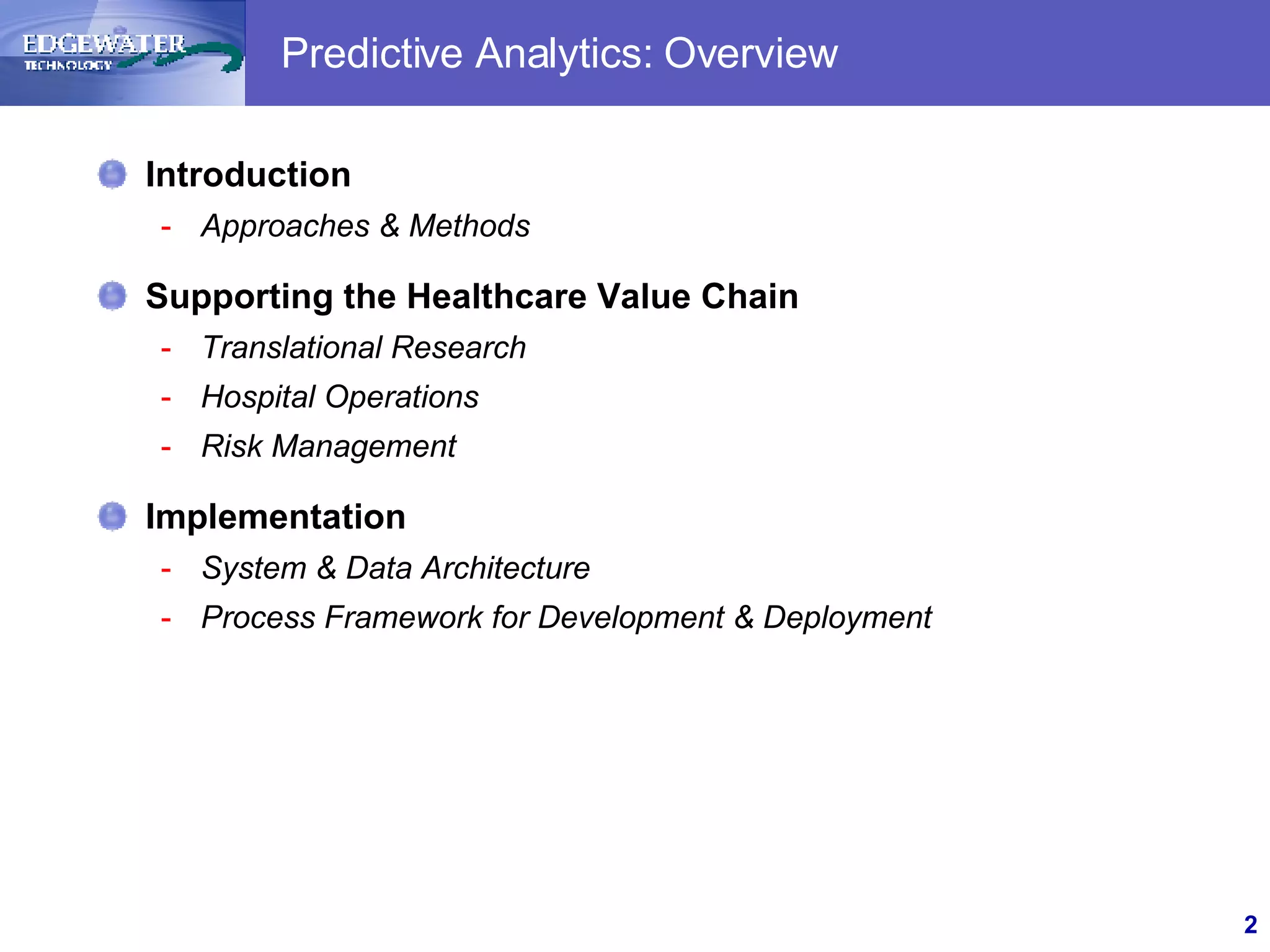
Introduction Approaches & Methods Supporting the Healthcare Value Chain Translational Research Hospital Operations Risk Management Implementation System & Data Architecture Process Framework for Development & Deployment Predictive Analytics: Overview
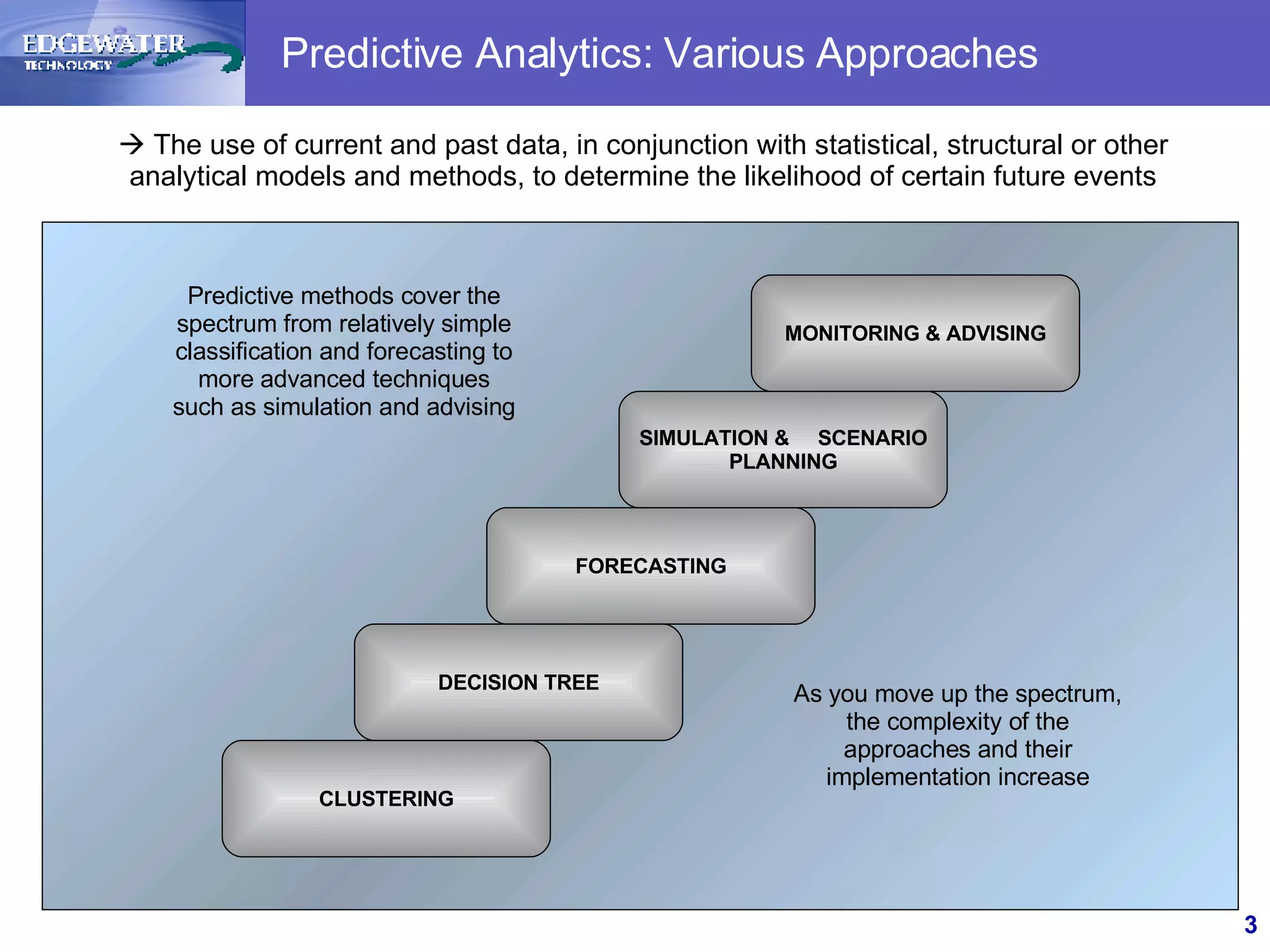
Predictive Analytics: Various Approaches CLUSTERING FORECASTING MONITORING & ADVISING SIMULATION &  SCENARIO PLANNING DECISION TREE    The use of current and past data, in conjunction with statistical, structural or other analytical models and methods, to determine the likelihood of certain future events Predictive methods cover the spectrum from relatively simple classification and forecasting to more advanced techniques such as simulation and advising As you move up the spectrum, the complexity of the approaches and their implementation increase
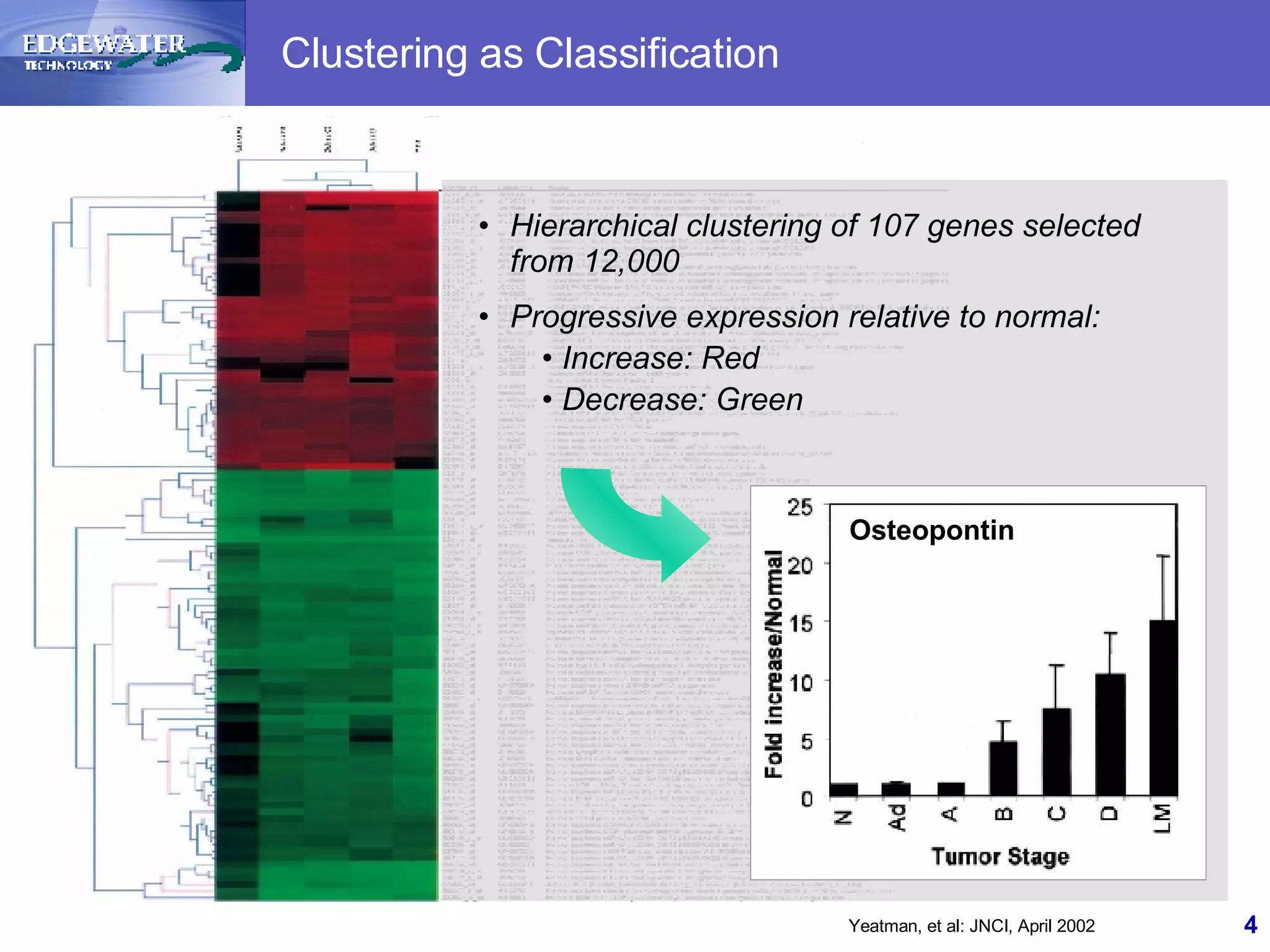
Clustering as Classification Hierarchical clustering of 107 genes selected from 12,000  Progressive expression relative to normal: Increase: Red Decrease: Green Yeatman, et al: JNCI, April 2002 Osteopontin
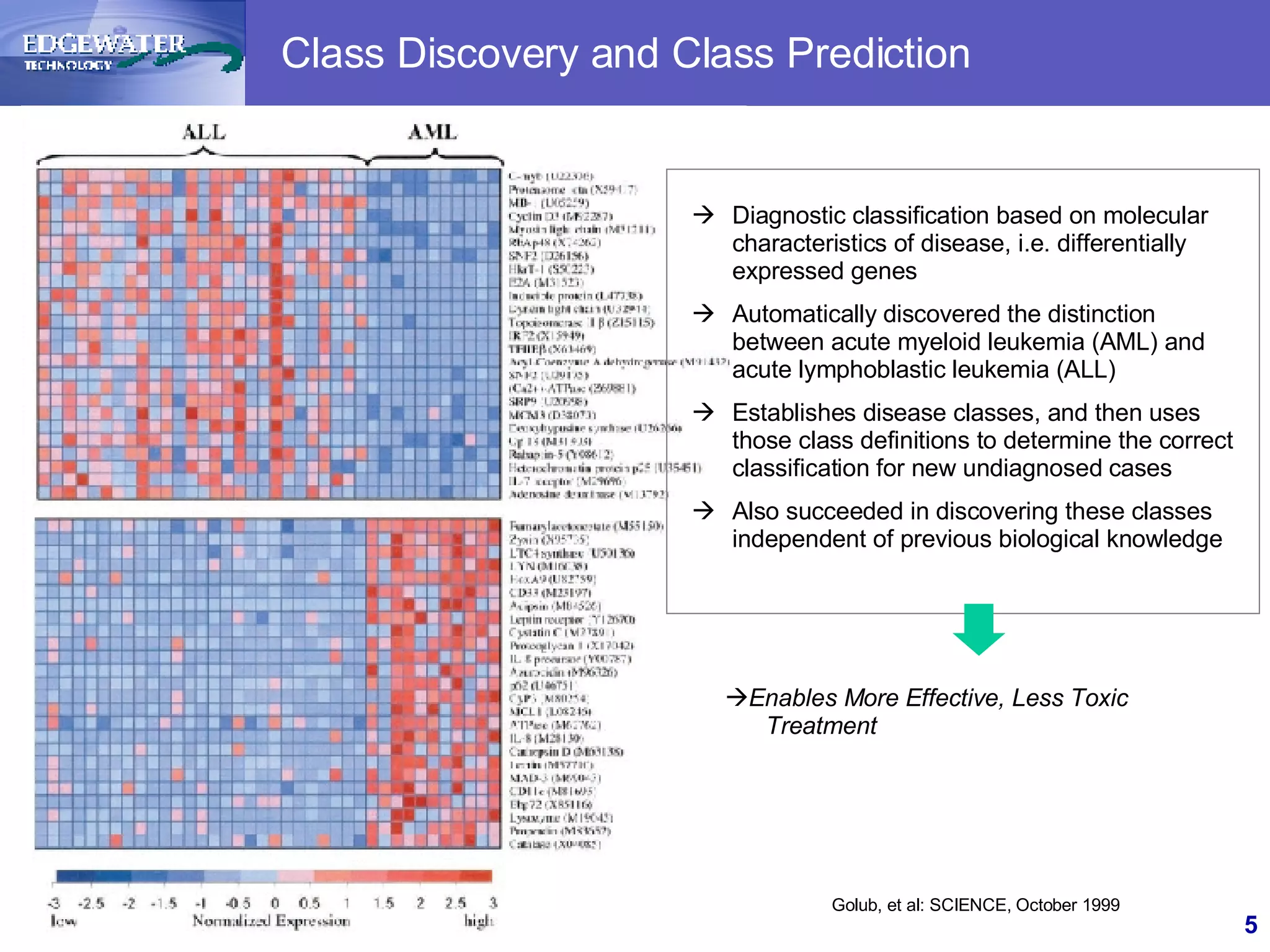
Class Discovery and Class Prediction Golub, et al: SCIENCE, October 1999 Diagnostic classification based on molecular characteristics of disease, i.e. differentially expressed genes Automatically discovered the distinction between acute myeloid leukemia (AML) and acute lymphoblastic leukemia (ALL) Establishes disease classes, and then uses those class definitions to determine the correct classification for new undiagnosed cases Also succeeded in discovering these classes independent of previous biological knowledge Enables More Effective, Less Toxic Treatment
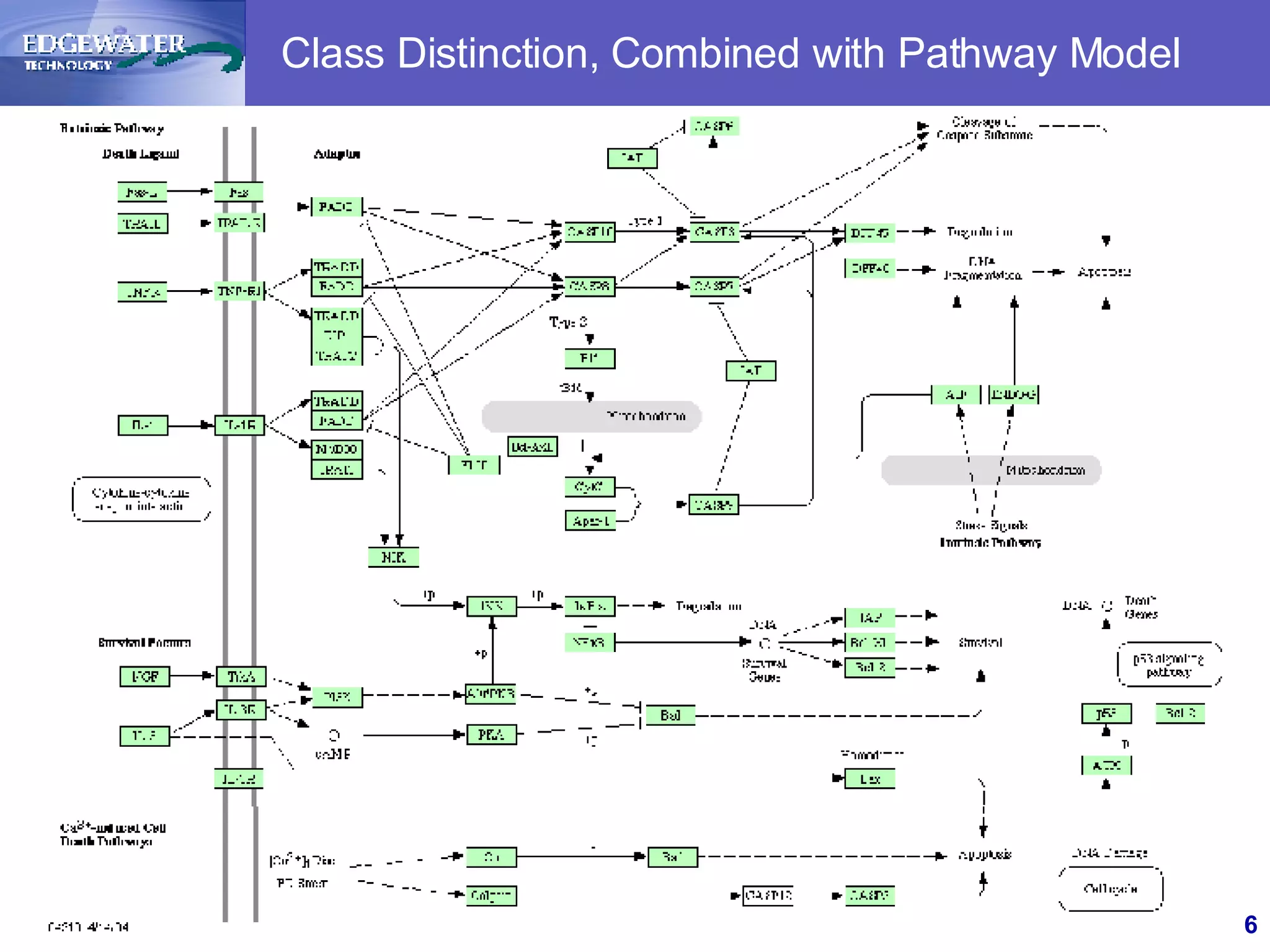
Class Distinction, Combined with Pathway Model Wei, et al: Cancer Cell, October 2006 GC apoptosis (cell death) rapamycin MCL1
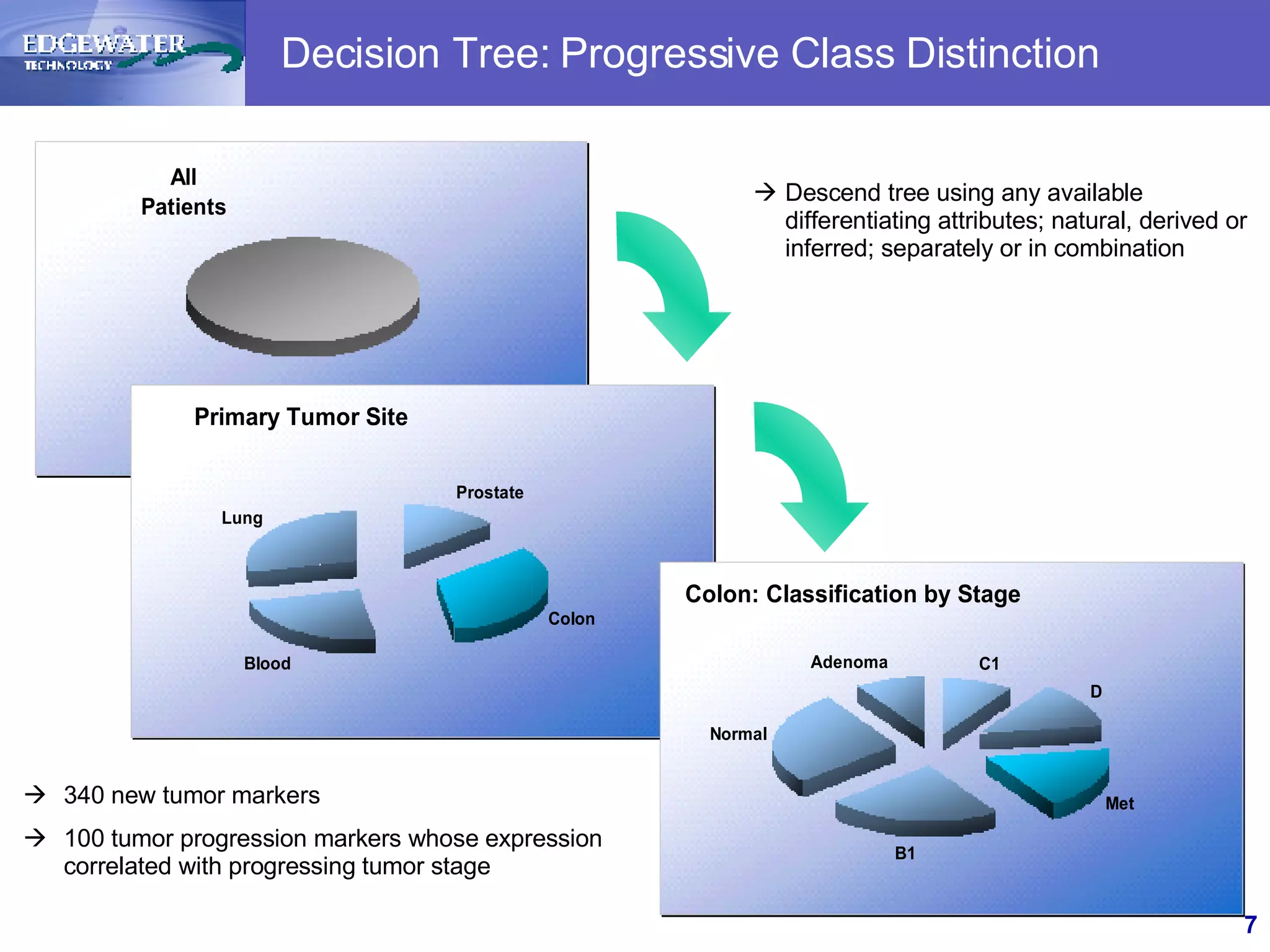
Decision Tree: Progressive Class Distinction 340 new tumor markers 100 tumor progression markers whose expression correlated with progressing tumor stage  Descend tree using any available differentiating attributes; natural, derived or inferred; separately or in combination
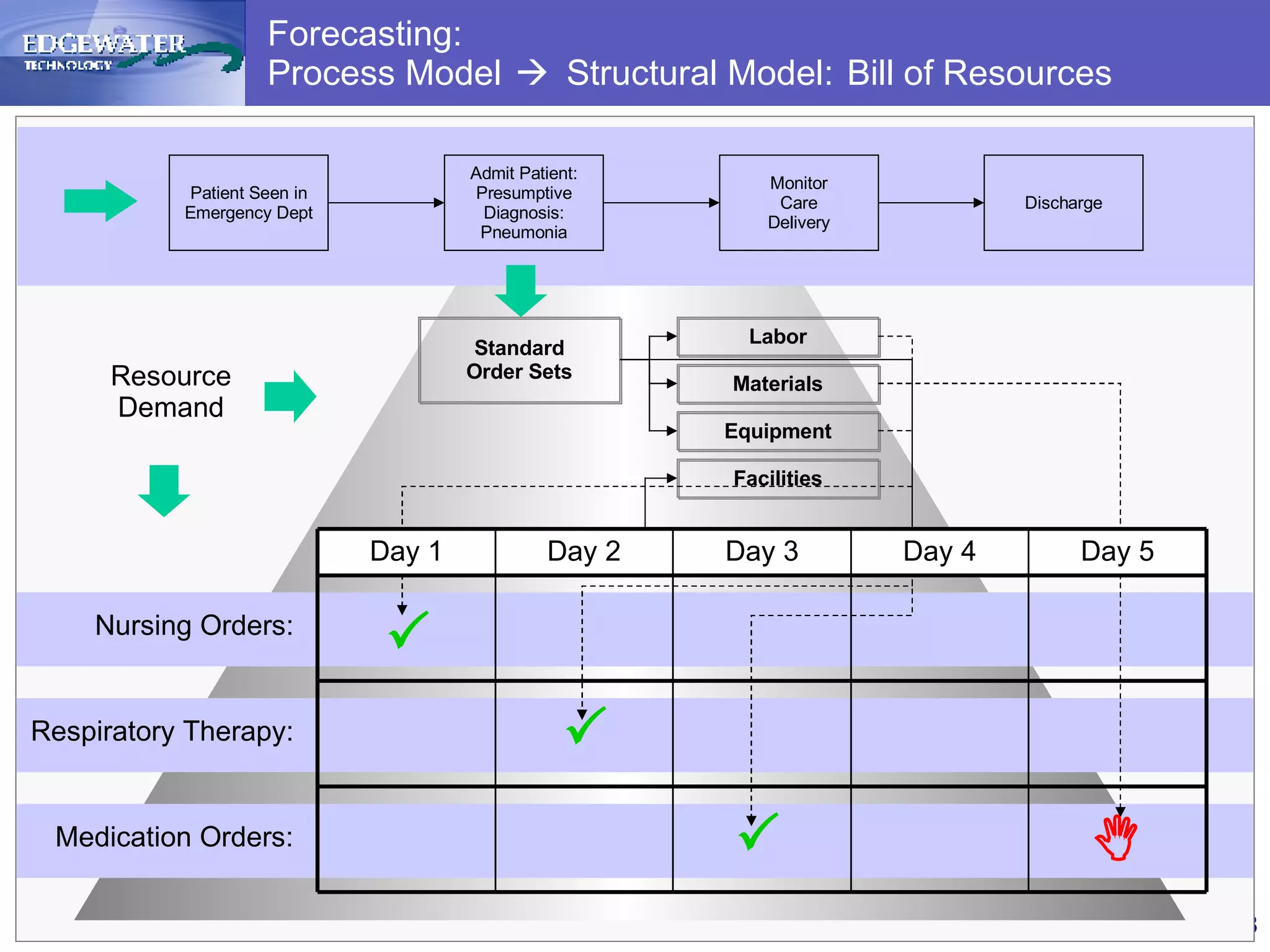
Forecasting:  Process Model      Structural Model:   Bill of Resources Patient Seen in Emergency Dept Admit Patient: Presumptive Diagnosis: Pneumonia Discharge Monitor Care Delivery Standard Order Sets Equipment Labor Materials Facilities Nursing Orders: Respiratory Therapy: Medication Orders: Resource Demand Day 5 Day 4 Day 3 Day 2 Day 1    
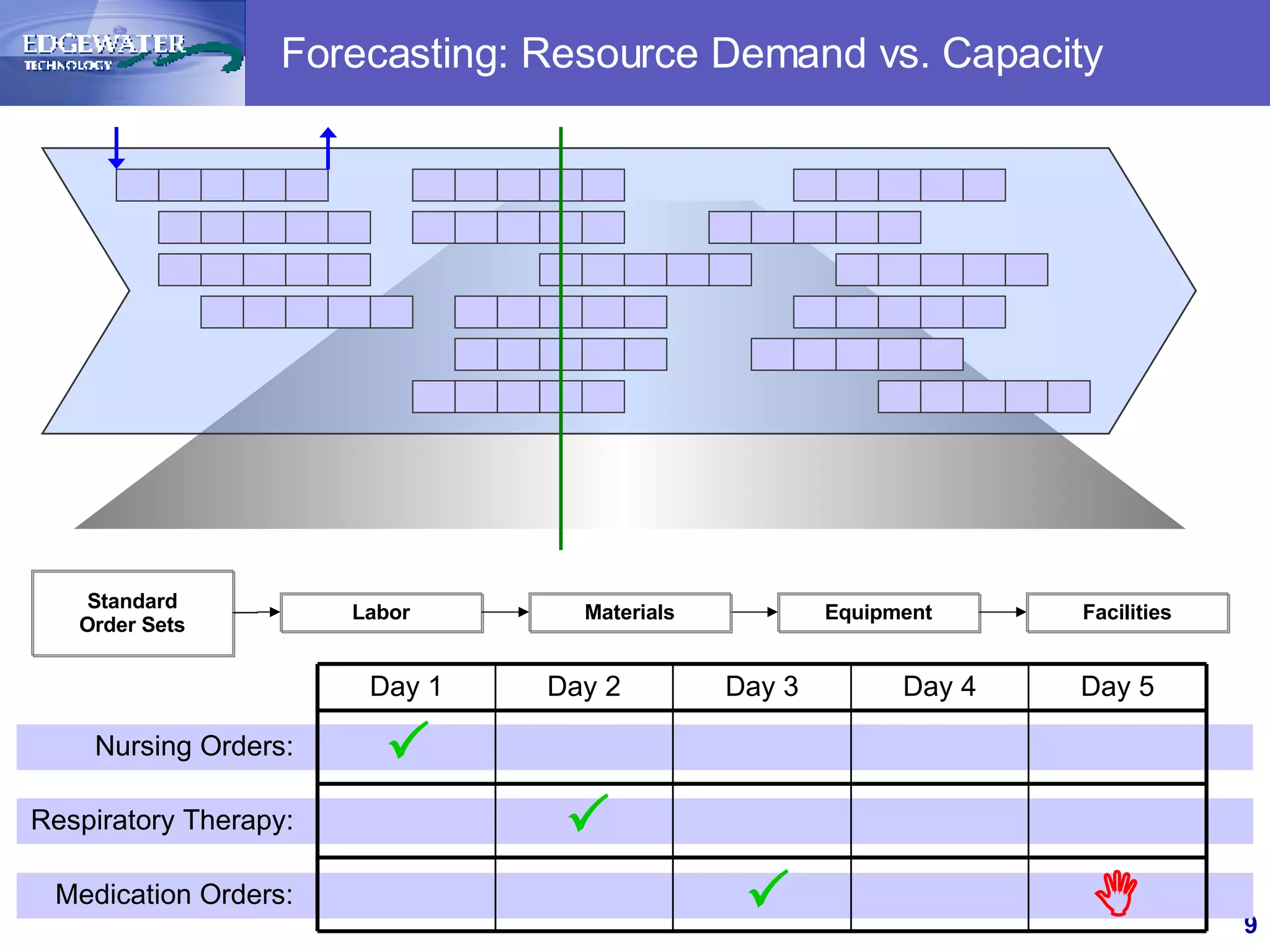
Forecasting: Resource Demand vs. Capacity Standard Order Sets Equipment Labor Materials Facilities Nursing Orders: Respiratory Therapy: Medication Orders: Day 5 Day 4 Day 3 Day 2 Day 1    
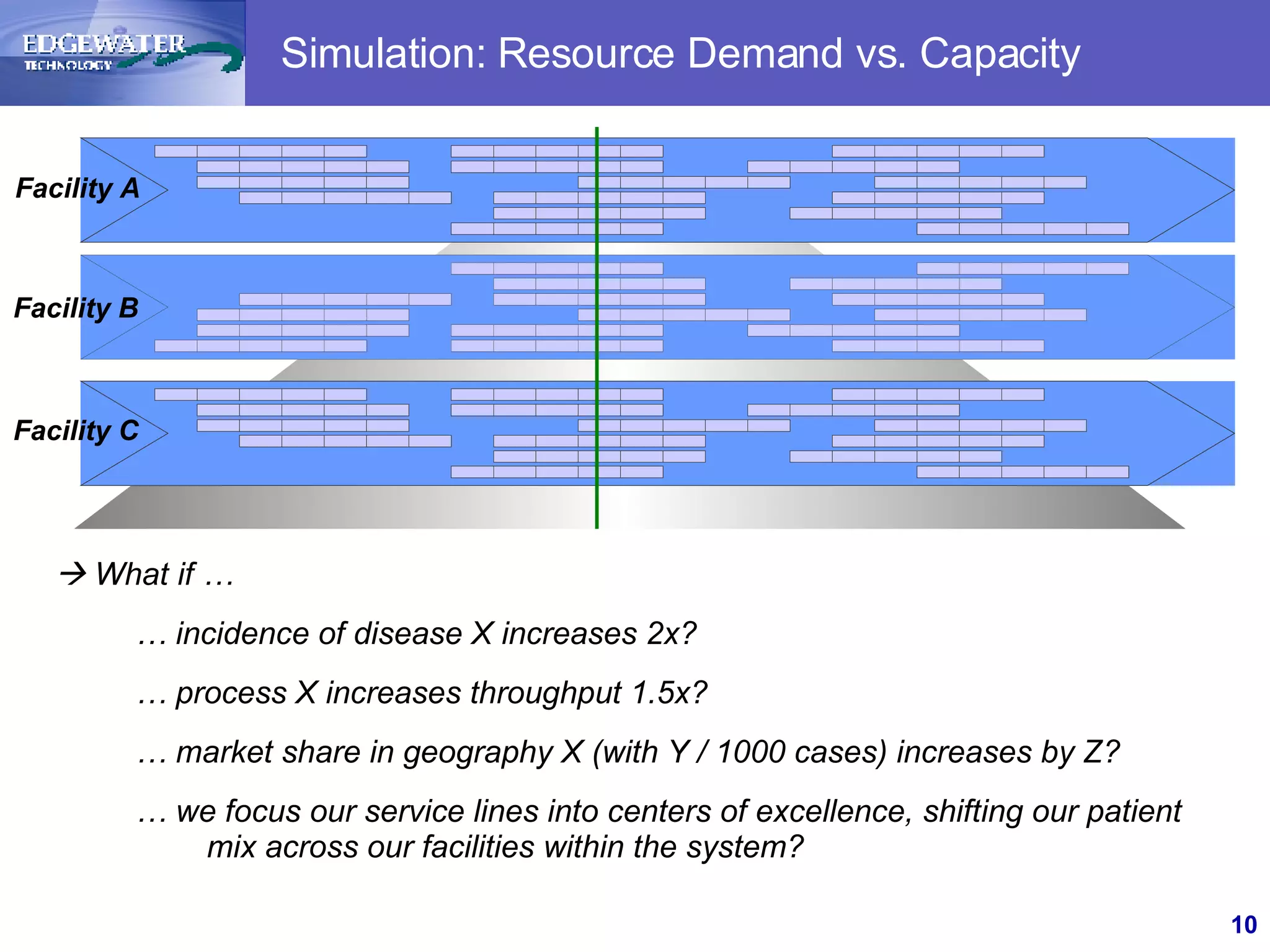
Simulation: Resource Demand vs. Capacity    What if … …  incidence of disease X increases 2x? …  process X increases throughput 1.5x? …  market share in geography X (with Y / 1000 cases) increases by Z? …  we focus our service lines into centers of excellence, shifting our patient mix across our facilities within the system? Facility A Facility B Facility C
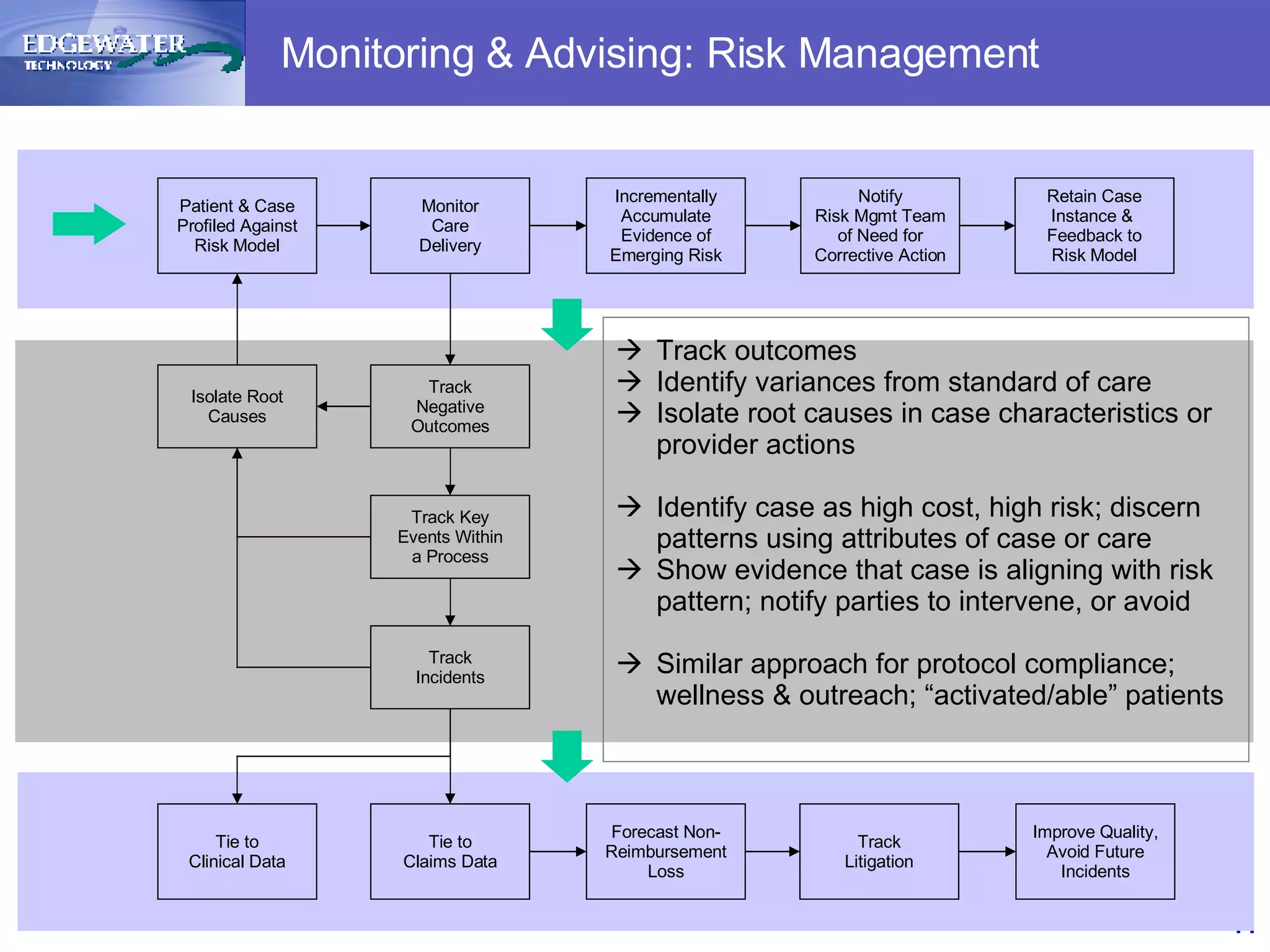
Monitoring & Advising: Risk Management Patient & Case Profiled Against Risk Model Incrementally Accumulate Evidence of Emerging Risk Retain Case Instance &  Feedback to Risk Model Notify Risk Mgmt Team of Need for Corrective Action Monitor Care Delivery Isolate Root Causes Track Negative Outcomes Track Key Events Within a Process Track Incidents Track outcomes Identify variances from standard of care Isolate root causes in case characteristics or provider actions Identify case as high cost, high risk; discern patterns using attributes of case or care Show evidence that case is aligning with risk pattern; notify parties to intervene, or avoid Similar approach for protocol compliance; wellness & outreach; “activated/able” patients Forecast Non- Reimbursement Loss Tie to Claims Data Tie to Clinical Data Track Litigation Improve Quality, Avoid Future Incidents
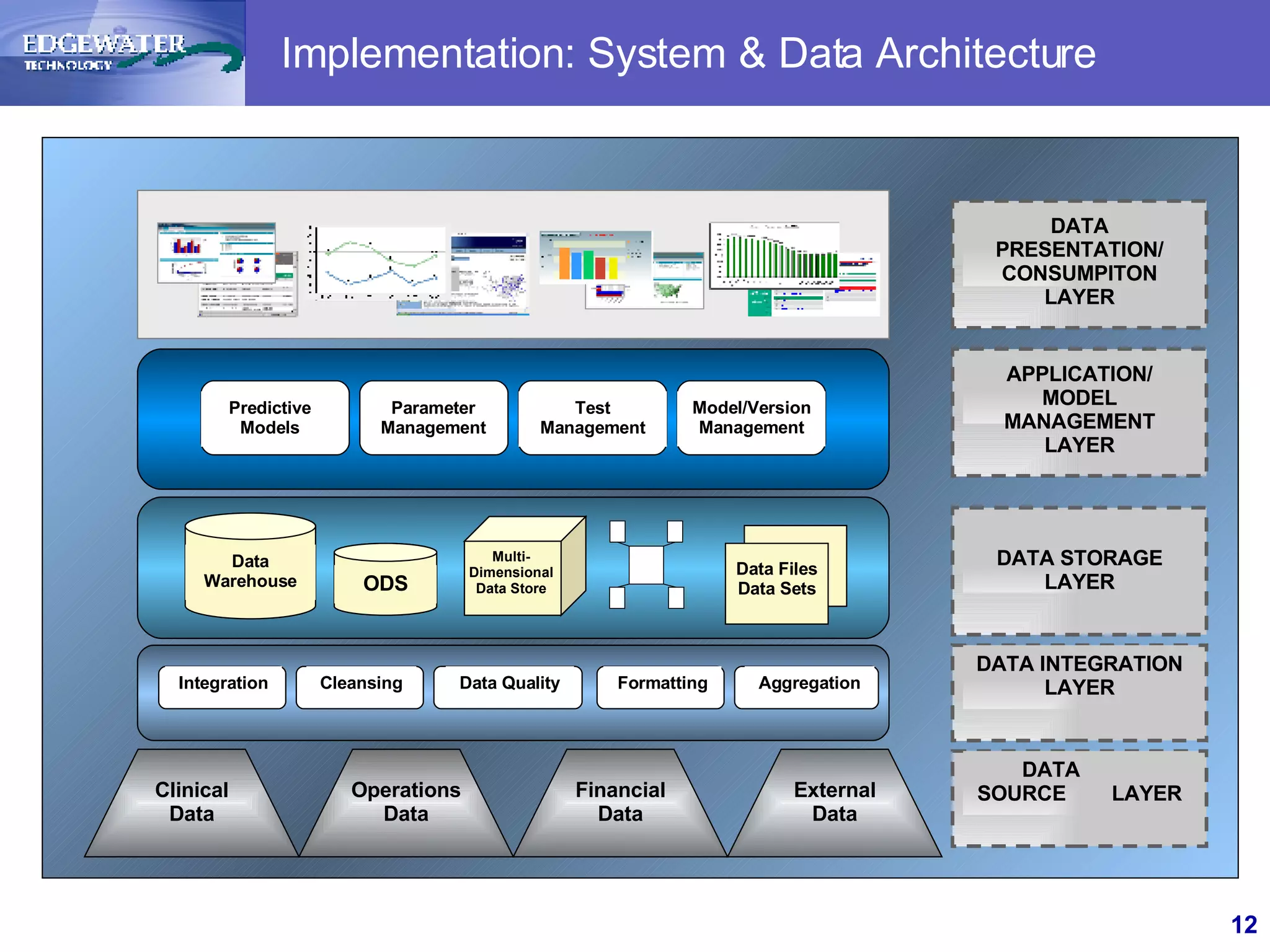
Implementation: System & Data Architecture Clinical Data Operations Data Financial Data External Data Data Warehouse Data Files Data Sets Parameter Management DATA PRESENTATION/ CONSUMPITON LAYER APPLICATION/ MODEL MANAGEMENT LAYER DATA STORAGE LAYER DATA INTEGRATION LAYER DATA  SOURCE  LAYER ODS Multi-Dimensional Data Store Integration Cleansing Data Quality Formatting Aggregation Predictive Models Test Management Model/Version Management
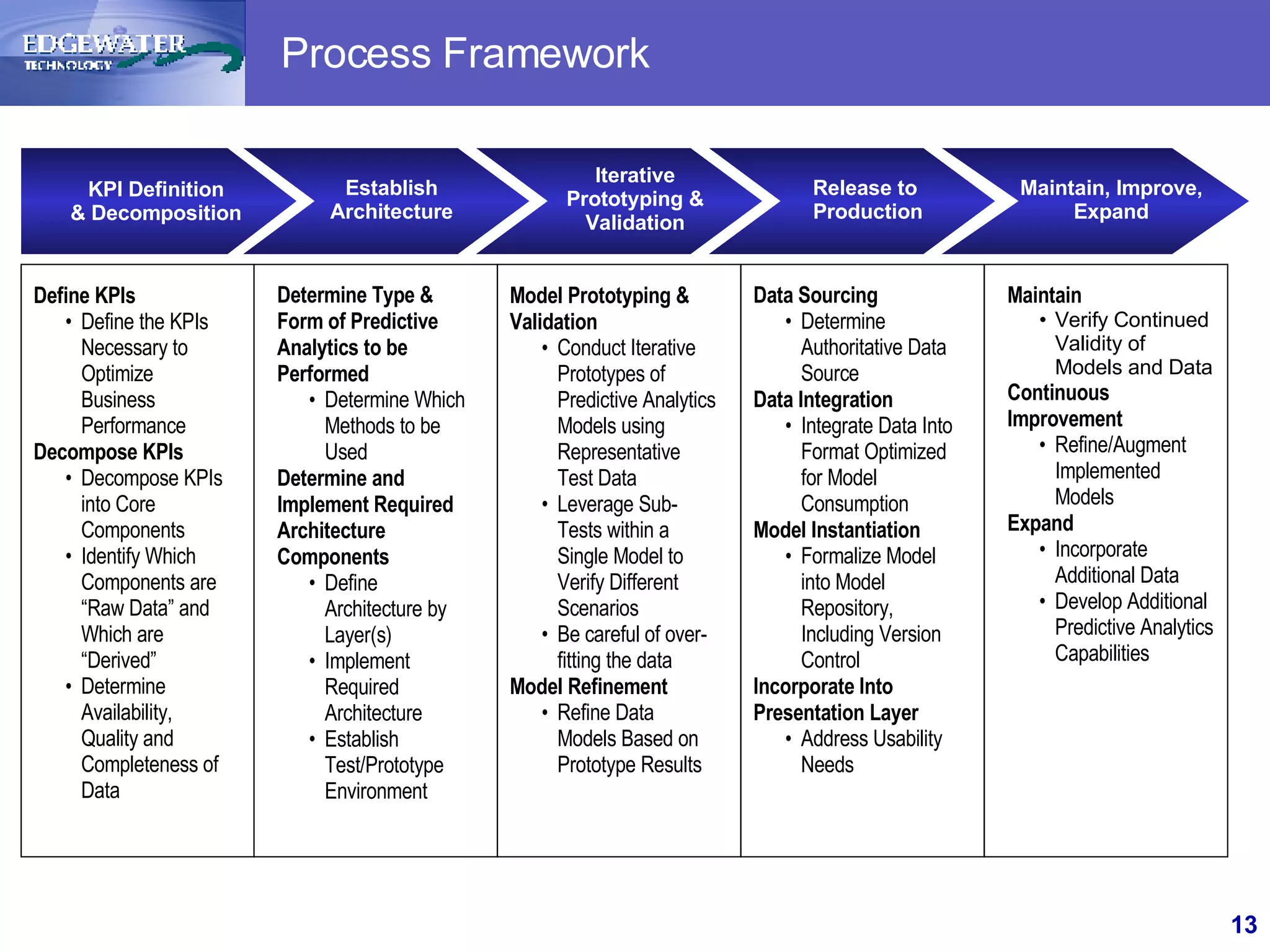
Process Framework KPI Definition  & Decomposition  Define KPIs Define the KPIs Necessary to Optimize Business Performance Decompose KPIs Decompose KPIs into Core Components Identify Which Components are “Raw Data” and Which are “Derived” Determine Availability, Quality and Completeness of Data Model Prototyping & Validation Conduct Iterative Prototypes of Predictive Analytics Models using Representative Test Data Leverage Sub-Tests within a Single Model to Verify Different Scenarios Be careful of over-fitting the data Model Refinement Refine Data Models Based on Prototype Results Prototyping and Refinement Data Sourcing Determine Authoritative Data Source  Data Integration Integrate Data Into Format Optimized for Model Consumption Model Instantiation Formalize Model into Model Repository, Including Version Control Incorporate Into Presentation Layer Address Usability Needs Determine Type & Form of Predictive Analytics to be Performed Determine Which Methods to be Used Determine and Implement Required Architecture Components Define Architecture by Layer(s) Implement Required Architecture Establish Test/Prototype Environment Establish Architecture Iterative Prototyping & Validation Release to  Production Maintain, Improve, Expand Maintain Verify Continued Validity of Models and Data Continuous Improvement Refine/Augment Implemented Models Expand Incorporate Additional Data Develop Additional Predictive Analytics Capabilities
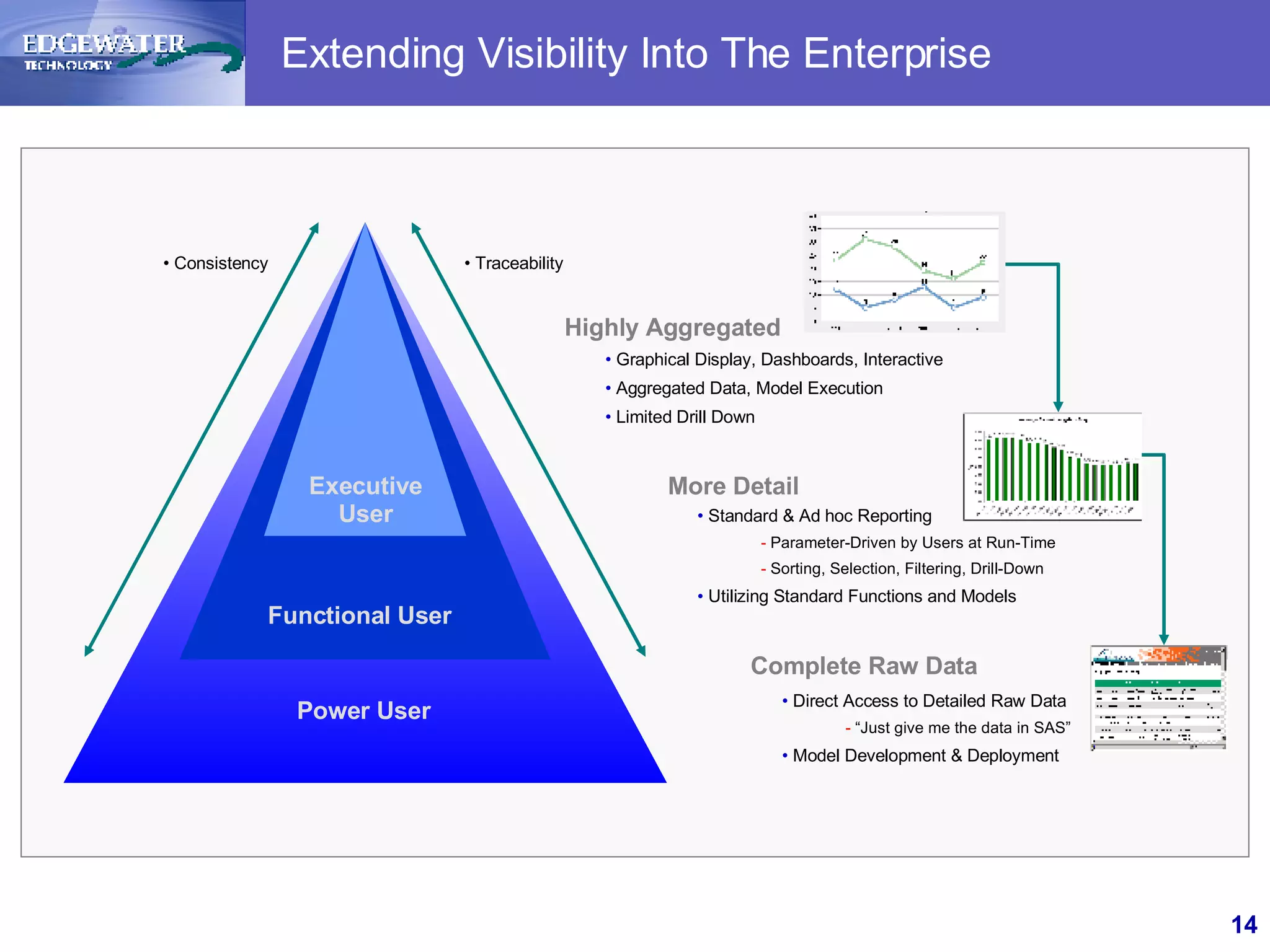
Extending Visibility Into The Enterprise Executive User Functional User Power User Highly Aggregated More Detail Complete Raw Data Graphical Display, Dashboards, Interactive Aggregated Data, Model Execution Limited Drill Down Standard & Ad hoc Reporting Parameter-Driven by Users at Run-Time Sorting, Selection, Filtering, Drill-Down Utilizing Standard Functions and Models Direct Access to Detailed Raw Data “ Just give me the data in SAS” Model Development & Deployment Traceability Consistency
www.edgewater.com October 1, 2008 Predictive Analytics in Healthcare

Predictive Analytics in Healthcare

  • 1.
    www.edgewater.com October 1,2008 Predictive Analytics in Healthcare
  • 2.
    Introduction Approaches &Methods Supporting the Healthcare Value Chain Translational Research Hospital Operations Risk Management Implementation System & Data Architecture Process Framework for Development & Deployment Predictive Analytics: Overview
  • 3.
    Predictive Analytics: VariousApproaches CLUSTERING FORECASTING MONITORING & ADVISING SIMULATION & SCENARIO PLANNING DECISION TREE  The use of current and past data, in conjunction with statistical, structural or other analytical models and methods, to determine the likelihood of certain future events Predictive methods cover the spectrum from relatively simple classification and forecasting to more advanced techniques such as simulation and advising As you move up the spectrum, the complexity of the approaches and their implementation increase
  • 4.
    Clustering as ClassificationHierarchical clustering of 107 genes selected from 12,000 Progressive expression relative to normal: Increase: Red Decrease: Green Yeatman, et al: JNCI, April 2002 Osteopontin
  • 5.
    Class Discovery andClass Prediction Golub, et al: SCIENCE, October 1999 Diagnostic classification based on molecular characteristics of disease, i.e. differentially expressed genes Automatically discovered the distinction between acute myeloid leukemia (AML) and acute lymphoblastic leukemia (ALL) Establishes disease classes, and then uses those class definitions to determine the correct classification for new undiagnosed cases Also succeeded in discovering these classes independent of previous biological knowledge Enables More Effective, Less Toxic Treatment
  • 6.
    Class Distinction, Combinedwith Pathway Model Wei, et al: Cancer Cell, October 2006 GC apoptosis (cell death) rapamycin MCL1
  • 7.
    Decision Tree: ProgressiveClass Distinction 340 new tumor markers 100 tumor progression markers whose expression correlated with progressing tumor stage Descend tree using any available differentiating attributes; natural, derived or inferred; separately or in combination
  • 8.
    Forecasting: ProcessModel  Structural Model: Bill of Resources Patient Seen in Emergency Dept Admit Patient: Presumptive Diagnosis: Pneumonia Discharge Monitor Care Delivery Standard Order Sets Equipment Labor Materials Facilities Nursing Orders: Respiratory Therapy: Medication Orders: Resource Demand Day 5 Day 4 Day 3 Day 2 Day 1    
  • 9.
    Forecasting: Resource Demandvs. Capacity Standard Order Sets Equipment Labor Materials Facilities Nursing Orders: Respiratory Therapy: Medication Orders: Day 5 Day 4 Day 3 Day 2 Day 1    
  • 10.
    Simulation: Resource Demandvs. Capacity  What if … … incidence of disease X increases 2x? … process X increases throughput 1.5x? … market share in geography X (with Y / 1000 cases) increases by Z? … we focus our service lines into centers of excellence, shifting our patient mix across our facilities within the system? Facility A Facility B Facility C
  • 11.
    Monitoring & Advising:Risk Management Patient & Case Profiled Against Risk Model Incrementally Accumulate Evidence of Emerging Risk Retain Case Instance & Feedback to Risk Model Notify Risk Mgmt Team of Need for Corrective Action Monitor Care Delivery Isolate Root Causes Track Negative Outcomes Track Key Events Within a Process Track Incidents Track outcomes Identify variances from standard of care Isolate root causes in case characteristics or provider actions Identify case as high cost, high risk; discern patterns using attributes of case or care Show evidence that case is aligning with risk pattern; notify parties to intervene, or avoid Similar approach for protocol compliance; wellness & outreach; “activated/able” patients Forecast Non- Reimbursement Loss Tie to Claims Data Tie to Clinical Data Track Litigation Improve Quality, Avoid Future Incidents
  • 12.
    Implementation: System &Data Architecture Clinical Data Operations Data Financial Data External Data Data Warehouse Data Files Data Sets Parameter Management DATA PRESENTATION/ CONSUMPITON LAYER APPLICATION/ MODEL MANAGEMENT LAYER DATA STORAGE LAYER DATA INTEGRATION LAYER DATA SOURCE LAYER ODS Multi-Dimensional Data Store Integration Cleansing Data Quality Formatting Aggregation Predictive Models Test Management Model/Version Management
  • 13.
    Process Framework KPIDefinition & Decomposition Define KPIs Define the KPIs Necessary to Optimize Business Performance Decompose KPIs Decompose KPIs into Core Components Identify Which Components are “Raw Data” and Which are “Derived” Determine Availability, Quality and Completeness of Data Model Prototyping & Validation Conduct Iterative Prototypes of Predictive Analytics Models using Representative Test Data Leverage Sub-Tests within a Single Model to Verify Different Scenarios Be careful of over-fitting the data Model Refinement Refine Data Models Based on Prototype Results Prototyping and Refinement Data Sourcing Determine Authoritative Data Source Data Integration Integrate Data Into Format Optimized for Model Consumption Model Instantiation Formalize Model into Model Repository, Including Version Control Incorporate Into Presentation Layer Address Usability Needs Determine Type & Form of Predictive Analytics to be Performed Determine Which Methods to be Used Determine and Implement Required Architecture Components Define Architecture by Layer(s) Implement Required Architecture Establish Test/Prototype Environment Establish Architecture Iterative Prototyping & Validation Release to Production Maintain, Improve, Expand Maintain Verify Continued Validity of Models and Data Continuous Improvement Refine/Augment Implemented Models Expand Incorporate Additional Data Develop Additional Predictive Analytics Capabilities
  • 14.
    Extending Visibility IntoThe Enterprise Executive User Functional User Power User Highly Aggregated More Detail Complete Raw Data Graphical Display, Dashboards, Interactive Aggregated Data, Model Execution Limited Drill Down Standard & Ad hoc Reporting Parameter-Driven by Users at Run-Time Sorting, Selection, Filtering, Drill-Down Utilizing Standard Functions and Models Direct Access to Detailed Raw Data “ Just give me the data in SAS” Model Development & Deployment Traceability Consistency
  • 15.
    www.edgewater.com October 1,2008 Predictive Analytics in Healthcare