Edel Technology
Technology Partner To The World
• What is Lean Start-up Methodology?
● Scientific approach to creating and managing
start-ups
● Ultimate goal is to get products to customers'
hands faster
● Takes its name from the lean manufacturing
revolution that Taiichi Ohno and Shigeo Shingo
are credited with.
Introduction to the LSM
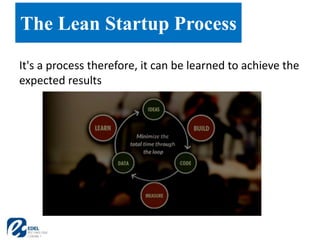
It's a process therefore, it can be learned to achieve the
expected results
The Lean Startup Process
Why Lean Methodology?
●The customer is the ultimate focus here.
●Involve the customer; speak to him to approve or
disapprove the ideas you have, else, you fail
●Eliminate uncertainty to create order
●Drives Innovation-
5
5
Why Lean Methodology? (Cont’d)
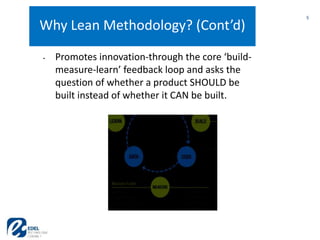
• Promotes innovation-through the core ‘build-
measure-learn’ feedback loop and asks the
question of whether a product SHOULD be
built instead of whether it CAN be built.
6
6
Why Lean Methodology?
(Cont’d)
• Promotes the principle of work smarter not
harder
• It is the best way to build an enduring
business today
• Starting Lean is today’s best practice for
innovators.” — Randy Komisar, founding
director of TiVo
Principles of LSM
The LSM is built on 5 core principles.
●Entrepreneurs are everywhere- irrespective of industry or
company size
●Entrepreneurship is management
●Validated Learning
●Build-Measure-Learn
●Innovative Accounting
Parts of the LSM (1)
The whole methodology can be broken into 3 segments;
Vision- (to achieve this, we employ a strategy, product
roadmap, point of view about partners and competitors and
ideas about who the customers will be )
i. Start
ii. Define
iii. Learn- which elements of our strategy will help us
achieve what we want
iv. Experiment
Parts of LSM (2)
Steer – Having a great a idea or building a great product is not
enough, the focus should be on minimizing the total time in this
loop.
v. Leap-'the-leap-of-faith' assumptions. ie. the value assumption-
What will generate value for the customer; and the growth
assumption- how will new customers discover our product.
vi. Test
vii. Measure
viii. Pivot (or Persevere)
Parts of LSM (3)
Accelerate- Which activities create value and those which
form waste?
ix. Grow
x. Adapt
xi. Innovate
xii. Join the Movement
● ‘In order to learn, failure must be an option, and failure while
learning must be accepted within the organization. If you
cannot fail, then you cannot succeed’. -Jake Simmons
● The story of Edel Technology Consulting - we failed once as a
startup. We came back strong. Thanks to the vision of our
founder
LSM at EDEL Tech Consulting
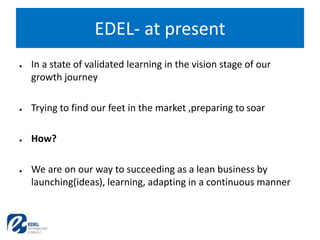
● In a state of validated learning in the vision stage of our
growth journey
● Trying to find our feet in the market ,preparing to soar
● How?
● We are on our way to succeeding as a lean business by
launching(ideas), learning, adapting in a continuous manner
EDEL- at present
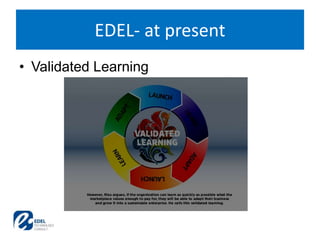
• Validated Learning
EDEL- at present
• Validated learning is
● a process
● of demonstrating empirically that a team has
discovered(a sign of learning)
● valuable truths about a start-up’s present and
future business prospects
What is validated learning?
How Do we Account?
●We are able to know if we are making progress by measuring
with concrete decisions- During the Learning phase of validated
learning.
●Eliminate what is not necessary and go only with what is
necessary for the customer- i.e. that which provides benefit to
the customer. All other things contrary to this is waste
●Productivity is when we know the right product to build
What Next?
●Prepare to steer in the direction defined in the current
phase
●Experiment, experiment, experiment more
●Not forgetting our vision as a company
●Experimentation drives innovation and causes us to be in
the lead
Preparing to Steer
●As we experiment, we must answer these 4 questions as
proposed by Ries:
●1.Do consumers recognize that they have the problem we
are trying to solve?
●2. If there was a solution, would they buy it?
●3. Would they buy it from us?
●4. Can we build a solution for that problem?
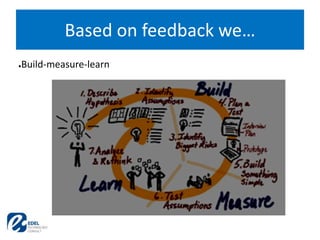
Based on feedback we…
●Build-measure-learn
M-ABLODE
● We identified an employment gap/desire for people to make
extra money
● Identified our 2 riskiest assumptions
● We plan and test our assumptions by reaching out to target
groups-with interviews/questions
● Build a prototype(MVP)- get groups to try it out so we can
measure
● Based on feedback, we Learn- and re-strategize where
necessary
● Continue cycle till we succeed- and LAUNCH!
Lean product Example
● The Build-measure-learn steering wheel will
help us to make constant adjustments while
headed to our destination
● we can learn when and if it’s time to make a
sharp turn or whether we should persevere
along our current path.
Example (cont’d)
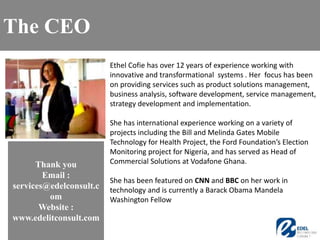
Ethel Cofie has over 12 years of experience working with
innovative and transformational systems . Her focus has been
on providing services such as product solutions management,
business analysis, software development, service management,
strategy development and implementation.
She has international experience working on a variety of
projects including the Bill and Melinda Gates Mobile
Technology for Health Project, the Ford Foundation’s Election
Monitoring project for Nigeria, and has served as Head of
Commercial Solutions at Vodafone Ghana.
She has been featured on CNN and BBC on her work in
technology and is currently a Barack Obama Mandela
Washington Fellow
The CEO
Thank you
Email :
services@edelconsult.c
om
Website :
www.edelitconsult.com

EDEL Technology Consulting and how we practice it in product development

  • 1.
  • 2.
    • What isLean Start-up Methodology? ● Scientific approach to creating and managing start-ups ● Ultimate goal is to get products to customers' hands faster ● Takes its name from the lean manufacturing revolution that Taiichi Ohno and Shigeo Shingo are credited with. Introduction to the LSM
  • 3.
    It's a processtherefore, it can be learned to achieve the expected results The Lean Startup Process
  • 4.
    Why Lean Methodology? ●Thecustomer is the ultimate focus here. ●Involve the customer; speak to him to approve or disapprove the ideas you have, else, you fail ●Eliminate uncertainty to create order ●Drives Innovation-
  • 5.
    5 5 Why Lean Methodology?(Cont’d) • Promotes innovation-through the core ‘build- measure-learn’ feedback loop and asks the question of whether a product SHOULD be built instead of whether it CAN be built.
  • 6.
    6 6 Why Lean Methodology? (Cont’d) •Promotes the principle of work smarter not harder • It is the best way to build an enduring business today • Starting Lean is today’s best practice for innovators.” — Randy Komisar, founding director of TiVo
  • 7.
    Principles of LSM TheLSM is built on 5 core principles. ●Entrepreneurs are everywhere- irrespective of industry or company size ●Entrepreneurship is management ●Validated Learning ●Build-Measure-Learn ●Innovative Accounting
  • 8.
    Parts of theLSM (1) The whole methodology can be broken into 3 segments; Vision- (to achieve this, we employ a strategy, product roadmap, point of view about partners and competitors and ideas about who the customers will be ) i. Start ii. Define iii. Learn- which elements of our strategy will help us achieve what we want iv. Experiment
  • 9.
    Parts of LSM(2) Steer – Having a great a idea or building a great product is not enough, the focus should be on minimizing the total time in this loop. v. Leap-'the-leap-of-faith' assumptions. ie. the value assumption- What will generate value for the customer; and the growth assumption- how will new customers discover our product. vi. Test vii. Measure viii. Pivot (or Persevere)
  • 10.
    Parts of LSM(3) Accelerate- Which activities create value and those which form waste? ix. Grow x. Adapt xi. Innovate xii. Join the Movement
  • 11.
    ● ‘In orderto learn, failure must be an option, and failure while learning must be accepted within the organization. If you cannot fail, then you cannot succeed’. -Jake Simmons ● The story of Edel Technology Consulting - we failed once as a startup. We came back strong. Thanks to the vision of our founder LSM at EDEL Tech Consulting
  • 12.
    ● In astate of validated learning in the vision stage of our growth journey ● Trying to find our feet in the market ,preparing to soar ● How? ● We are on our way to succeeding as a lean business by launching(ideas), learning, adapting in a continuous manner EDEL- at present
  • 13.
  • 14.
    • Validated learningis ● a process ● of demonstrating empirically that a team has discovered(a sign of learning) ● valuable truths about a start-up’s present and future business prospects What is validated learning?
  • 15.
    How Do weAccount? ●We are able to know if we are making progress by measuring with concrete decisions- During the Learning phase of validated learning. ●Eliminate what is not necessary and go only with what is necessary for the customer- i.e. that which provides benefit to the customer. All other things contrary to this is waste ●Productivity is when we know the right product to build
  • 16.
    What Next? ●Prepare tosteer in the direction defined in the current phase ●Experiment, experiment, experiment more ●Not forgetting our vision as a company ●Experimentation drives innovation and causes us to be in the lead
  • 17.
    Preparing to Steer ●Aswe experiment, we must answer these 4 questions as proposed by Ries: ●1.Do consumers recognize that they have the problem we are trying to solve? ●2. If there was a solution, would they buy it? ●3. Would they buy it from us? ●4. Can we build a solution for that problem?
  • 18.
    Based on feedbackwe… ●Build-measure-learn
  • 19.
    M-ABLODE ● We identifiedan employment gap/desire for people to make extra money ● Identified our 2 riskiest assumptions ● We plan and test our assumptions by reaching out to target groups-with interviews/questions ● Build a prototype(MVP)- get groups to try it out so we can measure ● Based on feedback, we Learn- and re-strategize where necessary ● Continue cycle till we succeed- and LAUNCH! Lean product Example
  • 20.
    ● The Build-measure-learnsteering wheel will help us to make constant adjustments while headed to our destination ● we can learn when and if it’s time to make a sharp turn or whether we should persevere along our current path. Example (cont’d)
  • 21.
    Ethel Cofie hasover 12 years of experience working with innovative and transformational systems . Her focus has been on providing services such as product solutions management, business analysis, software development, service management, strategy development and implementation. She has international experience working on a variety of projects including the Bill and Melinda Gates Mobile Technology for Health Project, the Ford Foundation’s Election Monitoring project for Nigeria, and has served as Head of Commercial Solutions at Vodafone Ghana. She has been featured on CNN and BBC on her work in technology and is currently a Barack Obama Mandela Washington Fellow The CEO Thank you Email : services@edelconsult.c om Website : www.edelitconsult.com