
The Bare Essentials Of 
“A LEAN STARTUP” 
Karthik Ramanujam
These are my personal opinions on the 
subject and in no way represent that of 
any of my past/current/future employer
Origin 
The Lean Methodology teaches you how to drive a company - how to steer, 
when to turn, and when to persevere - and grow a business with maximum 
acceleration. It is a principled approach to new product development. 
It is based on the principles of lean production, a manufacturing methodology 
that values a business' ability to change quickly
So why do startups fail? 
1. Building a wrong product 
2. Run out of Cash? 
3. Not being able to build the right team 
4. Lack of unique value propositions – Get Out 
Competed! 
5. Pricing/ Costing issues - “Go to Market 
Strategy”
Why do startups fail? 
6. Poor Product 
7. No Business Plan 
8. Poor Marketing 
9. Ignoring Customers 
10. A Completely mis-timed product
..and a whole lotta other 
reasons 
11. Lack of persistence 
12. Disharmony on the team/investors 
13. Failing to pivot/change direction 
14. No mentors or advisers 
15. CEO / Founder(s) unable to make decisions
Hang on. That's not all! 
16. Out of control growth 
17. Poor accounting controls 
18. Not enough cash cushion 
19. Operational ineptitude 
20. Obscure or marginal niche
Now try this 
Validated learning as a measure of 
progress
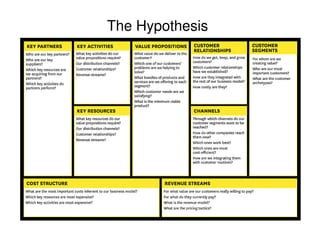
The Hypothesis
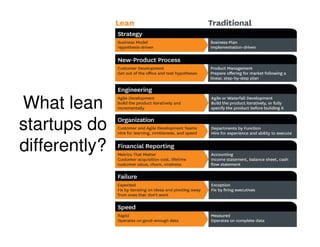
What lean 
startups do 
differently?
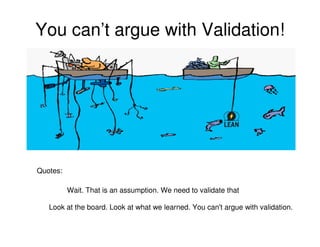
You can’t argue with Validation! 
Quotes: 
Wait. That is an assumption. We need to validate that 
Look at the board. Look at what we learned. You can't argue with validation.
Define it! 
1. Validated learning as a measure of 
progress, because it favors experimentation 
over elaborate planning, customer feedback 
over intuition, and iterative design over 
traditional “big design up front” 
development. 
2. Although the methodology is just a few 
years old, its concepts—such as “minimum 
viable product” and “pivoting”—have quickly 
taken root in the start-up world, and 
business schools have already begun 
adapting their curricula to teach them.
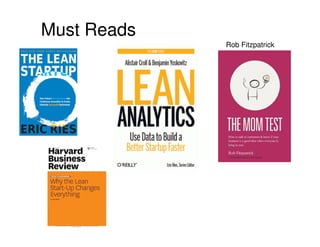
Must Reads 
Rob Fitzpatrick
Bare Essentials - A practical guide to building a lean Startup - Karthik Ramanujam is currently Digital Sales & MD, CricHQ

Bare Essentials - A practical guide to building a lean Startup - Karthik Ramanujam is currently Digital Sales & MD, CricHQ

  • 1.
    The Bare EssentialsOf “A LEAN STARTUP” Karthik Ramanujam
  • 2.
    These are mypersonal opinions on the subject and in no way represent that of any of my past/current/future employer
  • 3.
    Origin The LeanMethodology teaches you how to drive a company - how to steer, when to turn, and when to persevere - and grow a business with maximum acceleration. It is a principled approach to new product development. It is based on the principles of lean production, a manufacturing methodology that values a business' ability to change quickly
  • 4.
    So why dostartups fail? 1. Building a wrong product 2. Run out of Cash? 3. Not being able to build the right team 4. Lack of unique value propositions – Get Out Competed! 5. Pricing/ Costing issues - “Go to Market Strategy”
  • 5.
    Why do startupsfail? 6. Poor Product 7. No Business Plan 8. Poor Marketing 9. Ignoring Customers 10. A Completely mis-timed product
  • 6.
    ..and a wholelotta other reasons 11. Lack of persistence 12. Disharmony on the team/investors 13. Failing to pivot/change direction 14. No mentors or advisers 15. CEO / Founder(s) unable to make decisions
  • 7.
    Hang on. That'snot all! 16. Out of control growth 17. Poor accounting controls 18. Not enough cash cushion 19. Operational ineptitude 20. Obscure or marginal niche
  • 9.
    Now try this Validated learning as a measure of progress
  • 10.
  • 11.
    What lean startupsdo differently?
  • 12.
    You can’t arguewith Validation! Quotes: Wait. That is an assumption. We need to validate that Look at the board. Look at what we learned. You can't argue with validation.
  • 13.
    Define it! 1.Validated learning as a measure of progress, because it favors experimentation over elaborate planning, customer feedback over intuition, and iterative design over traditional “big design up front” development. 2. Although the methodology is just a few years old, its concepts—such as “minimum viable product” and “pivoting”—have quickly taken root in the start-up world, and business schools have already begun adapting their curricula to teach them.
  • 14.
    Must Reads RobFitzpatrick