Assistive Technologies
Presentation
Kyla Neely
ED505
Summer OL 2015
Assistive Technology
O What is Assistive Technology (AT)?
O Any device or method available for students with
physical or mental disabilities that allow them equal
access and opportunities to succeed inside and
outside the classroom.
O Devices
O Any technology ranging from highlighters and sticky
notes to hearing aids and technology software to
wheelchairs and text scanners.
O Services
O Any training offered to students, parents, teachers on
how to use the AT or support for the AT.
AT and the Law
O Individuals with Disabilities Education Improvement
Act 2004 – IDEA 2004
O “Any item, piece of equipment, or product systems,
that is used to increase, maintain or improve the
functional capabilities of a child”
O Teachers and schools have the responsibility to
evaluate students with any physical and mental
disability to see if the use of an AT would improve
their understanding of curriculum objectives and
socializing within and outside the school setting.
O Evaluate, Monitor, Observe, Collect Data and
Reevaluate.
AT and the Law
O Free Appropriate Public Education – IDEA 2004
O A portion of IDEA 2004 that says a student with
disabilities should receive the same learning
opportunities and necessary services as a student
without disabilities without any cost to the family.
O School personnel should make every effort to
accommodate a child with disabilities by providing
appropriate AT devices and services if deemed
beneficial for the child, while at the same time not
inconveniencing the family with cost of the device or
services.
Hearing Impaired AT: FM
Systems
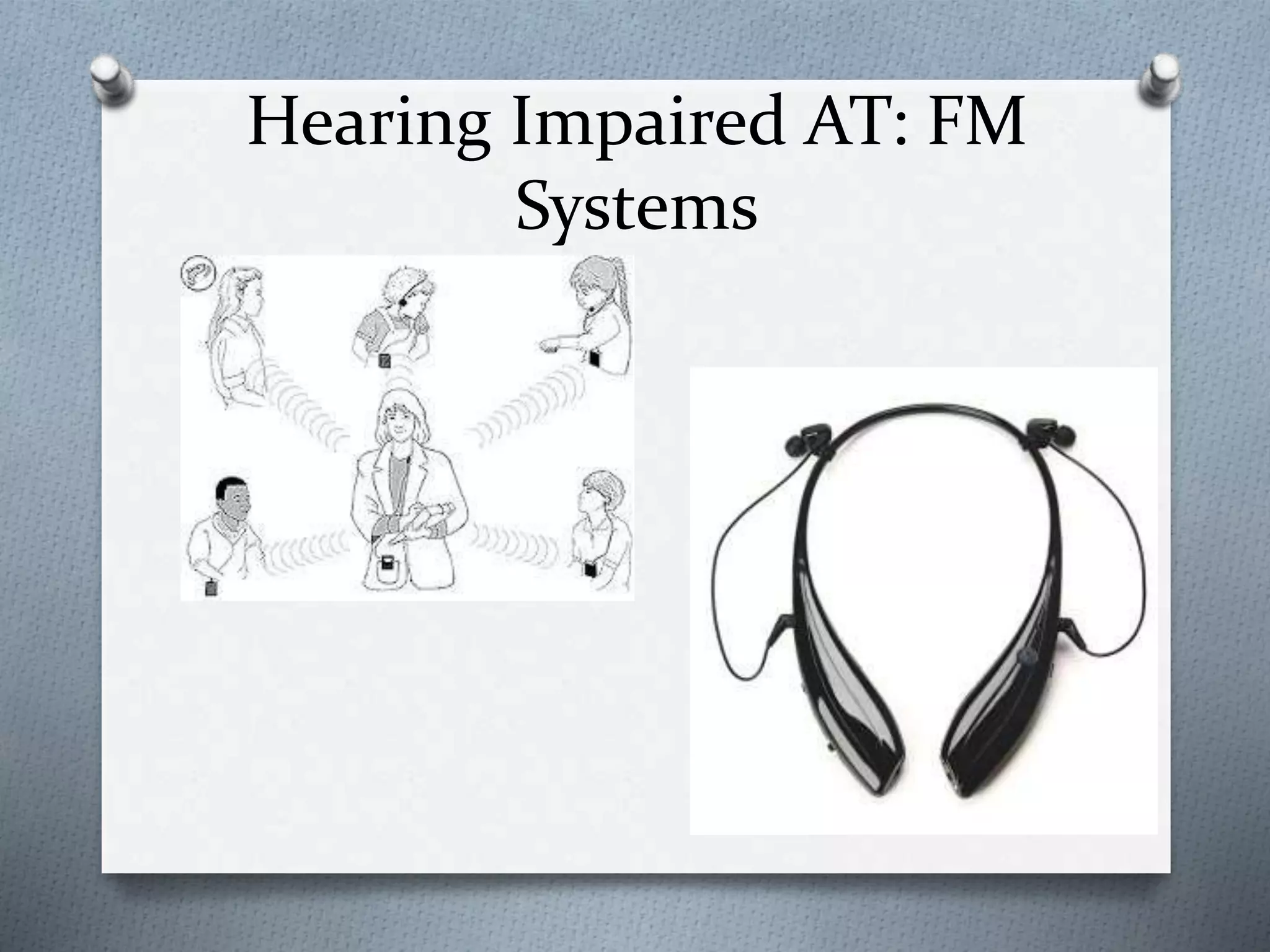
O What is it?
O A sound amplifier for personal/private conversations
or used in public settings/lectures without class
interference.
O How does it work?
O Student has a personal amplifier and head set kept
with them that they can adjust the volume for comfort
level.
O Teachers, peers or anyone wanting to communicate
has a microphone that connects to the students
amplifier. This allows the student to hear what needs
to be understood while drowning out background or
distractive sounds.
Hearing Impaired AT: FM
Systems
O How does this help?
O Students with hearing impairments are able to focus
and hear what the teacher or classmates are saying
without the “noise” to distract them.
O Students are able to listen and hear only to the
person who is speaking into the microphone that is
connected to the students amplifier.
O With this technology, students are able to participate
in class discussions, ask questions based on content
and complete daily class work more independently
and improve scores through understanding of the
teachers comments.
Hearing Impaired AT: FM
Systems
Visual Impaired AT: Text-to-
Speech Systems
O What is it?
O A 2 part system that consist of a scanner to read the
text and a computer and computer system that reads
the text to the student.
O How does it work?
O Students, teachers or aides scan the text or
document using the text scanner or text synthesizers
using a preprogramed key combination.
O The computer software program then reads the
information using correct pronunciation as much as
possible.
Visually Impaired AT: Text-to-
Speech Systems
O How does this help?
O Visually impaired students able to function more
independently in the classroom.
O Students can stay at the same level or point in
textbooks as other students in the classroom.
O Students can take test and work on projects in the
regular classroom setting.
O Possible Drawbacks…
O Students would need headphones as not to distract
others.
O Students may need a larger work area.
Visually Impaired AT: Text-to-
Speech Systems
Learning Disabled AT:
Electronic Math Worksheets
O What are they?
O Software programs that help students with identified
math learning disabilities to gain understanding of
math concepts they struggle with on pencil and paper.
O How do they work?
O Mathtalk.com products allow students to voice their
own homework problems and then allows them to talk
through the process of solving the problems.
O Mathtalk.com products also provide problems in all
areas and level of grade school math for practice in
concepts.
Learning Disabled AT:
Electronic Math Worksheets
O How do they help?
O Students with learning disabilities in math concepts
may find electronic and specifically voice reading
software useful in allowing them to talk through the
math process or concept instead of writing.
Physically Disabled AT:
Oversized Trackball Mouse
O What is it?
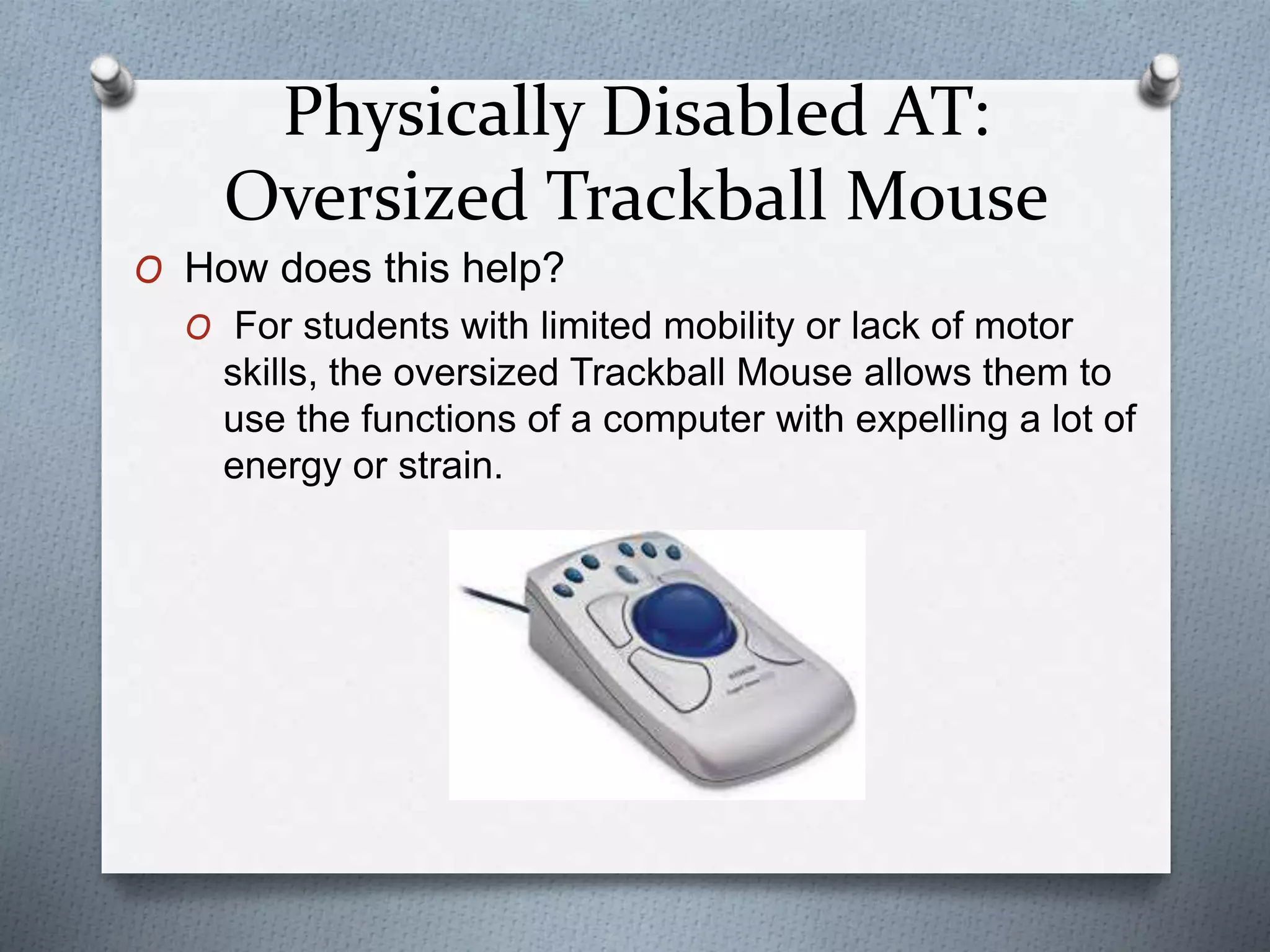
O This technology is a mouse that has the trackball on
the top of the mouse. The track ball is also typically
larger and easier and fits the whole palm of the user.
O How does it work?
O Most of the Oversized Trackball Mouses work the
same and have the same functions as a typical
computer mouse.
O Special modifications can be made for specific users
and needs.
Physically Disabled AT:
Oversized Trackball Mouse
O How does this help?
O For students with limited mobility or lack of motor
skills, the oversized Trackball Mouse allows them to
use the functions of a computer with expelling a lot of
energy or strain.
References
O American Speech-Language-Hearing Association | ASHA. (n.d.).
Retrieved June 10, 2015, from http://www.asha.org/
O Assistive technologies for people with physical impairments. (n.d.).
Retrieved June 10, 2015, from http://www.gmc-
uk.org/accessibility/assistive_technologies/physical_impairments.asp
O Assistive Technology: Tools That Help With Learning. (2014). Retrieved
June 10, 2015, from http://www.understood.org/en/school-
learning/assistive-technology/assistive-technologies-basics/assistive-
technology-tools-that-help-with-learning
O Center for History and New Media. (n.d.). Zotero Quick Start Guide.
Retrieved from http://zotero.org/support/quick_start_guide
O Experiments with Classroom FM Amplification : Ear and Hearing. (n.d.).
Retrieved June 10, 2015, from http://journals.lww.com/ear-
hearing/Fulltext/1998/06000/Experiments_with_Classroom_FM_Amplificat
ion.4.aspx
O Frequency Modulation (FM) Systems for Children with Normal Hearing
Brian M. Kreisman Carl C. Crandell. (n.d.). Retrieved June 10, 2015, from
http://www.audiologyonline.com/articles/frequency-modulation-fm-
systems-for-1166
O IRIS | Assistive Technology: An Overview. (n.d.). Retrieved June 10, 2015,
from http://iris.peabody.vanderbilt.edu/module/at/
References
O Northern, J. (2014). Hands & Voices :: Communication Considerations.
Retrieved June 10, 2015, from
http://handsandvoices.org/comcon/articles/FMamplification.htm
O Personal Hearing Amplifiers - Shop Hearing Assistance Devices for
Hearing Impaired - Products for Hearing Loss at Harris Communications
with Free Shipping and Returns. (2015). Retrieved June 10, 2015, from
https://www.harriscomm.com/equipment/personal-listening.html
O Roblyer, M. D. (2013). Integrating Technology into EducationRo (6th
Edition). Pearson Education, Inc.
O Speech Systems - American Foundation for the Blind. (2015). Retrieved
June 10, 2015, from http://www.afb.org/info/living-with-vision-loss/using-
technology/assistive-technology/speech-systems/1235
O Staff, G. (n.d.). Assistive technology for kids with LD: An overview.
Retrieved June 10, 2015, from
http://www.greatschools.org/gk/articles/assistive-technology-for-kids-with-
learning-disabilities-an-overview/
O Stanberry, K. (n.d.). Electronic math worksheets. Retrieved June 10,
2015, from http://www.greatschools.org/gk/articles/electronic-math-
worksheets/

Ed505 Assistive Technology

  • 1.
  • 2.
    Assistive Technology O Whatis Assistive Technology (AT)? O Any device or method available for students with physical or mental disabilities that allow them equal access and opportunities to succeed inside and outside the classroom. O Devices O Any technology ranging from highlighters and sticky notes to hearing aids and technology software to wheelchairs and text scanners. O Services O Any training offered to students, parents, teachers on how to use the AT or support for the AT.
  • 3.
    AT and theLaw O Individuals with Disabilities Education Improvement Act 2004 – IDEA 2004 O “Any item, piece of equipment, or product systems, that is used to increase, maintain or improve the functional capabilities of a child” O Teachers and schools have the responsibility to evaluate students with any physical and mental disability to see if the use of an AT would improve their understanding of curriculum objectives and socializing within and outside the school setting. O Evaluate, Monitor, Observe, Collect Data and Reevaluate.
  • 4.
    AT and theLaw O Free Appropriate Public Education – IDEA 2004 O A portion of IDEA 2004 that says a student with disabilities should receive the same learning opportunities and necessary services as a student without disabilities without any cost to the family. O School personnel should make every effort to accommodate a child with disabilities by providing appropriate AT devices and services if deemed beneficial for the child, while at the same time not inconveniencing the family with cost of the device or services.
  • 5.
    Hearing Impaired AT:FM Systems O What is it? O A sound amplifier for personal/private conversations or used in public settings/lectures without class interference. O How does it work? O Student has a personal amplifier and head set kept with them that they can adjust the volume for comfort level. O Teachers, peers or anyone wanting to communicate has a microphone that connects to the students amplifier. This allows the student to hear what needs to be understood while drowning out background or distractive sounds.
  • 6.
    Hearing Impaired AT:FM Systems O How does this help? O Students with hearing impairments are able to focus and hear what the teacher or classmates are saying without the “noise” to distract them. O Students are able to listen and hear only to the person who is speaking into the microphone that is connected to the students amplifier. O With this technology, students are able to participate in class discussions, ask questions based on content and complete daily class work more independently and improve scores through understanding of the teachers comments.
  • 7.
  • 8.
    Visual Impaired AT:Text-to- Speech Systems O What is it? O A 2 part system that consist of a scanner to read the text and a computer and computer system that reads the text to the student. O How does it work? O Students, teachers or aides scan the text or document using the text scanner or text synthesizers using a preprogramed key combination. O The computer software program then reads the information using correct pronunciation as much as possible.
  • 9.
    Visually Impaired AT:Text-to- Speech Systems O How does this help? O Visually impaired students able to function more independently in the classroom. O Students can stay at the same level or point in textbooks as other students in the classroom. O Students can take test and work on projects in the regular classroom setting. O Possible Drawbacks… O Students would need headphones as not to distract others. O Students may need a larger work area.
  • 10.
    Visually Impaired AT:Text-to- Speech Systems
  • 11.
    Learning Disabled AT: ElectronicMath Worksheets O What are they? O Software programs that help students with identified math learning disabilities to gain understanding of math concepts they struggle with on pencil and paper. O How do they work? O Mathtalk.com products allow students to voice their own homework problems and then allows them to talk through the process of solving the problems. O Mathtalk.com products also provide problems in all areas and level of grade school math for practice in concepts.
  • 12.
    Learning Disabled AT: ElectronicMath Worksheets O How do they help? O Students with learning disabilities in math concepts may find electronic and specifically voice reading software useful in allowing them to talk through the math process or concept instead of writing.
  • 13.
    Physically Disabled AT: OversizedTrackball Mouse O What is it? O This technology is a mouse that has the trackball on the top of the mouse. The track ball is also typically larger and easier and fits the whole palm of the user. O How does it work? O Most of the Oversized Trackball Mouses work the same and have the same functions as a typical computer mouse. O Special modifications can be made for specific users and needs.
  • 14.
    Physically Disabled AT: OversizedTrackball Mouse O How does this help? O For students with limited mobility or lack of motor skills, the oversized Trackball Mouse allows them to use the functions of a computer with expelling a lot of energy or strain.
  • 15.
    References O American Speech-Language-HearingAssociation | ASHA. (n.d.). Retrieved June 10, 2015, from http://www.asha.org/ O Assistive technologies for people with physical impairments. (n.d.). Retrieved June 10, 2015, from http://www.gmc- uk.org/accessibility/assistive_technologies/physical_impairments.asp O Assistive Technology: Tools That Help With Learning. (2014). Retrieved June 10, 2015, from http://www.understood.org/en/school- learning/assistive-technology/assistive-technologies-basics/assistive- technology-tools-that-help-with-learning O Center for History and New Media. (n.d.). Zotero Quick Start Guide. Retrieved from http://zotero.org/support/quick_start_guide O Experiments with Classroom FM Amplification : Ear and Hearing. (n.d.). Retrieved June 10, 2015, from http://journals.lww.com/ear- hearing/Fulltext/1998/06000/Experiments_with_Classroom_FM_Amplificat ion.4.aspx O Frequency Modulation (FM) Systems for Children with Normal Hearing Brian M. Kreisman Carl C. Crandell. (n.d.). Retrieved June 10, 2015, from http://www.audiologyonline.com/articles/frequency-modulation-fm- systems-for-1166 O IRIS | Assistive Technology: An Overview. (n.d.). Retrieved June 10, 2015, from http://iris.peabody.vanderbilt.edu/module/at/
  • 16.
    References O Northern, J.(2014). Hands & Voices :: Communication Considerations. Retrieved June 10, 2015, from http://handsandvoices.org/comcon/articles/FMamplification.htm O Personal Hearing Amplifiers - Shop Hearing Assistance Devices for Hearing Impaired - Products for Hearing Loss at Harris Communications with Free Shipping and Returns. (2015). Retrieved June 10, 2015, from https://www.harriscomm.com/equipment/personal-listening.html O Roblyer, M. D. (2013). Integrating Technology into EducationRo (6th Edition). Pearson Education, Inc. O Speech Systems - American Foundation for the Blind. (2015). Retrieved June 10, 2015, from http://www.afb.org/info/living-with-vision-loss/using- technology/assistive-technology/speech-systems/1235 O Staff, G. (n.d.). Assistive technology for kids with LD: An overview. Retrieved June 10, 2015, from http://www.greatschools.org/gk/articles/assistive-technology-for-kids-with- learning-disabilities-an-overview/ O Stanberry, K. (n.d.). Electronic math worksheets. Retrieved June 10, 2015, from http://www.greatschools.org/gk/articles/electronic-math- worksheets/

Editor's Notes

  • #3 Adapted from the book “Integrating Technology into Education” page 18. http://www.understood.org/en/school-learning/assistive-technology/assistive-technologies-basics/assistive-technology-tools-that-help-with-learning
  • #4 Information adapted from the IRIS Assistive Technology Module on Vanderbilt University’s Website. Federal law, IDEA 2004, requires that schools and teachers consider and research possible AT devices and services for students with physical and mental disabilities. AT devices and services should be consider if they will help improve the child’s capabilities in functioning in the school setting which includes better understanding and improvement with classroom curriculum and social interactions, depending on the disability of the students. School personal have the responsibility to communicate with parents and help decide which AT device(s) and services that would best suit each student and their disabilities. School personal and parents should monitor and observe the students engagement and and ability to reach learning goals with the chosen AT device(s) and services and to reevaluate as needed to make sure the student is being given every opportunity to learn.
  • #5 Information adapted from IRIS Assistive Technology Module on Vanderbilt University’s Website.
  • #6 www.asha.org http://handsandvoices.org/comcon/articles/FMamplification.htm
  • #7 www.harriscomm.com http://journals.lww.com/ear-hearing/Abstract/1998/06000/Experiments_with_Classroom_FM_Amplification.4.aspx http://www.audiologyonline.com/articles/frequency-modulation-fm-systems-for-1166
  • #8 https://www.enablemart.com/hearing/assistive-listening/personal-listening-devices/serene-innovations-dt-100-directalk-hands-free-personal-listener
  • #9 http://www.afb.org/info/living-with-vision-loss/using-technology/assistive-technology/speech-systems/1235
  • #12 http://www.greatschools.org/gk/articles/assistive-technology-for-kids-with-learning-disabilities-an-overview/ http://www.greatschools.org/gk/articles/electronic-math-worksheets/ http://www.mathtalk.com/index.htm
  • #14 http://www.gmc-uk.org/accessibility/assistive_technologies/physical_impairments.asp