Assistive Technologies in the
         Classroom
        By Megan Troutt
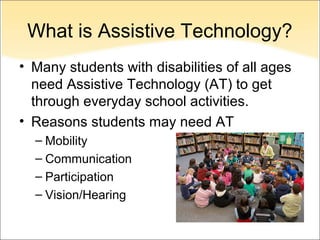
What is Assistive Technology?
• Many students with disabilities of all ages
  need Assistive Technology (AT) to get
  through everyday school activities.
• Reasons students may need AT
  – Mobility
  – Communication
  – Participation
  – Vision/Hearing
What to do in the Beginning (for
               teachers)
1.   Find out detailed information about the child and the
     family.
2.   Identify participation activities and what is holding them
     back from participating more
3.   How will you notice the changes as the occur?
     Brainstorm if an intervention would affect participation
     more.
Steps – cont’d

4. Think of Assistive Technology solutions for the students
   in need
5. Try out the Assistive Technology on the students
6. Identify what worked and what needs to be fixed for next
   time

These steps should be followed by all education
  professionals in order to determine what to do regarding
  AT for special needs children
The steps can be viewed more in depth at LDOnline
Assistive Technology in the
                  Classroom
•   IDEA defines AT as "any item, piece of equipment, or product
    system, whether acquired commercially off the shelf, modified, or
    customized, that is used to increase, maintain, or improve the
    functional capabilities of a child with a disability"
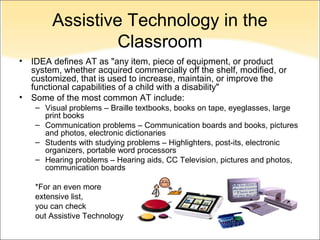
•   Some of the most common AT include:
     – Visual problems – Braille textbooks, books on tape, eyeglasses, large
       print books
     – Communication problems – Communication boards and books, pictures
       and photos, electronic dictionaries
     – Students with studying problems – Highlighters, post-its, electronic
       organizers, portable word processors
     – Hearing problems – Hearing aids, CC Television, pictures and photos,
       communication boards

     *For an even more
     extensive list,
     you can check
     out Assistive Technology
More In-Depth with Books on Tape
• Books on tape are great AT’s for students with
  many different disabilities. Students with visual
  impairments benefit the most from these books,
  but students with ADHD or learning disabilities
  can also excel by using an audio book.
• These books can help students focus more,
  especially if they have a hard time reading
  certain words or distracted by other noises.
• Books on tape are available everywhere now-a-
  days and they are usually accessible on learning
  tablets that many students utilize daily
The Truth of Assistive Technology
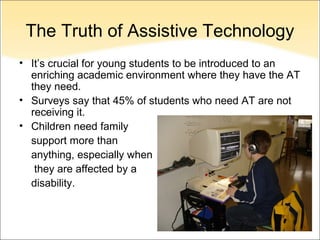
• It’s crucial for young students to be introduced to an
  enriching academic environment where they have the AT
  they need.
• Surveys say that 45% of students who need AT are not
  receiving it.
• Children need family
  support more than
  anything, especially when
   they are affected by a
  disability.
Individual Educational Plan (IEP)
• The IEP’s created by the educational
  professionals and the parents will
  determine what AT’s are necessary.
• IEP’s can be adjusted and changed when
  necessary if certain AT’s are not working.
• IEP’s need to be reevaluated after a year
  to see if progress was made. Students
  with special needs need IEP’s in order to
  succeed in the classroom.
Encouragement to Give to Parents
• Teachers should always communicate with the
  parents
• Make sure to always ask them questions
  because they will know more about the child’s
  behavior outside of school
• Tell the parents about organizations and groups
  that they can get involved in to learn more about
  having a child with special needs and dealing
  with assistive technologies
Resources
The Division for Early Childhood. http://www.dec-sped.org/

Friend, Marilyn. Including Students with Special Needs. 5th Edition. Pearson
    Education. 2009

Minnesota Department of Children, Families, and Learning. (2001). Assistive technology
   checklist process. Retrieved November 20, 2002, from
   http://www.integratingstandards.org/index.html


National Center for Technology Innovation and Center for Implementing Technology in
    Education (CITEd) (2006) by LDOnline http://www.ldonline.org/article/8088

North Central Regional Educational Laboratory
   http://www.ncrel.org/sdrs/areas/issues/methods/technlgy/te7assist.htm


Reed, P. R. (2001). A resource guide for teachers and administrators about assistive
   technology. Oshkosh, WI: Wisconsin Assistive Technology Initiative

Assistive Technology and Special Education

  • 1.
    Assistive Technologies inthe Classroom By Megan Troutt
  • 2.
    What is AssistiveTechnology? • Many students with disabilities of all ages need Assistive Technology (AT) to get through everyday school activities. • Reasons students may need AT – Mobility – Communication – Participation – Vision/Hearing
  • 3.
    What to doin the Beginning (for teachers) 1. Find out detailed information about the child and the family. 2. Identify participation activities and what is holding them back from participating more 3. How will you notice the changes as the occur? Brainstorm if an intervention would affect participation more.
  • 4.
    Steps – cont’d 4.Think of Assistive Technology solutions for the students in need 5. Try out the Assistive Technology on the students 6. Identify what worked and what needs to be fixed for next time These steps should be followed by all education professionals in order to determine what to do regarding AT for special needs children The steps can be viewed more in depth at LDOnline
  • 5.
    Assistive Technology inthe Classroom • IDEA defines AT as "any item, piece of equipment, or product system, whether acquired commercially off the shelf, modified, or customized, that is used to increase, maintain, or improve the functional capabilities of a child with a disability" • Some of the most common AT include: – Visual problems – Braille textbooks, books on tape, eyeglasses, large print books – Communication problems – Communication boards and books, pictures and photos, electronic dictionaries – Students with studying problems – Highlighters, post-its, electronic organizers, portable word processors – Hearing problems – Hearing aids, CC Television, pictures and photos, communication boards *For an even more extensive list, you can check out Assistive Technology
  • 6.
    More In-Depth withBooks on Tape • Books on tape are great AT’s for students with many different disabilities. Students with visual impairments benefit the most from these books, but students with ADHD or learning disabilities can also excel by using an audio book. • These books can help students focus more, especially if they have a hard time reading certain words or distracted by other noises. • Books on tape are available everywhere now-a- days and they are usually accessible on learning tablets that many students utilize daily
  • 7.
    The Truth ofAssistive Technology • It’s crucial for young students to be introduced to an enriching academic environment where they have the AT they need. • Surveys say that 45% of students who need AT are not receiving it. • Children need family support more than anything, especially when they are affected by a disability.
  • 8.
    Individual Educational Plan(IEP) • The IEP’s created by the educational professionals and the parents will determine what AT’s are necessary. • IEP’s can be adjusted and changed when necessary if certain AT’s are not working. • IEP’s need to be reevaluated after a year to see if progress was made. Students with special needs need IEP’s in order to succeed in the classroom.
  • 9.
    Encouragement to Giveto Parents • Teachers should always communicate with the parents • Make sure to always ask them questions because they will know more about the child’s behavior outside of school • Tell the parents about organizations and groups that they can get involved in to learn more about having a child with special needs and dealing with assistive technologies
  • 10.
    Resources The Division forEarly Childhood. http://www.dec-sped.org/ Friend, Marilyn. Including Students with Special Needs. 5th Edition. Pearson Education. 2009 Minnesota Department of Children, Families, and Learning. (2001). Assistive technology checklist process. Retrieved November 20, 2002, from http://www.integratingstandards.org/index.html National Center for Technology Innovation and Center for Implementing Technology in Education (CITEd) (2006) by LDOnline http://www.ldonline.org/article/8088 North Central Regional Educational Laboratory http://www.ncrel.org/sdrs/areas/issues/methods/technlgy/te7assist.htm Reed, P. R. (2001). A resource guide for teachers and administrators about assistive technology. Oshkosh, WI: Wisconsin Assistive Technology Initiative