Article Critiques
and Evaluations
Liz Johns emjohns@jhu.edu
Carrie Price cprice17@jhmi.edu
Carrie Price
cprice17@jhmi.edu
Liz Johns
emjohns@jhu.edu
POLL
Where are you located?
TONIGHT’S GOAL
Take a strategic approach to tackling an
article critique and better understand
the qualities of a strong evaluation.
Article Critique Break Down
Examples
Practice
Resources
WHAT ARE WE NOT
DOING TONIGHT?
Mechanics
Formatting
Writing style
Instructor-specific guidelines
DISCLAIMER
This session has been prepared using
the assignment guidelines, provided to
us by the MEHP courses. If your
instructor has additional or different
guidelines, always defer to the rules of
the person grading you.
STEPS TO CREATING AN ANNOTATED
BIBLIOGRAPHY
Find Your
Sources
Read
your
Sources
Prepare
your
notes
Cite your
sources
Write
Critique
Review
Critique
STEP 1: FIND YOUR SOURCES
CHAT
Where do you typically go first when
searching for peer-reviewed literature?
WHERE?
• Research Guide for Education:
guides.library.jhu.edu/education
• Best Best: ERIC, Scopus, Education
Journals
• Databases used for other assignments
STEP 2: READ YOUR SOURCES
Take notes as you are reading.
STEP 3: PREPARE YOUR NOTES
STUDY SUMMARIES
guides.library.jhu.edu/lit-review/summarize
Author/ti
tle
Purpose Framework
Sample/Po
pulation
Design/Met
hodology
Variables/
instrum-
ents
Results/Findi
ngs
Controver-
sies,
disagree-
ments with
other
authors
Limita-
tions
Implications
for practice,
research,
theory
Slytherin, S.
(2000)
Explore
potions
aptitude of
firth years
Theoretical
Fifth year
Hogwarts
students
(pure-bloods)
Naturalistic O.W.L.s
Slytherin and
Ravenclaw
students are
more apt at
potions by the
fifth year, other
houses even out
in sixth.
Findings are
different from
Gryffindor
(1998)
Author
left out
Muggles
from
populatio
n
New practices
and efforts
should be made
with Hufflepuff
and Gryffindor
houses earlier
to help them
keep up.
Gryffindor,
G. &
Ravenclaw,
R. (2009)
Examine
course
scheduling and
blocks
Conceptual
Fourth-
seventh year
Hogwarts
students
Emergent
Sleep
patterns,
alertness in
class,
observing
student
behavior
Older students
tend to stay up
later doing
homework, and
typically don’t
even begin their
work until 10pm
None so far.
Although
all
teenagers,
fourth
years are
very
different
from
seventh
years.
Older students
should have
courses on a
shifted (later)
schedule.
STEP 4: CITE YOUR SOURCES
Other APA Resources
APA Style Guide
apastyle.org
APA Blog
blog.apastyle.org/apastyle
Refworks
guides.library.jhu.edu/refworks
Purdue Owl
(Google it)
STEP 5: WRITE YOUR
CRITIQUE
Purpose:
• help you test your own ability to grasp new
concepts.
• Develop your own voice a scholar in the field.
• Flex your critical thinking skills by analyzing and
evaluating the work of others.
CHAT
What do you think are the major
components of a critique or
evaluation?
RECOMMENDED STRUCTURE A
1. Background and motivation: why does
this issue matter?
2. Research question presented
3. Data
4. Methods
5. Key findings
6. Limitations
7. Conclusions and topics/questions for
discussion
KEY ELEMENTS
1. Summary/Description
2. Evaluation and
Commentary/Reflection
RECOMMENDED STRUCTURE B
1. Summarize/Describe
1. Goal/aims of article, importance of
the issue.
2. Research questions and key findings
2. Critique
1. Presentation of article
2. Evidence, methods, stats
3. Conclusion
SUMMARY: PARAPHRASE
Use your own words, do not
copy the abstract.
Paraphrasing advice: owl.english.purdue.edu/owl/resource/563/02/
USE OF THE FIRST PERSON
• Allowed by APA
• Encouraged to avoid awkwardness
• Use sparingly
See APA Manual pp. 69-70
cc: Valerie Everett - https://www.flickr.com/photos/66742614@N00
QUESTIONS?
Example A
Rubin, A. (2012). Technology Meets Medical Education: Envisioning a Practical
Future Forum on the Future of Technology in Education. Journal of
Medical Education 3, 301-322.
This article looks at online learning from the perspective of graduate
level medical education instead of looking at medical education from the
perspective of online learning. Several categories of technology use are
discussed, noting the present situation and future possibilities. Most
prominently discussed is the idea of using interactive medical diagrams
using new programs and technology.
Five other powerful uses of technology in medical education are
listed, and factors that are necessary to fulfill the potential of technology
are considered. Some concerns about the integration of online learning
into medical education are also included as well as a brief closing
restatement of the dilemma. The study examines pilot programs across
five different medical schools in the U.S. and Canada.
Example A
Rubin, A. (2012). Technology Meets Medical Education: Envisioning a Practical
Future Forum on the Future of Technology in Education. Journal of
Medical Education 3, 301-322.
This article looks at online learning from the perspective of graduate
level medical education instead of looking at medical education from the
perspective of online learning. Several categories of technology use are
discussed, noting the present situation and future possibilities. Most
prominently discussed is the idea of using interactive medical diagrams
using new programs and technology.
Five other powerful uses of technology in medical education are
listed, and factors that are necessary to fulfill the potential of technology
are considered. Some concerns about the integration of online learning
into medical education are also included as well as a brief closing
restatement of the dilemma. The study examines pilot programs across
five different medical schools in the U.S. and Canada.
Example B
Cusatis, C., & Martin-Kratzer, R. (2010). Assessing the state of medical
education in AAMC-accredited and non-accredited medical programs.
Medical Educators, 64, 356-372.
Through surveys, the authors assessed medical education in the United States,
from both AAMC-accredited and non-accredited programs. Results indicated that
few programs offered a grant-writing course specifically for the novice researcher.
Instead, most relied on general education requirements and segments of core
medical writing courses to provide students with grant writing and research skills.
The average medical student's grant-writing skills were rated as "poor" or "fair" by
70.2% of school deans.
A lack of room in the curriculum was the most commonly cited constraint to the
implementation of grant-writing courses, although others, such as conflicts with the
scheduling and logistics, and the limiting effect of accreditation standards on the
curriculum, were also documented. The article is interesting and accessible, but it
relies almost entirely on self-reporting in the surveys, it is subject to bias and
dishonesty in the responses. This is useful in seeing an example of survey
methodology to guide my own project.
Example B
Cusatis, C., & Martin-Kratzer, R. (2010). Assessing the state of medical
education in AAMC-accredited and non-accredited medical programs.
Medical Educators, 64, 356-372.
Through surveys, the authors assessed medical education in the United States,
from both AAMC-accredited and non-accredited programs. Results indicated that
few programs offered a grant-writing course specifically for the novice researcher.
Instead, most relied on general education requirements and segments of core
medical writing courses to provide students with grant writing and research skills.
The average medical student's grant-writing skills were rated as "poor" or "fair" by
70.2% of school deans.
A lack of room in the curriculum was the most commonly cited constraint to the
implementation of grant-writing courses, although others, such as conflicts with the
scheduling and logistics, and the limiting effect of accreditation standards on the
curriculum, were also documented. The article is interesting and accessible, but it
relies almost entirely on self-reporting in the surveys, it is subject to bias and
dishonesty in the responses. This is useful in seeing an example of survey
methodology to guide my own project.
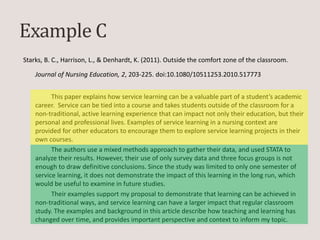
Example C
Starks, B. C., Harrison, L., & Denhardt, K. (2011). Outside the comfort zone of the classroom.
Journal of Nursing Education, 2, 203-225. doi:10.1080/10511253.2010.517773
This paper explains how service learning can be a valuable part of a student’s academic
career. Service can be tied into a course and takes students outside of the classroom for a
non-traditional, active learning experience that can impact not only their education, but their
personal and professional lives. Examples of service learning in a nursing context are
provided for other educators to encourage them to explore service learning projects in their
own courses.
The authors use a mixed methods approach to gather their data, and used STATA to
analyze their results. However, their use of only survey data and three focus groups is not
enough to draw definitive conclusions. Since the study was limited to only one semester of
service learning, it does not demonstrate the impact of this learning in the long run, which
would be useful to examine in future studies.
Their examples support my proposal to demonstrate that learning can be achieved in
non-traditional ways, and service learning can have a larger impact that regular classroom
study. The examples and background in this article describe how teaching and learning has
changed over time, and provides important perspective and context to inform my topic.
Example C
Starks, B. C., Harrison, L., & Denhardt, K. (2011). Outside the comfort zone of the classroom.
Journal of Nursing Education, 2, 203-225. doi:10.1080/10511253.2010.517773
This paper explains how service learning can be a valuable part of a student’s academic
career. Service can be tied into a course and takes students outside of the classroom for a
non-traditional, active learning experience that can impact not only their education, but their
personal and professional lives. Examples of service learning in a nursing context are
provided for other educators to encourage them to explore service learning projects in their
own courses.
The authors use a mixed methods approach to gather their data, and used STATA to
analyze their results. However, their use of only survey data and three focus groups is not
enough to draw definitive conclusions. Since the study was limited to only one semester of
service learning, it does not demonstrate the impact of this learning in the long run, which
would be useful to examine in future studies.
Their examples support my proposal to demonstrate that learning can be achieved in
non-traditional ways, and service learning can have a larger impact that regular classroom
study. The examples and background in this article describe how teaching and learning has
changed over time, and provides important perspective and context to inform my topic.
tinyurl.com/y7s8uu44
PRACTICE
POLL
Do you feel more confident in
preparing your article critique after
participating in this workshop?
cc: Valerie Everett - https://www.flickr.com/photos/66742614@N00
QUESTIONS?
STEPS TO CREATING AN ANNOTATED
BIBLIOGRAPHY
Find Your
Sources
Read
your
Sources
Prepare
your
notes
Cite your
sources
Write
Critique
Review
Critique
STEP 6: REVIEW CRITIQUE
Annotate your critique.
LIBRARY RESOURCES
Guide for Education
guides.library.jhu.edu/education
Library Research Modules in Blackboard
Lit Review Guide
guides.library.jhu.edu/lit-review
CITING
RefWorks Guide
guides.library.jhu.edu/refworks
RefWorks Workshop
Tuesday, Sept. 12, 6:30pm
jhu.libcal.com/event/3527771
EndNote Workshop
Monday, Sept. 18, 11am
jhu.libcal.com/event/3544145
FINAL THOUGHTS
tinyurl.com/zcoad68
Give us your feedback.
cc: Valerie Everett - https://www.flickr.com/photos/66742614@N00
QUESTIONS?
Liz: emjohns@jhu.edu
Carrie: cprice17@jhmi.edu

Article Critiques 1 Fall 2017

  • 1.
    Article Critiques and Evaluations LizJohns emjohns@jhu.edu Carrie Price cprice17@jhmi.edu
  • 2.
  • 3.
  • 4.
    TONIGHT’S GOAL Take astrategic approach to tackling an article critique and better understand the qualities of a strong evaluation.
  • 5.
    Article Critique BreakDown Examples Practice Resources
  • 6.
    WHAT ARE WENOT DOING TONIGHT? Mechanics Formatting Writing style Instructor-specific guidelines
  • 7.
    DISCLAIMER This session hasbeen prepared using the assignment guidelines, provided to us by the MEHP courses. If your instructor has additional or different guidelines, always defer to the rules of the person grading you.
  • 8.
    STEPS TO CREATINGAN ANNOTATED BIBLIOGRAPHY Find Your Sources Read your Sources Prepare your notes Cite your sources Write Critique Review Critique
  • 9.
    STEP 1: FINDYOUR SOURCES
  • 10.
    CHAT Where do youtypically go first when searching for peer-reviewed literature?
  • 11.
    WHERE? • Research Guidefor Education: guides.library.jhu.edu/education • Best Best: ERIC, Scopus, Education Journals • Databases used for other assignments
  • 12.
    STEP 2: READYOUR SOURCES
  • 13.
    STEP 2: READYOUR SOURCES Take notes as you are reading.
  • 14.
    STEP 3: PREPAREYOUR NOTES
  • 15.
    STUDY SUMMARIES guides.library.jhu.edu/lit-review/summarize Author/ti tle Purpose Framework Sample/Po pulation Design/Met hodology Variables/ instrum- ents Results/Findi ngs Controver- sies, disagree- mentswith other authors Limita- tions Implications for practice, research, theory Slytherin, S. (2000) Explore potions aptitude of firth years Theoretical Fifth year Hogwarts students (pure-bloods) Naturalistic O.W.L.s Slytherin and Ravenclaw students are more apt at potions by the fifth year, other houses even out in sixth. Findings are different from Gryffindor (1998) Author left out Muggles from populatio n New practices and efforts should be made with Hufflepuff and Gryffindor houses earlier to help them keep up. Gryffindor, G. & Ravenclaw, R. (2009) Examine course scheduling and blocks Conceptual Fourth- seventh year Hogwarts students Emergent Sleep patterns, alertness in class, observing student behavior Older students tend to stay up later doing homework, and typically don’t even begin their work until 10pm None so far. Although all teenagers, fourth years are very different from seventh years. Older students should have courses on a shifted (later) schedule.
  • 16.
    STEP 4: CITEYOUR SOURCES Other APA Resources APA Style Guide apastyle.org APA Blog blog.apastyle.org/apastyle Refworks guides.library.jhu.edu/refworks Purdue Owl (Google it)
  • 17.
    STEP 5: WRITEYOUR CRITIQUE Purpose: • help you test your own ability to grasp new concepts. • Develop your own voice a scholar in the field. • Flex your critical thinking skills by analyzing and evaluating the work of others.
  • 18.
    CHAT What do youthink are the major components of a critique or evaluation?
  • 19.
    RECOMMENDED STRUCTURE A 1.Background and motivation: why does this issue matter? 2. Research question presented 3. Data 4. Methods 5. Key findings 6. Limitations 7. Conclusions and topics/questions for discussion
  • 20.
    KEY ELEMENTS 1. Summary/Description 2.Evaluation and Commentary/Reflection
  • 21.
    RECOMMENDED STRUCTURE B 1.Summarize/Describe 1. Goal/aims of article, importance of the issue. 2. Research questions and key findings 2. Critique 1. Presentation of article 2. Evidence, methods, stats 3. Conclusion
  • 22.
    SUMMARY: PARAPHRASE Use yourown words, do not copy the abstract. Paraphrasing advice: owl.english.purdue.edu/owl/resource/563/02/
  • 23.
    USE OF THEFIRST PERSON • Allowed by APA • Encouraged to avoid awkwardness • Use sparingly See APA Manual pp. 69-70
  • 24.
    cc: Valerie Everett- https://www.flickr.com/photos/66742614@N00 QUESTIONS?
  • 25.
    Example A Rubin, A.(2012). Technology Meets Medical Education: Envisioning a Practical Future Forum on the Future of Technology in Education. Journal of Medical Education 3, 301-322. This article looks at online learning from the perspective of graduate level medical education instead of looking at medical education from the perspective of online learning. Several categories of technology use are discussed, noting the present situation and future possibilities. Most prominently discussed is the idea of using interactive medical diagrams using new programs and technology. Five other powerful uses of technology in medical education are listed, and factors that are necessary to fulfill the potential of technology are considered. Some concerns about the integration of online learning into medical education are also included as well as a brief closing restatement of the dilemma. The study examines pilot programs across five different medical schools in the U.S. and Canada.
  • 26.
    Example A Rubin, A.(2012). Technology Meets Medical Education: Envisioning a Practical Future Forum on the Future of Technology in Education. Journal of Medical Education 3, 301-322. This article looks at online learning from the perspective of graduate level medical education instead of looking at medical education from the perspective of online learning. Several categories of technology use are discussed, noting the present situation and future possibilities. Most prominently discussed is the idea of using interactive medical diagrams using new programs and technology. Five other powerful uses of technology in medical education are listed, and factors that are necessary to fulfill the potential of technology are considered. Some concerns about the integration of online learning into medical education are also included as well as a brief closing restatement of the dilemma. The study examines pilot programs across five different medical schools in the U.S. and Canada.
  • 27.
    Example B Cusatis, C.,& Martin-Kratzer, R. (2010). Assessing the state of medical education in AAMC-accredited and non-accredited medical programs. Medical Educators, 64, 356-372. Through surveys, the authors assessed medical education in the United States, from both AAMC-accredited and non-accredited programs. Results indicated that few programs offered a grant-writing course specifically for the novice researcher. Instead, most relied on general education requirements and segments of core medical writing courses to provide students with grant writing and research skills. The average medical student's grant-writing skills were rated as "poor" or "fair" by 70.2% of school deans. A lack of room in the curriculum was the most commonly cited constraint to the implementation of grant-writing courses, although others, such as conflicts with the scheduling and logistics, and the limiting effect of accreditation standards on the curriculum, were also documented. The article is interesting and accessible, but it relies almost entirely on self-reporting in the surveys, it is subject to bias and dishonesty in the responses. This is useful in seeing an example of survey methodology to guide my own project.
  • 28.
    Example B Cusatis, C.,& Martin-Kratzer, R. (2010). Assessing the state of medical education in AAMC-accredited and non-accredited medical programs. Medical Educators, 64, 356-372. Through surveys, the authors assessed medical education in the United States, from both AAMC-accredited and non-accredited programs. Results indicated that few programs offered a grant-writing course specifically for the novice researcher. Instead, most relied on general education requirements and segments of core medical writing courses to provide students with grant writing and research skills. The average medical student's grant-writing skills were rated as "poor" or "fair" by 70.2% of school deans. A lack of room in the curriculum was the most commonly cited constraint to the implementation of grant-writing courses, although others, such as conflicts with the scheduling and logistics, and the limiting effect of accreditation standards on the curriculum, were also documented. The article is interesting and accessible, but it relies almost entirely on self-reporting in the surveys, it is subject to bias and dishonesty in the responses. This is useful in seeing an example of survey methodology to guide my own project.
  • 29.
    Example C Starks, B.C., Harrison, L., & Denhardt, K. (2011). Outside the comfort zone of the classroom. Journal of Nursing Education, 2, 203-225. doi:10.1080/10511253.2010.517773 This paper explains how service learning can be a valuable part of a student’s academic career. Service can be tied into a course and takes students outside of the classroom for a non-traditional, active learning experience that can impact not only their education, but their personal and professional lives. Examples of service learning in a nursing context are provided for other educators to encourage them to explore service learning projects in their own courses. The authors use a mixed methods approach to gather their data, and used STATA to analyze their results. However, their use of only survey data and three focus groups is not enough to draw definitive conclusions. Since the study was limited to only one semester of service learning, it does not demonstrate the impact of this learning in the long run, which would be useful to examine in future studies. Their examples support my proposal to demonstrate that learning can be achieved in non-traditional ways, and service learning can have a larger impact that regular classroom study. The examples and background in this article describe how teaching and learning has changed over time, and provides important perspective and context to inform my topic.
  • 30.
    Example C Starks, B.C., Harrison, L., & Denhardt, K. (2011). Outside the comfort zone of the classroom. Journal of Nursing Education, 2, 203-225. doi:10.1080/10511253.2010.517773 This paper explains how service learning can be a valuable part of a student’s academic career. Service can be tied into a course and takes students outside of the classroom for a non-traditional, active learning experience that can impact not only their education, but their personal and professional lives. Examples of service learning in a nursing context are provided for other educators to encourage them to explore service learning projects in their own courses. The authors use a mixed methods approach to gather their data, and used STATA to analyze their results. However, their use of only survey data and three focus groups is not enough to draw definitive conclusions. Since the study was limited to only one semester of service learning, it does not demonstrate the impact of this learning in the long run, which would be useful to examine in future studies. Their examples support my proposal to demonstrate that learning can be achieved in non-traditional ways, and service learning can have a larger impact that regular classroom study. The examples and background in this article describe how teaching and learning has changed over time, and provides important perspective and context to inform my topic.
  • 31.
  • 32.
    POLL Do you feelmore confident in preparing your article critique after participating in this workshop?
  • 33.
    cc: Valerie Everett- https://www.flickr.com/photos/66742614@N00 QUESTIONS?
  • 34.
    STEPS TO CREATINGAN ANNOTATED BIBLIOGRAPHY Find Your Sources Read your Sources Prepare your notes Cite your sources Write Critique Review Critique
  • 35.
    STEP 6: REVIEWCRITIQUE Annotate your critique.
  • 36.
    LIBRARY RESOURCES Guide forEducation guides.library.jhu.edu/education Library Research Modules in Blackboard Lit Review Guide guides.library.jhu.edu/lit-review
  • 37.
    CITING RefWorks Guide guides.library.jhu.edu/refworks RefWorks Workshop Tuesday,Sept. 12, 6:30pm jhu.libcal.com/event/3527771 EndNote Workshop Monday, Sept. 18, 11am jhu.libcal.com/event/3544145
  • 39.
  • 40.
    cc: Valerie Everett- https://www.flickr.com/photos/66742614@N00 QUESTIONS? Liz: emjohns@jhu.edu Carrie: cprice17@jhmi.edu

Editor's Notes

  • #9 Focusing on Step 5 today, writing annotations.
  • #13 More than once.
  • #21 Each part should be both descriptive, and critical.
  • #22 Critique: Two sections of the critique: Presentation of the article (aesthetics and clarity of writing) Use and discussion of evidence (methods and statistics) The effectiveness (or lack of) in general presentation of the topic, questions and results: Is the methodology clear? Any concerns? Is the data adequately described? Results presented in appropriate detail? Use of tables and figures? Methodology/Evidence Do the researchers employ appropriate methods? Anything else you would like to see? Do the researchers offer a proper interpretation of the results? Does the evidence support the conclusions? Transparency of the researchers: do they discussion or acknowledge limitations?   Conclusions: Takeaways from the activity What did you learn from reviewing the article
  • #30 Background and motivation: why does this issue matter? Research question presented Data Methods Key findings Limitations Conclusions and topics/questions for discussion
  • #31 Background and motivation: why does this issue matter? Research question presented Data Methods Key findings Limitations Conclusions and topics/questions for discussion
  • #35 Focusing on Step 5 today, writing annotations.