About ASEAN
The Association of South East Asian Nations,
or ASEAN, was established on 8 August 1967 through
the Bangkok Declaration. The original member
states of ASEAN consist of five countries: Indonesia,
the Philippines, Singapore, Malaysia and Thailand.
The founders of ASEAN - Adam Malik from Indonesia,
Narciso R. Ramos from the Philippines, Tun Abdul
Razak from Malaysia, S. Rajaratnam from Singapore and enhance cooperation between ASEAN and
and Thanat Khoman from Thailand - also represent other international organizations.
the five member states. The ASEAN emblem consists of 10 stalks
Subsequently, ASEAN has welcomed other of padi representing the dream of the 10 ASEAN
The Role of Education in Building an ASEAN Community 2015 I
countries of Southeast Asia. Brunei Darussalam joined founders. The yellow symbolizes prosperity. The red
on 8 January 1984, Vietnam on 28 July 1995, Lao PDR signifies courage and dynamism. The white depicts
and Myanmar on 23 July 1997, and Cambodia on 30 purity. And the blue represents peace and stability.
April 1999.
ASEAN Secretariat
Main Objective of ASEAN The ASEAN Secretariat, located in Jakarta,
The main objective of ASEAN is to accelerate Indonesia, is a coordinating center for all ASEAN
economic, socio - cultural, technological and member states. The office is currently chaired by
administrative cooperation of all member states, ASEAN Secretary - General Dr. Surin Pitsuwan from
promote peace and security in the ASEAN region, Thailand under a five - year term (from 2008 to 2012).
30
32.
ASEAN at Present
All ASEAN leaders have signed the Declaration
of ASEAN Concord II or Bali Concord ll to establish
the ASEAN Community in 2020. The Declaration
thoroughly supports integration and cooperation on
several aspects. In terms of politics, there is a need
to launch the ASEAN Political Security Community
(APSC). To promote economic development, the
ASEAN Economic Community (AEC) was founded.
Regarding socio-cultural issues of ASEAN countries,
the ASEAN Socio-Cultural Community (ASCC) was
established. Soon after signing the Declaration, the
I The Role of Education in Building an ASEAN Community 2015
ASEAN leaders agreed to accelerate the founding of
the ASEAN Community within 5 years before 2020. As
a consequence, the ASEAN Community is expected
to be complete in 2015.
l ASEAN Security Community (ASC) aims to
ensure that all member states in the ASEAN
Community share the same values. It also helps all
its member states deal with security threats more
effectively. In addition, interaction between ASEAN
and other civil societies worldwide will be promoted
and strengthened. member states because it aims to promote ASEAN
l ASEAN Economic Community (AEC) as a single market and mutual manufacturing base,
enables ASEAN to actively compete with other which enhances capacity on economic competition,
regions in terms of economics. It will facilitate fosters equal economic development and facilitates
agreements on economic cooperation between economic integration. 31
ASEAN and other countries including business l ASEAN Socio-Cultural Community (ASCC)
completion, particularly investment, which tends to aims to build stable and caring societies where
be transferred to other countries than ASEAN’s. This is ASEAN people live in good conditions. To attain
a crucial factor that requires cooperation of all ASEAN this goal, quality of life needs to be improved,
sustainable use of natural resources has to be
promoted and ASEAN cultural identity should be
created. The ASEAN Socio - Cultural Community
Plan of Action is formulated to: 1) support the caring
societies, 2) deal with social impact caused by
economic integration, 3) promote sustainable and
proper environmental management and 4) improve
33.
better understanding amonggrass-roots people
The Role of Education in Building an ASEAN Community 2015 I
on historical and cultural awareness and access to
information which is fundamental to a successful
ASEAN Community. Thailand and ASEAN Presidency
Thailand assumed the presidency of ASEAN
ASEAN Charter upon the 41st ASEAN Ministerial Meeting in July
Adopted at the 13th ASEAN Summit in 2008 in Singapore. The post complete in
November 2007, the ASEAN Charter drafted to December 2009. During the presidency period,
facilitate the establishment of the ASEAN Community Thailand hosted national conferences and organized
in 2015. It aims to strengthen ASEAN as an effective activities and events that promoted ASEAN. Besides,
inter-governmental organization and proposes new this opportunity will enabled Thailand to push
issues that emphasize ASEAN advancement, such forward issues that supported its benefit within the
as emergence of an ASEAN Anthem, establishment ASEAN framework, namely, fulfilling the commitment
of ASEAN’s human rights body and a mechanism for stated by the ASEAN Charter and making ASEAN
settling any disputes among ASEAN member states. a community from which people could benefit. This
32 can be done by raising public awareness on ASEAN
as well as promoting human security and
development among people in the ASEAN region.
34.
Mobilizing Educational Cooperation
in the ASEAN Community
I The Role of Education in Building an ASEAN Community 2015
Thailand firmly believes that investment in development in the region. The network promotes
education represents an investment in a better future. co-operation and solidarity among ASEAN scholars 33
Education has a key role to play in restoring regional and academicians, develops academic and professional
unity, harmony, peace and democratic ways of life human resources, and facilitates the dissemination of
and for stimulating the global economy. As one of the information among the ASEAN academic community
ASEAN countries, Thailand is sharing the belief that Thailand’s efforts also include the promotion
the provision of life-long learning and the achievement of the mobility of students and faculty members.
of education for all (EFA) goals should remain our key Thailand cooperates with three of the SEAMEO
priorities. member countries, Malaysia, Indonesia and Thailand
As regarded to higher education level, the (the M-I-T), to carry out a pilot project known as the
establishment of the ASEAN University Network in M-I-T Student Mobility Programme. This will be used
1995 continues to make an important contribution as a platform to develop a Southeast Asian Credit
towards the achievement of human resources Transfer System.
35.
To successfully educationalcooperation
according to the ASEAN framework as mentioned
in a Blueprint for ASEAN Socio-Cultural Community,
The Role of Education in Building an ASEAN Community 2015 I
some principal goals should be attained. Human
resources should be developed to create an effective
and productive workforce. Moreover, educational
cooperation with other state members of ASEAN
should be strengthened, particularly in terms of
sciences and technology, to enhance capacity in
technology and human resources in ASEAN nations. - To improve educational quality with various
projects and training, such as a training to develop
Educational Plans under technical and vocational skills, as well as developing
the ASEAN Socio-Cultural Community projects on technical support, such as teacher
Extensive and Quality Education training and exchange programs for university - level
- To provide ASEAN people with extensive personnel, which must be completed in 2015
education in 2015 that illiteracy will be eliminated. particularly for CLMV countries;
In doing so, compulsory education will be promoted - To promote equal access to education
34 to ASEAN people regardless of their gender, social among children and women including sharing best
origin, race, location and physical disability; practices concerning gender equality in school;
- To strengthen cooperation between inter-
national organizations on education as well as
cross-regional cooperation to promote quality of
regional education;
- To provide ASEAN students with exchange
programs for 1 semester or 1 academic year; and
- To promote life-long learning in local
communities and in remote areas via information
technology (IT).
36.
ASEAN Scholarship andEducational Network
- To review approaches for the ASEAN
scholarship project in 2009 to reduce overlapping
processes;
- To promote educational networks of academic
institutions at all levels including networks of higher
education institutes and provide support for students ;
and
- To promote interaction among teachers via
joint research carried out by universities under
close collaboration with SEAMEO and the ASEAN
University Network.
I The Role of Education in Building an ASEAN Community 2015
Developing ASEAN Youths
Promoting Mutual Understanding - To constantly carry out the project on
- To promote cultural exchange among ASEAN Youth Leaders and other relevant projects
ASEAN members via educational systems to bring and promote good understanding among ASEAN
success and good understanding among ASEAN youth networks;
member states of diverse culture; - To organize the ASEAN University Games,
- To design course curricula that disseminate ASEAN Youth Volunteer and ASEAN Computer
ASEAN shared value and cultural heritage including Games and Academic Olympiad, all of which aim to
capacity building and improvement of teaching and enhance interaction and better understanding among
learning materials; ASEAN youths;
- To promote learning languages used in ASEAN - To constantly carry out ASEAN youth
countries and language exchange programs ; and competitions, such as ASEAN Youth Day Award and
- To formulate the course on ASEAN studies at Ten Accomplished Youth Organizations in ASEAN
primary, secondary and higher education levels. (TAYO ASEAN) to honor youths and people whose
contributions successfully promote ideas and values 35
among ASEAN people;
37.
The Role ofEducation in Building an ASEAN Community 2015 I
- To set up the ASEAN Youth Fund for other - To study how to produce the ASEAN Youth
projects and activities of ASEAN youths; Development Index to evaluate results and efficiency
- To set up a forum for sharing best practices of the ASEAN youth projects and to assist youths of
about effective child and youth development; ASEAN member states to create their innovations.
36
38.
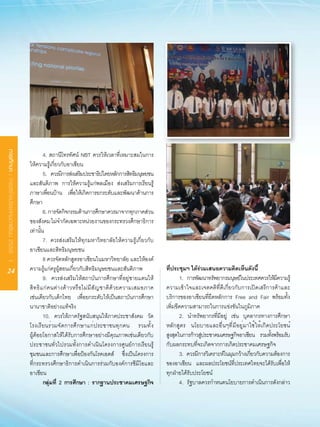
Members of theASEAN Socio-Cultural Community
Council Endorse the Thai Proposal to Mobilize
Education in the 15th ASEAN Summit
The 1st Meeting of the ASEAN Socio - Cultural
Community Council between 22 and 24 August
2009 at the Four Seasons Hotel ended with great
success as the council members endorsed a
proposal made by Thailand to mobilize the ASEAN
Community through education in the 15th ASEAN
Summit. The council members also noted with
appreciation the recommendations on education
I The Role of Education in Building an ASEAN Community 2015
from the First Regional Seminar on Strengthening
Cooperation on Education to Achieve an ASEAN
Caring and Sharing Community. Accepted by the
4th ASEAN Ministers of Education Meeting in Phuket,
the recommendations was promoted as the ASEAN
Educational Declaration and was endorsed during
the 15th ASEAN Summit in Hua Hin and Cha - am
from 23 to 25 October 2009.
37
39.
The Role ofEducation in Building an ASEAN Community 2015 I
The growing regional cooperation in Southeast process of establishing the International Institute for
Asian countries is an important means to strengthen Development of Educational Administrators (IIDEA) in
education systems in order to develop the human Bangkok, Thailand. The Institute will play a key role to
resources needed for regional competitiveness and uplift the skills of teachers, and educational personnel
future prosperity. The strength of the region stems both in Thailand and across the region.
from the great diversity that exists between the With the enhancement of required knowledge
sixteen countries in terms of levels of development, and skills, particularly knowledge of the Sufficiency
culture, languages and perspectives. Economy Approach to Sustainable Development
The Ministry of Education, Thailand, is in the and ASEAN awareness to be integrated in the
38
40.
I The Roleof Education in Building an ASEAN Community 2015
courses and programs, the teachers and educational
personnel will be equipped with appropriate
knowledge and skills to educate our children to
move forward the realization of the ASEAN
Community by the year 2015.
5-Year Work Plan on Education
A 5-year work plan is being developed to guide
SOMED in strengthening, deepening and widening an ASEAN Studies Programme for undergraduates,
educational cooperation within ASEAN and with the while a Masters in ASEAN Studies is already
Plus Three countries, the East Asia Summit countries available, and a PhD in ASEAN Studies will be
and other ASEAN Dialogue Partners. offered. The ASEAN Primary School Sport Olympiad,
which started in 2007, brings students together to
Activities in the Education Sector compete in athletics, football, chess, badminton and
The Education sector is working towards table tennis. The competition aims to promote ASEAN 39
developing source materials on ASEAN for reference awareness, strengthen regional solidarity and build
by primary and secondary schools. At the higher friendships among children in the region.
education level, work is progressing on developing The Southeast Asia Schools Principal Forum
an ASEAN Studies Programme for undergraduates, aims to strengthen the effectiveness of school
while a Masters in ASEAN Studies is already principals in the development of education, provide
available, and a PhD in ASEAN Studies will be opportunities for sharing ideas and experiences and
offered. to network. Scholarships, exchanges of students and
The Education sector is working towards scholars, internships, Rectors forums, workshops,
developing source materials on ASEAN for reference conferences, youth camps, etc. are also held to
by primary and secondary schools. At the higher enhance cooperation in education both within
education level, work is progressing on developing ASEAN and with ASEAN’s Dialogue Partners.
41.
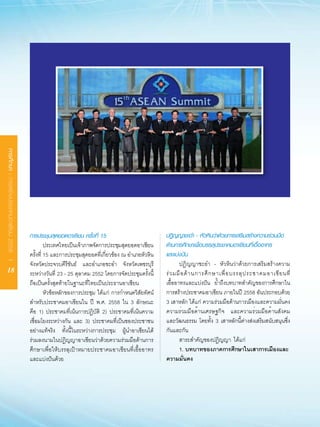
The 15th ASEANSummit, themed “Enhancing Assembly (AIPA), ASEAN youth and ASEAN civil
Connectivity, Empowering Peoples”, was held in Cha-am / society were also on the agenda.
Hua Hin, Thailand, from 23 to 25 October 2009.
One of the main highlights of this Summit was ASEAN Education Ministers Meeting (ASED)
the inauguration of the ASEAN Intergovernmental Education underpins ASEAN community
Commission on Human Rights. The Commission building. Education lies at the core of ASEAN’s
had worked for the promotion and protection of human development process, creating a knowledge-based
rights in ASEAN and the inauguration represented society and contributing to the enhancement of
another historic milestone for the region. ASEAN competitiveness. ASEAN also views education
One of the outcome documents of the 15th as the vehicle to raise ASEAN awareness, inspire
Summit was the Declaration on Strengthening the “we feeling”, and create a sense of belonging
Cooperation on Education to Achieve an ASEAN to the ASEAN Community and understanding of the
The Role of Education in Building an ASEAN Community 2015 I
Caring and Sharing Community that was adopted by richness of ASEAN’s history, languages, culture and
the Leaders. The Leaders also adopted the ASEAN common values.
Declaration on Climate Change.
Related Summits, which included the Plus At the 11th Summit in December 2005, ASEAN
One Summits with China, Japan, the Republic of Leaders set new directions for regional education
Korea and India; the ASEAN Plus Three Summit; collaboration when they welcomed the decision of
and the East Asia Summit also took place. Informal the ASEAN Education Ministers to convene the ASEAN
meetings between the ASEAN Leaders and Education Ministers’ Meetings (ASED) on a regular
representatives from the ASEAN Inter-Parliamentary basis. The Leaders also called for ASEAN Education
40
42.
Ministers to focuson enhancing regional cooperation
in education.
As the collective entity to enhance regional
cooperation in education, the ASEAN Education
Ministers identified four priorities that ASEAN
cooperation on education would address, namely :
(I) Promoting ASEAN Awareness among ASEAN
citizens, particularly youth; (II) Strengthening ASEAN
identity through education; (III) Building ASEAN
human resources in the field of education; and (IV)
Strengthening ASEAN University Networking. To this ASEAN cooperation on education is overseen
I The Role of Education in Building an ASEAN Community 2015
end, various projects and activities have been/are at the Ministerial level by an ASEAN Education
being developed/ organised to fulfil the directives. Ministers Meeting - which meets annually - and the
implementation of the programmes and activities
In recognition of the Southeast Asian Ministers for education matters is carried out by the ASEAN
of Education Organization’s (SEAMEO) contribution Senior Officials on Education (SOM-ED), which
to human resource development in the region since reports to the ASEAN Education Ministers Meeting.
1965, the Education Ministers agreed that the existing SOM-ED also oversees cooperation on higher
ASEAN and SEAMEO forums on education should education, which is coordinated by the ASEAN
integrate their respective programmes and activities University Network (AUN). The AUN was established
in a complementary manner. The priorities of ASEAN to serve as an ASEAN mechanism to (I) Promote
cooperation on education would be undertaken cooperation among ASEAN scholars, academicians,
through collaboration with SEAMEO. and scientists in the region; (II) Develop academic
41
43.
and professional humanresource in the region;
(III) Promote information dissemination among
the ASEAN academic community; and, (IV) Enhance
the awareness of regional identity and the sense
of ‘ASEANness’ among members. Visit the AUN
website at www.aun-sec.org
The Fifth ASEAN Education Ministers Meeting (5th
ASED) Cebu City, Philippines, 28 January 2010
The Fifth ASEAN Education Ministers Meeting
(5 ASED) was convened on 28 January 2010 in
th
Cebu, Philippines, in conjunction with the 45th
The Role of Education in Building an ASEAN Community 2015 I
SEAMEO Council Conference.
Recalling their views expressed at the 1st
ASED that education permeates through all three
pillars of the ASEAN Community in enhancing the
competitiveness of individual Member States as well
as ASEAN as a region, the Ministers welcomed the
adoption of the Cha - Am Hua Hin Declaration on
Strengthening Cooperation on Education to Achieve
an ASEAN Caring and Sharing Community by the
ASEAN leaders during the 15th ASEAN Summit on
24 October 2009. They tasked their Senior Officials Given the significance of educational cooperation
to follow up on the implementation of the Declaration as one of the priorities of the ASEAN Plus Three
to strengthen the education sector’s role incontributing cooperation under the Second Joint Statement
to the establishment of an ASEAN Community that on East Asia Cooperation and ASEAN Plus Three
42 is people - centred and socially responsible Cooperation Work Plan (2007 - 2017), the Ministers
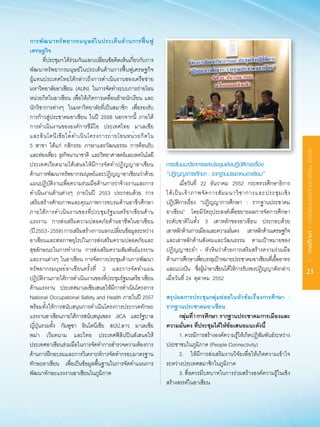
The Ministers noted the progress in developing welcomed Thailand’s proposal to host an ASEAN + 3
the five - year work plan, with financial support Senior Officials Ad Hoc Working Group Meeting
from the US, to guide their Senior Officials in on Education on 18-19 March 2010 in Bangkok to
strengthening, deepening and widening educational discuss the possibility of establishing an ASEAN + 3
cooperation within ASEAN and outside the region, Senior Officials Meeting on Education (SOMED + 3), as
taking into consideration the activities of ASEAN well as the draft ASEAN+3 Plan of Action on Education.
and AUN, and SEAMEO and its regional centres. The Ministers were pleased with the progress
Emphasising the important role of education in in education cooperation with the East Asia Summit
the ASEAN community building process, the (EAS) participating countries, noting that senior
Ministers tasked the ASEAN Secretariat to report the education officials from EAS participating countries
progress of the 5-year work plan at the 6th ASED. will hold two workshops this year to build education
44.
cooperation among theEAS participating countries for Member State to attend the programme.
regional competitiveness and community building. The The Ministers welcomed Brunei Darussalam’s
Ministers welcomed Australia’s offer to work with the offer to host the 6th ASED in conjunction with the
ASEAN Secretariat on the convening of the two work- 46th SEAMEO Council Conference in Bandar Seri
shops in Jakarta and another ASEAN capital in 2010. Begawan in 31 January – 3 February 2011.
The Ministers were pleased with the progress in
AUN activities, including the projected implementa- THE SENIOR OFFICIAL COMMITTEE
tion of the ASEAN Credit Transfer System (ACTS) in FOR ASCC (SOCA) MEETING
AUN Member Universities this year. The ACTS seeks The ASEAN Senior Officials Committee for
to enhance and facilitate student mobility among AUN the ASCC Council (SOCA) Meeting was held
Member Universities, which is one of the targets to on 2 March 2010 in Ho Chi Minh City, Viet Nam.
be achieved under the ‘Free Flow of Skilled Labour’ The Meeting was chaired by Ms. Le Kim Dung,
I The Role of Education in Building an ASEAN Community 2015
of the ASEAN Economic Community Blueprint. The Deputy Director General, Department of International
ACTS website has been developed and is hosted Cooperation, Ministry of Labour, Invalids and
by Universitas Indonesia at http://acts.ui.ac.id/. Social Affairs (MOLISA) of Viet Nam. The Meeting was
The Ministers noted that Thailand will host attended by delegations from Brunei Darussalam,
the 10th ASEAN Students Exchange Programme Cambodia, Indonesia, Lao PDR, Malaysia, Myanmar,
in August this year. The programme aims to bring Philippines, Singapore, Thailand and Viet Nam.
together students from ASEAN countries to cultivate Representatives of the ASEAN Secretariat were also
understanding, cooperation and networking, and in attendance.
to promote understanding of the different cultures The ASEAN Secretariat informed the Meeting
within ASEAN. Six secondary school students and that the 6th SOC-COM recognised the need for
two teachers will be invited from each ASEAN coordination of cross-sectoral issues, such as climate
43
45.
change, disaster managementand risk reduction,
food and energy security, Millennium Development
Goals (MDGs), emerging infectious diseases
and pandemic preparedness, which may involve
the sectoral bodies under the economic and
political - security pillars.
The Meeting was informed that the Coordinating
Conferences for the three ASEAN Communities
(i.e. SOC-COM for ASCC, ASCCO for APSC and
ECOM for AEC) are the main platforms to facilitate development of an ASEAN Declaration on human
coordination and consultations between and among resources development and an ASEAN Declaration
the various ASEAN sectoral bodies within each on action plan for employment collaboration and for
The Role of Education in Building an ASEAN Community 2015 I
Community. The Coordinating Conferences, however, the implementation of the following activities in 2010:
may not be adequate to facilitate coordination a.Strengthening the capacity and quality of
across Communities. Thus, a cluster approach to vocational trainings through the implementation of
the coordination of efforts addressing cross - cutting related activities under the ASEAN Labor Ministers
issues in ASEAN is being proposed for consideration Meeting (ALMM);
of the Meeting. b.Promotion of services of occupational safety
Human Resources Development for Economic and health (OSH) in ASEAN Member States (2010 -
Recovery 2015);
The area of Human Resources Development c.Enhancing information sharing between
for Economic Recovery is aimed at minimizing the ASEAN and EU in promoting labor safety and hygiene
risk of unemployment, poverty and inequality due and decent work ;
to the effect of the recent global economic crisis, d.Strengthening dialogues and promoting labor
reinforcing the competitiveness of human resources relations and decent work in ASEAN;
of ASEAN Member States and promoting the creative e.Convening the 2nd ASEAN Human Resource
44 competence and capacity to adapt to trans - border Development Meeting; and
movement of labor and technology advacement. f.Development of an Action Plan of the ALMM
Towards this end, Viet Nam proposed for the for 2010-2015.
The Meeting exchanged views and noted
the following comments of ASEAN Member States.
Regarding this area, Thailand informed the Meeting
on the initiative of the ASEAN University Network
(AUN) to develop an ASEAN credit transfer system
to facilitate greater mobility of students and scholars
and, towards this end, the AUN Actual Quality
Assessment had been piloted by a number of the
AUN Member Universities. Moreover, under the
46.
I The Roleof Education in Building an ASEAN Community 2015
SEAMEO framework, Indonesia, Malaysia and active participation of CSOs in the promotion and
Thailand had embarked on a pilot programme for protection of the rights of women and children in
credit transfer systems in five selected areas namely ASEAN.
agriculture, language and culture, hospitality and
tourism, international business, and science and ASEAN Plus Three Cooperation 45
technology. Since the process began in 1997, the ASEAN
Viet Nam informed the Meeting that a document Plus Three (APT) (China, Japan and the Republic of
on ‘ASEAN Women and Children: From Vision to Korea) cooperation has broadened and deepened
Action’ would be prepared for possible deliverable in many areas of cooperation. Cooperation is now
at the 17th ASEAN Summit in October 2010 and for being pursued in 20 areas, covering political and
this purpose, the current situations and priorities on security, transnational crime, economic, finance and
ASEAN women and children would need to be reviewed monetary, agriculture and forestry, energy, minerals,
and mapped out by May 2010. Thailand was of the tourism, health, labour, culture and arts, environment,
view that the proposed declaration should encourage science and technology, information and
ASEAN Member States to provide financial support communication technology, social welfare, rural
to such activities as well as to be engaged in more development and poverty eradication, disaster
47.
management, youth, women,and other tracks.
There are 57 bodies (1 Summit, 14 ministerial,
19 Senior Officials, 2 Directors - General, 18
technical level meetings and 2 other tracks meetings)
coordinating APT cooperation.
At the 9th APT Summit in December 2005 in
Kuala Lumpur, the Leaders of APT countries signed
the Kuala Lumpur Declaration on the APT Summit and
agreed to continue holding the APT Summit annually
in conjunction with the ASEAN Summit. The 9th in
2005 Summit and 10th APT Summit in 2006 reaffirmed
that the APT process will continue to be the main
The Role of Education in Building an ASEAN Community 2015 I
vehicle in achieving the goal of East Asia community,
with ASEAN as the driving force, and with the active Statement reviewed a decade of accomplishments,
participation of the Plus Three countries, in order to identified opportunities and challenges, and provided
promote shared ownership. strategic guidance for the future direction of APT
The 11th APT Summit in November 2007 in cooperation. The APT countries reiterated that APT
Singapore adopted the Second Joint Statement on cooperation would continue to support ASEAN
East Asia Cooperation and the ASEAN Plus Three integration with the objective to realise the ASEAN
Cooperation Work Plan (2007 - 2017). The Second Joint Community, and play a key role in regional community
building efforts for the long-term goal of realising
an East Asia community with ASEAN as the driving
force.
The 11th APT Summit endorsed the proposal
to establish an ASEAN Plus Three Cooperation
Fund to facilitate the implementation of the APT
46 Cooperation Work Plan. The 9th APT Foreign Ministers
Meeting in July 2008 in Singapore endorsed the
TOR and launched the APT Cooperation Fund.
In social welfare and development, APT
cooperation is focused on the following priority
areas: promoting a community of caring societies
in East Asia, developing policies and programmes
addressing the growing trends of ageing societies,
promoting community - based approaches for
delivering care and social services to the elderly and
the disabled, and giving attention to human resource
development in the social sector.
48.
ASEAN PLUS THREECOOPERATION WORK PLAN Plus Three countries for academic purposes, in
2007-2017 accordance with existing national regulations.
To realise the goals and objectives set l Cultivate an East Asian identity through
forth in the Second Joint Statement on East Asia promotion of ASEAN Studies and East Asian Studies
Cooperation: “Building on the Foundations of ASEAN in the region.
Plus Three Cooperation”, adopted by the Heads of
State/Government of ASEAN Plus Three countries The Draft ASEAN Plus Three Plan of Action on
on 20 November 2007, this Work Plan is formulated Education: 2010 – 2017
to serve as the master plan to enhance ASEAN Plus At the 15th ASEAN Summit in October 2009
Three relations and cooperation in a comprehensive in Cha - am Hua Hin, Thailand, the ASEAN Leaders
and mutually beneficial manner for the next ten years adopted the Cha-am Hua Hin Declaration on
I The Role of Education in Building an ASEAN Community 2015
(2007-2017). This Work Plan shall also support the Strengthening Cooperation on Education to enhance
establishment of the ASEAN Community by 2015. education cooperation as one of most important
In the field of educational cooperation, the Work elements in building an ASEAN Community and in
Plan has promoted joint actions and measures to achieving an ASEAN caring and sharing society.
enhance capacity building of the people through The 12th ASEAN + 3 Summit held back - to -
education as follows : back with the 15th ASEAN Summit also underscored
l Encourage investments in education and the importance of cooperation on education as
training to accelerate learning opportunities for one of a concrete means to implement the 2nd Joint
out - of - school children and youth and to upgrade Statement on East Asia Cooperation and the ASEAN+3
the quality of educational institutions, including Cooperation Work Plan (2007-2017). The Summit
human resources development for teachers, welcomed Thailand’s readiness to initiate education
lecturers and administrative personnel. cooperation under the ASEAN+3 process.
l Promote collaboration, networking, and The Draft Plan of Action for Education prepared
research and development among institutions and by Thailand has focused on educational cooperation
authorities involved in education. as follows: 47
l Promote higher education cooperation, 1) Encourage investments in education and
increase linkages between universities through the training to accelerate learning opportunities for
ASEAN University Network (AUN) and encourage out - of - school children and youth and to upgrade
credit transfers between universities in ASEAN Plus the quality of educational institutions, including
Three countries. human resources development for teachers, lecturers
l Support research activities and exchanges and administrative personnel.
of ASEAN Plus Three scholars and professionals 2) Promote collaboration, networking, and
interested in the ASEAN Plus Three relationship. research and development among institutions and
l Continue to make efforts to expedite visa authorities involved in education.
application procedures for students and intellectuals 3) Promote higher education cooperation,
of ASEAN Member Countries who travel to the increase linkages between universities through the
49.
ASEAN University Network(AUN) and encourage teachers, lecturers and administrative personnel.
credit transfers between universities in APT countries. Strategy 2 : Promoting collaboration, networking,
4) Support research activities and exchange of and research and development among institutions
APT scholars and intellectuals interested in the APT and authorities involved in education.
relationship. Strategy 3 : Promoting higher education
5) Continue to make efforts to expedite visa cooperation, increase linkages between universities
application procedures for students and intellectuals through the ASEAN University Network (AUN) and
of ASEAN Member Countries who travel to the encourage credit transfers between universities in
Plus Three countries for academic purposes, in ASEAN Plus Three countries.
accordance with existing national regulations. Strategy 4 : Supporting research activities
6) Cultivate an East Asian identity through and exchange of APT scholars and intellectuals
promotion of ASEAN Studies and East Asian Studies interested in the APT relationship.
The Role of Education in Building an ASEAN Community 2015 I
in the region. Strategy 5 : Continuing to make efforts to
The general objective of this Action Plan is to expedite visa application procedures for students and
encourage the ASEAN Plus Three Member Countries intellectuals of ASEAN Member Countries who travel
to expand their efforts in implementing the Plan at the to the Plus Three countries for academic purposes, in
national and bilateral levels to the regional level. accordance with existing national regulations.
The specific objectives of the Action Plan are Strategy 6 : Cultivating an East Asian identity
to urge the ASEAN Plus Three Member Countries to: through promotion of ASEAN Studies and East Asian
Develop a more cohesive, regional strategy aimed Studies in the region.
at promoting comprehensive education programmes
among the Member Countries for the seven year ASEAN + 3 Senior Officials Ad-hoc Working Group
(2010-2017) ; on Education
l Enhance awareness of the community The Ministry of Education, in cooperation with
building to youth through education and activities to the Ministry of Foreign Affairs, Thailand, will organize
foster an East Asian identity based on friendship and the ASEAN + 3 Senior Officials Ad - hoc Working
48 cooperation; Group on Education in June, 2010, Phuket, Thailand.
l Enhance coordination among ASEAN + 3 The purpose of the said meeting is to look into
bodies dealing with education; and Ensure the feasibility and modalities of a formal mechanism of
integration of education priorities into APT’s education cooperation with the Plus three countries.
development agenda. In addition, the meeting will discuss a possibility of
In order to achieve the general and specific establishing an ASEAN + 3 Senior Officials Meeting
objectives, ASEAN Plus Three Member Countries on Education (SOM - ED + 3) including a draft Terms
are encouraged to : of Reference (ToR) of the SOM - ED + 3 and consider
Strategy 1: Investing in education and training the draft ASEAN + 3 Plan of Action on Education.
to accelerate learning opportunities for all and to
upgrade the quality of educational institutions,
including human resources development for
50.
Conclusion
One of the key purposes of the ASEAN Charter is to promote a
people-oriented ASEAN in which all sectors of society are encouraged to
participate in, and benefit from, the process of ASEAN integration and
community building.
In establishing the ASEAN Community, facilitating universal access to
education for increased employability, good citizenship, and as a means of
empowerment and life-long learning have been highlighted under its Plan
I The Role of Education in Building an ASEAN Community 2015
of Actions. The Plan emphasizes the enhancement of improved standards
and increased access to education through networking and institutional
collaboration. By developing leadership skills, entrepreneurship, and
technical and vocational abilities, we can ensure that ASEAN youth have a
better future.
To accelerate the achievement of regional integration and build an
ASEAN caring Sharing Community by the year 2015, there are numerous
possibilities to consider. and its relevance to all and across all types and levels of
education, cultivating an appreciation and understanding of diversity is very
much a part of Thailand’s definition of what constitutes a quality education. This
goes hand in hand with the promotion of the Education for All goals, Sufficiency
Economy Theory, Education for Sustainable Development (ESD), Morals and
Values Education, Peace Education, Human Rights Education, Education for
International Understanding (EIU) and a variety intercultural and interfaith
exchange initiatives such as study visits, youth camps and participation in 49
international youth fora.
In summing up, Education is a key to achieve an ASEAN Caring and
Sharing Community. Without promoting educational cooperation at all levels
in ASEAN, our shared goal to move ASEAN towards Caring and Sharing
Community hardly seems possible.
51.
ANNEX 1
CHA-AM HUA HIN DECLARATION ON STRENGTHENING
COOPERATION ON EDUCATION TO ACHIEVE
AN ASEAN CARING AND SHARING COMMUNITY
WE, the Heads of State and Government of the Association of Southeast Asian Nations
(hereinafter referred to as “ASEAN”), namely Brunei Darussalam, the Kingdom of Cambodia, the
Republic of Indonesia, the Lao People’s Democratic Republic, Malaysia, the Union of Myanmar,
the Republic of the Philippines, the Republic of Singapore, the Kingdom of Thailand and the
Socialist Republic of Viet Nam, on the occasion of the 15th ASEAN Summit in Cha-am Hua Hin;
REAFFIRMING our commitment to support the establishment of an ASEAN Community
The Role of Education in Building an ASEAN Community 2015 I
comprising three pillars, namely political and security cooperation, economic cooperation and
socio-cultural cooperation that are closely intertwined and mutually reinforcing, by 2015 as called
for by our Leaders at the 12th ASEAN Summit on 13 January 2007;
REAFFIRMING that one of ASEAN purposes as stipulated on Article 1 Paragraph
10 of the ASEAN Charter is to develop human resources through closer cooperation in education
and life - long learning, and in science and technology, for the empowerment of the peoples of
ASEAN and for the strengthening of the ASEAN Community;
RECOGNIZING the importance of education sector in contributing to the establishment of
an ASEAN Community that is people - centred and socially responsible with a view to achieving
enduring solidarity and unity among the nations and peoples of ASEAN by forging a common
identity and building a caring and sharing society which is inclusive and where the well - being,
50 livelihood, and welfare of the peoples are enhanced;
RECALLING the views of the ASEAN Ministers of Education expressed at their First
Meeting (ASED) on 21 March 2006 that education sector should not be viewed solely under the
socio - cultural pillar but, by developing human resources, permeates through all the three pillars
of the ASEAN Community in enhancing competitiveness of individual Member States as well as
ASEAN as a region;
RECALLING the Cha-am Hua Hin Declaration on the Roadmap for the ASEAN
Community (2009-2015) which comprises the three Community Blueprints and the Second
Work Plan for the Initiative for ASEAN Integration, which highlight human development as
one of the key elements in the development of the ASEAN Socio - Cultural Community;
52.
ALSO RECALLING theviews of the ASEAN Education Ministers of Education in their
Fourth Meeting on 5 April 2009 in Phuket which considered and adopted the set of
Recommendations from the First Regional Seminar on Strengthening Cooperation on Education
to Achieve an ASEAN Caring and Sharing Community during 23-25 February 2009 in Bangkok
and Chonburi, Thailand, as well as the development of ASEAN’s Five-Year Work Plan on
Education in strengthening educational cooperation within ASEAN and Dialogue Partners.
DO HEREBY AGREE THAT THE FOLLOWING ACTIONS ARE NECESSARY IN
STRENGTHENING THE ROLE OF EDUCATION IN BUILDING THE ASEAN COMMUNITY BY 2015
I. ROLE OF EDUCATION SECTOR IN POLITICAL AND SECURITY PILLAR :
PROMOTE better understanding and appreciation of the ASEAN Charter through the
I The Role of Education in Building an ASEAN Community 2015
school curriculum on ASEAN and disseminating the ASEAN Charter which has been translated
into ASEAN national languages ;
GIVE greater emphasis on the principles of democracy, respect for human rights and
peace - oriented values in the school curriculum ;
PROMOTE better understanding and appreciation of different cultures, customs and
faiths in the region among teachers through training and exchange programmes and
establishment of an online database on this subject ;
CONDUCT a regular school leaders’ forum as a platform for exchanging views on various
regional issues in ASEAN, building their capacity and networking. We acknowledge the existing
Southeast Asia School Principals’ Forum (SEA-SPF) ;
II. ROLE OF EDUCATION SECTOR IN ECONOMIC PILLAR
DEVELOP national skills framework in ASEAN Member States as an incremental approach 51
towards an ASEAN skills recognition framework;
PROMOTE greater mobility of students by developing a regional catalogue of information
materials of education offered in ASEAN Member States;
SUPPORT greater mobility of skilled workers in the ASEAN region through regional
cooperation mechanisms among ASEAN Member States to be accompanied by efforts
to safeguard and improve educational and professional standards ;
DEVELOP an ASEAN competency-based occupational standard aimed at supporting
the development of ASEAN human resources that are regionally and globally competitive
53.
and meet theneeds of industries in coordination with the ASEAN Labour Ministers Meeting
(ALMM) process ;
ENCOURAGE the development of a common standard of competencies for vocational and
secondary education as a base for benchmarking with a view to promote mutual recognition ;
III. ROLE OF EDUCATION SECTOR IN SOCIO-CULTURAL PILLAR
DEVELOP a common content on ASEAN for schools as a reference for teacher training
and teaching ;
OFFER graduate courses on ASEAN arts and cultures in universities ;
The Role of Education in Building an ASEAN Community 2015 I
OFFER ASEAN languages as optional foreign language subjects in schools ;
PROMOTE regional outreach programmes aimed at raising ASEAN awareness among our
youth. We acknowledge the existing outreach programmes, such as the ASEAN Schools Tour,
ASEAN Student Exchange Programme, ASEAN Youth Cultural Forum, ASEAN University Youth
Summit, AUN Educational Forum and Young Speakers Contest ;
SUPPORT wider access of rural communities to quality education by establishing an
ASEAN community-based programme for young volunteers to support the learning centers in
rural areas and for indigenous people in Member States ;
PROMOTE life-long learning in ASEAN Member States in support of the Education for All
(EFA) ;
52
ESTABLISH an ASEAN educational research convention to promote collaborative research
and development (R&D) in the region and as a platform for researchers from Member States to
exchange views on various regional issues and concerns ;
PROMOTE better understanding and awareness of various environmental issues and
concerns in the ASEAN region by integrating it in school curriculum and presenting “ASEAN
Green School” awards ;
CELEBRATE the ASEAN Day (8th August) preferably in the month of August in schools
through various activities, such as singing the ASEAN Anthem, conducting a competition on
ASEAN history and cultures, displaying ASEAN emblem and other iconic elements, organising
an ASEAN youth camp, ASEAN youth festival and ASEAN children’s day ;
54.
AGREE that ASEANMember States should consider sharing their resources and consider
establishing a regional education development fund to ensure adequate financial support to
implement the recommended actions ;
TASK the concerned ASEAN Sectoral Ministerial Bodies and the Secretary - General
of ASEAN to implement this Declaration in guiding and supporting ASEAN’s Five Year Work
Plan on Education as well as monitor commitments supported by the Committee of Permanent
Representatives, and report to us regularly through the ASEAN Socio-Cultural Community
Council on the progress of the implementation ;
PLEDGE our resolve and commitment to strengthen education to realize an ASEAN
Community of Actions, a Community of Connectivity and a Community of and for the Peoples of
I The Role of Education in Building an ASEAN Community 2015
ASEAN.
ADOPTED at Cha-am Hua Hin, Thailand, this Twenty Forth Day of October in the Year Two
Thousand and Nine, in a single original copy, in the English Language.
53
55.
ANNEX 2
The Voice of the Youth on East Asia Community Building
After having gathered together in the 2007 East Asia Youth Leadership forum, from the 24th
to the 30th of November 2007 in Bangkok, Thailand, We, the youth of East Asia which consist
of, Brunei Darussalam, Cambodia, Indonesia, Lao P.D.R., Malaysia, Myanmar, Philippines,
Singapore, Thailand, Vietnam, China, Japan, and R.O. Korea propose a document that present
our voice to promote the East Asia Community.
One Caring, Sharing Community. A caring, sharing community is where each and every
country in the East Asian region can help out and support each other and be united. To realize
this we need to educate children at a young age on the importance of community, to make the
The Role of Education in Building an ASEAN Community 2015 I
youth network stronger. Workshops and meetings are also necessary to narrow the gaps and
promote development. Furthermore, we should create a welfare fund that can aid countries in
emergency situations. To share common concerns and cultures is also vital in integrating effectively.
Cultivating an East Asian Identity. Our view of East Asian identity is the way we think of
ourselves and how others view us. It is pertinent to cultivate a distinctive identity for economic
integration that aids prosperity, peace, stability and security, and facilitate solving of common
global problems. Knowing our similarities and recognising our differences help in building
strong friendships and networks. Languages and cultures should be taught to young children in
schools to retain our roots. Should these be achieved, East Asia would be on our way towards
closer cooperation for a more prosperous and stable region.
Integration of Tradition and Culture in Our Lifestyle. There are over 12 languages and 40
dialects in the 13 countries in East Asia and its strong culture of historical heritage should not be
54 lost. Empowering youths, through the establishment of a formal organisation that promotes the
preservation of tradition and culture in a country, the full richness of tradition and culture could
be successfully passed down to future generations. The organisation will act as a platform and
offer opportunities in which youths can leverage on, allowing them to reach out to the masses.
Fostering a sense of Community and the “We Feeling”. In a region of diverse beliefs and
cultures, it is imperative in today’s East Asia to develop a “we feeling.” We propose the establishment
of East Asia Youth Network (EAYN) for the purpose of growing and strengthening mutual
concern among the younger generation of the neighbouring states of East Asia. One body in the
youth network will tackle the issues of poverty and disasters under Aid Cooperation. Another body, the
Exchange Committee, will be responsible for spreading the vision of EAYN to the public through
the mass media and by introducing East Asian studies in East Asia schools as a subject.
56.
Impact of Musicand Film on Development of Contemporary Culture of East Asia. Governments
should adopt policies to strengthen the film industry by encouraging local TV networks to show
more films from East Asian countries. In addition, policies against piracy must be enforced
more strictly to strengthen film production in each country. Meanwhile, government should set
up funds for film industry. Film networking system should be reflected as well to ignite cultural
exchange. For example, each government can organize East Asian film festivals.
Linking Education and Cross-Culture with Leadership. Leaders are people who play a
major role and are in a position to kickstart initiatives to facilitate the education across cultures.
Education, whether formal or informal, provides the basic knowledge. However, we believe that
education alone is no longer sufficient in this globalised world where we are not self-sufficient.
I The Role of Education in Building an ASEAN Community 2015
This highlights the importance of cooperation and friendship between countries, which can be
achieved through citizens from different cultures and adopting an open mindset to learn and
understand each others’ cultures.
Role of Youth in Environmental Sustainability. The beautiful world is not only a heritage
from our ancestors, but also a treasure that we should take care of. We play an important role
in environmental sustainability by developing ourselves and being role-models for our generation.
Advocacies on law enforcement and awareness campaigns are also important in attaining
environmental sustainability. Starting with ourselves, we can help inculcate good values in every
person in our region through education to improve the condition of our environment.
Development of Regional Network of Youth Leaders on Environment. Environment is the
totality of the co-existence of living and non-living entities. The environment faces challenges
that affect people’s lives because of the major problems, for example, industrialization, air
pollution and waste management. To address these, government, non-government and individuals 55
should contribute to promote environmental activities like tree planting, implementation of
laws and policies that increase awareness of people, exercising the 3Rs- Reduce, Reuse and
Recycle. With these in hand, there should be strong linkages or regional network of youths.
Ideal Education for promoting sustainable development. After we shared about our education
systems, we realised that each country has a different education system. To respect each other,
we cannot expect everyone to be similar. We need to make the same perception in a statement
to achieve the importance of increasing awareness of sustainable development. Individuals need
to be equipped with global knowledge through proper education. To provide equal opportunities,
it must be done in an affordable and cost effective method. We must also change our mindsets
and attitudes to put what we have learnt into practical action in our daily lives.
57.
Economic Integration inEast Asia. We wish to see increased and sustained prosperity
in East Asia as one community. I believe our role to achieve this purpose is to participate in
economic activities at both local and international levels. We should change our mind to the
concept of one community and involve economic activities by forming a group and doing
voluntary work. For example, we could have a youth economic organisation and a youth
conference to share ideas. Therefore, we seek the government’s support in helping us
achieve this vision.
Free Trade, Customer Protection and Business Opportunity. We recognise that the
benefits of free trade outweigh its demerits. Youths should be committed to minimise the negative
effects by encouraging the government to increase its investments on education and help local
companies to stay relevant and competitive. Best practices from better-developed countries
The Role of Education in Building an ASEAN Community 2015 I
should be factored in when formulating trade policies by the developing nations. We strongly
encourage private companies to practice Corporate Social Responsibility to help the parties that
are adversely affected by Free Trade.
Mobility of Youth in East Asia. Mobility of Youth is the movement of people with same ideas
and objectives through networking, making use of technology having mutual understanding
and gaining government and non-government support. Our strength is the development of
communication skills, sense of community and voluntary work, values and vision. Thus,
the existence of the youth’s strength and the driving factors to ensure successful mobility
which in turn will lead to the better and more sustainable East Asia. We have identified
the precautions and taking into consideration the differences of political systems, religions, beliefs and
geographical set up.
Regional Peace, Stability and Prosperity. We feel that provision of Education would solve
56
the problems such as prejudices, lack of quality in education and environmental problems.
That’s because education will promote peace when people are more tolerant and learned to
accept each other. Also, education stabilizes society and reduces social problems. Lastly, when
people are educated they can contribute to the economy and bring prosperity.
At last, before assembling for the exchange of visions of the youth, we have a definition
of the East Asia community as a family of countries connected by geographical proximity.
However, today, after a great period of sharing and caring, we understand that we are
connected more closely with heart-felt proximity. Therefore, let us move together with full
confidence for the good of East Asia. In a nutshell, our cardinal objective is to form a strong and
lasting friendship or network amongst East Asian youths, hence steering us forward with full
confidence and allowing the world to hear our motto - Harmony in Diversity.
58.
ANNEX 3
East Asian Youth Chorus in Unity, Identity,
Opportunity and Responsibility
Following upon the principles and initiatives set forth at the Inaugural Youth Leadership
Forum in 2007, we, the assembled youth delegates from the ASEAN+3 nations have convened
for the 2008 Youth Leadership Forum in Thailand and declare our commitment to the promotion
and actualization of building an East Asian Community through the implementation of
the proposals agreed below.
It is our conviction that the voice of youth that we announce today shall become the chorus
of our generation, who will inherit the mantle of leadership in our nations, dedicated to the
well-being, prosperity, security and peace of our peoples and communities. We offer these
I The Role of Education in Building an ASEAN Community 2015
proposals in full recognition that these are but building blocks in the foundation of a more caring
community which shares common aspirations and visions among our diverse cultures.
We call upon the elders and all people in our community to join and support us as the
Voices of East Asia Chorus in Unity, Identity, Opportunity and Responsibility.
Unity: Sense of Community
Through a e-magazine focusing on ASEAN+3 Youth, we hope to build a sense of
community among East Asian countries and share information among ourselves on the
various community-based projects undertaken by youths in the region. By learning more about
community-based activities in the region, youth can explore opportunities to share resources
and expand on cooperation in such community-based efforts.
Identity: Culture
By setting up East Asian Cultural Clubs in our respective educational institutions, we hope
57
to establish an East Asian network for East Asian Youth. This would allow them to participate in
events which foster mutual understanding of our various cultures in order to cultivate, in the long
term, a common East Asian Cultural Identity.
Opportunity: Education
Many children around East Asia do not have the opportunity to be educated due to poverty
and lack of access to an equitable education system. We propose a coordinated effort among
ASEAN+3 nations to engage youth as education as part of a Youth Education Ambassadors
Network to go to rural areas during their holidays to teach children who otherwise lack
educational opportunities. Through this programme, we hope to empower more children to
become leaders in their societies and spread their zeal of life-long learning to their peers.
59.
Responsibility: Environment
To create awareness and promote understanding of the dire situation of the environment,
we propose to create online portals on the eastasianyouth.net website, popular social
networking sites and our blogs to promote the cause of Mother earth and provide real and
effective tips on how we as youth can do our bit to save our planet locally and as a region.
In conclusion, the delegates of this youth forum strive to create a better, brighter future
through the ideas that we have proposed and seek the cooperation of our governments and
peoples to see our vision of Unity, Identity, Opportunity and Responsibility through to fruition.
The Role of Education in Building an ASEAN Community 2015 I
58
60.
Adviser
Deputy Permanent Secretaryfor Education, Thailand
(Sivika Mektavatchaikul)
Editorial Team
Paisal Wisalaporn
Kanittha Hanirattisai
Phimwarat Muangnil
Komutee Yamolanan
Woramon Navaroj
Benjaporn Munyaton
I The Role of Education in Building an ASEAN Community 2015
Korapat Pruekchaikul
Jeeranan Songchart
Information source and photo credit : Bureau of International Cooperation
Office of the Permanent Secretary
Ministry of Education, Thailand
Public Relations Group, Office of the
Minister, Ministry of Education, Thailand
ที่ปรึกษา
รองปลัดกระทรวงศึกษาธิการ ฝ่ายต่างประเทศ
(นางศรีวิการ์ เมฆธวัชชัยกุล)
คณะบรรณาธิการ 59
ไพศาล วิศาลาภรณ์
ขนิษฐา ห้านิรัติศัย
พิมพ์วรัชญ์ เมืองนิล
โกมุที ยมลนันทน์
วรมน เนาวโรจน์
เบญจพร มรรยาทอ่อน
กรภัทร พฤกษ์ชัยกุล
จีรนันท์ ทรงชาติ
แหล่งข้อมูลและภาพ : สำนักความสัมพันธ์ต่างประเทศ สำนักงานปลัดกระทรวงศึกษาธิการ
กลุ่มประชาสัมพันธ์ สำนักงานรัฐมนตรี กระทรวงศึกษาธิการ










![ประชาคมอาเซียน%20(asean%20 community)[1]](https://cdn.slidesharecdn.com/ss_thumbnails/20asean20community1-111017044806-phpapp02-thumbnail.jpg?width=640&height=640&fit=bounds)


