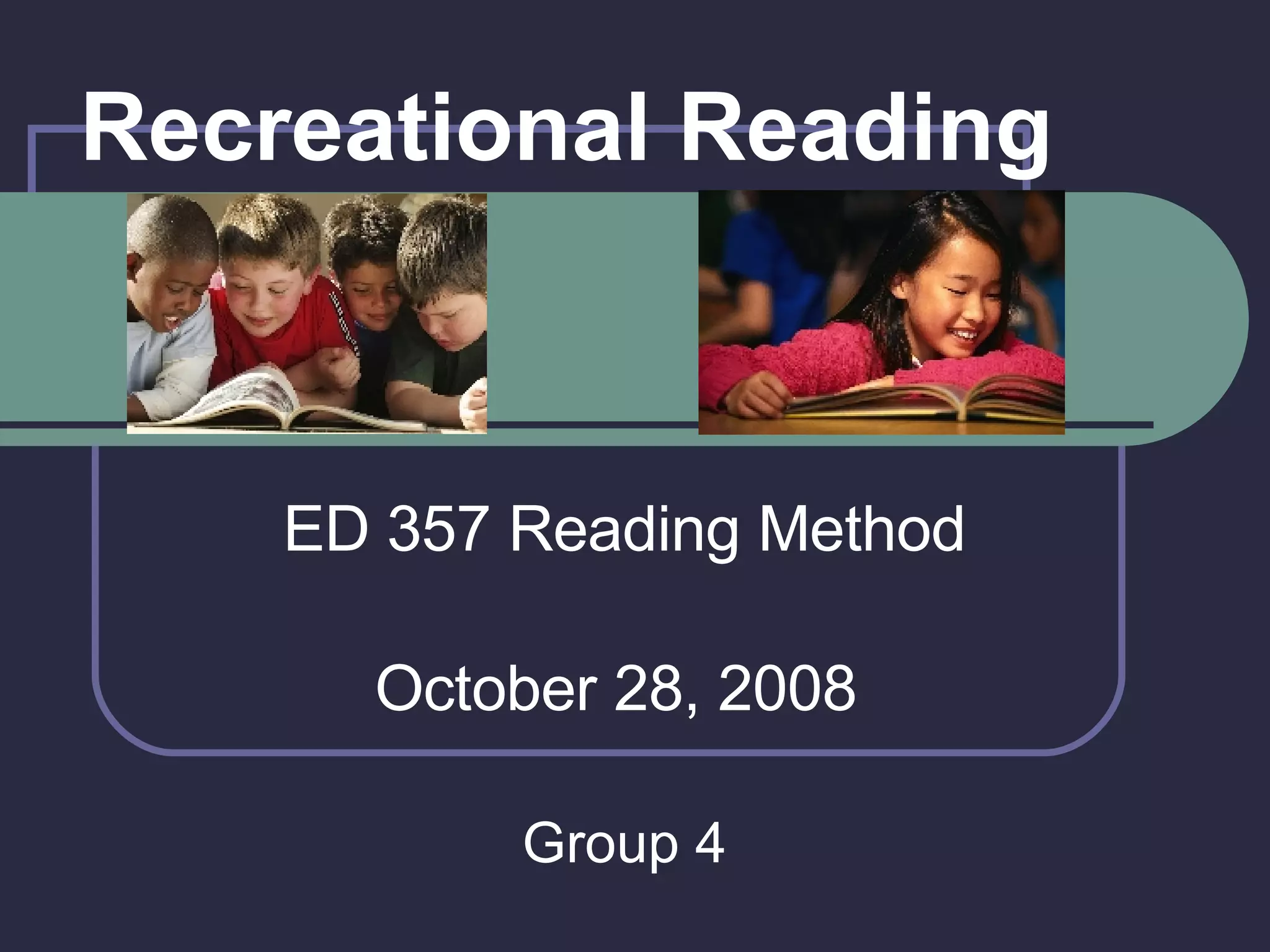
Recreational Reading ED 357 Reading Method October 28, 2008  Group 4
Objectives What is Recreational Reading? Reading as recreation  Studies on the method Tips to encourage RR Benefits Activities
What is Recreational Reading? Sangi M. Susuico
Recreational Reading….. Recreational Reading is simply “ fun reading .” Other names: Sustained Silent Reading (SSR) Free Voluntary Reading (FVR) Drop Everything and Read (DEAR) Free Uninterrupted Reading (FUR)
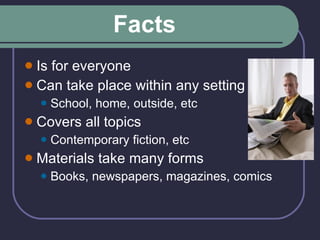
Facts   Is for everyone Can take place within any setting School, home, outside, etc  Covers all topics Contemporary fiction, etc Materials take many forms Books, newspapers, magazines, comics
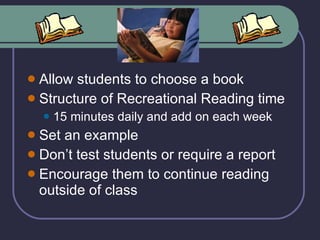
Allow students to choose a book Structure of Recreational Reading time 15 minutes daily and add on each week Set an example Don’t test students or require a report Encourage them to continue reading outside of class
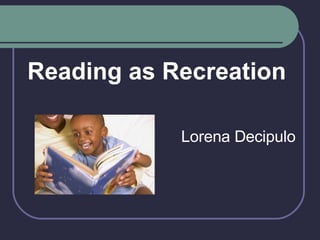
Reading as Recreation  Lorena Decipulo
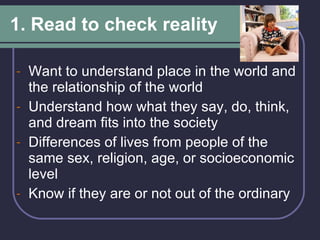
1. Read to check reality Want to understand place in the world and the relationship of the world Understand how what they say, do, think, and dream fits into the society  Differences of lives from people of the same sex, religion, age, or socioeconomic level Know if they are or not out of the ordinary
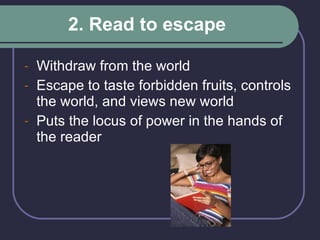
2. Read to escape Withdraw from the world  Escape to taste forbidden fruits, controls the world, and views new world Puts the locus of power in the hands of the reader
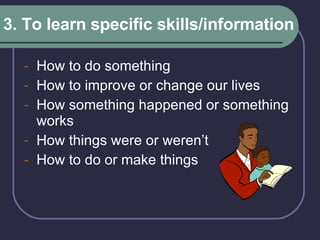
3. To learn specific skills/information How to do something How to improve or change our lives How something happened or something works How things were or weren’t How to do or make things
News on Recreational Reading  Kristy Galindo
Tips for Parents & Teachers: Encouraging Children to Read Alicia Quintanilla
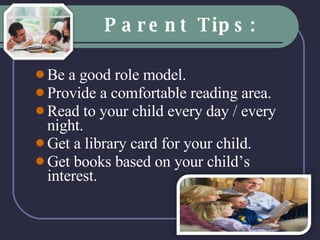
Parent Tips: Be a good role model. Provide a comfortable reading area.  Read to your child every day / every night. Get a library card for your child.  Get books based on your child’s interest.
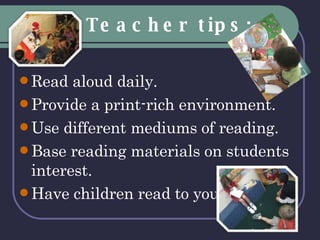
Teacher tips: Read aloud daily. Provide a print-rich environment. Use different mediums of reading. Base reading materials on students interest. Have children read to you.
Ewalani Escrupulo Read a loud
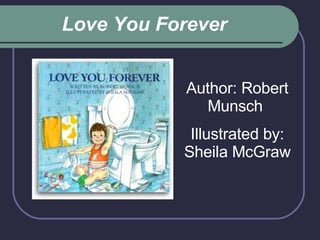
Love You Forever  Author: Robert Munsch  Illustrated by: Sheila McGraw
What are the benefits:  Increases children’s knowledge Allows children to practice and improve their reading skills Stimulates their imagination Leads to higher achievement skills Promotes positive attitudes towards reading Allows those who participate in this activity to become accelerated readers
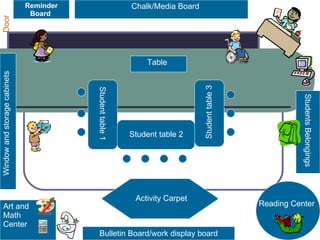
Bulletin Board/work display board Door   Chalk/Media Board Students Belongings Art and Math Center  Reading Center Activity Carpet Student table 1  Table  Window and storage cabinets  Student table 2  Student table 3 Reminder Board
Summary: Recreational reading is reading for fun Children need to be allowed to read for fun to help them learn more about their interests Parents and teachers can encourage RR by reading with their children  Reading topics of interests encourage readers to read more, increase their knowledge and success
References Understand Recreational Reading Patterns http://goliath.ecnext.com/coms2/summary_0199-6678582_ITM Children’s Choices for Recreational Reading http://findarticles.com/p/articles/mi_qa3785/is_200601/ai_n16452270 Americans close the book on Recreational Reading http://www.usatoday.com/news/education/2007-11-18-reading-decline_N.htm Sustained Silent Reading  http://en.wikipedia.org/wiki/Sustained_silent_reading

Ed 357 Recreational Reading

  • 1.
    Recreational Reading ED357 Reading Method October 28, 2008 Group 4
  • 2.
    Objectives What isRecreational Reading? Reading as recreation Studies on the method Tips to encourage RR Benefits Activities
  • 3.
    What is RecreationalReading? Sangi M. Susuico
  • 4.
    Recreational Reading….. RecreationalReading is simply “ fun reading .” Other names: Sustained Silent Reading (SSR) Free Voluntary Reading (FVR) Drop Everything and Read (DEAR) Free Uninterrupted Reading (FUR)
  • 5.
    Facts Is for everyone Can take place within any setting School, home, outside, etc Covers all topics Contemporary fiction, etc Materials take many forms Books, newspapers, magazines, comics
  • 6.
    Allow students tochoose a book Structure of Recreational Reading time 15 minutes daily and add on each week Set an example Don’t test students or require a report Encourage them to continue reading outside of class
  • 7.
    Reading as Recreation Lorena Decipulo
  • 8.
    1. Read tocheck reality Want to understand place in the world and the relationship of the world Understand how what they say, do, think, and dream fits into the society Differences of lives from people of the same sex, religion, age, or socioeconomic level Know if they are or not out of the ordinary
  • 9.
    2. Read toescape Withdraw from the world Escape to taste forbidden fruits, controls the world, and views new world Puts the locus of power in the hands of the reader
  • 10.
    3. To learnspecific skills/information How to do something How to improve or change our lives How something happened or something works How things were or weren’t How to do or make things
  • 11.
    News on RecreationalReading Kristy Galindo
  • 12.
    Tips for Parents& Teachers: Encouraging Children to Read Alicia Quintanilla
  • 13.
    Parent Tips: Bea good role model. Provide a comfortable reading area. Read to your child every day / every night. Get a library card for your child. Get books based on your child’s interest.
  • 14.
    Teacher tips: Readaloud daily. Provide a print-rich environment. Use different mediums of reading. Base reading materials on students interest. Have children read to you.
  • 15.
  • 16.
    Love You Forever Author: Robert Munsch Illustrated by: Sheila McGraw
  • 17.
    What are thebenefits: Increases children’s knowledge Allows children to practice and improve their reading skills Stimulates their imagination Leads to higher achievement skills Promotes positive attitudes towards reading Allows those who participate in this activity to become accelerated readers
  • 18.
    Bulletin Board/work displayboard Door Chalk/Media Board Students Belongings Art and Math Center Reading Center Activity Carpet Student table 1 Table Window and storage cabinets Student table 2 Student table 3 Reminder Board
  • 19.
    Summary: Recreational readingis reading for fun Children need to be allowed to read for fun to help them learn more about their interests Parents and teachers can encourage RR by reading with their children Reading topics of interests encourage readers to read more, increase their knowledge and success
  • 20.
    References Understand RecreationalReading Patterns http://goliath.ecnext.com/coms2/summary_0199-6678582_ITM Children’s Choices for Recreational Reading http://findarticles.com/p/articles/mi_qa3785/is_200601/ai_n16452270 Americans close the book on Recreational Reading http://www.usatoday.com/news/education/2007-11-18-reading-decline_N.htm Sustained Silent Reading http://en.wikipedia.org/wiki/Sustained_silent_reading