2.1 History of the Ecosystem Concept
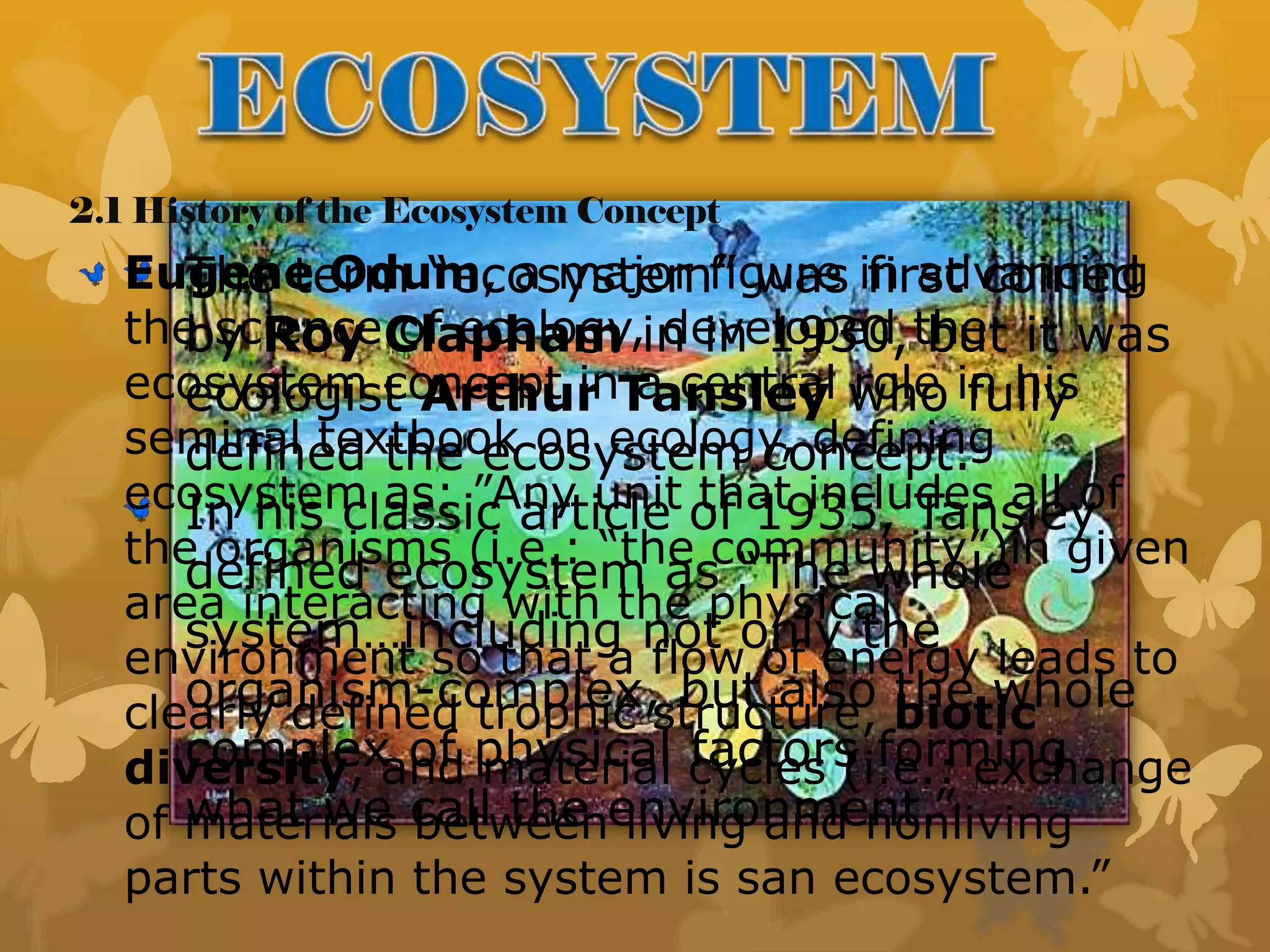
The term “ecosystem” was first coined
by Roy Clapham in in 1930, but it was
ecologist Arthur Tansley who fully
defined the ecosystem concept.
In his classic article of 1935, Tansley
defined ecosystem as “The whole
system…including not only the
organism-complex, but also the whole
complex of physical factors forming
what we call the environment.”
Eugene Odum, a major figure in advancing
the science of ecology, developed the
ecosystem concept in a central role in his
seminal textbook on ecology, defining
ecosystem as: ”Any unit that includes all of
the organisms (i.e.: “the community”)in given
area interacting with the physical
environment so that a flow of energy leads to
clearly defined trophic structure, biotic
diversity, and material cycles (i.e.: exchange
of materials between living and nonliving
parts within the system is san ecosystem.”
An ecosystem is a very complex entity with
many interactive components. It can be
defined as “ a system of complex
interactions of population between
themselves and with their environment” or
as “the joint functioning and interaction of
these two compartments (populations and
environment in a functional unit of variable
size” in a functional unit of variable size”
(Odum, 1975, Ellenberg,1973; Nybakken,
1992; Scialabba, 1998).
Ecosystem maybe considered at different
geographical scales from a grain of sand with its
rich micro fauna, to a whole beach, a coastal area
or estuary, a semi-enclosed sea and eventually,
the whole Earth. As stated by Lackey (1999),
ecosystems are defined at a wide range of scales
of observation “from a drop of morning dew to an
ocean,. From a pebble to a planet” Ecosystems
defined at a given geographical and functional
scale are therefore nested within larger ones and
contain smaller ones with within they exchange
matter and information.
Ecosystem are dynamic, composites
entities within which large quantities of
matter, energy and information flow, within
and between components, in a way that is
not yet completely understood. These
flows are controlled primarily by:
1.top predator’s feeding behavior (top
down control);
2.Primary procedures (bottom up control);
3.Some numerically abundant species
somewhere in the middle of the food
chain (wasp-waist control); or
4. Some combination of some or all of
these, depending on system and their
possible states ( Cury et al., 2003).
The functioning of an ecosystem results
from the organization of its species
communities, consisting of species
populations having their own dynamics in
terms of abundance, survival, growth,
production, reproductive and other
strategies.
The community's resilience depends on
its capacity to adapt to the physical
environment and on its relations with the
other communities, e.g. through
competition or predation.
Communities are interdependent and
interconnected as trophic networks (resulting
from predator-prey relationships) depending on
environmental variables.
Food-web analysis and estimates of
consumption are essential for understanding
possible reactions of the ecosystem to
exploitation regimes as well as rebuilding
strategies and, during the last decade, the
information on this matter has greatly improved
(Trites, 2003).
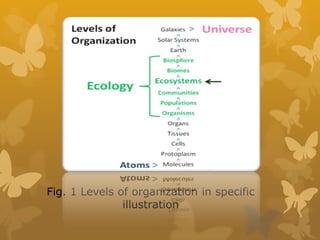
Fig. 1 Levels of organization in specific
illustration
Ecosystems may be observed in many
possible ways, so there is no one set of
components that make up ecosystem.
However, all ecosystem must include both
biotic and abiotic components, their
interactions, and some source of energy.
The simplest (and least representative) of
ecosystems might therefore contain just a single
living plant ( biotic component) within a small
terrarium exposed to light to which a water
solution containing essential nutrients for plant
for plant growth has been added (abiotic
environment)
The other extreme would be the biosphere,
which comprises the totality of Earth’s organism
and their interactions with each other and the
earth systems (abiotic environment).
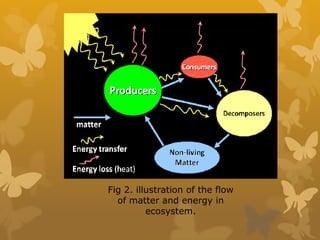
At a basic functional level, ecosystem
generally contain primary producers capable of
harvesting energy from the sun by
photosynthesis and of using this energy to
convert carbon dioxide and other inorganic
chemicals into the organic building blocks of
life.
Consumers feed on this captured energy, and
decomposers not only feed on this energy, but
also break organic matter back into its
inorganic constituents, which can be used again
by producers.
These interactions among producers and
the organism that consume and decompose
them are called trophic interactions, and
are composed of trophic levels in an
energy pyramid, with most energy and mass
in the primary procedures at the base, and
higher levels of feeding on the top of this,
starting with primary procedures consumers
feeding on primary procedures, secondary
consumers feeding on these and so on.
Trophic interactions are also described in more
detailed form as a food chain, which organizes
specific organism by their trophic distances from
primary procedures, and by food webs, which
detail the feeding interactions among all organism
in an ecosystem. Together, these processes of
energy transfer and matter cycling are essential in
determining ecosystem structure and function and
in defining the types of interactions determining
ecosystem structure and function and in defining
the types of interactions between organisms their
environment.
It must also be noted that most ecosystem
contain a wide diversity of species, and that
this diversity should be considered part of
ecosystem structure.
Fig 2. illustration of the flow
of matter and energy in
ecosystem.
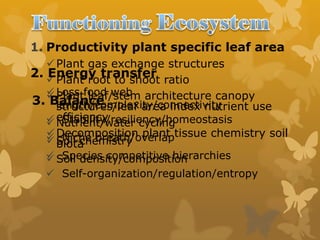
1. Productivity plant specific leaf area
Plant gas exchange structures
Plant root to shoot ratio
Plant leaf/stem architecture canopy
structures/leaf area index nutrient use
efficiency
Decomposition plant tissue chemistry soil
biota
2. Energy transfer
 Loss food web
length/complexity/connectivity
 Nutrient/water cycling
 Soil chemistry
 Soil density/composition
3. Balance
 Stability/resiliency/homeostasis
 Niche breath/overlap
 Species competitive hierarchies
 Self-organization/regulation/entropy
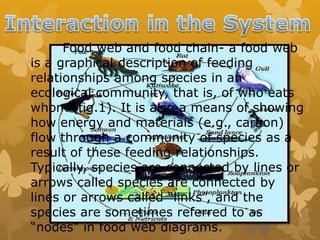
Food web and food chain- a food web
is a graphical description of feeding
relationships among species in an
ecological community, that is, of who eats
whom (fig.1). It is also a means of showing
how energy and materials (e.g., carbon)
flow through a community of species as a
result of these feeding relationships.
Typically, species are connected by lines or
arrows called species are connected by
lines or arrows called “links”, and the
species are sometimes referred to as
“nodes” in food web diagrams.
Energy input to ecosystem drives the
flow of matter between organism and the
environment in a process known as
biogeochemical cycling.
The biosphere provides a good example
of this, as it interacts with and exchanges
matter with the lithosphere, hydrosphere,
and atmosphere, driving the global
biogeochemical cycles of carbon, nitrogen,
phosphorus, sulfur and other elements.
Ecosystem processes are dynamic,
undergoing strong seasonal cycles in
response to changes in solar
irradiation, causing fluctuation in
primary productivity and varying the
influx of energy from photosynthesis
and fixation of carbon dioxide into
organic materials over the year,
driving remarkable annual variability
in the carbon cycle-the largest of the
global biogeochemical cycles.
Fixed organic carbon in plants then
becomes food for consumers and
decomposers, who degrade the carbon
to forms with lower energy, and
ultimately releasing the carbon fixed by
photosynthesis back into carbon dioxide
in the atmosphere, producing the global
carbon cycle.
The biogeochemical cycling of nitrogen
also uses energy, as bacteria fix nitrogen
gas from the atmosphere into reactive
forms useful for living organism using
energy obtained from organic materials
and ultimately from plants and sun.
Ecosystems also cycle phosphorus, sulfur
and other elements. As biogeochemical
cycles are defined by the exchange of
matter between organisms and their
environment, they are classic examples
of ecosystem-level processes.

Ecosystem structure and function

  • 1.
    2.1 History ofthe Ecosystem Concept The term “ecosystem” was first coined by Roy Clapham in in 1930, but it was ecologist Arthur Tansley who fully defined the ecosystem concept. In his classic article of 1935, Tansley defined ecosystem as “The whole system…including not only the organism-complex, but also the whole complex of physical factors forming what we call the environment.” Eugene Odum, a major figure in advancing the science of ecology, developed the ecosystem concept in a central role in his seminal textbook on ecology, defining ecosystem as: ”Any unit that includes all of the organisms (i.e.: “the community”)in given area interacting with the physical environment so that a flow of energy leads to clearly defined trophic structure, biotic diversity, and material cycles (i.e.: exchange of materials between living and nonliving parts within the system is san ecosystem.”
  • 2.
    An ecosystem isa very complex entity with many interactive components. It can be defined as “ a system of complex interactions of population between themselves and with their environment” or as “the joint functioning and interaction of these two compartments (populations and environment in a functional unit of variable size” in a functional unit of variable size” (Odum, 1975, Ellenberg,1973; Nybakken, 1992; Scialabba, 1998).
  • 3.
    Ecosystem maybe consideredat different geographical scales from a grain of sand with its rich micro fauna, to a whole beach, a coastal area or estuary, a semi-enclosed sea and eventually, the whole Earth. As stated by Lackey (1999), ecosystems are defined at a wide range of scales of observation “from a drop of morning dew to an ocean,. From a pebble to a planet” Ecosystems defined at a given geographical and functional scale are therefore nested within larger ones and contain smaller ones with within they exchange matter and information.
  • 4.
    Ecosystem are dynamic,composites entities within which large quantities of matter, energy and information flow, within and between components, in a way that is not yet completely understood. These flows are controlled primarily by: 1.top predator’s feeding behavior (top down control); 2.Primary procedures (bottom up control); 3.Some numerically abundant species somewhere in the middle of the food chain (wasp-waist control); or 4. Some combination of some or all of these, depending on system and their possible states ( Cury et al., 2003).
  • 5.
    The functioning ofan ecosystem results from the organization of its species communities, consisting of species populations having their own dynamics in terms of abundance, survival, growth, production, reproductive and other strategies. The community's resilience depends on its capacity to adapt to the physical environment and on its relations with the other communities, e.g. through competition or predation. Communities are interdependent and interconnected as trophic networks (resulting from predator-prey relationships) depending on environmental variables. Food-web analysis and estimates of consumption are essential for understanding possible reactions of the ecosystem to exploitation regimes as well as rebuilding strategies and, during the last decade, the information on this matter has greatly improved (Trites, 2003).
  • 6.
    Fig. 1 Levelsof organization in specific illustration
  • 7.
    Ecosystems may beobserved in many possible ways, so there is no one set of components that make up ecosystem. However, all ecosystem must include both biotic and abiotic components, their interactions, and some source of energy. The simplest (and least representative) of ecosystems might therefore contain just a single living plant ( biotic component) within a small terrarium exposed to light to which a water solution containing essential nutrients for plant for plant growth has been added (abiotic environment) The other extreme would be the biosphere, which comprises the totality of Earth’s organism and their interactions with each other and the earth systems (abiotic environment). At a basic functional level, ecosystem generally contain primary producers capable of harvesting energy from the sun by photosynthesis and of using this energy to convert carbon dioxide and other inorganic chemicals into the organic building blocks of life. Consumers feed on this captured energy, and decomposers not only feed on this energy, but also break organic matter back into its inorganic constituents, which can be used again by producers. These interactions among producers and the organism that consume and decompose them are called trophic interactions, and are composed of trophic levels in an energy pyramid, with most energy and mass in the primary procedures at the base, and higher levels of feeding on the top of this, starting with primary procedures consumers feeding on primary procedures, secondary consumers feeding on these and so on. Trophic interactions are also described in more detailed form as a food chain, which organizes specific organism by their trophic distances from primary procedures, and by food webs, which detail the feeding interactions among all organism in an ecosystem. Together, these processes of energy transfer and matter cycling are essential in determining ecosystem structure and function and in defining the types of interactions determining ecosystem structure and function and in defining the types of interactions between organisms their environment. It must also be noted that most ecosystem contain a wide diversity of species, and that this diversity should be considered part of ecosystem structure.
  • 8.
    Fig 2. illustrationof the flow of matter and energy in ecosystem.
  • 9.
    1. Productivity plantspecific leaf area Plant gas exchange structures Plant root to shoot ratio Plant leaf/stem architecture canopy structures/leaf area index nutrient use efficiency Decomposition plant tissue chemistry soil biota 2. Energy transfer  Loss food web length/complexity/connectivity  Nutrient/water cycling  Soil chemistry  Soil density/composition 3. Balance  Stability/resiliency/homeostasis  Niche breath/overlap  Species competitive hierarchies  Self-organization/regulation/entropy
  • 10.
    Food web andfood chain- a food web is a graphical description of feeding relationships among species in an ecological community, that is, of who eats whom (fig.1). It is also a means of showing how energy and materials (e.g., carbon) flow through a community of species as a result of these feeding relationships. Typically, species are connected by lines or arrows called species are connected by lines or arrows called “links”, and the species are sometimes referred to as “nodes” in food web diagrams.
  • 11.
    Energy input toecosystem drives the flow of matter between organism and the environment in a process known as biogeochemical cycling. The biosphere provides a good example of this, as it interacts with and exchanges matter with the lithosphere, hydrosphere, and atmosphere, driving the global biogeochemical cycles of carbon, nitrogen, phosphorus, sulfur and other elements. Ecosystem processes are dynamic, undergoing strong seasonal cycles in response to changes in solar irradiation, causing fluctuation in primary productivity and varying the influx of energy from photosynthesis and fixation of carbon dioxide into organic materials over the year, driving remarkable annual variability in the carbon cycle-the largest of the global biogeochemical cycles. Fixed organic carbon in plants then becomes food for consumers and decomposers, who degrade the carbon to forms with lower energy, and ultimately releasing the carbon fixed by photosynthesis back into carbon dioxide in the atmosphere, producing the global carbon cycle. The biogeochemical cycling of nitrogen also uses energy, as bacteria fix nitrogen gas from the atmosphere into reactive forms useful for living organism using energy obtained from organic materials and ultimately from plants and sun. Ecosystems also cycle phosphorus, sulfur and other elements. As biogeochemical cycles are defined by the exchange of matter between organisms and their environment, they are classic examples of ecosystem-level processes.